

Table 1
Categories and descriptions
| Category | Description |
|---|---|
| Social | The content concerns intense and noticeable social relationships (e.g., gossip, cheating, group alliances, controversies) but also everyday interactions and relationships (e.g., friends, family). |
| Threat-related | The content concerns possible threats (e.g., illness, violent acts, dangerous situations, death, and unvoluntary abortion). |
| Positive | The content expresses emotions that can be considered overall as positive (e.g., amusement, love, joy, etc.). |
| Negative | The content expresses emotions that can be considered overall as negative (e.g., sadness, regret, fear, anger, etc.). |
| Intergroup-related | The content concerns intergroup relationships, differences, or attitudes based on group membership (e.g., based in cultural, religious, social, and value differences). |
[i] Comments: The definitions are inspired by earlier work (see Acerbi, 2019; Berriche & Altay, 2020; Scheffer et al., 2021; Stubbersfield et al., 2017).

Figure 1
Mock example of how the posts might look
Comments: The image of cars included in the mock post was generated by ChatGPT Plus.
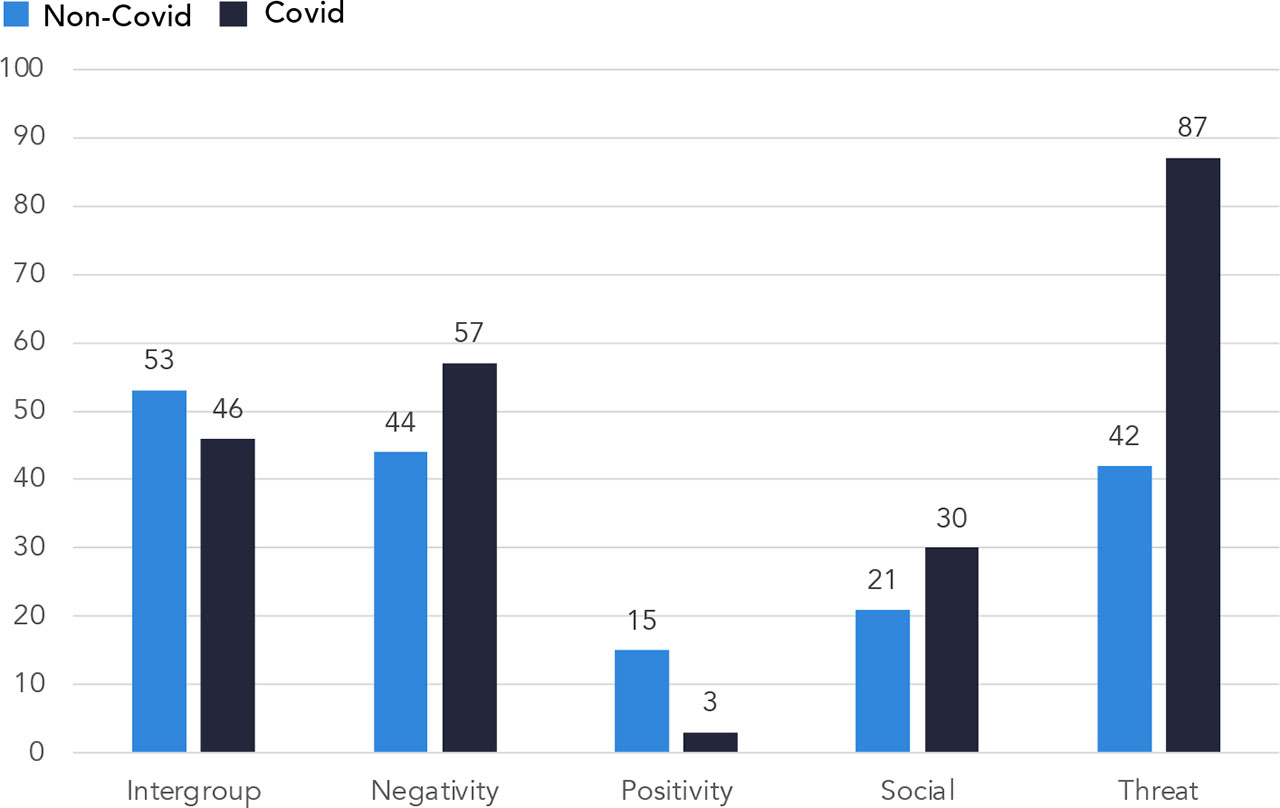
Figure 2
Proportion of factors by Covid status (per cent)
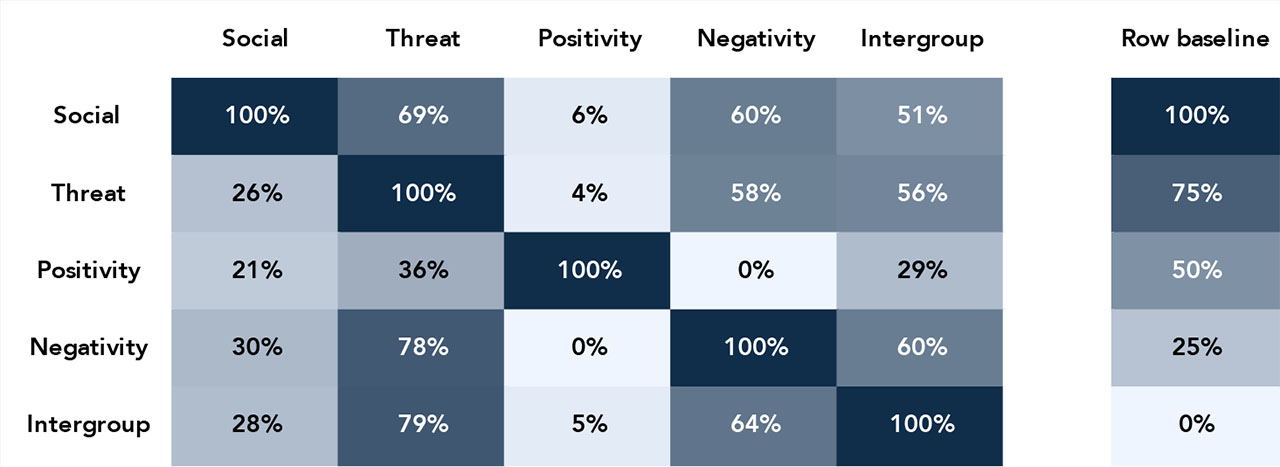
Figure 3
Co-occurrences of factors of attraction (row baseline, per cent)
Comments: The row is the baseline, which means that, for example, of the times that intergroup-related information is present, it co-occurs with social information 28 per cent of the time, threat-related information 79 per cent of the time, and so on, whereas of the times social information occurs, it co-occurs with intergroup-related information 51 per cent of the time. The difference in percentage is caused by a difference in frequency between the categories.
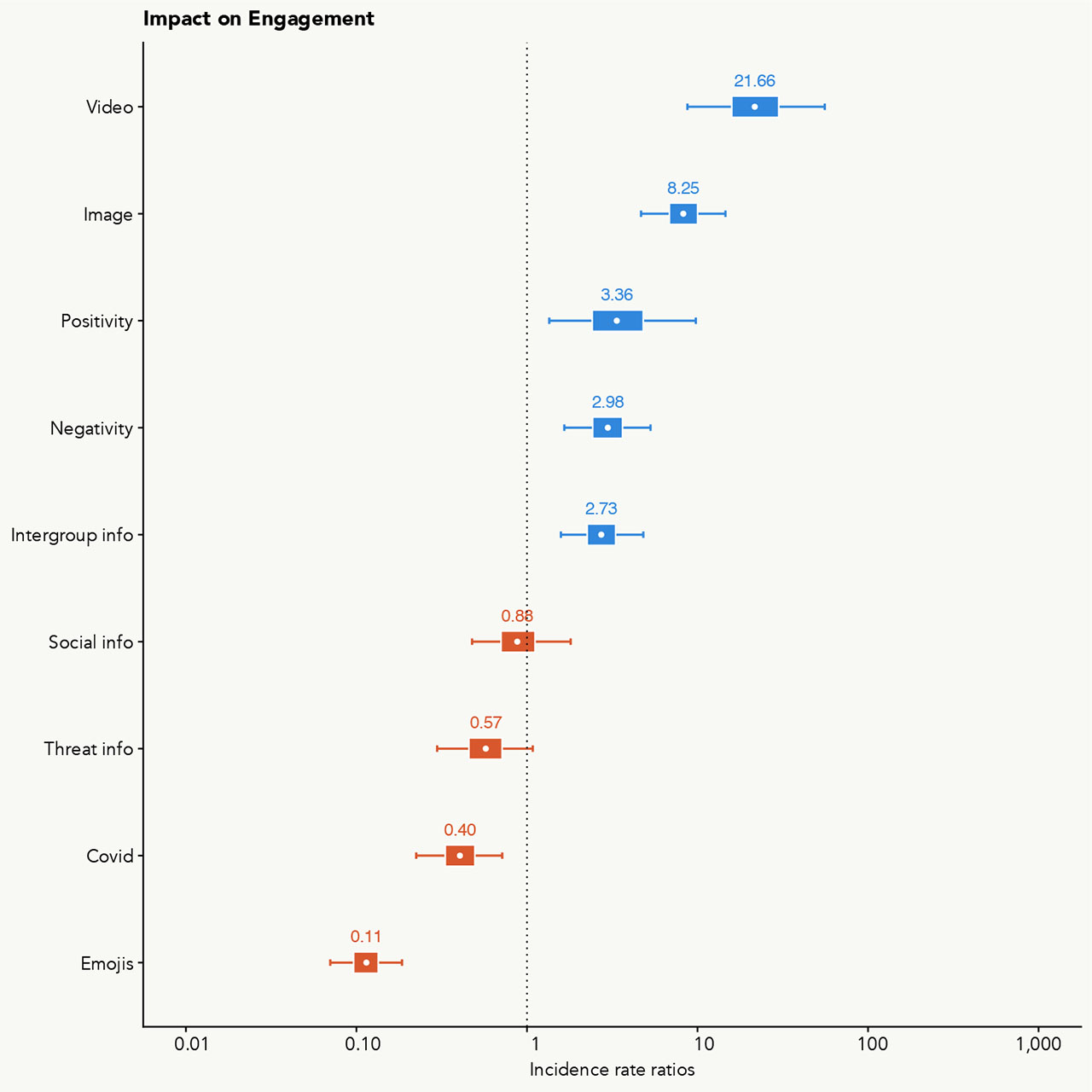
Figure 4
Incidence rate ratios of predictor variables on total engagement
Comments: Values lower than 1 have a negative influence on engagement, while values above 1 have a positive influence. Dots indicate the median of the posterior distributions, as do the values above each point. Whiskers indicate 95 per cent credible intervals, and bars indicate 50 per cent credible intervals.
Table 2
Incidence rate ratios for total and subtypes of engagement (i.e., comments, shares, and reactions)
| Predictors | Total | Comments | Shares | Reactions |
|---|---|---|---|---|
| Video | 21.66 (14.07) | 3.19 (1.91) | 52.52 (43.2) | 3.02 (1.69) |
| Image | 8.25 (3.18) | 2.8 (1.25) | 12.54 (7.44) | 3.72 (1.44) |
| Positivity | 3.36 (2.4) | 1.85 (1.34) | 2.76 (2.85) | 2.51 (1.6) |
| Negativity | 2.98 (1.21) | 2.28 (0.92) | 4.46 (2.32) | 1.65 (0.6) |
| Intergroup info | 2.73 (1.06) | 0.99 (0.39) | 3.86 (1.86) | 2.54 (0.88) |
| Social info | 0.88 (0.41) | 1.08 (0.48) | 0.92 (0.55) | 0.96 (0.37) |
| Threat info | 0.57 (0.26) | 0.82 (0.42) | 0.87 (0.45) | 0.65 (0.27) |
| Covid | 0.4 (0.16) | 0.15 (0.07) | 0.38 (0.2) | 0.36 (0.13) |
| Emojis | 0.11 (0.04) | 0.77 (0.3) | 0.05 (0.02) | 0.22 (0.07) |
[i] Comments: The incident rate ratios shows how many times more or less likely a post is to get engagement per predictor variable; the closer to 1, the less influence the predictor has on engagement. Values lower than 1 have a negative influence on engagement, while values above 1 have a positive influence. The number in parentheses is the interquartile range.