

TABLE 1
Classification of Danish alternative media
| Left-wing | Right-wing | |
|---|---|---|
| High degree of alternativeness |
| |
| Low or moderate degree of alternativeness |
|
|
[i] Comments: Folkets Avis and Konfront were not included in the content analysis in Brems, 2023. In this study, they are grouped together with the alternative media with a low or moderate degree of alternativeness. If the respondents who were coded as users of alternative media based on use of Folkets Avis and Konfront are dropped from the analysis (n = 39), this makes no substantial differences to the results.
[ii] Source: based on findings from Brems, 2023
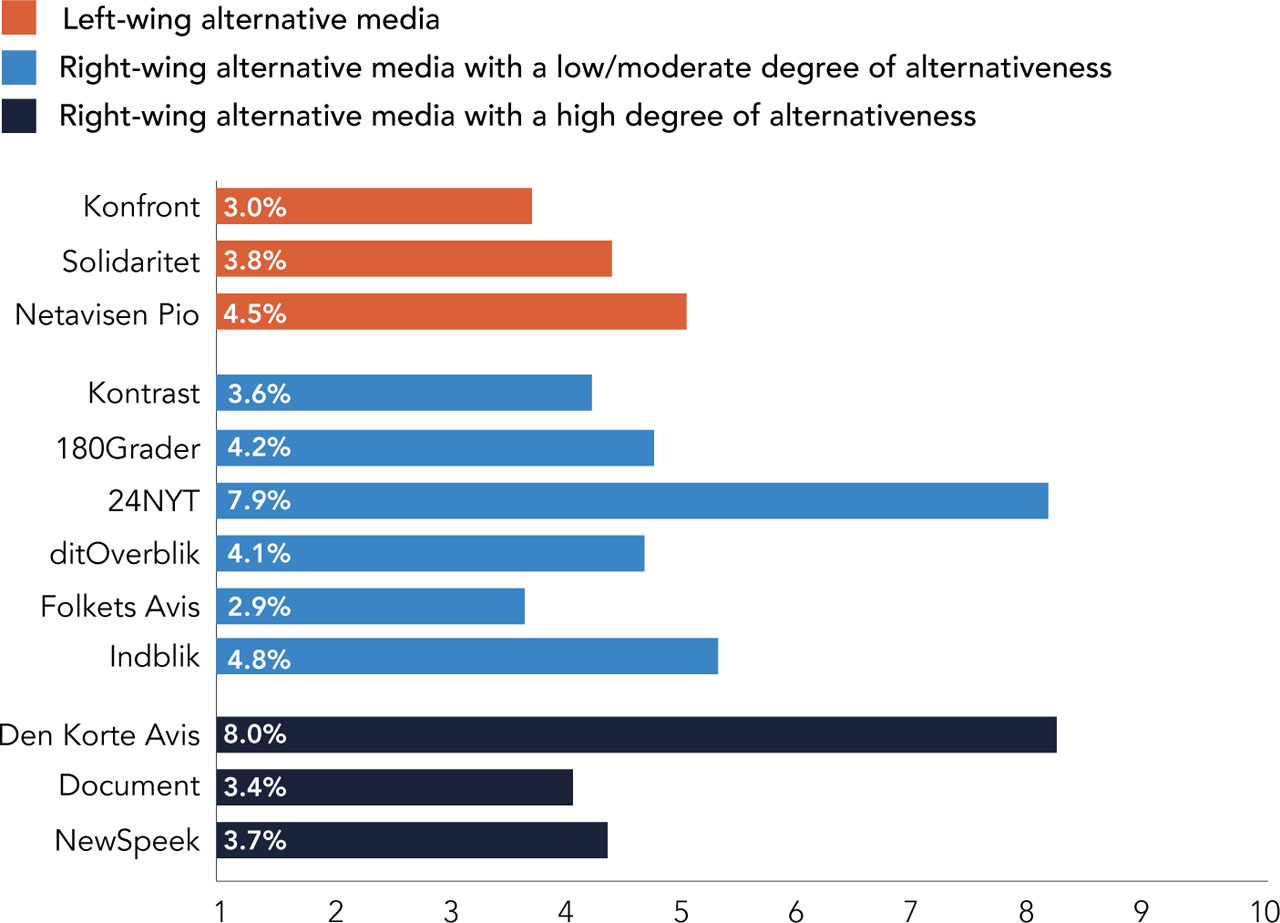
FIGURE 1
Estimated use of alternative media among the adult Danish population (per cent)
Comments: N = 2,455. Data weighted to match the adult Danish population on age, gender, level of education, and place of residence.
TABLE 2
Use of different types of alternative media
| Category | % (weighted) | n |
|---|---|---|
| Use no alternative media | 76.6 | 1,867 |
| Use left-wing alternative media, low/moderate alternativeness | 3.2 | 81 |
| Use right-wing alternative media, low/moderate alternativeness | 7.6 | 195 |
| Use left-wing and right-wing alternative media, low/moderate alter-nativeness | 1.5 | 38 |
| Use right-wing alternative media, high alternativeness | 8.2 | 208 |
| Use left-wing and right-wing alternative media, high alternativeness | 2.9 | 66 |
| Total | 100 | 2,455 |
[i] Comments: No left-wing alternative media were classified as characterised by a high degree of alternativeness. Therefore, there is no user category for use of left-wing alternative media with a high degree of alternativeness.
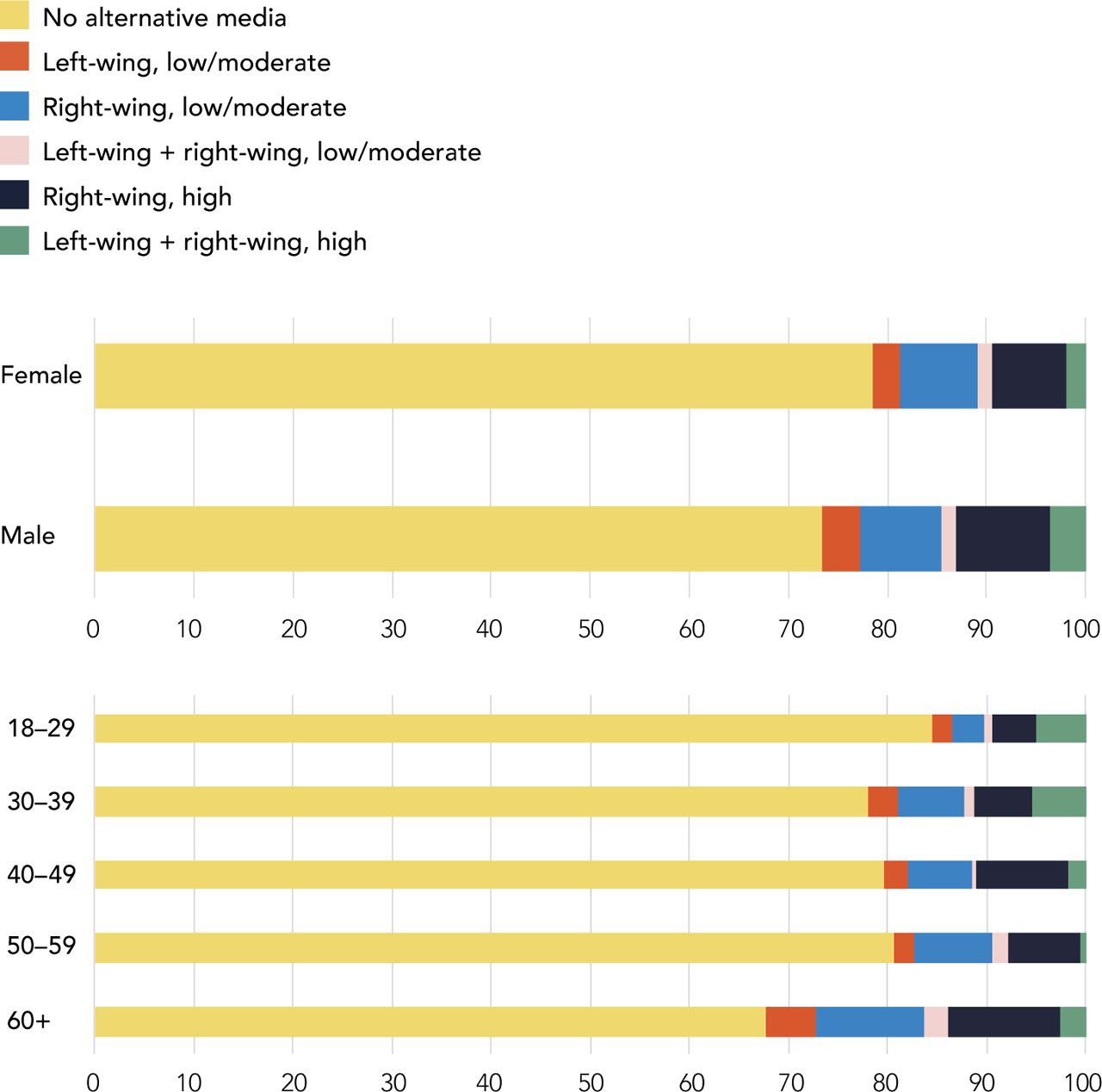
FIGURE 2
Predicted average probability of alternative news use, by gender and age (per cent)
Comments: N = 2,455. McFadden’s pseudo-R2 = 0.028; Nagelkerke’s pseudo-R2 = 0.059. Variables included in the model: gender and age. CI error bars omitted for better graphical overview (for graphs with error bars see Appendix E in the online supplement).
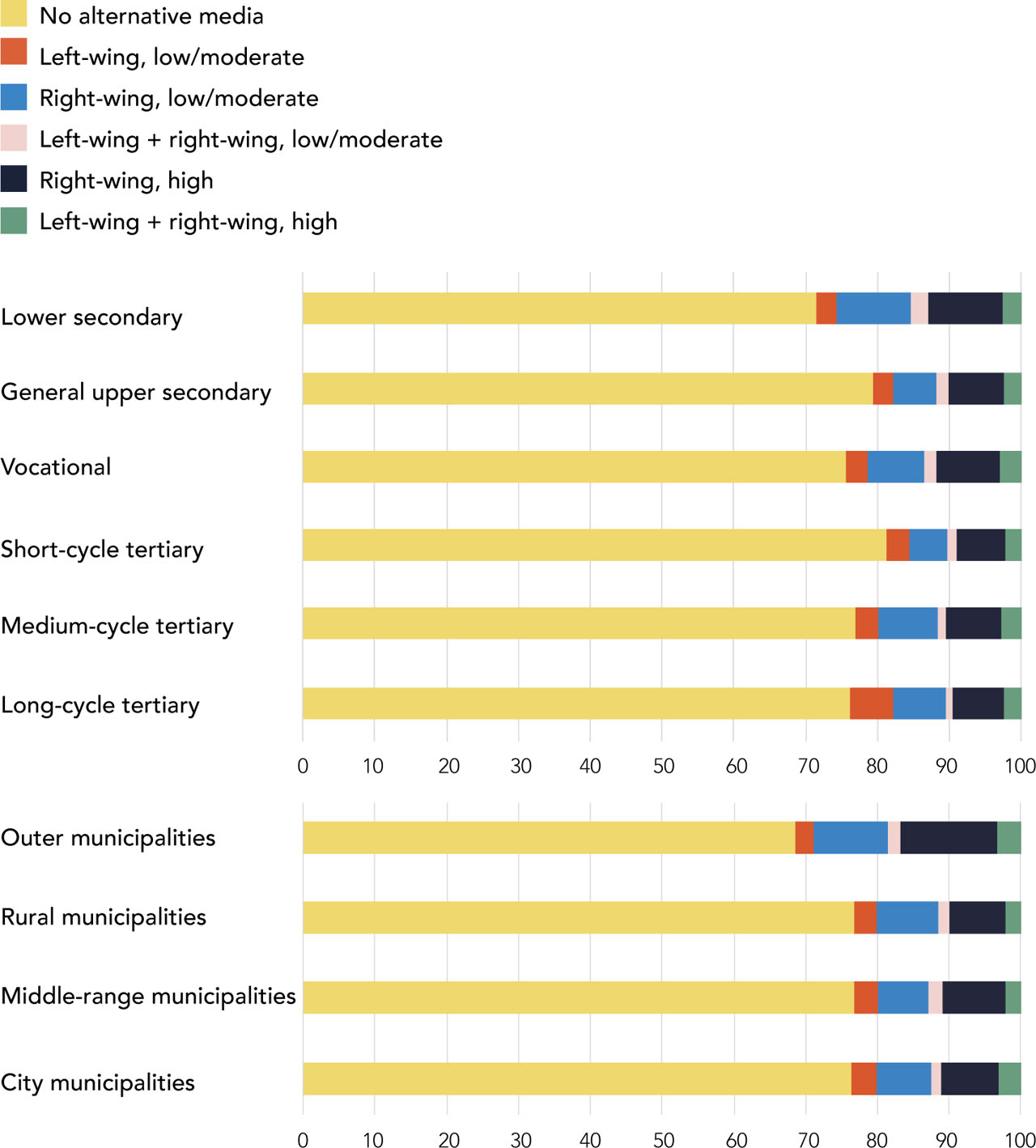
FIGURE 3
Predicted average probability of alternative news use by level of education and place of residence (per cent)
Comments: N = 2,455. McFadden’s pseudo-R2 = 0.035; Nagelkerke’s pseudo-R2 = 0.072. Variables included in the model: gender, age, level of education, and place of residence. CI error bars omitted for better graphical overview (for graphs with error bars, see Appendix E in the online supplement).
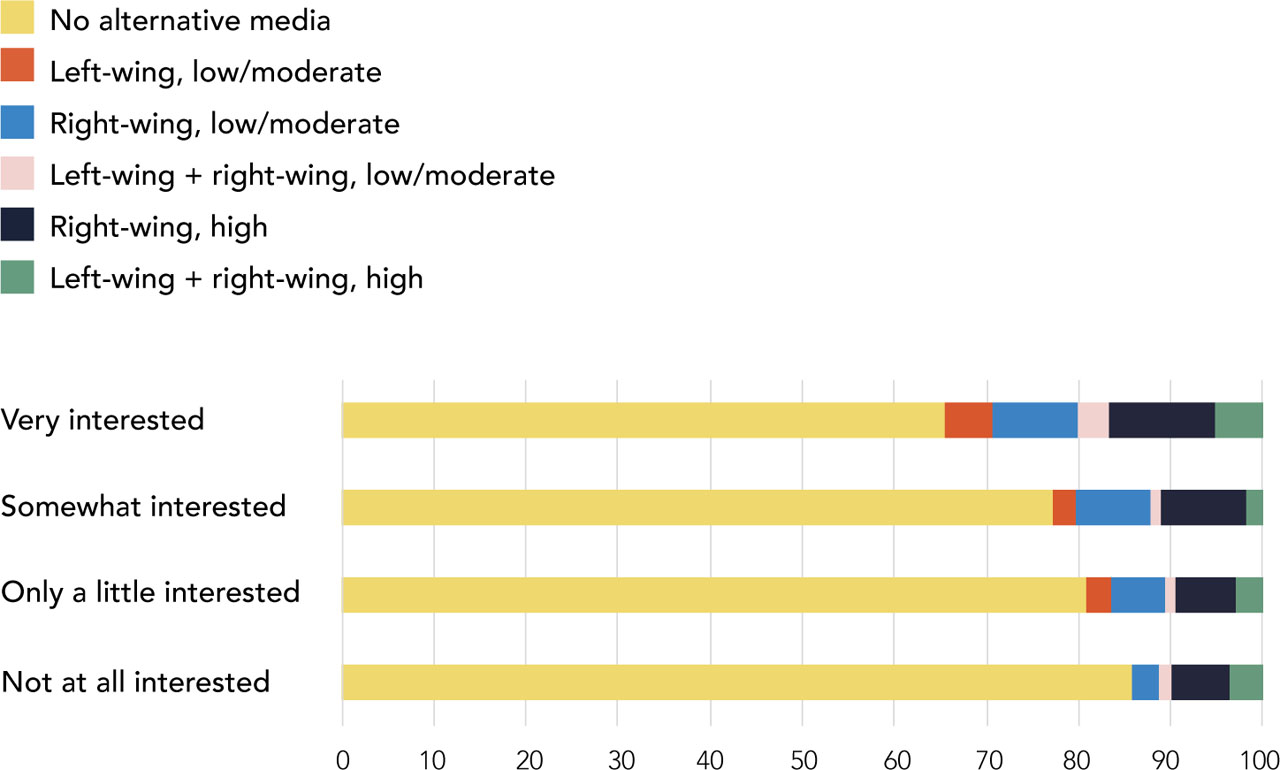
FIGURE 4
Predicted average probability of alternative news use by political interest (per cent)
Comments: N = 2,118. McFadden’s pseudo-R2 = 0.066; Nagelkerke’s pseudo-R2 = 0.135. Variables included in the model: gender, age, level of education, place of residence, ideological orientation, and political interest. Results for “do not wish to answer” not displayed in figure (n = 22). CI error bars omitted for better graphical overview (for graphs with error bars, see Appendix E in the online supplement).
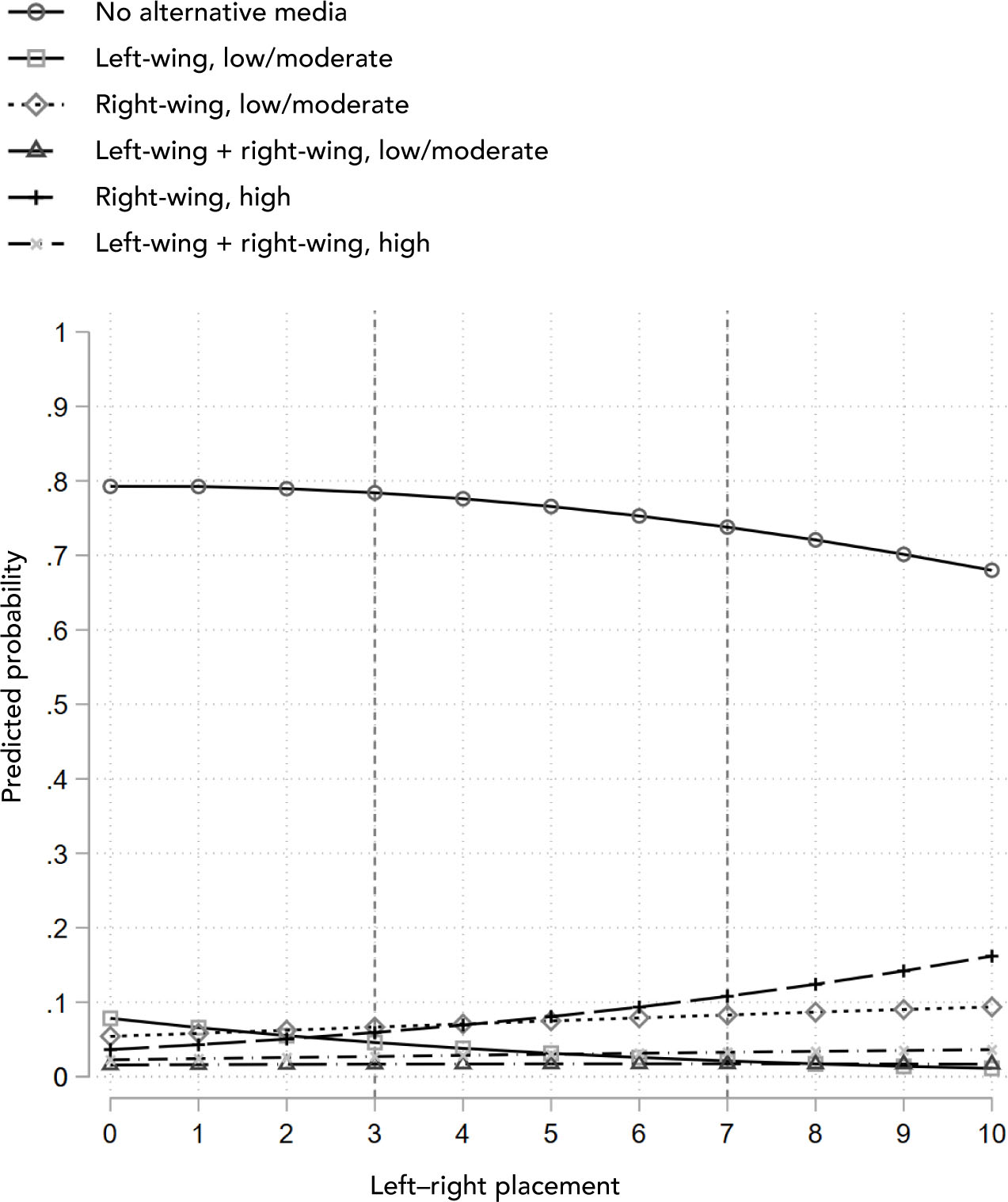
FIGURE 5
Predicted average probability of alternative news use by ideological orientation
Comments: N = 2,118. McFadden’s pseudo-R2 = 0.066; Nagelkerke’s pseudo-R2 = 0.135. Variables in the model: gender, age, level of education, place of residence, political interest, and ideological orientation (0 = left; 10 = right). Vertical lines indicate lower and upper quartiles. CI error bars omitted for better graphical overview (for graphs with error bars, see Appendix E in the online supplement).
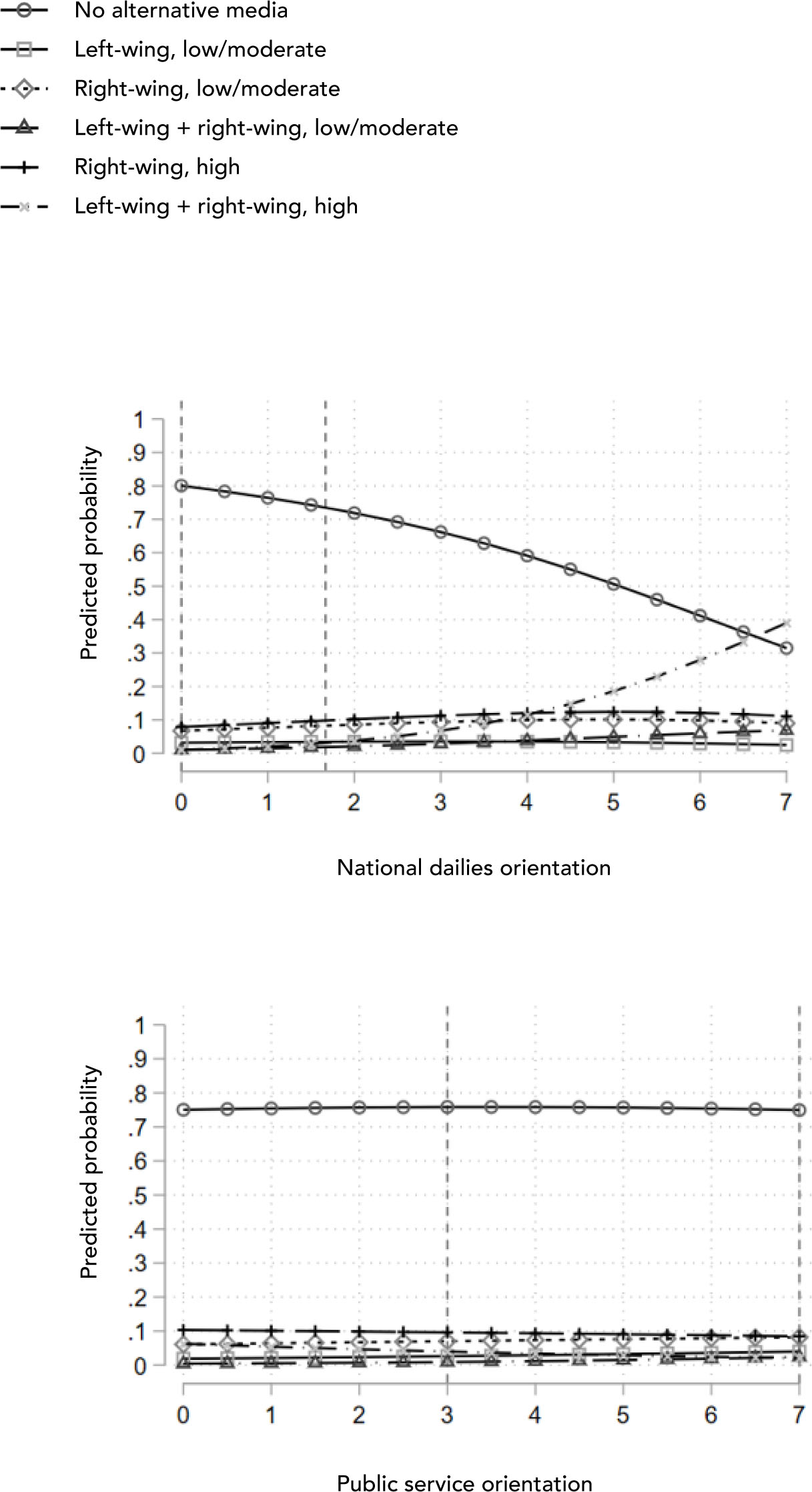
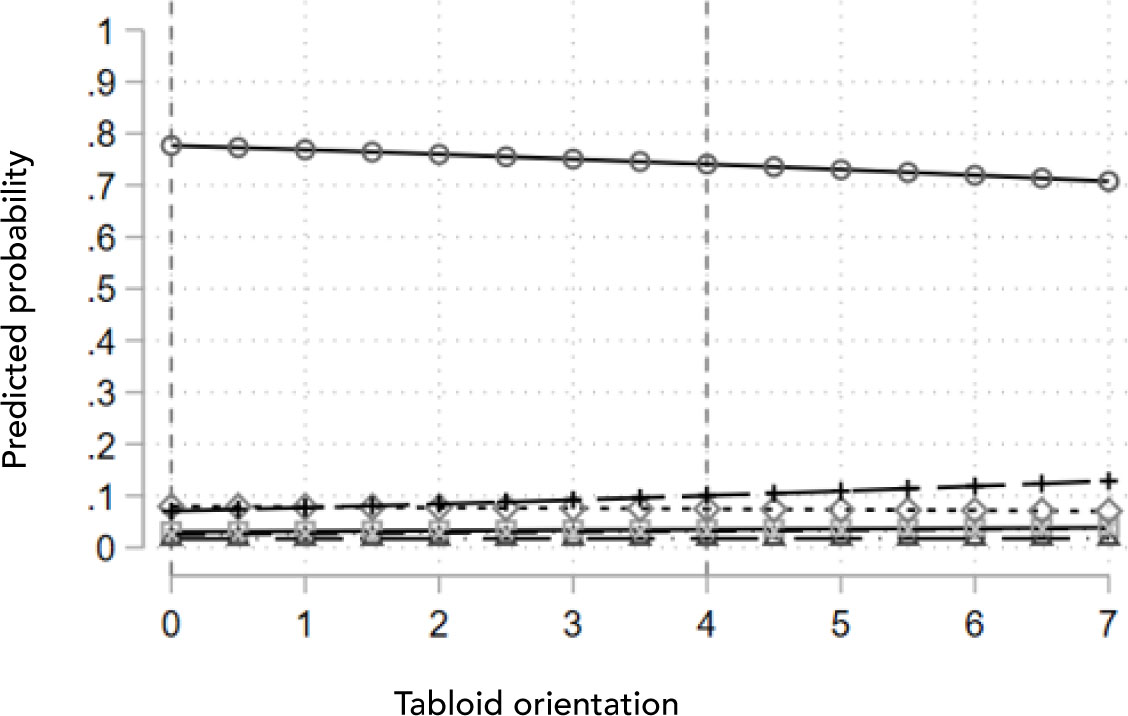
FIGURE 6
Predicted average probability of alternative news use by mainstream news orientation
Comments: N = 2,118. McFadden’s pseudo-R2 = 0.102; Nagelkerke’s pseudo-R2 = 0.202. Variables included in the model: gender, age, level of education, place of residence, political interest, ideological orientation, public service orientation, national dailies orientation, tabloid orientation. Vertical lines indicate lower and upper quartiles. CI error bars omitted for better graphical overview (for graphs with error bars, see Appendix E in the online supplement).
TABLE A1
Measurements of alternative media use in previous studies
| Study | Method | Item(s) and/or number of outlets included | Country | Estimated share of population using alternative media |
|---|---|---|---|---|
| Andersen et al., 2021 | Survey self-report |
| Sweden | Across four survey waves, approximately 16% report using alternative media once a week or more often. |
| Frischlich et al., 2022 | Survey self-report |
| Germany | 12% |
| Müller & Bach, 2021 | Digital tracking (2.5 months in 2017; 1 month in 2019) | 137 online news sites defined as populist alternative news media. Use defined as at least one visit to the page in the observation periods. | Germany |
|
| Müller & Schulz, 2021 | Survey self-report |
| Germany |
|
| Schulze, 2020 | Survey self-report (secondary analysis of 2019 Reuters Institute Digital News Report data) |
|
|
|
| Steppat et al., 2021 | Survey self-report |
|
|
|
| Theorin & Strömbäck, 2020 | Survey self-report |
| Sweden |
|
TABLE B1
Sociodemographic variables in the analysis weighted and unweighted
| Variable | Weighted (%) | Unweighted (%) | n | |
|---|---|---|---|---|
| Gender | Female | 50.6 | 52.3 | 1,283 |
| Male | 49.4 | 47.7 | 1,172 | |
| Age | 18–29 | 17.8 | 13.9 | 342 |
| 30–39 | 15.8 | 13.9 | 342 | |
| 40–49 | 14.5 | 14.8 | 363 | |
| 50–59 | 20.1 | 21.5 | 527 | |
| 60+ | 31.8 | 35.9 | 881 | |
| Level of education | Lower secondary | 12.7 | 12.5 | 306 |
| General upper secondary | 11.8 | 10.5 | 257 | |
| Vocational | 43.7 | 44.2 | 1,084 | |
| Short-cycle tertiary | 5.8 | 6.1 | 149 | |
| Medium-cycle tertiary | 16.6 | 17.4 | 426 | |
| Long-cycle tertiary | 9.4 | 9.5 | 233 | |
| Residence | Outer municipalities | 6.3 | 6.4 | 158 |
| Rural municipalities | 25.1 | 26.2 | 644 | |
| Middle-range municipalities | 16.5 | 17.1 | 419 | |
| City municipalities | 52.1 | 50.3 | 1,234 | |
[i] Comments: N = 2,455. The education category “vocational” includes the technically and commercially oriented upper secondary educations (in Danish, HTX and HHX). In the survey, the small islands of Fanø, Læsø, Langeland, Samsø, and Ærø were collapsed into one response category for the municipality question. Respondents ticking this category were coded as outer municipalities, as four of the five islands belong to this category in Kristensen et al., 2007.
TABLE B2
Other variables in the analysis
| Variable | Mean | Standard deviation | Minimum value | Maximum value | n |
|---|---|---|---|---|---|
| Political interest | 2.78 | .85 | 1 | 4 | 2,433 |
| Ideological orientation | 5.31 | 2.58 | 0 | 10 | 2,118 |
| Public service orientation | 4.52 | 2.24 | 0 | 7 | 2,455 |
| National dailies orientation | .93 | 1.39 | 0 | 7 | 2,455 |
| Tabloid orientation | 2.30 | 2.46 | 0 | 7 | 2,455 |
[i] Comments: In the analysis, political interest is treated as a categorical variable and “do not wish to answer” included as a separate category (n = 22).