

Table 1
Thematic categorisation of headlines in Swedish newspapers, 2010–2019 (sample)
| Positive and encouraging | Negative and alarmist |
|---|---|
| “The children love their tablets” Aftonbladet (Davidsson, 28 November 2012) | Money back for Smurf games Göteborgs-Posten (TT, 15 April 2011) |
| Web user before he can walk Göteborgs-Posten (Karlsson, 17 October 2012) | Tablets put children's health at risk Aftonbladet (Ladberg & Hedendahl, 1 April 2012) |
| The tablet makes learning a children's game Metro (Andersson, 26 September 2012) | Computers steal playtime Svenska Dagbladet (Stienstedt, 19 October 2012) |
| Technology turns music into pure play Aftonbladet (Persson, 31 January 2014) | “Children are part of an experiment” Aftonbladet (Lidbo, 8 November 2016) |
| Children make film – already in preschool Göteborgs-Posten (Henricson, 14 November 2014) | Warning: Electronic gadgets in the home can give your children cancer Kvällsposten (Bäsén, 19 March 2016) |
| Child health advice: For sure, your baby can use apps Sydsvenskan (Philipson, 5 April 2016) | “Screen children” develop empathy disturbance Kvällsposten (Birgersson, 7 August 2017) |
| Here are the best apps for kids: 10 tips on apps for your child Aftonbladet (Sjöblom, 20 July 2019) | Study: Screen time makes you more stupid Kvällsposten (Thomasson, 13 December 2018) |
[i] Comments: The examples in the table illustrate the polarised debate on children's usage of digital media. On the one hand, Swedish newspapers write about the issue in a positive and encouraging way; on the other hand, many articles are critical to the extensive use of digital media. Titles have been translated from Swedish.
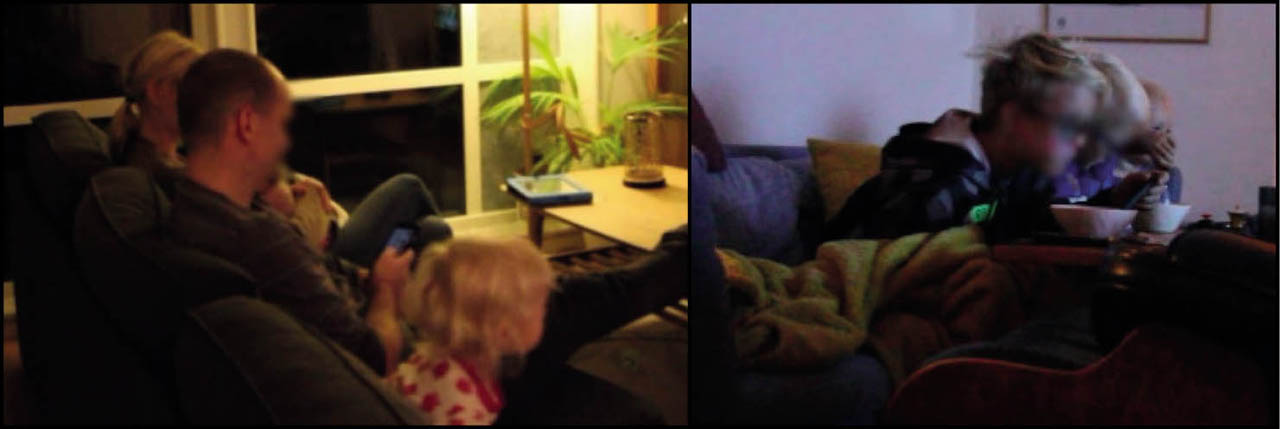
Figure 1
Watching children's programmes on the digital TV screen with family members
Comments: The left image shows Anna and her parents together on the couch facing the television. The right image shows Oscar with his siblings on the couch watching television and eating. Images are published with the informed consent of the parents.
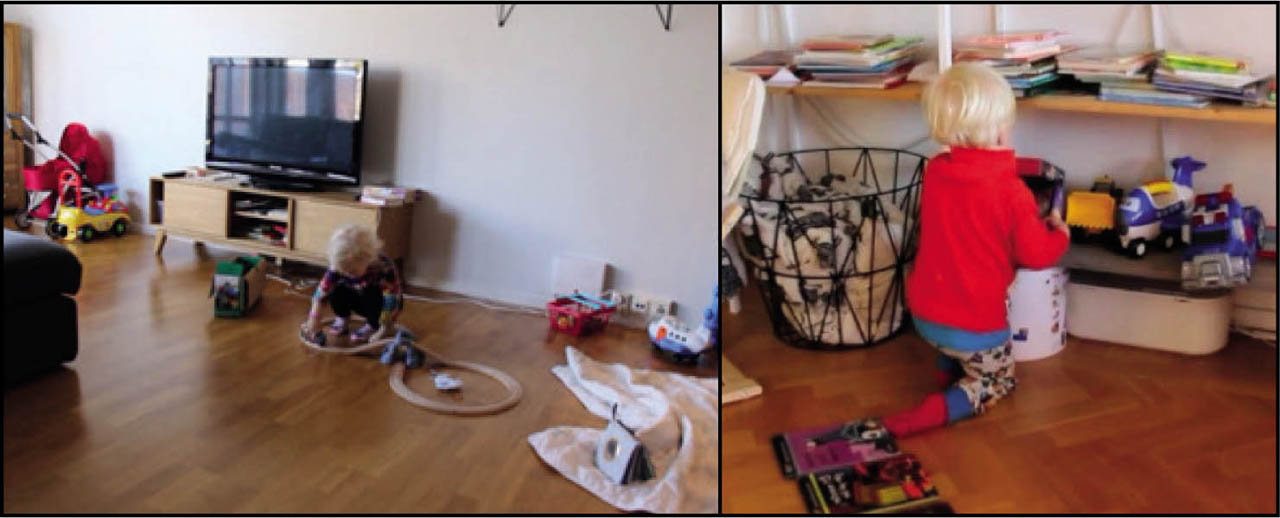
Figure 2
Traditional patterns of play offline as part of everyday routines
Comments: In the left image, Anna plays with a wooden train set among other toys. In the right image, Oscar chooses among toys on a shelf. Images are published with the informed consent of the parents.
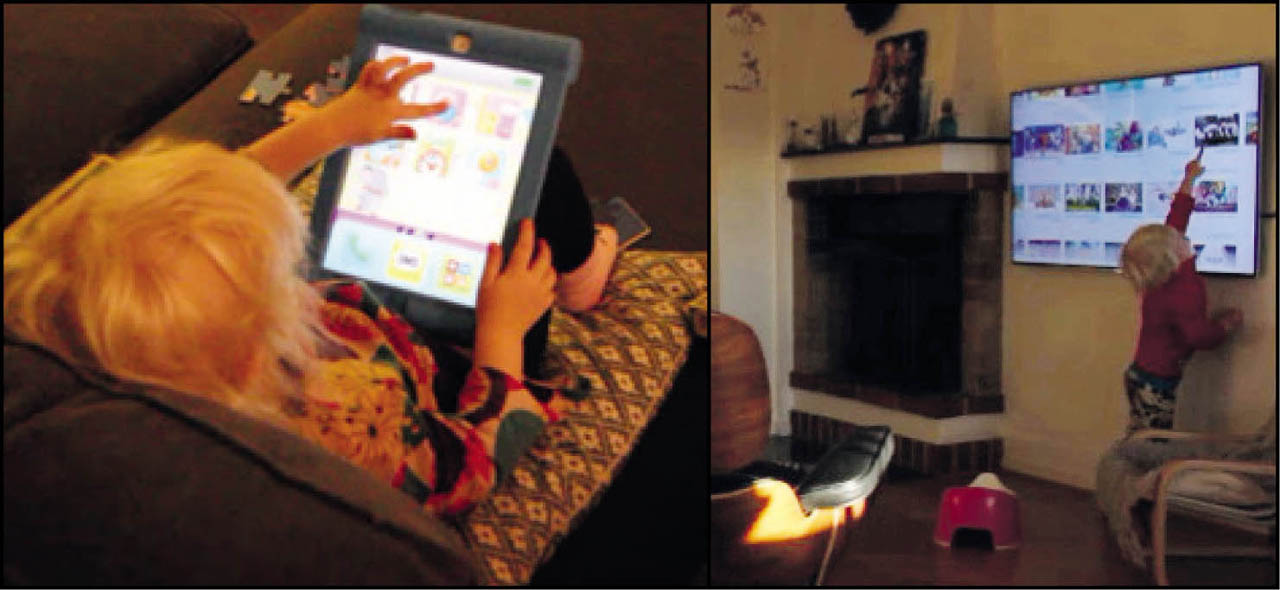
Figure 3
Interacting with digital technology
Comments: On the left, Anna uses an app on a tablet. On the right, Oscar points to a programme he would like to watch on digital TV. Images are published with the informed consent of the parents.