

Table 1
Coding of political issues discussed in the debates
| Policy dimension | Issue | Topics discussed |
|---|---|---|
| Left/right | Economy and labour market | The state’s economy and labour market (e.g. unemployment, budget deficit, taxes) |
| Left/right | School | Educational attainment, school performance, private schools and profits, class sizes, grades etc. |
| Left/right | Healthcare | Queues, waiting times, reduced capacity, care for the elderly etc. |
| GAL/TAN | Law and order; Defence | Crime, rape, crime prevention and penalties, safety policy, military capability, Ukraine, Russia, Swedish fighter planes, NATO |
| GAL/TAN | Environment | Climate change, CO2 emissions, renewable energy, UN negotiations |
| GAL/TAN | Immigration; Open borders | Common asylum rules within the EU, refugee crisis, EU migration, begging, labour migration |
[i] Comments: “Law and order” was a theme in one debate and “Defence” in the other, likewise “Immigration” and “Open borders”.
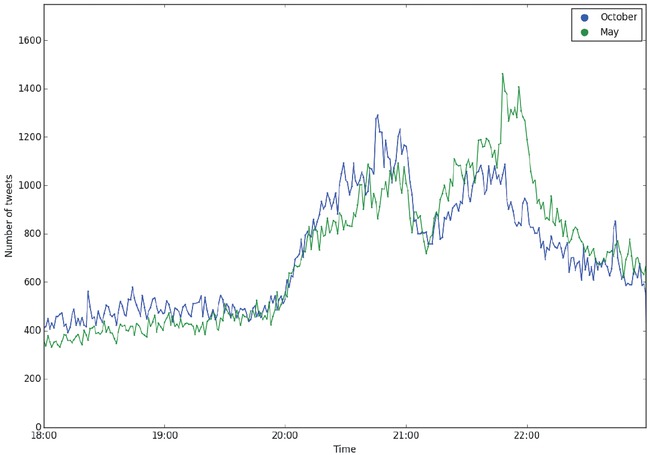
Figure 1
Total amount of tweets sent during the time of the debate
Comments: The figure shows all the tweets in our dataset sent between two hours before the debate and one hour after. The debates started at 8 pm (20:00) and ended at 10 pm (22:00), with a break between 9 pm (21:00) and 9.15 pm.
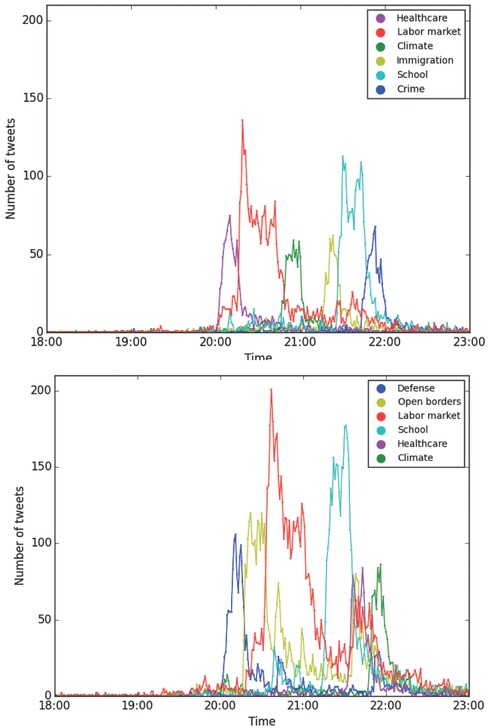
Figure 2
Timing and frequency of issue discussion on Twitter during the party leaders’ debates in October 2013 and May 2014
Comments: The upper panel shows data from the October 2013 debate and the lower panel data from the May 2014 debate.
Table 2
Issue discussions in the televised debate and frequency in tweets
| Percentage of debating time spent discussing the issue | Percentage of debate-related tweets mentioning the issue | Difference between relative debating time and tweet volume | |
|---|---|---|---|
| October 2013 | |||
| Healthcare | 14 | 12 (1,168) | - 2 |
| Labour market | 31 | 36 (3,549) | +5 |
| Climate | 13 | 9 (939) | -4 |
| Refugees | 12 | 9 (933) | -3 |
| School | 17 | 24 (2,437) | +6 |
| Crime | 14 | 9 (937) | -5 |
| Total | 100 | 100 (10,023) | |
| May 2014 | |||
| Defence | 15 | 10 (2,167) | -5 |
| Open borders | 16 | 21 (4,416) | +5 |
| Labour market | 28 | 35 (7,224) | +7 |
| School | 16 | 20 (4,174) | +4 |
| Healthcare | 13 | 6 (1,296) | -7 |
| Climate | 12 | 7 (1,486) | -5 |
| Total | 100 | 100 (20,763) | |
[i] Comments: The time devoted to each issue in the televised debates was measured manually and calculated as a percentage of the total time of the debate. The number of tweets mentioning issue-specific words was calculated and expressed as a percentage of all debate-related tweets, but it should be remembered that a tweet could address more than one issue. Pearson correlation coefficients for the relationship between relative time and relative volume were significant in both debates (October: R = .943, R2 = .8892; May: R = .9271 and R2 = .8595).
Table 3
Relative salience of political discussions grouped by policy dimension
| Percentage of time devoted to policy dimension during the televised debate | Percentage of debate-related tweets mentioning policy dimension | Difference between relative debating time and tweet volume | |
|---|---|---|---|
| October 2013 | |||
| GAL/TAN (climate; refugees; crime) | 39 | 27 | -12 |
| Left/Right (labour market; healthcare; school) | 61 | 72 | +11 |
| May 2014 | |||
| GAL/TAN (climate; open borders; defence) | 43 | 38 | -5 |
| Left/Right (labour market; healthcare; school) | 57 | 61 | +4 |
[i] Comments: The table shows the salience of the two dimensions (the GAL/TAN and the Left/Right dimension) in the televised debates and in tweets related to the debates.