

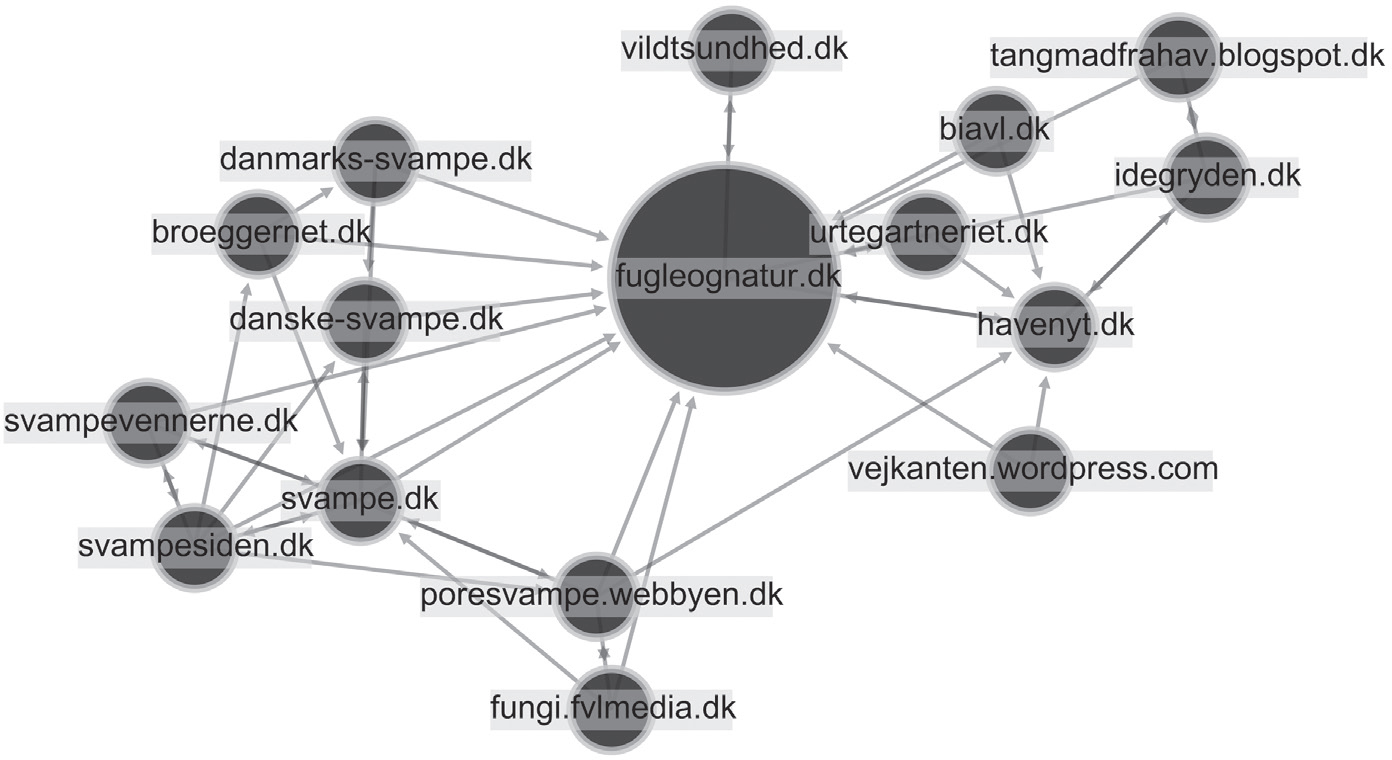
Figure 1
The beginning of a web corpus forming around the website of www.fugleognatur.dk (ego network)
Comment: The websites were crawled using the Navicrawler plug-in for Firefox (Jacomy et al., 2007) and they were spatialized in Gephi with ForceAtlas2 (Jacomy et al., 2014) and sized by their in-degree (the number of hyperlinks received from other sites in the network).
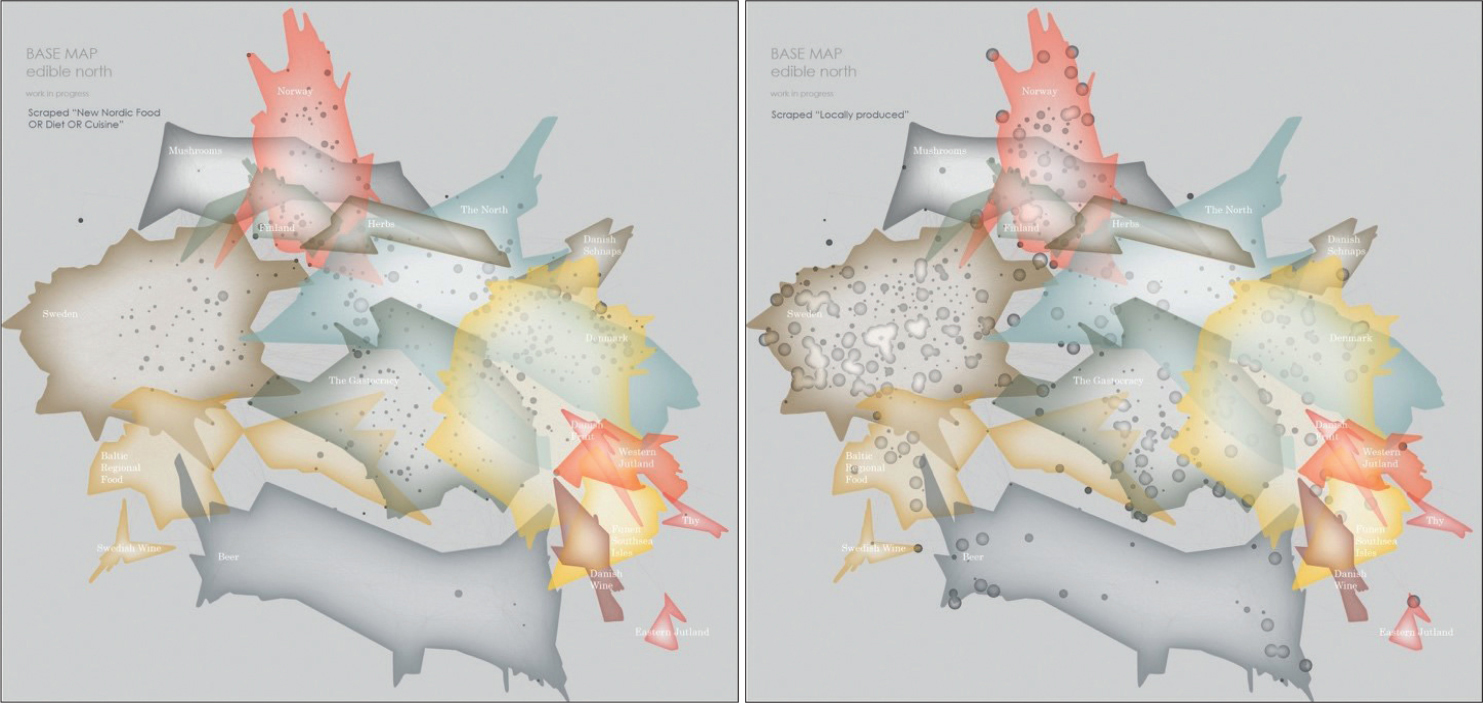
Figure 2
Stylized interpretation of the web corpus (2007 websites connected by hyperlinks – see also Figure 6) with two semantic overlays
Comment: On the left, mentions of the terms “new Nordic food”, “new Nordic cuisine” or “new Nordic diet” in any of the Nordic languages are highlighted. On the right are mentions of the term “locally produced”.
Table 1
Four styles of quali-quantitative analysis
| The quali-quantitative as: | Addresses the meaning problem by: |
|---|---|
| Complementarity | Interpreting insights from a quantitative analysis of onlife traces by situating these insights qualitatively in the everyday environments that they claim to reflect. |
| Single-level analysis | Tracing how quantitative patterns on the macro level emerge directly from qualitatively rich interactions on the micro level, demonstrating how onlife traces simultaneously embody both qualitative richness and quantifiability. |
| Curation | Critically reappropriating (and thus manually curating) onlife traces to speak on behalf of certain phenomena or address certain questions. |
| Algorithmic sensemaking | Attempting to reveal emic modes of ordering the world through quantitative techniques, for example pattern recognition. |
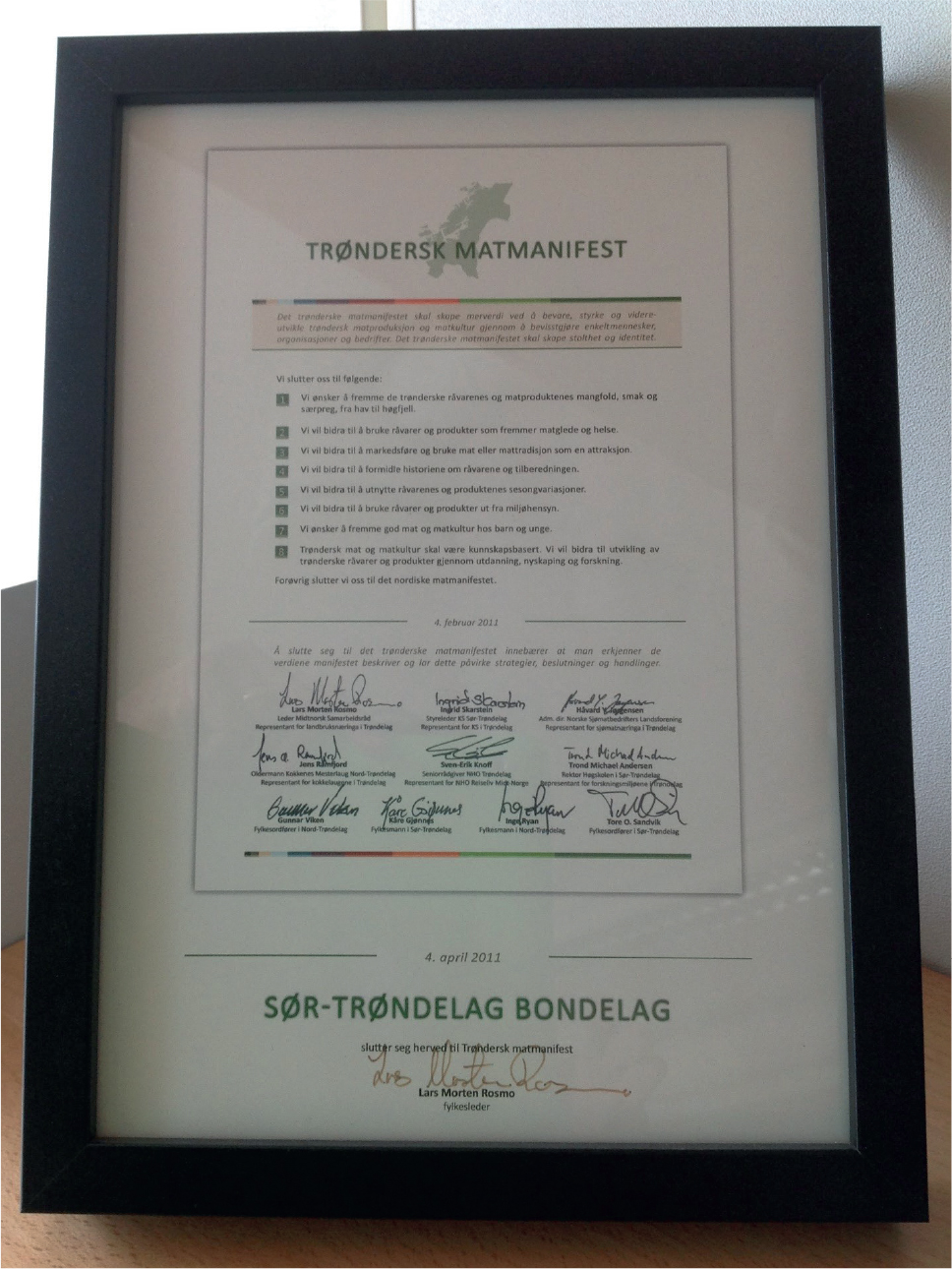
Picture 1
Trønderlagen’s food manifesto in the offices of a food agency in Trondheim
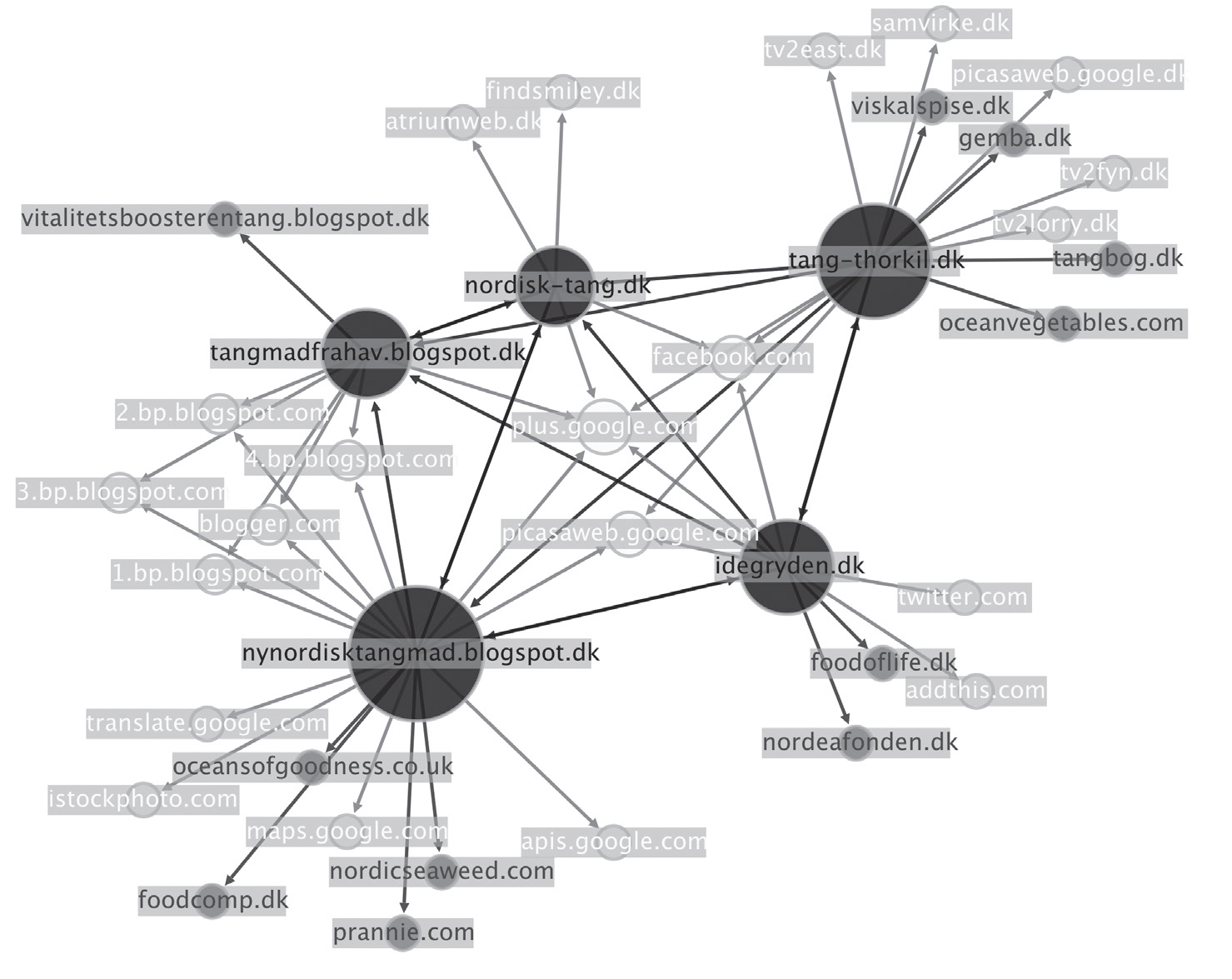
Figure 3
Curating prospect web entities for the corpus
Comment: Starting from the user profile of Thorkild Degn Johansson on www.idegryden.dk, a network of five websites emerged (black nodes). They are all related either to his business as a seaweed retailer or to his advocacy of seaweed as an edible and sustainable resource. The network has been spatialized using a spring-based algorithm (ForceAtlas2) to make it possible to explore the next layer of potentially interesting neighbouring sites (grey nodes) and those sites that I had already decided, through Navicrawler, not to explore further (white nodes).
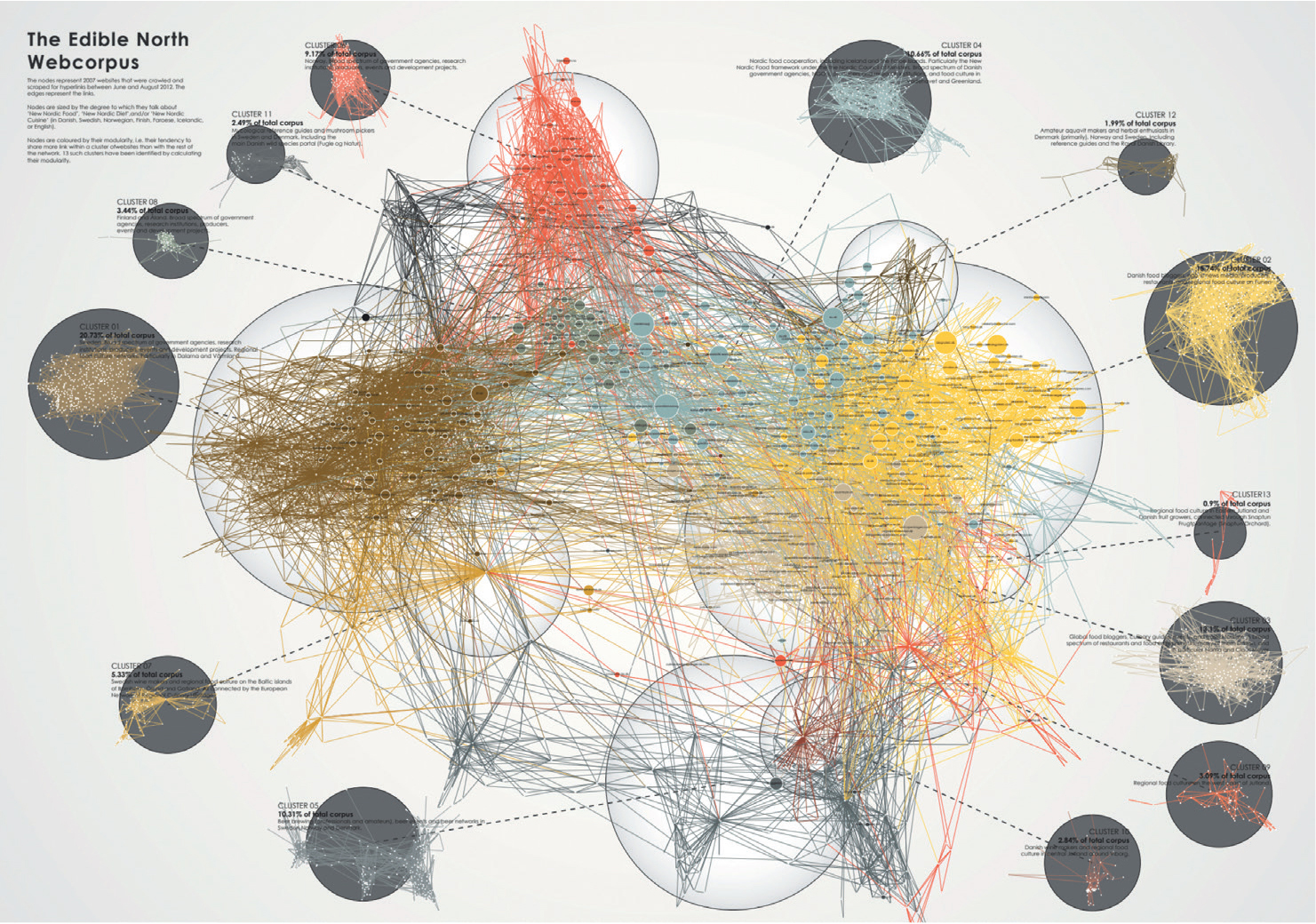
Figure 4
Poster of the full new Nordic web corpus that the author carried with him on fieldwork
Comment: The full new Nordic web corpus (Munk & Ellern, 2015) comprises 2007 food-related websites from Scandinavia that have all been scraped for hyperlinks using Navicrawler (Jacomy et al., 2007). It has been spatialized in Gephi with ForceAtlas2 (Jacomy et al., 2014). The nodes have been colour coded by their modularity (Blondel et al., 2009).
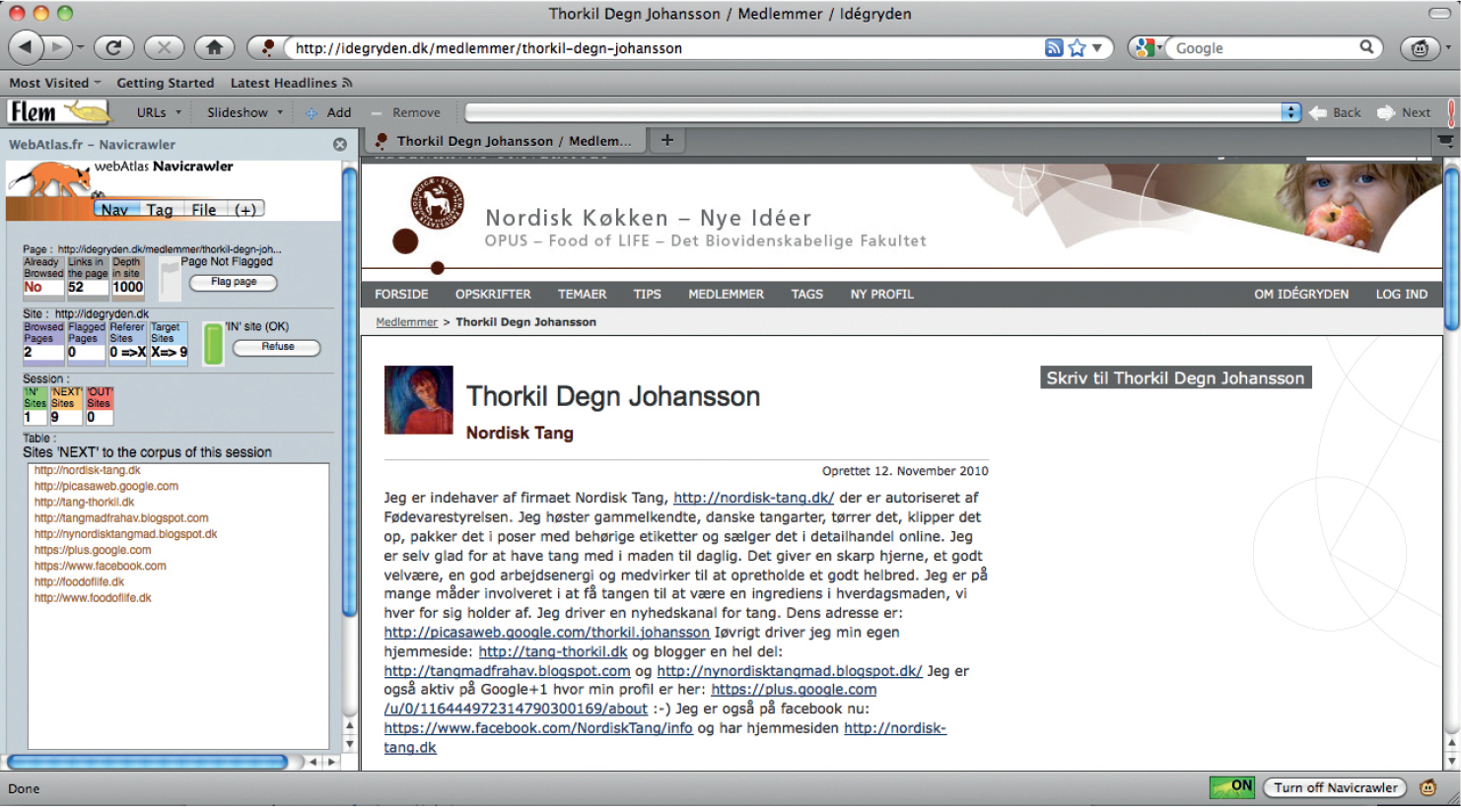
Picture 2
The web corpus under construction (Navicrawler is running as a Firefox plug-in with the control panel to the left)
Comment: Screenshot from the website of www.idégryden.dk, the online forum of the OPUS research project exploring the potentials of the New Nordic Diet.