

Introduction
In addition to serving as an avenue for recreation, social media has become a forum for discussing moral and political propositions for social change. Simultaneously, platformisation has facilitated the development of repertoires of contention wherein activists have discovered new ways of structuring and presenting their statements. Digital platforms promote and shape personalised interactions, while the process of platformisation allows for the reorganisation of cultural practices and imaginations (Poell et al., 2019). This process also involves the ways platform-based user practices are formulated in the cultural sense and the ways they facilitate political expression through different interlacing technical and semiotic affordances.
Social media platforms can also be understood as rhetorical spaces (Code, 2013) shaped by changing forms of gendered power hierarchies and dynamics on which certain statements are taken more seriously than before. Rhetorical spaces, as arenas for discourses, can be powerfully influential if the arguments made are valued and considered valid by audiences. We define rhetoric here as “the disciplined use of oral and gestural actions for the purpose of persuading others (and self) of the credibility of the speaker's moral position” (Sarbin, 1995: 216). Furthermore, rhetorical situations always involve exigencies as a form of organising principles – such as the presentation of a problem to specific audiences that demands action to enact change (Bitzer, 1968).
In this article, we highlight the study of a rhetorical space involving an Icelandic feminist movement on TikTok called Öfgar (meaning Extreme). According to members of the movement, the name reflects ironic verbal play, as there is no such term as “extreme equality”. We investigate the short video vignettes posted by the group topicalising gender-based violence and gender inequality amidst the second wave of the #metoo movement in Iceland in 2021.
Iceland has a history of active grassroots feminism, dating to the women's liberation Redstocking movement of the 1970s. The fourth wave of feminism has also been equally visible and evident there, marked by initiatives and the involvement of young women and national media attention. Irma Erlingsdóttir has argued that Icelandic activists have focused on counter-narratives in their efforts as well as on politicising the personal. Participants in the #metoo movement also focused on the lack of political responsibility and societal accountability (Erlingsdóttir, 2021), an emphasis reflected in the discourse of the Öfgar movement as well, as it manifests personal experiences and strives for moral engagement. Members share their views, emotions, and experiences online through multimodal means of communication involving the affective gesturalism of the body. As a form of social interaction, it deploys the sequential structure of conversational storytelling, conveying trajectories of events with an evaluative point (Labov & Waletzky, 1997) and expecting the recipient to express alignment and evaluative affiliation with the story (Stivers, 2008). Gesturalism of the body refers to the unfolding of expressive movements of the body with a focus not only on the body's physical motion but also on the motion's affective relevance (Müller et al., 2014). This includes considering the bodily process of producing and transitioning facial gestures, gazes, emblem gestures, body posturing, body sounds (tonality of voice), and the body's animated state and state of stillness.
In social movement studies, emotions constitute a vital component of both motivating and sustaining activism: particularly, moral emotions (feelings about right and wrong) and affective commitments (i.e. long-term emotional commitments) and moods (i.e. energising or de-energising feelings) are considered important (Jasper, 2018). However, reflex emotions, described by Jasper (2018: 4) as “fairly quick, automatic responses to events and information” – such as anger, fear, disgust, surprise, shock, disappointment, and joy – are described as playing only a modest role in political actions. All these emotions are typically expressed via facial gestures and tonality, but little attention has been paid to reflexive gestures as part of the concerted efforts to promote political change and to the ways these gestures can serve as essential elements of political rhetoric. Our aim with this article is to explicate how body gesturalism, adopted as a communication strategy by a feminist movement, can be understood as an important asset within contemporary cultural politics. In other words, we explain how the body is put to rhetorical use on TikTok, including how it functions as a form of political expression within this platform.
This article contributes to the research on the political relevance of bodily gestures in the visuality of social media and on the ways that gender politics are relayed via and through the body. We consider this particular use of the body to be a specific method of interrelating with other users through gestural expressions of recognisable emotions and affect, such as indignation, surprise, and anger. Yet, to understand the signification logic of such gestures, we apply Peirce's typology of signs (1867), approaching the body as a site of signification. We analyse bodily gestures as communicative operations conveying meaning on three levels of signification. First, they express the evaluative state of the body (iconic sign of affect and emotion, such as moral indignation). Second, they make statements about social reality, pointing to the prominence of hierarchical structures in society (indexing the persistence of gendered oppression in cultural practices). And third, they symbolise institutionalised agency (as a recognisable symbol of the movement taking a public stance in the matter). In this context, we understand bodily expression as an “ekphrastic medium” (Rautajoki et al., 2020) used for persuasive purposes. Whereas “ekphrasis” refers to translating messages from one form of expression to another, as a rhetorical device, the embodied form of a physical performance has the ekphrastic capacity to portray normative positionings, whereby social scenes are represented through affective visual cues.
More specifically, we explore the medium-specific (Toikkanen, 2020) affordances of TikTok available for the purpose of evaluative address. Our results show that TikTok's audiovisual platform has raised the relevance of “reflex rhetoric” as a component of persuasion in cultural politics. Further, the analysis unravels the ways which moral feelings and reflex expressions translate into embodied practices of activism performed through short, engaging, dramatic, and gesturally accentuated narrative scenes. In this setting, bodily expressed emotional cues serve as means for working on the “multimodal recipient design” of the talk and project evaluative identifications for viewers (Rautajoki, 2014). Identifications and contrasting narrative positionings are visually staged through dramatic performances, conveying affective evaluations and judgements about the state of the world. Hence, a facial gesture becomes a site of signification through which moral judgements and identifications are literally embodied, such as in a frowning face or in an expression of surprised incredulity, indignation, or even anger. Furthermore, the “contextual configuration” (Goodwin, 2000) of this embodied action is built in exaggeratedly and it is often intensified by other simultaneous emotional cues and sceneries of experience, such as popular music in which lyrics and symbols communicate meaning semiotically in a layered fashion but simultaneously in a clear and poignant manner. Such added signals provide anchoring, by which viewers' interpretations are guided (Barthes, 1977). The overall outcome is akin to what Sarbin (1995) referred to as “dramatistic rhetoric”, which is structured around culturally embedded narratives, moral identities, and social roles that deal with moral conflicts and their resolution.
The concepts of emotions, gestures, and dramatist rhetoric are closely interrelated. Emotions, or the more encompassing term affect, are often bodily mediated, signalled through bodily gestures and are “important resources in expressing affective meanings” (Jing, 2021: 99). Inevitably, affects are therefore part of dramaturgical performances – the theatrical staging of narratives.
Our argument is organised as follows. First, we address the unique affordances of TikTok that shape it as a platform emphasising meaning-making through expressive movements of the body. Next, we introduce the data and explain our focus for the analysis. Subsequently, we outline our theoretical approach and analytical method, explaining how Peirce's theory of signs can be applied to elucidate the political use of facial expressions and bodily gestures. We then demonstrate the method by analysing seven embodied scenarios that each represent a particular form of rhetoric in which the Öfgar movement engages in. Finally, we summarise our findings and reflect on the rhetorical appeal of the body in the cultural and political theatre of TikTok.
Semiotic and technical affordances of TikTok
The emphasis on the short video communication format is a feature that sets TikTok apart from other popular global social media platforms. Indeed, TikTok provides a rich medium for storytelling, facilitating the distribution of fast and far-reaching message snapshots. As a platform, TikTok is ideally suited for emotional communication, bodily gestures, and affective emphasis in its narrative format. Primarily designed for smartphone users, TikTok videos also typically focus on the face and on facial expressions and gestures, leading to the accentuation of those areas of the body.
Like many other social media platforms, TikTok is utilised by activists to organise, mobilise support, and protest. The arena allows for repertoires of contentious actions that involve visual arrangements of the body (clothing, positioning, body language, expressions, and movements), auditory cues (spoken language and tonality, music, and other sound clips), and texts and symbols (written text and emojis). The options for creatively combining communicative signs thus lend the platform extensive and unique semiotic affordances. What further distinguishes TikTok from other video-based social media, such as YouTube, are special features that allow the altering and editing of content that is easily accessible by smartphones.
The technical affordances of TikTok therefore allow for the creative processes of transferring, mixing, linking, and adapting different semiotic resources. As a forum for user creativity, it continuously facilitates new meaning-making, drawing on popular cultural materials, while driven by a standard prose of mimicry and adaption. At the same time, TikTok users are linked by an algorithm functionality that propels the popularity of content and form. Hence, intersemiotics (Aktulum, 2017) and resemiotisation (Iedema, 2003) play vital roles in the production of meaning-making on TikTok and are integral to its creative appeal and subtexting functions.
Beyond its usability functions, TikTok has remained a controversial medium due to its rapid popularity, security concerns over user data, and geopolitical and geoeconomic tension as a China-based platform (Mishra et al., 2022). The app is also heavily monetised through different features and partnerships, such as through data generation, which facilitates collaboration between brands and influencers. There are also multiple partnerships with other companies for both societal and profit gains, such as a programme to pay certain video creators (Jia & Liang, 2021). The Öfgar group does not receive any direct financial benefits from TikTok, but they advertise their brand products on the page (e.g., clothing items and pins with their logo) and advertise their website for donations to finance their operations.
Öfgar and the embodied scenario of gender inequality and violence
Over 200 videos posted on Öfgar's TikTok channel during June 2021–May 2022 were collected and analysed with the consent of the Öfgar group (content is posted from the group's account). All videos were transcribed and translated from Icelandic into English, and of the videos collected, we selected 75 as our primary dataset for this study. For the material appearing here, individual consent was also obtained. We chose these video vignettes for examination because the content creators had specifically utilised embodied scenarios as a narrative form, employing facial and bodily gestures more extensively than in the content not selected.
In the transcription process, we paid attention to lyrics, body and facial gestures, direction of gaze, and affective signals through text, symbols, and gestures, such as culturally recognisable expressions of sadness, joy, irony, indignation, or anger. In evaluating facial movements and emblem gestures, we conferred with Ekman's work and his classification of facial expressions and emotions (Ekman, 2004, 2013; Ekman & Keltner, 1997). Ekman's early work focused on how facial expressions could be understood across cultures, thus demonstrating that human faces are habitually expressed and read in certain ways according to display rules (Ekman & Keltner, 1997). Drawing on this foundational work on universalistic facial behaviour, we became interested in how expressions of basic emotions such as happiness, surprise, anger, contempt, sadness, and disgust, are intermediated in the videos. Additionally, were interested in how these affective signals are utilised in the context of activism to indicate the emotional stance of a communicative body (physically), and the moral stance of a political actor (societally), which, together in the multiplicity of parallel videos, create a trademark for the institutional body of the movement (symbolically).
To emphasise, our own position as interpreters of these affective signals, operating as co-members in the system of culturally recognisable cues on affects and emotions, remains central to the analysis, and it is ultimately left for readers to validate. Moreover, recognising the distinctive features of “embodied semiotics” in the platform required familiarisation with the vernacular and cultural practices employed on the Öfgar channel and on the TikTok platform itself in the form of digital ethnography. We identified viral content and popular memes and then traced their origins and their popular use among other users to decode their localised meaning within the Öfgar channel. TikTok users often subvert meaning and recontextualise elements from popular social media, such as viral audio memes and dances. For instance, the Internet meme has been defined as a “piece of culture” that is typically a joke but that gains influence through online dissemination (Davison, 2012: 121). Memes can be understood as multimodal metaphors that function similar to verbal metaphors (Scott, 2021). The use of audio and visual memes is a widespread practice among content creators to both mimic and produce resemiotised meanings in social media. Due to these features, memes often rely on enthymematical processes where users need to be “culturally, socially and politically in the know” to understand their meanings in full (Zulli & Zulli, 2022: 1877). To enhance our own interpretative intuitions, we also read viewers' responses to these videos to scan their interpretations and affective responses. This eventually allowed us to verify meanings associated with the discursive and semiotic choices made in the videos, which often rest on shared notion of irony and humour within the platform culture.
Method and theoretical approaches
In the broader framework of multimodal discourse analysis (Goodwin, 2000; O'Halloran, 2011), we first applied digital ethnography (Pink et al., 2016) to become familiarised with the data. Empirically, we also applied analytic tools developed in the framework of membership categorisation analysis (Housley & Fitzgerald, 2002; Jayyusi, 2014) and in approaches to the mediality of the body. With multimodal discourse analysis, we analysed semiotic resources extending beyond language, incorporating other such elements as images, symbolism, gestures, music, sound, and action (Goodwin, 2000; O'Halloran, 2011). The empirical and theoretical aim of multimodal discourse analysis is to uncover the rich field of meaning-making through intersemiotics (Aktulum, 2017) and resemiotisation (Iedema, 2003).
Innovatively, we combine this interest with Charles Peirce's approach to signs, according to which we viewed sequentially organised dramaturgical performances of the body – not only as manifestations of political theatre and attention-seeking action, but also as a vehicle for purposeful interaction that engages in the creative use and mixture of semiotic resources to convey a message via the mediality of the body. Our interest aligns with the epistemic governance framework (Alasuutari & Qadir, 2019), which explores various discursive strategies to influence views about the world in political arenas. The theory of epistemic governance holds that actors who seek social change via persuasive discourse focus on three objects of epistemic work: 1) the appeal to acceptable norms and ideals, 2) actors' identifications, and 3) the ontology of the social environment, whereby speakers must adhere to certain culturally shared elements to be rhetorically effective. However, whereas the epistemic governance framework tends to focus on what is said rather than on the mode through which it is said, in our research, we placed analytic attention on the how question. Pragmatically, this means that we also focused our analysis on the gestural manifestation of persuasive elements in our data. Our analysis demonstrates that persuasive intent is not limited to spoken language; non-verbal communication is equally significant in conveying political meaning semiotically.
The embodied enactment of social scenes performed in the videos involves the “moral casting” of participants, which is consequential to evaluations and inferences made about the scene (Rautajoki, 2012). One of the most foundational “cultural membership collections” – gender – lies at the core of signification (Sacks, 1972), and messaging in Öfgar videos is about the renegotiation of the gender order. Furthermore, the moral casting around gender is relational: The staging of social scenes in the videos works to address the viewer normatively and invite moral inferences, rhetorically “scaffolding” the aims of the activism (Rautajoki, 2022; Rautajoki 2023). The strategic use of multilevel (storied, interactional, cultural) narrative positionings (Bamberg, 1997), for example, through external voicing (Rautajoki & Hyvärinen, 2021), become relevant assets in moral casting.
We tackle the “how” question of political persuasion, relational moral casting, and the body using Peirce's theory of signs, which illuminates how different levels of signification connect to political messaging. To unravel the affordances of bodily gestures in activism, we experimented with an analytic tool applying a Peircean conceptualisation of a three-tier signification that envisions the relationship between the signifier and the signified as a triad: a sign serving as an icon, an index, and a symbol (Peirce, 1867). The sign resembles the signified, a form of objective likeness, in the iconic function (Fiske et al., 2011; Short, 2007). For example, some emojis are icons resembling facial gestures, such as smiling. The face itself can be used also as a sign to indicate a bodily state of happiness or discontent as a non-verbal cue, regardless of the sincerity of the message. In either case, it is prone to be morally appealing. The iconic level involves a reading of gestures depending on the visual resemblance of an emotion that indicates an affective state (e.g., an expression of anger indicates the affective state of anger). By referencing facial gestures as icons, we aim to delineate how facial gestures can be used to signal a reflexive affective disposition deliberately because of their communicative function rather than merely as an indication of the emotion being experienced. In “Ekmanian faciasemiotics”, as outlined by Schiller (2021), facial gestures are also understood in this semiotic fashion. Unlike Ekman, we are not interested in whether facial gestures are intrinsic or arbitrary; rather, we are interested in the recognisability and communicative affordances of the face and its evaluative valence, both of which are equally expressed in the contextuality of Öfgar's activism. Similarly, the decoding of faces as iconic, arbitrary, or intrinsic depends on “the predominant function of the nonverbal behaviour in the given context” (Schiller, 2021: 378). Essentially, there is a difference between performing emotion indexically (making us wonder why someone is sad) and iconically portraying the emotion in an action of resemblance (enabling us to recognise a sign of sadness).
Determining, what, where, when, and how facial gestures are displayed is contingent on what Ekman and Keltner (1997) and Hochschild (1983) termed “display rules” and “feeling rules”, respectively. In addition, bodily gestures, when used in rhetorical practice, are always in relation to the ontological backdrop that continuously contextualises the body. This makes the body a resourceful site in narration, because in understanding the rules, we can both act on and enact the meaning of facial cues that are culturally recognisable in that setting. Thus, reading the physical body is almost an effortless endeavour for “natives”.
The index sign, on the other hand, need only have a causal relation to the signified (Fiske et al., 2011), but it relies on the logic of inference rather than analogy motivated by interests (Dyer, 2009). It leads us to read faces as an indicator of internal states that exist in causal relation to something. Indexically, an emotional gesture in a specific context can be interpreted as signalling unfairness, oppression, and problems in the social reality that the videos are staging. Finally, the third level is the symbolic level of signification, which rests on arbitrary convention or a contract and where a prior link between the sign and the signified is lacking (Dyer, 2009). Symbolically, the patterned gestural accentuation recurring in the videos serves as a locus of identification for the members of the movement, providing a symbolic trademark for the movement as an institutional body.
Embodying scenes of moral disorder
In the analysis that follows, we explore six distinct data examples, each representing patterned rhetorical acts, to demonstrate how the body and its gestures are used in the arena of online activism. When reading cognisant body gestures on TikTok, contextualisation and recognising resemiotisation (Iedema, 2003) are essential to decode meaning-making. Here, auditory and textual modes, typically composed of superimposed text, lyrics, and auditory cues such as a tonality or music that holds specific meaning (Vadén & Torvinen, 2014), serve as a tapestry to guide the reading of the body, which is the entry point of our analysis.
While the auditory cues and subtitles sequentially inform what is being communicated, our focus in this article is instead on the rhetorical affordances of affective gesturalism in political meaning-making. In the analysis of gestures, we have pinpointed the opening and closing of gestures as 1) an observable change in the body or in the intensity of gestures (e.g., when exaggerated or held) and 2) their communicative function and sequential organisation (Goodwin & Goodwin, 2001) in relation to the political messaging conveyed in the video. Accentuated gesturality often marks a shift from a non-emphatic to an emphatic speech style that marks the “peaks of involvement” (Selting, 1994), which have been shown to be conveyed through the tone and intonation of speakers (Goodwin & Goodwin, 2001). In TikTok videos, the same effect can be accomplished by timing of lyrics and rhythm of music. Thus, sensitising ourselves with the communicative environment, we are not reading gestures just as universally or culturally recognisable markers of emotions, but also as rhetorical assets employed through the medium-specific means of the TikTok arena to support specific political claims.
Gesturing defiance
Members of Öfgar often address critics and detractors in their rhetoric and in such videos, emblem gestures, such as displaying the middle finger or putting up a hand with unfolded fingers in a gesture of rejection, are used in a dynamic cohort of text and audio clips. The emblem gesture is also accompanied by a specific visual arrangement of the face: unlike in most of the other videos, the body depicted in Figure 1 appears as a non-animated image, with superimposed text gradually appearing (frames 2–4). Hence, the face is locked in an emphatic style (Selting, 1994) throughout the video and does not change from one state to another. This image illustrates succinctly the intentionality of visual arrangements of the body within the Öfgar movement where the rhetorical aim is to communicate resistance and defiance against detractors of the group and their arguments.
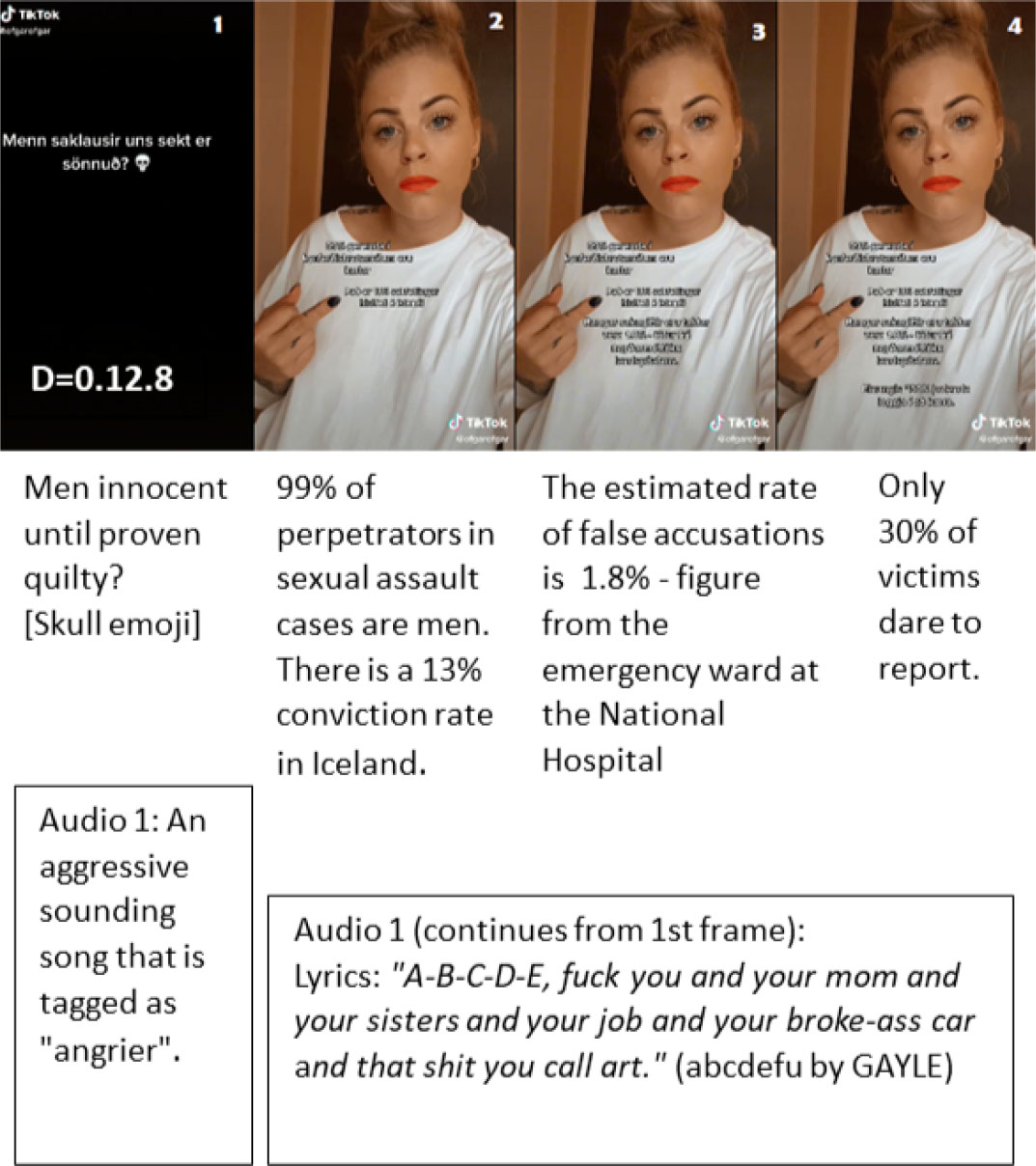
FIGURE 1
Gesturing defiance
Source: Öfgar, 2022a
This is exemplified in Figure 1, which summarises the narrative in a vignette entitled, “Innocent Until Proven Guilty?” We start the analysis by looking at body posture and then tracing the body narrative in a cohort of other modes from frames 1 to 4. In the first frame of this video, the narrator refutes the common idea that men, in the context of accusations about gender-based violence, are innocent until proven guilty. An emblem gesture – a raised middle finger – appears sequentially in response to the opening question in frame 1 and can thus be understood as an answering statement to the question. The gesture is used in cohort with other multimodal signals, such as song lyrics, the aggressive music style and the contouring of the face with an expression marked by a flat stare and downturned mouth. At the point in the music's lyrics when they begin with “fuck you”, the video switches from frame 1 to frame 2, accentuating the aggressive tone of the video. The stance of the narrator is thus made clear via the iconic signalling of the face and in relation to the text in the first frame. The facial expression signifies anger, as communicated in interpersonal interactions, something that is reflexively expressed by the face yet produced here for rhetorical purpose. We recognise the affect of anger not only because of the iconic resemblance to anger, but also because of other elements of anchoring (Barthes, 1977) that include the provocative question in frame 1, the angry music, the well-timed lyrics and the universally recognisable emblem gesture. This is not to doubt the sincerity of the anger; rather, the way the anger is expressed and communicated via facial gesturing is iconic in its use and signalling of the affective disposition of anger and hostility, indicating a moral judgment. The aggressive tonality and lyrics of the song being played simultaneously underline the essence of the message as an aggressive and dismissive stance. The subtitles, then, clarify the social cause of the hostility and its justification via statistical information (representing “facts”) and they act to contextualise the affective gesturing. Moral casting takes place when the activist is portrayed as righteously angry about injustice paired with holding ontological authority in relation to sexual violence, while “disbelievers” receive moral condemnation. Indexically, the gesturing and text co-act as evidence of the social problem of epistemic inequality, that is, guilt in sexual assault cases is difficult to establish because victims rarely report, and though false reporting is rare, perpetrators are rarely convicted. Anger and hostility, therefore, are affectively staged via the body as olitical reactions and proclamations. Symbolically, the gesture signals a feminist standing and crystallises the aims of the movement, both ideologically (feminist) and attitudinally (anger). The angry gesturing in the video thus serves as a form of defiance and aggressive refutation of normative notions about the link between executive legal justice and truth, as well as the assumption that court institutions alone have the moral authority to determine guilt and innocence.
Ridiculing adversaries
Humour, irony, and ridicule play a significant role in the overall Öfgar rhetoric, as shown in as shown in Figure 2 in a video titled “In One Ear, Out the Other”. This video exemplifies how an audio meme functions as a component in a metaphorical narrative to ridicule the rhetorical adversaries of the Öfgar group or those described as defending patriarchy. The audio meme is a loud yell in a masculine voice and ends in a thumping sound, indicating a body crashing against a wall. The narrative consists of a woman with a cup in her hand, sitting at a table, drawing a parallel imagery of a woman sitting at a kitchen table while conversing with a friend over a cup of coffee. A sudden yell (audio 2) interrupts the conversation (audio 1), the woman looks up, following the trajectory of a moving object above her with an attentive expression (mouth open, other facial features slack). After it crashes (as indicated in audio 3), she stills her body for a few seconds (frame 5), but then she turns her head (frame 6) and continues the interrupted conversation.
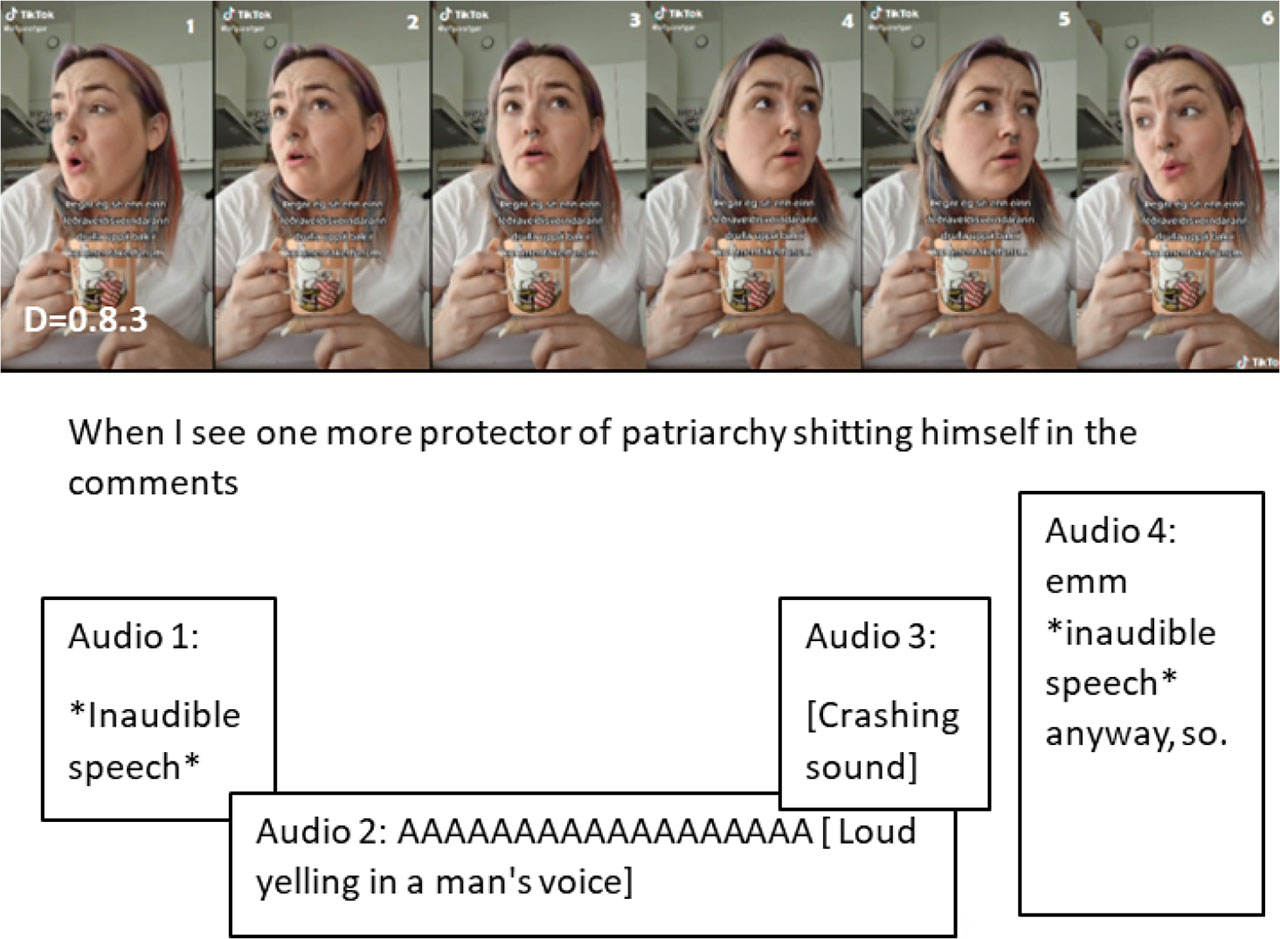
FIGURE 2
Ridiculing adversaries
Source: Öfgar, 2021b
In looking at the body, we see that the face changes noticeably at two junctions in the video (in frames 2 and 6). We thus consider how other multimodal resources intersect with the opening of the gesture and the peak of involvement. In this case, the start and end of the masculine yell are shown to alter the face, and the crashing sound in audio 3 then marks a change in the gesturing of the body and a new gesture is performed: the turning of the head and the gaze direction.
At the iconic level, the face and body posture comically signal the momentary attention and amazement, held in an emphatic style in frames 2–5, followed by the abrupt loss of interest in frame 6. On the indexical level, the video infers through metaphor that adversaries of the Öfgar agenda can be given only minimal attention despite the “loudness” of their opinions. Amazement in the look also signals moral distance and a higher moral position; in other words, she judges the act via the facial gesturing as something odd or bizarre, but the act of keeping the facial gesture fixed throughout most of the video intensifies the gesture, drawing the viewer's eye to it. The casual dismissal of the interruption also symbolises an empowered position, the available choice of whether to consider a discursive input and incorporate it into a current conversation. By uttering “anyway, so” and turning her head, the narrator establishes her rhetorical dominance, as she completely disregards the relevance of the screaming voice. Furthermore, the opinions of the “protectors” are also ridiculed in the form of someone making a spectacle of themselves in public. Hence, they are excluded from rhetorical engagement in the public debate and cast as morally irrelevant. Symbolically, the vignette then reflects the rhetorical dismissal of those whom the movement defines as “protectors of patriarchy”. The capacity to ignore certain groups and opinions also reiterates in-group and out-group boundaries and symbolises the united front and power of the movement.
Role modelling
In an effort to frame feminist activism as a positive and rewarding endeavour, the members of Öfgar produce videos in which they aim to inspire and become role models for others. This rhetorical act is exemplified in Figure 3, where a member of Öfgar chronicles her traumatic experiences of gender-based violence and her reactions across six separate subtitles, while mouthing to the lyrics of a song. In this video, the change in the body is marked by its sequentially increased movement and peaking in certain gestures. During the playback, a song performed a cappella increases in pitch and volume (with more voices joining the singing) and its expressive tonality parallels the increasing movement and gesturalism of the narrator. The highest tonal pitch in the music is reached in frames 6 and 7 in conjunction with the peaking of involvement that is manifested by moving the hand. The content creator has thus choreographed subtitles, music, and bodily gestures that signal and frame the affective disposition expressed by the iconic face. As the song is only composed of one stanza, the lyrics are repeated six times during the video. The lyrics are about being “whatever you like”, reflecting a changing state of agentic identity, from being a victim to a survivor to an activist. In frame 1, when she begins chronicling her experiences of abuse, her face remains impassive and her body relatively still in comparison to later in the video. Between frames 2–7, the volume of the song increases as more voices join the a cappella, and the narrative changes to fighting, seeking help, and gaining agency. Parallel to these narrative turning points, her body gradually becomes more animated and “peaks” at several intervals. The head starts to move slowly from side to side in a rhythmical “feel” of the music and the story (frame 4), the eyes close (frame 5), the fist is clenched in an emblematic gesture (frame 6), and she begins to gesture with her hand while recounting her recovery (frame 7). Hence, there is a link between gesturing and music (visually expressing what is felt), the narrative trajectory (telling what happened) and lyrics (verbally expressing what is felt).
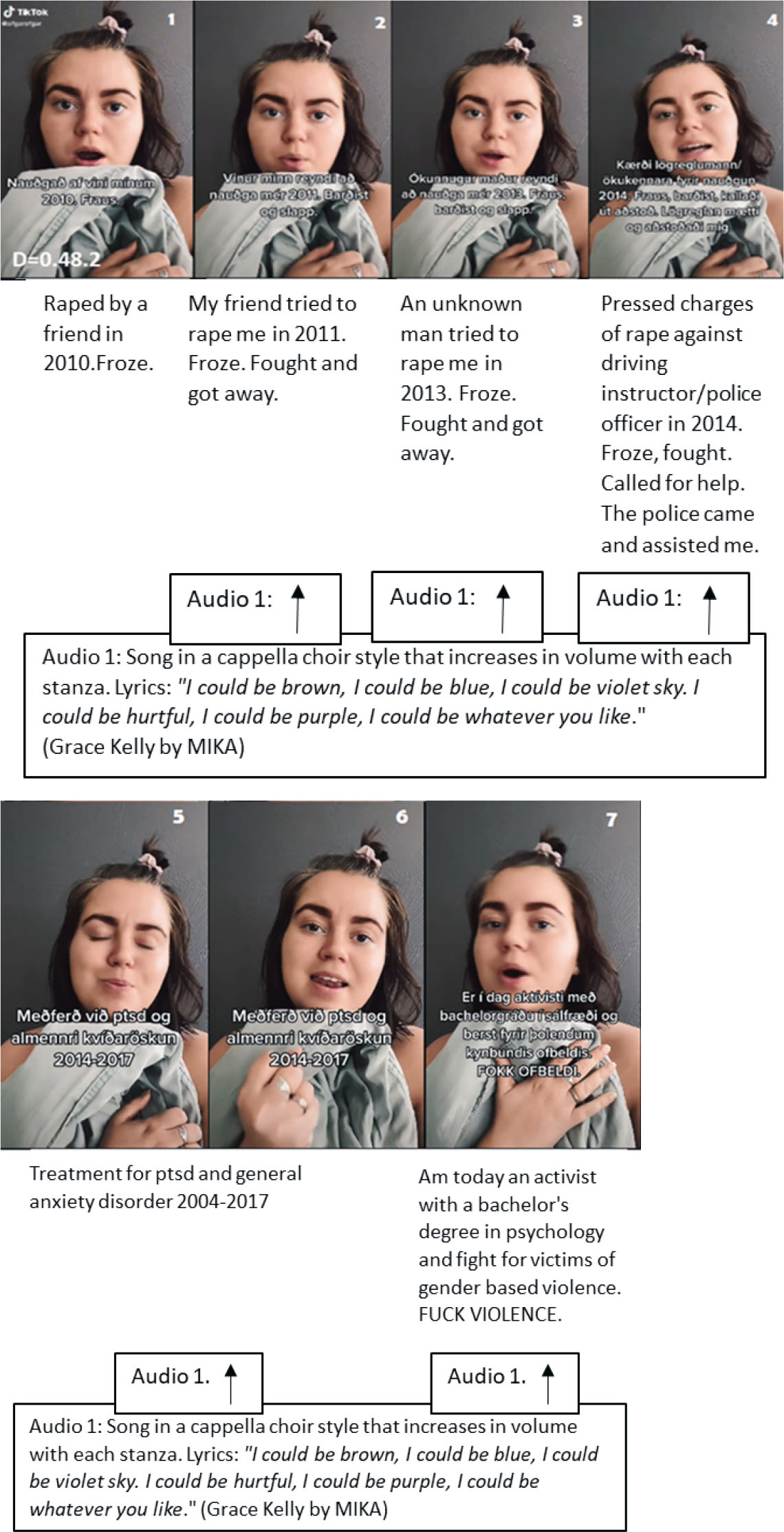
FIGURE 3
Role modelling
Source: Öfgar, 2021c
The video serves as an educative and empowering narrative of a protagonist moving through different sentiments and events. Indexically, facial expressions signal overcoming obstacles of traumatic violence through reaching pinnacle life events, such as pressing charges, the process of healing, and of fighting back against the oppression of systematic violence. Iconically, these actions are shown to contain emotional depth and to be emotionally satisfying via facial and body gestures. Symbolically, the narrative is a story of gradual self-actualisation, but it also points to the meaning of the Öfgar movement as a vehicle for activism and social justice. It defines the movement as a part of a moral endeavour, where activism is portrayed as something to which one should aspire to. Through the story, the movement itself gains concreteness as an example of a journey towards emancipation, of fighting back physically but also of other avenues of fighting back against the structure and impact of violence, such as pressing charges, succeeding in life despite the trauma, and the emancipatory action of activism against violence in society.
Manifesting inequality
Many of the videos contain stories and examples of how inequality is manifested in society; for instance, in Figure 4, the narrator gives advice to women and non-binary persons on what to do when going to a doctor in order to be “taken seriously”. Throughout the video, the narrator switches between a bemused expression on her face in a form of a smile and pursed lips and a wide smile, and she gestures with her finger rhythmically to the subtitles appearing in each frame while jovial instrumental music is played in the background. At the end of the video (last frame), she smiles sardonically and gives the thumbs-up sign. The changing gestures thus underscore a point being made where the indexical meaning of the turn-opening smile (Kaukomaa et al., 2013) changes and the gesture of the hand works in tandem as it instrumentally points to the subtitles. We now understand the changing state of the body in relation to the subtitles and the jovial atmosphere of the music along with the ontological settings of Öfgar, signalling the affective tone of the encounter. Here, the face is used iconically to express irony: The turn-opening smile and the widening smile in the last frame are not indicators of happiness but rather the opposite, a sign of social-political discontent. The thumb is also used in this ironic sense, as it usually signals something positive, but the indexical reading of the narrative here includes a negative evaluation. The cheerfulness of the music further reiterates this ironic frame.
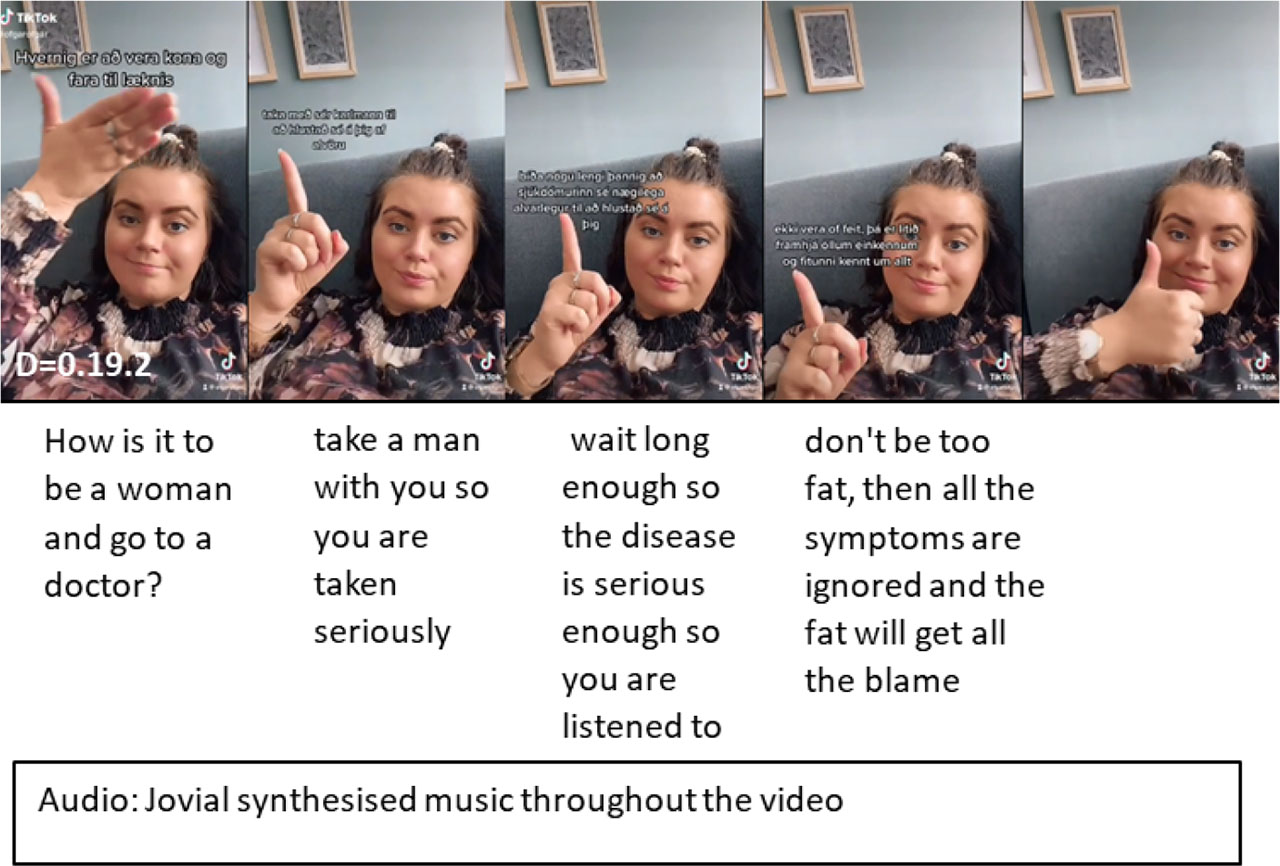
FIGURE 4
Manifesting inequality
Source: Öfgar, 2021a
Meanwhile, indexically, the video showcases how the activist observes the prevalence of sexist attitudes in formal institutional settings and the ironised acknowledgement of its existence. Suggestions on how to circumvent this sexism pertain certain ontological assumptions that need no further explanation or evidence. Symbolically, the video reinforces the boundaries of the in-group, the members, and the supporters of the Öfgar movement as the decoding of the ironised message necessitates awareness of how inequality is practiced in daily interactions. Irony also works here as a symbol of resistance, as its decoding rests on a shared understanding of how inequality is manifested in micro practices (Nevill et al., 2023). Irony is used rhetorically here to ridicule (and hence criticise) and highlight the sexist character of such a practice.
Staging debates
In their efforts to challenge the discursive practices surrounding gender-based violence, members of Öfgar engaged in rhetorical roleplay in many of the videos, where debates were staged between two personas, echoing the voices of diverse ideological subject positions (Rautajoki & Hyvärinen, 2021). Figure 5 exemplifies one such video titled, “Everybody has the right to tell about their own violence”. In this example, the same individual performs the roles of two debaters, and each character presents an opposing view of the justification of disclosing experiences of violence. Here, the sequencing of body gestures in hand with utterances, and the tonality of words, emphasise a critical point in the argument, while the face fluctuates in and out of an emphatic speech style which marks the intensive tone of the entire staged debate. In the first role (frame 1), a narrator wearing a discernible red jacket declares her intent “to tell” about the violence “he” has subjected her to. In the second role (frame 2), another persona, “a protector”, tries to dissuade the first speaker via various arguments. This staged interaction is rhetorically managed via the change in bodily positioning – the peak of gestures performed in sequential order and in sync with utterances and subtitles (the subtitles in the video are a textual representation of the audio speech). For example, in the last frame (frame 10), the narrator (now out of character) turns to the camera, leans forward, and addresses the audience directly. The tonality of voice expresses incredulity by pitching voice higher (frames 2 and 3). Voice also expresses rationality at other times by maintaining a flat and steady level of tonality without inflections of anger (frame 2). Moral positioning is also communicated through tonality of voice by emphasising certain words (e.g., in frame 3, “will I ruin this life?”, and frame 7, “Yes I want to tell” and “telling about violence is not gossiping it's integrity”). Here, peak of involvement is signalled by a tonal change and emphasis that underscores the moral accountability of actors, for example, the refuting of the statement that “I” will ruin his life when it was “himself”.
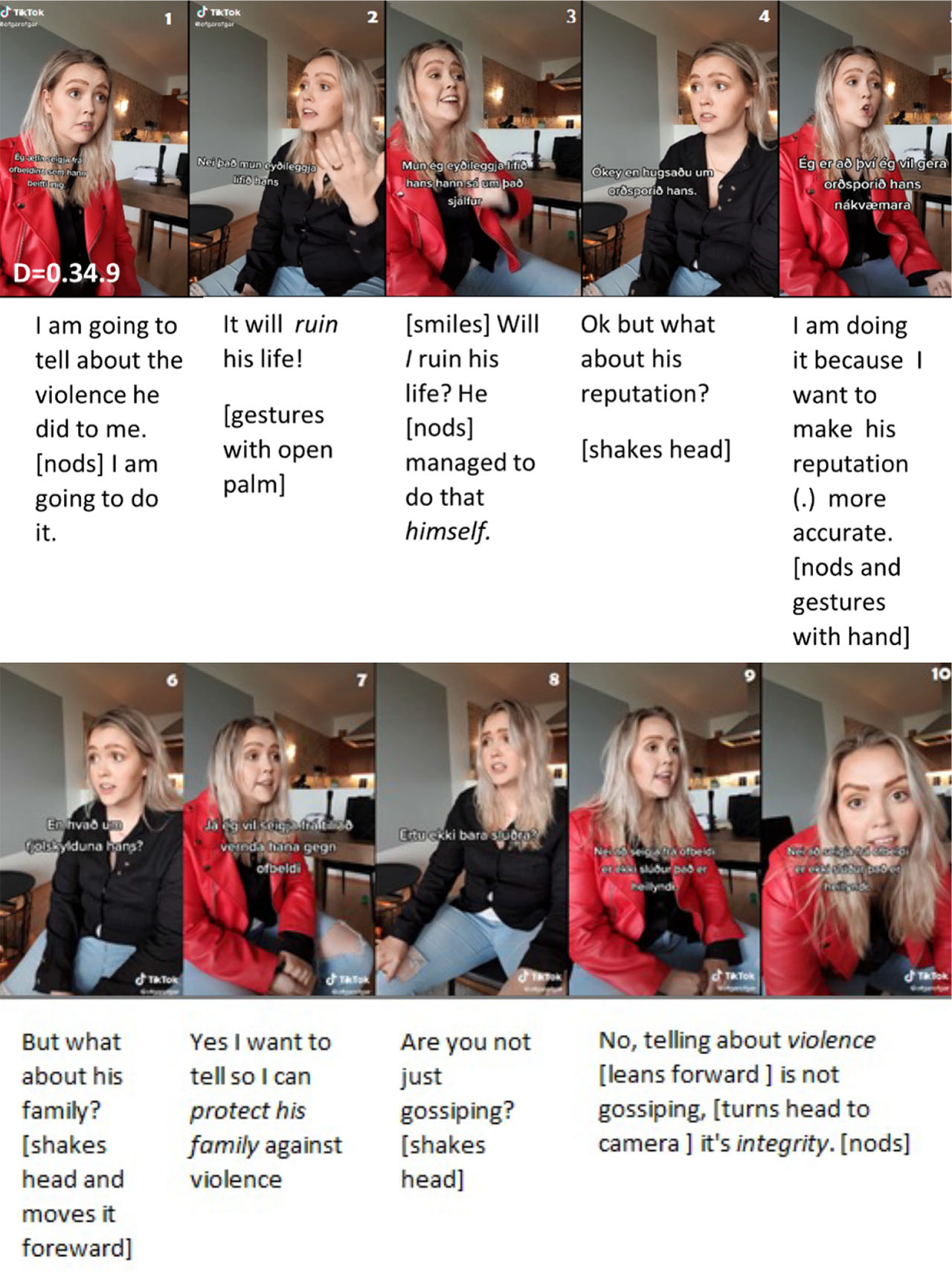
FIGURE 5
Staging debates
Source: Öfgar, 2021d
Meanwhile, the face and body posturing of the first speaker (frames 1, 3, 5, 7, 9, and 10) iconically communicate honesty and a moral conviction. The posture and gaze are steady and consistently held, apart from in frame 3, where she quickly smiles in repudiation and in the last frame, where she leans forward and looks directly at the camera. Otherwise, the body remains tightly patterned in its animated and emphatic style of expression. In the first frame, the facial features are slack, the eyes are wide and the gaze steady. The mouth is half open and the body is leaning forward slightly (bodily projecting of honesty and sincerity in the interaction) and when speaking, she either slightly nods her head in affirmative body language or shakes her head when stressing a point or in rejection of the argument made (frames 4 and 8). In the last frame, she leans forward more, facial expression still projecting honesty and moral evaluation (eyes wide, eyebrows raised, unsmiling) and she turns her head to the camera and says, with emphasis, “Telling about violence is not gossiping, it's integrity”. This transitory action prompts the moral agency of the viewer, who is positioned as the subject of the returned gaze (Rautajoki, 2014). Hence, the evaluative signalling is repeatedly made bodily evident and, along with the tonality of voice, makes clear evaluations and moral positionings of the victim versus those who object to openly accusing perpetrators and those who are authentic protectors of family and societal values by possessing moral integrity.
The narrative presents a cultural generalisation about attitudes towards coming forward with the experience of violence and understanding it as detrimental to the accused and their family, rather than as the right of a victim to relay to others their experience. In this vignette, members of Öfgar present such arguments indexically as evidence of oppressive attitudes, unreasonableness, and inequality in society. Symbolically, it signals the educative aims of the movement to deconstruct conventional truths about violence and identify cultural practices of silencing.
Embodying institutions
In the final example, we show how the Öfgar movement exerts effort to embody social institutions, such as feminism, rape culture, and patriarchy. Understanding body gestures here is dependent on their sequential presentation, the peak of involvement, and the juxtaposition of identifications. In Figure 6, the activist in the first frame tilts her head slightly and gazes smilingly at the camera as the peak of affective engagement. The subtitles describe her as feeling “happy” to finally see people believe and support victims. During the video, upbeat music is played and carefree lyrics of “la la la la” are heard, further signalling the affect of joy (audio 1). The frame then switches to a new persona with only two eyes and a mouth, identified by the subtitles as “Patriarchy”, and at the same time the lyrics in the song change, reflecting the sudden introduction to the new face (“I say hey!”). In the third frame, “Patriarchy” then starts to laugh (audio 2). The video is an interesting example the metonymic use of the body and face, where the face represents the whole of social institution: happy feminism and malicious patriarchy that has a quality of omnipotent presence. On the iconic level, both faces display a state of “happiness” – a sense of enjoyment with the current state of affairs. Indexically, it can be inferred in a cause-and-effect relation, that the happiness of the first speaker is disrupted by the abrupt entry of Patriarchy who then laughs (frame 3, audio 2). As Patriarchy is identified by Öfgar as a malignant social institution, the laughter takes on a malignant quality, signalling a stance against victims and a malicious intent (to disrupt support and credibility). Patriarchy is thus identified here as a personalised adversary with ekphrastic affordances of a face that expresses gleeful maliciousness. Symbolically, the video stages the cultural antagonism that the members of the movement must “face” (here presented in the form of faces). This example acutely illustrates the symbolic relevance of the face as a site of political signification in a medium like TikTok. The face embodies the affective stance of institutional bodies, which exist dynamically aside one another, rendering micro practices of inequality intensely personal and visual, as something that exists as an antagonistic relationship between physical bodies.
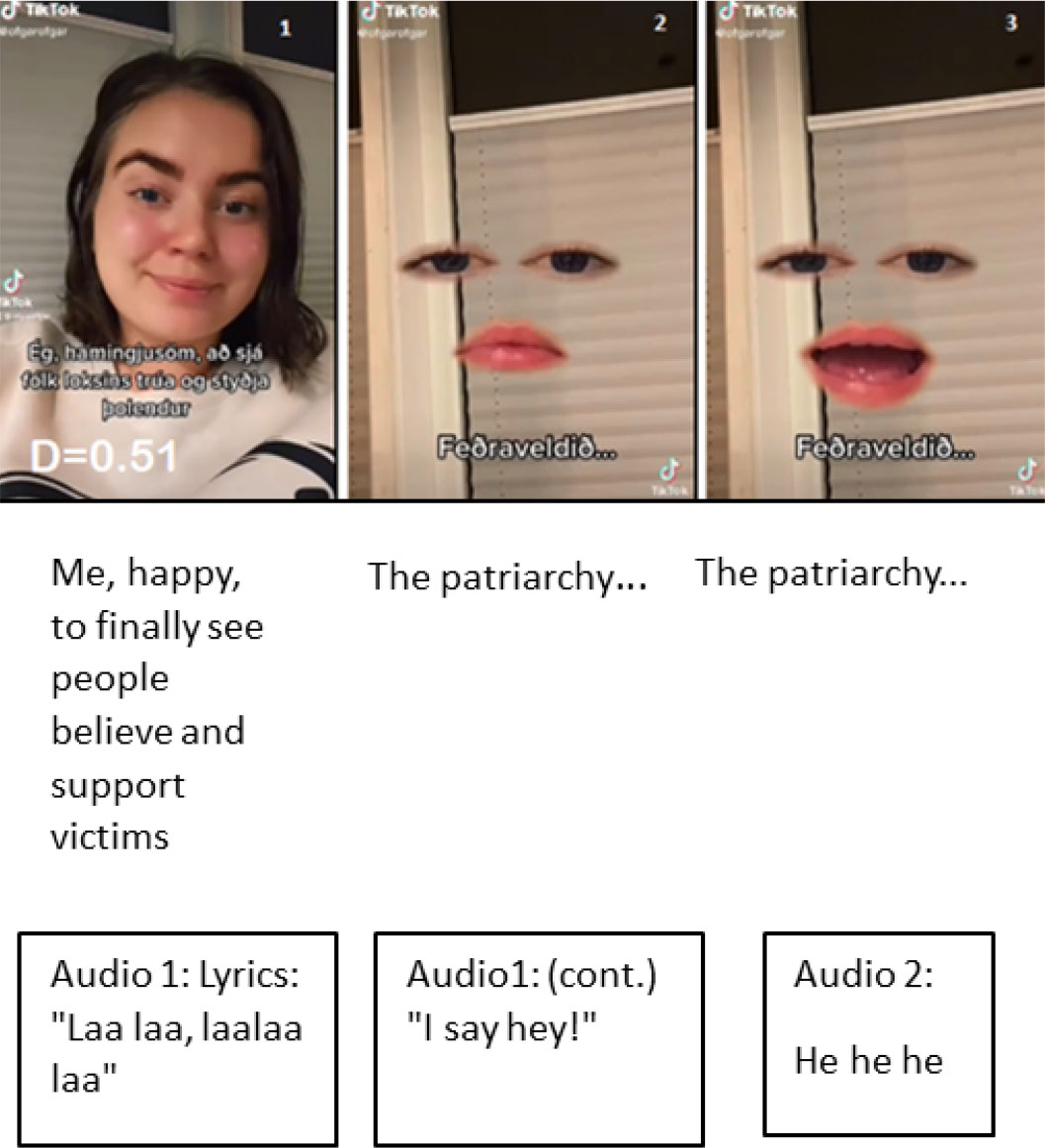
FIGURE 6
Embodying institutions
Source: Öfgar, 2022b
Summary of the embodied scenes performing political persuasion
Moral casting of participants provides an important rhetorical asset in persuasive narration: Core actors identified and evaluated on the level of the story, interaction, and cultural identities builds an appealing interrelational scaffolding for the arguments being staged (Rautajoki, 2012, 2022; Rautajoki & Fitzgerald, 2022). Members of Öfgar use embodied scenes as a means of setting up the stage where the moral casting of actors can then be signified and performed. The scene serves as an illustrative event of what the members consider a problematic aspect of society. The portrayal of scenes deploys dramatistic rhetoric (Sarbin, 1995), where moral conduct or stances are then enacted bodily. The societal problem is further evidenced by the rhizomatic flow of parallel examples of experiences among the young women who constitute the Öfgar group – some of whom disclose their first-hand experiences of gender-based violence in separate videos and are motivated to activism. Interestingly, a narrative scene does need not be based on one's personal experience or rest on factual recounting by the narrator, but it can be a hypothetical event that could happen and it represents a contemporary aspect of social reality (Rautajoki et al., 2020). Hence, the scenes serve as a generalised embodied experience of some particularised women, somewhere, sometimes, and explicitly contextualised within cultural practices and in the moral choices people make. The expressive movements of the body then encase evaluations and judgements, providing a diagnosis for the moral disorder.
In Table 1, we summarise the six rhetorical acts enacted in scenes involving the gesturalism of the body and we exemplify their semiotic significance. We discovered six distinct patterns of embodied scenes being performed across the videos, whereby rhetorical acts are performed via the ekphrastic use of the body in combination with auditory cues and subtitles that then scaffold the semiotic reading. Hence, gesturalism of the body, facial expressions, and bodily movements work to signal evaluations, judgements, and positionings and become an inherent part of political stance-taking.
TABLE 1
Embodied rhetorical acts in Öfgar
| Embodied scene | Rhetorical act | Examples: |
|---|---|---|
| Gesturing defiance | To show defiance and aggressive rejection of detractors. | Giving the finger with hostile expression while playing aggressive music (Feminism embodied as a defiant and empowering act). |
| Ridiculing adversaries | To mock and delegitimate competing arguments, practices and the rhetorical “other”. | Roleplaying a woman who is momentarily surprised by a loud scream of a man representing patriarchal views as he catapults in the air above her and crashes into the wall (Ridicule and gestural dismissal). |
| Role modelling | To inspire and model for supporters. | Chronicling an emancipatory path of a young woman to activism through narrating experience of violence via gestural singing (Bodily expressing feminism as an emancipatory action). |
| Manifesting inequality | To interpret and expose how certain cultural practices are manifestations of gender inequality and sexism. | Advising how to navigate sexism in healthcare and then smiling sarcastically and giving a thumbs-up (Sarcastic smile as a sign of undercurrent socialpolitical discontent). |
| Staging debates | To challenge cultural practices and master narratives in staged dyadic interaction. | Staging rhetoric debate of two embodied sides, about the moral justification of publicly disclosing experiences of sexual violence (Rearrangement of the moral order via embodied stance and prompting moral agency). |
| Embodying institutions | To embody institutional identities and stage their gestural expressions. | Displaying patriarchy as a maliciously laughing face that spoils feelings of happiness (Affording patriarchy, a persona and an affective disposition emphasising the interpersonal and affective aspect of gender inequality). |
Affective gesturalism as an asset in political persuasion
To explicate further how to assess the politics of the body, we outline in Figure 7 how our combination of three-tier-signification, moral casting, and epistemic governance interrelate in the findings. We understand bodily gestures as operating on three levels of signification (iconic, indexical, and symbolic) simultaneously to pursue several persuasive goals in online activism.
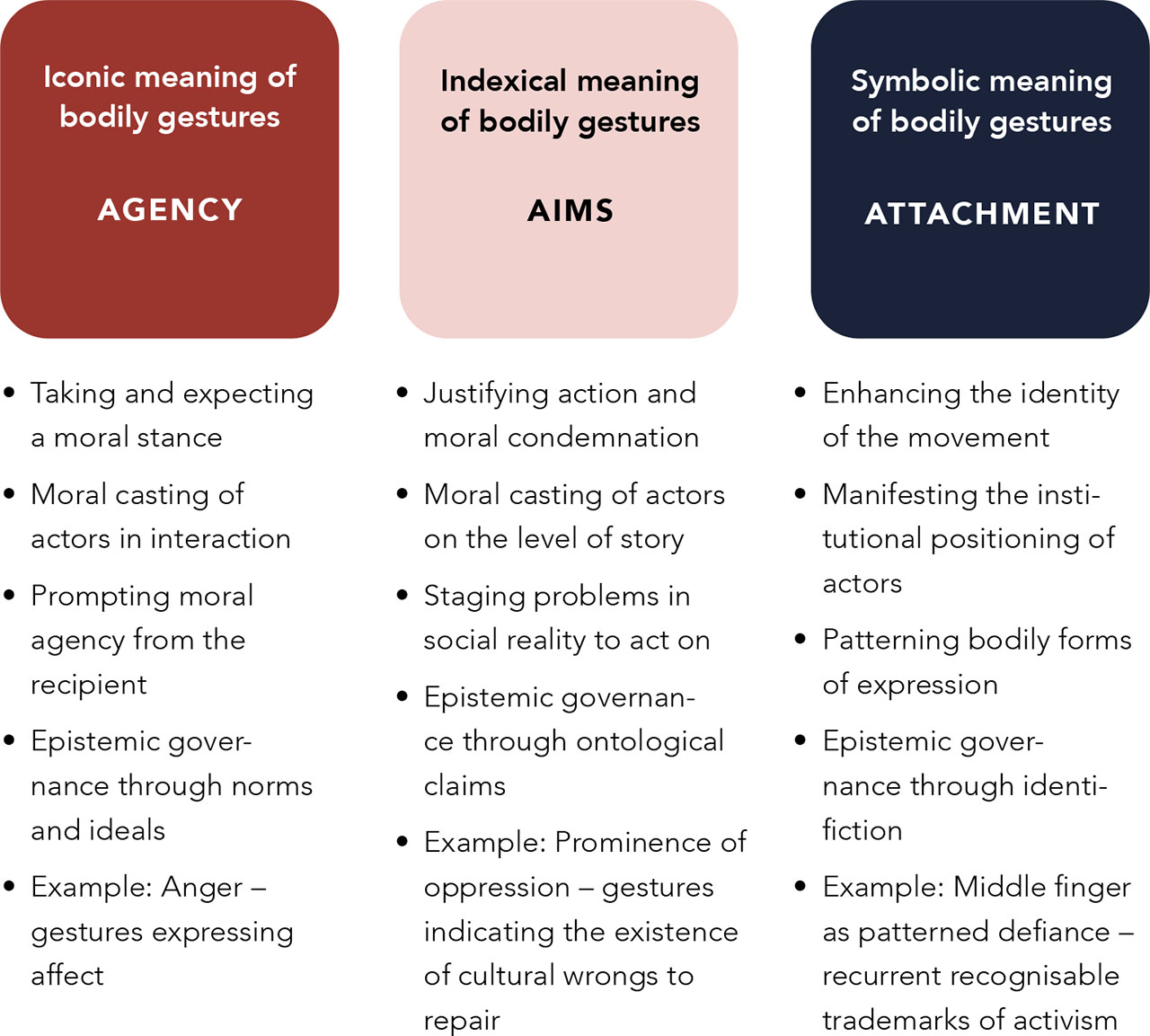
FIGURE 7
Three-tier signification occurring through bodily gestures.
The moral scenery of videos deploys cultural norms and ideals, such as justice and equality. Activists work on these ideals by ascribing evaluative identities to the key actors and participants in the scene. The gesturalism of the body serves to reiterate their own moral stances and prompt the moral agency of the audience, for example, by accentuating a conclusive evaluative look gazed at the camera at the end of the talk. Such bodily communication locates political agency within a physical body and its artful puppetry. Actors can make political statements and embody narrative positioning through multimodal performances in a platform that enables complex and appealing semiotic structures. The indexical level, then, relies on the inferences made regarding gesturing and expressions as the reason for the origins of the affective state being shown. The audience is expected to infer about the cause and context of the affect, such as by interpreting anger as a sign of social problems in need of repair, rendering gestures as particles in making ontological claims. Indexing social issues also iterates the aims of the movement for social change.
Third, the symbolic meaning is established by the patterned forms of bodily expressions, such as showing the middle finger as an act of defiance or the constant use of expletives. Such patterning of gestures exhibits and enhances the identity of the movement (as defiant, provocative, and demanding of social change) and manifests the institutional positioning of actors: us (feminist activists, victims, etc.) versus them (perpetrators and enablers). Simultaneously, this functions in the form of attachment between members and the movement. In these rhetorical moves, the evaluative organisation of the scene configures with the political persuasion and affective signalling of physical bodies.
Discussion: Embodied semiotics in political signification
Our analysis has shown how bodily gestures can function as a key rhetorical resources in the visual production of meaning, turning the body into a major site of signification in political rhetoric rather than a backdrop of verbal communication. The body serves as a surface on which to be visually focused on and interpreted by the viewer rather than a by-product of language. What is said is as important as how it is (visually and auditorily) enacted, and as such, bodily rhetoric works to mediate affect, experientiality, and evaluative stances in an interactional setting (Rautajoki et al., 2020). Furthermore, the expressive affordances of the body can be turned into a political asset in the exhibition of embodied scenarios. The body works as a gaze magnet in an arresting visual, as a canvas of density capable of communicating a myriad of meanings, as a conveyer of emblematic gestures with indexical and symbolic meanings and as an incorporate entity providing face and affective disposition to social institutions.
Affective signalling as manifested in the data was deliberately conveyed and expressed as an embodied communicative act, visually indicating the emotional stance of the speaker as the heart of the argumentative point being delivered (setting the body as the stage). Hence, the visual rhetoric used by the Öfgar movement is designed to be gesture-rich, where the presence of emotions is meant to be seen and interpreted acutely and, therefore, is repeatedly signalled and reinforced through different multimodalities.
Agamben (2000: 201) placed great significance of the role of face and gestures in his writing and theorisation on politics, describing the face as “the only location of community” where, inevitably, politics take place. He opined that it has become an avenue for the struggle over the truth as humans strive to possess and take control over their appearance. He attributed this to the face serving as an arena of communicability, as do all bodily gestures that are exhibitions of the mediality of the body (Agamben, 2000). Gestures are also a part of the spoken language, but they constitute a pure communicative medium on their own with the capacity to reach beyond spoken language.
Therefore, the body as a vehicle for emotional expression is not only inherently interesting to audiences, but also communicatively effective. The activists in Öfgar take advantage of the communicative density of the face as part of their visual narrative production, using it as a fabric for intentional meaning-making in communicative encounters and to closely simulate face-to-face encounters.
The fusion of technical and semiotic affordances on such a platform as TikTok also lends communication a multidimensionality, and the ability to pack complex multilayered meanings and structural arguments into short interactive narratives (even under a minute). In addition to indexing social problems and symbolising the institutional body of the activism, the movement of a living physical body also attracts the eye while drama assists in holding it captive. This emphasis on TikTok as a space of performativity is encapsuled in Boffone's (2022: 42) definition of TikTok as theatre. It is where meaning-making becomes visually manifested in the body and whose affective gesturalism plays a leading role in the evaluative organisation and moral casting of the scene, aimed at renegotiating social orders by prompting the viewer to emotionally engage in and “morally reflect” on the societal wrongs presented.
Acknowledgements
We wish to thank Tampere University, the Finnish Concordia Fund, and the Academy of Finland (project number 348744) for supporting the work for this article.”