
Introduction
After fertilizers are used near bodies of water, nutrients within them often end up in nearby waterways. These nutrients commonly cause harm to nearby ecosystems through the process of eutrophication (National Oceanic and Atmospheric Administration, 2024). Eutrophication occurs when algae consume nutrients (nitrogen & phosphorus), largely from anthropogenic input, causing rapid growth of the algae. Once algae die, it is consumed by bacteria in the water. These bacteria call for large amounts of oxygen, leaving little dissolved oxygen for other organisms (United States Geological Survey, 2019). In recent years, warming global temperatures have created conditions that support algal blooms, allowing for more incidents of eutrophication to happen (Nazari Sharabian et al., 2018). Eutrophication poses numerous wide-scale threats, including that of anoxic dead-zones in bodies of water. Dead zones are areas that result from extreme eutrophication, restricting the ability of many organisms to survive (NOAA, 2024). Cyanobacteria (blue-green algae) is a strain of photosynthetic bacteria that is a common origin of harmful algal blooms. They can cause economic issues, such as loss in tourism or fish kills, at an estimated cost of $49 million annually in coastal states (Centers for Disease Control and Prevention, 2023). Currently, algaecides are manufactured to include several chemicals, including copper sulfate (CuSO ), which can danger non-target organisms. Copper sulfate is also a potential toxin to humans, which is a major risk if it is not handled properly (National Pesticide Information Center, 2012).
Nanoparticles are particles at the nanoscale, which give them special properties compared to larger materials (Mirsasaani et al., 2019). They are of growing interest in many different fields of research, as they have numerous applications, including more efficient drug delivery, agriculture, and water treatment (Altammar, 2023). A partial reason for how nanoparticles efficiently kill bacteria is their ability to penetrate bacterial biofilms, which are bacterial survival mechanisms (Gondil & Subhadra, 2023; Tungare et al., 2024). Nanoparticles have been used to prevent this growth in the past, and are found to be an effective alternative to typical algaecides (Gao & Keller, 2021). Although they are extremely useful for many different areas of study, the need for safer and cleaner nanoparticles is also necessary. Currently, the most common types of nanoparticles include heavy metals, such as gold, zinc, or copper (Gavas et al., 2021). Heavy metals are potentially dangerous substances, however, and have been studied in water fleas (Daphnia carinata) for their negative impacts. Daphniids are often chosen to be studied in bioassays because of their sensitivity to changes in the environment, and one study found that exposure to silver nanoparticles reduced their feeding rate (Altshuler et al., 2011; Lekamge et al., 2019). The reaction faced by Daphnia carinata indicates that exposure to heavy metal nanoparticles could be hazardous to other organisms in aquatic environments.
A potential alternative to heavy metal nanoparticles is polymeric nanoparticles, which are also known to have antimicrobial properties, without being toxic (Zielińska et al., 2020). Chitosan is an organic polymer that is derived from chitin, a component of crustacean shells (Aranaz et al., 2021). Chitosan nanoparticles are of interest for their antimicrobial activity against both gram negative and gram-positive bacteria (Chandrasekaran et al., 2020). Instead of taking a potentially damaging approach to managing cyanobacteria, less harsh techniques such as chitosan nanoparticles can be tested to prevent damage to aquatic ecosystems. The objective of this study was to evaluate the potential of chitosan nanoparticles to regulate the presence of algae in water, controlling the environmental impacts of eutrophication in an environmentally friendly manner.
Materials and Methods
Nanoparticle Synthesis
The method for chitosan nanoparticle synthesis is largely adapted from Chakraborty et al., 2017, with modifications based on available resources. Three-hundred milligrams of chitosan was dissolved in 100 mL of a 1% acetic acid solution to create a 3% w/v solution of chitosan. Next, 100 milligrams of sodium tripolyphosphate (STPP) was dissolved in 100 mL of water. The chitosan solution was added to a beaker on a stir plate. The entire STPP solution was added dropwise to the chitosan solution at a very slow rate. The colloidal suspension was created and stirred for an additional 15 minutes. The evident change in color and opacity confirmed the creation of the cross-linked nanoparticles.
Flocculation Testing
Relative fluorescence (RFU) was measured throughout this experiment with an AquaFluor handheld fluorometer. Fluorescence is an indirect measure of chlorophyll, which is why it can be used to compare cyanobacteria density in different cultures. Cyanobacteria cultures of a strain of Anabaena were used for this project. Bristol’s medium was used to culture the cyanobacteria, and typical procedures were followed to create three stock cultures. Fifteen 97.5 mL treatment subcultures containing the cultured Anabaena were created, and the fluorescence was collected from each subculture. This will be referred to as the initial measurement. Each cyanobacteria culture was treated with 2.5 mL of the chitosan nanoparticles to create 100 mL subcultures. Five minutes after the nanoparticles were added, the fluorescence of the subcultures were measured again. This will be referred to as the post-floc measurement and was taken to measure the immediate impact the nanoparticles have on the cyanobacteria.
Growth Inhibition Testing
Fourteen subcultures of Anabaena were created similar to the procedure mentioned above. These cultures were created to test the growth inhibition caused by the nanoparticles. To each 97.5 mL subculture of cyanobacteria, 2.5 mL of the chitosan nanoparticles were added.
To each subculture, 2.5 mL of the chitosan nanoparticles were added to create a 100 mL total solution. The fluorescence of each culture was measured after five minutes of the addition of the nanoparticles. This value will be referred to as the five-minute measurement. The fluorescence of each culture was collected again after two days under constant lighting. This measurement will be referred to as the two-day measurement. The two-day measurement was taken to analyze the impact the nanoparticles have on cyanobacteria during an extended period. In addition to the fourteen experimental cultures, four control cultures were created the same way, except without nanoparticles. These cultures were measured at the same time intervals as the experimental cultures.
Statistical Analysis
Fluorescence data was analyzed using both paired sample and Welch’s t-tests. The paired sample t-tests were used to compare the beginning and ending fluorescence of the cyanobacteria cultures. The Welch’s t-tests were used to compare the changes in fluorescence in cultures measured at five-minute and two-day intervals. An alpha of 0.05 or less was used to determine significance for all tests.
Results
The percent reduction in fluorescence between the initial measurements and the post-floc measurements ranged from 44.0% to 56.6%. The mean of these calculated percentages is 52.2% (n = 15, Initial: 570.79 ± 477.47 RFU; Post-Floc: 265.53 ± 207.88 RFU). All cultures saw a reduction in fluorescence after the first five minutes (Figure 1). The paired sample t-test indicated that there was a significant difference between the beginning and ending fluorescence measurements (t = 4.36, df = 14, P = 0.0003).
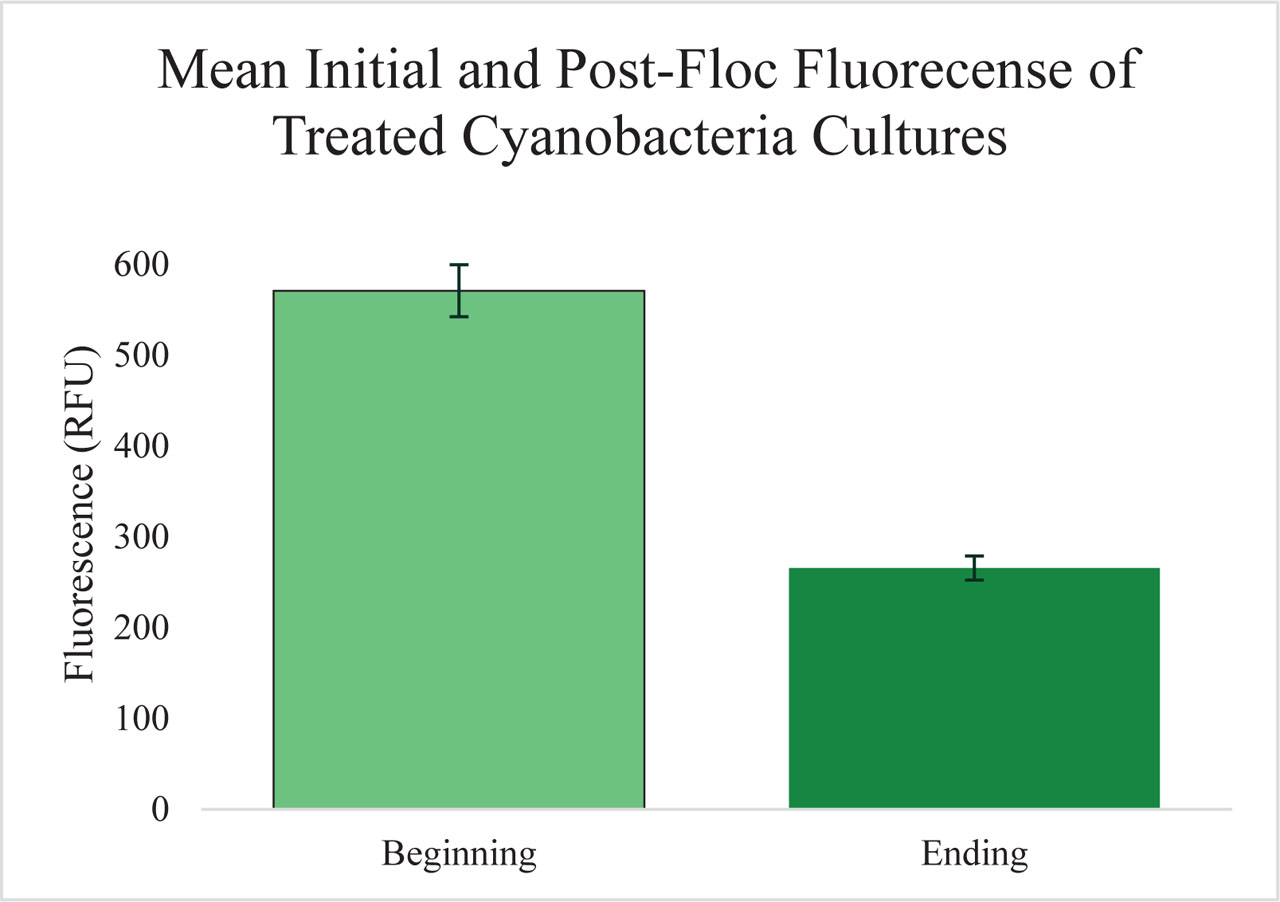
Figure 1.
The fluorescence of the cyanobacteria cultures taken before and after the addition of nanoparticles, resulting in a significant reduction in fluorescence (± 0.05, n = 15, p = 0.0003). There was a mean reduction percentage of 52.2% among each trial. Graphic created with Excel, 2025.
The percent reduction in fluorescence between the five-minute measurements and the two-day measurements for the growth inhibition testing ranged from 27.6% to 75.3%. The mean of these calculated percentages is 53.1% (n = 14, Five-Minute: 225.10 ± 103.52 RFU; Two-Day: 99.49 ± 46.54 RFU). Another paired sample t-test indicated that there was a significant difference between the five-minute and two-day fluorescence measurements (t = 5.99, df = 13, P < 0.0001). The control cultures, however, increased in fluorescence on average (Figure 2). Control culture fluorescence did not differ significantly after two days (t = −1.91, df = 3, P = 0.15).
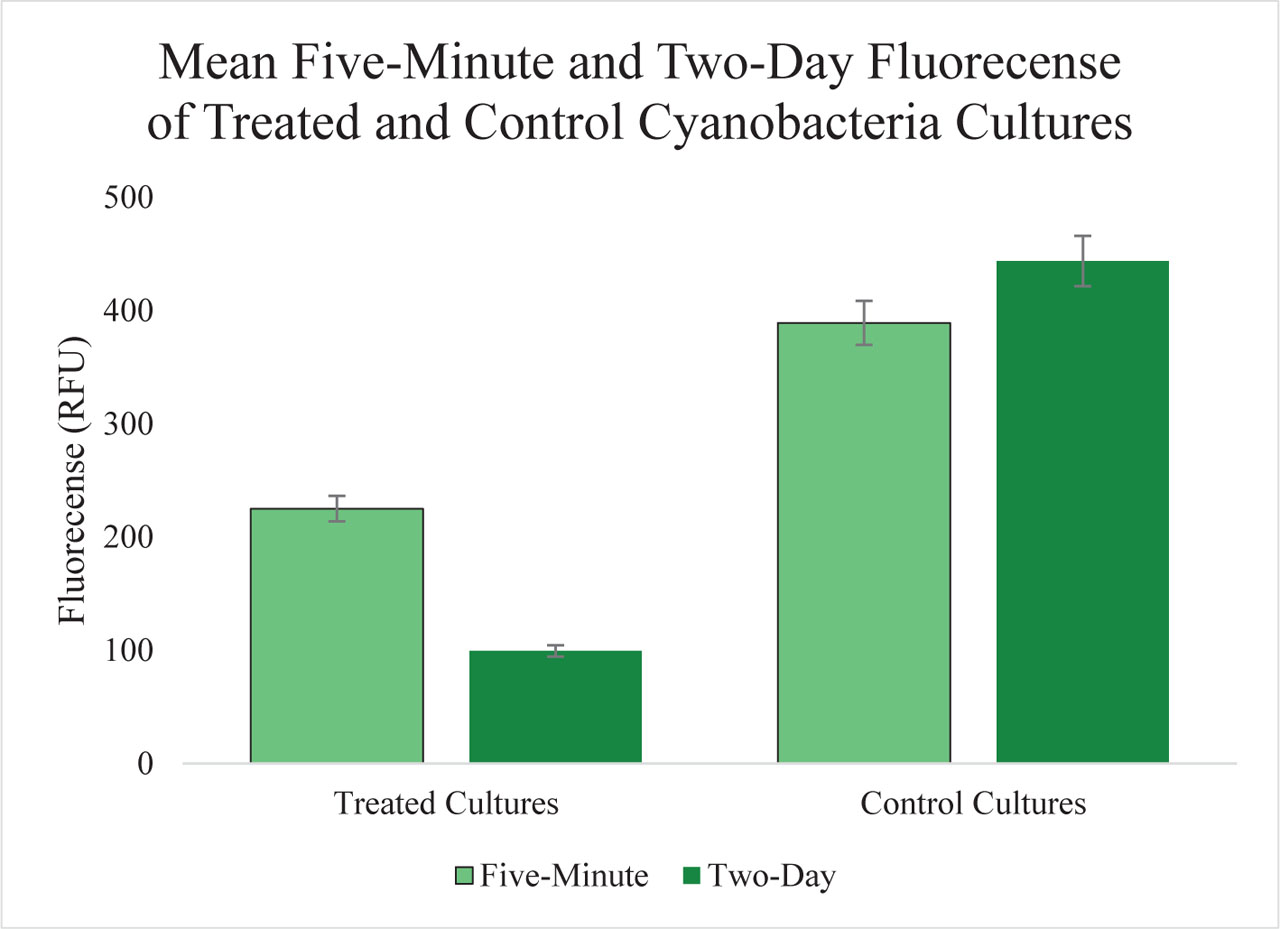
Figure 2.
Fluorescence of the cyanobacteria cultures taken before and after two days of growth, resulting in significant reduction in fluorescence in the treated cultures (± 0.05, n = 14, p < 0.0001). There was no significant change in the control cultures (± 0.05, n = 4, p > 0.05). Graphic created with Excel, 2025.
The differences between the fluorescence measurements in the cultures at the five-minute measurement point and the two-day measurement point were calculated for a Welch’s t-test. The t-test indicated there was a significant difference between the fluorescence differences in the experimental and control cultures (t = 5.45, df = 6, P = 0.0007).
Discussion
All cultures prepared with chitosan nanoparticles showed a reduction in fluorescence, seen both immediately and after extended time. Although the control cyanobacteria cultures showed an increase in fluorescence, the experimental cultures displayed a further reduction in fluorescence, indicating the cyanobacteria could not grow in the presence of chitosan nanoparticles. Cyanobacterial flocculation with the nanoparticles can be attributed to the positive charge of the nanoparticles and the negative charge on the cyanobacterial cell wall (Yang et. al, 2016). Bacterial cell walls are made of peptidoglycan, which has a negative charge. When it interacts with chitosan, which has a positive charge in acidic conditions, the charges are counteracted and the bacterial cells are clumped together, causing flocculation (Rokhati et al., 2021). As for growth inhibition of the cyanobacteria, this is likely due to the disruption of the cell wall caused by the nanoparticles, which has been studied as a mechanism of chitosan nanoparticles in other bacteria (Yan et al., 2021; Figure 3). In the same way the charge imbalances can flocculate the cells, it can also cause the cells to burst, making them release cellular components, thus inhibiting their growth (Figure 4). The nanostructure of the chitosan provides a higher surface area for these mechanisms to work. The use of chitosan nanoparticles to control cyanobacterial growth has applications in recreation, aquaculture, and environmental monitoring and protection (Sivakami et. al, 2013).
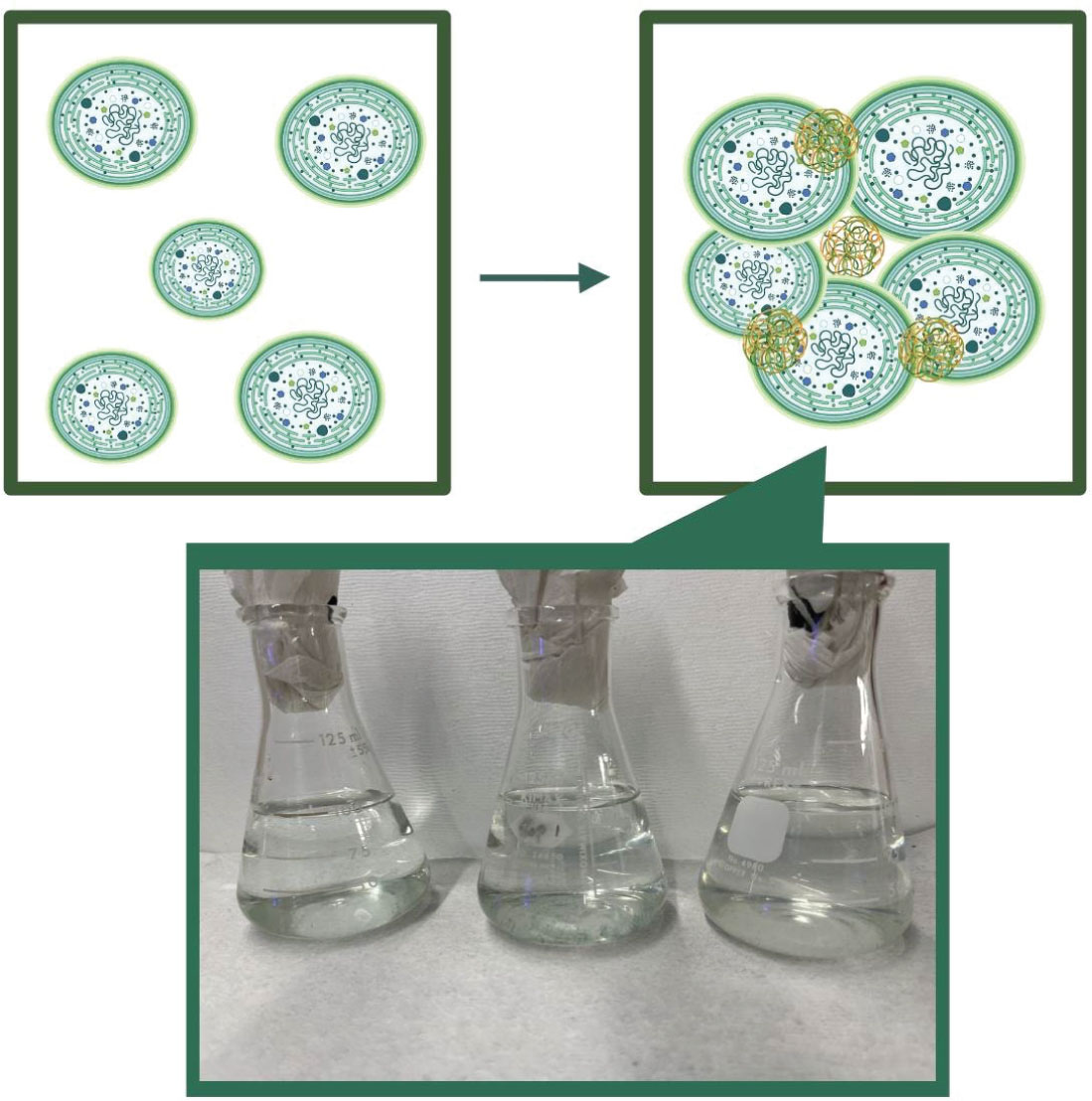
Figure 3.
A proposed mechanism for the flocculation within cyanobacteria cultures. The chitosan nanoparticles neutralize the surface charge of the cyanobacteria cell walls, causing the cells to clump together and sink to the bottom. Photograph taken by researcher, 2025. Diagram created using BioRender by researcher, 2025.
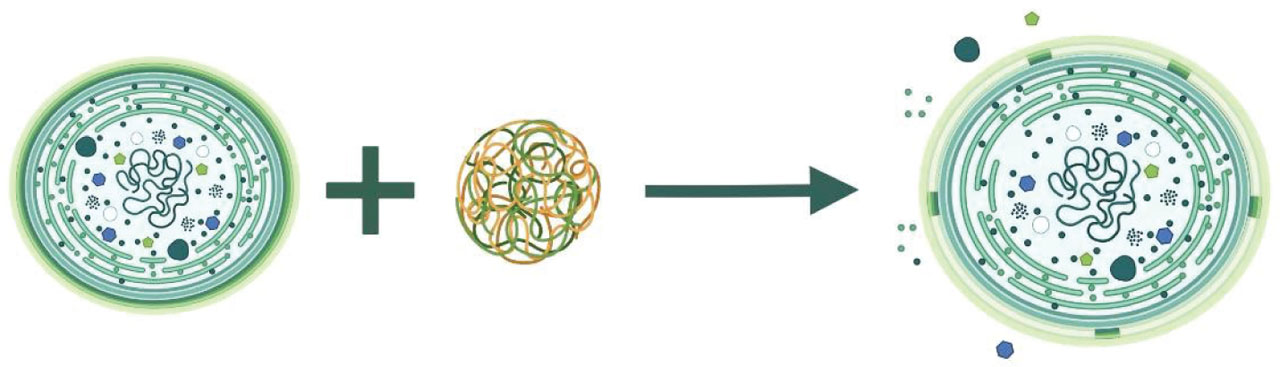
Figure 4.
A proposed mechanism for the growth inhibition experienced by cyanobacteria cultures. The chitosan nanoparticles have the ability to disrupt the cell wall of the cyanobacteria, causing the cells to leak intracellular components. This leads to reduced overall growth within the cultures. Diagram created using BioRender by researcher, 2025.
Chitosan nanoparticles as antimicrobial agents also have applications within coatings technology. Future research can be focused on coating surfaces prone to algae growth with chitosan nanoparticles to prevent growth. Similar research has been done in the biomedical field, and chitosan nanoparticles have acted as an antibacterial coating on heart prosthesis (Perepelkin et al., 2023). Additionally, chitosan nanoparticle composites have been researched to preserve fruits, which reduced fungal activity on the fruit (Wardana et al., 2024). Overall, the antimicrobial abilities of chitosan nanoparticles provided an excellent method to control cyanobacteria. Unlike copper sulfate, chitosan is often regarded as non-toxic and being safe for the environment (Abir El-Araby et al., 2024). As a liquid application, chitosan nanoparticles can be used in areas cyanobacteria might grow, such as lakes or ponds. Chitosan nanoparticles can be a practical and sustainable solution to water quality issues worldwide.
Conclusion
Chitosan nanoparticles have been found to be useful in managing cyanobacteria populations. In the future, the application of chitosan nanoparticles to manage algal blooms could be tested in ecosystems to evaluate their potential in the real world. Additionally, future research can be aimed at exploring methods for delivering chitosan nanoparticles to bodies of water. Overall, chitosan nanoparticles successfully controlled cyanobacteria cultures, providing a more natural solution to managing harmful algal blooms.
Acknowledgements
We would like to thank my teachers and advisors for providing me with the materials and equipment necessary to complete this project. We would also like to acknowledge the support from my family throughout this project.