
Visualization, AI-generated, Prompt GCO Medienagentur
Despite sociopolitical backlash against sustainability-focused corporate practices, many consumers continue to view climate change as a pressing and personally relevant issue. On one hand, public discourse in certain segments has become increasingly critical of environmental, social and governance (ESG) efforts, framing them as ideological, performative or economically burdensome. On the other hand, a substantial portion of consumers remains deeply concerned about environmental degradation and climate risk, continuing to prioritize products and brands that signal environmental responsibility. The spectrum of sustainable business action is broad, and many contemporary practices focus on climate change mitigation, including the adoption and use of renewable energy sources, such as solar and wind power. These practices also include purchasing carbon offsets and credits, as well as reducing waste, increasing recycling efforts and utilizing greener supply chains, such as by choosing suppliers with environmentally friendly practices or by reducing emissions associated with the production and transportation of goods.
BOX 1
Studying green energy contagion: A minimal manipulation, a meaningful effect
To test the contagion effect, we conducted a controlled experiment in which participants evaluated a packaged food product. All aspects of the product – ingredients, nutrition facts, brand presentation and packaging design – were identical across conditions. The only difference was a short production statement. In one study, one group was shown a bag of potato chips. In contrast, another group was shown an otherwise identical packet labeled "Made with Renewable Wind and Solar Energy". No health claims were made, and no additional benefits were described.
Despite the products' objective similarity, participants rated the renewable-energy product as significantly healthier. They also expressed more favorable attitudes toward it, reported stronger purchase intentions and indicated a higher willingness to pay. In other words, a single line about energy sourcing shifted perceptions of the product's intrinsic qualities.
This effect was replicated across different food categories and consumer samples, including a study in which participants tasted cookies labeled either “Made with Renewable and Solar Energy” or “Follow us at Facebook, Twitter & Instagram,” demonstrating its robustness and generalizability.
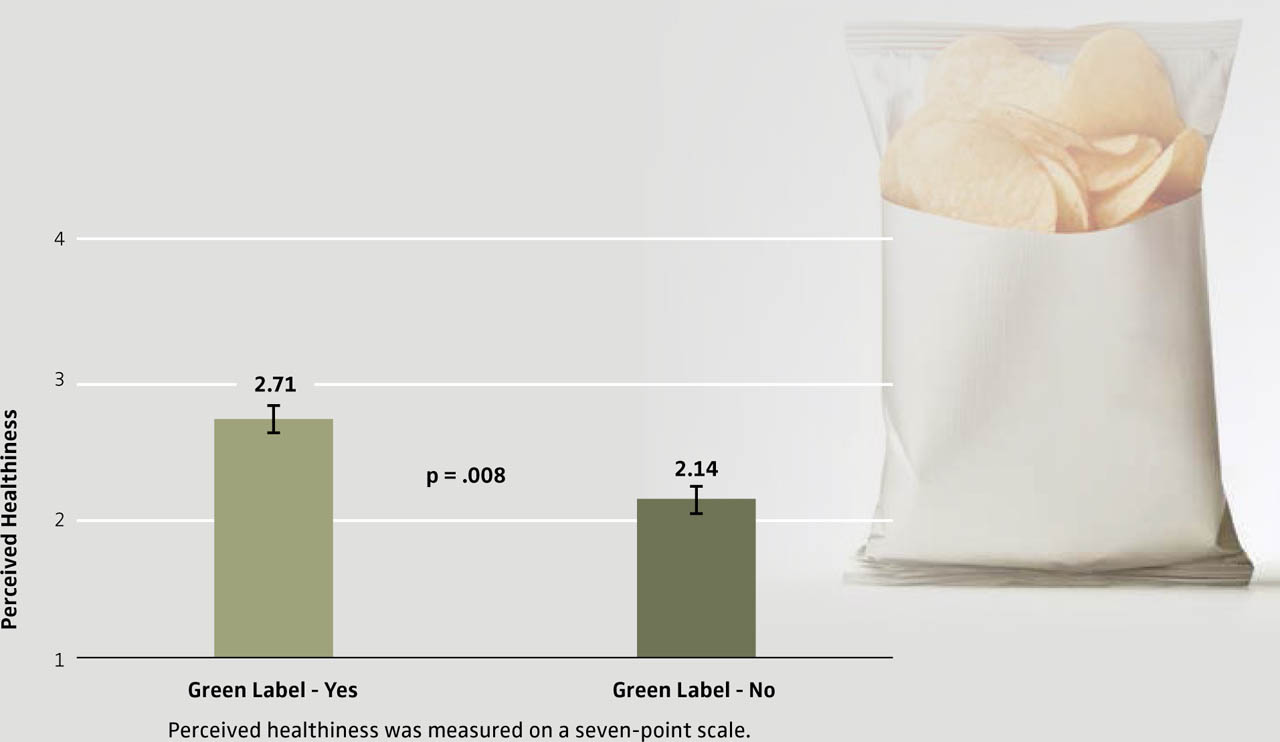
FIGURE 1
Perceived healthiness of potato chips with a green energy label compared to no label
Sustainability is more than an operational decision
For many companies, sustainability begins as an operational decision. Renewable energy investments are made to meet regulatory standards, reduce long-term costs, satisfy investors or align with corporate values. For example, solar panels are installed, and carbon footprints are reduced. These decisions are typically framed as environmental commitments. But sustainability investments may generate a second, less obvious return. They may also shape how consumers evaluate product quality.
Our research (Box 1) shows that when a food product is labeled as produced using renewable energy – a current practice among brands such as Takis, Himalaya Salt and VitaFusion – consumers perceive it as healthier. Importantly, nothing about the ingredients, nutritional profile or formulation changes. The shift is entirely psychological. Yet the consequences are tangible. Perceived healthiness increases, and product attitudes improve, leading to critical downstream consequences: purchase intentions rise, and willingness to pay grows. In short, renewable energy production functions not only as an environmental signal but as a positive differentiator in the marketplace.
The transfer of “good for you” from energy to food
Objectively speaking, the qualities and characteristics of a food product are not impacted by the source of the energy used to produce it. Whether a granola bar is produced at a factory powered by coal or wind changes nothing about the production process, ingredients, texture or taste of that granola bar. Consumers are not told that renewable production makes food healthier. They infer it and perceive a “good for you” contagion. When consumers shop for food, they rarely conduct detailed nutritional analyses. Instead, they rely on cues – packaging design, ingredient labels, brand reputation, and increasingly, sustainability signals. Importantly, this does not mean consumers are irrational. Rather, they use heuristics and learned associations that typically serve them well. These patterns create strong associative links.
Consumers believe that green energy is more beneficial to consumer health and well-being than conventional energy. This is because green energy typically produces far less pollution and thus is less detrimental to the health of humans and other species than conventional energy, both directly, via reduced disease and illness, and indirectly, via slower climate change. So the essential aspect of green energy that differentiates it from conventional forms of energy is that it is “good for you.” Consumers perceive that this “good for you” essence is transferred from green energy to the food during production, thereby increasing the food's perceived healthiness. In turn, such products are more likely to be purchased than otherwise identical products produced with non-green or conventional energy (see Figure 2).
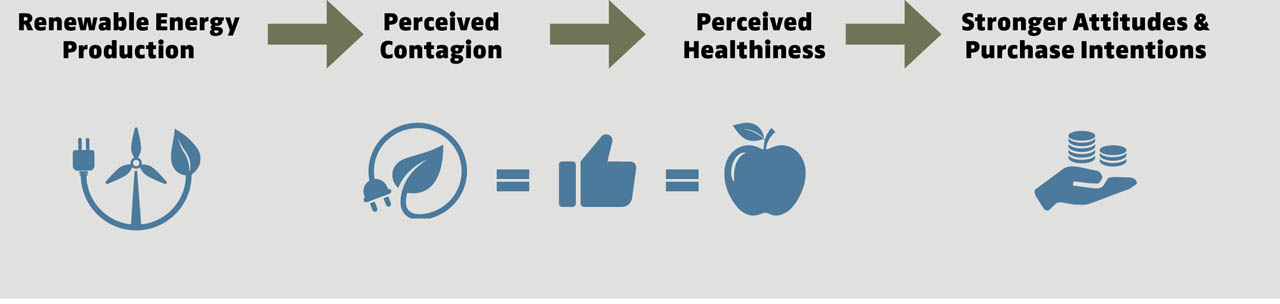
FIGURE 2
Renewable energy production impact on perceived healthiness and purchase intentions
Stronger effects for health-oriented consumers
We also tested whether the strength of the health impact was universal across all consumers or for all food categories. Since more health-oriented consumers are more likely to attend to explicit health cues, we expected stronger effects for this group.
„Renewable energy production functions not only as an environmental signal but as a positive differentiator in the marketplace.“
Indeed, the perceived healthiness of the focal food product was more influenced by the presence of a green energy label for more health-oriented consumers. Further, the effect was most evident in product categories where health perceptions are somewhat flexible – such as snacks, cereals and packaged foods. In categories already strongly defined as healthy, such as air-fried broccoli, the effect was weaker.
Future research might examine whether the contagion effect can be replicated across other categories and services where health concerns are relevant, such as supplements, spa treatments, medical procedures and topical treatments. An exploratory study already showed similar results in a gym context: Participants thought that exercising in a gym where the entire facility, including all the equipment, was powered by renewable energy would make them healthier and more rejuvenated than exercising in a gym that was powered by conventional energy.
Chances and heightened responsibility for marketing leaders
Many companies openly communicate their sustainable initiatives. For example, Grupo Bimbo, the maker of the popular snack brands Takis and Salmas, became the first baking company in the U.S. to use and communicate 100% renewable energy for its operations in 2020. In 2024, Oatly, the world's original and largest oat drink brand, converted its production facilities globally to 100% renewable electricity. For consumers, these sustainability initiatives do not operate in isolation. They have entered consumers’ broader meaning-making processes, with consequences that extend well beyond carbon emissions.
„Sustainability initiatives may create perceptual spillovers that extend beyond environmental responsibility and into judgments of product healthiness.“

Visualization, AI-generated, Prompt GCO Medienagentur
Sustainability investments can enhance core product value …
The fact that the same food product is perceived as healthier when it is produced using green energy has implications for food product marketers. It gives marketers another business-aligned reason to undertake green energy initiatives in their manufacturing processes, as sustainability investments can enhance core product value. Simply put, sustainability investments can generate marketing returns and not just reputational benefits. This means that marketers should take sustainable initiatives out of operational manuals and straight to consumers. As such, marketers should use the renewable production initiatives as a branding element. Notably, we found that an individual's health orientation moderates the impact of green energy labels on health perceptions, suggesting a nuanced form of the perceived “good for you” essence transfer. Specifically, such perceptions are most likely to arise among those who are sensitive and attentive to implicit health cues, such as green energy labels. Marketers aiming to target health-sensitive consumers with healthy product lines can use the green production cue as a potential engagement tool that also aligns well with the true nature of their healthy product lines.
… but ethical challenges should not be neglected
However, this research shows that a green energy label makes dubiously unhealthy foods like potato chips appear relatively healthier. Of course, the ethicality of such strategies is questionable and, from a public policy standpoint, plausibly disconcerting.
At the same time, the fact that environmentally responsible production can shift beliefs about healthiness – independent of objective nutritional changes – raises important questions. Companies may unintentionally (or strategically) benefit from inference-based halo effects that blur the line between environmental virtue and product attributes. Managers should therefore recognize that sustainability signals can reshape consumer judgments in domains they may not anticipate and should ideally seek to leverage them in contexts where it can be argued with good reason. Further, regulators may wish to consider how such spillovers affect informed choice.
„Making products seem healthier simply because they are produced using green energy can create short-term marketing advantages but may, in some cases, backfire in the long run.“
Sustainability as a value driver – Between perception effects and credibility risks
Our findings suggest that green energy production does more than reduce a company's environmental footprint: It can meaningfully reshape how consumers interpret the product itself. Specifically, sustainability initiatives may create perceptual spillovers that extend beyond environmental responsibility and into judgments of product healthiness. For managers, this presents both a strategic opportunity and an ethical consideration.
On the opportunity side, investments in green energy may generate returns that exceed operational efficiencies or reputational gains, influencing core product evaluations in ways that affect demand. Sustainability, in this sense, becomes not merely a compliance or signaling tool, but a driver of perceived product value.
However, using such associative links to make products seem healthier simply because they are produced using green energy can create short-term marketing advantages but may, in some cases, backfire in the long run. When consumers realize that sustainability labels are used to make objectively unhealthy products appear healthier, they may feel misled and begin to question the brand's honesty. This can damage brand credibility, as companies risk being perceived as relying on marketing sleight of hand rather than genuine product improvements. Over time, such practices may also undermine the broader sustainability agenda. If consumers repeatedly encounter instances in which environmental achievements are used “creatively”, they may begin to doubt the real value of sustainability efforts altogether and view them as empty talk with no meaningful impact.
Ultimately, companies should not overstress such associative or contagion-based effects and align honest communication with genuine improvements in both product quality and environmental impact. In doing so, they can strengthen consumer trust while reinforcing the credibility and long-term value of sustainability initiatives that preserve our planet for future generations.