
INTRODUCTION
The practice of creating pasticcios, so popular in Baroque opera, received very positive feedback in the Czech Lands.1 Since the mid-1720s, which saw great progress in the reception of Italian opera in the territory of the Bohemian Crown, the principle of pasticcio appears almost simultaneously even in other genres, such as the oratorio or monastery plays in Latin. The carnival play Facetum Musicum from 1738 from the Osek monastery with arias by Antonio Vivaldi, Georg Frideric Handel, and Antonio Lotti, is an example of the last genre mentioned above.2
In this study, attention is paid primarily to Italian pasticcio oratorio in Brno and Prague approximately between the years 1720 and 1760, although this practice was much more widespread.3 The principle of pasticcio will be observed in two aspects – firstly in pre-existing works with inserted arias (‘oratorio impasticciato’), and secondly in new compositions made up entirely of music by various composers.4
In the Czech Lands, oratorio first appears as a genre imported by the imperial ensemble during the visit of the Viennese court to Prague in 1679–1680.5 As concerns the topics, the time and place of the performances, oratorios were usually held on Good Friday at the Holy Sepulchre – the so-called sepolcro.6 The new genre was primarily promoted by the Jesuits, who performed sepolcri in their Clementinum College. As of the second decade of the eighteenth century, the Good Friday oratorios were also shown in the Jesuit St Nicolas Church in the Lesser Town (Malá Strana). The first documented piece, performed in 1713, was the German oratorio Doloris et pietatis speculum Jesus in cruce demoriens bonis & peccatoribus à Deo propositum, oder Christus Jesus am Creutz ein Spiegel der Schmertzen [etc.] by Georg Reutter.7
In 1724, the oratorios also began to be performed by the Knights of the Cross with the Red Star (Crusaders) in their church of St. Francis.8 Since this church is situated directly opposite the Clementinum College with St. Salvator Church, where oratorios were performed by Jesuits, each had to develop different operating habits over time. While the Jesuits played the oratorios on Good Friday in the evening and sometimes on Holy Saturday, always in Latin,9 the Knights performed on Good Friday at 11 am, and after initial attempts with Latin and German, starting from the early 1730s their oratorios would be in Italian only. The repertoire focused on Viennese composers and compositions acquired directly from Italy or Germany (mainly Dresden). The productions of oratorios in Prague grew over the following years, and by the middle of the century oratorios were presented around Easter in more than ten churches in Prague.10
The oratorio in Prague has been studied in recent years mainly by the Czech musicologist Michaela Freemanová. One of the last papers that she and Janice B. Stockigt wrote on this topic concerned the Latin version of S. Elena in Calvario by Leonardo Leo, performed at the Prague Jesuits in 1734, in which she identified two inserted arias by Jan Dismas Zelenka.11 The article opened the very interesting theme of oratorio ‘impasticciato’, interpolated, similarly to contemporary opera, with arias by other composers. Recent research demonstrates that this case was not unique in the Czech Lands. The oratorios produced in Brno under the patronage of Bishop Schrattenbach are further evidence of this practice.
ORATORIOS PRODUCED BY BISHOP SCHRATTENBACH IN BRNO
The Olomouc Bishop Wolfgang Hannibal Cardinal Schrattenbach (1660–1738, bishop from 1711) was one of the most prominent music patrons in Moravia.12 As former Viceroy of Naples, he was very fond of Italian opera and arranged performances at episcopal châteaux in Kroměříž and Vyškov. In his family palace in Brno, he organised concerts of sacred music for every week of Lent. Up until the present, thirty-six oratorios have been documented thanks to librettos, but the total number is undoubtedly much higher.
The first references to oratorios in Brno come from the year 1723. Two years later, there was already evidence that oratorios performed here were interpolated with arias by foreign composers, as documented in preserved librettos. The final part of the libretto of Il rè del dolore in Giesù Cristo Signor nostro coronato di spine by Antonio Caldara (Brno 1725) provides four ‘arie aggiunte’. They are indicated in the respective places within the libretto with an asterisk and the instruction ‘Vedi in fine’. Three of these added arias are newly inserted (L’angelo Gabriello: ‘Tace sol chi è crudele’, ‘Non speri alcun contento’; L’anima penitente: ‘Cerca pur giudice ingiusto’). In contrast, the fourth one, ‘Con la sua morte’, used for the role of Gabriello, replaces the original ‘Con sua morte l’immortal’, which is preserved in the libretto. The new lyrics are based on the original, but the verse structure is simpler, as illustrated in Table 1.
Table 1
A comparison of the original aria and the inserted aria in the oratorio Il rè del dolore (Vienna 1722, Brno 1725)
| Original text (Pietro Pariati, Vienna 1722) | Aria aggiunta (Brno 1725) |
|---|---|
| Con sua morte l’immortal vita, e gloria a l’uom darà, che peccando al Ciel morì, dove mai, dove si udì, tanto amore, e tanta bontà? Ma il superbo, il disleale a morir ritornerà ritornando al suo peccar. Chi mai può, chi può pensar, tanto ardir, tanta cecità? | Con la sua morte l’uomo immortale a l’uomo frale vita darà. Ma il disleale nel vechio inganno con novo danno morrir vorrà. |
The second oratorio with inserted arias is Il sacrificio di Gefte by Giuseppe Porsile, performed in Brno in the same year 1725. The libretto uses marking with three asterisks; there are five arias marked in this way. The first one is the aria of Elon ‘Io scuso il tuo dolor’, although there are no changes to the lyrics. The arias ‘Astri, che in Ciel splendete’ (Elon) and ‘Alma mia, che già t’aggiri’ (Menulema) are entirely new; they come in places where the original does not include any aria. Gefte’s original aria ‘Sento mancarmi in sen’ is replaced with the new lyrics ‘Lasciatemi in pace’. Instead of another aria of Gefte, ‘Misero son, si, si’, the Brno libretto includes Menulema’s aria ‘Dimmi almeno, o padre caro’; in order to maintain the dramatic expression, its position was shifted six recitative verses ahead. In contrast to the case of the libretto Il rè del dolore, the substituted arias do not have anything in common with the originals.
The graphic marking of inserted arias ‘con stelletta’, common in opera librettos, does not appear in other Brno oratorios. While librettos of adopted pieces often include changes in arias, these are not marked in any way. Another source of information regarding ‘oratorio impasticciato’ are therefore the few preserved music scores.
Regarding sheet music, only five full scores and one fragment of oratorios produced in Brno have been discovered up until the present (see Tab. 3). These are Il peccato di Adamo (anonymous fragment), Il trionfo della croce (Giacomo Cesare Predieri), Morte, e sepoltura di Christo (Antonio Caldara), Il martirio di S. Giovanni Nepomuceno (Nicola Porpora) and Cristo nell’orto and La deposizione dalla croce (Johann Joseph Fux). With the exception of the last mentioned, all the scores share one interesting common feature. They contain inserted arias written on a similar type of paper by the same few local copyists. Several indicators, however, suggest that instead of newly composed music, these are arias borrowed from other works. First of all, it is the highly uncertain aligning of the text, which required multiple corrections, scraping and rewriting in the music. A direct reference to another opera has been found in the score of Cristo nell’orto: the notes ‘Atto II’ and ‘del Sig. Jacomelli’ in one of the arias. These borrowed arias are always retexted in accordance with the original libretto. The local arranger, however, often struggled with Italian diction, as is evident, for example, from the aria ‘Gioja la cruda morte’ from Caldara’s Morte e sepoltura, where the first bar is even pasted over.
Nearly half of the borrowings have been identified to date. The mentioned aria used in Caldara’s oratorio Morte e sepoltura (Brno 1730) comes from Porpora’s opera Siface (Venice 1726). A fragment of the anonymous Il peccato di Adamo (Brno 1726) was identified as an aria from Astarto by Giovanni Bononcini (Rome 1715, Kroměříž 1730). Particularly noteworthy are the borrowings in Cristo nell’orto (Brno 1731) from operas which premiered in Italy just one year before the Brno production. It is one aria from Vinci’s Alessandro nell’Indie (Rome 1730) and four arias from Giacomelli’s Scipione in Cartagine nuova (Piacenza 1730; these are the ones identified by the inscription ‘del Sig. Jacomelli’ in the score). The reason for the substitutions was mostly the replacement of ‘old-fashioned’ arias accompanied by basso continuo (those which remained in the scores are marked with the ‘col basso’ instruction for violins and violas).
What is remarkable, however, is the very different musical language of the inserted arias compared to the rest of Fux’s oratorio, which is composed in the traditional style of the Viennese high Baroque. As an example, we can mention the aria ‘Più forte incontrerai’, where the difference is obvious at first sight. Fux’s version is in A minor, with typical syncopated bass and elaborated treatment of both voices (see Fig. 1). Vinci’s aria, on the other hand, is in B flat major, is homophonic, symmetrical, with a simple quaver accompaniment, where the opening ritornello uses typical gallant elements, such as small values, sextuplets and ornamentation (see Fig. 2).
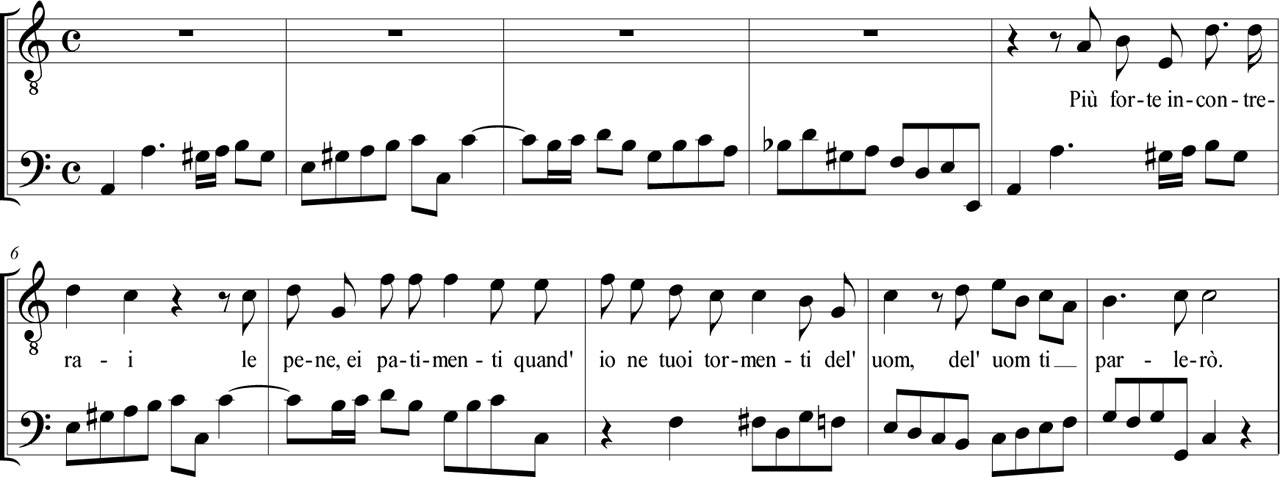
Figure 1
Aria ‘Più forte incontrerai’ from the oratorio Cristo nell’orto by Johann Joseph Fux (Vienna 1718)
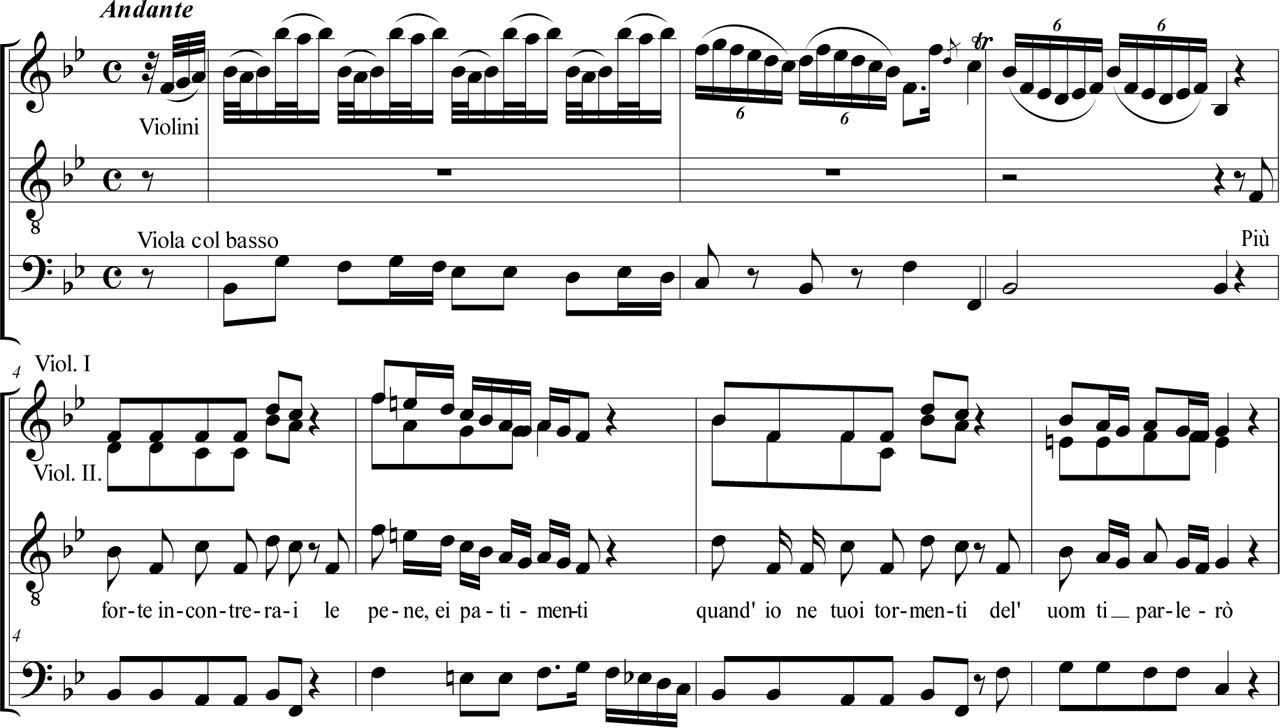
Figure 2
Inserted aria ‘Più forte incontrerai’ in the oratorio Cristo nell’orto (Brno 1731), originally from the opera Alessandro nell’Indie by Leonardo Vinci (Rome 1730)
An interesting case is Porpora’s oratorio Il martirio di S. Giovanni Nepomuceno (Brno 1732). It contains only one inserted aria ‘Come all’Olimpo in cima’ that has not been identified yet. Although the aria is intended for the tenor role of Consigliere, it is written in a soprano clef, apparently in accordance with the original. This fact is pointed out in the note ‘Nota bene Consigliere’ inscribed on the edge of the page. What is more remarkable, however, is the use of two arias from this oratorio in the opera Nitocri performed at Schrattenbach’s court three years later. Identification is possible thanks to slips of paper fixed to the score providing the name of the singer (‘Jon’, i.e. Anton John), the role (‘Manete’), the location of the aria (‘atto terzo’), and an incipit of the lyrics (see Fig. 3).
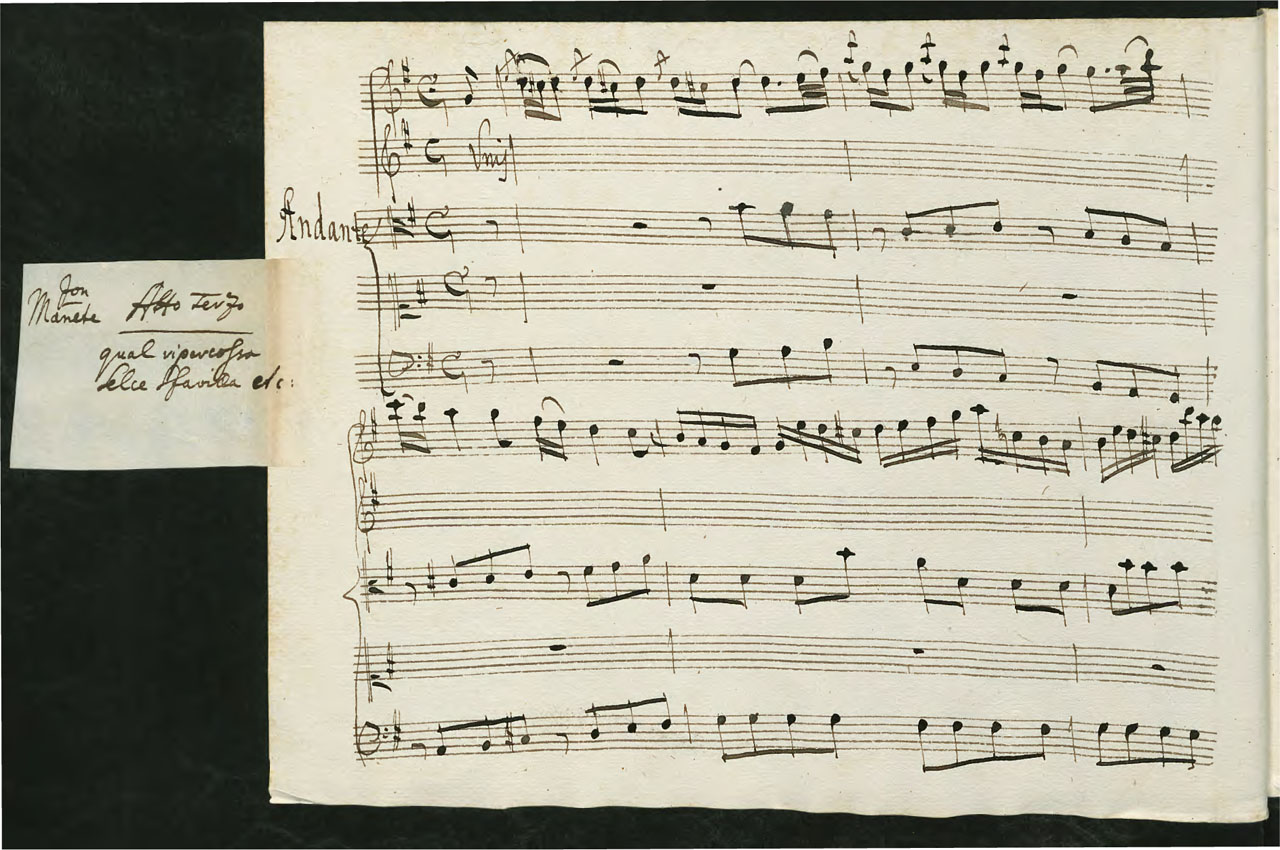
Figure 3
Slip of paper in the score of Porpora’s Il martirio di S. Giovanni Nepomuceno [D-B Mus. Ms.17781, fol. 15v], referring to the use of the aria in the opera Nitocri
This has been the only recorded example of a borrowing of an aria from an oratorio to an opera up to the present time. One should bear in mind, however, that with regard to the music style, Porpora’s S. Giovanni Nepomuceno is extremely modern, with virtuoso arias that were undoubtedly well-suited for use in an opera.
The inserted arias were, of course, adapted for the local production, primarily by reducing the virtuoso vocal passages. The technical limits of Schrattenbach’s court soloists are also reflected in the original layers of scores: the coloraturas are simplified (by rhythm adjustment or omitted notes), some bars and entire arias are transposed due to new tessituras, etc.
What was the manner of adaptation of these inserted arias with regard to lyrics? In all the cases, they are equipped with new texts (corresponding to the given oratorio) which have nothing to do with their original text. This was not very common in pasticcios, where the text was typically left basically as it was, with a few words changed according to the new dramatic situation. The substitution of one text for another is usually referred to as contrafactum, but for eighteenth century opera, the term ‘parody’ is more appropriate.13
The inserting of re-texted opera arias into oratorios was only a step away from using the pre-existing music to compose a complete brand-new piece. Such a piece of music could be termed ‘parodic pasticcio’. This phenomenon is most prominent in a group of otherwise unknown oratorios by famous Italian composers, performed in Brno in the 1730s (see Tab. 4). As Bishop Schrattenbach was a renowned music patron with personal contacts in Italy, some of the pieces could have been composed on his commission. These definitely did not include La santissima annunziazione di Maria sempre Vergine (Brno 1732) and La donna forte (Brno 1737) by Leonardo Vinci, however, as by this time the composer had been dead for several years. All these oratorios were most likely composed as parodic pasticcios out of opera arias by those composers who are named on the printed librettos as the authors of the music.14 Schrattenbach’s court musicians, who were responsible for procuring the new pieces of music every year for the entire six weeks of Lent, apparently combined, under the pressure of the time, a practical point of view with the Bishop’s preference for contemporary Italian opera.
An example is the oratorio Daniello (Brno 1737), which is cited as the work of Francesco Araja. The score of this work has not yet been found, but one of the arias used here certainly comes from the opera Tigrane (first set to music by Johann Adolph Hasse, Naples 1729). A comparison of the two texts shows that the aria was modified only slightly for use in Brno (see Tab. 2).
Table 2
A comparison of an aria used in the oratorio Daniello (Brno 1737) with the original from the opera Tigrane
| Original text in the opera Tigrane | Francesco Araja: Daniello |
|---|---|
| Che gran pena traffigge il mio core l’odio parla e son vinta d’amore fremo irata e pietosa mi struggo quel che fuggo più deggio bramar. | Che gran pena traffigge il suo cuore l’odio il rode ed un fiero rancore, freme irato, e superbo si strugge, sempre fugge che deve bramar. |
| Forma il labro sdegnosi gl’accenti sorge il core e li dice tu menti chi vuoi morto? quel dolce tesoro per cui moro e m’è caro il penar. | Forma il labbro sdegnoso gl’accenti benche il core gli dica tu menti: morto brama quel primo sostegno che nel regno si deve bramar. |
LA VITTIMA D’AMORE AND THE BEGINNINGS OF THE PASTICCIO ORATORIO IN PRAGUE
The fact that this practice of pasticcio oratorios found a very favourable response in Brno can be proved by the oratorio La vittima d’amore, produced in that city in 1741, that is, already after Schrattenbach’s death. According to the libretto, the author of the music was Joseph Umstatt (1711–1762), the Kapellmeister of Count Dietrichstein. The work was considered lost for a long time, but Steffen Voss identified its score several years ago, previously known as Hasse’s La morte di Cristo.15 According to this source, only the smaller part of the piece was composed by Umstatt, since he used arias by other composers, namely by Johann Adolph Hasse, Leonardo Leo, Francesco Feo, Giovanni Battista Pescetti, and Giovanni Porta. Most of the arias were taken over complete with the text, which was only slightly modified. A connection to Schrattenbach’s oratorios can be demonstrated in the aria ‘Schernito, e disprezzato’, which was adopted directly from the local sources, as is evident from the text inscribed in the score of Caldara’s oratorio Morte e sepoltura, which originated in Brno.16
The subsequent fate of this work is very interesting from the perspective of the spreading of the oratorio pasticcio genre to another location – the church of St Francis in Prague, which belonged to the Knights of the Cross with the Red Star. As already mentioned, oratorios were performed there every year on Good Friday. One of the first pieces performed was the Latin pasticcio oratorio Fides, spes, charitas peccatorem ex contemplatione passionis ad poenitentiam invitantes (1725). The printed libretto does not provide the name of the librettist or the composer. The work is listed, however, among the oratorios which were performed at St Francis’ from 1724 until 1759. The list is part of the Crusaders’ inventory from 1737.17 The records include the title, composer, sometimes the librettist or the donor, and are an important source of information in addition to the printed librettos (see Tab. 5).18
Based on the records, the librettist of Fides, spes, charitas was Karel Kořínek, a member of the Order, and the author of the music was one ‘Hönel’. The Czech musicologist Jiří Fukač, who devoted his thesis and several studies to the Crusaders’ inventory, identifies this musician as the Piarist Anselm Hönel, chaplain in Schlackenwerth.19 This view has been accepted by Barbara Renton and others.20 A closer look at the inventory and a comparison with the actual state of the Crusaders’ collection offer another explanation, though. This ‘Hönel’ is in fact none other than George Frideric Handel. The collection contained a copy of his Laudate pueri (HWV 237) and the Latin version of the Utrecht Te Deum (HWV 278). The title pages of the music carry a similar version of his name – ‘Hänel’.21
Apart from Fides, spes, charitas, the Crusaders’ inventory mentions another pasticcio oratorio. It was a German oratorio about Perseus and Andromeda, arranged ‘from music by various authors’.22 The score originally belonged to the St. Vitus’ regens chori Christoph Gayer; following his death (1734), his music collection became the property of the Crusaders. According to a newly found libretto titled Jesus Christus ein Heyland, it is most likely the oratorio performed at Prague’s St Nicholas Church in 1728.23 The lyrics of the piece are identical with the so-called ‘oratorium germanicum’ by Johann Joseph Fux.24
Umstatt’s pasticcio oratorio La vittima d’amore was performed at the Prague Crusaders in 1744. According to the inventory, the acquisition of the score was arranged by Dietrichsteins’ former tenor Karl Beer, thus it was in all probability the music material of the Brno production.25 The Crusaders’ diary for the year 1744 provides us with the information that the reception of the composition by the audience was highly positive.26 The composer himself knew the Prague Crusaders because he had visited their monastery already in 1737, at that time in service to Imre Esterházy, Primate of Hungary.27
PASTICCIO ORATORIOS AT THE PRAGUE CRUSADERS AROUND 1750
It was possibly due to the success of Umstatt’s La vittima d’amore (but perhaps even for practical reasons) that the practice of pasticcio oratorios gained complete prevalence at the Crusaders’ church in the following years. Oratorios were performed in two-year cycles: the first part was played in one year and the second – in the following year, but each part was performed under a different title. Librettos do not state the authors of the music, but their identity may be discerned thanks to the list of performed oratories provided at the end of the Crusaders’ inventory. The arranger of pasticcios was the Crusaders’ regens chori Josef Bleilebel. At the time of research, it was impossible to analyse these works in detail, because the Crusaders’ collection is inaccessible. We can therefore examine them only on the basis of the librettos and records in the inventory.
The first pair of oratorios consisted of La caduta di Pietro (1749) and Gesù Cristo negato da Pietro (1750). The arias in the first part are attributed to Fux, Porpora, and Graun; the second part, performed one year later, also includes the names of Conti and Lotti (see Tab. 5). The basis for the pasticcio was probably provided by Fux’s oratorio with the lyrics of Pietro Pariati’s Gesù Cristo negato da Pietro – a score that was in the possession of the Crusaders.28 Arias by other composers cannot be identified, but it is possible that with Porpora, the music was not a recycled older work but a newly composed piece, as the author lived in Prague at that time.29 In any case, it is very interesting to observe the representation of different generations of authors, as there was music in very different styles performed within one event (similarly to Schrattenbach’s performances in Brno).
The next pair of compositions was La deposizione dalla croce (1751) – La sepoltura di Gesù Cristo Salvatore nostro (1752). The second libretto is already clearly marked as ‘Parte Seconda’, which confirms that it was a follow-up to the performance from the previous year. Based on the name of the librettist and an analysis of the text, it is possible to identify the work as La deposizione dalla croce by Giovanni Claudio Pasquini; however, it is the first version from 1728 created for Johann Joseph Fux, not the second one from 1744. The score of Fux’s oratorio was, nonetheless, not part of the Crusaders’ collection. With regard to the music, the inventory only states that the oratorio was ‘arranged very well from works by different authors’, but it does not provide any names of the authors included.30
The last example from this group of pasticcio oratorios is Il martirio per l’osservanza della divina legge sofferto da’ primi quattro fratelli Macabei (1757) – La madre de Macabei (1758). The name echoes Fux’s oratorio La donna forte nella madre de’ sette Maccabei with lyrics by Pietro Pariati (Vienna 1715), whose score was part of the Crusaders’ collection.31 An attractive hypothesis regarding the use of this piece as the basis for the new oratorio (as with the performances in 1749 and 1750) has to be disproved, however, since based on the libretto (from which only the first part has been preserved) the lyrics have been identified as L’osservanza della divina legge nel martirio de’ Macabei written by Antonio Maria Lucchini for Francesco Bartolomeo Conti in 1732.
The music for the first part was selected from among compositions by Hasse, Jomelli and Galuppi. Once again, the arrangement of arias was done by Josef Bleilebel and the music for the recitatives was composed by a local musician, Zachow. The process of creation of the second part was somewhat complicated; according to a record in the inventory, the music was adapted from a German Passion oratorio by Graun, which had been brought from Berlin by Václav Schödl, who had studied with the Crusaders.32 The work has not been identified more precisely so far. Although the music for Metastasio’s Italian libretto La passione di Gesù Cristo was composed by Johann Gottlieb Graun, a note concerning the German language points rather to the famous Der Tod Jesu by his brother Carl Heirich Graun. In addition, several parts of this work have been preserved by the Crusaders as contrafacta.33 The Sinfonia was composed by Hasse, recitatives and the final choir were composed by Zachow, and the lyrics of the arias were translated and adapted by Bleilebel.
The preserved librettos of these ‘compiled’ oratories do not suggest in any way that these works might be pasticcios. The lyrics correspond verbatim to original versions of the respective librettos, which indicates careful arrangement work that avoided adjustments of lyrics to new music. At the same time, it prevents even hypothetical attribution of the original arias, which would allow us to identify the individual pieces of music by the various authors represented in the compilation.
CONCLUSIONS
What could be the reasons for inserting operatic arias into oratorios or writing brand new pieces in the style of parodic pasticcios? One fact is that in the Czech Lands, there was an enormous concentration of places where opera was cultivated, considering the size of the country. Apart from Prague, Brno, and Breslau (now Wrocław) with their Italian companies, it was the châteaux in Jaroměřice, Kroměříž, Vyškov and Holešov that, particularly in the 1730s, enjoyed a lively music life with their own independent ensembles and court composers.34 The beginnings of the Italian oratorios at the Knights of the Cross in Prague overlap with the launch of the first Italian opera company in 1724.35 Copies of opera arias were easily available thanks to the travelling Italian singers or agents employed by many of the nobility directly in Italy.36
The question is whether the practice of the pasticcio oratorio was not actually triggered by social demand instead of practical reasons. Oratorios are considered the spiritual counterpart of the opera, performed during Lent, when theatres were closed. Unlike the opera, they had the advantage of being less demanding to present (no need for stage and costumes or singing by heart) and had a more stable institutional background. Under the guise of spiritual drama (and with a perfect understanding of the story), the audience could enjoy its favourite modern opera music. Similar reasons probably lie behind the mass expansion of Latin contrafacta of opera arias used in the church as part of the liturgy.37
The last problem is the question of genre purity or confusing the oratorio with opera. Could there possibly be a greater gap than is between Fux’s traditionalist musical language on the one hand and the modern, high Neapolitan aria, full of coloraturas and petty gallant ornamentation on the other? And yet they were performed within a single piece of music.
Pasticcio is defined as a medley, a patchwork of heterogeneous parts. In ‘Czech-made’ pasticciooratorios, the combination of various musical styles is also complemented with blending of purpose, since the primary function of an oratorio is no longer the praise of God or spiritual uplifting; instead, it is becoming a form of entertainment, in the same way as contemporary opera.
REFERENCES TO THE SCORES AND LIBRETTOS IN TABLE 3 AND 4.
Table 3
Oratorios from Brno with inserted opera arias
| PLACE YEAR | TITLE | MUSIC | SOURCE |
|---|---|---|---|
| Brno 1725 | Il rè del dolore in Giesu Cristo Signor nostro coronato di spine | A. Caldara | Libretto: CZ-R Z.f.18/adl.6a |
| Brno 1725 | Il sacrificio di Gefte | G. Porsile | Libretto: CZ-R Z.f.18/adl.5ab |
| Brno 1730 | Morte, e sepoltura di Christo | A. Caldara, N. Porpora | Score: D-B Mus. Ms. 2720 |
| Brno 1730 | Il trionfo della croce | G. C. Predieri, ? | Score: D-B Mus. Ms.17900 |
| Brno 1731 | Cristo nell’orto | J. J. Fux, L. Vinci, G. Giacomelli | Score: A-Sm RaraHs Fux 2 |
| Brno 1732 | Il martirio di S. Giovanni Nepomuceno | N. Porpora, ? | Score: D-B Mus. Ms.17781 |
Table 4
Pasticcio oratorios in the Czech Lands
| PLACE YEAR | TITLE | MUSIC | SOURCE |
|---|---|---|---|
| Prague 1725 | Fides, spes, charitas peccatorem ex contemplatione passionis ad poenitentiam invitantes | G. F. Handel | Libretto: CZ-Pu 55.G.71/adl.2, CZ-Pnm B 4033; Crusaders’ inventory, f. 55v |
| Brno 1726 | Il peccato di Adamo | G. Bononcini (and others | Fragment of the parts: CZ-Bm A 20.648, A 20.763 |
| Brno 1732 | La santissima annunziazione di Maria sempre Vergine | L. Vinci | Libretto: CZ-OLu 35.477 |
| Brno 1732 | Il trionfo della virtù in S. Nicolò di Bari | L. Leo | Libretto: CZ-OLu 35.476 |
| Brno 1736 | Il candor vendicato di Nostra Signora | G. Porta | Libretto: CZ-HR Y.309 |
| Brno 1737 | San Vicenzo Fererio | G. Bonno | Libretto: CZ-Pnm B 4154 |
| Brno 1737 | La donna forte | L. Vinci | Libretto: CZ-Pnm B 4155 |
| Brno 1737 | Daniello | F. Araja | Libretto: CZ-Pnm B 4141 |
| Brno 1738 | David umiliato | F. Araia | Libretto: CZ-Bk 3486/adl.23 |
| Brno 1738 | La divina pietà trionfante nell’imaculata concezione di Maria Vergine | N. Porpora | Libretto: CZ-OLu II-44.146 |
| Brno 1741, Prague 1744 | La vittima d’amore | J. Umstatt, J. A. Hasse, L. Leo, F. Feo, G. B. Pescetti G. Porta, A. Caldara | Libretto Brno: CZ-Bm B 325/adl.5 Libretto Prague: CZ-Pu 34.C.319/adl.17; CZ-OLu 33.498 Score: see S. Voss, Das Johann Adolf Hasse zugeschriebene Passions-Oratorium, Crusaders’ inventory, f. 56v |
| Prague 1749 | Caduta di Pietro | J. J. Fux, N. Porpora, Graun | Crusaders’ inventory, f. 56v |
| Prague 1750 | Giesu Cristo negato da Pietro | J. J. Fux, Conti, Graun, N. Porpora, A. Lotti | Libretto: CZ-Pnm B 4036; Crusaders’ inventory, f. 56v |
| Prague 1751 | La deposizione dalla Croce | ‘collectum ex diversis authoribus’ | Libretto: CZ-Bu CH-0000.471; Crusaders’ inventory, f. 56v |
| Prague 1752 | La sepoltura di Gesu Cristo Salvatore nostro | ‘collectum’ | Libretto: CZ-Pnm B 4037; Crusaders’ inventory, f. 56v |
| Prague 1757 | Il martirio per l’osservanza della Divina legge sofferto da’primi quattro fratelli Macabei | J. A. Hasse, N. Jomelli, B. Galuppi, Zachow, J. Bleilebel | Libretto: CZ-Pu 52 C 8/adl. 8; Crusaders’ inventory, f. 57r |
| Prague 1758 | La madre de Macabei | Graun, J. A. Hasse, Zachow, J. Bleilebel | Crusaders’ inventory, f. 57r |
Table 5
Selected records of pasticcio oratorios in the Crusaders’ inventory (Prague 1737)
| 1725 f. 55v | Oratorium latinum Fides, Spes, Charitas peccatorem ex Contemplatione Passionis ad paenitentiam invitantes Textus R P: Caroli Korzinek Aria Dni Hönel productum Annô 1725 |
| 1744 f. 56v | Oratorium cum libellis La Vittima d’amore emptum 7 f: 30 x a D. Tenorista quondam Beer Authore Vmstadt apud Principem Dittrichstein in Moravia Capelae Magistro |
| 1749 f. 56v | Oratorium collectum ex diversis Authoribus Fux, Porpora, Graun coram operistis et Nobilitate plena bene productum a Joseph Bleileb cum libellis Caduta di Pietro prima pars |
| 1750 f. 56v | Oratorium collectum secunda pars libelli Giesu negato ex diversis Authoribus Fux, Contini, Graun, Porpora, Lotti cum applausu productum a Bleileb |
| 1751 f. 56v | Oratorium vel compamento collectum ex diversis Authoribus titulatur la Deposizione dalla Croce prima pars coram magna Nobilitate productum à Bleileb |
| 1752 f. 56v | Oratorium vel compamento secunda pars collectum cum applausu productum titulatur La sepoltura à Bleileb |
| 1757 f. 57r | Oratorium seu prima pars titulatur Il Martirio sofferto da’ primi fratelli Macabei ex diversis Authoribus Hasse, Jomelli, Galuppi, collectum attente productum. Recitativo à D. Zachkow: Ariae à Bleileb |
| 1758 f. 57r | Oratorium vel secunda pars titulatur La madre de’ Macabei Ariae ex Oratorio germanico de passione Authore Graun à D. Wenceslao Schödl Berlin: symphonia Hasse. Recitat: et Chorus à D. Zachow. Cum laude et copiosa Nobilitate sine invitatione productum. Textus transversus à Bleileb. |
Jana Spáčilová is an Associate Professor at the Department of Musicology, Faculty of Arts, Palacký University Olomouc (Olmütz), the Czech Republic. She graduated in musicology from the Charles University, Prague (2001). She subsequently received her PhD degree from the Masaryk University, Brno (2007). She participated in research projects concerning Baroque opera in the Czech Lands at the Masaryk University. Between 2007 and 2014, she worked as curator for early music in the Department of Music History, Moravian Museum, Brno. Since 2014, she has worked at the Department of Musicology, Palacký University Olomouc. She specialises in Baroque music in Central Europe, predominantly Italian opera and oratorio.