
Is it well-known that after his first appearance in 1720, Farinelli made a brilliant career1 and became the emblem of a castrato singer for centuries to come. First in Italy and then in other countries, he conquered the public with displays of his spectacular vocal skills. He made his debut in Naples in the sacred (Cappella musicale del Tesoro di San Gennaro) and secular spheres (serenatas, operas) and was engaged in the not very distant Rome for female roles in operas from 1722. In Venice, he appeared relatively late, at the very end of 1728 (on 26 December), in the most prestigious theatre of the city, the Teatro San Giovanni Grisostomo. He appeared in the city on the lagoon only after having performed in minor operatic centres such as Parma (1726, spring 1728), Milan (1726), Bologna (1727), Florence (summer 1728), and Munich (October 1728) 2.
In Venice, expectations of the audience and owners of the San Giovanni Grisostomo theatre, the Grimani brothers, ran very high. As Abbate Antonio Conti informs, Farinelli's contract earned him a huge sum of money. It is logical to assume that pressure on the Grimanis was enormous, and the operas featuring Farinelli had to bring financial success. This was by no means a simple task since the competition in the opera market was fierce in the 1728/29 season. The main competitor was the Teatro San Cassiano, where stars such as Faustina Bordoni and Senesino performed in Geminiano Giacomelli's Gianguir and Giuseppe Maria Orlandini's Adelaide3. Farinelli's arrival in Venice aroused such intense curiosity in the Venetians that a kind of mass stalking took place after his arrival when, reportedly, 300 persons followed him in St Mark's square. Naturally, the public had heard wonderful tales of Farinelli's singing, so it was keen to see and hear him in person; for the first time, in church during the traditional mass at Christmas Eve (where the most prestigious theatre singers sang before the opera performances of the carnival season began)4, as Conti wrote:
La plus grande nouvelle de ce pays qui ne connoît que l’oisiveté est l’arrivée de Farinelli. 300 personnes le suivoient l’autre jour dans la place de St Marc. Imaginez-vous quel sera le concours la nuit de Noël dans cette Eglise, où il doit chanter avec Senesino. Les connoisseurs prétendent qu’on n’a jamais entendu une voix pareille depuis qu’on chante sur le théâtre. Il touche toutes le cordes quelquefois dans le même air avec une agilité surprenante, et la voix qu’on appelle di petto est aussi forte en lui et aussi variée que celle di testa est sçavante et harmonieuse5.
Later they looked forward to his stage performances.
In the end, the operas seem to have proved financially successful. Paolo Rolli comments in a letter to Senesino (London, 4 February 1729):
Il Farinello è di primo Predicamento; e tanto più quanto da poco fa, sono venute Lett[er]e di Venezia, e particolarmente a questo Residente Vignola: che il teatro dove il Farinello recita à tutto il Concorso, e quello dove voi [Senesino] e la Faust[in]a siete è quasi vuoto6.
This success is confirmed also by the fact that a second libretto edition of both operas featuring Farinelli was issued: Catone in Utica by Pietro Metastasio (with music by Leonardo Leo) as well as Semiramide riconosciuta by the same poet (mus. Nicola Porpora) have been preserved in two text versions published subsequently and marked as new editions7. Moreover, a pasticcio, L’abbandono di Armida, presented at the end of the carnival, incorporated the best arias of the season.
Below I will analyse the musical strategies adopted in these two operas, reflecting the Grimani brothers’ pressure for financial success as well as Farinelli's self-fashioning in the context of the high expectations of an audience of connoisseurs, which Venice, with its long operatic tradition and the high number of simultaneous opera performances in several concurrent opera houses, must have possessed (this concerns the city's residents, but also partly the ‘tourists’ flocking to the city more or less regularly in the operatic seasons). I hope my analysis will reveal the principles of balancing commercial, personal and musical requirements in the process of creating an opera.
LEONARDO LEO’S CATONE IN UTICA
Leo's Catone in Utica underwent a very unusual procedure at its premiere. At a premiere, it was uncommon to alter an opera; Catone in Utica was not staged in its original form, but some arias were substituted. The reason was not merely time pressure. In fact, Farinelli had come to Venice at the beginning of December at the latest and had more than three weeks for rehearsals8. I believe that this procedure was adopted because the opera had to be a commercial success, at any cost. Thus, Leo's original music was cut (or moved) in favour of music by other composers.
What strategies can be detected? First of all, most aria substitutions concern the part sung by Farinelli, so we can assume that he did not feel comfortable with Leo's music, which did not allow him to present his vocal abilities as he wished. Although Leo knew Farinelli's voice well since he had composed specially for him the roles of Decio in Zenobia in Palmira (Naples 1725)9 and of Rodrigo in Il Cid (Rome 1727), the selection of music was altered by the singer himself. Other singers may have followed his example and substituted arias as well. In comparison with Metastasio's original libretto written for Rome 1728, the following arias were exchanged (they are marked in the libretto with an asterisk indicating that they are not by the same text/music author10 or they are printed as an appendix):
| Act, Scene | Role | Singer | Rome 1728 | Venice 1728 | Taken from |
|---|---|---|---|---|---|
| I,3 | Arbace | Farinelli | Che legge spietata | * Mi lusinga il dolce affetto | R. Broschi, L’isola d’Alcina, Rome 1728 |
| I,5 | Catone | Nicola Grimaldi | Si sgomenti alle sue pene | * Pensa di chi sei figlia | ? |
| I,13 | Arbace | Farinelli | È in ogni core | Che legge spietata | Moved from I,3 |
| II,2 | Catone | Grimaldi | Va’, ritorna al tuo tiranno | * Mi conosci? Sai chi sono? | ? |
| II,6 | Marzia | Lucia Facchinelli | In che ti offende | * Di tenero affetto | G.M. Orlandini? (beginning identical with his trio sonata No. 5 in B-Bc, 14077) |
| II,7 | Fulvio | Giuseppe Maria Boschi | Per te spero e per te solo (Emilia) | * Il tuo affanno ed il tuo sdegno | G.F. Handel, Radamisto, London 1721 |
| II,8 | Emilia | Antonia Negri | Nascesti alle pene (Fulvio) | * Ombra cara, ombra adorata | ? |
| II,16 | Arbace | Farinelli | Che sia la gelosia | Che sia la gelosia | |
| Cerva in bosco se l’impiaga (printed as appendix) | L. Vinci, Medo, Parma 1728 | ||||
| Scherzo dell’onda instabile (printed as appendix in 2nd ed.)11 | L. Vinci, Medo, Parma 1728 | ||||
| III,3 | Arbace | Farinelli | Combattuta da tante vicende | * Sarebbe un bel diletto | ? |
| III,4 | Cesare | Domenico Gizzi | Quell’amor che poco accende | * Al vento che la scuote | ? |
| III,10 | Emilia | Negri | Nacqui agli affanni in seno | * Chi mai saper desia | ? |
| Nacqui agli affanni in seno12 |
11 In a transcription for mandolin the aria is found with a much altered text: “Nave nell’onda instabile” (I-Vnm, Mss.It.Cl.IV.472 (= 10350) “Arie per Mandolino / dell’Opera 2.a / In S. Gio: Grisost:o 1729. / Venet.a”, cf. “Appendix: Sources”).
The table shows that nine out of 26, that is, one third of Metastasio's original aria texts were removed. Moreover, although Metastasio was involved in the production himself (he rewrote the end of the opera13) also the recitative texts were cut and altered, and the scene structure was changed. Since Domenico Lalli signed the dedication of the libretto, these alterations may have been his work. With respect to the arias, the substitution achieved specific aims. The procedure ensured in some cases a different profiling of the dramatis personae. Catone (Nicola Grimaldi), for example, was shown in the new aria texts as a more powerful and obstinate character, a trait also reflected in the new music and possibly in the singer's personality. Emilia's (Antonia Negri) role as a mourning widow, an element brought out by Metastasio in her first aria “O nel sen di qualche stella” (I,8), but not further developed, was underscored by a newly written scene (II,8, including the aria “Ombra cara, ombra adorata”). Only in one instance is a suitcase aria (aria di baule) found in the new score, certainly reflecting a previous success: Giuseppe Maria Boschi (Fulvio) inserted an aria he had sung earlier in London in George Frideric Handel's Radamisto (1721). For the Venetian performance it was rewritten, though14.
It is, however, not clear at which stage these substitutions and changes were made. If they were carried out before the text was set by Leo, then the music of the non-identified pieces may also have been composed by Leo. He may even have composed them later, during rehearsals, to meet the requirements of the singers or of other agents involved in the production15. That Leo seems to have played a role in staging the opera, in one way or another, is suggested by the following fact: In several sources, a second setting of “Confusa, smarrita”, Marzia's (Lucia Facchinelli) aria from Act III, Scene 2, has been preserved, which may either have been replaced in the final version in the score or may have replaced the earlier one during performances16 (Music Examples 1 and 2).
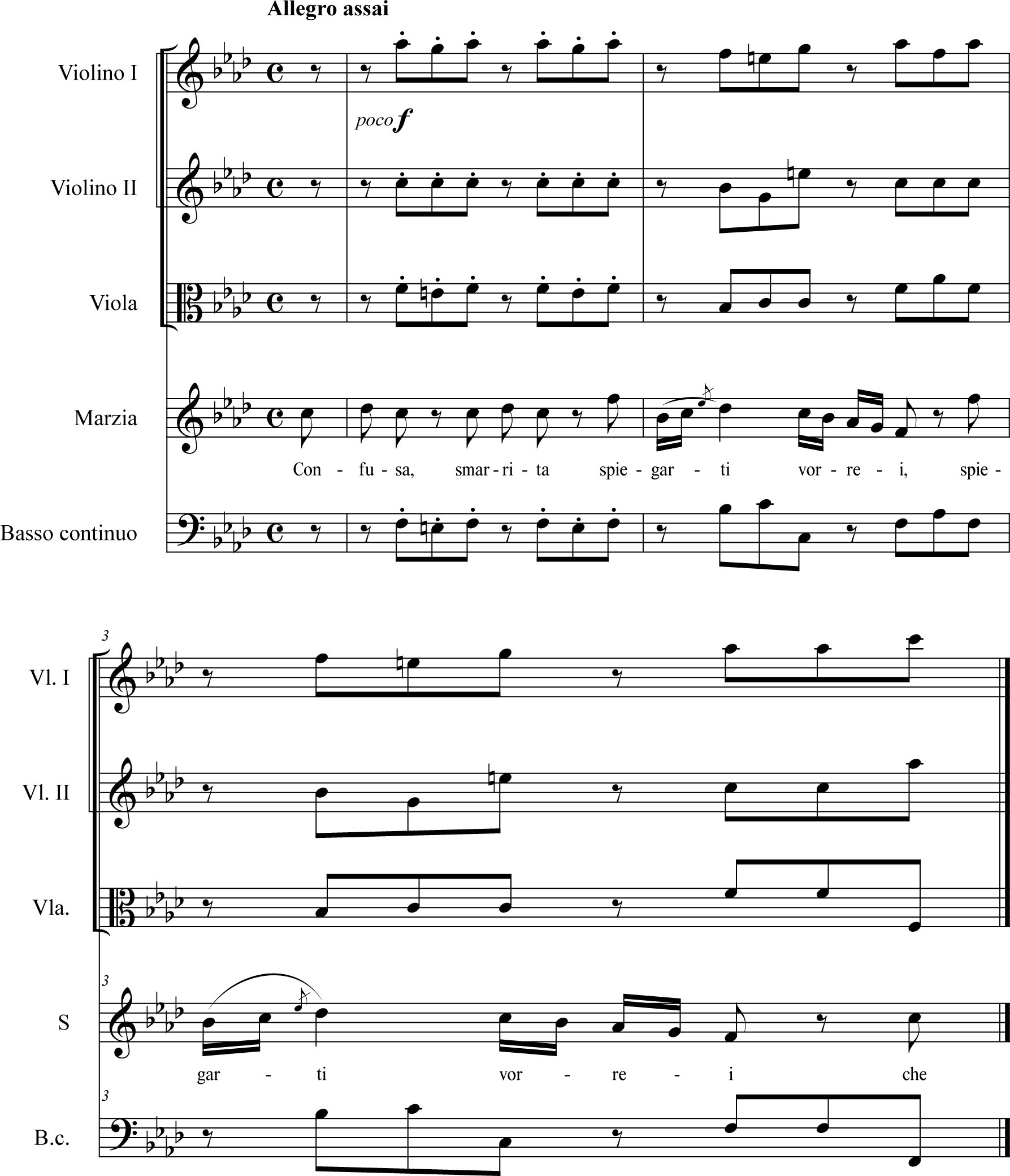
Music Example 1
“Confusa, smarrita”, version of the score, GB-Lam, MS 75, fol. 166r (own transcription)
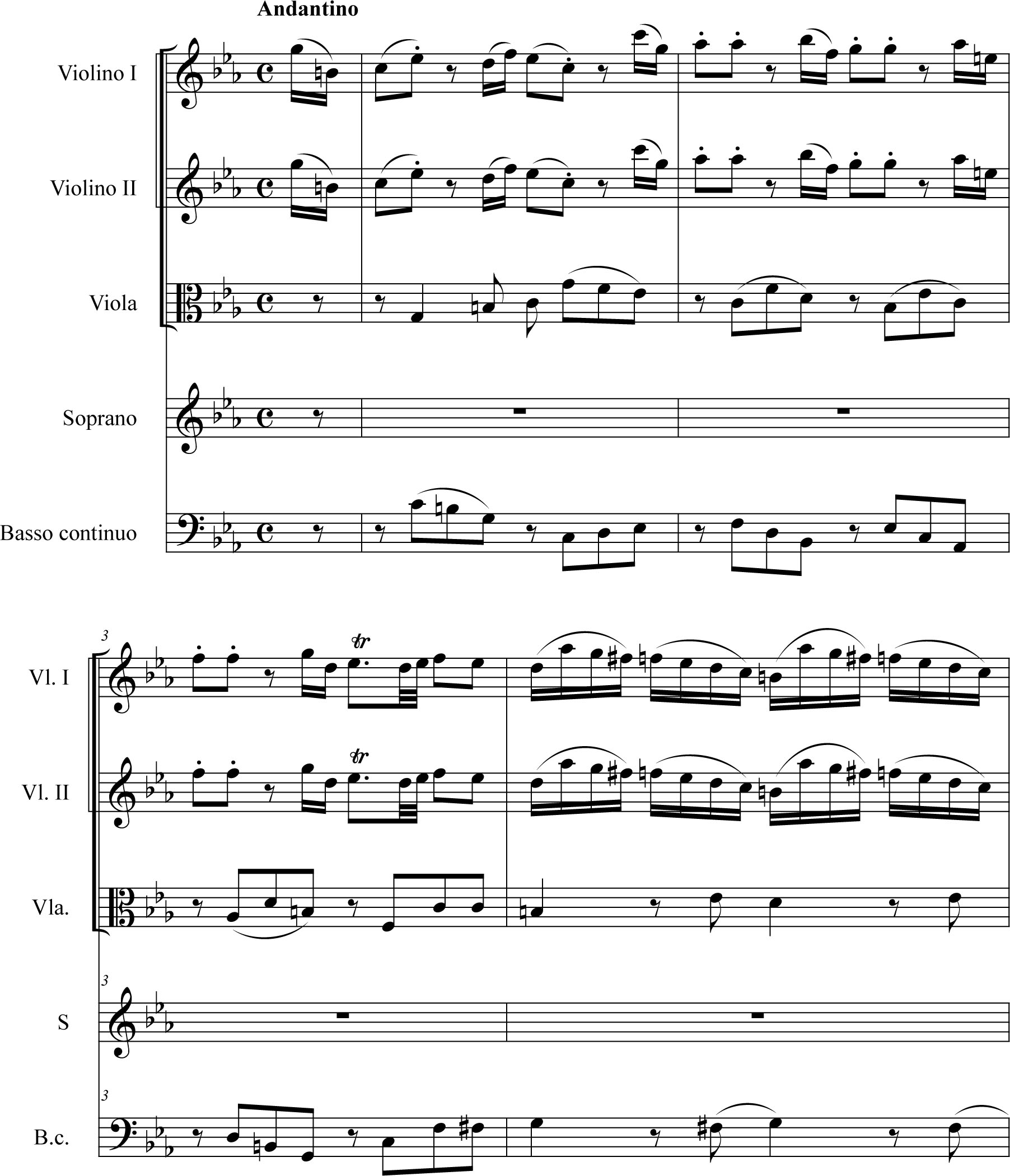
Music Example 2
“Confusa, smarrita”, single aria, I-Nc, Cantate 175, fol. 106r (own transcription)
This could imply that Leo was present when the opera was rehearsed and performed or at least involved in the adaptation of the music for the singers. Still, given the relatively high amount of music by other composers – three out of the nine substituted pieces are definitely by other composers, plus two pieces inserted during the performance – Leo's presence and authorship, already questioned by Rosy Candiani in her Metastasio biography17, seems improbable. It seems more likely that the majority, if not all of the music of the substitute arias was written by other composers.
If we have a look at Farinelli's arias, we will be able to reconstruct his strategy of presenting himself to the Venetian public, which was meant to excite and, at the same time, to satisfy expectations. We are lucky to have both the Leo version and the version actually sung by Farinelli of his very first aria in Act I, Scene 3, which was, so to speak, his business card by which he introduced himself to the curious audience. The aria actually performed, “Mi lusinga il il cor d’affetto”, was taken from L’isola d’Alcina by his brother Riccardo Broschi, staged in Rome for the carnival of 1728 at the Capranica theatre with Farinelli as Ruggiero. Although it is marked “di Vinci” in the Catone score at the Royal Academy of Music in London, there is a concordant source bearing Broschi's name kept at the Casanatense library in Rome18. While the original aria, Leo's “Che legge spietata” (moved to I,13), poses no major vocal challenge, Farinelli's choice of his brother's aria reveals his wish to lay his entire vocal mastery at the feet of the Venetian audience.
Leo's aria (Music Example 3) is a fast one marked Allegro that contains syncopated rhythms as well as some chromaticisms, but none of the special characteristics for which Farinelli was renowned, such as messa di voce, fast coloraturas, and quick register changes19.
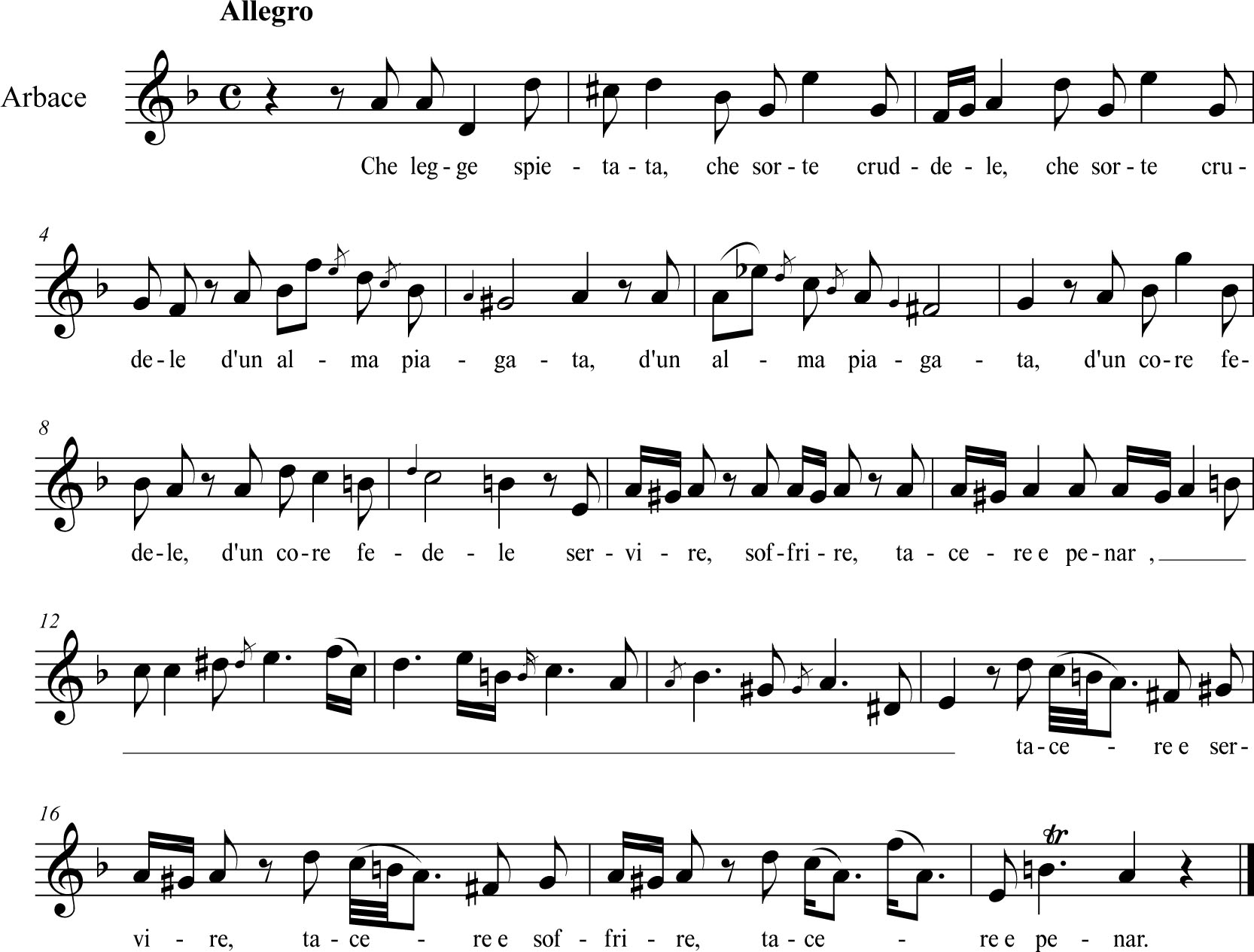
Music Example 3
Leonardo Leo, “Che legge spietata”, A1 section, GB-Lam, MS 75, fols. 67r–67v (own transcription)
In contrast, Broschi's aria in a slow tempo (score in GB-Lam: no tempo markings, the single aria in I-Rc: Largo, Music Example 4) is packed full of various vocal complexities: sophisticated short motifs (“Lombard” rhythms et al.), note repetitions, fast coloraturas, chromaticisms, messa di voce, instrumental motifs (the fast motifs at the end of the example, played immediately before by the violins), leaps (“canto di sbalzo”), the enormous tessitura of two octaves (B♭ to B♭”). These complexities are embedded in a sonorous, unobtrusive four-part scoring, which makes the free flow of the vocal line possible. Leo's aria, on the contrary, in many passages only has three actual parts, which in many instances are independent from the vocal line. Thus, the soloist cannot sing freely at all, but is forced to observe the metre and, with regards to ornamentation, harmonies and the melodic structures of the accompanying instrumental parts. At the same time, Farinelli shifts the focus to another character type. “Che legge spietata” is an aria di sdegno condemning love's laws, whereas “Mi lusinga il dolce affetto” speaks of the pleasures and fears of love. In choosing to sing his brother's aria Farinelli opted for an initial self-fashioning as a sensitive hero, a character type he impersonated rather frequently20, combined with a much freer style of singing and the display of his entire vocal capabilities, which very likely astonished the audience.
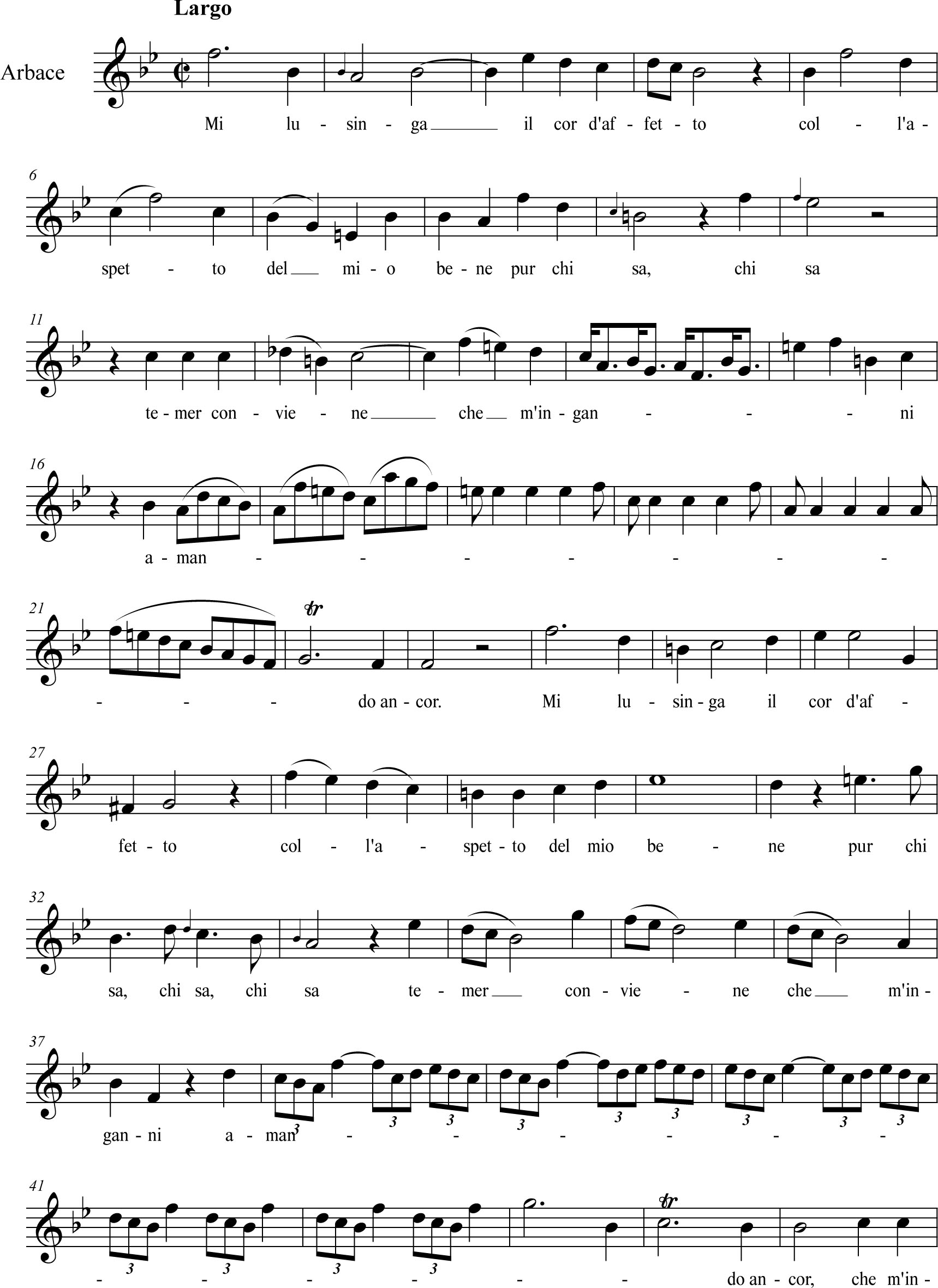
Music Example 4
Riccardo Broschi, “Mi lusinga il cor d’affetto”, A section, GB-Lam, fols. 27r–29v (own transcription)
Having laid down all his vocal art, and thus, metaphorically, having shot his bow, it is interesting to see how Farinelli proceeded in Catone in Utica. His next aria is the already mentioned “Che legge spietata” in Act I, Scene 13 (transferred from Scene 3), which, as has been said, is a not vocally a very demanding act, but a very effective one from the musical-dramatic point of view. It fits well into the situation. Its powerful melody and sometimes surprising harmonic progressions may have been the reason why this aria was postponed rather than deleted.
The first aria in Act II is Leo's “So che pietà non hai” (Scene 3). It is marked Larghetto, e Cantabile and shifts to a tender musical idiom with plenty of appoggiaturas, chromaticisms, and tiny motifs (Music Example 5). It also features ascending trills. In its melodic shape and restrained accompaniment, it is very similar to “Mi lusinga il dolce affetto”.
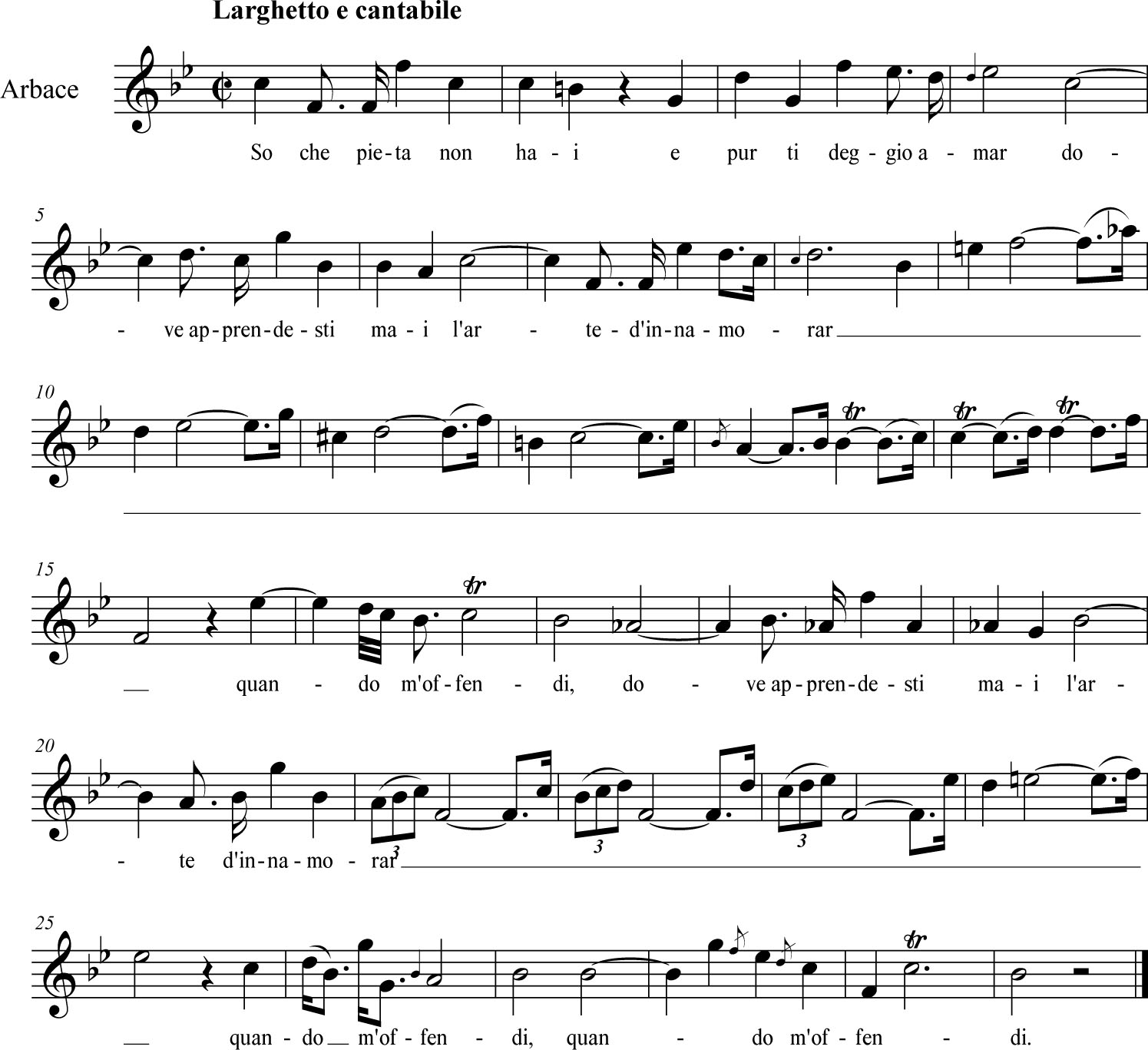
Music Example 5
Leonardo Leo, “So che pietà non hai”, A2 section, GB-Lam, MS 75, fols. 95v–96v (own transcription)
At the end of the act (II,16) the original aria “Che sia la gelosia” (now lost) was replaced by two virtuosic arias that Farinelli had sung earlier in Parma in May of the same year21. Both are taken from Leonardo Vinci's Medo and both are simile arias. Farinelli first sang “Cerva in bosco se l’impiaga”, followed by “Scherzo dell’onda instabile”. Both feature coloraturas, arpeggios, trill chains, leaps, top notes, and register changes in a fast tempo22. From the textual point of view “Che sia la gelosia” does not strictly fit into the simile aria category, because it speaks of the pains of jealousy, which is compared to ice in a fire only in a brief phrase. Its substitution with ‘real’ simile arias shows that Farinelli wanted to end Act II with highly effective musical pieces which, furthermore, represented a more popular aria type23.
The next aria and his last one in the opera is found in Act III, Scene 3. “Sarebbe un bel diletto” is by an unknown composer and in a fast tempo (Allegro, e staccato, Music Example 6). It oscillates at some instances between the major and minor modes, enabling the singer to adapt his voice to the meaning of the text and the mood of the music, an art in which, according to Giovenale Sacchi, Farinelli's first biographer, he excelled24. Moreover, it again features wide leaps and chromaticism.
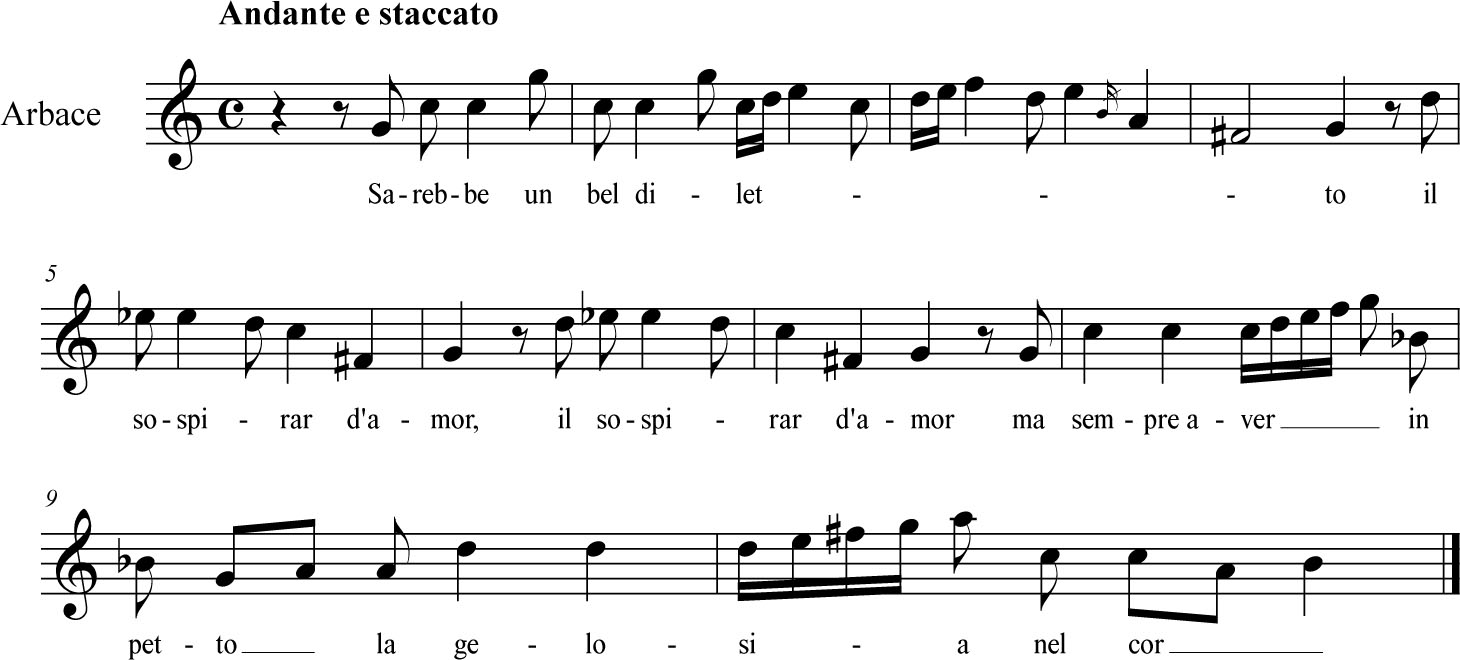
Music Example 6
Leonardo Leo, “Sarebbe un bel diletto”, beginning of A1 section, GB-Lam, MS 75, fols. 173v–174r (own transcription)
Summing up, in Catone in Utica Farinelli demonstrated all his vocal powers in his very first aria and then emphasises several elements in the following arias, in particular – wide leaps and chromaticisms. In these arias, Farinelli embraces a variety of moods: “Mi lusinga il dolce affetto” shows Farinelli as a sensitive hero; “Che legge spietata” is an aria di sdegno; “So che pietà non hai” adopts a tender musical idiom, pointing to the sensitive hero again, “Sarebbe un bel diletto” is a lively aria with some “shades” in the minor mode. The only virtuosic bravura aria is found at the end of Act II, the substitute aria “Cerva in bosco se l’impiaga”, which during the performances was replaced by, or alternated with, “Scherzo dell’onda instabile”.
NICOLA PORPORA’S SEMIRAMIDE RICONOSCIUTA
A different strategy, however, is adopted in Porpora's Semiramide riconosciuta, where Farinelli concentrated on other musical features. Here the focus is on brief, very fast and sometimes rhythmically complex motifs, which in some instances make the impression of being notated improvisations. The first aria, “Bel piacer saria d’un core” (I,7) presents Farinelli (Mirteo) once again as a sensitive hero, and depends on these highly complicated motifs (Music Example 7).
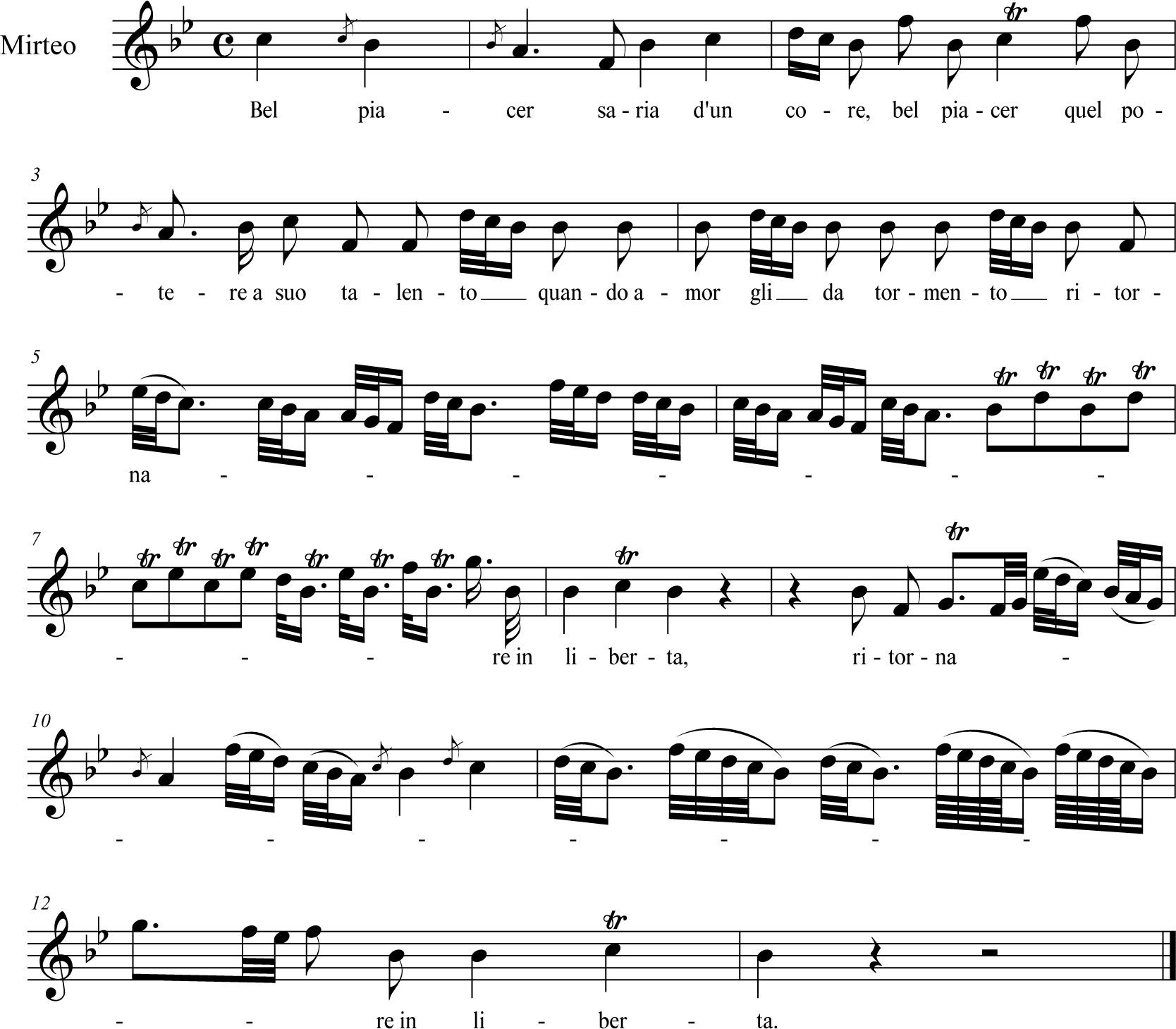
Music Example 7
Nicola Porpora, “Bel piacer saria d’un core”, A2 section, GB-Lam, MS 81, no foliation (own transcription)
“Rondinella a cui rapita” (I,15), ending the first act, is a simile aria representing the lament of the dove after the death of her beloved as an emblem of Mirteo's state of mind. Its tempo is not very fast (Con spirito), and enables the singer to present some brief motifs (Music Example 8).
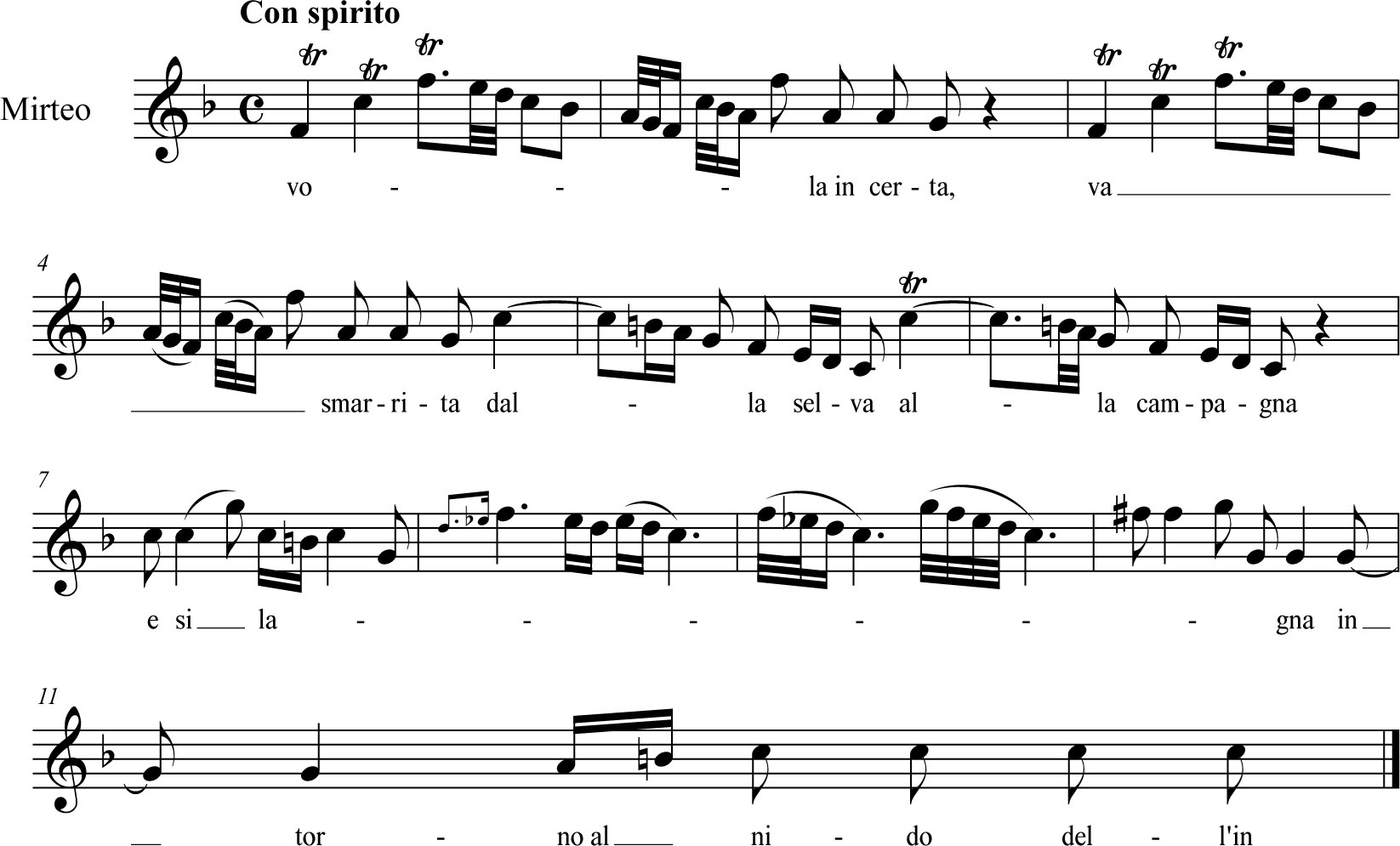
Music Example 8
Nicola Porpora, “Rondinella a cui rapita”, part of A1 section, GB-Lam, MS 81, no foliation (own transcription)
“Sì pietoso il tuo labro ragiona” (II,5) is another aria in an unhurried tempo (A tempo giusto, Music Example 9). The short, very fast motifs are found at the end of the stanzas in the A section (triplets and demisemiquavers), but also in the B section. The aria shows Mirteo once again as a sad lover who fears that Semiramide's offer to help him win Tamiri's love is insincere.
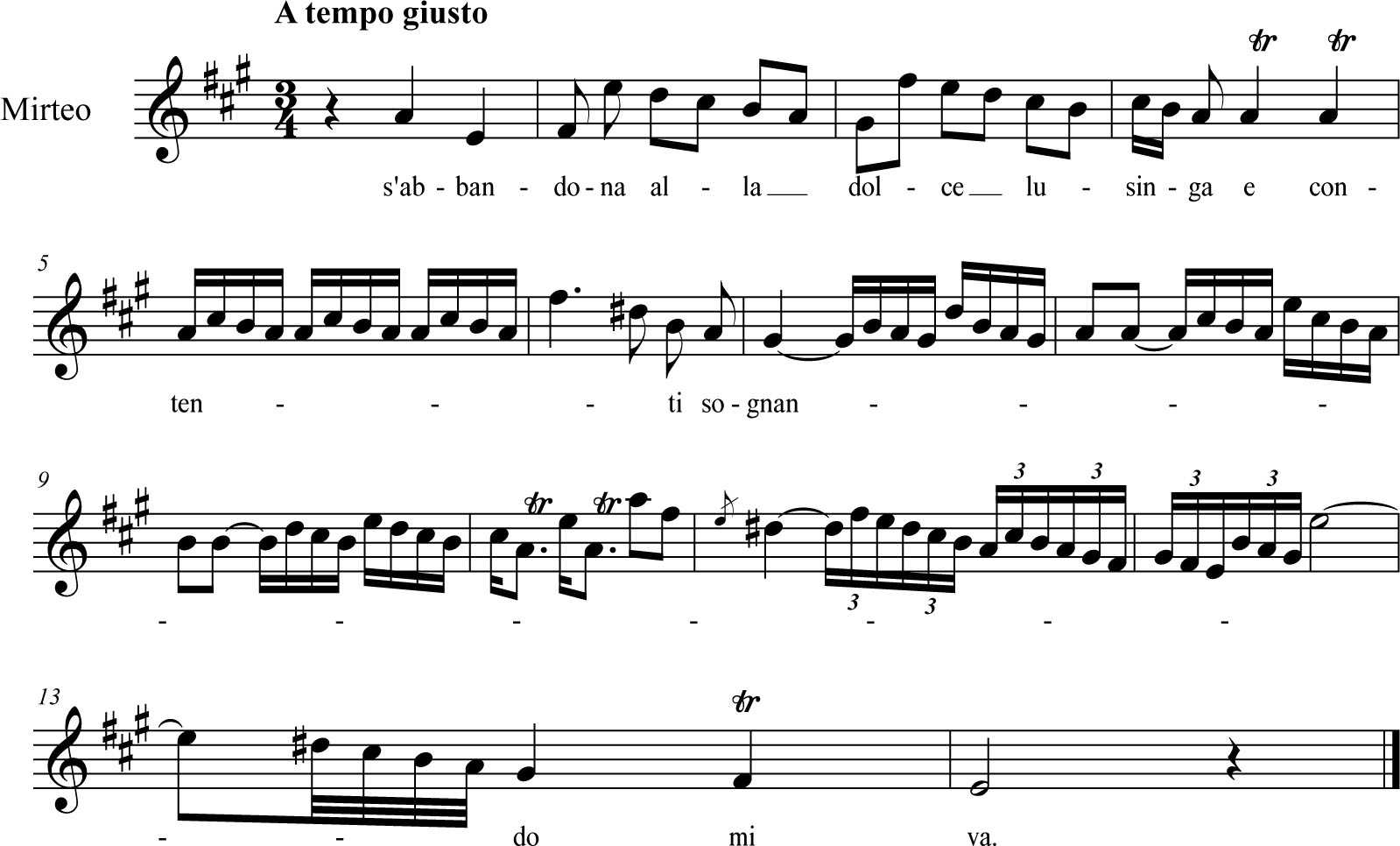
Music Example 9
Nicola Porpora, “Sì pietoso il tuo labro ragiona”, part of A1 section, GB-Lam, MS 81, no foliation (own transcription)
The next aria, “Siete barbare, amate stelle” (II,9, Music Example 10), is another text that presents Mirteo as a languishing lover whose attitude is criticised severely by Tamiri in the preceding recitative (“Mirteo cangia favella o cangia affetto./ Io tolerar non posso/un languido amator che mi tormenti/con assidui lamenti,/ che mai lieto non sia, che sempre innanzi/ mesto mi venga e che tacendo ancora/ con la fronte turbata/ mi rimproveri ognor ch’io sono ingrata.”). The aria bears no tempo marking, but is certainly meant to be sung in a slow Andante tempo.
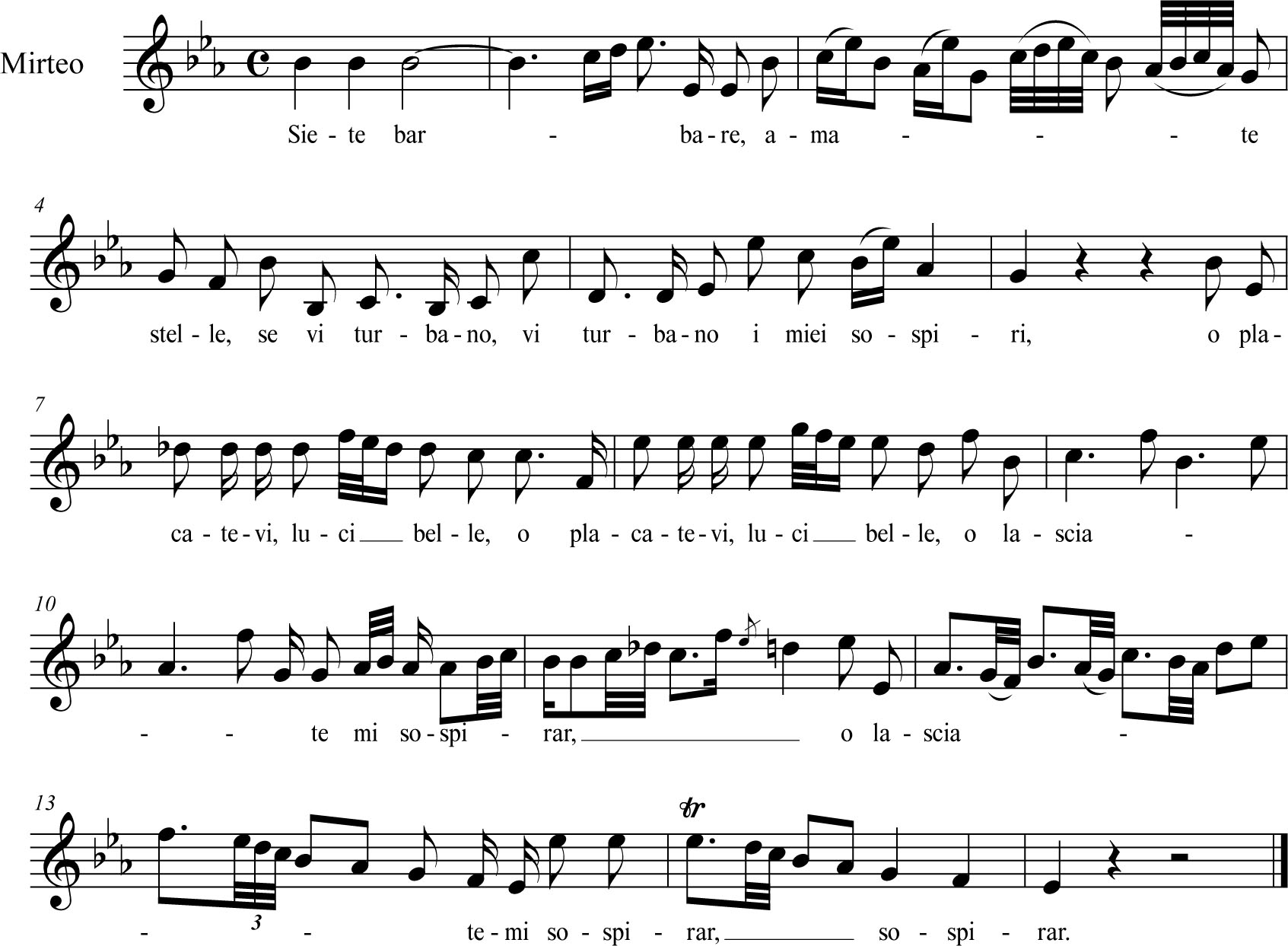
Music Example 10
Nicola Porpora, “Siete barbare, amate stelle”, part of A2 section, GB-Lam, MS 81, no foliation (own transcription)
Mirteo's first aria in Act III, “In braccio a mille furie”, is a virtuosic coloratura piece marked Presto. It does not contain brief sophisticated motifs, which feature again in the following aria “Quel vapor che in valle impura” (III,11, Music Example 11). It is apparently again in a slow Andante tempo (no tempo indicated in the score), and compares Mirteo's ever depressed mental state and dimmed reason to impure vapours dispersed by the sun. (In the preceding aria Tamiri accuses Mirteo: “Vuoi dirmi, lo so:/ ‘Languisco per te,/ riposo non ho,/ domando mercé,/ ingrata, spietata,/ tiranna crudele’/ noiose querele/ usate in amor”, and he himself recognises that: “Ah la nube importuna/ che m’adombrò della ragione i rai/ si sciolga alfine. Ho vaneggiato assai.”)
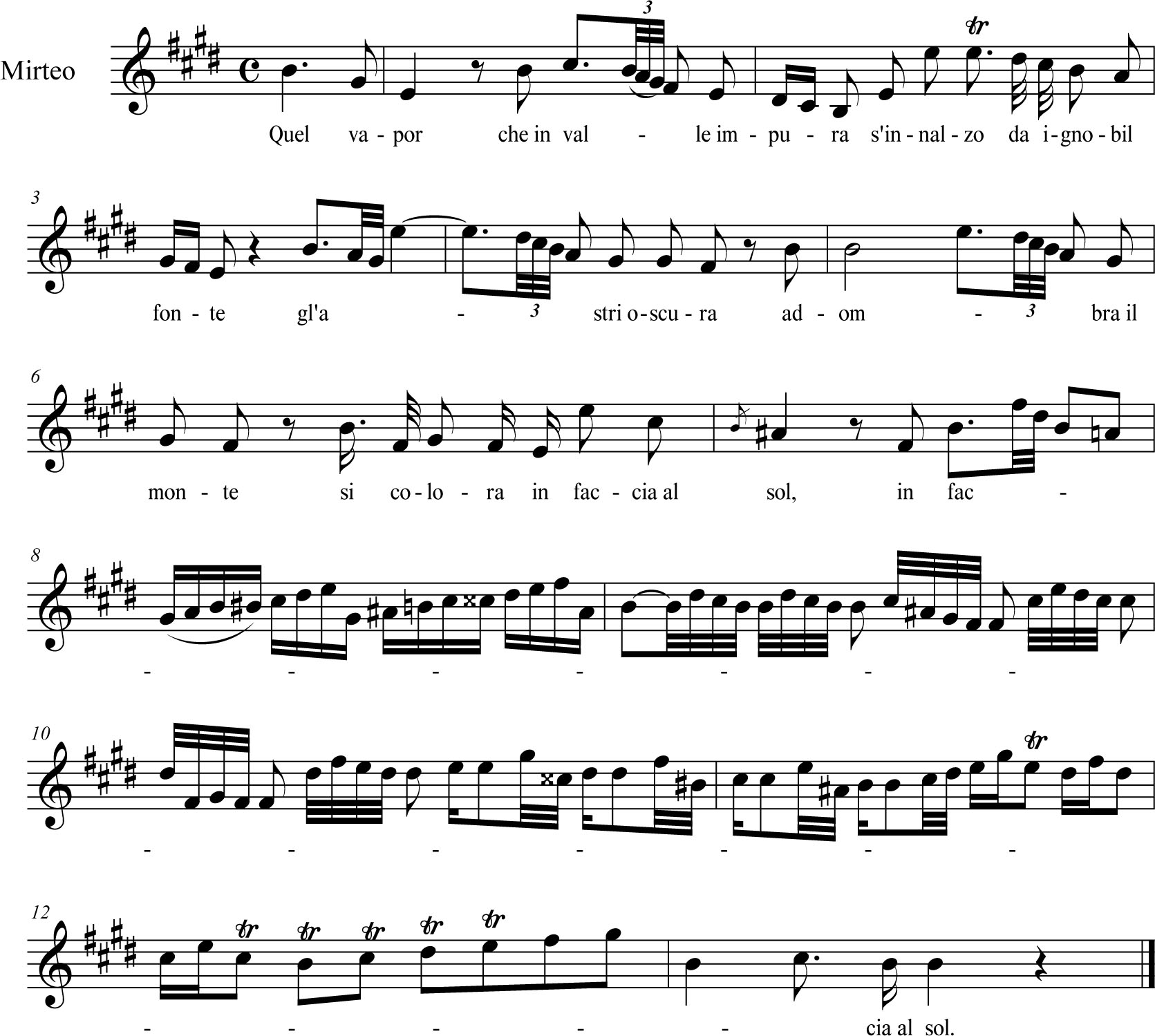
Music Example 11
Nicola Porpora, “Quel vapor che in valle impura“, A1 section, GB-Lam, MS 81, no foliation (own transcription)
In addition to the short motifs present in almost all of Farinelli's arias, they also contain such typical elements of his style as leaps, trill chains, and chromatic melodic writing. In addition to the virtuosic coloratura aria “In braccio a mille furie” (III,4), two other arias of the same type, “Spira il vento nel foco nascente” (unattributed), and the famous virtuosic aria “Nobil onda” from Porpora's Adelaide (Rome 1723, I,17), were inserted at a point not specified in the libretto. They are printed at the end of the second edition and lack an indication as to the point at which they should be sung. Messa di voce and note repetitions are, significantly, almost absent from Porpora's arias sung by Farinelli in Semiramide (but not from the substitute aria “Nobil onda”)25. However, Porpora knew his pupil's voice very well and perhaps explicitly wanted to demonstrate its flexibility and velocity with regard to other special musical qualities.
Why the composer did so may be explained by a passage found in Sacchi's biography. According to Sacchi, Farinelli studied with Antonio Bernacchi at that time. After a kind of vocal competition held in 1727 in Bologna, which was won by Bernacchi (who appeared in Giuseppe Maria Orlandini's La fedeltà coronata), Farinelli studied more intensively with that singer in Rome. However, following the 1727 Bologna performance, the two stars did not sing together in Rome at all, and thus the story could only refer to Vinci's Medo, staged in Parma in the spring of 1728, where the two singers were both engaged. However problematic such sources may be26, they may contain some truth. It is possible that the small, quasi-improvised motifs appearing in Semiramide riconosciuta are the “grazie sopraffine” mentioned by Sacchi, which Farinelli is supposed to have learned from Bernacchi earlier that year27. In fact, the arias in Medo are definitely more virtuosic and do not depend on such brief motifs as we find in Semiramide riconosciuta. Such motifs, however, can be found in Pietro Torri's Nicomede, staged in October 1728 in Munich, after Medo but immediately before Farinelli's Venetian engagement. Farinelli sang the title part. These small motifs are all there, apart from virtuosic coloraturas. Brief motifs are present in the very first aria “Amorosa rondinella” (I,1), as well as in the arias “L’ubbidir se mi mostra tuo figlio” (I,9) and “Se traditor mi credi” (II,14) 28.
However, we can see such motifs in earlier operas as well, including those written for other singers (cf., for example: L. Leo, Zenobia in Palmira, D. Sarro, Tito Sempronio, L. Vinci, Astianatte, all staged in Naples, 1725; L. Vinci, Farnace, Rome 1724; N. Porpora, Imeneo, Naples 1723) and in later ones (G. Giacomelli, Lucio Papirio, Parma 1729; P. Torri, Edippo, Munich 1729; R. Broschi, Idaspe, J.A. Hasse, Artaserse, both Venice 1730). In this context, the idea of Farinelli's “grazie sopraffine” goes up in smoke. What is nonetheless striking in Semiramide riconosciuta is the high frequency of the occurrence of these motifs in Farinelli's part. They are present in almost every aria sung by him (I,7: “Bel piacer saria d’un core”, I,15: “Rondinella a cui rapita”, II,5: “Sì pietoso il tuo labro ragiona”, II,9: “Siete barbare, amate stelle”, III,11: “Quel vapore che in valle impura”). Only one virtuosic aria, “In braccio a mille furie” (III,4), does not depend on these short motifs. In contrast, in the arias of his partner singers they are hardly ever found; only in one aria performed respectively by Gizzi (I,8: “Come all’amiche arene” (Music Example 12), cf. the not-so-easy syncopations at the end of the section) and Negri (I,12: “Fiumicel che s’ode appena”, Music Example 13). Note that the complex elements in these arias are far less demanding.
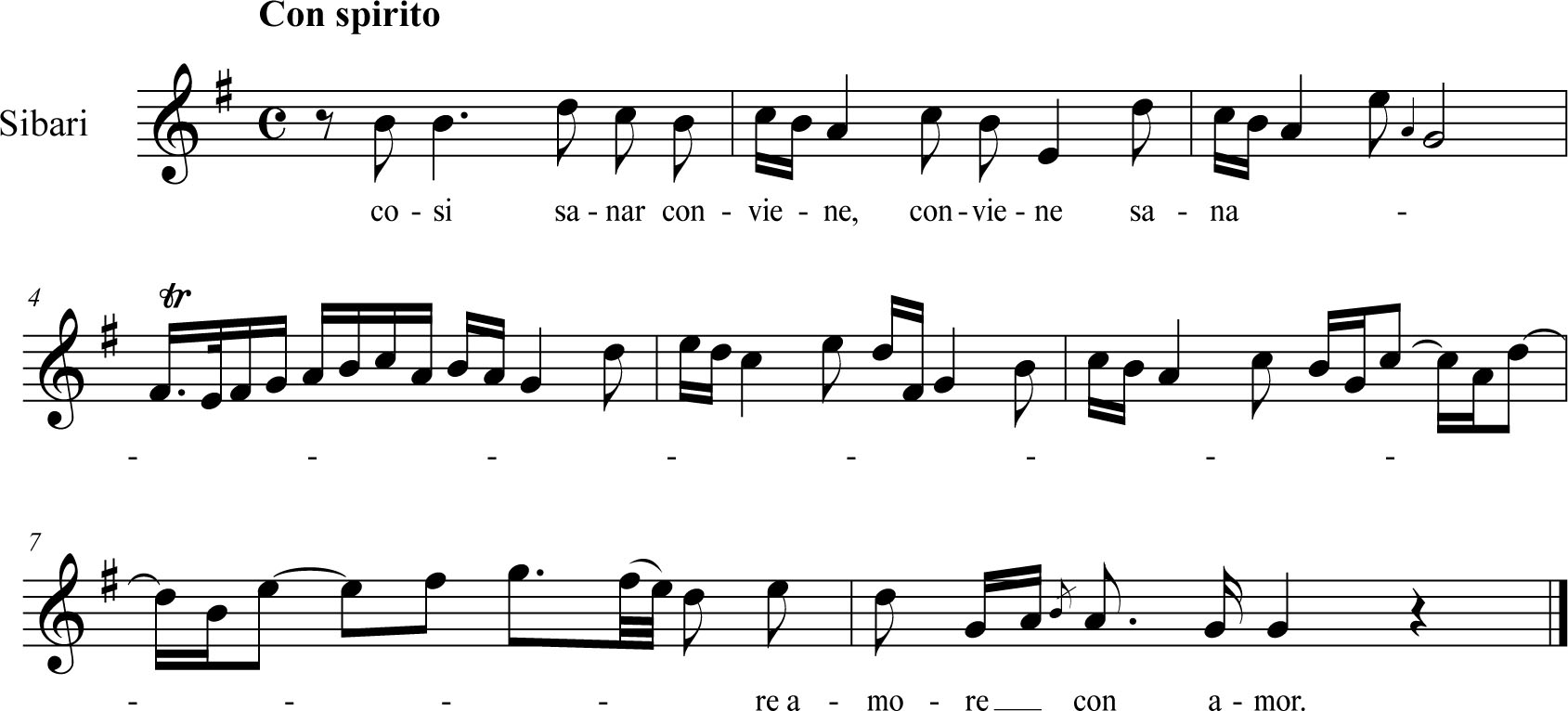
Music Example 12
Nicola Porpora, “Come all’amiche arene”, part of A1 section, GB-Lam, MS 81, no foliation (own transcription)
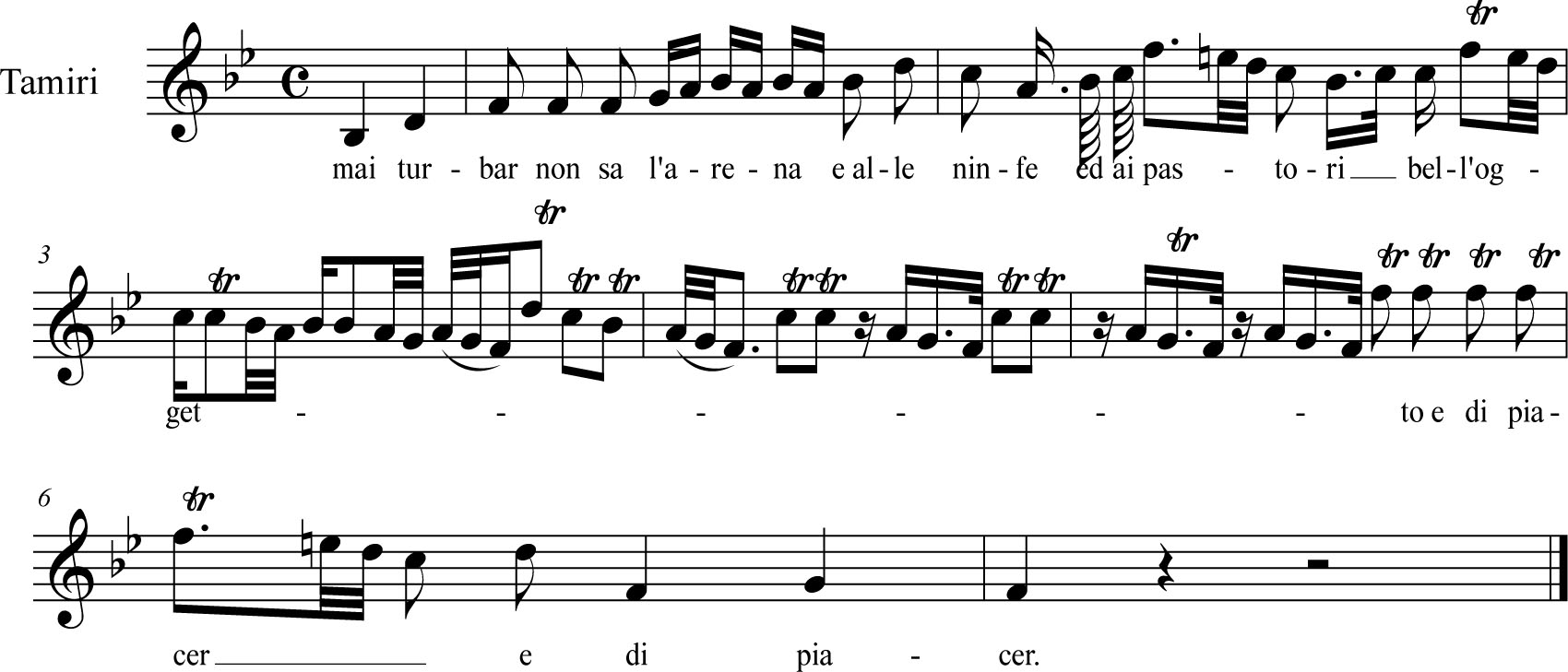
Music Example 13
Nicola Porpora, “Fiumicel che s’ode appena”, part of A1 section, GB-Lam, MS 81, no foliation (own transcription)
However, in Catone in Utica the proportions are quite the opposite: Farinelli only sings a very small number of these motifs (such as the “instrumental” motif in “Mi lusinga il cor d’affetto”) and the other singers get many more. Gizzi performs them in “Soffre talor del vento” (II,5, Music Example 14), while the syncopations present in “Come all’amiche arene” are also found in Facchinelli's “Non ti minaccio sdegno” (I,2) and in Gizzi's “Chi un dolce amor condanna” (I,10). Through their overwhelming presence in Semiramide riconosciuta, Farinelli (and Porpora) thus created a kind of counterpoint to the earlier opera with these short, quasi-improvisational motifs, and here Farinelli obviously intends to surpass his partners on the stage.
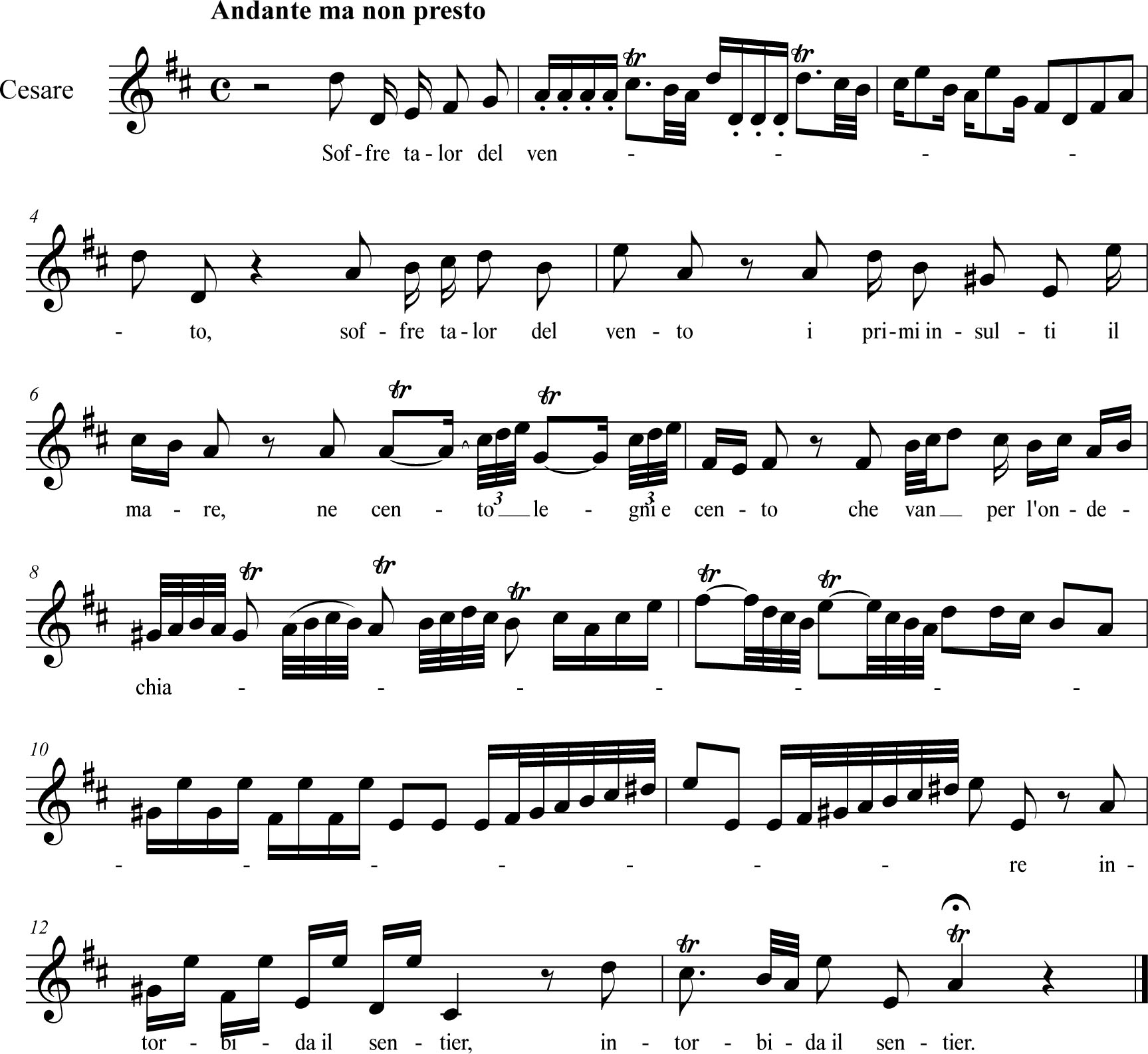
Music Example 14
Leonardo Leo, “Soffre talor del vento”, A1 section, GB-Lam, MS 75, fols. 102r–103r (own transcription)
Some objections could be made to such an interpretation of the aria contents. Firstly, it must be examined whether these motifs were not a stylistic feature generally characteristic of Porpora29. However, as we can see from the above-listed examples, they are not only restricted to Porpora, but used by a variety of composers. Moreover, although these small motifs are definitely found in Porpora's operas, they do not appear as frequently in them as in Farinelli's part in Semiramide riconosciuta. Another objection might be whether these quasi-improvisational motifs can be distinguished from ‘actual’ improvisations, which constituted part of the operatic performance practice in the 18th century. But where these motifs could not be heard, in every case they could still be seen in the written score of the entire opera or in single arias. That the written material seems to have been as important as the orally transmitted practice in Farinelli's art can be gleaned from the fact that an aria he sang, “Qual guerriero in campo armato” from his brother's Idaspe (Venice 1730), is written in several different clefs (violin, soprano, mezzo-soprano, alto, tenor, and bass clefs). This specific notation cannot be heard, but only seen, and probably, like the short motifs, it may have enhanced Farinelli's image as a fabulous singer.
SUMMARY
To sum up, the reason for the highly unusual aria substitutions in Leo's Catone in Utica in its Venetian production seems to have been the fact that the opera needed to prove a financial success in order to cover Farinelli's high remuneration for the 1728/29 Venetian opera season. All the cast had their arias substituted to a more or less substantial degree. Most substitutions concern Farinelli's part. In his case we can observe his strategy to impress the public by demonstrating a wide range of exceptional vocal skills first, and later concentrating on selected qualities in the arias that followed. In this respect, Catone in Utica can be interpreted as a showpiece for Farinelli's entire vocal artistry. Porpora's Semiramide riconosciuta, on the other hand, seems to have been a vehicle to bring out another element absent from his part in Leo's opera, that is, short, complex, quasi-improvisational motifs. These are found in a type of aria that is characterised by a rather slow tempo and free flow of the melodic line, associated with the character type of the unhappy lover-hero whom Farinelli's frequently impersonated. In fact, in Semiramide riconosciuta this character type is represented by almost every aria sung by the famous singer, and was intended by Metastasio in his concept for this role. The original aria texts in II,5 (“Io veggo in lontananza”, substituted by “Sì pietoso il tuo labbro ragiona”) and III,11 (“Sentirsi dire”, substituted by “Quel vapor che in valle impura”) do not depart from this type. At the same time, the focus on these small complex motifs seems to reflect his evident intention to enter into competition with his stage partners (who sang such motifs in Catone in Utica), and to surpass them. Thus, Farinelli's well-conceived sequence of musical element presentation, linked to the idea of presenting his multifaceted vocal art and of direct comparison with the other singers, most likely made a lasting impression on the public in the Lagoon City, where he performed for three more seasons of his operatic career.
Appendices
APPENDIX: SOURCES (IN CHRONOLOGICAL ORDER)
Selected operas from the period 1723–1730 featuring Carlo Broschi (Farinelli) or composed by Nicola Porpora
Porpora, N., Imeneo, Naples 1723 (Jan); score: [D-Dl, Mus.2417-F-1] Dresden, Sächsische Landesbibliothek – Staats- und Universitätsbibliothek, online: http://nbn-resolving.de/urn:nbn:de:bsz:14-db-id4345333511 (accessed 4 November 2020).
Vinci, L., Farnace, Rome 1724 (Jan); score: [D-Bsa, SA1211] Berlin, Sing-Akademie zu Berlin, online: http://resolver.staatsbibliothek-berlin.de/SBB0002658C00000000 (accessed 4 November 2020); [D-MÜs, Sant.Hs.4243] Münster, Bischöfliche Diözesanbibliothek, Santini-Sammlung.
Sarro, D., Tito Sempronio Gracco, Naples 1725 (carnival); score: [I-Nc, Rari 7.3.12] Napoli, Conservatorio di Musica “S. Pietro a Majella”, online: http://www.internetculturale.it (accessed 4 November 2020).
Leo, L., Zenobia in Palmira, Naples 1725 (May); score: [I-Nc, Rari 7.3.9] Napoli, Conservatorio di Musica “S. Pietro a Majella”, online: http://www.internetculturale.it (accessed 4 November 2020).
Vinci, L., Astianatte, Naples 1725 (2 Dec); score: [I-Nc, Rari 7.3.13] Napoli, Conservatorio di Musica “S. Pietro a Majella”, online: http://www.internetculturale.it (accessed 4 November 2020).
Porpora, N., Siface, Venice 1725 (26 Dec); score: [B-Br, Ms II 3972 MusFétis 2530] Bruxelles, KBR – Koninklijke Bibliotheek/Bibliothèque royale, online: https://uurl.kbr.be/1420930 (accessed 4 November 2020).
Porpora, N., Meride e Selinunte, Venice 1726 (Dec); score: [B-Br, Ms II 3973 MusFétis 2531] Bruxelles, KBR – Koninklijke Bibliotheek/Bibliothèque royale, online: https://uurl.kbr.be/1577495 (accessed 4 November 2020).
Broschi, R., L’isola d’Alcina. Drama da rappresentarsi in Roma nella Sala de’ Signori Capranica il carnovale dell’anno 1728. Dedicato all’Altezza Reale di Violante Beatrice di Baviera Gran Principessa Vedova di Toscana, e Governatrice di Siena, Florence, M. Nestenus, [1728 (carnival)]; libretto, several copies available online, cf. http://corago.unibo.it/libretto/DRT0025041, (accessed 4 November 2020).
Broschi, R., Mi lusinga il dolce affetto; a single aria from L’isola d’Alcina in the aria collection [I-Rc, Ms.2771] Roma, Biblioteca Casanatense, pp. 97–108.
Vinci, L., Medo, Parma 1728 (May); score: [I-MC, 1-A-18, 1-A-19, 1-A-20] Montecassino, Biblioteca dell’Abbazia, online: http://www.internetculturale.it (accessed 4 November 2020).
Vinci, L., Scherzo dell’onda instabile; a single aria from Medo in aria collections [D-MÜs, Sant. Hs.4241 and Sant.Hs.4262], Münster, Bischöfliche Diözesanbibliothek, Santini-Sammlung.
Torri, P., Nicomede, Munich 1728 (Oct); score: [D-Mbs, Mus.ms.214] München, Bayerische Staatsbibliothek, online: http://mdz-nbn-resolving.de/urn:nbn:de:bvb:12-bsb00110140-1 (accessed 4 November 2020).
Leo, L./Metastasio, P., Catone in Utica. Tragedia per musica di Artino Corasio Past. Arcade da rappresentarsi nel famosissimo Teatro Grimani di S. Gio. Grisostomo nel’ Carnevale del 1729, Venezia, Buonarigo, [1728]; printed libretto, several copies online: http://corago.unibo.it/libretto/DPC0001584 (accessed 4 November 2020).
Leo, L./Metastasio, P., Catone in Utica. Tragedia per musica di Artino Corasio Past. Arcade da rappresentarsi nel famosissimo Teatro Grimani di S. Gio. Grisostomo nel’ Carnevale del 1729. Seconda editione, Venezia, Buonarigo, [1729]; printed libretto, copy online: http://corago.unibo.it/libretto/DPC0001585 (accessed 4 November 2020).
Leo, L./Metastasio, P., Catone in Utica, Venice 1728 (Dec); score, [GB-Lam, MS 75] London, Royal Academy of Music, online: https://archive.org/details/GB-Lam_MS75/page/n3/mode/2up (accessed 4 November 2020); [B-Bc, 2194] Bruxelles, Conservatoire royal de musique.
Leo, L./Metastasio, P., Catone in Utica; transcription for voice and mandolin, [I-Vnm, Mss.It.Cl.IV.472 (= 10350) (“Arie per Mandolino/dell’Opera 2.a/In S. Gio: Grisost:o 1729./Venet.a”)] Venezia, Biblioteca Nazionale Marciana.
Leo, L./Metastasio, P., Confusa, smarrita (2nd version); a single aria from Catone in Utica, [I-Nc, Cantate 175 (“Sig.r Leo”)] Napoli, Conservatorio di Musica ‘San Pietro a Majella’; [B-Bc, 4342 (“Catone in Uttico Aria del Sigr Leonardo Leo.”)] Bruxelles, Conservatoire royal de musique; [GB-Lbm, R.M.23.f.1 (late 18th century: “Confusa smarrita spiegarti vorrei/Del Sigr./D: Leonardo Leo.”)] London, British Library.
Porpora, N./Metastasio, P., Semiramide riconosciuta. Dramma per musica di Artino Corasio Pastore Arcade da rappresentarsi nel famosissimo Teatro Grimani di S: Gio: Grisostomo nel Carnevale del 1729, Venezia, Buonarigo, [1729]; printed libretto, copies available online: http://corago.unibo.it/libretto/DPC0001590 (accessed 4 November 2020).
Porpora, N./Metastasio, P., Semiramide riconosciuta. Dramma per musica di Artino Corasio Pastore Arcade da rappresentarsi nel famosissimo Teatro Grimani di S: Gio: Grisostomo nel Carnevale del 1729. Seconda editione, Venezia, Buonarigo, [1729]; printed libretto, for copies cf. http://corago.unibo.it/libretto/DPC0001591 (accessed 4 November 2020), copy consulted: [I-Vnm, Dramm.3555.008] Venezia, Biblioteca Nazionale Marciana.
Porpora, N./Metastasio, P., Semiramide riconosciuta, Venice 1729 (Feb); score, [GB-Lam, MS 81] London, Royal Academy of Music, online: https://archive.org/details/GB-Lam_MS81/mode/2up (accessed 4 November 2020).
Giacomelli, G., Lucio Papirio dittatore, Parma 1729 (spring); score: [GB-Lam, MS 71] London, Royal Academy of Music, online: https://archive.org/details/ms71_20190722 (accessed 4 November 2020).
Torri, P., Edippo, Munich 1729 (Oct); score: [D-Mbs, Mus. ms.156] München, Bayerische Staatsbibliothek, online: http://mdz-nbn-resolving.de/urn:nbn:de:bvb:12-bsb00109967-6 (accessed 4 November 2020).
Broschi, R., Idaspe, Venice 1730 (Jan); score: [A-Wn, Mus. Hs.18281] Wien, Österreichische Nationalbibliothek, online: http://data.onb.ac.at/rep/1001FA27 (accessed 4 November 2020).
Hasse. J.A., Artaserse, Venice 1730 (Feb); [GB-Lam, MS72] London, Royal Academy of Music, online: https://archive.org/details/ms72_hasse (accessed 4 November 2020).
Berthold Over, PhD, is a Research Associate at the University of Greifswald. He wrote his PhD on music at the Venetian ospedali in the 18th century and became a Research Associate at the University of Mainz in 2009. From 2010 until 2013 he worked on the research project The Cantata as an Aristocratic Medium of Expression in Rome During Handel's Time (c. 1695–1715), funded by the Fritz Thyssen Foundation, and from 2013 until 2016 on the international HERA project MusMig. Music Migrations in the Early Modern Age: The Meeting of the European East, West and South. Since 2018 he has been a member of the German research group in the Polish-German project PASTICCIO. Ways of Arranging Attractive Operas, financed by the national research councils (NCN and DFG). His main research interests lie in the cultural history of music in a European context. He has discovered unknown autographs by Vivaldi, Handel, and Mahler.