
1. Introduction
A comprehensive understanding of atomic behavior across various rare elements requires consideration of specific properties of atoms, such as electron affinity. Studies of negative ions yield valuable insights into these characteristics.
Although the existence of gadolinium (Gd) negative ions has not yet been experimentally confirmed, theoretical calculations suggest that Gd can form negative ions [1]. Negative ions can be produced by using a beam of positive ions and a charge-exchange cell [2]. Therefore, developing a positive Gd ion source is a crucial first step toward producing negative ions.
Gadolinium is a low-volatility element with a melting point of 1585 K and a boiling point of 3273 K [3]. Its saturated vapor pressure is 10−4, 10−3, and 10−2 Torr at 860 °C, 966 °C, and 1093 °C, respectively. These properties require specific experimental approaches when working with gadolinium in the gaseous phase, where the aforementioned Gd vapor pressures are more commonly applicable for spectroscopy or plasma investigations. Thus, we tested two advanced methods to obtain Gd atoms (Gd I) and ions (Gd II): laser-induced breakdown spectroscopy (LIBS) and a hybrid plasma technique using a hollow cathode (HC) discharge combined with low-pressure radiofrequency inductively coupled plasma (RF-ICP) discharge. In both cases, the presence of Gd atoms and ions is confirmed by the recording of the relevant resonance spectral lines in the plasma emission spectra.
Laser-induced breakdown spectroscopy uses a pulsed laser to ablate and excite the sample, producing plasma that contains both atoms and positive ions of the sample [4], [5]. The detection of positive ions of Gd using LIBS for specific studies has been reported in [6], [7]. In [7], microwave-assisted laser-induced breakdown spectroscopy (MA-LIBS) was investigated as a potential method for analyzing nuclear fuel. A pelletized gadolinium oxide (Gd2O3) sample was used as a simulated nuclear fuel and was irradiated by a pulsed Nd:YAG laser (532 nm, 5 mJ) coupled with microwaves (2.45 GHz, 400 W) under various conditions. Spectral lines of Gd I and Gd II were observed from both regular and microwave-enhanced emission of laser-induced plasma.
The low-pressure radiofrequency inductively coupled plasma is a well known source suitable for studies of the spectroscopic properties of easily volatile elements, starting with highly volatile mercury [8] and ending with tellurium [9], which has a saturated vapor pressure of 6.5 · 10−3 Torr at 200 °C (achievable due to the self-heating of the ICP plasma used in combination with experimentally simple thermal isolation of the source) [9].
However, for gadolinium, achieving such a high saturated vapor pressure requires approximately 1000 °C, which poses significant challenges for direct use in inductively coupled plasma. A hybrid system was implemented to address this challenge, combining hollow cathode discharge with low-pressure radiofrequency inductively coupled plasma. The hybrid plasma technique used (HC & RF-ICP) was developed as part of a project focused on a next-generation, small-sized boron ion implantation apparatus [10]. The first part of the hybrid system was a hollow cathode in which low-volatility boron atoms [11] were supplied to the discharge plasma via sputtering [12] from a solid boron sample, resulting in the emission of resonance spectra of boron atoms (B I) and ions (B II).
2. Subject & methods
A. LIBS measurements of Gd I and Gd II
At the beginning of our research, we repeated the previously mentioned laser-induced breakdown spectroscopy studies of gadolinium using a gadolinium oxide (Gd2O3) sample in air. We used a pulsed Nd:YAG picosecond laser EKSPLA PL2230, with a wavelength of 1064 nm, and pulse energies of 0.6–1.6 mJ, and a spectrum detection system based on the Flame-T-XR1-ES digital spectrometer. Both strong atomic (378.305 nm, 432.712 nm, 440.186 nm) and ionic spectral lines (335.047 nm, 408.556 nm) were identified in the recorded spectra. These spectra were consistent with those reported in article [6], confirming the feasibility of developing a source of positive Gd ions using the LIBS technique. However, forming a beam of positive Gd ions in such a source is expected to be challenging. For this reason, we did not conduct further measurements of Gd using LIBS.
B. HC & RF-ICP system and measurements
Therefore, to obtain an improved Gd ion beam source for further advancements, we developed a hybrid plasma technique combining a hollow cathode and a radio-frequency inductively coupled plasma methods, as shown in Fig. 1. The hollow cathode was fabricated in-house from high-purity graphite in a hollow cylindrical shape (inner diameter of 5 mm). The sample (an approximately 1 cm3 Gd metal piece) was inserted and left to freely rest inside the cathode. We used custom-built power sources for the hollow cathode and RF coil. The HC discharge was powered at a voltage of 400 V. The current ranged from 300 to 400 mA, depending on the argon pressure, which was maintained around 1 Torr in current studies. The RF energy source operated at 54 MHz with an electrical power consumption of approximately 70 W and a conversion rate to RF power of up to 10 %.
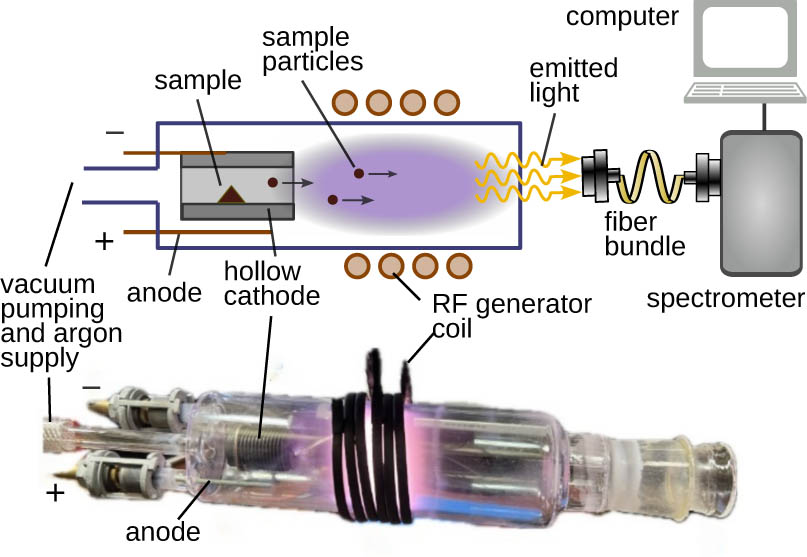
Fig. 1.
Experimental setup used for the HC & RF-ICP system.
In both configurations, the presence of Gd atoms and ions was confirmed by the detection of relevant resonance spectral lines in the plasma emission spectra. We analyzed the produced plasma spectra using a Princeton Instruments Action SpectraPro2300 Czerny-Turner type spectrometer equipped with a Princeton Instruments Pixis 400 CCD camera. The Pixis 400 camera captures spectra from 250 to 1100 nm, covering a 64 nm range in a single capture. With a 1200 G/mm diffraction grating and 20 µm slit width, it achieves spectral resolution of 0.14 nm. We used the Ar I lines observed in the spectra as references to confirm the spectrometer wavelength accuracy.
The following procedure was employed to study Gd spectra from the hybrid source. Firstly, the intensities of Gd spectral lines from the hollow cathode discharge were recorded (column 2 in Table 1 and Table 2). After that, the spectral lines were recorded using the hybrid system: HC & RF-ICP (column 3 in both tables below). During the discharge, the gadolinium atoms and ions produced inside the graphite cathode by the HC plasma discharge diffuse into the region covered by ICP plasma (see Fig. 1). The emission of Gd I and Gd II spectral lines is initiated under the influence of the skin effect of the ICP magnetic (H) component of the plasma discharge, where the temperature of electrons reaches around 104 K. It is well known that under optimized conditions, ICP plasma produces spectra of atoms with intensities much higher than the HC discharge [13]. By introducing the HC discharge, this hybrid setup addresses the limited ability of ICP to vaporize (atomize) the element from the solid phase.
Table 1.
Observed Gd I spectral lines and their intensities.
| Spectral line [nm] | I1 [arb. units] | I2 [arb. units] | I2/I1 | Ei [cm−1] | Ek [cm−1] | Aki [s−1] |
|---|---|---|---|---|---|---|
| 368.413 | 1230 | 2070 | 1.68 | 0.000 | 27135.695 | 9.1e+07 |
| 371.357 | 1680 | 2960 | 1.76 | 215.124 | 27135.695 | 9.2e+07 |
| 371.748 | – | – | – | 532.977 | 27425.245 | 6.8e+07 |
| 378.305 | 1340 | 2280 | 1.70 | 999.121 | 27425.245 | 9.4e+07 |
| 405.364 | – | – | – | 999.121 | 25661.340 | 6.2e+07 |
| 405.822 | 4390 | 9170 | 2.09 | 215.124 | 24849.514 | 5.7e+07 |
| 407.870 | 3330 | 6410 | 1.92 | 532.977 | 25043.649 | 5.9e+07 |
| 417.554 | 1830 | 3110 | 1.70 | 1719.087 | 25661.340 | 4.2e+07 |
| 419.078 | 3730 | 7630 | 2.05 | 999.121 | 24854.297 | 3.0e+07 |
| 422.585 | 8600 | 19060 | 2.22 | 1719.087 | 25376.313 | 8.9e+07 |
| 431.384 | 3000 | 5830 | 1.94 | 215.124 | 23389.780 | 4.3e+07 |
| 432.712 | 4950 | 10420 | 2.11 | 0.000 | 23103.660 | 5.2e+07 |
| 434.646 | 5770 | 10870 | 1.88 | 999.121 | 23999.912 | – |
| 440.186 | 3979 | 8630 | 2.17 | 1719.087 | 24430.425 | 3.8e+07 |
| 442.241 | 4580 | 9030 | 1.97 | 215.124 | 22820.895 | 2.8e+07 |
| 443.063 | 4000 | 7560 | 1.89 | 0.000 | 22563.824 | 3.0e+07 |
| 451.966 | 2670 | 5480 | 2.05 | 215.124 | 22334.508 | 3.8e+07 |
| 510.345 | 2530 | 5440 | 2.15 | 7947.294 | 27536.397 | – |
| 515.584 | 2310 | 4750 | 2.06 | 7480.348 | 26870.393 | – |
Table 2.
Observed Gd II spectral lines and their intensities.
| Spectral line [nm] | I1 [arb. units] | I2 [arb. units] | I2/I1 | Ei [cm−1] | Ek [cm−1] | Aki [s−1] |
|---|---|---|---|---|---|---|
| 335.047 | – | – | – | 1158.943 | 30366.818 | – |
| 335.862 | 1070 | 1610 | 1.50 | 261.841 | 31145.651 | – |
| 336.223 | – | – | – | 633.273 | 29353.344 | – |
| 342.247 | – | – | – | 1935.310 | 29045.291 | – |
| 354.580 | – | – | – | 1158.943 | 29353.344 | – |
| 358.496 | 1239 | 1850 | 1.49 | 1158.943 | 27864.534 | – |
| 364.619 | – | – | – | 1935.310 | 27162.224 | – |
| 374.347 | 1550 | 2770 | 1.79 | 1158.943 | 26595.222 | – |
| 376.839 | 1930 | 3150 | 1.63 | 633.273 | 25960.073 | – |
| 379.637 | 1680 | 2900 | 1.73 | 261.841 | 26211.912 | – |
| 385.097 | 2080 | 3200 | 1.54 | 0.000 | 30366.818 | – |
| 385.245 | – | – | – | 261.841 | 32677.540 | – |
| 391.651 | – | – | – | 4841.106 | 30996.851 | – |
| 404.986 | – | – | – | 7992.268 | 30101.366 | – |
| 409.861 | – | 3620 | – | 6605.154 | 30366.818 | – |
| 413.037 | – | – | – | 5897.264 | 31145.651 | – |
| 418.425 | – | – | – | 3972.167 | 29353.344 | – |
3. Results
In this study, the hybrid plasma source was used to record spectral lines of Gd I and a smaller number of Gd II spectral lines. The observed spectral lines with known transition probabilities (from the NIST database [14]) are shown in Table 1 and Table 2 for Gd I and Gd II, respectively. The tables show the wavelengths (column 1), the recorded relative intensities of spectral lines in emission from the HC cathode alone (I1, the second column in the tables), and from the hybrid system HC & RF-ICP (I2, the third column in the tables). The given values are for the maximum intensity of the line. The I2/I1 in the fourth column gives the ratio of increase in line intensity when the hybrid plasma is in operation. Columns 5, 6, and 7, respectively, present the energies of the lower Ei and upper Ek energetic levels in cm−1, and the transition strength Aki in s−1 (where available) of the spectral transition found in the NIST database. The presence of gadolinium atoms (Gd I) and ions (Gd II) in the area of ICP excitation is defined by their production and thermal diffusion from the HC in the presence of Ar atoms at a pressure of 1 Torr. Therefore, the concentration of atoms and ions depends on the current powering the HC. Table 1 and Table 2 show that we failed to observe a few lines from the list for Gd I, but Gd II shows many more unobserved spectral lines. In addition to Gd, only Ar I lines were observed. No other spectra were observed. Using graphite prevents HC spectra from contaminating the recordings, since the resonance spectra of atomic carbon lie below 200 nm [14].
4. Discussion and conclusions
Our pilot studies show that the hybrid plasma technique (HC & RF-ICP) could be a valuable tool for producing positive Gd ion beams and support further research on negative gadolinium ions. The developed hybrid plasma source also creates good opportunities to study the spectroscopic properties of Gd I and Gd II, which can deepen our understanding of atomic gadoliniumi and help update the NIST databases.
We plan to continue developing both applications. Using more power for the HC discharge in both cases should increase the amount of gadolinium sputtered into the discharge, leading to more ions for beam research and stronger resonance spectra of Gd I and Gd II. This will help us study the basic features of atomic gadolinium. Additionally, running a controlled, low flow of Ar gas through the HC should produce more gadolinium atoms and ions in the ICP plasma region of the hybrid source. This could make their spectra up to 10 times stronger than from the HC alone, as shown in [13].
It is important to note that for many years, most research in various labs has focused on developing and using hollow cathodes with advanced designs to study the atomic and ion spectra of elements that are not easily vaporized [15]. In our studies, we found that using the hybrid plasma technique is a breakthrough. It greatly improves the prospects for studies of the basic properties of atoms and ions from these elements and will also help advance beam technologies.
Acknowledgment
The work was supported by the ERDF projects No. 1.1.1.1/19/A/144 and No. 1.1.1.5/2/24/A/004, and the FLPP project (No. Lzp-2023/1-0199) from the Latvian Science Council.