
1. INTRODUCTION
Sometimes, instead of recording all data from multiple measurements, it is necessary to limit oneself to only the maximum and minimum values.
This occurs due to: technical limitations (insufficient memory or processing speed); in emergency situations (earthquakes or floods, when it is important to estimate the scale of the disaster based on peak values); when studying the limits for improving the parameters of an object (in sports or technology); or in visual observations, when device readings change too quickly.
It is important to remember that this approach has its drawbacks. By analyzing only the extreme values of measurements, you lose all information about the dynamics and intermediate components. In addition, extreme values are very sensitive to blunders and can distort measurement results. Therefore, before using this method, it is necessary to carefully evaluate its applicability in each particular case.
In this article we will show how, using the extreme values of a measured quantity, we can find its numerical value and determine the type A uncertainty for a sample of known size, with both known and unknown probability density functions (PDF) of observation results.
2. Subject & Methods
In situations where it is not possible to record all sample results from repeated observations, the characteristics of the sample range can be used to estimate the measurand and its type A uncertainty. This approach also improves the productivity of repeated measurements.
A. Evaluation of the measurand
In statistics, various estimates of the expected value are used to evaluate the results of repeated observations: arithmetic mean, median, and midrange. Formulas (1)–(3) for their calculation are presented in Table 1 [1].
Table 1.
Expressions for various estimates of the measurand.
| Estimators | Formulas |
|---|---|
| Sample mid-range – – | |
| Sample mean –– | |
| Median – ⸳ – |
For different PDFs of observations, these estimates have different variances. Fig. 1 shows the dependence of the sample variance (Var) of these estimates on the sample size n for different PDFs, obtained by the Monte Carlo method [2].
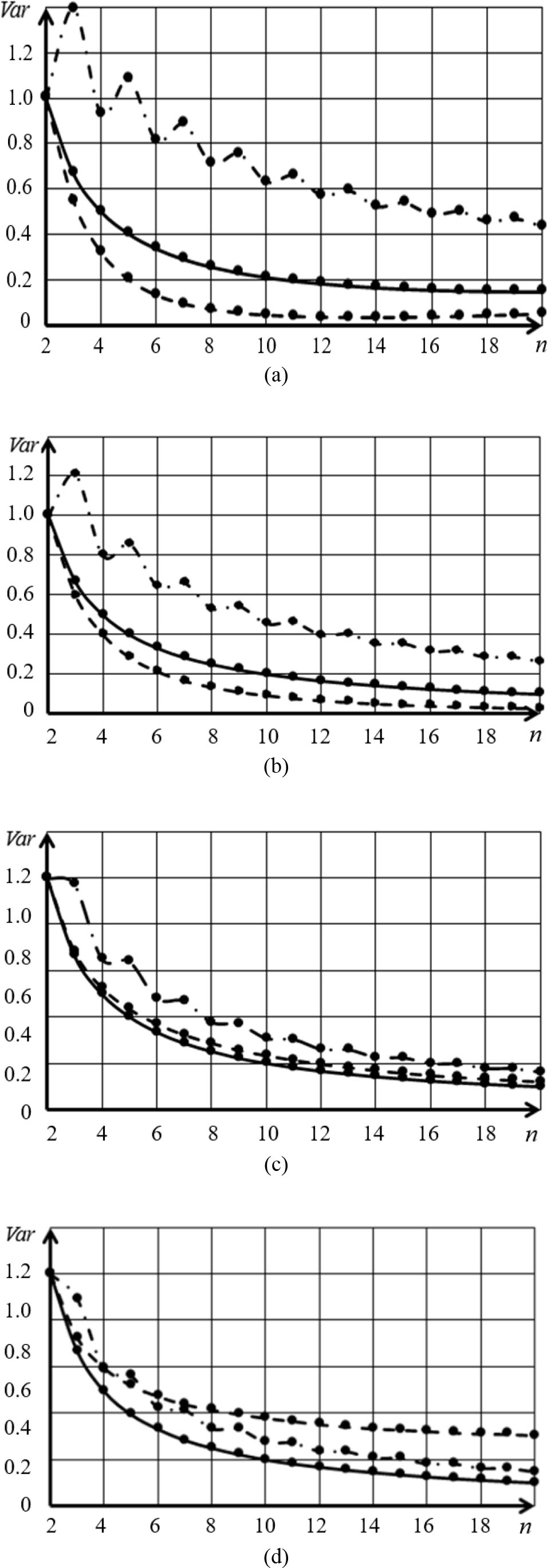
Fig. 1.
Dependence of the efficiency Var of various estimators of the expected value for different PDFs of the observed dispersion of IMI readings: (a) Arcsine; (b) Uniform; (c) Triangular; (d) Normal.
The variances of the various estimates presented in Fig. 1 were normalized to the variances of these estimates for the number of repeated observations n = 2 to ensure meaningful comparison of the distributions.
As shown in Table 1, the various estimates of the sample expectation for n = 2 are determined by the same expression:
consequently, the variances of these estimates for n = 2 are equal, and the starting point on the graphs in Fig. 1 is equal to 1 for all distribution laws of the result. The basic estimator of experimental variance and the variance of the mean for a sample of normal distribution are given by the following formulas:The distributions chosen for comparison are the most relevant for measurement situations because a normal distribution is typically assigned to the readings of indication measuring instruments (IMIs) based on the central limit theorem of probability theory; the arcsine PDF of the readings of IMIs occurs in the presence of interference from the AC network in their measuring circuits (or in the presence of pulsations in the power supply circuit of the IMIs); a uniform PDF is accepted when the input quantities are specified by boundaries without specifying the distribution law within these boundaries [3]; and a triangular PDF is the composition of two uniform distributions with identical boundaries.
All these distributions are symmetrical, and estimates of their parameters (expected value, sample variance, sample standard deviation, standard uncertainty of type A) are obtained during the processing of repeated observation results.
A more detailed description of the various PDFs and their application cases is provided in the standard [4].
Analysis of Fig. 1 shows that for the arcsine and uniform PDFs, the mid-range has the minimum variance, making it the most efficient estimate for multiple observations [5].
A similar conclusion can be drawn by analyzing the relationship between the well-known expressions for estimating the variances of the sample mid-range and the sample average (Fig. 2):
for a uniform distribution law of observation results, defined by its boundaries [a; b].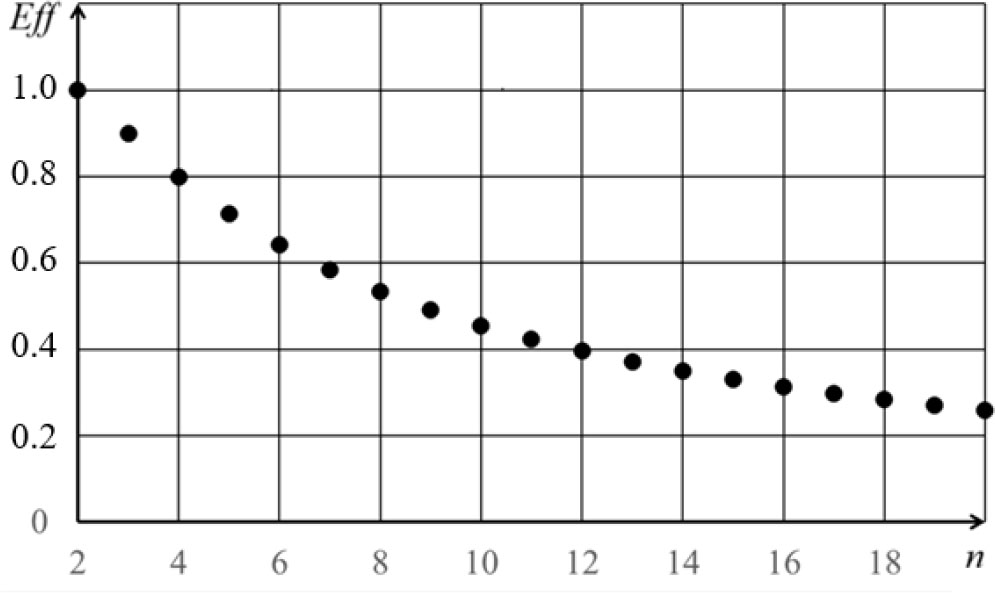
Fig. 2.
Dependence of the ratio of the variances of the sample mid-range and the sample average on the number of repeated measurements n with their uniform distribution law.
B. Evaluation of type A uncertainty of a measurand
The standard uncertainty of the estimate of the measurand, evaluated by a type A method, must be calculated according to the expression [3] – for example, for a normal distribution, from (5b):
where s is the sample standard deviation of repeated observations, and n is the number of observations.To determine the sample standard deviation of the results of repeated observations s by their sample range R, one can use the expression obtained in [6]:
where R = yminmax; α is a conversion coefficient that depends on the number of observations n and the PDF of the observed dispersion of the IMI readings – indications of the measuring instrument obtained under specified measurement conditions.It should be noted that in work [6], an analytical dependence α on n was obtained, which is valid only for the normal distribution law of IMI readings.
Using the Monte Carlo method, we calculated the dependence of α on n for various distribution densities of observation results (Fig. 3) listed in Fig. 1.
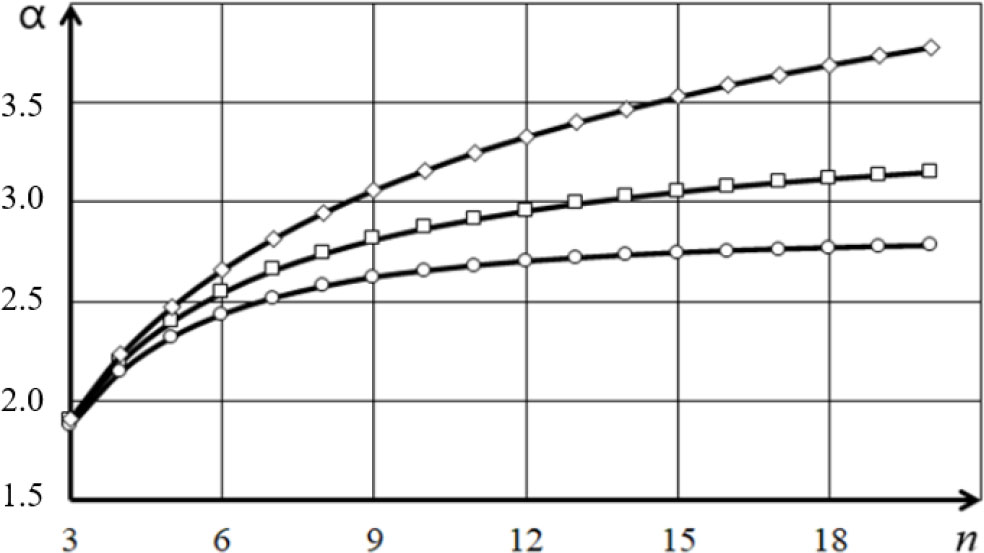
Fig. 3.
Dependence of the coefficient α on n for different distribution laws: o – arcsine; ◊ – normal; □ – uniform.
The dependence of α on n can be determined in the same way for any other PDFs of observation results.
To calculate α, M = 104 samples of a random number y of size n = 3,4, … , 20 were generated, each having a given PDF with zero expected value and unit standard deviation.
After this, α was determined by the formula:
where the sample standard deviation value sj is calculated using the estimator formula for the normal distribution (5a) while the estimator of the mean value for the normal distribution isTo generate random numbers distributed according to uniform and normal laws, the random number generator embedded in MS Excel was used. To obtain random numbers distributed according to the arcsine law, random numbers distributed according to the uniform law (in the range 0–1) were generated and then transformed into numbers distributed according to the arcsine law , using the inverse function method according to the formula:
Thus, to use the characteristics of the observation sample range to estimate the numerical value of the measurand and its type A standard uncertainty, it is necessary to study the PDF of the IMI readings [7].
It should be noted that even with a sufficiently large sample size, it is not always possible to describe the PDF analytically by applying fitting criteria.
In this case, the dependence of α on n can be directly determined using the results of the measurement experiment, as shown in the example below.
Example:
Evaluation of the numerical value and type A uncertainty of a standard hygrometer
We investigated the distribution law of the observed scatter in the standard hygrometer readings. For this purpose, 6392 humidity measurements were performed using the standard hygrometer Testo 400 with a humidity generator type “Huminator” at a point of 25 % RH under repeatability conditions (Fig. 4).
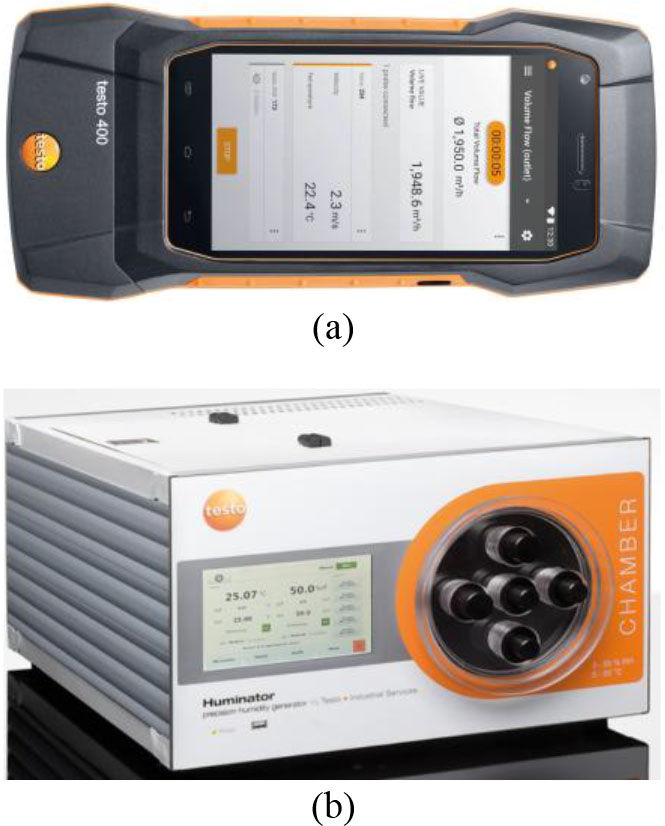
Fig. 4.
Standard hygrometer Testo 400 (a) and humidity generator type “Huminator” (b).
The histogram of the scatter in these readings after eliminating outliers is shown in Fig. 5.
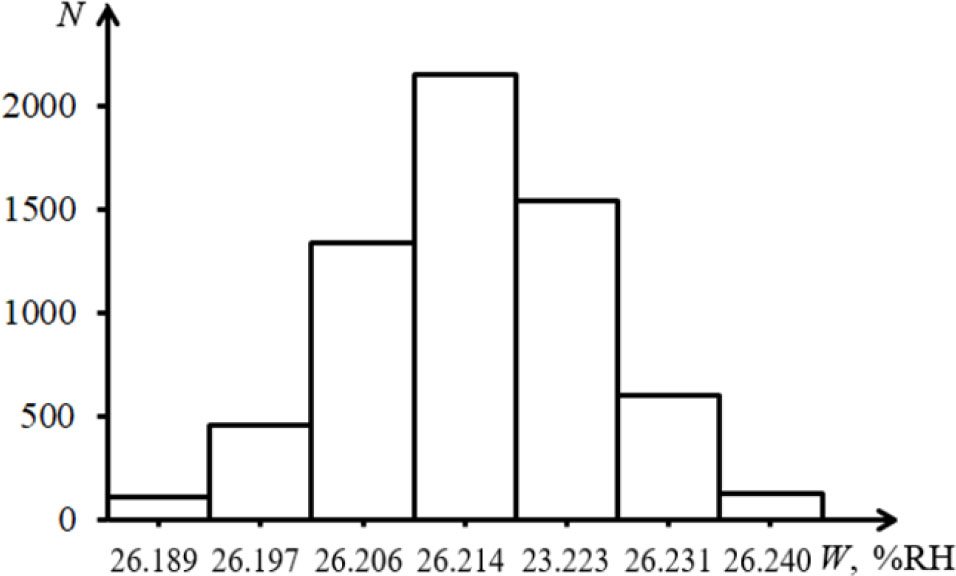
Fig. 5.
Histogram of standard hygrometer readings scatter.
To eliminate gaps in the histogram, it was necessary to expand the bin width by reducing the number of bins to 7.
This reduced the number of degrees of freedom to 4.
Despite the visual similarity of the histogram to the normal distribution law, Pearson’s chi-squared test gave a negative result: the value of χ2 = 825 at for a probability of 0.999 and 4 degrees of freedom. A similar situation occurred when using triangular, double exponential, and lognormal distributions as hypothetical models.
Based on repeated humidity measurements using a standard hygrometer, the dependences of the sample mean
and the sample mid-range were obtained depending on the sample size n (Fig. 6).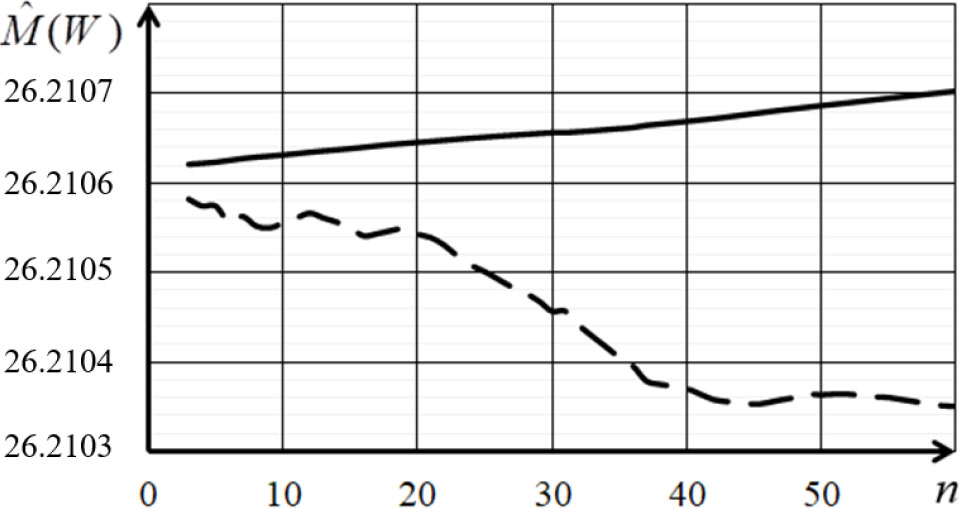
Fig. 6.
Dependence of estimates of the expected value on n: –– arithmetic mean; – – mid-range
The figure shows that as the sample size increases, the arithmetic mean of the sample increases, while the mid-range decreases.
For n = 60, the difference between the estimates can be 0.0035 % RH. This difference can be neglected if the resolution of the reference hygrometer is greater than 0.01 % RH.
Fig. 7 shows the experimental dependence of the coefficient α on the sample size n for the real PDF of hygrometer readings (▲).
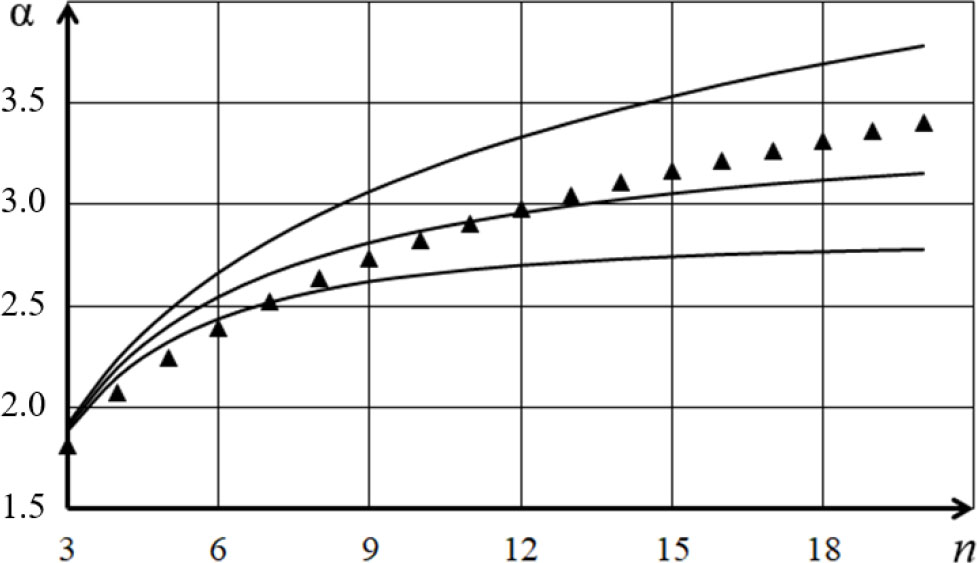
Fig. 7.
Experimental dependence (▲) of the conversion coefficient α of the sample range of readings of the standard hygrometer into the sample standard deviation on the sample size n.
It is clear from the figure that this dependence is not approximated by any of the theoretical curves shown in Fig. 2.
For this dependence, the least squares method was used to find an approximation in the form [8]:
3. Results
For the results of multiple humidity measurements with a standard hygrometer given in Table 2 [9], we will calculate various estimates of type A standard uncertainties.
Table 2.
Reference hygrometer readings.
| №. of observations | Wsi [% RH] | №. of observations | Wsi [% RH] |
|---|---|---|---|
| 1 | 26.13 | 6 | 26.10 |
| 2 | 26.11 | 7 | 26.11 |
| 3 | 26.12 | 8 | 26.13 |
| 4 | 26.10 | 9 | 26.14 |
| 5 | 26.14 | 10 | 26.12 |
The classical estimate of type A standard uncertainty was calculated using the well-known formula [3]:
and for the data in Table 2, this value was 0.00471 % RH.Since the maximum humidity value in Table 2 is 26.14 % RH, and the minimum is 26.10 % RH, the estimate of type A standard uncertainty, calculated using the sample range and considering the dependence (8), was:
Thus, the difference between the results of evaluating the type A standard uncertainty using the classical method and the sample range was 4.75 %.
4. Conclusions
The study of the dependence of the sample variance of different expected value estimates for various PDFs of the observed variability of IMI readings showed that the midrange is the most effective estimate for the arcsine and uniform PDFs, while the arithmetic mean is the most effective estimate for the triangular and normal PDFs.
It is demonstrated that in order to use the characteristics of the sample range of the observation sample to estimate the numerical value of the measurand and its type A standard uncertainty, it is necessary to know the PDF of IMI readings.
For unknown distributions, the conversion coefficient α can be determined empirically by repeated measurements under repeatability conditions with the same IMI. In such experiments, both the empirical standard deviation s and the range R are available, enabling estimation of α from the ratio R/s. This procedure can be regarded as a form of calibration of the IMI with respect to range-based estimation, linking the extreme-value behavior of indications to conventional measures of variability.
An experimental dependence of the conversion coefficient α of the sample range of readings of the standard hygrometer into the sample standard deviation is obtained, on the basis of which estimates of the value of the type A standard uncertainty of humidity measurement are obtained that are close to the classical estimates based on the GUM procedure.
Acknowledgment
The authors thank the editors of Measurement Science Review for their assistance and support, as well as the reviewers, whose valuable comments helped improve the quality of the article.