
Table 1.
Terminology.
| Terminology | Explanation |
|---|---|
| IoT | A network of interconnected devices that communicate and exchange data, often including sensors, actuators, and smart devices. |
| ISM-AAC | A security framework for IoT networks integrating FE and RBAC to ensure secure communication and data access. |
| FE | An advanced encryption technique that enables selective decryption of specific functionalities or computations of encrypted data without exposing the entire dataset. |
| Re-encryption | The process of updating encryption keys when a device's role changes or unauthorized access is detected, ensuring continued security and integrity of transmitted data. |
| Access control | A mechanism that regulates who can access certain data or resources in the IoT network, based on role assignments and permissions. |
| Key management | The process of generating, distributing, storing, and updating cryptographic keys used in encryption and decryption processes. |
| Data confidentiality | Ensuring that sensitive data remains protected from unauthorized access during transmission and storage within the IoT network. |
| Data integrity | Ensuring that the data is accurate, unmodified, and has not been manipulated during transmission or storage. |
| 1. Initialize the IoT network with devices (deviceID) and users (UserCredentials) |
| 2. Assign Roles to the users (RoleAssignments) |
| 3. Authenticate the user/device using the credentials |
| 4. If the user is authenticated: |
| 5. Check the access permissions for the assigned role (RBAC) |
| 6. If access is allowed: |
| 7. Encrypt the data with FE |
| 8. Transmit the encrypted data via the IoT network |
| 9. If unauthorized access is detected: |
| 10. Trigger Re-encryption process to update the encryption keys |
| 11. Upon reception, the recipient decrypts the data with their decryption keys |
| 12. Verify the recipient’s access permissions based on their role |
| 13. If access is verified: |
| 14. Decrypt the data and process it |
| Otherwise: |
| 15. Deny access and log the event |
| End algorithm |
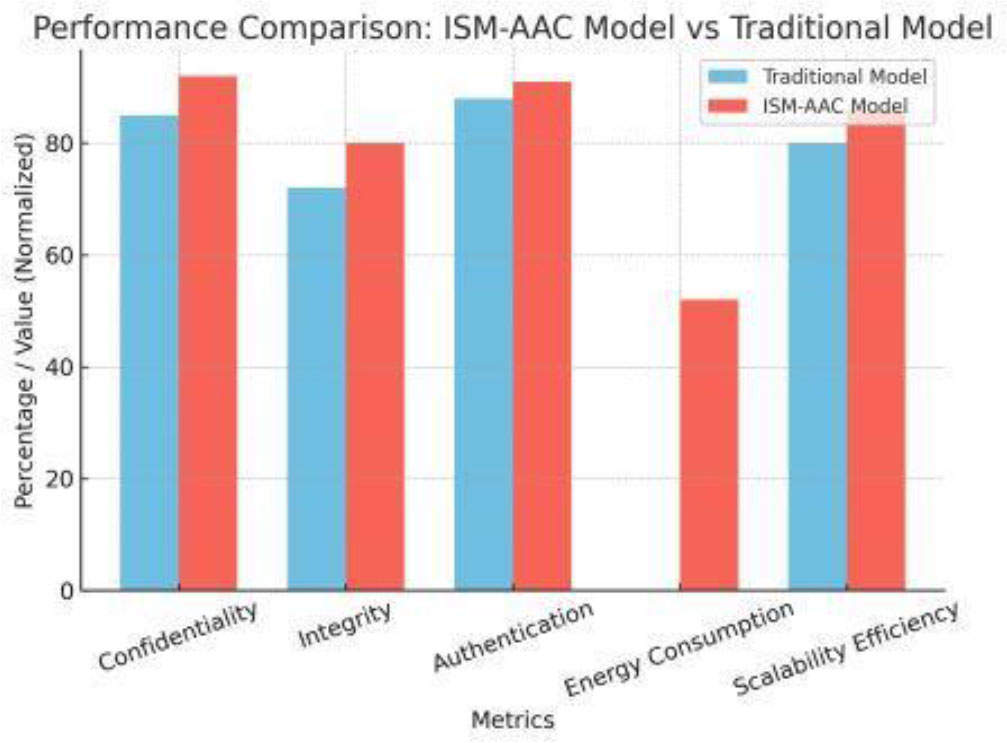
Fig. 1.
Performance comparison.