
1. Introduction
The mining industry has historically been one of the most significant economic activities in Mexico; it currently contributes 2.05% to the national gross domestic product [1]. However, its development has generated large volumes of solid waste, notably mining tailings (MTs), byproducts characterized by complex mixtures of sulfides, carbonates, metal oxides, and, in many cases, a high proportion of silicates. This problem is not unique to Mexico; globally, it is estimated that mining generates between 10 billion and 80 billion metric tons of tailings per year, with projections warning of a possible doubling of this figure over the next decade [2].
In light of this growing accumulation, various studies have focused on recovering this type of waste, considering its potential for reuse in strategic industrial sectors [3]. One of the most promising approaches is the incorporation of mine tailings (MTs) into cementitious materials since their chemical and mineralogical composition – particularly the presence of reactive silica and aluminosilicate phases – may confer pozzolanic properties and favor their use as supplementary cementitious materials [4]. Furthermore, the reuse of MT helps reduce the demand for virgin raw materials and promotes strategies aligned with the principles of the circular economy. However, due to the high mineralogical and chemical variability of tailings depending on their geological origin and beneficiation process, it is essential to conduct a detailed characterization to assess their technical and environmental feasibility before their application in construction materials.
In this regard, the sequential extraction technique has been widely used to analyze the speciation of metals in soils, sediments, and mining waste [5]. This methodology allows for the identification of different mineralogical associations of the elements and the estimation of their potential release under specific environmental and geochemical conditions. In MT, this information is particularly relevant due to the presence of potentially toxic elements that may pose environmental risks during the storage or reuse of the material. Furthermore, the physical, chemical, and mineralogical characterization of tailings provides essential information for determining their suitability as a supplementary cementitious material and for understanding their potential interaction within concrete matrices [6].
At the same time, the concrete industry faces significant environmental challenges. Concrete is one of the most widely used materials globally [7], with growing demand driven by urban and industrial development. Its production involves mixing rock aggregates, water, and cement [8], with cement being the component with the greatest environmental impact. It is estimated that the cement industry is responsible for approximately 6% of global carbon dioxide (CO₂) emissions [9,10], while the extraction of natural aggregates involves high resource and energy consumption [11,12]. Consequently, there is growing interest in developing alternative cementitious materials that reduce cement consumption without compromising concrete performance.
Although various studies have investigated the use of mine tailings as partial substitutes for cement or aggregates in cementitious materials, most have focused on evaluating mechanical properties and, to a lesser extent, durability. However, the environmental viability of these materials remains a significant concern due to the possible presence and mobility of potentially toxic elements contained in the tailings
Although geochemical tools such as sequential extraction have been widely used to assess the distribution and mobility of these elements in mining waste, their application in studies that aim to use tailings as partial substitutes for cement in cementitious materials remains limited. Consequently, a knowledge gap persists regarding the relationship between the geochemical characteristics of tailings, their potential environmental risk, and their behavior within cementitious matrices.
Given this scenario, the incorporation of silica-rich mining tailings as a partial substitute for Portland cement represents a promising alternative to promote the circular economy in the construction industry. This strategy not only helps reduce the carbon footprint associated with cement production but also offers a sustainable pathway for recovering mining waste, transforming it into value-added materials for construction applications [13].
Therefore, the objective of this study was to evaluate the technical and environmental feasibility of using silica-rich mining tailings as a partial substitute for Portland cement in concrete mixtures. To this end, a comprehensive characterization of the material was conducted, including physical, chemical, and mineralogical analyses, as well as an evaluation of the mobility of potentially toxic elements through sequential extraction. Subsequently, concrete mixtures were prepared with varying percentages of cement replacement and evaluated using compressive strength and chloride penetration tests to assess their mechanical performance and durability.
The main contribution of this research is integrating the geochemical evaluation of tailings with the analysis of concrete properties, providing a methodology for the simultaneous assessment of the technical feasibility and environmental safety of their reuse. The results provide criteria for the sustainable recovery of mining tailings in cementitious applications and contribute to the development of strategies that mitigate the environmental impacts associated with both mining and cement production.
2. Materials and methods
2.1. Characterization of the mining tailings
The tailings used in this study were collected from the Dos Carlos mining tailings dam (20°06′18.5″ N, 98°42′49.7″ W), located in the municipality of Mineral de la Reforma, Hidalgo, Mexico. This deposit belongs to the Pachuca–Real del Monte mining district, a region with a long tradition of exploiting polymetallic deposits, primarily silver and other associated metals. Consequently, the tailings studied are a mining residue representative of the historical mineral processing operations in this area.
The cone-and-quartering technique was used to obtain a representative sample of approximately 50 kg. Based on the method described by Ruiz et al. [14], the sample’s pH and electrical conductivity were determined. The measurement was performed using 1 g of sample in a 50-mL beaker containing 10 mL of deionized water. The suspension was stirred for 5 min and allowed to stand for another 5 min.
Subsequently, the values were recorded using a pH/ATC electrode connected to a Thermo Scientific Orion Ultra Triode Combination Electrodes potentiometer. It should be noted that the test was performed in triplicate, and the average was calculated at the end.
Subsequently, to determine the particle size distribution of the mining tailings, 200 g of a representative sample were collected. Using Tyler series sieves, the particle size analysis was performed in accordance with the provisions of standard M-MMP-2-02-020/18 [15]. Although the standard recommends using the dry method, the wet method was chosen due to the material’s fine nature and to minimize sample loss.
To determine the presence of potentially toxic elements (Fe, As, Pb, Zn, Cu, and Ca), 1 g of each retained fraction was digested with 20 mL of aqua regia (a 3:1 mixture of HCl and HNO₃) for 60 min. The digestion solutions were analyzed using inductively coupled plasma (ICP) optical emission spectroscopy with a Perkin Elmer Model 8300 instrument.
X-ray fluorescence (XRF) was used to determine the presence of silica and the remaining elements. Based on the technique reported by Nolasco et al. (2025) [16], the tailings were ground in an agate mortar to a particle size of less than 38 µm (400 mesh), using approximately 100 g of a representative sample of mining tailings. The sample was analyzed using the Olympus Delta XRF portable analyzer in Geochem mode.
The characterization of the mining tailings sample was performed by X-ray diffraction (XRD), using an EQUINOX 2000 X-ray diffractometer with Co-Kα1 radiation (1.789010 Å), operating at 30 mA, 20 kV, and 220 V. The sample powders were then embedded in epoxy resin to create a specimen, which was polished to a mirror finish and analyzed using scanning electron microscopy with energy-dispersive X-ray spectroscopy (SEM-EDS) on a JEOL JSM-6610LV instrument.
2.2. Evaluation of the mobility of potentially toxic elements via sequential extraction
Finally, the potential mobility of the elements Fe, As, Pb, Zn, Cu, and Ca was evaluated using a sequential extraction procedure based on the methodology proposed by Parviainen [17] and adapted by Ruiz-Sánchez et al. [14].
This procedure allows differentiation of the main geochemical fractions responsible for metal retention and estimation of their behavior in response to changes in environmental conditions [18]. Stage 1 focused on the dissolution of water-soluble minerals; stage 2 on the release of adsorbed and exchangeable species associated primarily with carbonates; stages 3 and 4 focused on the extraction of amorphous and crystalline iron oxides and hydroxides; stage 5 on the dissolution of primary sulfides; and stage 6 on the evaluation of the residual fraction associated with silicates.
In stage 1, 20 g of tailings were mixed with 1 L of deionized water for 1 h at room temperature. The resulting residue was extracted in stage 2 using a buffer solution containing 0.15 M acetic acid and 0.26 M sodium acetate (pH = 5) for 6 h. Subsequently, in stage 3, the residues were treated with 0.4 L of 0.2 M ammonium oxalate (pH = 3) for 1 h at room temperature to dissolve amorphous Fe(III) precipitates and manganese oxides. Stage 4 consisted of an extraction with the same reagent at 80 °C for 2 h to remove crystalline iron precipitates. In stage 5, the residue was treated with a mixture of 15 g KClO₃, 0.3 L of 12 M HCl, and 0.2 L of 4 M HNO₃ and then heated at 90 °C in a water bath for 20 minutes to dissolve the primary sulfides. Finally, in Stage 6, the remaining residue was digested with aqua regia (HCl and HNO₃ in a 3:1 ratio) to evaluate the residual fraction associated primarily with silicates.
2.3. Sand, gravel, and water
The gravel used in this study was supplied by the San Bernardo aggregate quarry, located in Tuxtla Gutiérrez, Chiapas, Mexico, while the sand was collected from the Santo Domingo River in the same region. The average particle sizes were 9.5 mm for the gravel and 0.30 mm for the sand.
Deionized water (ultrapure, ≈18 MΩ·cm) was used for mixture preparation to eliminate contaminants that could affect the chemical reactions involved in cement hydration. The cylindrical specimens were cured in potable water at room temperature (≈28 °C), in accordance with standard N·CMT·2·02·003 [19], to ensure an adequate hydration process representative of actual exposure conditions.
2.4. Cement
The cement used was a Type II composite Portland cement (CPC 30 R RS), known for its high early strength, good impermeability, and resistance to sulfide attack. This type of cement is also characterized by lower heat of hydration and greater cohesion with the aggregates, thereby reducing segregation and bleeding in the mixtures. Its chemical composition consists mainly of 3CaO·SiO₂ (0–85%), 2CaO·SiO₂ (0–85%), 4CaO·Al₂O₃·Fe₂O₃ (0–30%), 3CaO·Al₂O₃ (0–20%), and CaO free (1–2%) [20].
2.5. Concrete mix design
The mix design was performed in accordance with the recommendations of the American Concrete Institute (ACI) [21], with the objective of evaluating the mechanical behavior and durability against chloride penetration in concrete made with MTs as a partial substitute for Portland cement.
Cylindrical specimens measuring 15 × 30 cm were prepared to determine compressive strength, and specimens measuring 7.5 × 15 cm were prepared for durability testing. The replacement ratios of cement with tailings were 0, 2.5, 5, 10, 15, and 20% by weight, maintaining a design strength of 25 MPa. The selected percentages were defined with the aim of progressively evaluating the effect of incorporating tailings on the mechanical properties and chloride transport characteristics of the concrete, considering both low replacement levels – where fine particles may promote physical filling and packing effects – and higher levels that allow for the identification of the threshold beyond which the reduction in cement content begins to affect the material’s performance.
The maximum substitution limit was set at 20%, considering that Zhang et al. [22] reported changes in compressive strength and microstructure associated with the incorporation of iron ore tailings and other supplementary cementitious materials, while Arunachalam et al. [23] demonstrated the influence of copper MTs addition on the mechanical performance of cement mortars. Similarly, Gu et al. [24] showed that increasing iron tailings content affects the hydration behavior and mechanical performance of ultra-high-performance concrete, particularly when the tailings are mechanically activated. Collectively, these findings indicate that excessive replacement may reduce mechanical strength by decreasing the proportion of cement available for hydration.
At moderate replacement levels, Gu et al. [24] demonstrated that appropriately processed iron tailings can be incorporated without compromising mechanical performance. Adiguzel et al. [25] reviewed the use of various MTs in concrete products and identified moderate replacement ratios as technically feasible, depending on tailings characteristics and treatment. Cheng et al. [26] further showed that mechanochemical activation of iron tailings can enhance their contribution to concrete compressive strength, whereas Onuaguluchi and Eren [27] demonstrated that copper tailings can partially replace cement while maintaining suitable mechanical and durability-related properties. These studies support substitution rates of up to approximately 20%, particularly when silica-rich mining wastes with appropriate physicochemical characteristics are incorporated. Therefore, the selected range enables a systematic evaluation of the influence of tailings content on concrete performance and the identification of technically feasible substitution levels.
Regarding particle size, Eugenio et al. [28] highlighted the importance of the particle-size characteristics of mining waste for its incorporation into cement-based materials, while Koroglu et al. [29] demonstrated that particle-size distribution influences the performance of waste materials used as Portland cement replacements. Zhang et al. [30] investigated the size fractions of Portland cement and showed that particle size affects its composition and fundamental properties. Considering these findings and the typical micrometric particle-size range of Portland cement, this study selected tailings with a particle size smaller than 0.037 mm to ensure adequate granulometric compatibility with the cement and homogeneous particle dispersion within the concrete matrix. This selection aims to promote adequate particle dispersion and enhance the potential physical filling and packing effects, the influence of which was evaluated experimentally on mechanical and transport properties.
The mix design was kept constant in aggregate content, while the cement was partially replaced with mining tailings at equivalent mass proportions. The total cementitious material content (cement + tailings) was maintained at 432 kg/m³ for all mixtures, while the water content was 216 L/m³, maintaining a water-to-cementitious material ratio (w/c) of 0.50 (Table 1).
Table 1
Mix proportions for experimental concrete mixtures with partial replacement of cement with mine tailing.
| Weights per 1 m3 | ||||||
|---|---|---|---|---|---|---|
| Material | 0% Replacement | 2.5% Replacement | 5% Replacement | 10% Replacement | 15% Replacement | 20% Replacement |
| Water (L/m3) | 216 | 216 | 216 | 216 | 216 | 216 |
| Cement (kg/m3) | 432 | 421 | 410 | 389 | 367 | 346 |
| Mine tailings (kg/m3) | 0 | 11 | 22 | 43 | 65 | 84 |
| Gravel (kg/m3) | 1,072 | 1,072 | 1,072 | 1,072 | 1,072 | 1,072 |
| Sand (kg/m3) | 780 | 780 | 780 | 780 | 780 | 780 |
Note: The total cementitious material content (cement + tailings) was 432 kg/m³ across all mixtures, maintaining a water-to-cementitious-material ratio (w/c) of 0.50.
2.6. Compressive strength and chloride tests
The cylindrical specimens were cured in a curing chamber under controlled temperature and humidity conditions (23 ± 2°C and 95 ± 5% RH). Subsequently, they were subjected to unconfined compressive strength tests at 7, 14, 28, and 60 days of age, in accordance with standard NMX-C-083-ONNCCE-2014 [31]. The tests were conducted on a Forney universal compression testing machine, maintaining a loading rate within the recommended range of 137–343 kPa/s (equivalent to 84–210 kg/cm²/min) until specimen failure. Average strength values were recorded for each replacement percentage and curing age.
The evaluation of durability against chloride penetration was performed in accordance with ASTM C1202 [32], which measures the total electrical charge passing through a saturated concrete specimen under a potential difference of 60 ± 0.1 V for 6 h. It should be noted that the tests on the cylinders were conducted after 60 days of curing. The procedure consisted of encapsulating 50-mm-thick concrete discs in PVC tubes sealed with silicone, using a sodium chloride (3% NaCl) solution as the cathodic medium and a sodium hydroxide (0.3 M NaOH) solution in the anodic compartment [33] (Table 2).
3. Results and discussion
3.1. Physical and chemical characterization of mine tailings
Table 3 shows the results for the analyzed pH and conductivity parameters; the average pH was 8.22, and the average conductivity was 1,150 μS/cm. According to the standard NOM-021-SEMARNAT-2000 [34], the tailings sample is classified as moderately alkaline and very slightly saline.
Table 3
Physical parameters of the tailings: pH and conductivity.
| Parameter | Sample 1 | Sample 2 | Sample 3 | Average |
|---|---|---|---|---|
| pH | 8.15 | 8.22 | 8.28 | 8.22 |
| Conductivity (μS/cm) | 1,153 | 1,150 | 1,146 | 1,150 |
This behavior represents a significant advantage for its incorporation into concrete mixtures, as its initial alkaline nature suggests that conditions compromising the chemical stability of the cementitious system will not arise, thereby promoting a suitable environment for cement hydration reactions.
On the other hand, Figure 1a shows the percentages of material retained on each sieve during the particle size analysis. It can be seen that more than 60% of the sample has a particle size greater than 0.074 mm (No. 200 mesh), while approximately 40% consists of smaller particles, of which 22.23% are smaller than 0.037 mm. Due to the high content of fine particles, it is recommended that this type of waste be properly contained, as these particles can be carried by wind, facilitating their entry into the human respiratory system and increasing the likelihood of developing diseases such as silicosis [35].
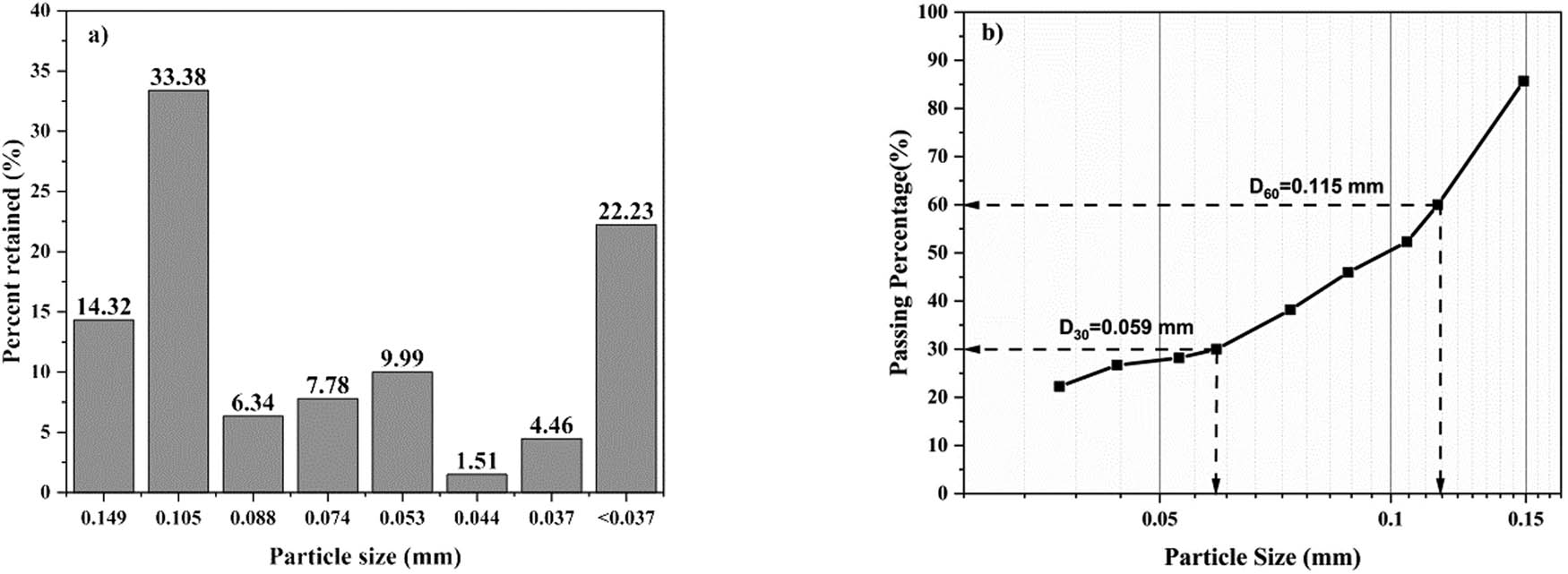
Figure 1
(a) Percent retained and (b) cumulative percent passing of the mine tailings.
As a result of the aforementioned analysis, the cumulative percentage passing was calculated (Figure 1b), yielding 30% (D 30) and 60% (D 60) for the tailings, as suggested by the Mexican standard M-MMP-1-02-03 [36]. The results obtained were D 30 = 0.059 mm and D 60 = 0.115 mm. Based on this standard, the material was classified as sand containing fines because more than 12% by mass passed through the No. 200 mesh.
The concentrations of Fe, As, Pb, Zn, Cu, and Ca in the different particle-size fractions are shown in Table 4. A clear trend is observed: the smaller the particle size, the greater the release of the analyzed elements, suggesting that the metals tend to concentrate in the finer fractions. Of particular note is Fe, with a concentration of 1.878% at a particle size of less than 0.037 mm.
Table 4
Elemental composition of the tailings at different particle sizes.
| Particle size (mm) | Elemental composition (Wt%) | |||||
|---|---|---|---|---|---|---|
| Fe | As | Pb | Zn | Cu | Ca | |
| 0.149 | 0.837 | 0.005 | 0.038 | 0.018 | 0.009 | 0.083 |
| 0.105 | 0.880 | 0.004 | 0.026 | 0.014 | 0.008 | 0.086 |
| 0.088 | 1.939 | 0.005 | 0.048 | 0.029 | 0.031 | 0.157 |
| 0.074 | 1.028 | 0.004 | 0.022 | 0.014 | 0.021 | 0.089 |
| 0.053 | 1.597 | 0.000 | 0.024 | 0.028 | 0.021 | 0.115 |
| 0.044 | 1.666 | 0.000 | 0.024 | 0.029 | 0.009 | 0.109 |
| 0.037 | 1.827 | 0.000 | 0.076 | 0.031 | 0.012 | 0.104 |
| <0.037 | 1.878 | 0.005 | 0.056 | 0.028 | 0.020 | 0.116 |
However, the variability observed among the fractions indicates a heterogeneous composition of the material, necessitating the estimation of a representative overall composition to evaluate the content of potentially toxic elements. For this reason, it is necessary to consider a reference overall composition () that allows for the calculation of the total percentage of potentially toxic elements previously analyzed. To do so, equation (1) reported by Ruiz-Sánchez et al. [37] was used, where n corresponds to each of the eight particle sizes, is the mass percentage retained in each fraction n (Figure 1a) present in the tailings, and represents the metal composition for each particle size.
The results of this calculation, shown in Table 5, indicate an average composition in the tailings of 1,300% Fe, 0.004% As, 0.037% Pb, 0.021% Zn, 0.015% Cu, and 0.101% Ca. In addition, a spot analysis of the tailings was performed using XRF (Table 5), a nondestructive technique that provides results quickly. According to the results, Si is the most abundant element, with a concentration of 25.012%, followed by Fe (1.890%). A significant concentration of Ca was also identified, with an average value of 0.209%.Table 5
Metal content in mine tailings for a random sample quantified by ICP and XRF.
| Elements | ICP | XRF | Average |
|---|---|---|---|
| Fe | 1.300 | 1.890 | 1.595 |
| As | 0.004 | — | — |
| Pb | 0.037 | 0.064 | 0.051 |
| Zn | 0.021 | 0.112 | 0.067 |
| Cu | 0.015 | 0.016 | 0.015 |
| Ca | 0.101 | 0.316 | 0.209 |
| Si | — | 25.012 | — |
| S | — | 1.562 | — |
| K | — | 1.195 | — |
| Ti | — | 0.444 | — |
| Mn | — | 0.462 | — |
| Rb | — | 0.002 | — |
| Sr | — | 0.005 | — |
| Y | — | 0.002 | — |
| Zr | — | 0.005 | — |
| Mo | — | 0.004 | — |
| Th | — | 0.004 | — |
| BAL | — | 63.376 | — |
BAL = light elements such as oxygen (molecular weight ≤ Mg).
The combined presence of silicon, calcium, and iron is a key component in the chemical composition of Portland cement. The presence of these elements in the mining residue suggests they may participate in hydration mechanisms and promote the formation of cementitious products such as calcium silicate hydrate (C-S-H), thereby enhancing its value as a partial cement substitute.
3.2. Mineralogical characterization of mining tailings
Figure 2 shows the diffractogram of the analyzed tailings sample. The mineralogical phases were identified using the Materials Data JADE software and the PDF-2 database. The peaks in the diffraction pattern were assigned to the following phases: quartz (SiO₂) [PDF 46-1045], moganite (silica polymorph, SiO₂) [PDF 46-1441], gypsum (CaSO₄·2H₂O) [PDF 21-0816], rozenite (FeSO₄·4H₂O) [PDF 19-0632], and sanidine ((K,Na)(Si₃Al)O₈) [PDF 19-1227]. The highest-intensity peak corresponds to quartz, indicating its predominance in the tailings’ mineralogical matrix. This composition is consistent with the findings reported by Moreno et al. [38], Patiño et al. [39], and Hernández et al. [40], who also identified a high proportion of siliceous phases in tailings from nearby deposits.
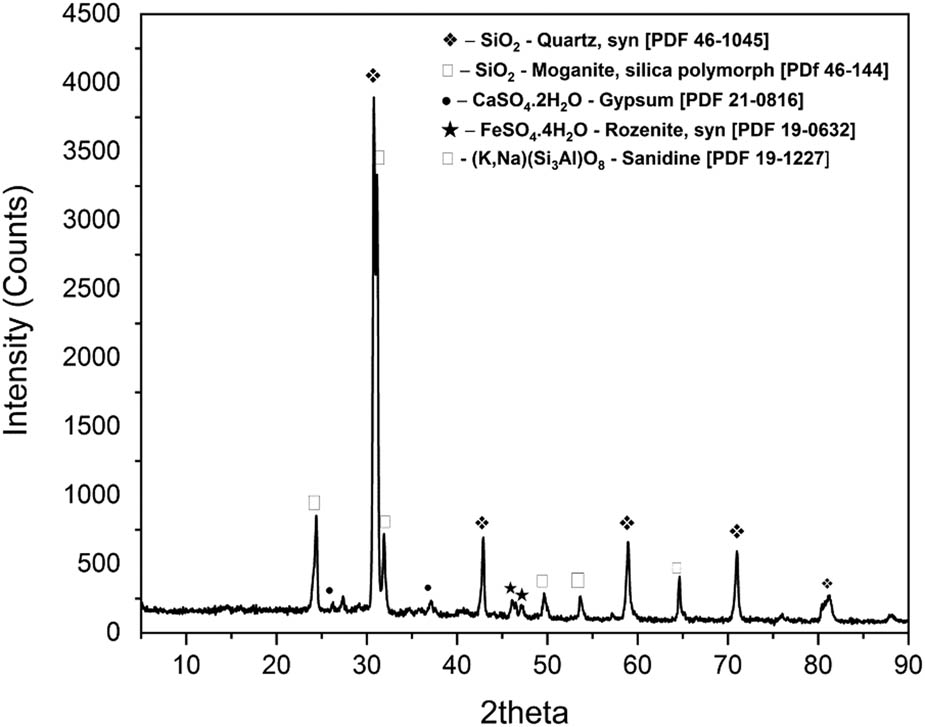
Figure 2
X-ray diffraction pattern of the “Dos Carlos” mining tailings dam, Mineral de la Reforma, Hidalgo, Mexico.
To evaluate the spatial distribution of elements in the tailings, elemental maps were generated using EDS and are presented in Figure 3. The SEM micrograph in the same figure reveals a heterogeneous surface composed of particles of varying sizes and morphologies. The elemental maps show that the major elements (Si, O, Al, Fe, and K) are relatively homogeneous across the analyzed area, whereas Ca, Mg, Na, S, Zn, Mn, As, Pb, and Co occur at lower concentrations and are more localized, indicating regions of elemental enrichment associated with minor mineral components. Taken together, the elemental maps complement the information obtained from XRD and enable visualization of the spatial distribution of elements in the tailings.
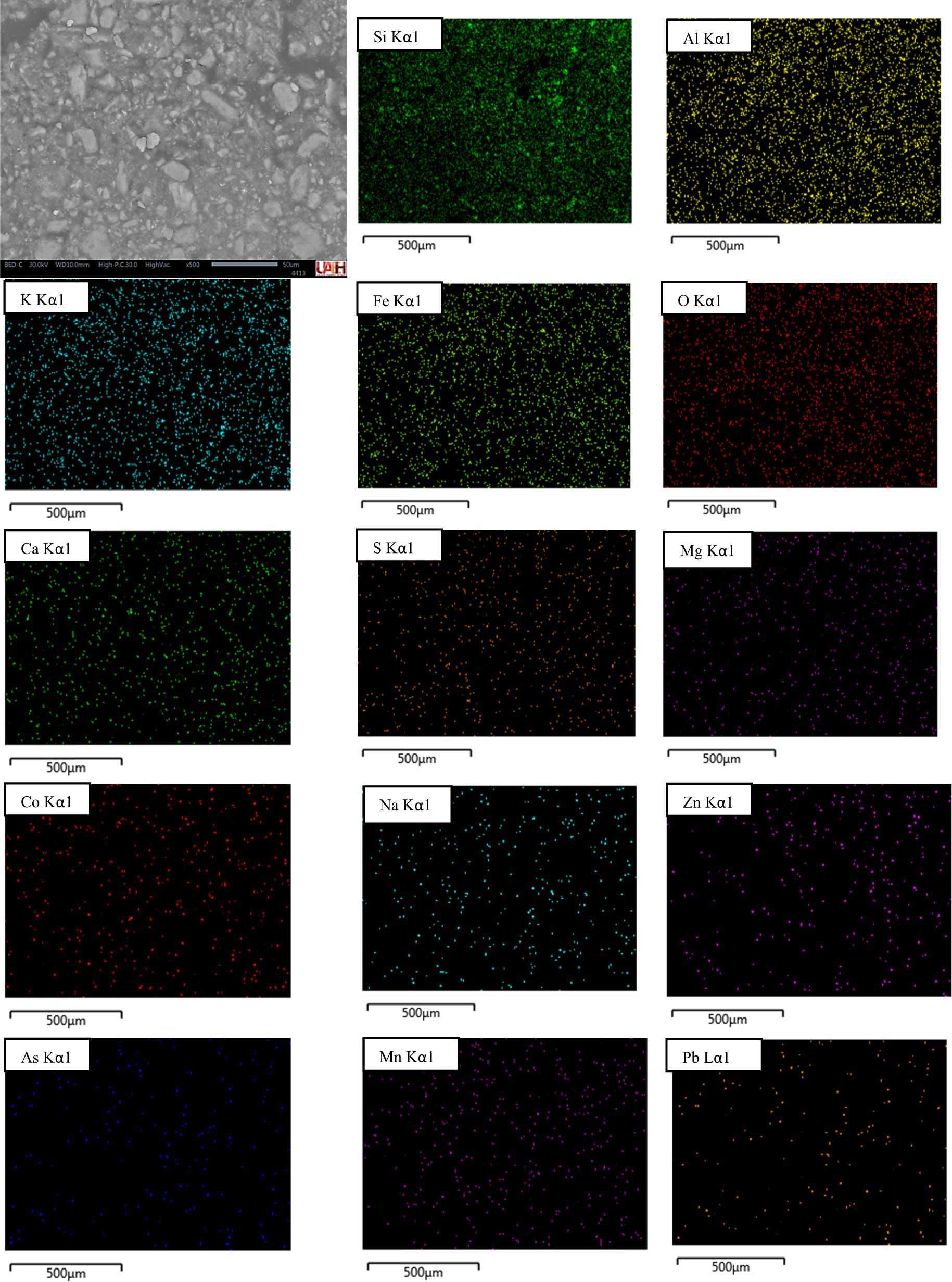
Figure 3
General micrograph of the tailings and elemental distribution maps obtained using SEM–EDS.
To supplement the information from the elemental maps, Figure 4 presents the EDS spectrum and the semi-quantitative elemental composition of the analyzed region. The results indicate that the predominant elements are oxygen, silicon, aluminum, iron, and potassium, consistent with the predominance of quartz and aluminosilicate minerals identified by XRD.
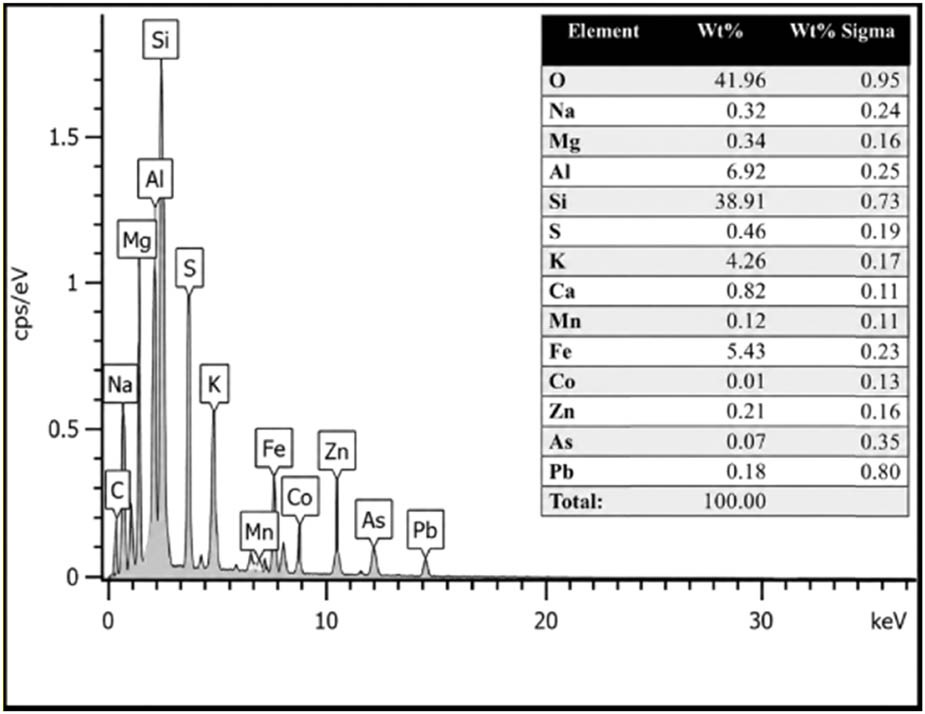
Figure 4
Energy-dispersive spectrum of the mineral species related to elemental content.
3.3. Sequential extraction
Sequential extraction allowed us to evaluate the geochemical distribution of potentially toxic elements present in the MTs and to determine the mineral phases responsible for their retention. The results are shown in Figure 5. In stage 1, a limited release of elements was observed, with calcium (9.78%) being the only predominant element. This behavior indicates a low concentration of highly soluble salts, consistent with the findings described in Section 3.1, “Physical and Chemical Characterization of Mine Tailings,” suggesting that the immediate mobility of metals is reduced under normal environmental conditions.On the other hand, in stage 2 of the sequential analysis, a significant release of calcium (Ca, 42.29%), zinc (Zn, 17.31%), lead (Pb, 11.12%), and copper (Cu, 6.93%) was recorded, suggesting that these elements are associated with carbonate phases. These phases, together with the silicates previously identified by XRD and scanning electron microscopy coupled with energy-dispersive spectroscopy, may play a temporary role in the in situ neutralization of acid drainage, according to reactions 2 through 4:
However, if the material is not properly stabilized, its chemical buffering capacity decreases. In this scenario, incorporating tailings into highly alkaline cementitious matrices, such as concrete, is an effective strategy for immobilizing toxic elements. In systems with a pH greater than 12, metals tend to precipitate as compounds with very low solubility, significantly reducing their mobility and, consequently, the risk of environmental contamination. This condition promotes the geochemical stability of the waste while contributing to the sustainability of low-environmental-impact construction materials.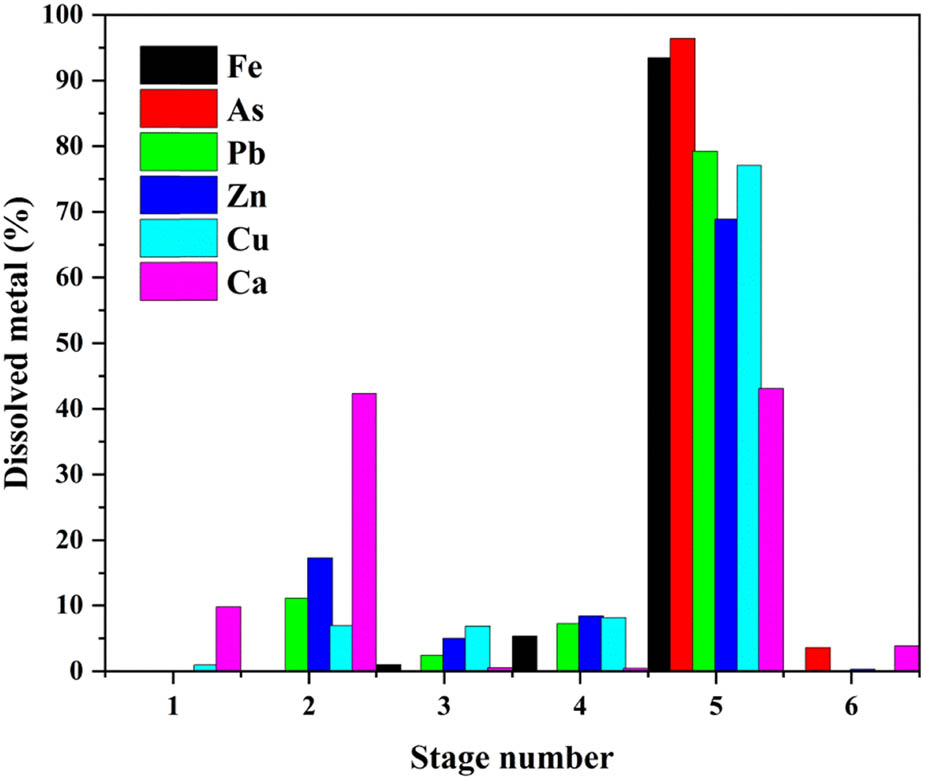
Figure 5
Evaluation of the mobility of potentially toxic metals present in mining tailings through sequential extraction.
In stages 3 and 4, a slight release of the analyzed ions (except arsenic) was observed, associated with the dissolution of oxides and hydroxides in the tailings. However, the percentages extracted were notably lower than those observed in stage 5, indicating that these stages are not the primary reservoir for the analyzed elements.
However, the greatest release of metals occurred during stage 5, in which 93.46% of the iron and 96.39% of the arsenic were extracted, along with the highest proportions of zinc (68.86%), copper (77.09%), lead (79.23%), and calcium (43.07%). This behavior is attributed to the oxidizing mixture of HCl, HNO₃, and KClO₃, which is specifically designed to dissolve primary sulfides. The results suggest that a significant fraction of the elements present in the tailings is associated with sulfide minerals, likely pyrite (FeS₂), arsenopyrite (FeAsS), and other metallic sulfides characteristic of the Pachuca–Real del Monte mining district [41].
When exposed to water and atmospheric oxygen, sulfide minerals may undergo oxidative weathering, releasing sulfate and generating acid. In the case of pyrite, AMD formation involves pyrite oxidation, oxidation of Fe(II) to Fe(III), and subsequent hydrolysis and precipitation of ferric iron, as summarized in reactions (5)–(8) [42]:
Arsenopyrite oxidation also releases arsenic, initially as As(iii), along with Fe(ii) and sulfate; subsequent oxidation produces As(v) species and additional acidity, as described in reactions (9) [43] through (12) [44]: Finally, stage 6 showed residual release of elements, indicating that only a minor fraction remains retained in silicates and structurally stable minerals. This behavior is consistent with the XRD results, which identified a predominance of siliceous phases, including quartz and moganite.3.4. Compressive strength test
Figure 6 presents the compressive strength results for mixtures prepared with different percentages of cement replacement by MTs, evaluated at 7, 14, 28, and 60 days. Although the most commonly used ages for the mechanical characterization of concrete are 7 and 28 days, this study also considered ages of 14 and 60 days to analyze the evolution of mechanical behavior and the possible effect of fine particles in the tailings on strength development.
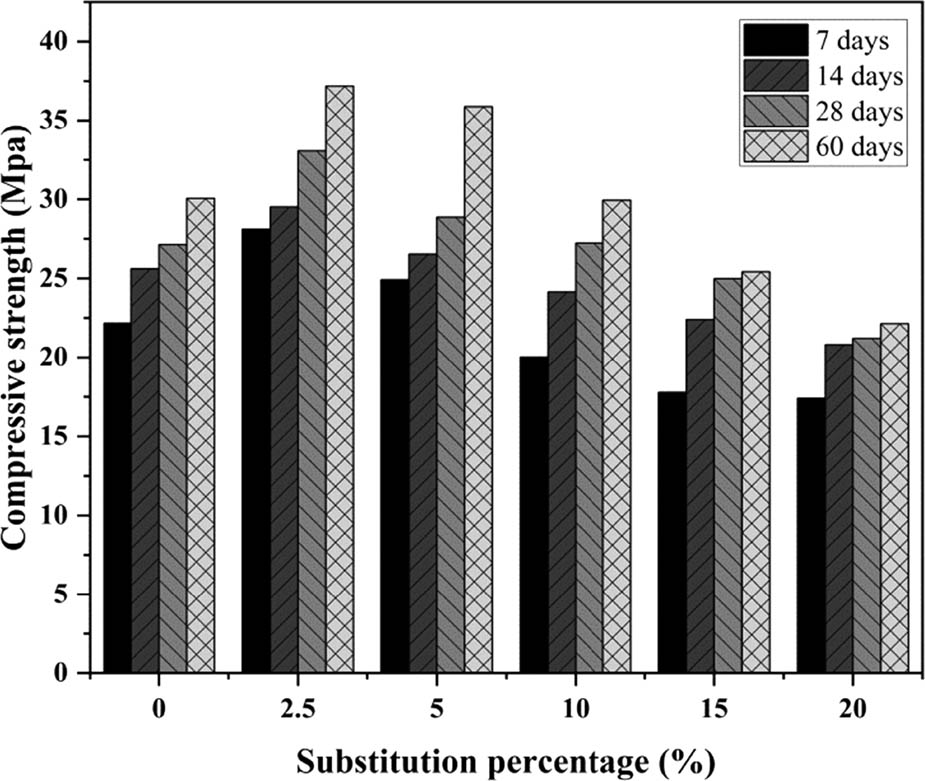
Figure 6
Comparison of compressive strength tests on cylinders with all cement replacement percentages.
The results show that the mixtures with 2.5% and 5% replacement exhibited superior performance compared to the reference concrete. The mixture with 2.5% replacement reached a maximum strength of 37.17 MPa at 60 days, exceeding the control concrete (30.06 MPa) by approximately 23.7%. Similarly, the mixture with 5% replacement achieved a strength of 35.88 MPa, representing a 19.4% increase over the reference mixture.
The increase in strength observed for the mixtures containing 2.5% and 5% can be attributed to the fine particles and siliceous phases (quartz and moganite) present in the tailings, which favor the filling effect within the cementitious matrix. This suggests that the observed improvement is primarily attributable to physical particle-packing effects rather than to a pozzolanic contribution, as demonstrated in the previous study [25].
On the other hand, when the replacement percentage was at or above 10%, the mechanical strength decreased. At 60 days, the mixtures with 15% and 20% reached strengths of 25.42 and 22.14 MPa, respectively. This behavior can be explained by the predominance of the cement dilution effect. As the amount of tailings increases, the clinker content available for hydration decreases proportionally, reducing the amount of cement available for hydration (C-S-H) and, consequently, the potential formation of hydration products responsible for the development of mechanical strength. Due to the predominantly crystalline nature of the tailings, the benefit of the filling effect no longer compensates for the reduction in cementitious material, resulting in a gradual decline in strength.
To correlate mechanical behavior with microstructural evolution, a SEM analysis coupled with EDS was performed on mixtures with 2.5% and 20% cement replacement by mining tailings; the results are presented in Figures 7 and 8.
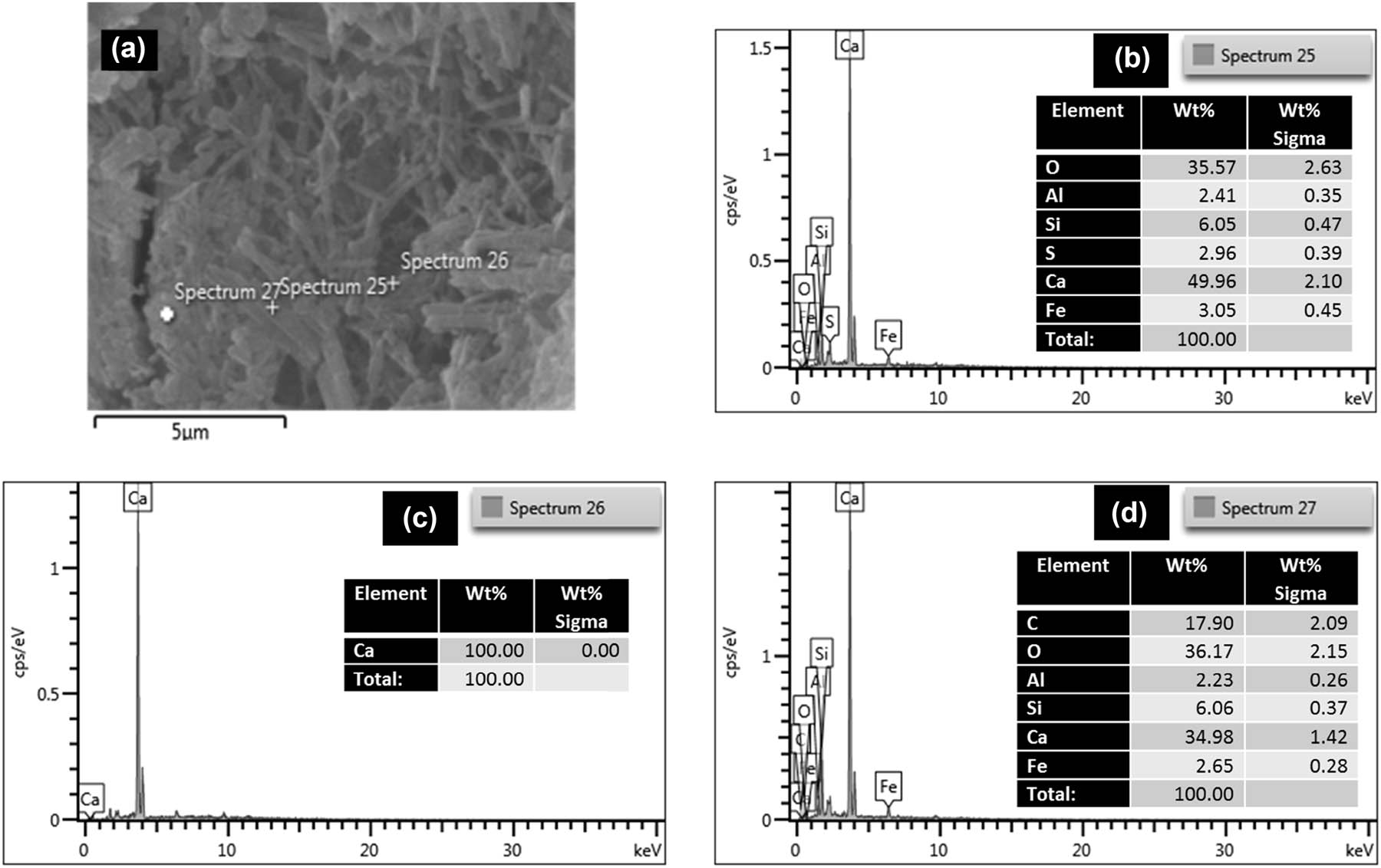
Figure 7
Microstructure of the mixture with 2.5% cement replacement by mine tailings obtained via SEM at 5 µm scale: (a) general view of the cementitious matrix and (b–d) EDS spectra of representative regions corresponding to hydration products and tailings particles.
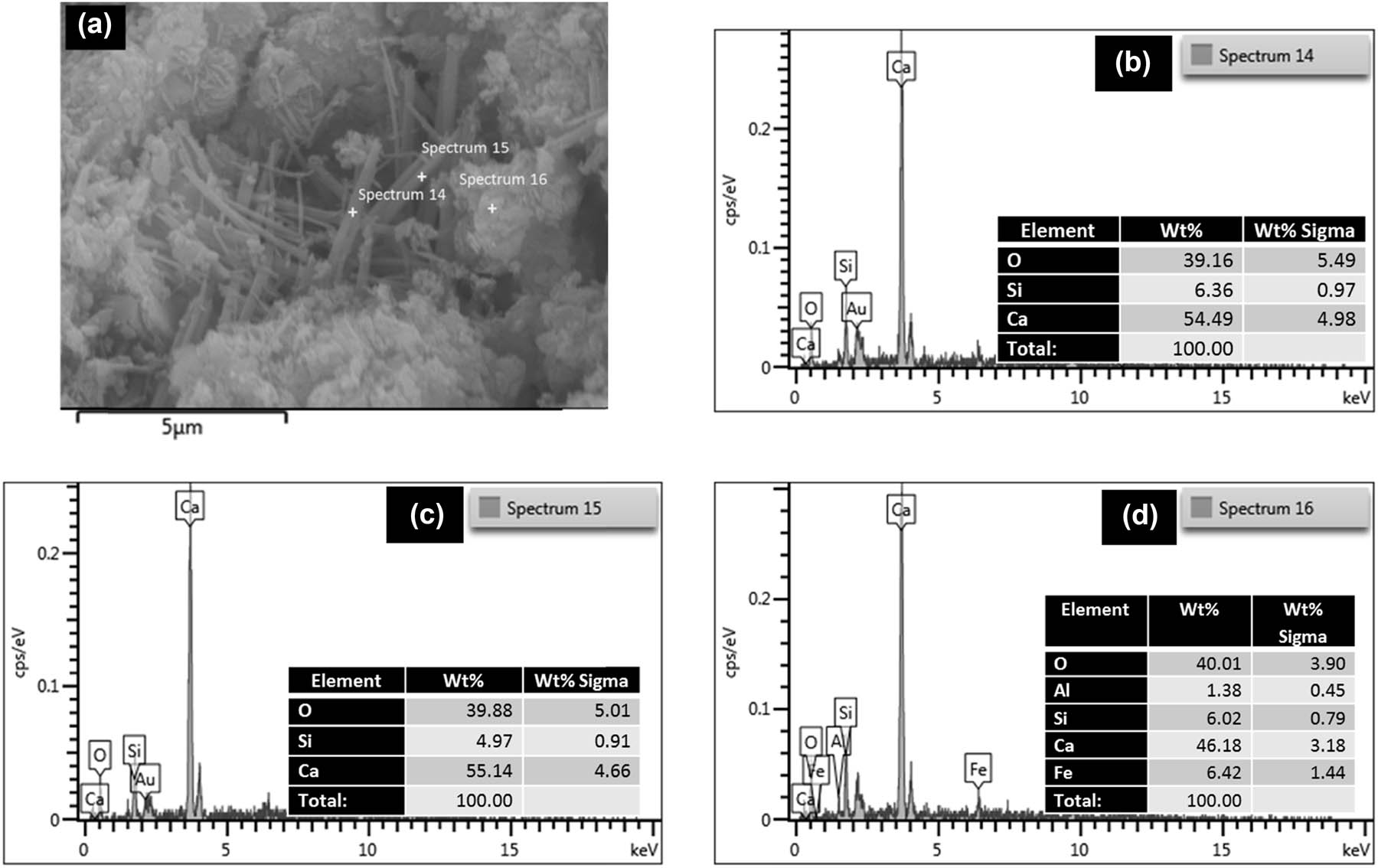
Figure 8
SEM micrograph (5 µm scale) of the concrete mixture with 20% cement replacement by mine tailings: (a) general microstructure and (b–d) EDS point analysis corresponding to the selected regions.
Figure 7, corresponding to the mixture with 2.5% substitution, shows a relatively compact and continuous cementitious matrix (Figure 7a), characterized by homogeneously distributed acicular structures and adequate integration between the tailings particles and the cement paste. The EDS spectrum in Figure 7b represents a mixed phase. The acicular morphology, combined with the presence of Ca, O, Al, and S, is highly characteristic of ettringite or other hydrated calcium sulfate phases in cement matrices. On the other hand, the spectrum in Figure 7c corresponds to a single-point measurement, indicating the presence of Ca, while the spectrum in Figure 7D shows the simultaneous detection of C, O, and Ca in high proportions – a composition consistent with calcium carbonate (CaCO₃). Both products may be associated with carbonation processes or with calcareous particles present in the cementitious matrix.
In contrast, Figure 8, corresponding to the mixture with 20% substitution, shows a less compact microstructure and a greater presence of tailings particles distributed within the cementitious matrix (Figure 8a). Although acicular structures consistent with hydration products continue to be observed, these are surrounded by mineral particles with irregular morphology, indicating lower continuity of the cementitious phase compared to the mixture with 2.5% substitution.
The EDS analyses in Figure 8b and c, performed on the acicular structures, show very similar compositions, dominated by Ca (54.49 and 55.14 wt.%), O (39.16 and 39.88 wt.%), and small amounts of Si (6.36 and 4.97 wt.%). These results are consistent with calcium-rich hydration products, which, based on their shape (Figure 8a), are primarily associated with ettringite, while the detected silicon may be associated with both the C-S-H gel and the proximity of fine tailings particles incorporated into the cementitious matrix. The Au signals observed in the spectra correspond exclusively to the metal coating applied during sample preparation for SEM analysis and are not part of the concrete’s composition.
The spectrum corresponding to Figure 8d, obtained from the surrounding matrix, exhibits a more heterogeneous composition, consisting of Ca (46.18 wt.%), O (40.01 wt.%), Fe (6.42 wt.%), Si (6.02 wt.%), and Al (1.38 wt.%). The simultaneous presence of Fe, Si, and Al indicates the incorporation of particles from the tailings into the cement paste, consistent with chemical and mineralogical characterization previously obtained via XRF and XRD, which identified a predominance of quartz, moganite, and iron-rich minerals.
3.5. Chloride permeability test
Figure 9 shows the relationship between compressive strength and chloride ion permeability for mixtures prepared with different percentages of cement replacement by MTs. According to ASTM C1202 [32], all mixtures are classified as high-permeability concrete, as they recorded values greater than 4,000 C [45].
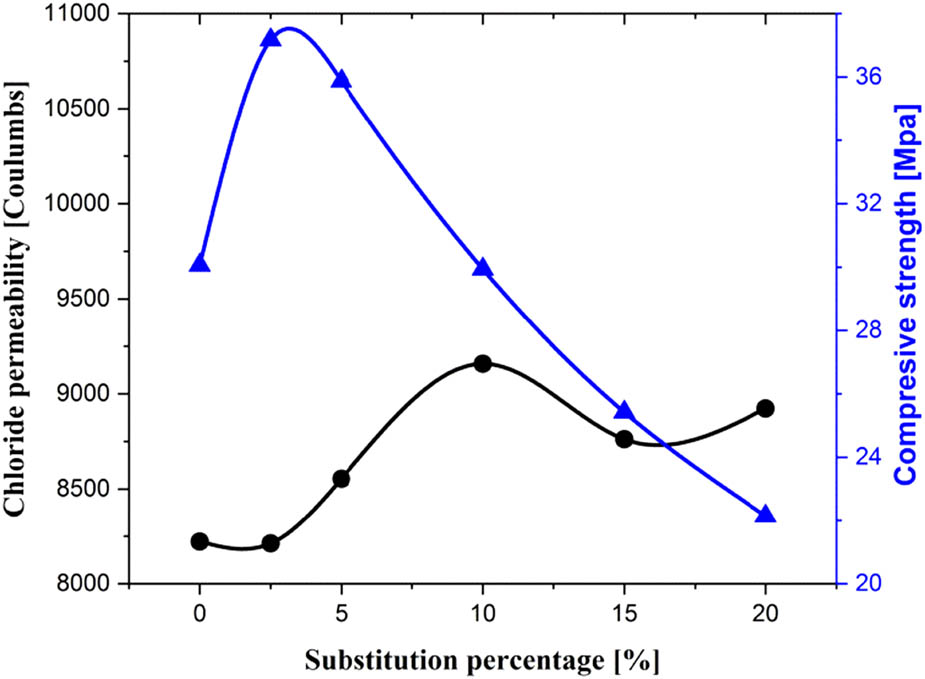
Figure 9
Relationship between chloride permeability (coulombs) and compressive strength (MPa) of concretes with cement replacement by MT.
The mixture with 2.5% substitution exhibited an electrical charge nearly equal to that of the reference concrete and, at the same time, the highest mechanical strength in the study. This result indicates that incorporating small amounts of tailings does not significantly affect ionic transport while improving the mechanical performance of the concrete [46].
As the replacement percentage increased to 10%, the electric charge increased, reaching the maximum value in the study (10,645.1 C). This behavior can be attributed to the reduced amount of cement available to form hydration products, which promotes greater connectivity within the porous network and, consequently, increases ion transport.
For mixtures with 15 and 20% replacement, a slight decrease in electrical charge was observed; however, the mechanical strength continued to decrease. This indicates that the permeability determined by the RCPT test is not linearly related to compressive strength since the measured electrical charge depends on both the pore structure and the ionic composition of the solution in the concrete.
4. Conclusions
The tailings studied were dominated by crystalline siliceous phases, primarily quartz and moganite, and contained a significant fraction of fine particles. These characteristics primarily favor a filling and packing effect within the cementitious matrix, while the crystalline nature of the silica limits its participation in pozzolanic reactions. Sequential extraction also showed that a significant proportion of the analyzed elements was associated with more stable fractions, complementing the evaluation of the tailings’ composition.
Partial cement replacement showed a response that depended on the tailings content. A 2.5% replacement produced the highest compressive strength, reaching 37.17 MPa at 60 days, compared with 30.06 MPa for the reference concrete, representing a 23.7% increase. A 5% replacement also outperformed the control, with 35.88 MPa. This increase is primarily due to the packing effect of the fine particles. Starting at 10%, further increases in tailings no longer compensated for the reduction in cementitious material, and strengths decreased to 25.42 and 22.14 MPa for 15% and 20%, respectively. SEM-EDS observations were consistent with this trend, showing a more continuous matrix at 2.5% and a greater presence of mineral particles with reduced continuity of the cementing phase at 20%.
Chloride transport behavior did not improve with the incorporation of tailings. All mixtures exhibited chloride transport values greater than 4,000 C, indicating a high-permeability classification per ASTM C1202. The mixture with 2.5% substitution showed 8,616 C, comparable to the control (8,350 C), while the maximum value of 10,645 C was obtained with 10% substitution. Although the mixtures with 15% and 20% substitution had values below the maximum, they remained in the same classification; therefore, these results do not indicate a substantial improvement in resistance to chloride transport.
Overall, the 2.5% replacement rate provided the best balance between mechanical performance and resistance to chloride transport under the conditions studied. The results indicate that for this tailings material, the benefits of the filler effect are most evident at low replacement levels, whereas high replacement levels are constrained by the reduced availability of cementitious material. Therefore, using low percentages of tailings is a technically promising alternative for partially reducing cement consumption; however, its application in chloride-exposed environments requires further durability studies.
On the other hand, mixtures with replacement contents of 10% or more showed a progressive decrease in mechanical strength. At 60 days, the mixtures with 15% and 20% MT reached strengths of 25.42 MPa and 22.14 MPa, respectively. This reduction can be attributed primarily to the dilution of cement since increasing the substitution percentage reduces the amount of clinker available to form hydration products – particularly calcium silicate hydrate (C-S-H) gel – which is responsible for the development of mechanical strength. Furthermore, XRD analysis indicates a predominance of crystalline silica, suggesting limited chemical reactivity of the tailings; therefore, at high substitution percentages, the benefit of the filler effect is insufficient to offset the reduction in cementitious material.
Acknowledgements
Melissa Gordillo Salazar, the first author, gratefully thanks the Secretaría de Ciencia, Humanidades, Tecnología e Innovación (SECIHTI, Mexico) for funding her postgraduate studies with a doctoral scholarship. All the authors acknowledge the Consejo de Ciencia, Tecnología e Innovación de Hidalgo (CITNOVA) for providing access to the facilities and equipment used in part of the experimental characterization. The authors are also grateful to the Universidad Autónoma del Estado de Hidalgo (UAEH), specifically the Earth and Materials Sciences Academic Area, for its technical and institutional support, and the Universidad Autónoma de Chiapas (UNACH) for its academic and laboratory staff's help and the facilities for mechanical testing.
Funding information
Authors state no funding involved.
Author contributions
Melissa Gordillo Salazar: Investigation, Methodology, Formal analysis, Data curation, Writing – original draft. Erick Jesus Muñoz Hernandez: Investigation, Methodology, Validation. Martin Reyes Pérez: Methodology, Formal analysis, Writing – review & editing. Julio Cesar Juárez Tapia: Investigation, Resources, Formal analysis. Alexander López González: Investigation, Methodology, Validation. Ana María Bolarín Miró: Conceptualization, Supervision, Writing – review & editing. Màrius Ramírez Cardona: Conceptualization, Investigation, Formal analysis, Supervision, Writing – review & editing.
Conflict of interest statement
Authors state no conflict of interest.