
1. Introduction
Additive manufacturing (AM) technologies enable the direct fabrication of three-dimensional parts from computer-aided design (CAD) data through layer-by-layer material deposition following slicing and process planning stages. Depending on the selected AM method and material system, post-processing steps such as support removal, post-curing, surface finishing, or machining may be required to achieve the desired functional and dimensional characteristics [1].
Among photopolymerization-based AM techniques, Digital light processing (DLP) has emerged as a prominent method due to its high printing speed and capability to fabricate geometrically complex structures with fine surface quality. In the DLP systems, a liquid photopolymer resin is selectively cured by patterned light exposure, where each layer is polymerized simultaneously rather than through point-wise scanning, as in Stereolithography. This area-based curing mechanism enables significantly shorter build times while maintaining high dimensional precision [2].
Today, two main masking techniques are used in the DLP method: LCD-based and projection-based systems. In the LCD-based DLP systems, the liquid photopolymer is cured only in permeable regions by masking the light source through an LCD screen. In the projection-based systems, the layer geometry is directly projected through digital projectors, and the liquid resin is polymerized simultaneously with the light pattern consisting of the unmasked parts of the projection lamp. DLP and LCD AM methods are shown schematically in Figure 1.
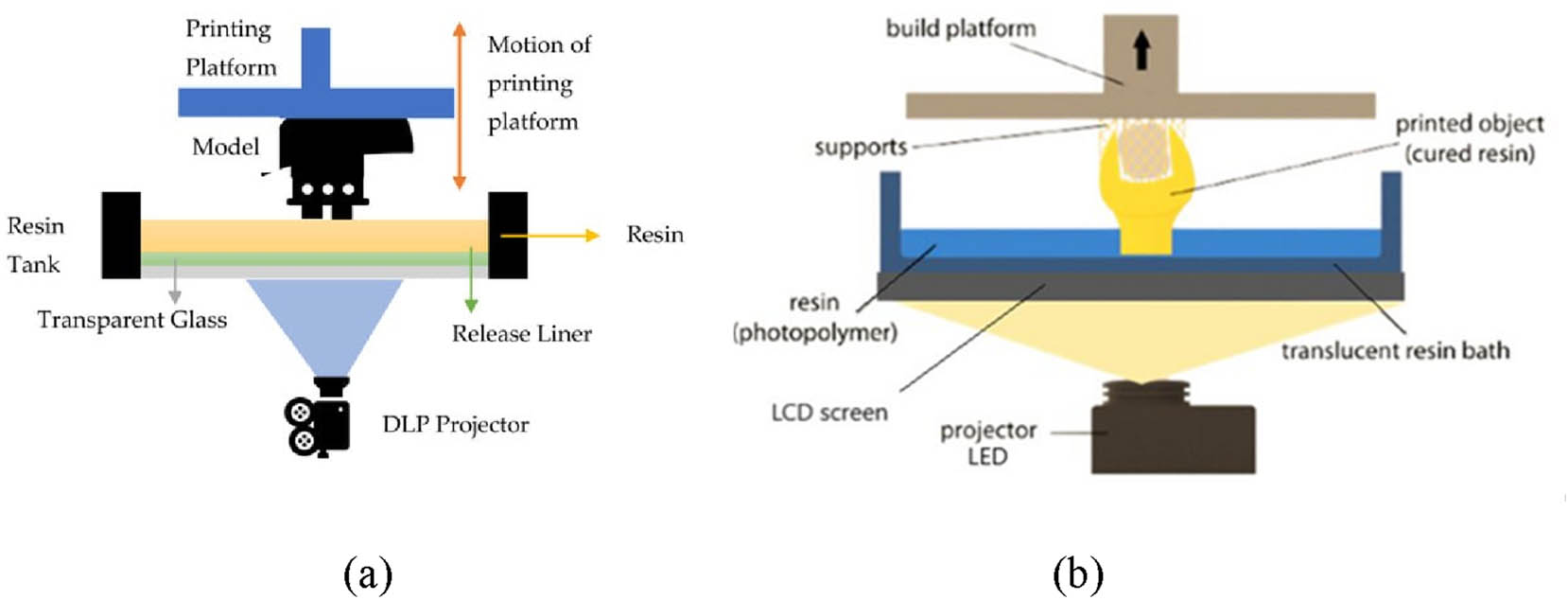
Figure 1
(a) Schematic representation of the DLP method (upstream) [3] and (b) schematic representation of the LCD method [4].
DLP-based AM has been widely adopted in applications that demand high resolution, sharp edge definition, and dimensional fidelity at the microscale. These applications include dental restorations and surgical guides, microfluidic devices, micro-optical components, precision casting patterns, ceramic-based functional parts, and other geometrically demanding structures. Despite this broad applicability, achieving consistent high resolution remains challenging in projection-based DLP systems, particularly in low-cost configurations where optical limitations become more pronounced [5–8].
Projection-based DLP systems rely on digital micromirror device (DMD) technology, which consists of arrays of independently tilting micromirrors that define the spatial light pattern for each layer [9]. However, the fixed pixel counts of the DMD, and the optical expansion required to project the image onto the resin surface inherently limit the achievable resolution in the XY plane. As the projection distance increases, the effective pixel size increases, leading to a reduction in lateral resolution. Figure 2 illustrates the conventional downward and upward projection configurations commonly employed in DLP systems.
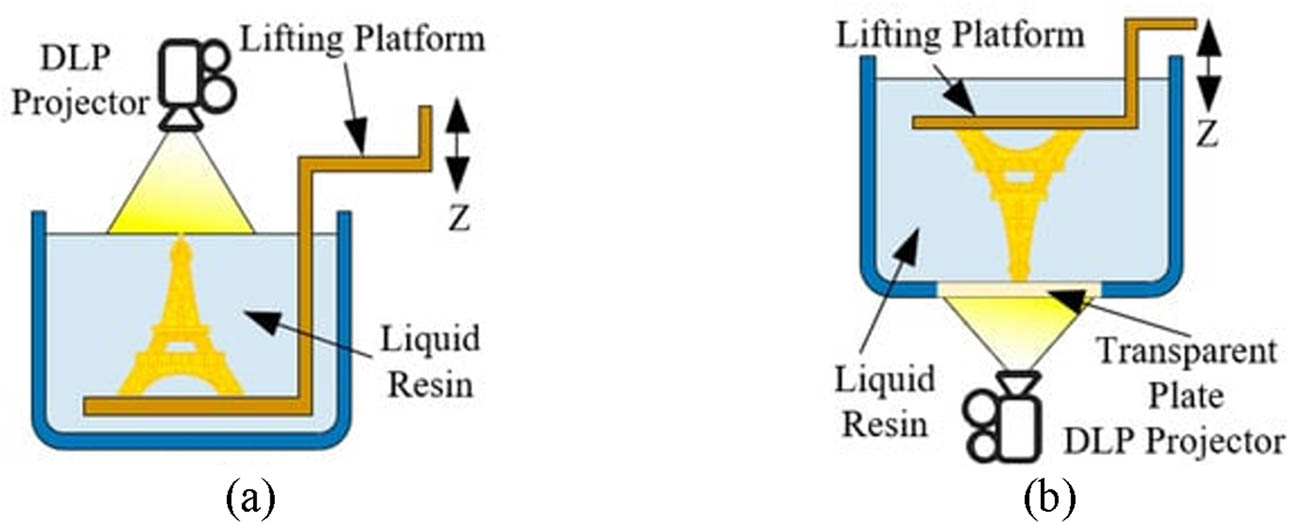
Figure 2
(a) Downward DLP projection and (b) upward DLP projection [13].
A fundamental limitation of the projection-based DLP systems arises from the angular incidence of light on the photopolymer surface. When the projected light does not reach the build plane at normal incidence, the resulting voxel geometry deviates from the ideal rectangular prism shape. Angled illumination induces lateral light spreading within the resin, leading to broadened voxel bases, blurred pixel boundaries, and geometric distortions, particularly near part edges and fine features [10]. As schematically illustrated in Figure 3, oblique light propagation can cause two primary curing defects: excessive energy deposition near the voxel base, resulting in unintended polymerization beyond the designed voxel boundaries (unintended curing), and insufficient exposure near the voxel top, leading to incomplete polymerization (insufficient curing). The optically critical region where these competing curing mechanisms originate is indicated as region A in Figure 4. The resulting undesirable volume expansion in the lower regions of the voxels is consistent with the light propagation behavior described by the pixel-based solidification model [11] and the geometric deviations associated with the optical proximity effect reported in the literature [12].
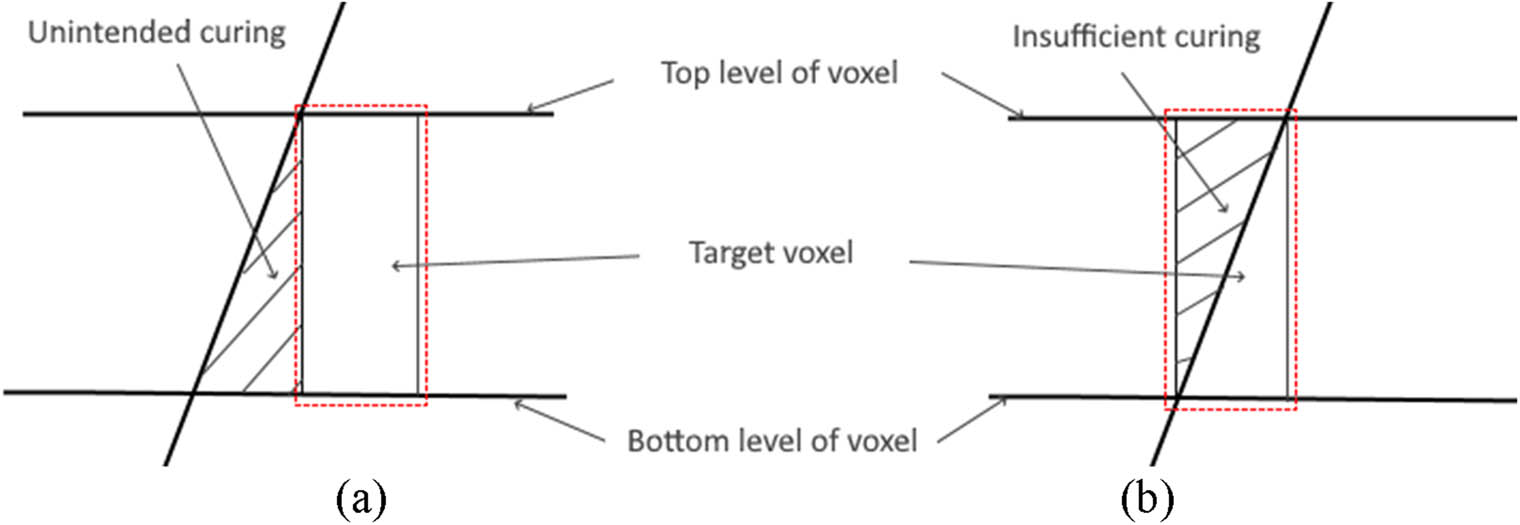
Figure 3
Schematic illustration of voxel curing defects induced by oblique light incidence: (a) Unintended curing of material adjacent to the target voxel and (b) insufficient curing within the target voxel caused by reduced effective exposure.
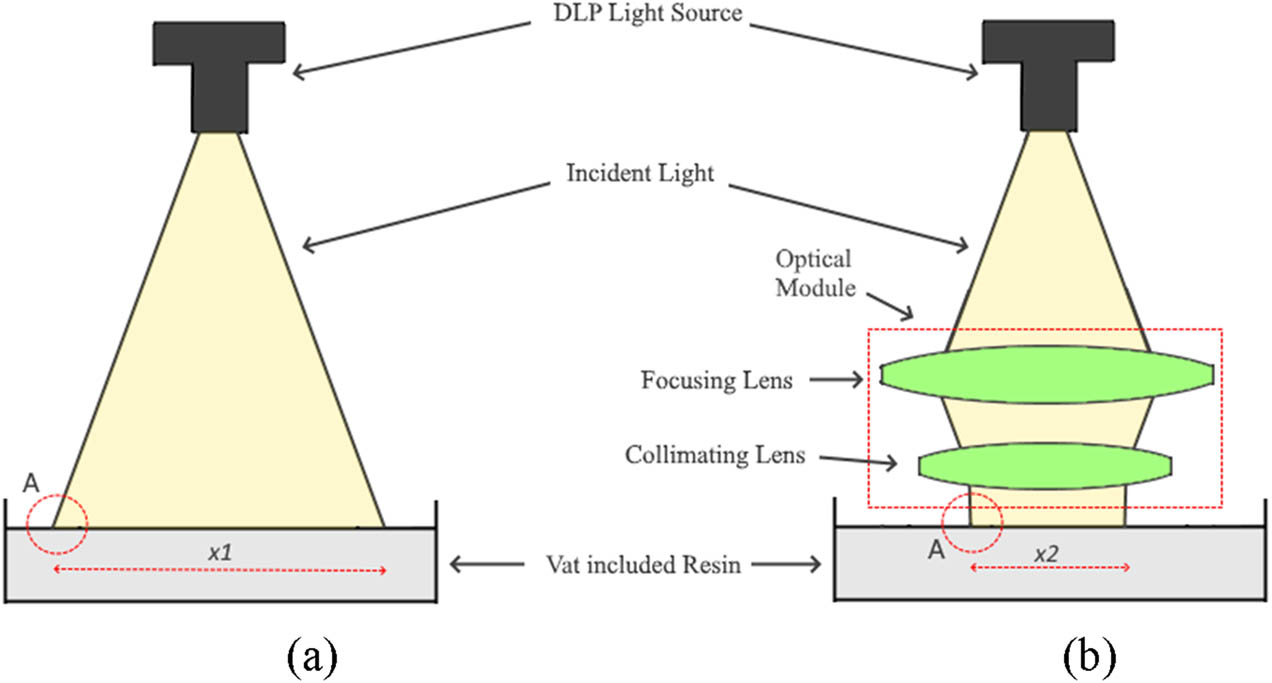
Figure 4
DLP 3D printer schematics: (a) Without optical module and (b) with optical module.
From a photopolymerization standpoint, these geometric voxel distortions are directly linked to the non-uniform spatial distribution of exposure energy within the resin. In the projection-based DLP systems, the curing behavior is commonly described by Jacob’s working curve, which relates curing depth (Cd) to the applied exposure energy and the optical penetration characteristics of the photopolymer. Under ideal conditions, uniform and perpendicular light incidence ensures a predictable and homogeneous energy distribution throughout the voxel volume. However, when light propagates at an oblique angle, the assumptions underlying Jacob’s working curve are locally violated, leading to excessive energy accumulation near the voxel base and insufficient exposure near the voxel top. This imbalance promotes simultaneous unintended curing and insufficient curing phenomena, ultimately degrading dimensional accuracy, surface quality, and interlayer bonding strength [14].
The Cd in photopolymerization-based AM is governed by Jacob’s working curve, and is expressed as
where D p represents the optical penetration depth of the resin, E max represents the maximum exposure energy delivered at the resin surface, and E c denotes the critical exposure energy required to initiate polymerization [14]. While this relationship assumes a uniform and perpendicular light field, deviations from normal incidence disrupt the local energy balance within the voxel. As a result, excessive exposure near the voxel base may trigger parasitic polymerization, whereas insufficient exposure near the voxel top can lead to incomplete curing and weakened interlayer adhesion. These effects collectively compromise dimensional fidelity, surface quality, and mechanical integrity in DLP-printed parts [15].By enforcing near-normal light incidence and increasing local irradiance, the proposed optical configuration partially restores the boundary conditions under which Jacob’s working curve is locally applicable at the voxel scale.
In addition to curing depth deviations, voxel bleeding – caused by unintended light propagation into neighboring pixels – further reduces feature clarity, especially in systems with low native pixel density or resins exhibiting significant optical scattering. Such effects collectively limit the achievable resolution and repeatability of low-cost DLP systems, despite their advantages in production speed [10].
To address these challenges, various resolution-enhancement strategies have been reported in the literature, including optical, mechanical, algorithmic, and material-based approaches. Valentinčič et al. [16] reported notable improvements in lateral resolution by physically modifying the internal optical path of a DLP projector using spacer-based lens repositioning, an approach that, while effective, requires disassembly and limits practical applicability in low-cost commercial systems. Huang et al. [17] introduced the Scalable DLP Printing Method (SDPM), which dynamically adjusts projection distance to balance resolution and build volume, achieving improved shape accuracy across a range of printing scales. Algorithmic approaches such as grayscale-based sub-pixel manipulation have also been proposed to exceed native DMD resolution limits [18], while material-based studies have focused on modeling and compensating for resin shrinkage and curing behavior [19].
These studies collectively indicate that resolution limitations in DLP systems arise from a complex interplay between optical geometry, light propagation, and photopolymerization kinetics. Among these factors, controlling the angular distribution and focusing of projection light represents a particularly effective yet underexplored pathway for improving lateral resolution without relying on computational complexity or material modification.
Despite the promising results reported in prior optical and algorithmic resolution-enhancement strategies, most existing approaches either rely on software-based grayscale manipulation, dynamic projection scaling, or complex calibration procedures that do not fundamentally address the angular light propagation at the photopolymerization plane. Moreover, optical solutions reported in the literature primarily focus on resolution improvement, while their influence on exposure efficiency and printing time is often treated as a secondary or implicit outcome. Consequently, a systematic investigation of hardware-based optical focusing and collimation strategies that simultaneously enforce near-normal light incidence, reduce effective pixel size, and enhance photopolymerization efficiency in low-cost DLP systems remains notably limited. As a result, voxel bleeding caused by lateral light spreading into neighboring pixels continues to be a persistent challenge.
To mitigate these voxel-induced defects, optical strategies that enforce near-normal light incidence at the resin surface are critically important. Normalized illumination promotes more uniform voxel formation, suppresses both unintended curing and insufficient curing effects, and leads to improved dimensional accuracy, enhanced surface quality, and stronger interlayer bonding.
In this study, a custom-designed optical focusing and collimation system is integrated between a commercial low-cost DLP projector and the photopolymer vat to directly address resolution degradation caused by angular light propagation. By concentrating the projected light onto a reduced exposure area and enforcing near-normal incidence at the resin surface, the proposed optical configuration enables a simultaneous reduction in effective pixel size, suppression of voxel distortions, and enhancement of lateral resolution. Although this approach inherently reduces the available build area, the resulting increase in irradiance significantly shortens layer exposure times, thereby improving the overall production efficiency.
Accordingly, this study investigates the effectiveness of a hardware-based optical geometry approach as a practical alternative to software-driven super-resolution methods for mitigating resolution constraints in low-cost DLP-based AM systems.
2. Materials and methods
In this study, a comparative experimental evaluation was conducted between a conventional DLP system and an optically modified configuration incorporating a focusing and collimation module. Both systems were assessed under consistent processing conditions to isolate the effect of optical geometry on printing performance. The evaluation was primarily performed in terms of lateral resolution, effective pixel size, and edge definition in the XY plane. Mechanical properties were not considered within the scope of this study, as the focus was placed on optical and geometrical performance.
To achieve this, a specially designed optical module was integrated between the digital projector and the photopolymer vat to mitigate resolution loss and dimensional inaccuracies arising from angular light propagation in DLP-based AM. The proposed optical configuration aims to reduce the effective pixel size in the XY plane by concentrating the projected light onto a smaller exposure area, thereby enhancing lateral resolution.
The optical module consists of a focusing lens used to reduce the illuminated area and a collimating lens employed to align the projection rays toward normal incidence at the resin surface. A schematic representation of the optical configurations is provided in Figure 4, where (a) illustrates the conventional DLP setup and (b) presents the proposed configuration incorporating the optical module.
By modifying the angular distribution of the projection light, the optical module promotes near-normal incidence at the build surface, thereby mitigating voxel distortions associated with curing defects discussed in Figure 3. As illustrated in Figure 4(a), conventional DLP systems exhibit oblique light incidence in peripheral regions (region A), whereas the proposed configuration enables near-normal light incidence through optical redirection and collimation (Figure 4(b)).
Concentrating the projection light onto a reduced cross-sectional area inherently limits the available horizontal build volume. This effect is illustrated in Figure 4 by the reduction in the illuminated area from ×1 in the conventional configuration to ×2 in the proposed system. However, this reduction leads to a corresponding increase in irradiance per unit area, which is expected to shorten the required layer exposure time and reduce the overall fabrication duration.
Photopolymerization experiments were conducted using an Acer X118H DLP projector operating in the visible spectrum (400–700 nm), where effective curing occurs near the resin activation wavelength of approximately 400 nm. A single daylight-sensitive photopolymer resin supplied by a local manufacturer was used throughout the study. To control the geometry and angular distribution of the projected light, a custom optical module composed of two bi-convex lenses was integrated into the projection path. The focusing lens had a diameter of 60 mm and a focal length of 133.3 mm, while the collimating lens had a diameter of 50 mm and a focal length of 222 mm. When positioned at an optimized distance, the equivalent focal length of the optical system was calculated as 83.3 mm based on collimator design.
In the conventional configuration, the projected light covered an area of approximately 50 cm2 on the resin surface; with the optical module, this area was reduced to nearly 12.5 cm2. This reduction increases the irradiance by approximately four times, which is expected to accelerate photopolymerization and allow each layer to cure within a shorter exposure duration.
To evaluate the effectiveness of the proposed approach, a modular DLP printing system was configured and operated both with and without the optical module. The influence of the optical system on lateral resolution and production efficiency was experimentally assessed by comparing effective pixel sizes and total printing times under identical processing conditions.
Exposure parameters were systematically adjusted depending on the presence or absence of the optical module, and the finalized printing conditions are summarized in Table 1. The exposure times were determined through preliminary trials to ensure sufficient curing and dimensional stability for each configuration. In the conventional setup, a longer exposure time (2,500 ms) was required due to lower energy density, whereas the optically modified system enabled effective curing at a significantly reduced exposure time (100 ms) due to increased localized irradiance. All other processing parameters, including resin type, layer thickness, and geometry, were kept constant to ensure a fair comparison.
Table 1
Printing parameters with and without optical module
| Parameters | Printing parameters without optical module | Printing parameters with optical module |
|---|---|---|
| Layer thickness | 0.065 mm | 0.065 mm |
| Number of layers | 82 | 82 |
| Lift and sequence time | 5,000 ms | 5,000 ms |
| Exposure time | 2,500 ms | 100 ms |
| First layer exposure time | 10,000 ms | 4,000 ms |
The Z-axis motion system was designed using an NEMA 17 stepper motor, a ball screw, and two linear guide shafts. System control was achieved using an Arduino Mega 2560 microcontroller. The printer was operated using the open-source Marlin firmware configured for DLP-based systems and synchronized with the Creation Workshop slicing software.
All system components, including the projector, optical module, resin vat, Z-axis mechanism, and control electronics, were mounted on a structural frame constructed from 20 mm × 20 mm aluminum profiles. To minimize shadowing effects caused by the projector housing, the projection unit was positioned at a 30° angle relative to the build platform while the optical module redirected the projection rays to achieve near-normal incidence at the resin surface. An overview of the developed DLP system is shown in Figure 5.
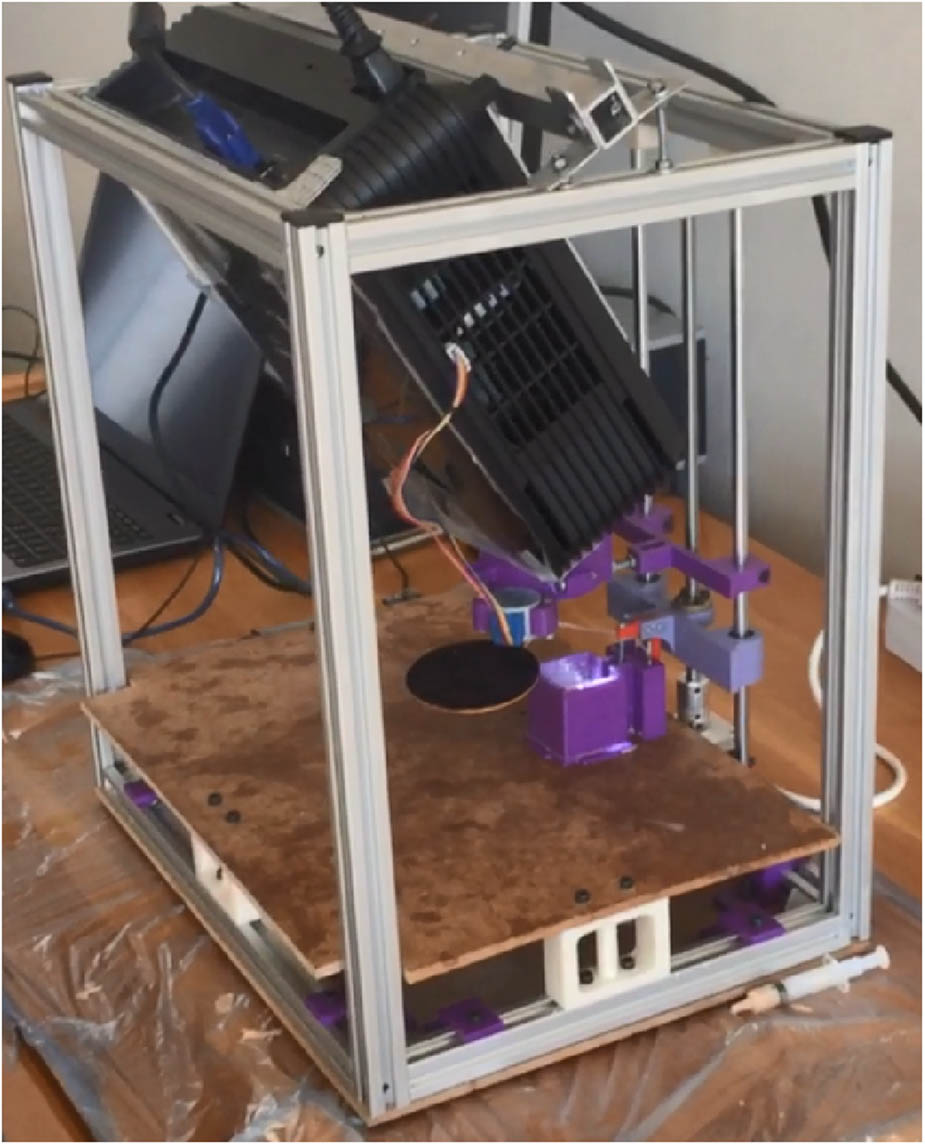
Figure 5
General view of the experiment setup.
Test specimens were fabricated with and without the optical module in accordance with the study objectives. Macroscopic dimensional accuracy was measured using a digital caliper, while lateral resolution characteristics were evaluated through optical microscope imaging of the samples in the XY plane. The acquired images were processed using ImageJ software. Calibration was performed using a 1 mm reference scale to convert pixel-based measurements into real dimensions. Pixel size was determined by measuring the distance between adjacent pixel boundaries in the XY plane. For each configuration, 10 measurements (n = 10) were taken from different regions of the specimens to ensure statistical reliability, and the results were expressed as mean value ± standard deviation. Z-directional resolution analysis was not included in this study, as the primary focus was placed on lateral resolution enhancement induced by optical projection control.
3. Results and discussion
In this study, a custom-designed optical module was successfully integrated into a projection-based DLP AM system to address resolution degradation and print quality limitations commonly observed in low-cost DLP printers. The proposed optical configuration improves lateral resolution by concentrating the projected light onto a reduced exposure area and by enabling near-normal incidence of light on the photopolymer surface. This configuration effectively suppresses voxel distortions associated with angular illumination during photopolymerization.
The fundamental strategy of the proposed approach is to enhance part resolution by reducing the effective projection area, thereby increasing the irradiance per unit area. As a consequence of optical focusing, the illuminated region on the resin surface is reduced, while the local light intensity is significantly increased. This increase in irradiance not only improves lateral resolution but also enables a substantial reduction in the exposure time required for curing each layer.
Some printed samples subjected to both visual inspection and microscopic evaluation are presented in Figure 6. The benchmark geometry shown in Figure 7 was fabricated under identical process conditions, without the optical module (left) and with the optical module integrated into the projection path (right). All samples were produced using a layer thickness of 0.065 mm.
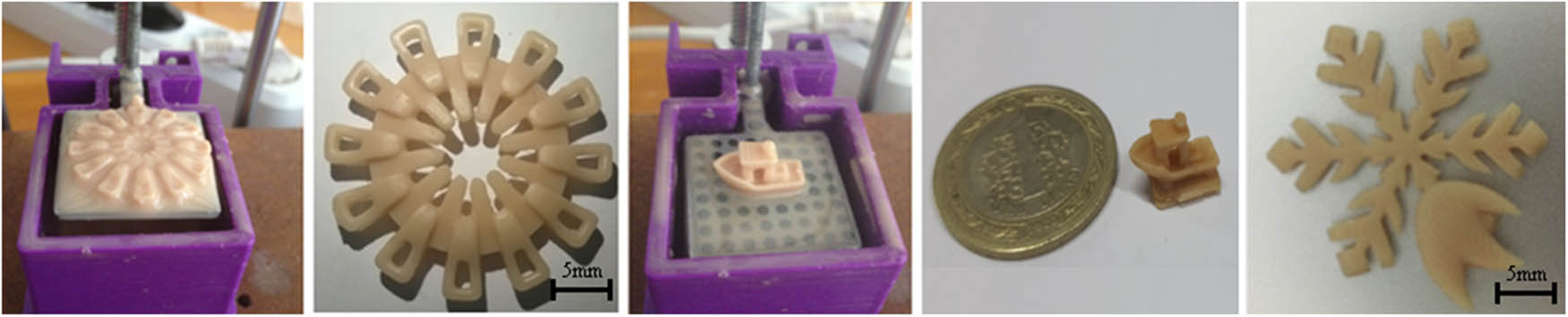
Figure 6
Some printed samples for visual and microscopic investigations.
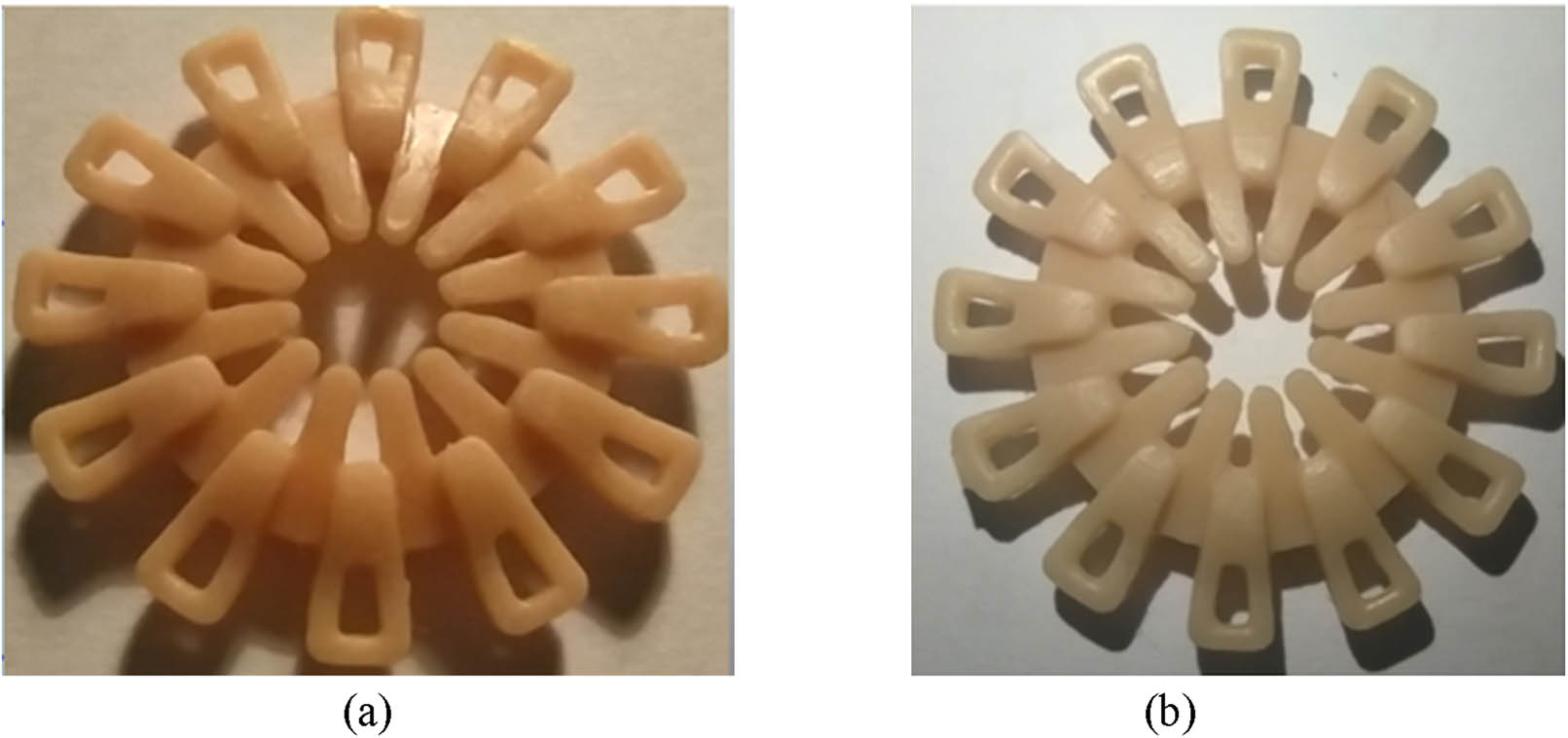
Figure 7
(a) Part printed without optical module and (b) part printed with optical module.
The reduction in exposure time per layer from 2,500 to 100 ms for the same geometry clearly indicates that the optical module significantly enhances photopolymerization efficiency. As summarized in Table 1, this reduction in exposure time resulted in an approximately 30% decrease in total printing time. The reported 30% decrease refers to the total printing time, including lifting and sequence operations. Although the exposure time per layer decreased from 2,500 to 100 ms, the lifting and sequence time remained constant at 5,000 ms per layer, thereby limiting the overall reduction in total printing time to approximately 30%.
These results demonstrate that the reduction in build area introduced by optical focusing – from approximately 50 to 12.5 cm2 (a 75% decrease) – is associated with improved production efficiency, highlighting a trade-off between printable area and processing speed. Such a trade-off is particularly advantageous for applications requiring high geometric precision within a confined build area, such as microfluidic devices, dental components, and micro-scale functional structures.
The observed exposure time reduction is consistent with the principles described by Jacob’s working curve, which governs photopolymerization behavior [2]. The increased irradiance at the resin surface allows the critical energy threshold (E c) required for polymerization to be reached more rapidly, while the effective penetration depth (D p) is achieved within a shorter exposure duration [14]. Consequently, the kinetics of photopolymerization are enhanced through optical control of light distribution rather than through material modification or chemical acceleration mechanisms.
The effect of the optical module on lateral resolution is clearly demonstrated by the optical microscope images presented in Figure 8 and the corresponding printing performance is summarized in Table 2. A pronounced reduction in effective pixel size in the XY plane is observed when the optical module is employed. This reduction indicates that the projected pixel geometry is more precisely defined due to the combined effects of optical focusing and reduced angular divergence of the projection light.
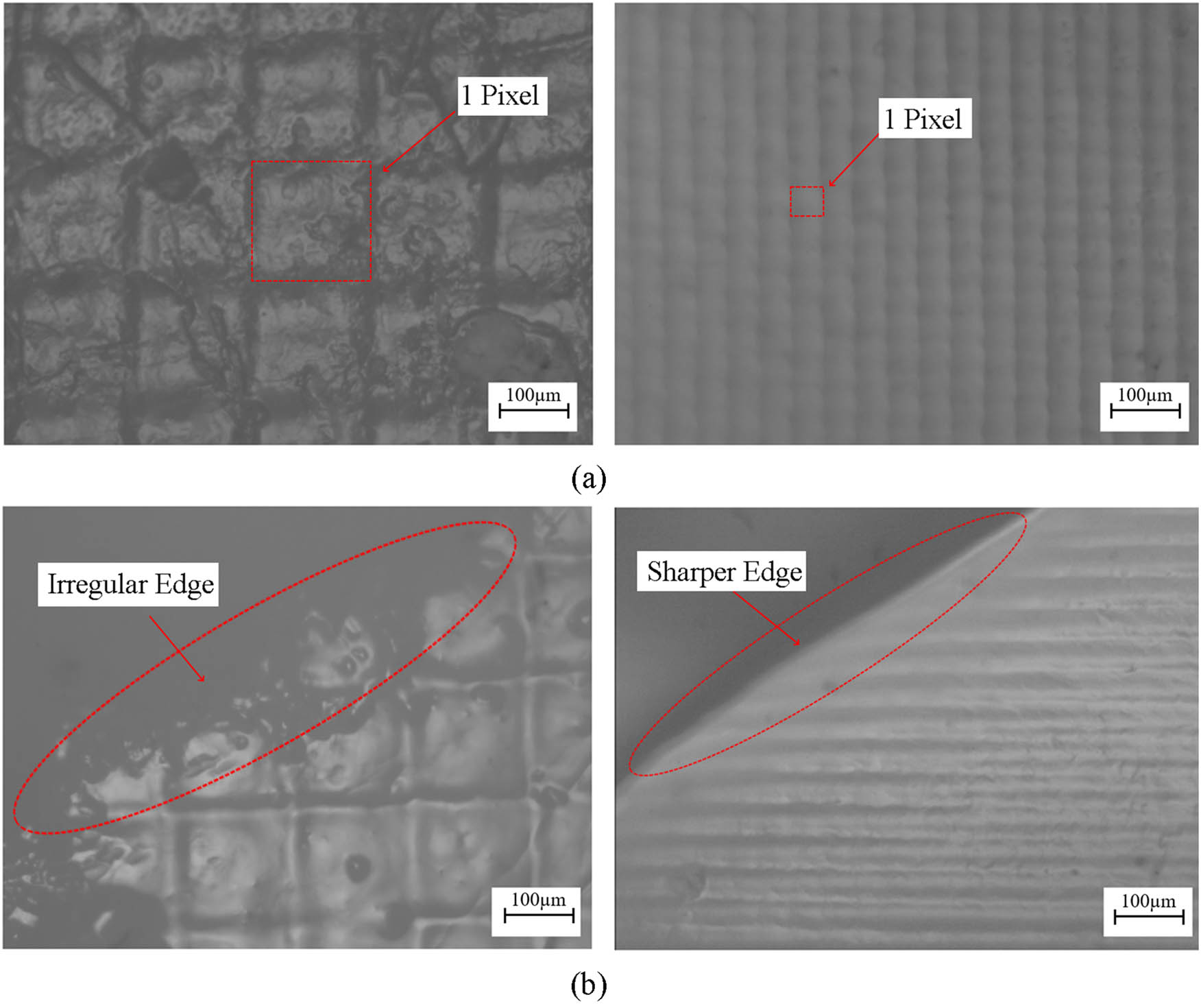
Figure 8
(a) Images from the middle parts of the parts (without optical module on left and with optical module on right) and (b) images from the angled edges of the parts (without optical module on left and with optical module on right).
Table 2
Impact of optical system on resolution and printing performance
| Parameters | Without optical module | With optical module | Improvement |
|---|---|---|---|
| Layer exposure time | 2,500 ms | 100 ms | 25× reduction |
| Total printing time | 00:10:45 | 00:07:17 | 1.45× faster |
| Pixel size | 168.1 µm ± 3.4 | 44.5 µm ± 2 | ∼3.8× reduction |
| Edge definition/pixel array | Irregular/blurred | Homogeneous/sharp | Visual enhancement |
In addition to numerical pixel size reduction, qualitative improvements in pixel alignment and edge continuity are evident in the optical microscope images shown in Figure 8. Samples fabricated without the optical module exhibit blurred pixel boundaries and irregular edge transitions, which are characteristic of voxel overlap and parasitic curing induced by angled illumination. In contrast, samples produced with the optical module display more homogeneous pixel arrangement and sharper edge definition, confirming that voxel overflow and unintended curing are effectively suppressed.
The pixel size reduction achieved in this study is comparable to the resolution improvements reported by Valentinčič et al. [20], who optimized the DMD–lens distance to enhance lateral resolution. However, in the present study, the accompanying reduction in exposure time represents a distinct advantage, contributing not only to resolution enhancement but also to improved manufacturing efficiency.
Compared to approaches such as the SDPM proposed by Huang et al. [17], which relies on varying projection distance to improve resolution, the present optical configuration offers improved suppression of angular curing effects through near-normal illumination. This contributes to improved surface quality and dimensional fidelity, particularly in the fabrication of small and geometrically complex features.
Nevertheless, the integration of the optical module inevitably reduces the available horizontal build area, which constitutes a limitation for large-volume part fabrication. Comparable trade-offs between build area, system complexity, and achievable lateral resolution have been reported for various resolution-enhancement strategies in the literature. Valentinčič et al. [16] demonstrated notable improvements in lateral resolution by modifying the internal optical configuration of a DLP projector through spacer-based lens repositioning. While this method effectively reduces pixel size, it requires direct intervention within the projection unit and careful optical realignment, which may limit its ease of implementation in standard commercial systems.
Huang et al. [17] presented a mechanically adaptive optical framework in which three axis linear motion system dynamically adjusts the projection distance based on a parallelogram mechanism, enabling variable pixel sizes for both large-scale geometries and fine local features. This approach provides a high degree of flexibility and is particularly advantageous for applications involving large parts with localized high-resolution regions. However, the reliance on active mechanical components and precise motion control introduces additional system complexity.
In contrast, the present study focuses on a passive, externally integrated optical focusing and collimation module placed in front of a commercial off-the-shelf projector, without altering the internal projection optics or introducing active mechanical subsystems. By prioritizing simplicity, modularity, and ease of integration, the proposed configuration offers a practical pathway for enhancing lateral resolution in low-cost DLP systems, particularly for applications where high geometric fidelity is required within a limited build area.
Finally, the results demonstrate a significant improvement in lateral resolution, with the effective pixel size reduced from 168.1 ± 3.4 µm to 44.5 ± 2 µm (∼3.8× reduction) through the proposed optical focusing and collimation strategy.
By increasing pixel density per unit area through optical modification, a notable enhancement in lateral resolution is achieved directly at the photopolymerization plane, exhibiting resolution performance comparable to software-based super-resolution approaches, while avoiding their computational complexity [18,21]. These findings confirm that the proposed optical configuration provides a viable and effective pathway for improving resolution in low-cost DLP-based AM systems.
4. Conclusion
In this study, a unique optical system was designed and experimentally validated in order to increase resolution and print quality in low-cost DLP-based AM systems. The developed optical system has significantly reduced the effective pixel size by focusing the projection light on a narrower area and has enabled the light to reach the photopolymer surface at a right angle, greatly reducing voxel distortions due to angular curing.
Experimental results showed that pixel sizes in the XY plane were reduced by about fourfold with markedly improved print resolution and edge definition. In addition, the exposure time per layer has decreased from 2,500 ms to 100 ms thanks to the increased light intensity, resulting in a reduction of approximately 30% in total print time.
The results obtained reveal that the optical approach developed not only increased the resolution but also improved the production efficiency. In this respect, the study is in line with similar resolution-enhancing approaches reported in the literature and offers a viable and competitive alternative for low-cost DLP systems. Especially in terms of small-scale part production that requires high precision, the proposed system is considered to have significant potential.
This study demonstrates that key resolution constraints of low-cost DLP systems can be effectively mitigated through an integrated optical focusing and collimation strategy, providing a physical alternative to software-based grayscale and masking approaches widely used in the literature.
Overall, the study demonstrates that the proposed optical configuration offers a practical, scalable, and cost-effective pathway for achieving high-resolution DLP printing without reliance on software-driven super-resolution techniques.
Although the optical system proposed in this study provides significant gains in terms of resolution and production time, it also comes with some limitations. The main limitation is that the horizontal size of the printing platform is reduced as a result of the projection light being focused on a narrower area. This can be restrictive for the production of large volumes of parts and creates an inevitable trade-off between resolution and print area.
In addition, the optical system used in the study consists of fixed focus lenses, which inherently limits their flexibility for different part sizes or variable printing scenarios. Furthermore, the potential effects of increased light intensity on photopolymer aging or thermal behavior during long-term use were not investigated in detail. Within this framework, the study is primarily focused on voxel-level geometrical accuracy and curing behavior governed by optical projection characteristics, whereas detailed microstructural or material-level analyses fall outside the main scope and are considered as a direction for future research.
Funding information
Authors state no funding involved.
Author contributions
Conceptualization, M.E.; methodology, M.E.; software, O.K. M.C.K. and S.S., validation, M.E. and Ö.T.; formal analysis, M.E.; Ö.T.; investigation, M.E.; O.K. M.C.K., S.S. and Ö.T.; resources, M.E.; data curation, M.E.; writing – original draft preparation, M.E., Ö.T., writing – review and editing, M.E.; visualization, M.E.; supervision, M.E.; project administration M.E.
Conflict of interest statement
Authors state no conflict of interest.