
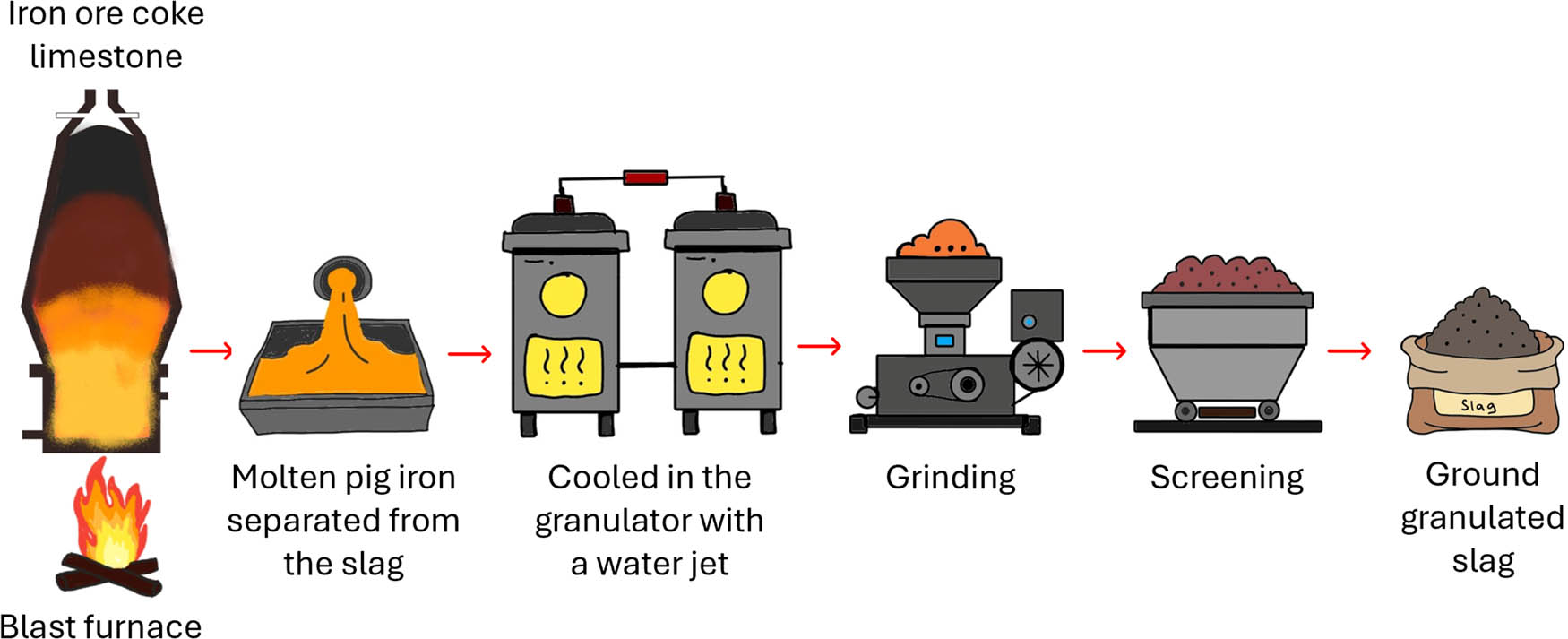
Figure 1
Process of producing the slag. Adapted from Hanani Ismail et al. paper, licensed under CC BY-NC 4.0 https://creativecommons.org/licenses/by-nc/4.0/ [22].
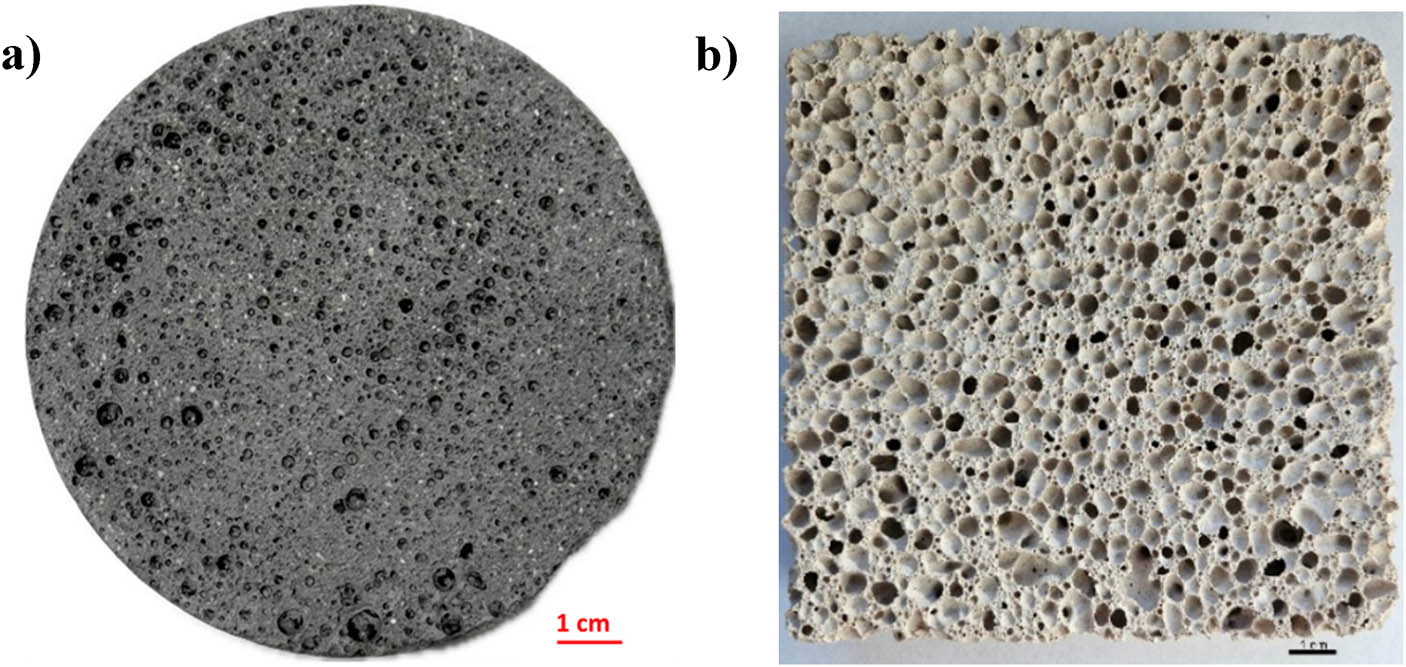
Figure 2
Geopolymer foam using foaming agent: (a) hydrogen peroxide and (b) aluminum powder (results from personal data).
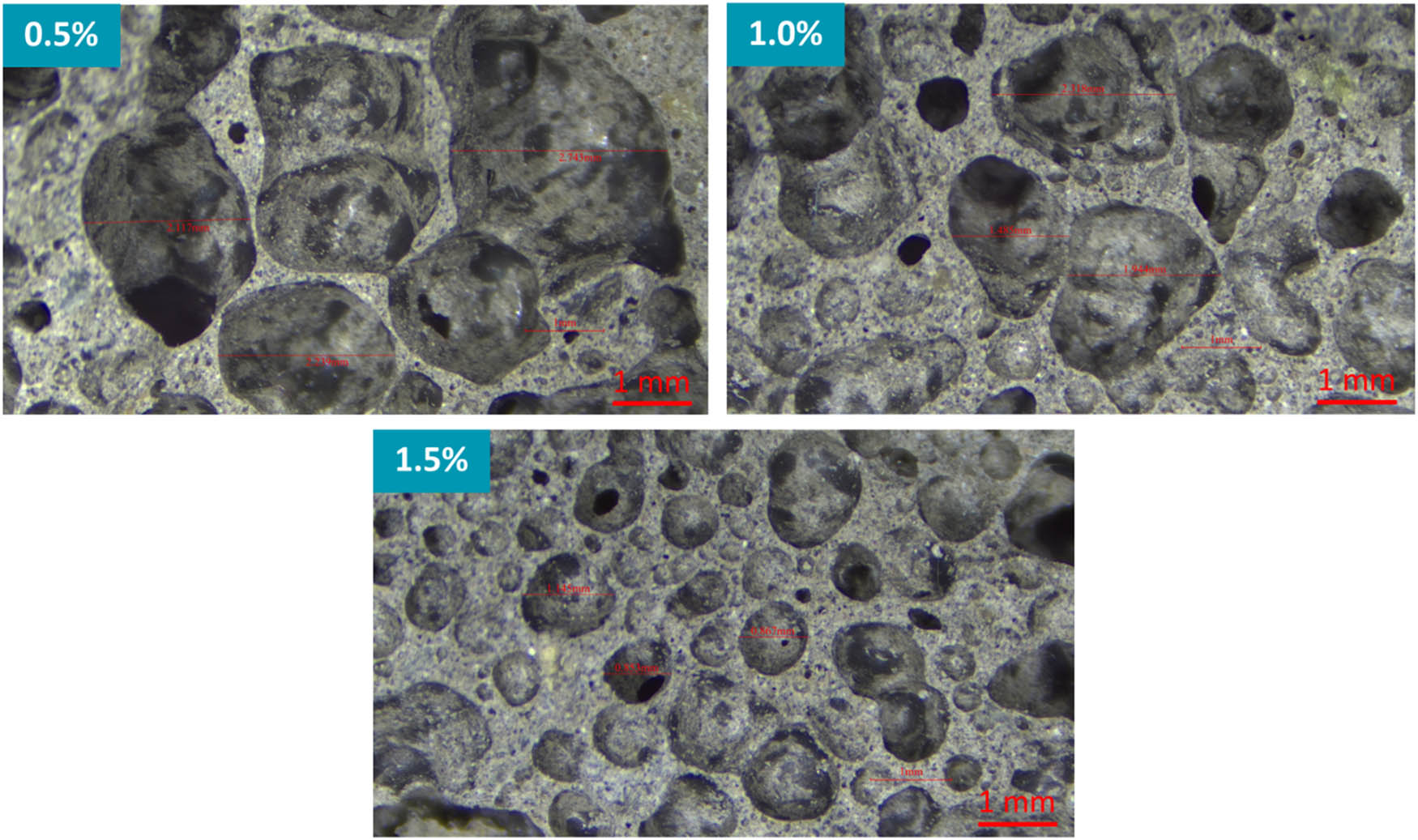
Figure 3
Microscopic results of samples using 2 wt% H2O2 with the variation of PVA (results from personal data).
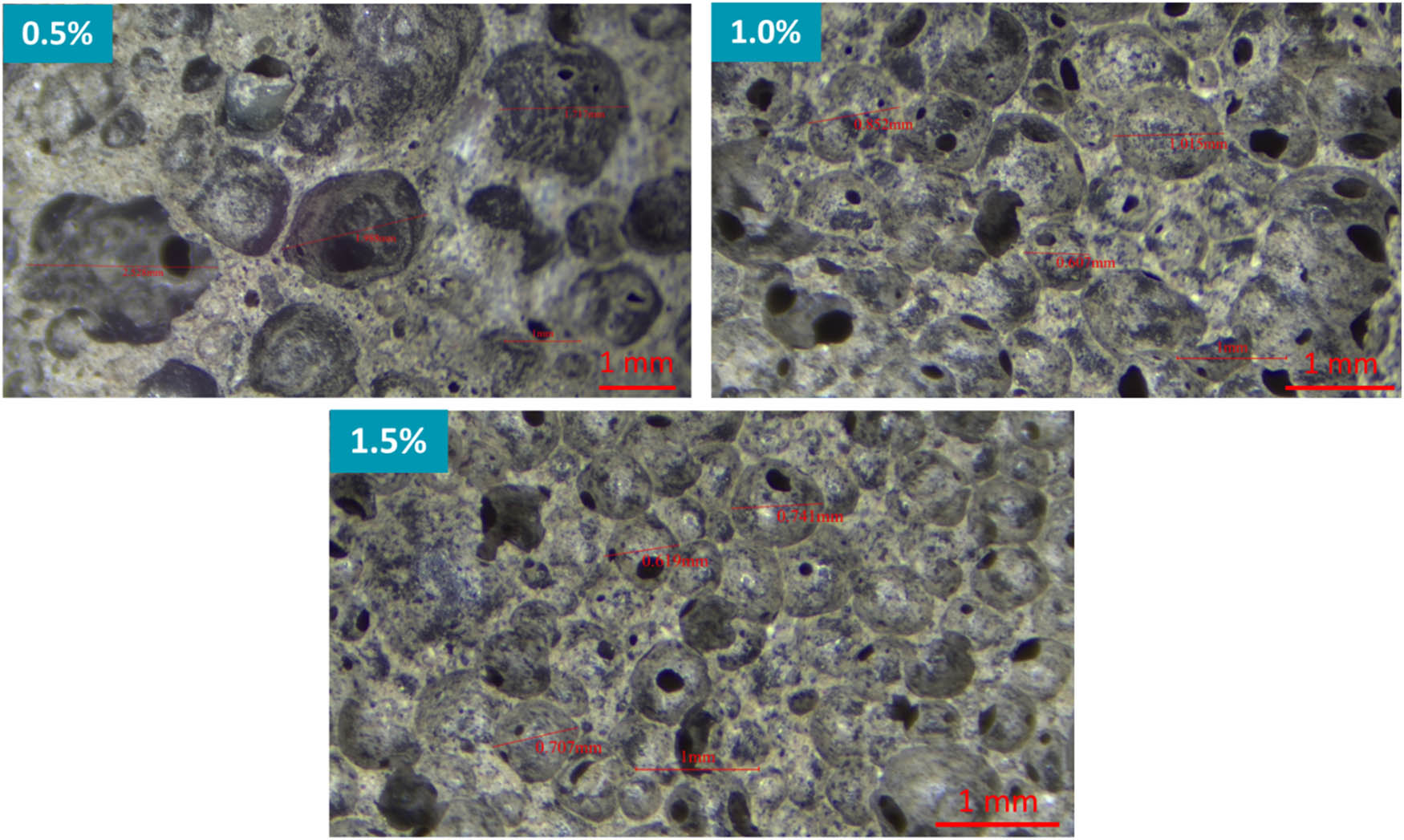
Figure 4
Microscopic results of samples using 2 wt% H2O2 with the variation of vegetable oil (results from personal data).
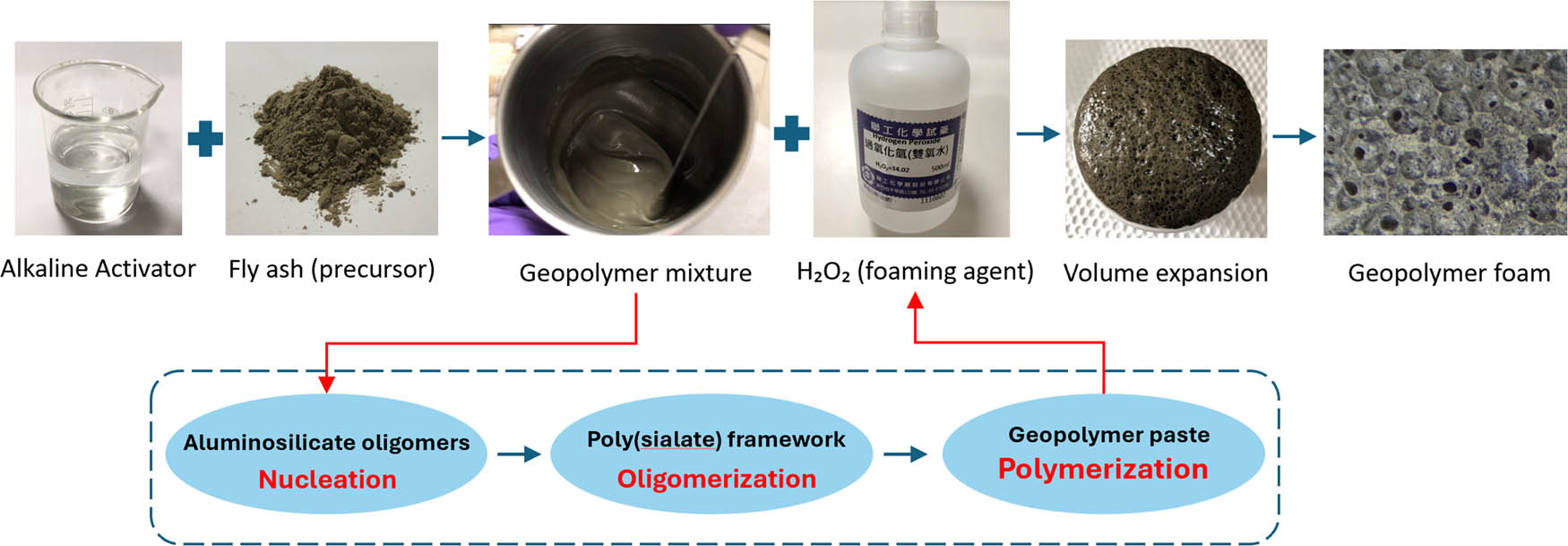
Figure 5
The geopolymerization foam process (results from personal data).
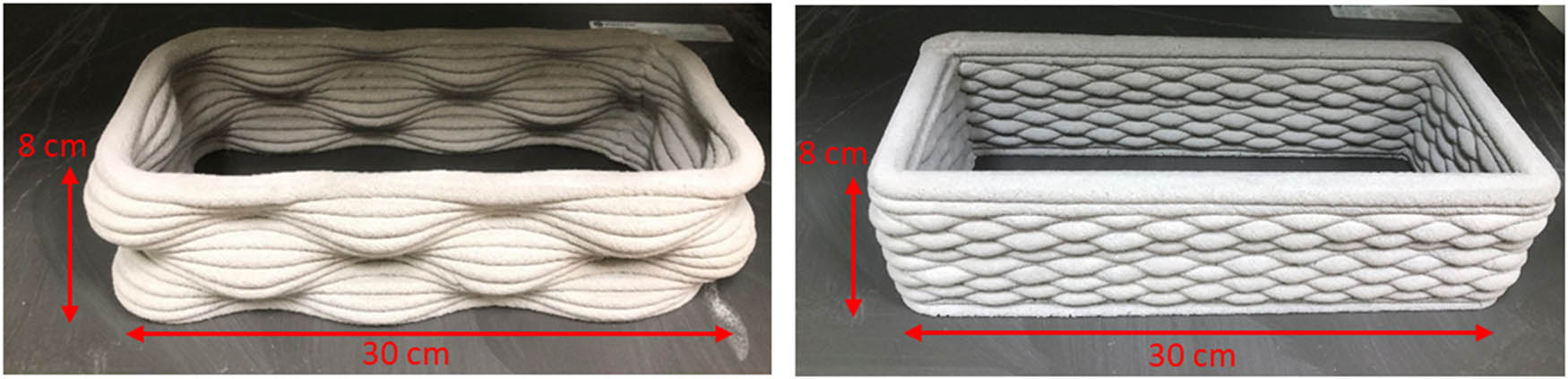
Figure 6
3D printed elements (results from personal data).
Table 2
Effect of foaming agents on the compressive strength and density.
| Foaming agent | Compressive strength and density | Ref. |
|---|---|---|
| H2O2 | Increasing H2O2 concentration from 1 to 3.5% in geopolymer foam leads to a decrease in compressive strength (44.81–3.2 MPa) and density (1,021–142 kg/m3) | [94] |
| Using 0.1–1% H2O2 reduces the compressive strength from 5.9 to 0.26 MPa and the apparent density from 1,100 to 230 kg/m3 | [95] | |
| Al powder | The use of Al powder with increasing percentages of 0.01–0.15% reduces the compressive strength (42.0–4.6 MPa) and density (1,830–1,031 kg/m3) | [64] |
| 1.5–5.0% of Al powder decreases the compressive strength from 4.35 to 0.9 MPa and density from 1,309 to 403 kg/m3 | [96] |
Table 3
Effect of agent material on the porosity of geopolymer foam.
| Material agent | Effect on porosity | Ref. |
|---|---|---|
| Foaming agent | The addition of aluminum powder at concentrations of 0.07–0.2% increased porosity from 47.9 to 58.4%, while H2O2 at 0.5–2% enhanced porosity from 37.9 to 44.9% | [101] |
| Increasing the H2O2 concentration from 1 to 3.5% in geopolymer foam increased the porosity from 32.3 to 63.1% | [94] | |
| Stabilizing agent | Tween 80 as a surfactant, with a concentration ranging from 1 to 5%, increased the porosity from 38 to 86% | [97] |
| Using olive oil as a stabilizing agent at concentrations ranging from 1.25 to 15% with the same H2O2 concentration reduced the porosity from 75.1 to 72.3% | [67] | |
| Alkaline solution | Increased ratio of NaOH to Na2SiO3 enhanced the porosity from 55.6 to 66.3% while maintaining the same foaming agent concentration | [99] |
| Increasing the Na2O ratio from 4 to 7% in an alkaline solution increased the porosity of the structure from about 61.6 to 68% | [11] |
Table 4
Reference relationships among density, compressive strength, porosity, and thermal conductivity of geopolymer foam.
| Precursor | FA | SA | Density (kg/m3) | Compressive strength (MPa) | Porosity (%) | Thermal conductivity (W/(m k)) | Ref. |
|---|---|---|---|---|---|---|---|
| Metakaolin | H2O2 | Olive oil | 320–610 | 0.2–3.9 | 75–87 | 0.147 | [103] |
| Metakaolin | Na2O2 | SDBS | 300–460 | 0.6–1.6 | 72–81 | 0.085–0.115 | [104] |
| Fly ash | H2O2 | — | 240–340 | 0.60–0.38 | 79–81 | 0.09–0.07 | [105] |
| Metakaolin | H2O2 | — | 470–1,210 | 0.37–6.00 | 36–86 | 0.11–0.30 | [97] |
| FA, GGBS | SDS | RCA | 824–838 | 1.3–1.8 | 42–71 | 0.270–0.360 | [106] |
| Metakaolin | SLES | — | 690–1,060 | 4.7–14.8 | 56–72 | 0.197–0.364 | [107] |
| FA, POFA | Sika AER | — | 1,300–1,700 | 8–13 | 25–40 | 0.47–0.50 | [74] |
| FA | H2O2 | CSFS | 310–380 | 1.45–1.60 | 70–82 | 0.095–0.139 | [108] |
| FA | H2O2 | Calcium stearate | 150–240 | 0.45–0.75 | 88.94–91.94 | 0.0485–0.0594 | [109] |
| FA | H2O2 | Calcium stearate | 200–300 | 1.06–2.84 | 59–83 | 0.05223–0.0711 | [110] |
| HCFA | Natural protein | — | 844–2,100 | 2.7–57.8 | 2.82–49.42 | 0.13–1.62 | [111] |
| Metakaolin | H2O2 | Vegetable oil | 370–740 | 0.3–11.6 | 66–83 | 0.11–0.17 | [67] |
| Metakaolin | H2O2 | Tween 80 | 300–750 | 0.3–9.4 | 67–86 | 0.289–0.091 | [112] |