
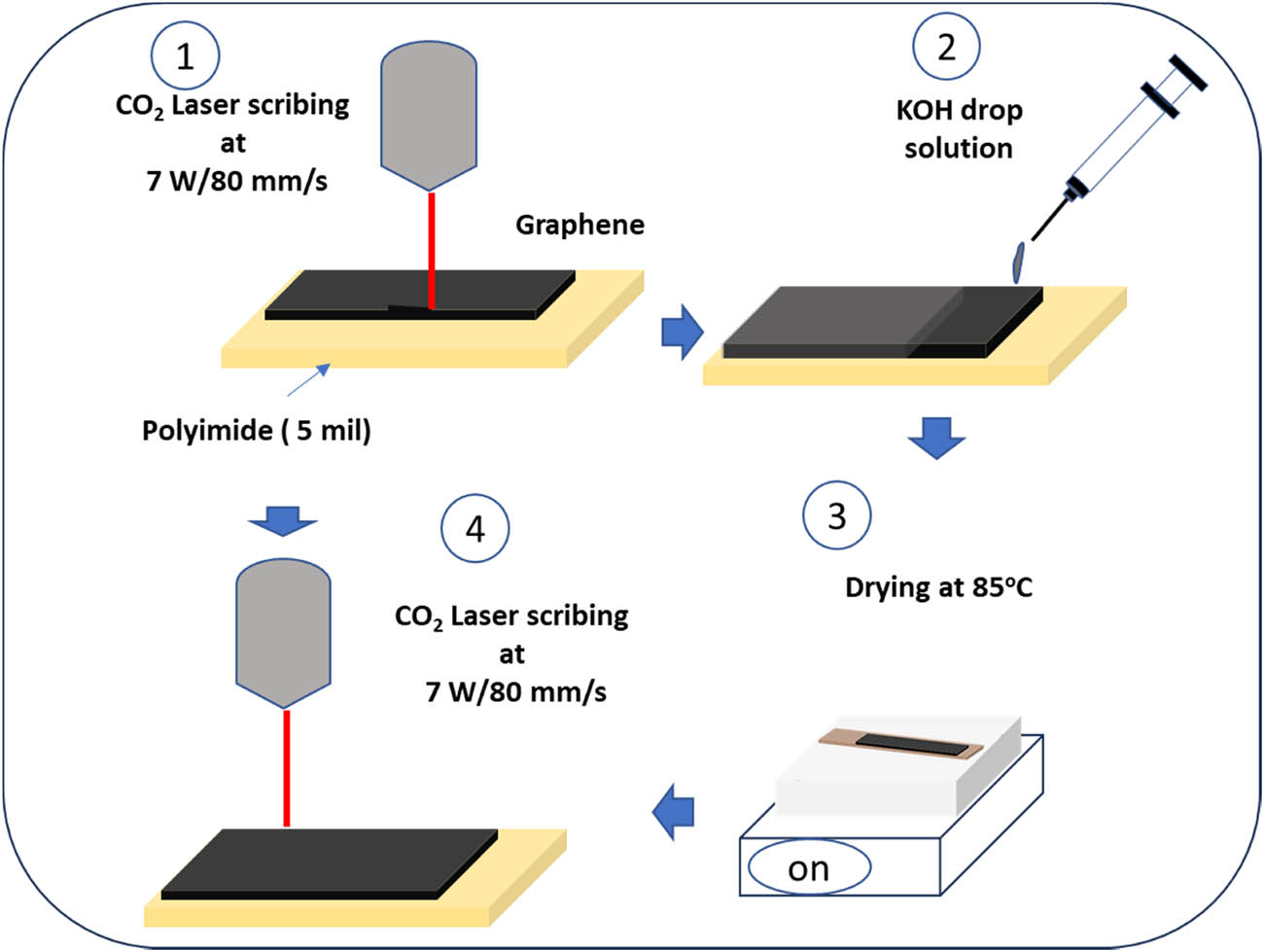
Figure 1
Diagram illustrating the procedures for fabricating LIG and PLIG electrodes utilizing a CO2 laser machine.
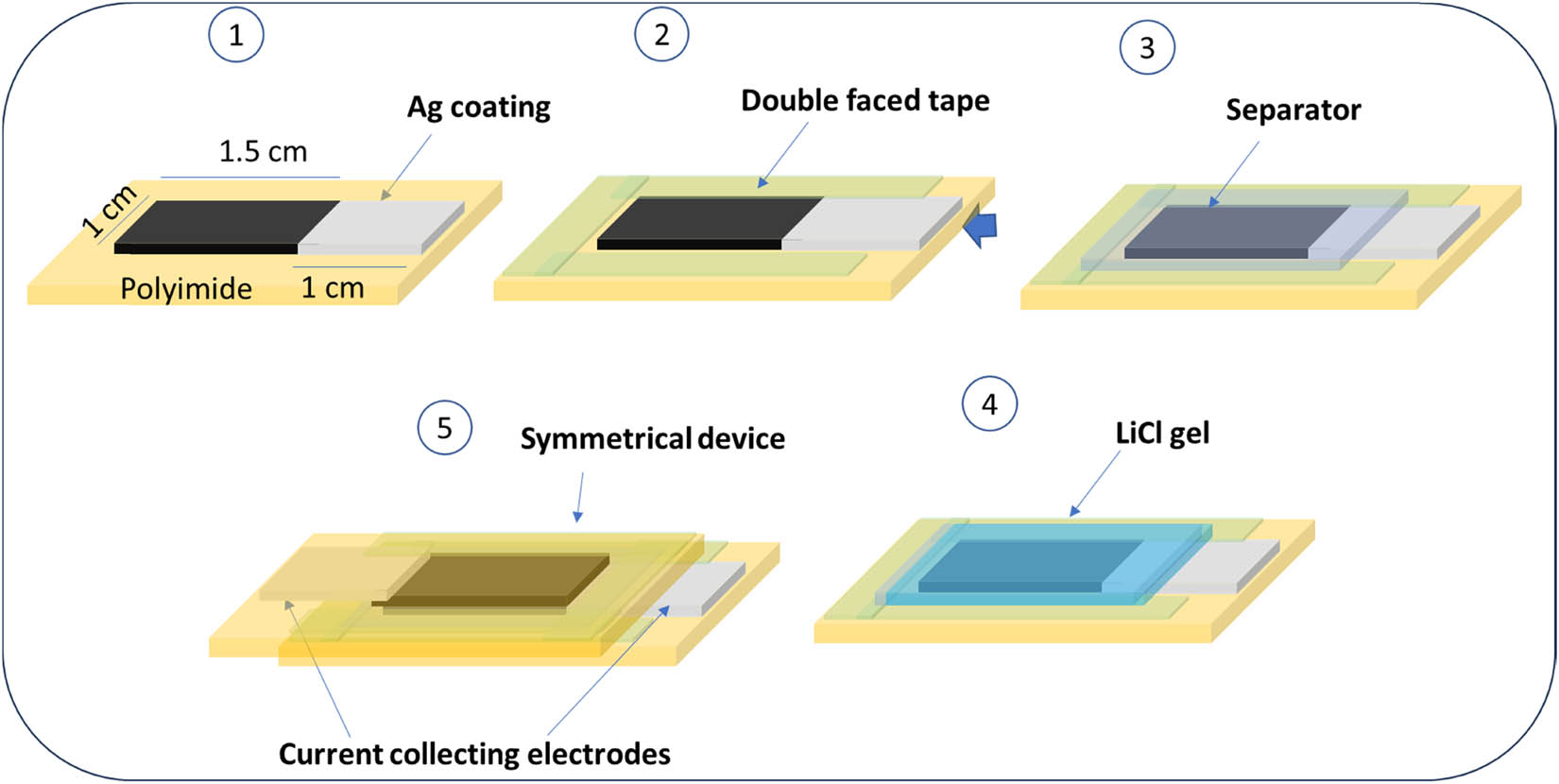
Figure 2
Fabrication of the symmetrical supercapacitor device based on PLIG and LiCl electrolyte.
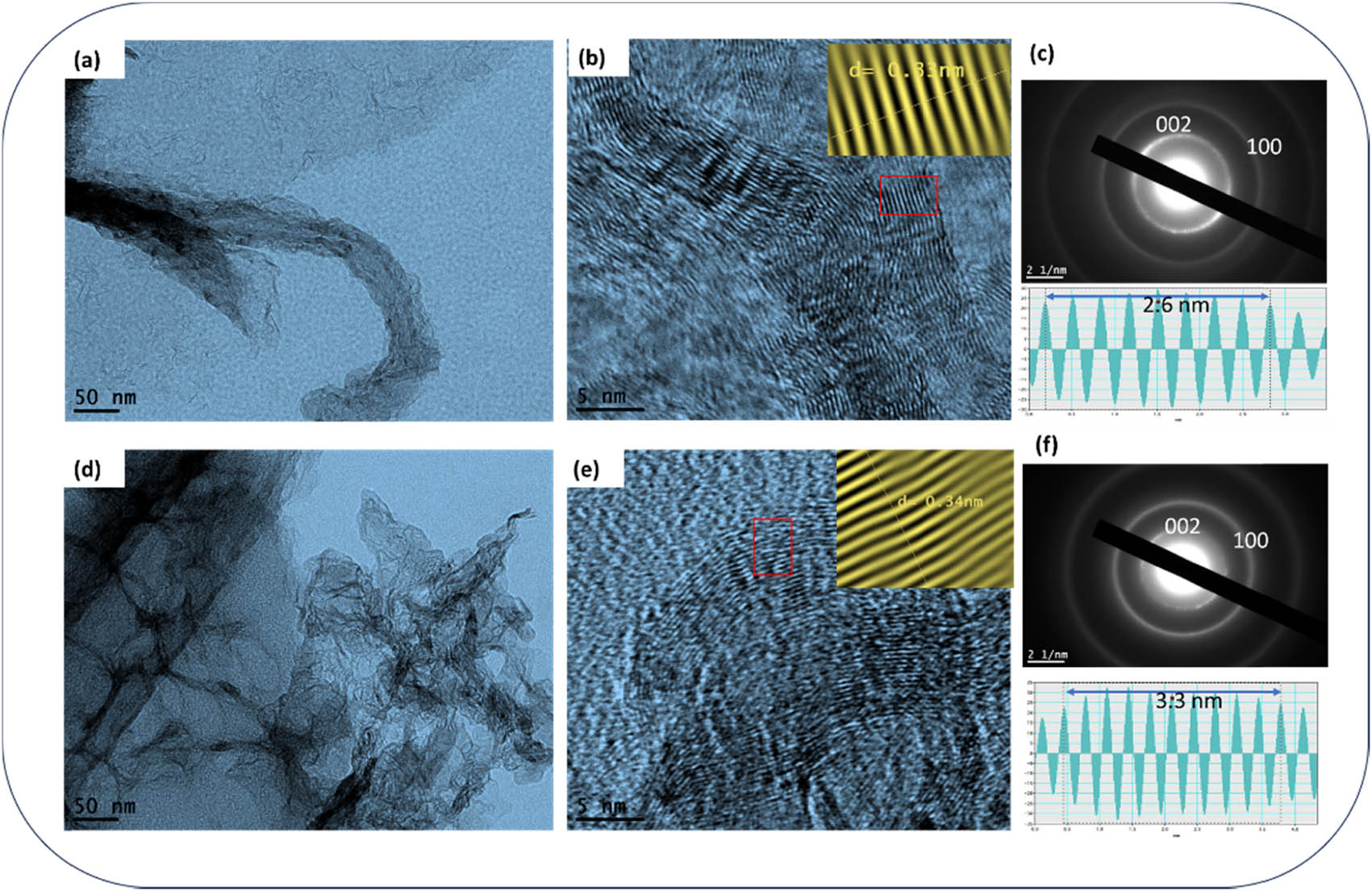
Figure 3
The investigation comprised two main aspects: TEM images focusing on few-layer graphene for (a) LIG and (d) PLIG. HRTEM imaging capturing the extensive lattice variation of (b) LIG and (e) PLIG. SAED and lattice profiles for (c) LIG and (f) PLIG.
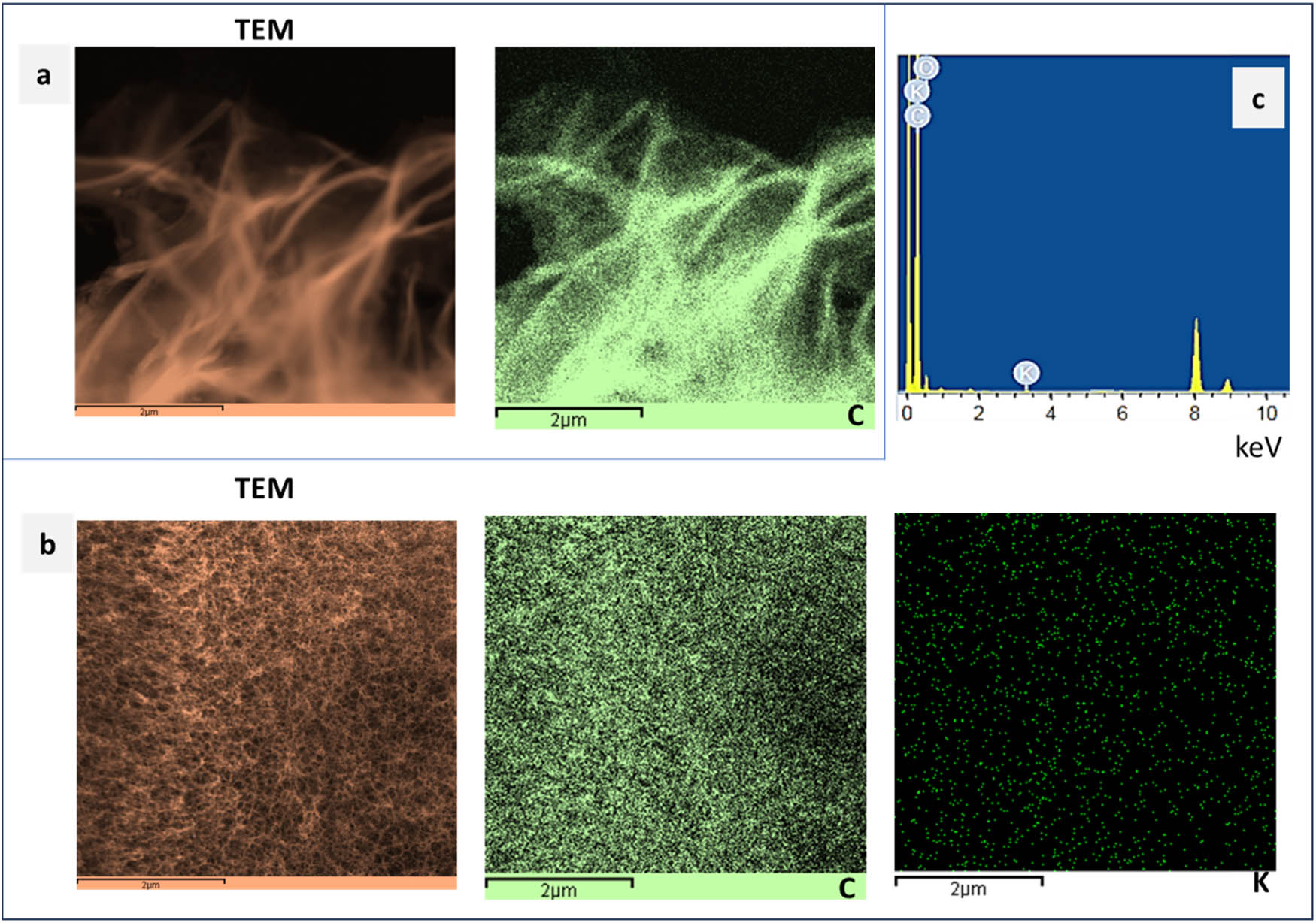
Figure 4
EDX mapping of (a) LIG and (b) PLIG for carbon and potassium distribution. (c) EDX spectrum of PLIG.
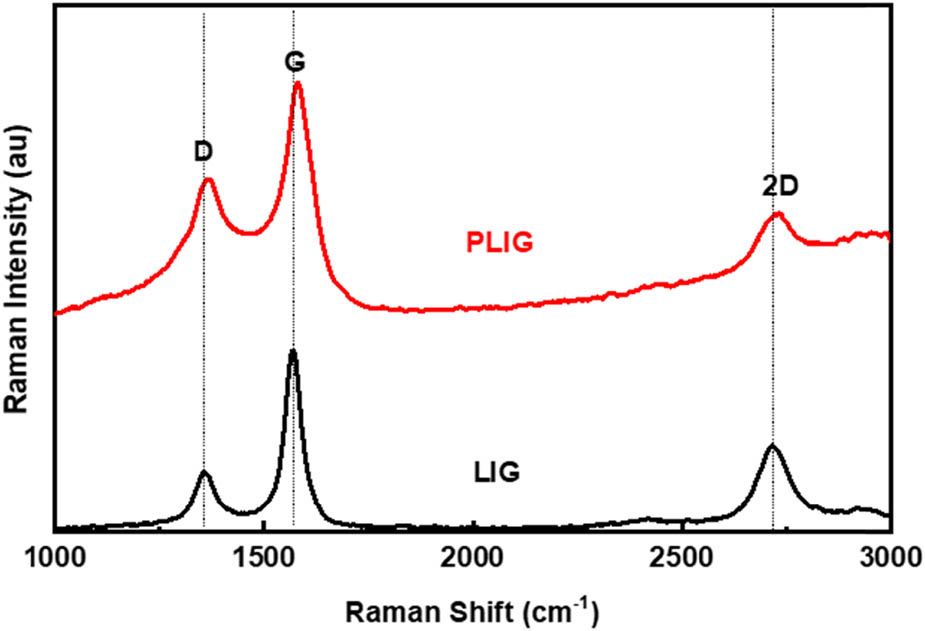
Figure 5
Raman spectra obtained from bare graphene and K-doped graphene.
Table 1
Raman parameters for bare graphene and K-doped graphene.
| Sample | FWHM (cm−1) | D band (cm−1) | G band (cm−1) | 2D band (cm−1) | I D/G | I 2D/G | ||
|---|---|---|---|---|---|---|---|---|
| D band | G band | 2D band | ||||||
| LIG | 65.2 | 46.2 | 117.1 | 1,357 | 1,567 | 2,720 | 0.28 | 0.42 |
| PLIG | 169.2 | 76.4 | 242.7 | 1,369 | 1,580 | 2,743 | 0.54 | 0.38 |
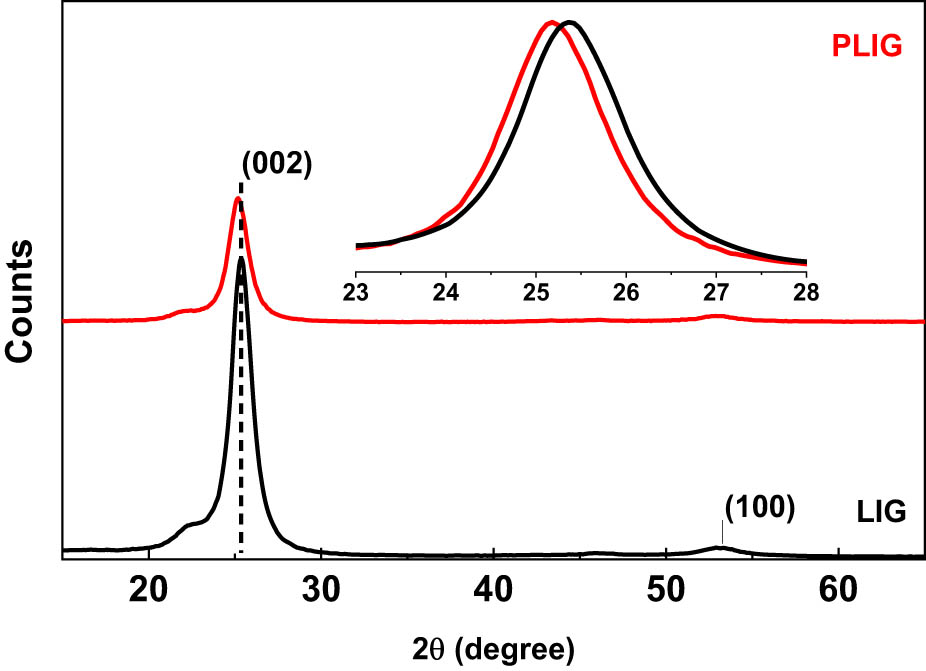
Figure 6
XRD patterns of LIG and PLIG recorded in diffraction angles of 15–65o.
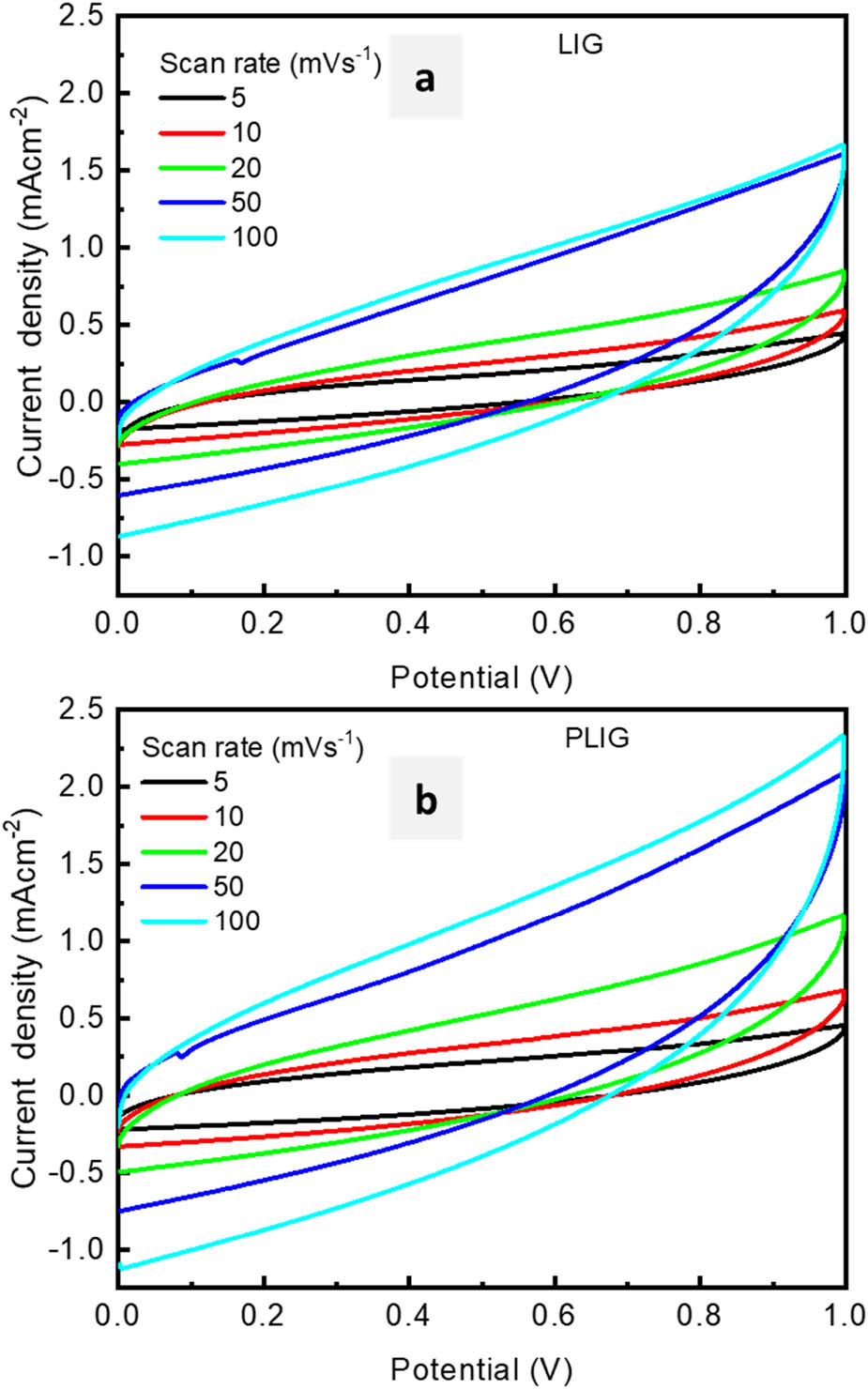
Figure 7
CV curves recorded at different scan rates for (a) LIG and (b) PLIG electrodes.
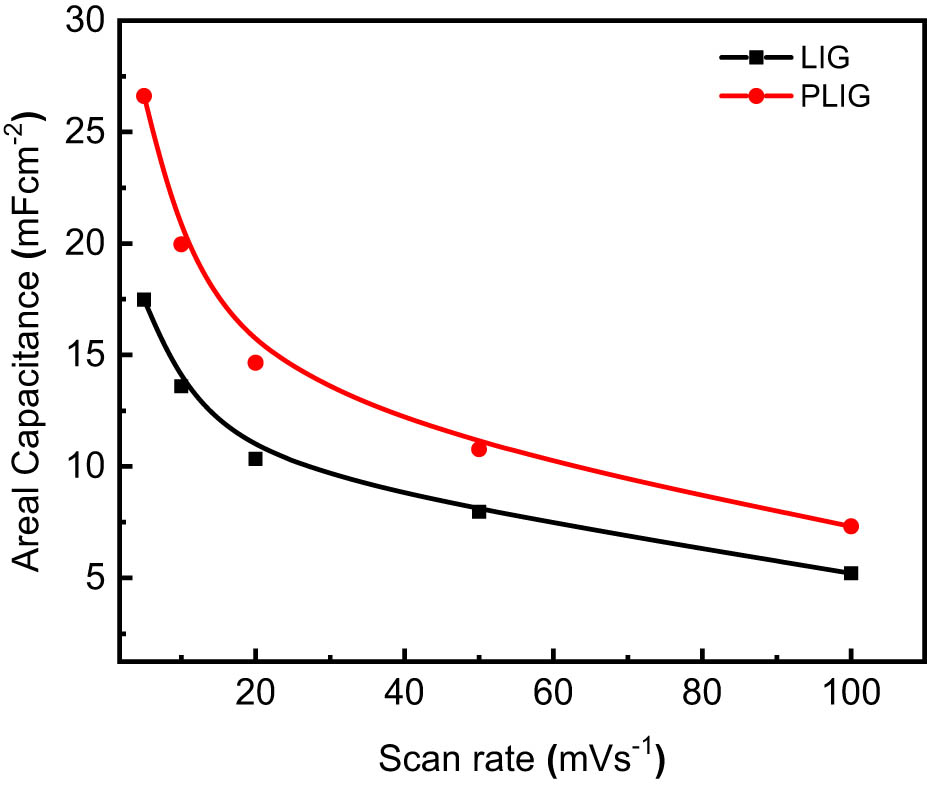
Figure 8
Relationship of areal capacitance of LIG and PLIG with the scan rate.
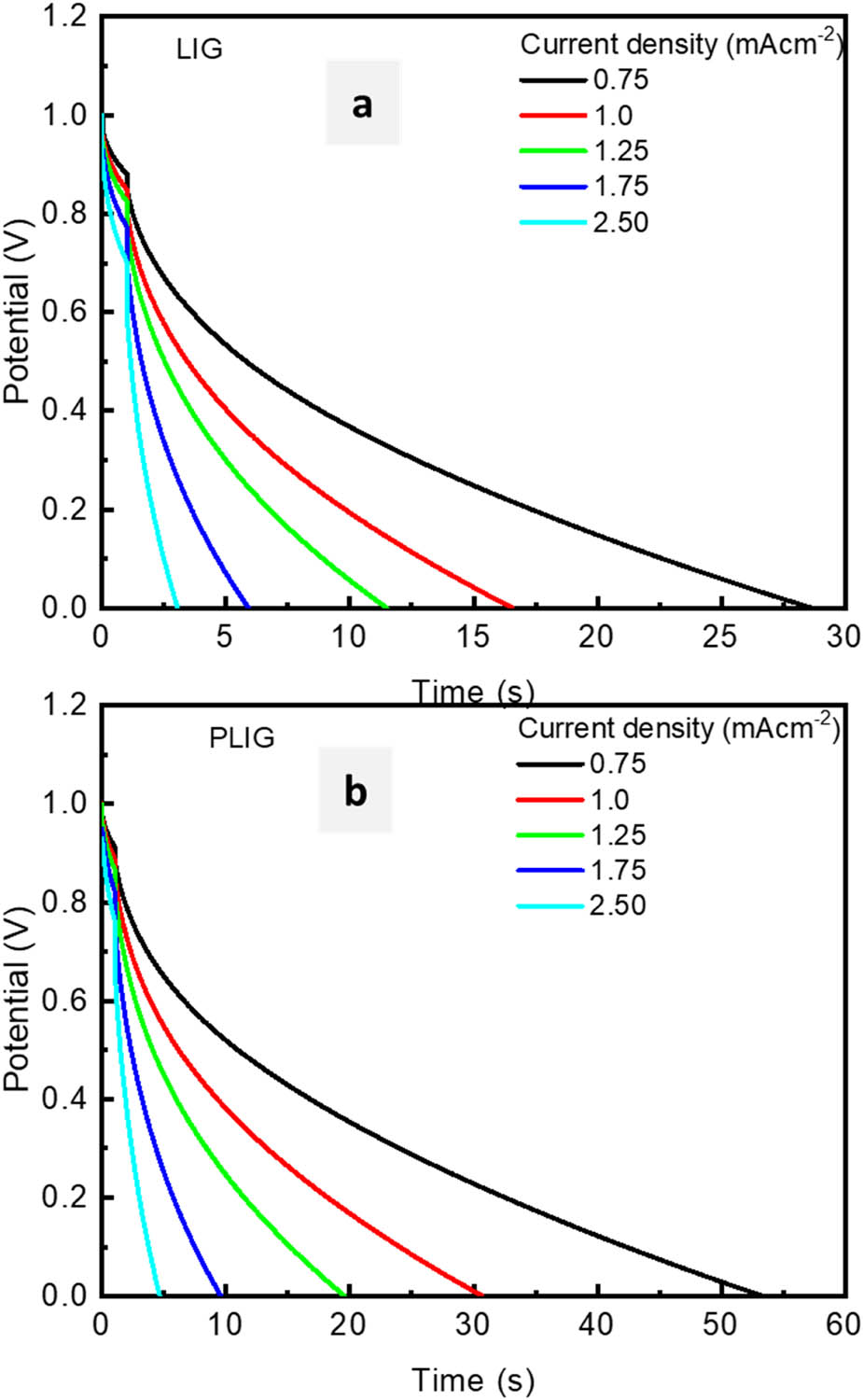
Figure 9
Galvanostatic charging–discharging curves recorded at different current densities for (a) LIG and (b) PLIG.
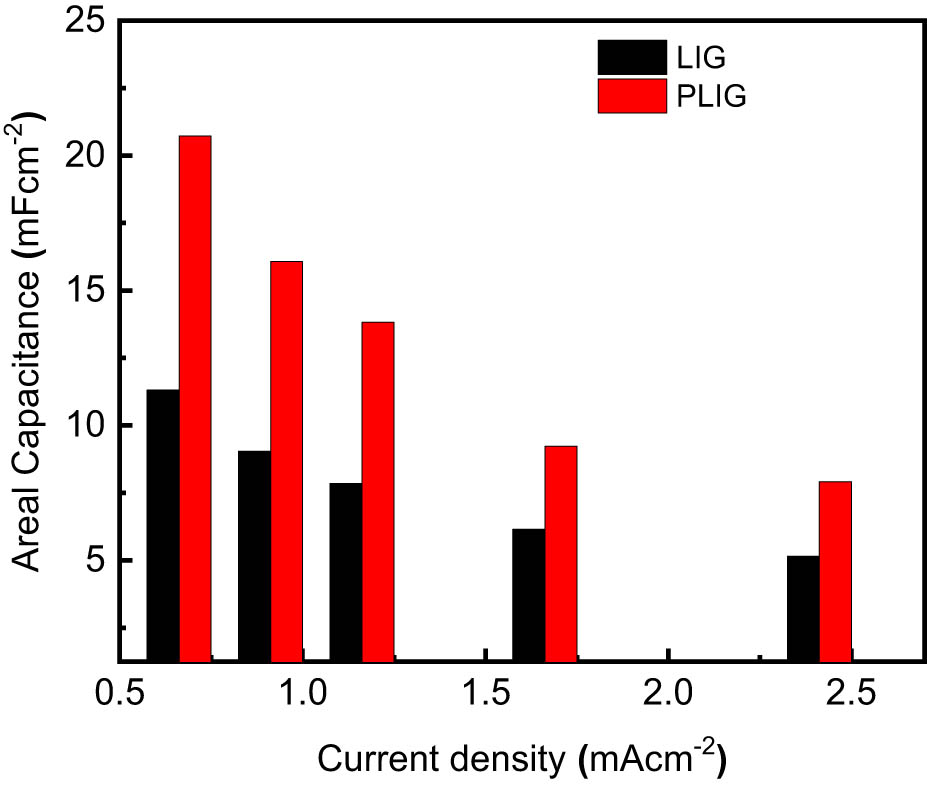
Figure 10
Relationship between areal capacitance and current density for LIG and PLIG electrodes.
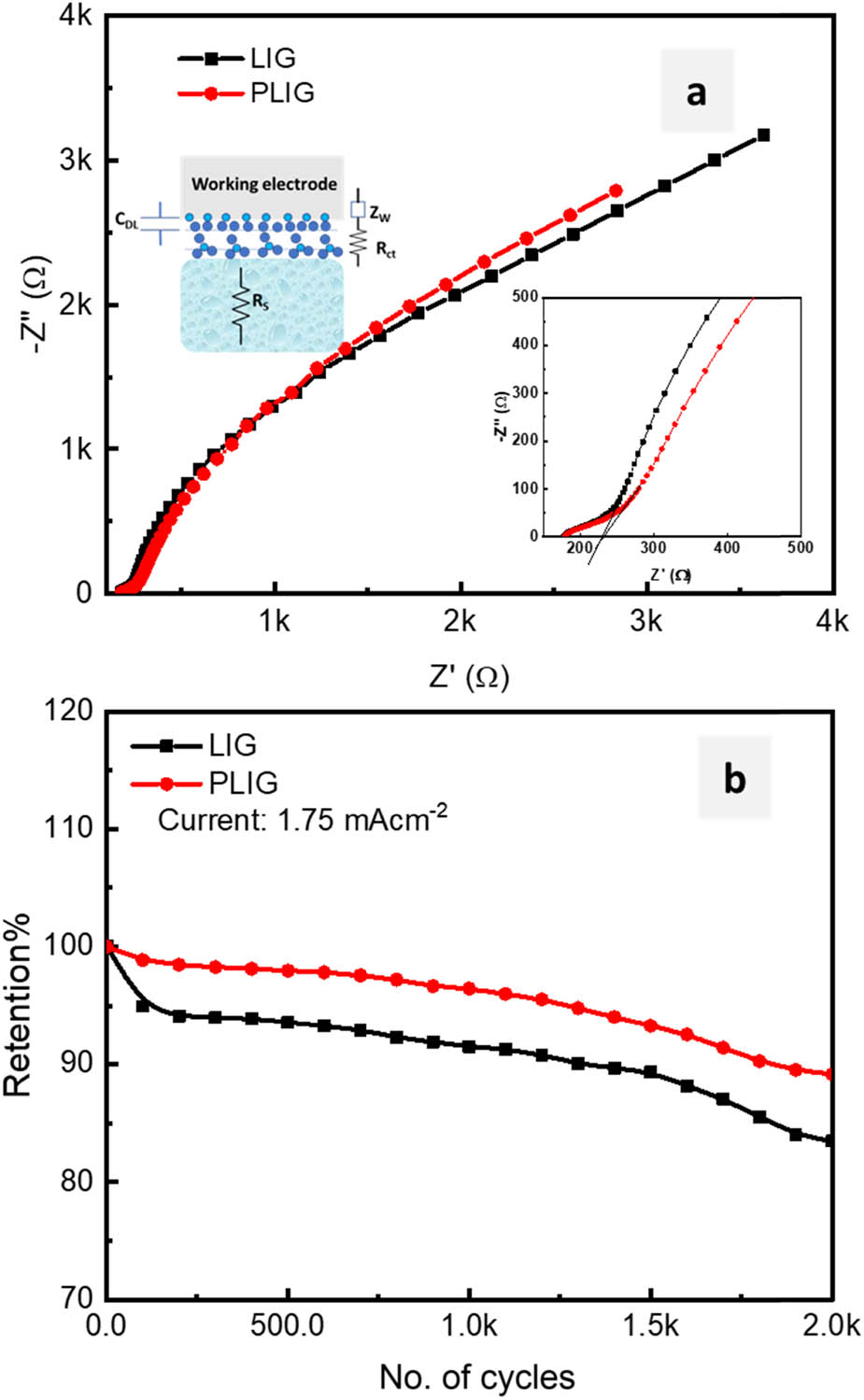
Figure 11
(a) Nyquist diagrams and (b) cycling stability of the electrodes, evaluated at a discharge current density of 1.75 mA cm⁻2 over 2,000 cycles.
Table 2
Comparison between supercapacitor electrodes made from laser-induced graphene.
| Electrode | Areal capacitance | Areal energy | Areal power | References |
|---|---|---|---|---|
| Graphene | 0.8 mF/cm2 at 10 mV/s | — | — | [32] |
| Graphene | 34 mF/cm2 at 0.1 mA/cm2 | 1.0 mWh/cm3 | 11 mW/cm3 | [33] |
| Graphene + MoS2 + MnS | 58.3 mF/m2 at 50 mA/cm2 | 7 µWh/cm2 | 49.9 µW/cm2 | [34] |
| NiO/Co3O4/graphene | 29.5 mF/cm2 at 0.05 mA/cm2 | — | — | [35] |
| Graphene | 6.1 mF/cm2 at 20 mV/s | 0.96 µWh/cm2 | 0.25 mW/cm2 | [36] |
| LIG | 11 mF/cm2 at 0.75 mA/cm2 | 1.5 µWh/cm2 | 186 µW/cm2 | Present work |
| PLIG | 21 mF/cm2 at 0.75 mA/cm2 | 2.8 µWh/cm2 |