
Table 1
The main characteristics of the used BeO powder grade “B2”
| Characteristic, batch number | b 67 | |
|---|---|---|
| Bulk density, ρo × 103 kg/m3 | 0.77 | |
| Specific surface S, cm2/g | 11,000 | |
| Moisture, wt.% | 0.08 | |
| Element-by-element impurities content, wt.% | Boron | 1.7 × 10⁻⁵ |
| Silicon | 7.3 × 10⁻³ | |
| Manganese | 8.2 × 10⁻⁴ | |
| Ferrum | 5.1 × 10⁻² | |
| Magnesium | 5.2 × 10⁻³ | |
| Chromium | 1.0 × 10⁻² | |
| Nickel | 1.1 × 10⁻² | |
| Aluminum | 3.2 × 10⁻² | |
| Copper | 8.0 × 10⁻⁴ | |
| Zinc | 7.5 × 10⁻³ | |
| Calcium | 4.2 × 10⁻³ | |
| Silver | 1.1 × 10⁻⁵ | |
| Cadmium | 1.2 × 10⁻⁵ | |
| Lithium | 6.7 × 10⁻⁴ | |
| Natrium | 8.7 × 10⁻³ | |
| Amount of impurities, wt.% | 0.14 | |
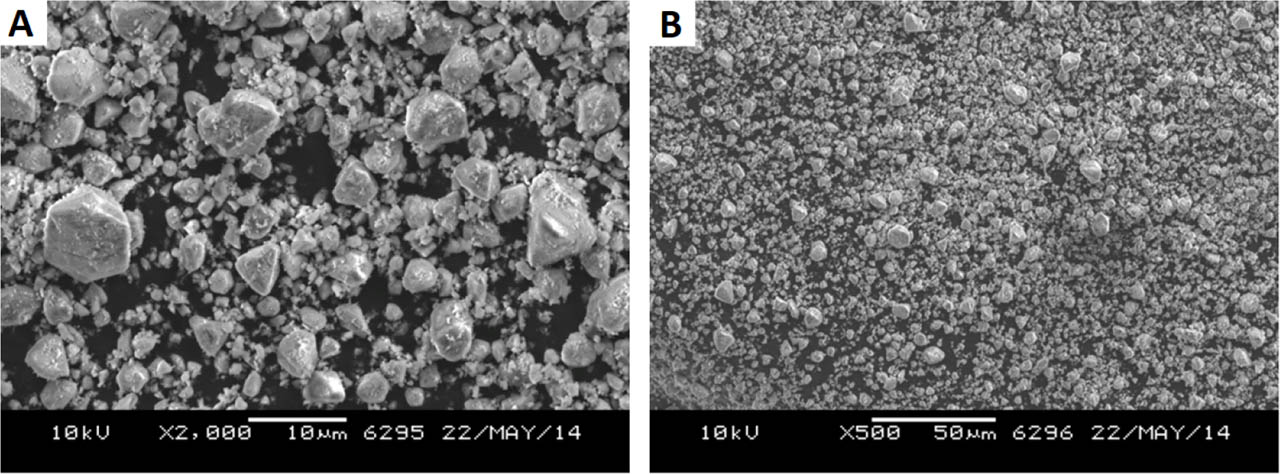
Fig. 1
Micrographs of beryllium oxide powder crystals, with a specific surface of 11,000 cm2/g. (A) 2,000× magnification; (B) 500× magnification
Table 2
Main characteristics of the TiO2 micron powder used
| TC requirements, % | Analysis results | ||
|---|---|---|---|
| 1 | Mass fraction of titanium dioxide, %, no less | 99 | 99.5 |
| 2 | Mass fraction of rutile form, %, no less | 97 | 100 |
| 3 | Mass fraction of iron compounds in terms of Fe2O3, %, no more | 0.08 | 0.05 |
| 4 | Mass fraction of phosphorus compounds in terms of P2O5, %, no more | 0.03 | 0.03 |
| 5 | Mass fraction of sulfur compounds in terms of SiO3, %, no more | 0.03 | 0.01 |
| 6 | Mass fraction for silicon compounds in terms of SiO2, %, no more | 0.15 | 0.15 |
| 7 | Mass fraction of “metallic iron”, %, no more | 0.02 | 0.01 |
| 8 | Specific surface, cm2/g, within | 3,300–4,600 | 4,060 |
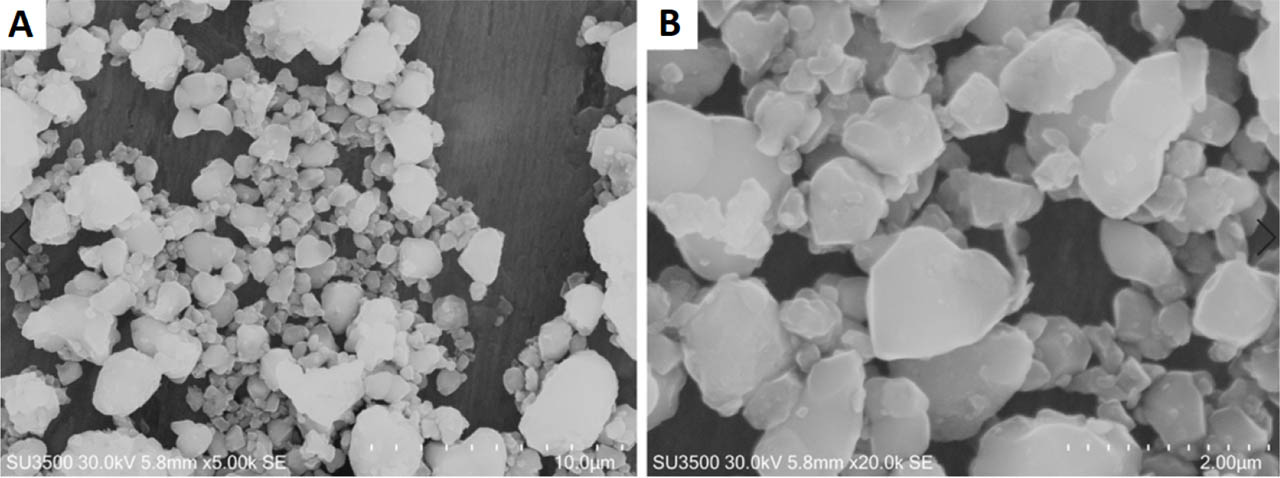
Fig. 2
Micrographs of micron titanium dioxide powders. (A) 5× magnification; (B) 20× magnification
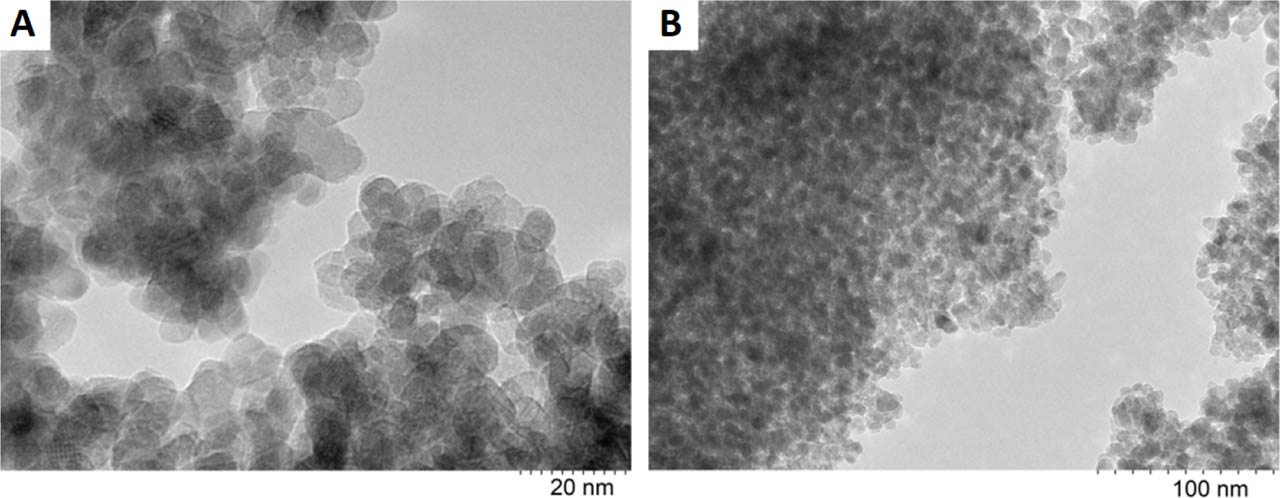
Fig. 3
Micrograph of TiO2 nanoparticles obtained through the electric explosion of a conductor. (A) 400× magnification; (B) 100× magnification
Table 3
Change in apparent density from the sintering temperature of (BeO + TiO2)-ceramics with the addition of TiO2 nanoparticles within 0.1–2.0 wt.%
| Batch No. | Sintering temperature, °C | Composition of the ceramics | Density, g/cm3 |
|---|---|---|---|
| BT-30 | 1,530 | 3.2 | |
| B1 | 1,520 | 3.11 | |
| 3.13 | |||
| 3.15 | |||
| 3.15 | |||
| 3.16 | |||
| B2 | 3.23 | ||
| 3.23 | |||
| 3.23 | |||
| 3.22 | |||
| 3.23 | |||
| B3 | 3.22 | ||
| 3.23 | |||
| 3.22 | |||
| 3.22 | |||
| 3.22 | |||
| B4 | 3.22 | ||
| 3.23 | |||
| 3.22 | |||
| 3.23 | |||
| 3.22 |
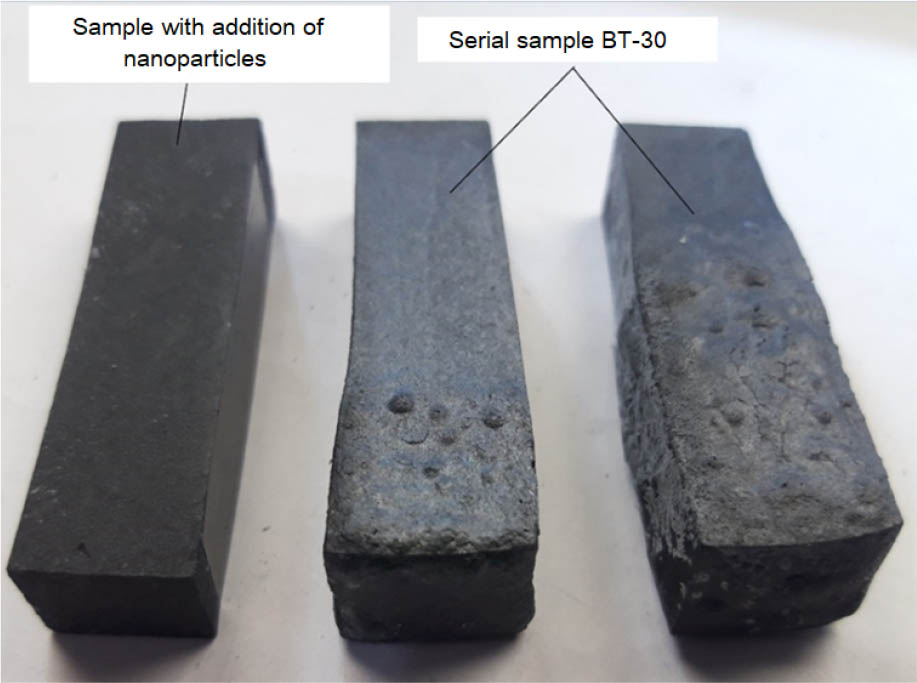
Fig. 4
Appearance of blanks sintered at 1,550°C, which are made, respectively, of ceramic to which TiO2 nanoparticles (1.0%) have been added and serial ceramic BT-30 material
Table 4
Water absorption, and open, total, and closed porosities of BeO ceramics, depending on the content of (0.1%–2.0%)
| Batch No. | Water absorption, % | Porosity, % | ||
|---|---|---|---|---|
| Open | Total | Closed | ||
| BT-30 | 0.03 | 0.10 | 7.076 | 6.977 |
| B1 | 0.06 | 0.187 | 5.92 | 5.73 |
| B2 | 0.05 | 0.165 | 5.329 | 5.164 |
| B3 | 0.07 | 0.211 | 5.329 | 5.118 |
| B4 | 0.06 | 0.186 | 5.031 | 4.845 |
| B5 | 0.07 | 0.217 | 4.126 | 3.909 |
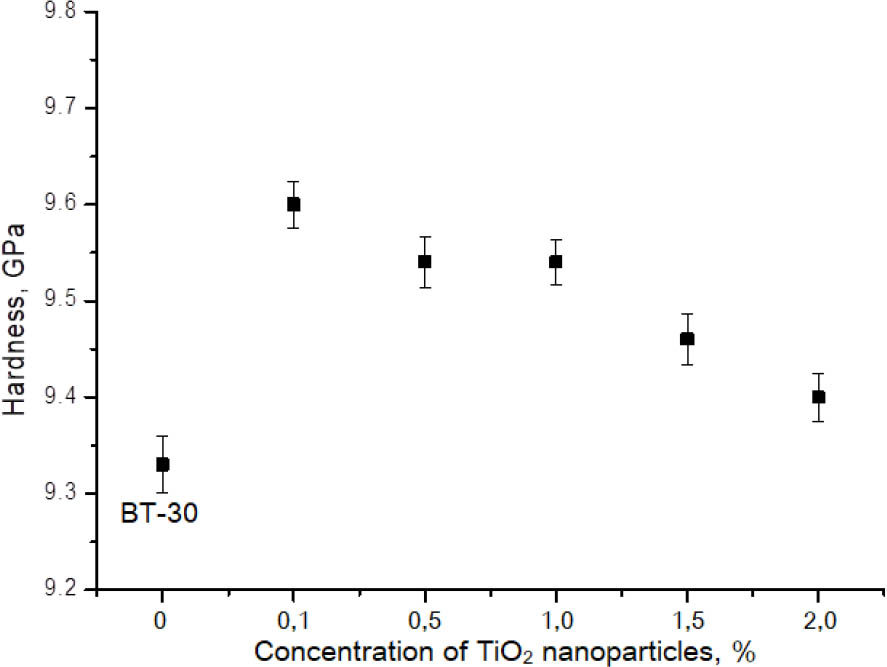
Fig. 5
Graph indicating the dependence of the change in the microhardness of samples on the content of nanoparticles (0.1%–2.0%)
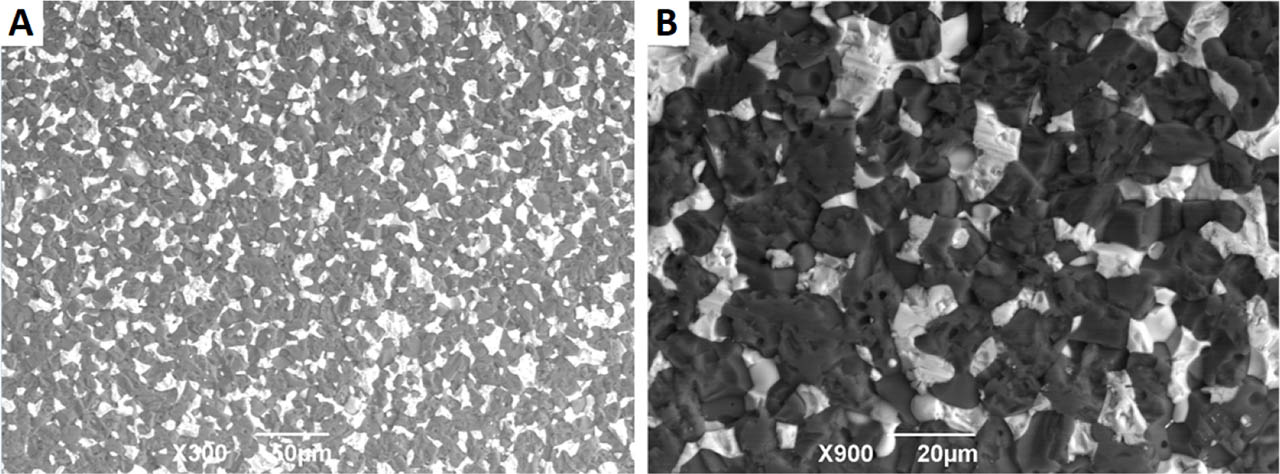
Fig. 6
Microstructure of BT-30 ceramic sample (BeO + 30 wt.% TiO2) obtained from the initial BeO and TiO2 powders having micron sizes: light – TiO2; dark – BeO. (A) Magnification 300×; (B) Magnification 900×
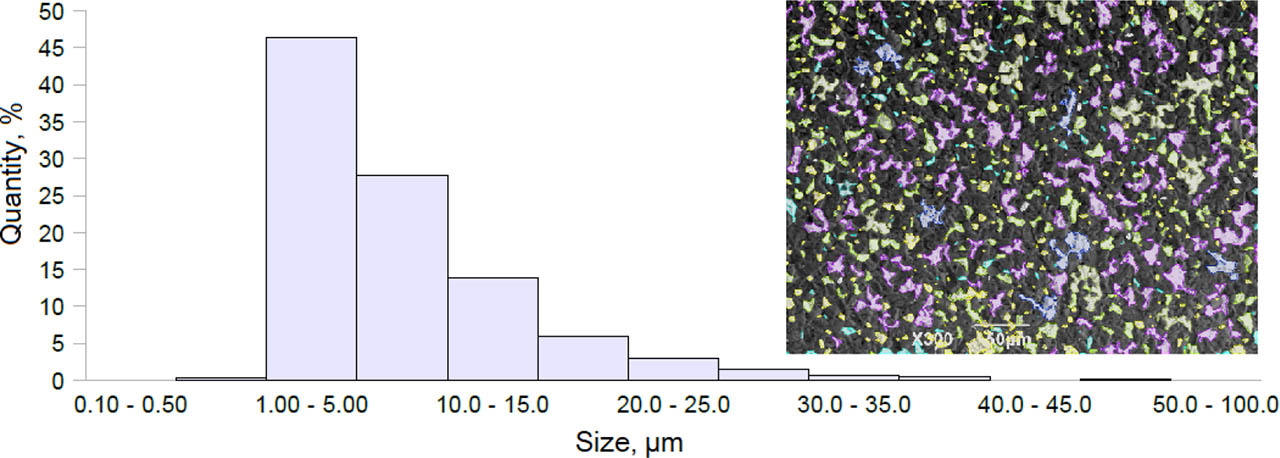
Fig. 7
Distribution of particle by size and quantity. Microstructure of BT-30 ceramics
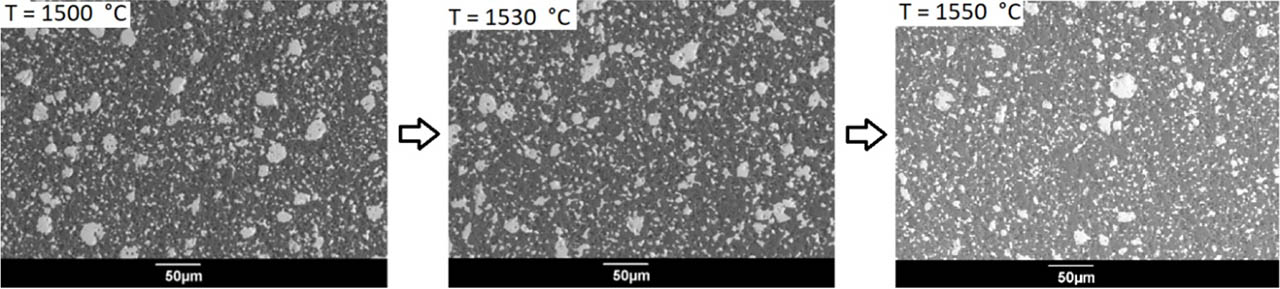
Fig. 8
Evolution of the microstructure of ceramics having a composition of under the influence of various temperatures
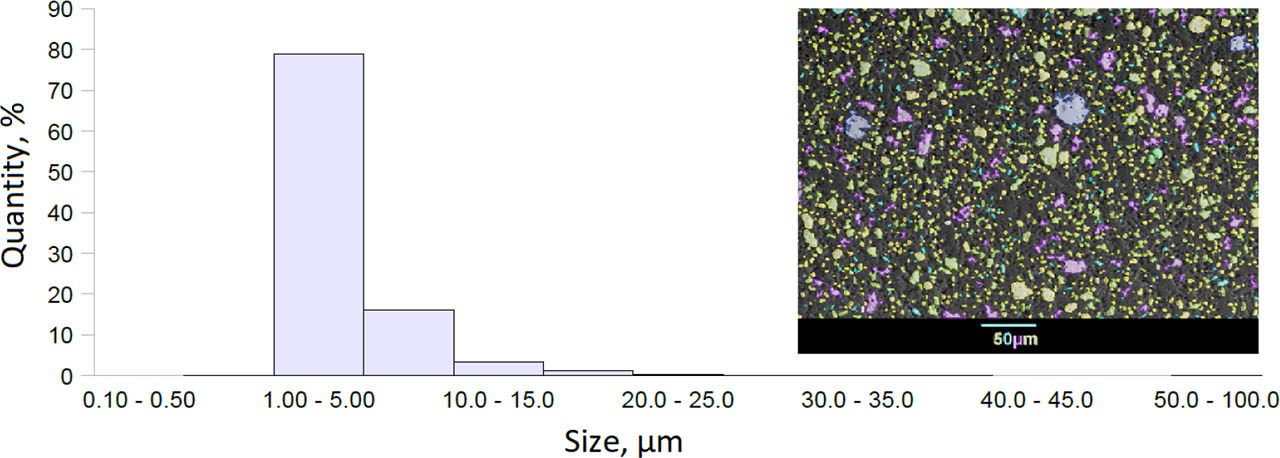
Fig. 9
Distribution of particle by size and quantity. Microstructure of ceramics. T= 1,550°C
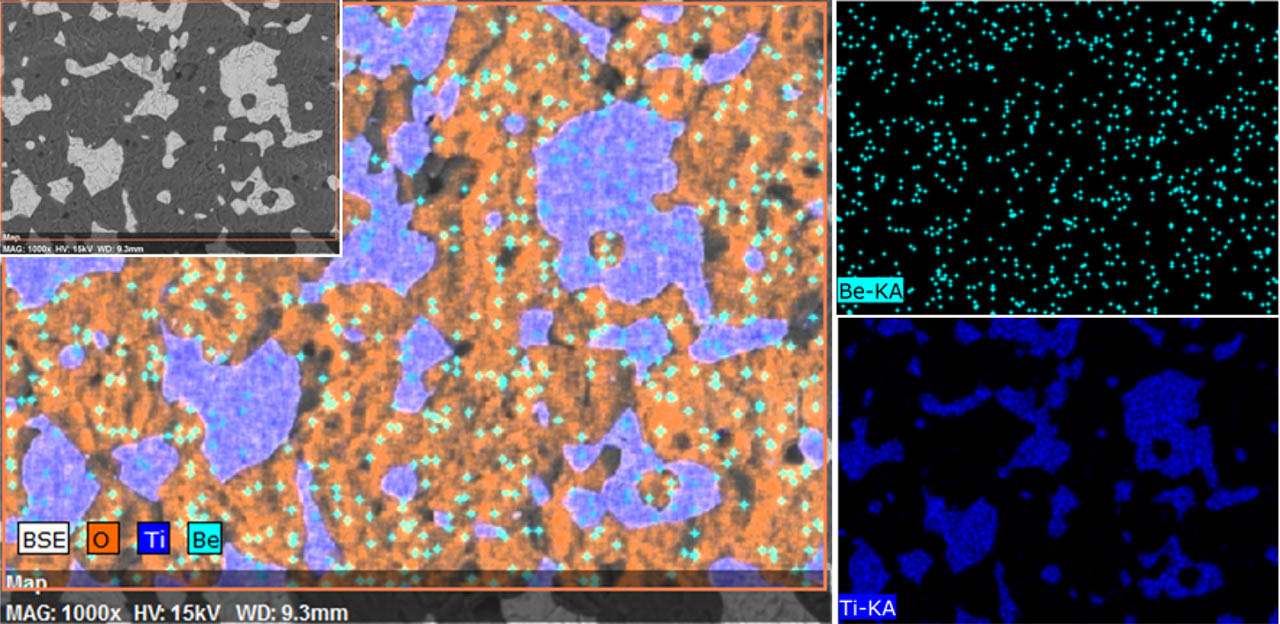
Fig. 10
Maps of phase distribution in ceramics of composition . T= 1,550°C
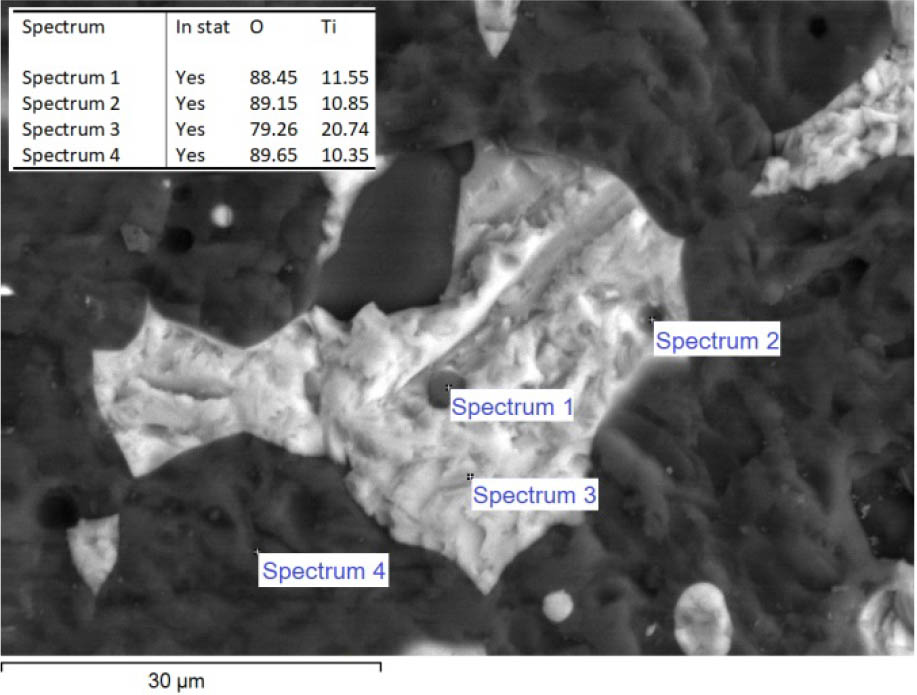
Fig. 11
Point energy dispersive X-ray spectroscopy (EDS) analysis of the grain structure of ceramics. T = 1,550°C
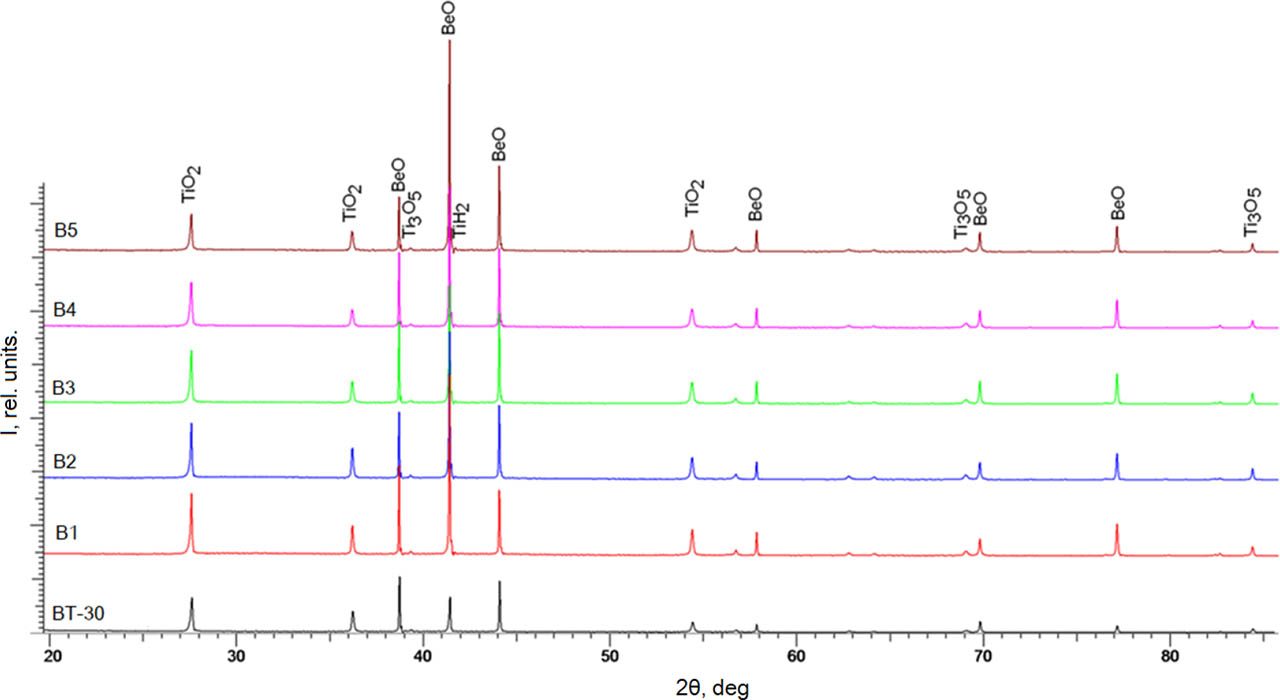
Fig. 12
X-ray diffraction patterns of the studied ceramics
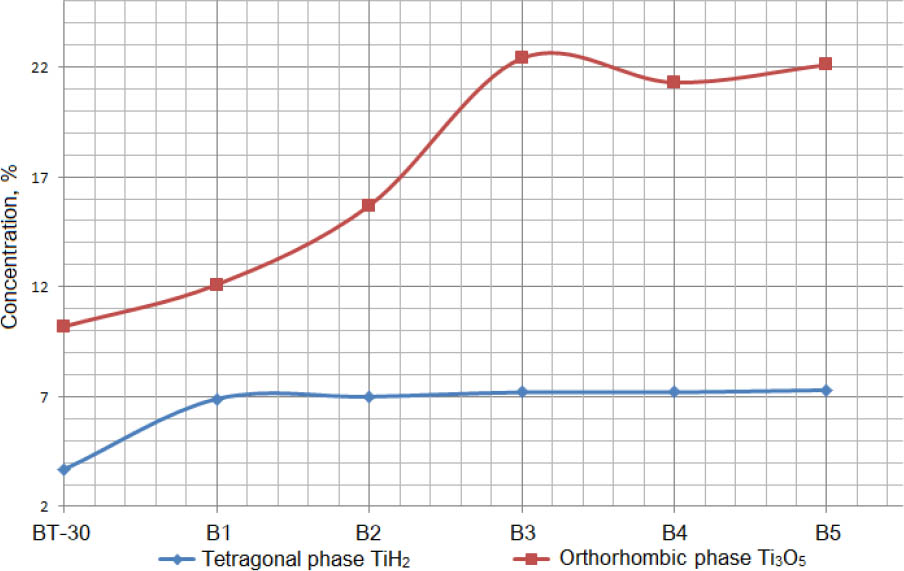
Fig. 13
The concentration of tetragonal and orthorhombic phases in the studied ceramics, depending on the number of introduced TiO2 nanoparticles at the sintering temperature of T = 1,550°C