
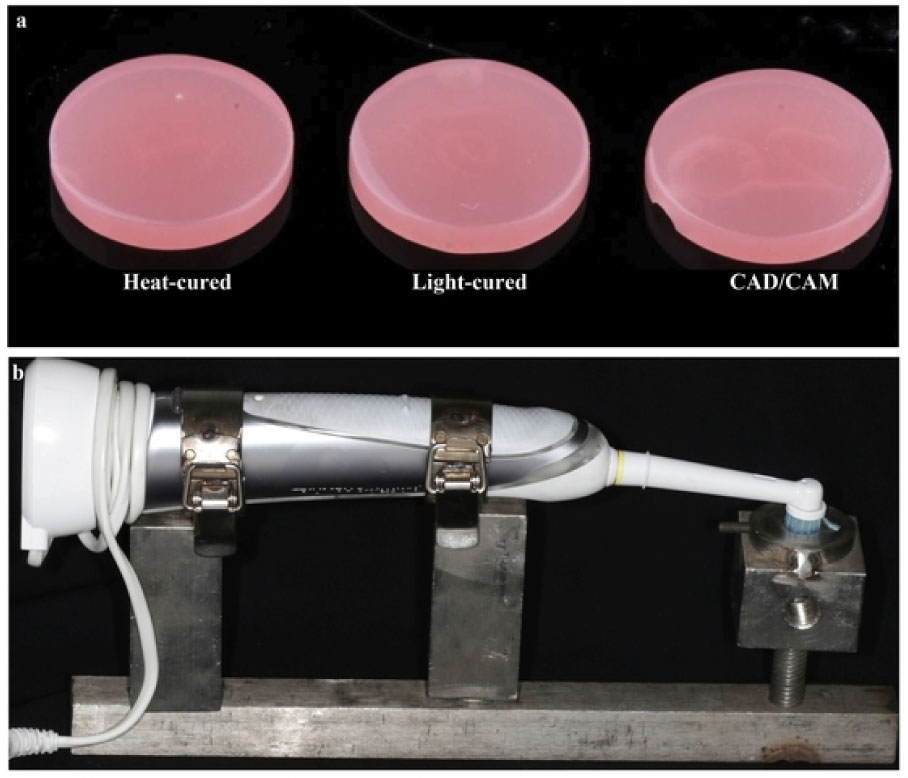
Fig. 1
(A) Prepared specimen; (B) power brush stabilized in the stand. CAD/CAM, computer-aided design/computer-aided manufacturing.
Table 1
Two-way repeated-measures ANOVA results for the interactions between resin type and disinfectants on the roughness values.
| Source | Type III SS* | DF | MS | F-value | p-value |
|---|---|---|---|---|---|
| Corrected model | 145.99 | 8 | 18.24 | 18.45 | 0.000* |
| Intercept | 235.61 | 1 | 235.61 | 238.28 | 0.000* |
| Resin | 104.22 | 2 | 52.11 | 52.70 | 0.000* |
| Disinfectants | 15.63 | 2 | 7.81 | 7.90 | 0.001* |
| Resins×Disinfectants | 26.13 | 4 | 6.53 | 6.60 | 0.000* |
| Error | 80.09 | 81 | 0.98 | ||
| Total | 461.70 | 90 |
* Type III SS infers a significant effect and interaction of the resin type and disinfectants on the surface roughness.
F-value = variation between sample means/variation within the samples; p-value = probability value.
ANOVA, analysis of variance; DF, degrees of freedom (N-1); MS, mean square computed by dividing an SS value by the corresponding DFs; SS, sum of squares.
Table 2
Mean surface roughness (Ra, μm) of the acrylic resins at baseline.
| Acrylic resins | N | Mean ± SD | p-value |
|---|---|---|---|
| HC | 30 | 0.24 ± 0.06 | <0.001* |
| CAD/CAM | 30 | 0.03 ± 0.02 | |
| LC | 30 | 0.17 ± 0.03 |
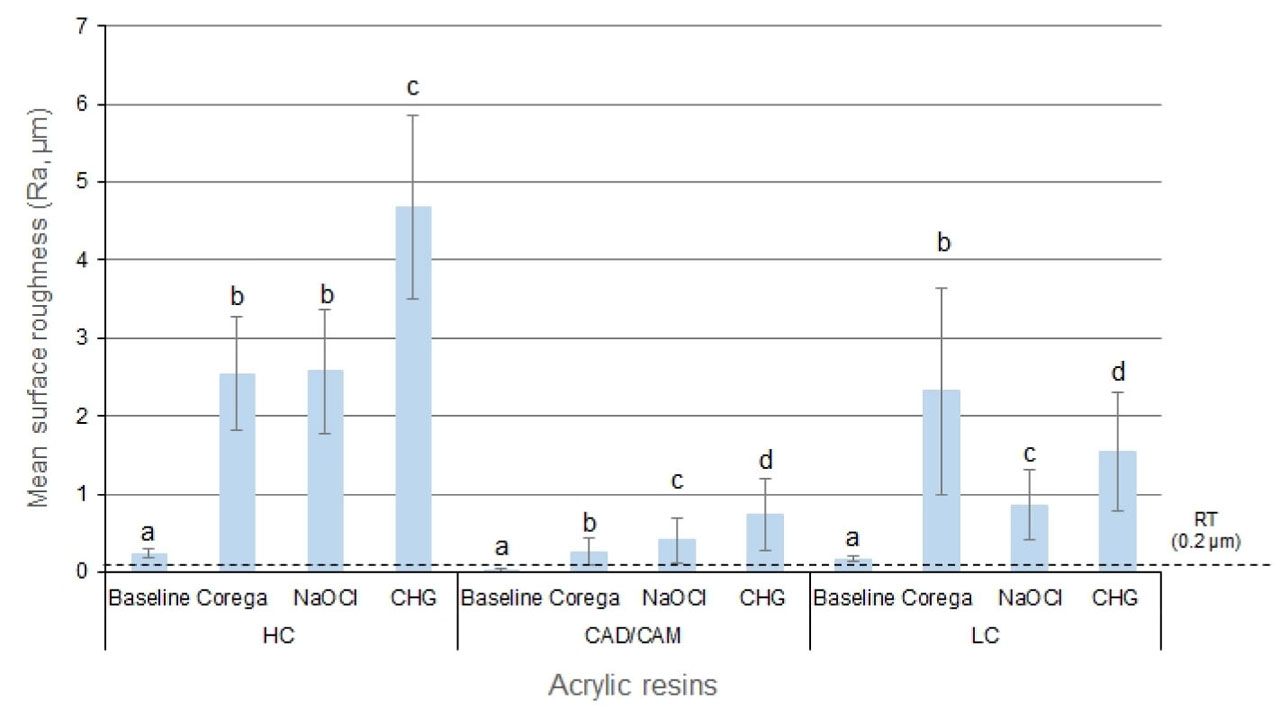
Fig. 2
Mean surface roughness of the acrylic resins at baseline and following surface treatments. Different lower case letters within the material groups indicate statistically significant differences (p<0.001) between the materials for the disinfectant used. CAD/CAM, computer-aided design/computer-aided manufacturing; CHG, chlorhexidine gluconate; HC, heat-cured resin; LC, light-cured resin; RT, roughness threshold (0.2 μm).
Table 3
Pairwise comparison of the final surface roughness for the acrylic resins and disinfectants tested.
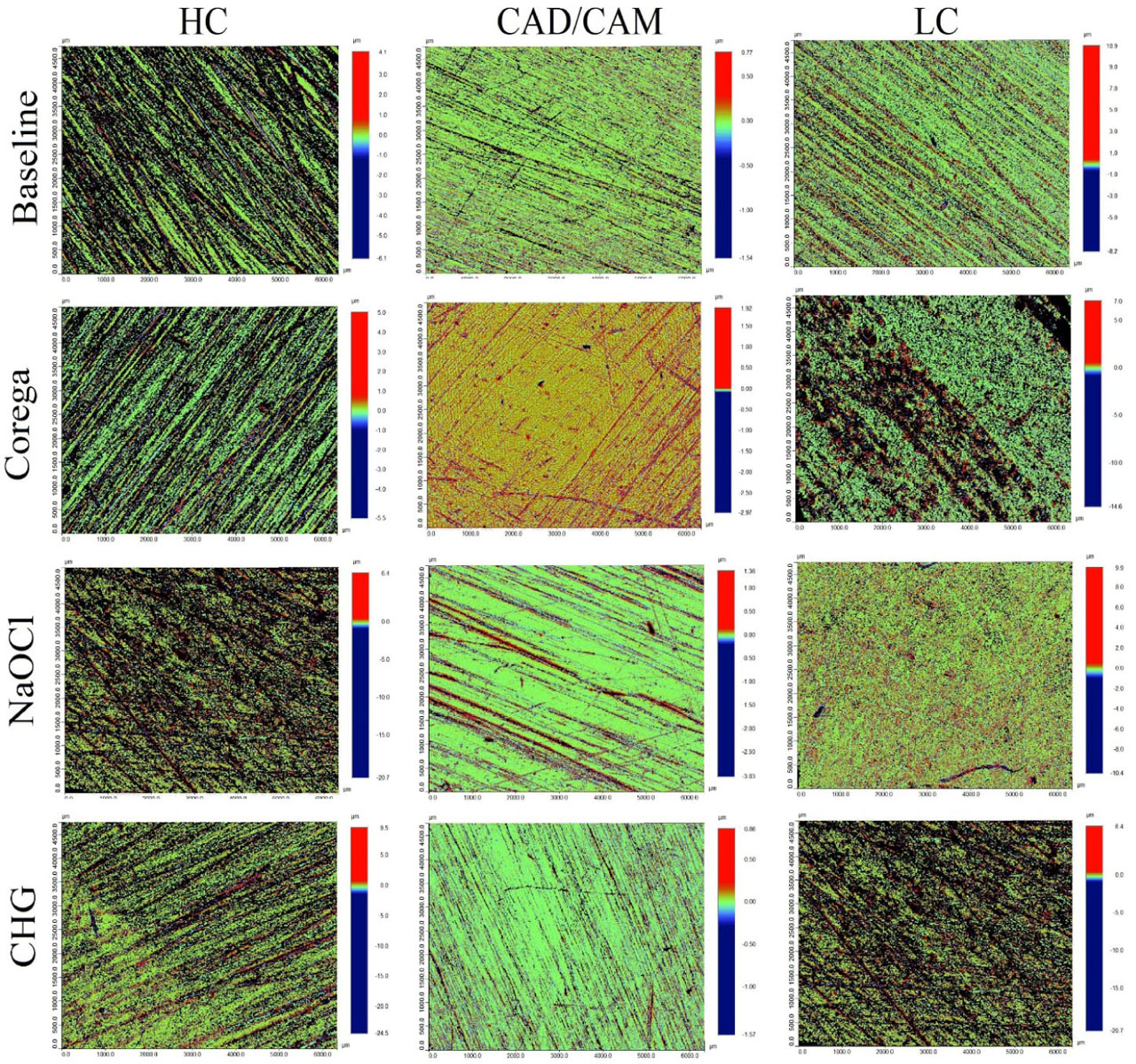
Fig. 3
Surface roughness images of the specimens at baseline and following various surface treatments. CAD/CAM, computer-aided design/computer-aided manufacturing; CHG, chlorhexidine gluconate; HC, heat-cured resin; LC, light-cured resin.