
Table 1
Focus group participants.
| Category | Participants | Expertise/Role |
|---|---|---|
| Academia (regional university) | 1 vice president, 1 professor, 1 lecturer | Relevant academic and professional experience in energy and climate change projects, and directly involved in educating future experts in sustainability, mining, and energy. |
| High school education | 1 high school teacher | Technical school training in mining and energy in the region |
| Regional labour agency | 1 representative | Experience and relevant knowledge on job evolution and implementation of projects to stimulate professional reconversion |
| Social assistance | 2 representatives | Deep knowledge and experience in projects aiming to support vulnerable categories of people in the Hunedoara region, as employed by the Regional Direction for Social Assistance and Child Protection |
| Religious leaders | 2 orthodox priests | Influential community figures in the Hunedoara Region, a high-trust institution. N.B. More than 80% of the region’s population is Orthodox (INS, 2023). The Orthodox Church has the second-highest level of trust in Romania after the military (INSCOP, 2023), thus being important in how it positions itself on social and economic topics |
| Unions | 1 local leader | Local leader of the biggest alliance of unions |
| NGOs | 5 representatives | Experience in energy, territorial development, and management of sustainability projects |
| Industrial enterprises | 2 managers hired by enterprises based in the Hunedoara region | Involvement in JT mechanisms beyond company impacts |
| Local administration | 3 experts from different towns of the region | Project management in city halls from the region (both urban and rural) |
Source: Author’s contribution.
Table 2
Key findings by category.
| Category | Main concerns/perspectives | Implications for JT implementation |
|---|---|---|
| Awareness and understanding of the JT concept and mechanisms | Abstract definitions are seen as insufficient; demand for concrete guidance, mechanisms, and rapid results | Need for practical, technical, and legislative clarity |
| Perceptions of risks and socio-economic challenges | Anxiety about job losses, economic decline, and an aging population; miners’ vulnerability is strongly emphasized | JT policies must address employment security and support vulnerable groups. |
| Knowledge and skills for local leaders | Strong emphasis on technical, legislative, and managerial expertise; consultancy perceived as crucial | Strengthening local administrative and managerial capacity is essential. |
| Collaboration and governance gaps | Lack of coordination between central and local authorities; need for teamwork, integration, and feedback | Effective JT requires inter-institutional collaboration and inclusive governance. |
| Communication needs and channels | Messages should be simple, transparent, and adapted to different audiences; actors include government, church, schools, NGOs | Communication is central to building legitimacy and public support. |
Source: Author’s contribution.
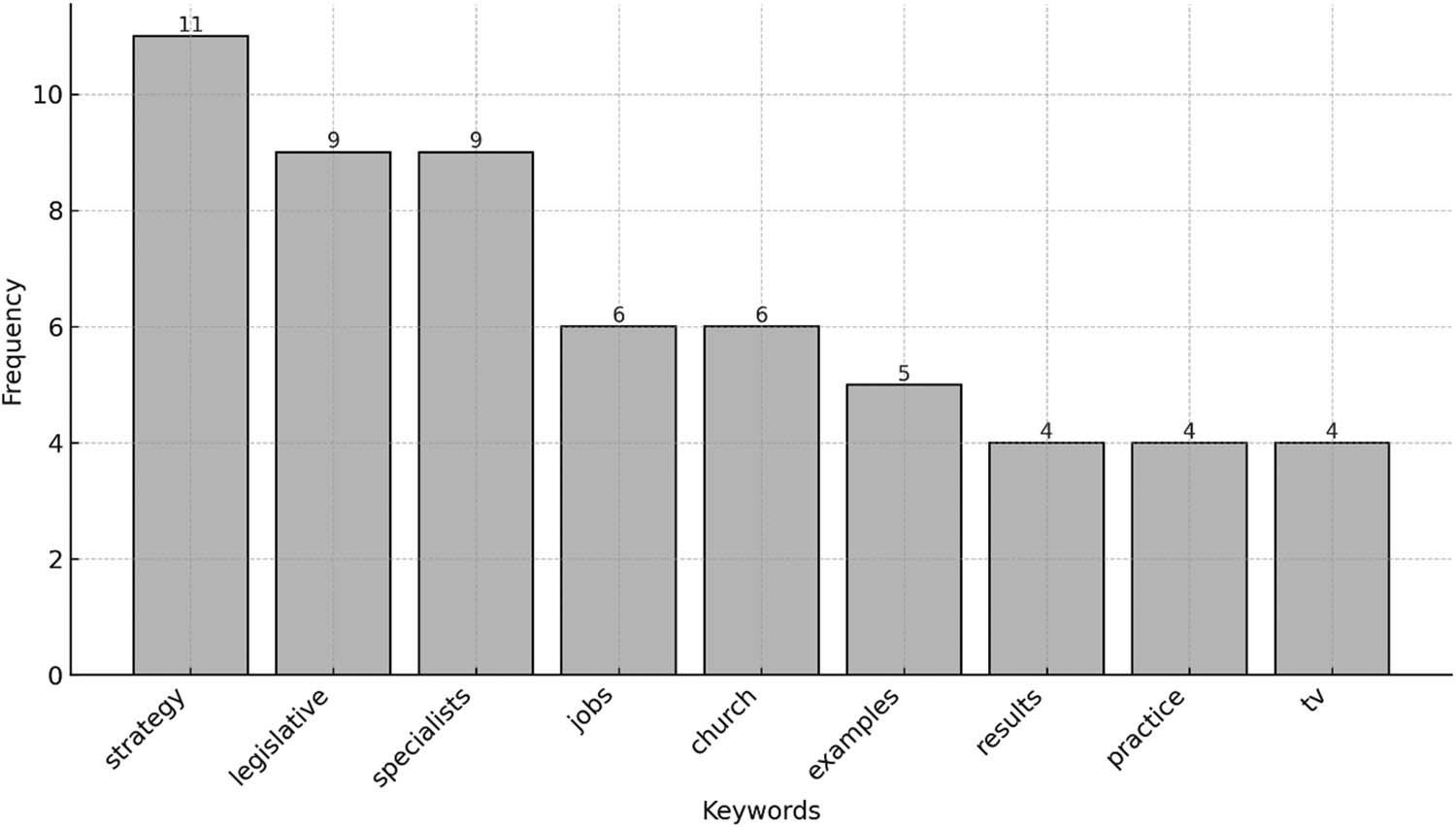
Figure 1
Frequent terms.
Source: Author’s contribution.