
1. Introduction
The urgency of mitigating climate change has placed energy policy and, generally, sustainability at the centre of global debates. This is particularly true in the case of the European Union (EU), which has positioned itself as a frontrunner in this transition, formulating ambitious policies to decarbonize the economy. However, these policies have also faced heavy criticism regarding the economic burdens that the transition might place on certain regions and industries. In response to these concerns, the concept of a Just Energy Transition has gained prominence. In line with the terminology used in official documents of the EU and international organizations, we will employ in this text the shorter and widely recognized formulation “Just Transition” (JT) to refer to what is also described as the “Just Energy Transition.”
JT acknowledges the need for a structural change while ensuring that the social and economic burdens of decarbonization are equitably distributed. With this objective, the EU has introduced the Just Transition Mechanism, with its first pillar being the Just Transition Fund. However, a significant concern is that the funding from the EU Just Transition Mechanism may not fully mitigate the economic disruptions experienced by the affected regions (Vedder, 2022). Critics argue that the provided support may be inadequate to address the expenses associated with transitioning from fossil fuels and high-emission industries, potentially jeopardizing the stability of local economies reliant on these sectors. This concern is particularly salient in discussions about the balance between environmental sustainability and the economic stability of implemented policies (Śniegocki et al., 2022). Critics claim that although the transition seeks to be fair and inclusive, it often falls short in delivering adequate economic alternatives, opportunities, or sustainable employment solutions, thereby making workers and communities vulnerable to economic decline and social struggles.
More than decarbonization, in the official understanding of the European Union approach, JT ensures that the shift to a climate-neutral economy is fair, inclusive, and leaves no one behind, a key pillar of the European Green Deal (European Commission, 2019). The Just Transition programs are established at the EU level, yet their administration largely falls to member states, which have significant flexibility in choosing projects for funding within the design principles outlined by the European framework. The EU’s Just Transition Platform is a single access point for financing, technical assistance, and assistance in project implementation, aimed to increase the overall effectiveness of transition assistance; it has an equivalent in the United States, developed by the Biden administration (Verdolini et al., 2024). In line with this framework, our analysis considers both the distributive dimension of JT (concerning the fair allocation of costs and benefits) and the procedural dimension (emphasizing participation, transparency, and inclusiveness in decision-making).
The concept of Just Transition originated in the 1960s and 1970s in the United States (Carley & Konisky, 2020), particularly within the coal mining sector, as communities confronted the impacts of industrial restructuring and environmental degradation. American labour and environmental activist Tony Mazzocchi is credited with coining the term (Eisenberg, 2018). At present, the Just Transition concept encompasses environmental justice, social inclusion, and poverty alleviation alleviation, as is expected “to generate new senses of injustice surrounding processes of community” (McCauley & Heffron, 2018). Therefore, building procedural-based capacity is paramount for the development of JT programs, as experience from other countries (e.g., Thailand, Indonesia, and South Africa) proves (Archer & Dodman, 2015; Ziervogel, 2022). Thus, even if this approach might not necessarily decrease or avoid tensions and conflicts during the actual implementation of programs, it should, at least, foster resilience within communities and lead to more engagement (McCauley & Heffron, 2018). In this respect, leadership plays a pivotal role, especially local leadership, which balances the prerequisites of larger programs with the necessities of communities and local context.
Our article focuses on exploring the understanding of the JT concept and how to communicate it better, as found out from an exploratory qualitative research on representatives of stakeholders from the Hunedoara Region, Romania, historically reliant on coal mining and heavy industry. Three focus groups were conducted with representatives from academia, local government, civil society (mainly NGOs involved in sustainability projects), and religious institutions (for their impact on the perceptions of workers, which is a local specificity) to explore how stakeholders perceive and communicate the Transition and what they understand as Just Transition. This article presents the main outcomes from these discussions, with a focus on excerpts from respondents to preserve the authenticity and depth of the research. Although the findings are based on a research conducted in the Hunedoara Region, the conclusions reflect broader patterns specific to coal-dependent regions in Europe on their path to the Just Transition, demonstrating a need for emphasis on community trust, local leadership, and communication strategies.
The article delves into understanding at the grassroot level what is needed from a public management perspective, being developed from general to particular, and considering the double paramount question of the readiness of leadership and public opinion support. The local perspective is relevant given the cascaded form of the JT concept, and conducting the research in one of the EU’s most affected areas of the energy transition, as a traditional coal-extracting region, brings more insights that have the potential to be considered in other parts of the world with similar dependence on fossil-fuelled industries or agriculture.
This article is organized as follows: Section 2 presents a comprehensive literature review that examines the Just Transition concept from multiple perspectives, focusing on two critical dimensions for local implementation: the leadership competencies, skills, and knowledge required to manage JT programs and projects effectively, and the communication strategies necessary to build public support and address resistance to European regulations promoting the Just Transition. Section 3 details the qualitative research methodology and presents findings from three focus groups conducted with 20 local stakeholder representatives in the Hunedoara region (a coal mining area heavily dependent on fossils), exploring their understanding of JT mechanisms, required competencies, and effective communication approaches for securing community engagement. Section 4 discusses the research findings, their implications for JT implementation, and acknowledges the study’s limitations while identifying future research directions that could inform policy and practice in similar coal-dependent regions undergoing energy transition.
2. Literature review
Literature analyses JT from a variety of standpoints, covering main aspects such as perceptions on the phenomenon (Banerjee & Schuitema, 2022), macroeconomic policies influencing the JT mechanisms (Braga & Ernst, 2023), and the social impact (Sun et al., 2023). A significant area of current research is the preparedness of leaders and professionals required to implement such programs, particularly at the local level. Their capacity to traverse intricate socio-economic environments, including communities, administer resources, and tackle difficulties, will be decisive for the overall efficacy of these programs. Consequently, research must investigate both the structural conditions required for implementation and the human factors (such as leadership styles, decision-making processes, and stakeholder engagement) that facilitate effective execution. Moreover, public support is paramount for successfully implementing the JT policies, especially in the case of the local communities directly affected. Is JT, therefore, understood properly by stakeholders? How should it be communicated?
2.1. Leadership, skills, and knowledge: The engines to implement the Just Transition projects
There is no successful change without leadership support and proper management. Largely discussed at an organizational level, the leadership role in change management is crucial to ensure the correct implementation of change by establishing a sense of urgency, constant communication of the new vision, and empowering and consolidating gains (Kotter, 2012). The discussion on leadership’s role in ensuring change success is not new. Bridges and Mitchell (2000) emphasize that leaders are inherently prepared for change, at least in business organizations, where there is common knowledge that success today cannot necessarily be replicated using yesterday’s means. Since the 2000s, such a paradigm seems to apply also in public administration, especially with the rise of the concept of New Public Management, which emphasizes innovation and governance (Pînzaru, Săniuță & Sălăgeanu, 2022).
When addressing the topic of transformational programs, local leadership’s role is paramount, as shown in the literature. Local leadership is often regarded as a catalyst for transformation, especially in public administration and community development. Bayraktar & Jiménez (2020) assert that transformational leadership positively impacts change-related outcomes such as commitment and support for initiatives. Local leadership has the capacity to mobilize local resources by bridging on-the-place actions with support enhanced through collaboration with stakeholders, which is in line with studies showing that transformational leadership is most successful when it actively promotes community participation (Davies, 2009; Van Popering-Verkerk et al., 2022). Servant leadership (a leadership style that prioritizes serving others and empowering people before exercising authority) in this respect matters even more, as it brings value to the community as a team (Meuser & Smallfield, 2023), creating the so-called social identification and, therefore, the very premise of support for transformation in the long term.
Beyond the mission assumed by leaders in driving change, the fundamentals of success lie in clear objectives and proper knowledge and skills. Frameworks such as the European JT provide implementers with clear objectives, guidelines, and key performance indicators, and a variety of training programs for experts and stakeholders’ representatives are proposed at the level of the European Union.
Effective implementation of JT measures requires more than just technical, legislative, economic, and administrative expertise, but also skills, participation, deliberation, and inclusion of marginalized groups. JT measures that have at their centre deliberation are essential for their success (Narain, 2022). Skilled local leadership is also essential for including communities in the development and implementation of adaptation measures within the framework of climate resilience. Thus, Kohlitz et al. (2024) argue that local government personnel must be adequately prepared to participate in transformative processes to address climate challenges. This preparation entails navigating the political environment and developing new competencies essential for promoting effective local governance. Ziervogel (2019) highlights the value of inclusive governance in enhancing the transformative capacity of local governments, especially in urban areas where the urban poor face increased climate risks.
The most important knowledge and skills that leaders and project managers need for successful change management and, consequently, for successful transformations can be summarized as follows:
(1) System thinking analysis (Errida & Lotfi, 2021) to include business acumen, change management models, technical aspects, legislation, and social outcomes. This capacity goes beyond implementation, requiring project managers to see above the limits of their work by delving deeper into the very core of the change, as stated by Hornstein (2015) when advocating for the necessity to pair project management with change management. Such systemic thinking is essential in the JT context, where economic, social, and environmental dimensions are deeply interlinked and cannot be managed in isolation.
(2) A clear understanding of the nature of the change, its risks, and gains to foresee supporters, opponents, and paths to follow. In this respect, understanding the Just Transition not only as a guiding project but also as a form of adopting sustainability allows leaders and experts to find valuable resources that go beyond administrative guidelines into involvement in the process of business, government, and civil society (Doppelt, 2017).
(3) Almost intrinsically associated with change management (Hornstein, 2015), resistance management in organizational settings provides valuable lessons to be learned in the context of the Just Transition. For example, Hamidianpour et al. (2016) found that transformational leadership positively influences employee resistance to change. Their research suggests that leaders who exhibit cultural intelligence and transformational attributes can mitigate resistance. Thus, leaders with the skills mentioned earlier are more likely to succeed in their roles of advancing transformation processes. In JT, resistance management is vital, as the transition often disrupts established economic and social structures, making community acceptance a key success factor.
(4) Effective communication, deliberation, participation, and co-creation start with assessing the communication needs of all stakeholders (Hornstein, 2015) and continue through ongoing dialogue with all involved stakeholders to foster support and engagement in the transformation process. For JT, continuous and inclusive communication ensures that diverse groups are heard, fostering trust and enabling collaborative solutions in sensitive contexts. The necessity of collaboration in this respect has already been noted by the literature when discussing other types of transformations, such as the digital one (Gangneux & Joss, 2022). The research of Macedo et al. (2020) indicates in this respect that successful transformations frequently arise from collaborative experiments at the municipal level, which can inform policy and practice. The phasing out of long-standing industries often encounters scepticism and opposition to change, as seen in the JT processes (Geels, 2019). By working together with experts and leaders at local levels, project managers provide technical data, methodologies, and sometimes implementation mechanisms to demonstrate the feasibility of the Transition (Marcelino-Sádaba, González-Jaen & Pérez-Ezcurdia, 2015). At the same time, local officials act as credible advocates and as leaders of programs under which specific projects are developed. Collaboration mitigates, therefore, opposition, diminishes misinformation, and facilitates a successful transition (Topaloglou et al., 2024), being sustained by efficient communication and co-learning (Luederitz et al., 2017).
(5) Reinforcement and sustainment of change, with clear roadmaps, including all the mechanisms and activities to be used for sustaining and reinforcing the change through appropriate planning, monitoring, and measurement (Hornstein, 2015; Jayatilleke & Lai, 2018). This long-term reinforcement is directly relevant to JT, where transition efforts must be maintained over decades and require constant adjustment to evolving social and economic realities.
Ultimately, while leadership, skills, and knowledge provide important pillars of successful Just Transition initiatives, their efficacy depends on the efficacy of communication, dissemination, and incorporation into collective action, making communication a key avenue to implementation.
2.2. Communication and public support
Public perception plays a decisive role in shaping sustainability policies, as policymakers often align with public opinion given the importance of voter support to political survival (Esiri et al, 2023). Consequently, public support or opposition can significantly advance or obstruct the implementation of sustainable energy transition, making effective policy communication essential. Nevertheless, the idea of environmental sustainability itself is increasingly contested: “Compared with the fossil fuel industry, then, the modern environmental movement has two problems: (1) a power problem and (2) a branding problem” (Eisenberg, 2018, p. 312). Simply put at the level of public opinion, the broad phenomenon of decarbonization is largely associated with the loss of good jobs, hence, much of the branding problem. Some truth behind the negative perception of the decarbonization programs can be observed: Eisenberg (2018) observes that historically, in the United States, such measures did not necessarily leave miners without employment options. However, the alternatives were often low-quality jobs, as the industries that replaced mining mostly offered lower-paying positions in the service sector. Verdolini et al. (2024) also highlight the limited impact of the EU’s previous programs (2014–2020) that did not convince former miners to become entrepreneurs as a form of professional reconversion consequential to decarbonization processes.
Mansaray (2019), quoting Alvesson & Kärreman (2011), shows that management literature highlights that two themes dominate the debate when resistance to change is discussed: (1) power and (2) discourse. Communication is of utmost importance in shaping change, as discourse can be “used as a methodological device to cast light on the phenomenon of workplace resistance” (Alvesson & Kärreman, 2011, p. 1137). What matters is not only the way change is communicated but also the type of information that is considered relevant. Support for change (or opposition, for that matter) is evident in public discourse (or organizational discourse if we address smaller changes).
Studies on how well the JT concept is known are scarce. For example, a survey conducted in South Africa in 2023 on 3,112 respondents (Roberts, Struwig, & Zond, 2024) showed that a significant part of the South African population (65%) had never heard of the term Just Transition, while 13% had heard of the term but did not understand what it meant.
The success of leadership endeavours is dependent on the presence of supportive governance frameworks that offer the requisite resources and structures for implementation, as discussed previously when addressing the imperative of education for capacity building (Kennedy Hussein, 2006; Mickson & Anlesinya, 2020) or the lessons learned previously from the operationalization of avoid hard hyphen initiatives (Torres, Pina & Royo, 2005; Pedersen, 2018; Escobar, Almeida & Varajão, 2023).
Political views influence the support of the fight against climate change and the adoption of sustainability in general, therefore, the Just Transition processes. We can extrapolate that the public agenda communication of politicians influences the support of citizens, but nuances are to be observed. In the United States, Republicans are less likely than Democrats to support a bargain of transition assistance for climate policy, as shown by the studies of Gazmararian (2024) and Egan and Mullin (2017). Nevertheless, Gazmararian (2024) shows that US Republicans become about 11% more supportive of climate policy if it includes Just Transition assistance, which suggests that transition assistance policies may foster public support, with the condition of being credible to impacted workers and community members. This observation is consistent with other studies conducted at the international level, such as that of Fritz et al. (2024), which shows, based on 44 focus groups conducted in 22 countries, that trust is a fundamental theme in participants’ reflections regarding public engagement and the governance of climate-intervention technologies. Thus, Fritz et al. (2024) argue that fostering trust in institutions requires transparent communication regarding side effects and uncertainties and that it needs to involve trusted experts and provide early clarification on the outcomes to ensure legitimacy.
Public support for JT seems to exist worldwide, even if, as seen in the case of South Africa, awareness of the concept is still to be defined. Nevertheless, individuals understand general concepts such as “climate change” and “sustainability,” with differences as seen earlier. However, who communicates, and especially what is communicated about the JT, is paramount, as are education, political views, and media exposure. By using a multiple case study approach, Chwialkowska (2019) shows, for example, that social media influences consumer behaviour more effectively than face-to-face interactions towards adopting green behaviour habits by fostering a community that educates about products and their detrimental impacts while advocating for environmentally friendly and sustainable alternatives. These findings are consistent with those of Johns and Lindh (2018, 2022), who confirmed influencers’ role in increasing sustainability awareness in younger consumers. However, even if awareness and consequent knowledge are mandatory to create the foundation of behavioural change, they do not necessarily lead to such changes. A study on 649 Taiwanese consumers published in 2018 concluded, for example, that “upon discussing the correlations between environmental knowledge, consciousness, and green buying behaviour, it was discovered that environmental knowledge alone is not enough to lead to a change in the consumer’s actions to protect the environment” (Lin & Niu, 2018, p. 7). Especially in an age of instantaneous communication through social media, knowledge management of vital information becomes paramount (Vătămănescu & Pînzaru, 2018), both at the level of decision-makers and of the public opinion. Public support for actions and changes catalysed by the Just Transition implementation depends on a variety of factors that should be clearly understood by decision-makers and managers of JT projects, with local adaptation if needed. According to the AdJUST framework (AdJUST, 2023), these factors include the bureaucratic capacity of institutions to design and implement coherent policies; the quality of vertical and horizontal coordination between different levels of governance; and the extent of deliberation, public engagement, and legitimacy-building in decision-making processes. Public support is also influenced by the ability to incorporate business perspectives without succumbing to capture, as well as by institutional capacities for dealing with uncertainty through experimentalist and collaborative governance approaches. Finally, maintaining credible long-term commitments is essential for building trust and ensuring sustained support for the transformative measures required by the Just Transition (AdJUST, 2023).
3. Research
The Hunedoara region was chosen as the focus of this research because it is one of the Romanian regions most exposed to the socio-economic impacts of the Just Transition, making it a highly relevant case for understanding local readiness and stakeholder engagement. The region is historically specialized in coal extraction and metallurgy, industries that are directly targeted by decarbonization policies. With an area of 7,063 km² and a population of 380,105 inhabitants registered in 2020, Hunedoara faces both economic and demographic challenges linked to industrial decline (Consiliul Județean Hunedoara, 2021). The Jiu Valley, located within Hunedoara and bordering the Gorj Region, was once Romania’s main coal-producing area. Today, after decades of mine closures and reorganizations, the number of coal workers has dropped from 45,000 in the communist era to 11,000, contributing to significant depopulation and social vulnerability. The Hunedoara region has witnessed a continuous decrease in population. The main cause of the population decline of 52% within the last 30 years was the low economic opportunities, active people migration to the rest of the EU, and low birth rate (INS, 2023).
The EU JT mechanism will be implemented mostly through projects. In this respect, an essential first step is to explore how local leaders, the experts supervising project implementation, and other stakeholders understand the concept, the framework, and the expected outcomes. This exploration is necessary to assess the starting point for implementation. This section highlights the research insights derived from three focus groups with major stakeholders in the Hunedoara region. The analysis examines their viewpoints on the comprehension and communication of the Just Transition process, emphasizing significant themes, obstacles, and learning that resulted from the talks.
3.1. Methodology
To investigate how the concept of the Just Transition is understood locally and to identify effective methods of communicating it, this study adopted a qualitative research methodology based on three focus groups to achieve three objectives:
(1) to investigate the knowledge and skills required by local leaders and experts for effective management of the Just Transition;
(2) to evaluate the level of awareness and understanding of the concept among key stakeholders;
(3) to determine communication strategies that can enhance trust, engagement, and public support within the community.
Focus groups were selected as the most appropriate approach due to the need to obtain a variety of opinions, experiences, and expectations. This method facilitates engaging dialogues that allow participants to articulate their perspectives candidly and to jointly contemplate the difficulties and potential of the change. The three focus groups were held in Hunedoara, Romania, from 11–13 September 2023, each including members from several stakeholder groups of the region, engaged in the Just Transition process (Table 1).
Table 1
Focus group participants.
| Category | Participants | Expertise/Role |
|---|---|---|
| Academia (regional university) | 1 vice president, 1 professor, 1 lecturer | Relevant academic and professional experience in energy and climate change projects, and directly involved in educating future experts in sustainability, mining, and energy. |
| High school education | 1 high school teacher | Technical school training in mining and energy in the region |
| Regional labour agency | 1 representative | Experience and relevant knowledge on job evolution and implementation of projects to stimulate professional reconversion |
| Social assistance | 2 representatives | Deep knowledge and experience in projects aiming to support vulnerable categories of people in the Hunedoara region, as employed by the Regional Direction for Social Assistance and Child Protection |
| Religious leaders | 2 orthodox priests | Influential community figures in the Hunedoara Region, a high-trust institution. N.B. More than 80% of the region’s population is Orthodox (INS, 2023). The Orthodox Church has the second-highest level of trust in Romania after the military (INSCOP, 2023), thus being important in how it positions itself on social and economic topics |
| Unions | 1 local leader | Local leader of the biggest alliance of unions |
| NGOs | 5 representatives | Experience in energy, territorial development, and management of sustainability projects |
| Industrial enterprises | 2 managers hired by enterprises based in the Hunedoara region | Involvement in JT mechanisms beyond company impacts |
| Local administration | 3 experts from different towns of the region | Project management in city halls from the region (both urban and rural) |
Source: Author’s contribution.
The ages of the participants in the three focus groups varied between 34 and 66 years. All participants have at least a university education, senior or management expertise, and experience in managing programs or projects of territorial development/or sustainable development, and/or social assistance. Twelve participants were women, and eight were men. No significant difference in opinions was registered that could be interpreted as a consequence of gender or age.
Focus groups were conducted in Hunedoara on 11–13 September 2023 and recorded with the consent and approval of participants. All three focus groups were structured according to a common moderation guide, including a range of participants from the categories outlined in Table 1, rather than dividing stakeholders by category. This design choice was designed to facilitate cross-sector dialogue, enable participants to engage with each other’s perspectives, and document the interaction dynamics among stakeholders involved in the Just Transition implementation. The duration of each focus group was approximately 90 min, corresponding to a logical sequence of thematic blocks: understanding of JT mechanisms, knowledge and skills, and communication strategies.
The recordings of the three focus groups were fully transcribed and anonymized, generating a corpus of discussions from 20 participants who represent diverse sectors of community life in Hunedoara, including public administration, education, social protection, nongovernmental organizations, the economic sector, and religious institutions. The transcripts underwent analysis through inductive thematic analysis, adhering to the six stages outlined by Braun and Clarke (2006). Initially, the researchers engaged with the data by thoroughly reviewing the transcripts and documenting analytical observations regarding the emerging themes. Subsequently, initial codes were generated to identify significant segments of participants’ discourse, without reliance on a pre-established theoretical framework, allowing the coding to be directly informed by the narrative content. In the subsequent phase, the codes were categorized into potential themes by recognizing similarities and differences in participants’ descriptions of their experiences, concerns, and perceptions of the transition process. The candidate themes were reviewed to ensure internal consistency and differentiation from other themes. The stabilization of the thematic structure led to the definition and naming of themes, thereby clarifying the central meanings they encapsulate and their roles in interpreting local experiences associated with just transition. In the final stage, the analysis results were presented as an interpretative narrative, supplemented by representative quotes chosen to accurately represent the participants’ voices and substantiate the analytical interpretation.
Themes identified indicate consistent patterns in the experiences and perspectives of participants across various institutional roles, genders, and ages, implying that they represent a wider community climate rather than merely isolated individual viewpoints.
3.2. Findings
This section highlights the principal findings from three focus groups with 20 representatives of stakeholders engaged in or impacted by the Just Transition process in the Hunedoara region. The most important aspects explored were the awareness of the JT concept, the needed knowledge and skills for local leaders and experts that will implement it, as well as the possible efficient communication approaches on the Just Transition: who should communicate, what the messages should be, and how the messages should look; the appropriate communication channels.
The findings are presented by categories. Thus, Table 2 synthesizes the main concerns expressed by participants and their implications for the implementation of the Just Transition in Hunedoara. This thematic presentation provides a coherent overview of how participants understand and assess the transition at the community level.
Table 2
Key findings by category.
| Category | Main concerns/perspectives | Implications for JT implementation |
|---|---|---|
| Awareness and understanding of the JT concept and mechanisms | Abstract definitions are seen as insufficient; demand for concrete guidance, mechanisms, and rapid results | Need for practical, technical, and legislative clarity |
| Perceptions of risks and socio-economic challenges | Anxiety about job losses, economic decline, and an aging population; miners’ vulnerability is strongly emphasized | JT policies must address employment security and support vulnerable groups. |
| Knowledge and skills for local leaders | Strong emphasis on technical, legislative, and managerial expertise; consultancy perceived as crucial | Strengthening local administrative and managerial capacity is essential. |
| Collaboration and governance gaps | Lack of coordination between central and local authorities; need for teamwork, integration, and feedback | Effective JT requires inter-institutional collaboration and inclusive governance. |
| Communication needs and channels | Messages should be simple, transparent, and adapted to different audiences; actors include government, church, schools, NGOs | Communication is central to building legitimacy and public support. |
Source: Author’s contribution.
Figure 1 summarizes the frequency of the most salient keywords across the focus groups; it is not meant as a statistical representation but rather as an indicative visualization of which themes were most dominant in the discussions, highlighting the relative prominence of governance- and expertise-related terms such as strategy, legislative, and specialists, alongside recurring references to jobs, church, and examples.
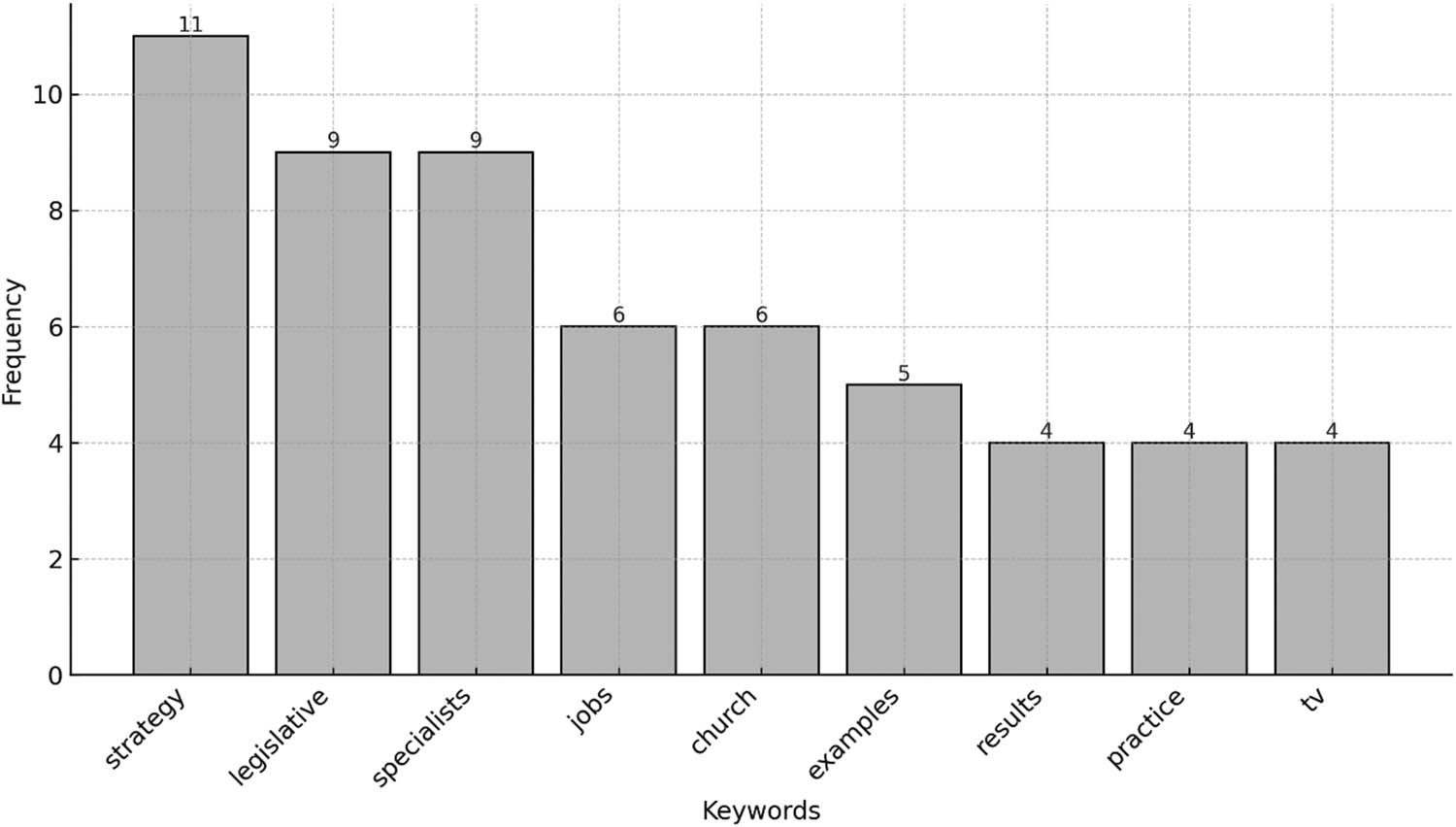
Figure 1
Frequent terms.
Source: Author’s contribution.
The findings are further detailed through narrative analysis of the main themes identified in the three focus groups. On the basis of transcription and coding of discussions with the 20 stakeholder representatives, we structured the findings into five main categories that reflect the most relevant aspects for Just Transition implementation in the Hunedoara region: awareness and understanding of the JT concept and mechanisms, perceptions of risks and socio-economic challenges, knowledge and skills needed by local leaders, collaboration and governance gaps, and communication needs and channels. These categories provide a comprehensive perspective on how local actors perceive and prepare for the challenges of the energy transition.
3.2.1. Awareness and understanding of the JT concept and mechanisms
The first important finding is that the Just Transition concept, per se, is less important without clear mechanisms. Thus, for some respondents, the main challenge was not grasping the abstract definition of Just Transition, but the lack of concrete guidance on how it should be implemented in practice. Their answers reflected a pragmatic orientation, shaped by technical and legislative concerns and likely influenced by experience with EU-funded projects. They emphasized the need to clearly understand the JT mechanisms and to see concrete, positive, and timely results.
“People are not against change, but they need to see a clear alternative. Without clear opportunities, the Just Transition remains an abstract concept.”
“We must have the guide correctly defined, with all the details about accessibility conditions. Once we have the correct information, we can apply it.”
“There will be guides, and consultancy will be sought, but it is essential to know Romanian legislation that incorporates regulations from the European Union.”
3.2.2. Perceptions of risks and socio-economic challenges
The shift away from fossil fuels has created uncertainties for local workers and businesses. The focus groups revealed deep concerns over job losses and economic stagnation. Participants commented about how hard it is for their region in this process, pointing out problems of miners or impoverished elders:
“My father and grandfather worked in the mines. I did, too. Now, my children must find something else, but what?”
“I called the labor union representatives from all the mines for consultations/discussions. I understand their pain because I also grew up in that region. I know tens of thousands have lost their jobs. I know what a miner’s family looks like: with 2–3 children, it’s hard.”
“If you are 70 years old and you are from this area, the concept of Just Transition in Hunedoara is a cause for panic.”
3.2.3. Knowledge and skills for local leaders
When discussing what local leaders need to know and the skills necessary for managers who will implement the Just Transition policies in practice, practical knowledge (mainly technical and legislative), was the first mentioned. In addition, the possibility of using consultancy services to bridge knowledge gaps was also mentioned, especially for managers who do not possess sufficient expertise in this field. Personal experience with politically appointed managers in public institutions may explain the warnings about the need to involve real experts, but only if their advice is genuinely considered and implemented, and not only acknowledged, without practical follow-up.
“When discussing decarbonization, we must understand the field from a technical point of view. Specialists in the field must find solutions for more environmentally friendly energy. We talk about decarbonization, but we don’t speak enough about reforestation, which is one solution.”
“Regarding skills, those who do not have project management skills should bring consultancy teams with them because there are deadlines, such as hours and days. Requests for transfers, or whatever they will be called, must be made by individuals who are very familiar with fund management and accounting and record-keeping aspects.”
“Seeking appropriate consultancy should become an obligation to accept advice. You have to acknowledge that you need consultancy, you need somebody who knows what it means to implement a project that implies a request for funding and all that.”
“I mean, all this time we spent with consultations. it seems to me that from one meeting to another, the observations go unnoticed. Somehow, they fall on deaf ears.”
3.2.4. Collaboration and governance gaps
Managers involved in programs and projects related to the Just Transition need knowledge in the energy and environmental fields and decision-making skills, and should collaborate with others rather than make decisions alone. Teamwork, ability to manage personnel, and adaptability are critical. Decision-makers should listen to feedback and integrate suggestions.
“I think the first skill is the ability to be a team player. I think it is important that they have at least minimal knowledge about what’s outside of the area of that project’s implementation. For example, the knowledge of how to manage the personnel.”
Cooperation, commitment, and the skills to negotiate and collaborate are essential. These findings are consistent with the signals of previous studies on addressing change management and transformations impacting local communities, as mentioned previously (Gangneux & Joss, 2022; Macedo et al., 2020). However, participants in the focus groups warned that, at least in the case of their region, according to their knowledge, the appropriate skills were lacking, a fact that can be seen in the gap between the central and the local authorities, and that is consistent with the experience of lack of collaboration and alignment between public authorities in Romania. Moreover, some of the participants expressed frustration about the fact that the implementation of already existing good plans is almost impossible as a direct consequence of poor collaboration with other institutions.
“It is important to remember that Just Transition takes place at an integrated level and involves several areas. We must consider not only a singular community but a community interconnected with others around it.”
“The ability to integrate information, situations, and environments is necessary. Openness to various suggestions and the ability to work with multiple stakeholders are crucial. I feel that this aspect of a Just Transition is important to happen with participants from all backgrounds. When discussing the public sector and decision-makers in the private sector, it seems important to me that they can work together.”
“When a strategy is drawn up, it is essential to gather all the factors and actors and implement them immediately so that the gap I mentioned does not appear. The gap leads us into chaos. For example, we have a very well-planned development strategy in the Hunedoara Region that cannot be implemented.”
3.2.5. Communication needs and channels
When ensuring public support for the JT measures through communication, the actors involved should be selected according to the communication objectives. If the objective is to persuade the public of the benefits of the Just Transition, a myriad of actors should be involved in co-creating the communication. However, a top-down strategy of communication should be considered, with fine-tuning at a local level.
“If the strategy is aimed at the citizens, the path is through all the authorities, institutions, and maybe even the NGOs that interact directly with these citizens. In our society, information usually comes from the top down, and we must ensure we convey it as clearly as possible to the citizens. Here in our region, there was an attempt, but there was a time gap between when the strategy was made and when it was implemented. I think it lost a bit of relevance and has led to the demotivation of those involved.”
“It has to come from the government because they have all the communication channels: media, social media, TV, schools, etc. All ministries must be involved. I think this is what we’re missing: a common project that can bring all institutions and citizens together. The citizens must participate, too.”
In the respondents’ opinion, the appropriate channels of communication on the Just Transition are the church (for rural areas, but it depends on the will of the local priest and his commitment to environmental issues), schools, and social media. Informal leaders of communities, such as priests, need, however, training to be sure that the message they give to the community is correct and makes sense.
“Some people will get the message from church, others from television, and the children will take their message from school. It will certainly be a challenge.”
“The church is involved. We have discussions after the Mass, over agape meals or over a glass of brandy, but I don’t know what to tell them. The message is very complicated. You don’t know how to explain it.”
“(We should use social media). For the last 10 years, we have been getting all the information from our phones. The TV is used too little.”
The messages on the Just Transition should be honest (i.e., about the actual costs) and emphasize the benefits of the Just Transition. Second, they should be simple, short, adapted to each audience (age, channels of communication), and easy to understand (i.e., like videos posted online or presented on TV).
“If we are transparent about the purpose and the cost and are honest with the citizens, I think the message will be well received and implemented.”
“I’m sure there are all kinds of freelancers (influencers). Some people could talk about Just Transition in an attractive, funny way.”
“A short TV commercial would probably have a positive impact because many still watch TV.”
“It is important to create some examples of good practices, even in video format. Successful projects from the West about renewables can be found on the net, and they can be put on TV. There used to be a Sunday morning agricultural show with examples of successful farms that made you think about investing in that area. If someone sees examples of good practice, they begin to believe that it works. But they should be properly promoted.”
“Mass media is a communication channel, that’s all. Just conveying information. The problem is who creates the information, who generates/builds it.”
“It’s important that an elderly person feels something tangible. If they spend all their pension money on heating or energy, it’s a problem. When you tell them that there are other possibilities. When they see in the media that a solar panel park was a fraud of one million euros, they start to wonder if the Just Transition was only a trick. That is why I said and wrote that it must be something tangible. Now, we are discussing, but we have to get beyond these discussions. It really needs to be put into practice.”
3.3. Discussions and limitations
The first important insight of our study is that the Just Transition concept is not really understood, despite being discussed with experts and leaders who represent stakeholders involved in the front line of the process at a local level. If we think of the established models of change management that should guide any well-managed transformation, such as the one of Kotter (2012), the findings show that the first stage of effective change, namely, creating a shared sense of urgency, has not yet been achieved in the region. Despite the experience and educational attainment of the representatives of stakeholders, the concept seems to be too vague and, thus, hard to communicate and, therefore, to engage communities. Studied respondents from public administration and NGOs do not correlate the Just Transition with decarbonization or sustainability first, but with legislation and guidelines, using a pragmatic approach defined by experience in managing public funds for development. Without a widely acknowledged need for change, the discussions around transition remain abstract and distant, rather than mobilizing.
Successful change, as outlined in Kotter’s model (2012), requires a guiding coalition that can connect institutions, strategic actors, and trusted community figures. Our findings indicate that such a coalition is currently weak or only partially formed: institutional leaders, educators, civil society representatives, and religious actors operate in parallel rather than as an integrated leadership core. The separation complicates the construction and communication of a coherent vision for the transition that aligns with the everyday concerns and identities of individuals in Hunedoara.
Public support for the Just Transition is essential in the Hunedoara region, which has historical biases and challenging memories related to mine closures and industrial restructuring. Respondents identified the communication of JT’s benefits, support, compensation, and alternatives as essential to the foundation of local education. This corresponds with Kotter’s model of change management, which posits that effective change communication requires translating a strategic vision into narratives and concrete examples relevant to individuals’ experiences. Participants consistently observed the absence of visible, tangible “quick wins” or outcomes that could demonstrate that the transition offers both future-oriented benefits and immediate social value. The lack of early, credible signals reduces trust and reinforces the perception of disconnection between decision-making centres and the local population.
To properly communicate the Just Transition, the credibility of emitters is paramount, as well as a top-down strategy involving the coordination of multiple players. Respondents emphasized the role of schools and local administrations in enhancing communication efforts and advocated for vocational training in energy-related fields to equip future professionals with the necessary skills for the Just Transition. The findings correspond with the source credibility theory, which posits that the effectiveness of a message is largely determined by the perceived trustworthiness and expertise of the communicator, rather than solely on the informational content (Hovland & Weiss, 1952).
A very important aspect is that the role of the church was repeatedly mentioned. The Orthodox Church emerged as a particularly significant communication channel in the focus group discussions, reflecting both its high trust levels in Romanian society and its deep community penetration. This is consistent with Koehrsen and Ives’ findings (2025), who posit that religious actors can significantly influence sustainability transitions by leveraging trust-based relationships and community embeddedness, enabling them to convey and interpret transformative policies in a manner that aligns with everyday experiences and local value systems.
The dynamics in the region can be analysed also by using Arnstein’s (1969) ladder of participation. Various institutions engage in the communication and implementation of the Just Transition; however, the participation reported by respondents primarily aligns with the intermediate levels of involvement, where communities receive information or consultation but lack significant influence over priority setting or decision-making processes. This restricted level of engagement strengthens the notion that the transition occurs to the community rather than in collaboration with it. High levels of trust in schools, local administrations, and the Orthodox Church suggest the potential for deeper participation. However, participation becomes meaningful only when communities are empowered to shape agendas, define local priorities, and oversee implementation. The absence of a transition to collaborative power-sharing renders communication strategies insufficient for fostering trust, legitimacy, or sustained engagement.
From a managerial perspective, a key policy implication emerging from this research is the urgent need for targeted capacity-building programs specifically designed for local leaders responsible for Just Transition implementation and communication. This is consistent with Heifetz and Linsky’s theory of adaptive leadership (2003), which posits that complex transformations necessitate both technical solutions and the ability to learn collectively, negotiate priorities, and coordinate diverse interests amid uncertainty. Our findings indicate notable discrepancies between the intricate, multifaceted nature of JT requirements and the existing competency levels of local stakeholders, including those with previous experience in sustainability and development projects. The study outlines five essential skill domains necessitating structured enhancement: (1) technical and legislative expertise pertinent to energy transition and EU regulatory frameworks; (2) participatory governance skills, encompassing deliberation and inclusive decision-making; (3) collaborative leadership abilities facilitating effective cross-institutional coordination and stakeholder involvement; (4) strategic communication skills for converting intricate policy concepts into comprehensible, contextually relevant messages; and (5) adaptive project management competencies capable of addressing the uncertainties and prolonged nature of transition processes. The challenges identified in Hunedoara indicate not only deficiencies in operational skills but also highlight the necessity for enhancing adaptive leadership capabilities among individuals tasked with facilitating and maintaining the transition and are consistent with the literature about the importance of comprehensive managerial skills and knowledge and the use of expert teams to successfully implement strategic change (Hornstein, 2015; Doppelt, 2017).
The study has some limitations. First, it was designed as an exploratory phase; therefore, it only gives insights from a specific region of Romania. The study, although focused on Hunedoara, is relevant for other European regions undergoing post-coal transitions. Institutional fragmentation, community mistrust, and identity tensions are prevalent in coal-dependent regions of Europe, characterized by a historical reliance on heavy industry, multigenerational connections to mining, and the socio-psychological effects of previous restructuring phases, which have led to persistent economic instability (Śniegocki et al., 2022). Research on sustainability transitions indicates that decarbonization policies are influenced by local histories, cultural meanings, and collective identities, leading to comparable challenges concerning legitimacy, communication, and public trust (Rogge & Johnstone, 2017). The findings, while not statistically generalizable, can be analytically applied to regions with similar economic pathways, demographic decline, and governance structures as those of Hunedoara. The identified patterns are pertinent not only to Romania’s coal regions but also to wider European discussions regarding the alignment of technical transition strategies with community-based leadership, participation, and communication methods.
Another limitation of the study is the number of three focus groups containing 20 representatives of local stakeholders already engaged in the Just Transition processes. This choice was made considering the specificity of qualitative research: data saturation and depth of analysis are essential. The selection of participants already involved in Just Transition processes (local leaders, experts with previous expertise and experience in management of sustainability and social assistance projects) is justified by the fact that understanding the concept and its institutional mechanisms is essential for examining the actual capacity for implementation. The methodological approach used is in line with exploratory qualitative research, which is appropriate for analysing emerging processes such as Just Transition, where institutional structures and implementation practices are still in the process of formation. In such contexts, the focus is on understanding the perspectives of the actors directly involved and capturing informal coordination mechanisms, rather than on obtaining statistically generalizable results (Creswell & Poth, 2016). Therefore, the use of a purposive sample, consisting of local leaders and experts with experience in sustainable development and social assistance projects, is justified by their ability to provide in-depth and contextualized information.
3.4. Implications for managers and policymakers
This research indicates that enhancing the capabilities of local actors involved in Just Transition implementation is essential for improving coordination, accelerating project delivery, and fostering community legitimacy. The five specified skill categories can be transformed into practical capacity-building activities to achieve these outcomes. Transformative policy processes rely not only on regulatory and financial instruments but also on the skills, knowledge, and collaborative capacities of the people responsible for implementation at the territorial level. For example, climate transition depends on the implementation capacities of local actors, not just on the national policy framework (Bulkeley & Betsill, 2005). Transitions are socio-institutional processes that depend on the ability of local organizations to collaborate and adapt (Köhler et al., 2019). The institutional and professional capabilities of participants are essential in influencing the speed and legitimacy of transition measures (Loorbach, 2010), and successful implementation is closely associated with the ability of local actors to foster trust, engage in joint decision-making, and negotiate effectively across various sectors and administrative boundaries (Ansell & Gash, 2008; Emerson, Nabatchi & Balogh, 2012). Thus, the development of skills and collaborative competencies among local implementers is a fundamental requirement for advancing Just Transition processes.
The initial skill category identified in the study pertains to technical and legislative expertise regarding energy transition and EU regulations. Enhancing this category requires the development of specialized training modules focused on understanding regulatory frameworks, eligibility criteria for relevant funding instruments, and the integration of climate objectives into local development strategies. The second skill category pertains to abilities related to participatory governance. Establishing stable and recurring platforms for local consultation may effectively address this dimension by uniting different stakeholders (public authorities, civil society organizations, business representatives, and citizens). The third category, collaborative leadership, requires structural mechanisms that enable and institutionalize cross-institutional cooperation via regular working groups or councils dedicated to transition planning and implementation, equipped with clear mandates and resources to operate independently of project cycles. The fourth skill category involves strategic communication, emphasizing the ability to translate complex policy frameworks into clear and contextually relevant messages. Improving this capacity necessitates the development of standardized communication materials, such as social media toolkits, infographics that encapsulate the objectives and expected outcomes of transition policies, and succinct explanatory video content. Adaptive project management competencies are critical for effectively managing the uncertainties and prolonged timelines associated with Just Transition processes. Enhancing this skill set can be achieved through training in iterative planning methods, continuous monitoring practices, feedback-driven adjustment mechanisms, interdisciplinary project teams with clearly defined responsibilities.
Collectively, these capacity-building interventions strengthen the conditions that enable local actors to convert strategic transition objectives into legitimate, coherent, and sustainable territorial transformations. It is essential for managers and policymakers to prioritize institutional capacity-building over project-based knowledge to translate necessary skills into measurable achievements in the Just Transition’s implementation.
4. Conclusions and future avenues of research
The study performed in the Hunedoara Region provides important insights into sensitivity in coal-dependent regions on topics related to environmental policies that translate into the closure of mines and the reorganization of industrial sites. The research shows that the concept of Just Transition is accepted, but it is supported only if properly, pragmatically, and honestly communicated. The fact that even experts and leaders with experience in the management of sustainable development projects find the concept of the Just Transition too vague raises a red flag on the necessity to communicate more, better, and more credibly about the JT outcomes.
The study also highlights the knowledge and skills that managers of JT-associated projects need to successfully implement at the local level. We found that knowledge of energy-related legislation, proper project management skills, collaboration, teamwork, communication, flexibility, and working with experts is paramount. Thus, our findings indicate that JT’s success in coal-dependent regions like Hunedoara will be ultimately determined by the capacity to bridge the gap between European policy frameworks and local institutional realities through sustained investment in collaborative governance and targeted capacity building.
Future avenues of research in this respect should focus, in our opinion, on the red flags signalled by respondents regarding issues of collaboration and alignment between institutions in Romania. At the international level, our research could be continued by investigating what concrete outcomes should be communicated by leaders to support and engage communities in the Just Transition, as well as comparative analysis in this respect. From a managerial perspective, a future avenue of research relevant at the international level, inspired by our study, could be on the comprehensive knowledge and skills needed to successfully lead JT projects and programs.
Funding information
The authors acknowledge funding from the European Union’s Horizon 2020 Research and Innovation Programme HORIZON-RIA as part of the AdJUST (Advancing the understanding of challenges, policy options and measures to achieve a JUST EU energy transition) project, grant agreement ID 101069880. The content of this paper does not reflect the official opinion of the European Union. Responsibility for the information and views expressed herein lies entirely with the authors.
Author contributions
I. P., F. P., K. K., I. O., and G. Ș. designed the study. F. P. conducted the focus groups and wrote the manuscript, with content inputs from I. P. and G. Ș. I. P., K. K., and I. O. edited the manuscript to completion.
Conflict of interest statement
The authors declare no competing interests.