
1. Introduction
The European Union’s (EU’s) Framework Programs for Research and Innovation, currently manifested as Horizon Europe, represent one of the world’s most significant transnational public funding mechanisms. For Higher and Secondary Education (HES) institutions, securing these funds has transcended simple financial objectives to become a critical pillar of internationalization, talent retention, and network centrality (Reichert, 2019). However, the distribution of these funds exhibits severe heterogeneity, often characterized by a persistent “core-periphery” divide where institutions in Western and Northern Europe consistently outperform those in widening countries (Balland et al., 2018).
Despite the vast availability of open data via CORDIS, the majority of existing scientometric studies focus on descriptive patterns, ranking who wins the most, rather than isolating the causal mechanisms that explain why they win (Enger & Castellacci, 2016). Standard econometric approaches often struggle to distinguish between correlation and causation. For instance, do institutions secure more funding because they coordinate projects, or do wealthy institutions simply have the resources to assume coordination roles? Do regions cultivate leadership through spillover effects, or do leaders simply cluster in economically developed regions?
This work addresses the “causal gap” in research policy evaluation (Lane et al., 2015), by moving beyond standard regression analysis to a causal inference framework based on directed acyclic graphs (DAGs) (Pearl, 2013), we analyze a comprehensive dataset of HES participation. We define HES broadly to include both higher education establishments (Universities) and secondary education institutions, recognizing the full educational pipeline involved in EU projects. The study answers three specific questions:
Micro-level (strategy): What is the causal financial return of assuming the administrative role of “coordinator,” and does it justify the administrative burden?
Meso-level (geography): Does the geographic location (NUTS3 region) causally influence the likelihood of an institution obtaining a coordination role via peer effects?
Macro-level (policy): Do HES institutions act as “anchor institutions” that drive the total volume of national projects in subsequent years?
2. Literature review
2.1. EU framework programs: Participation, coordination, and performance
The EU’s Framework Programs, culminating in the current Horizon Europe (2021–2027), represent the world’s largest transnational public research funding mechanism, with an indicative budget of approximately €86.1 billion (European Commission, 2021a). For HES institutions, participation in these programs has evolved from a supplementary funding source to a strategic imperative tied to internationalization, network centrality, and institutional reputation. Enger and Castellacci (2016) provided one of the most rigorous analyses of participation dynamics, distinguishing between the propensity to apply and the probability of success conditional on application. Their two-stage analysis revealed that prior participation in EU Framework Programs significantly predicts both application behavior and success rates, with scientific reputation of the applicant organization serving as a strong predictor of funding outcomes. This finding raises critical endogeneity concerns: do institutions succeed because they have prior experience, or does prior success reflect underlying capabilities that independently predict future performance?
The role of project coordinator carries particular significance in Framework Program participation. According to the European Commission’s Model Grant Agreement, coordinators bear responsibility for monitoring project implementation, serving as the intermediary between the consortium and the granting authority, submitting deliverables and reports, and distributing payments to beneficiaries (European Commission, 2021b). These administrative responsibilities impose substantial burdens on coordinating institutions, leading to what practitioners describe as the “coordination dilemma,” weighing the prestige and strategic benefits of leadership against the resource costs of administration (Birlan et al., 2025; Davidescu et al., 2025).
Empirical evidence on the returns to coordination remains largely descriptive. Studies consistently find that coordinating institutions receive larger funding shares than participating partners, but whether this premium reflects genuine value creation through leadership or simply the tendency for well-resourced institutions to assume coordination roles remains unclear. The present article addresses this gap by estimating the causal financial return to coordination share using structural causal modeling.
2.2. Cumulative advantage and core-periphery dynamics
A persistent concern in EU research policy is the uneven geographic distribution of funding, often characterized as a core-periphery divide between established research systems in Western and Northern Europe and developing systems in Central, Eastern, and Southern European countries. This pattern manifests empirically as higher participation rates, larger funding shares, and greater network centrality for institutions in EU-15 countries compared to those in EU-13 (post-2004 accession) states (Gräbner & Hafele, 2020). Network analyses of Horizon 2020 participation reveal stark differences in structural position: higher education institutions from EU-15 countries exhibit average degree centrality of 50 compared to 41 for EU-13 counterparts, with even larger gaps in eigenvector centrality measures that capture embeddedness in influential network clusters (Balland et al., 2019). These patterns extend to program composition, with EU-13 participants more central in lower-complexity research activities while EU-15 institutions dominate knowledge-intensive domains.
The Matthew effect, namely, the tendency for initial advantages to compound over time through preferential attachment, has been rigorously documented in research funding contexts. Bol et al. (2018) exploited the threshold-based allocation of Dutch research grants to show that scientists who barely won early-career grants accumulated more than twice as much subsequent funding as those who barely missed the threshold, even though their initial quality was essentially identical. Critically, this emergent funding gap operated through two reinforcing mechanisms: winners received higher evaluation scores in subsequent competitions, and winners were more likely to reapply for funding than near-miss losers. Gräbner and Hafele (2020) situated these dynamics within a broader structuralist framework, arguing that core-periphery patterns in Europe reflect asymmetric technological capabilities and power relations that standard neoclassical convergence models fail to capture. From this perspective, policy instruments aimed at “widening participation” must address not merely capacity gaps but structural dependencies that constrain peripheral institutions’ opportunities for knowledge accumulation. The EU’s response to these disparities includes the Widening Participation and Strengthening the European Research Area (WIDERA) component of Horizon Europe, which reserves coordination roles for institutions in designated widening countries and provides targeted support for capacity building (European Commission, 2025). However, whether these interventions effectively alter causal pathways to success or merely redistribute participation without changing underlying dynamics remains an open empirical question.
2.3. Knowledge spillovers, tacit knowledge, and regional peer effects
The geography of innovation literature provides theoretical grounding for understanding why institutional leadership and research success might exhibit spatial clustering. Howells (2002) emphasized the importance of tacit knowledge (know-how that is difficult to codify and transmit across distances) in shaping the relationship between geographic proximity and innovative activity. Because tacit knowledge requires face-to-face interaction, observation, and shared experience to transfer, knowledge spillovers tend to be spatially bounded, conferring advantages on actors located near knowledge sources. Audretsch et al. (2005) provided empirical evidence that high-technology startups in Germany exhibit strong propensities to locate near universities, presumably to access knowledge spillovers that would be prohibitively costly to obtain from more distant sources. The spatial decay of spillovers implies that the benefits of knowledge creation are not uniformly distributed but concentrate in regions with dense networks of research-active institutions. At the regional level, Balland et al. (2018) demonstrated that European regions diversify into new technologies in ways consistent with path-dependent specialization: regions with high “relatedness density” (many existing capabilities adjacent to a target technology) are more likely to develop those technologies, particularly when they are complex and valuable. This finding has direct implications for research policy: regions may cultivate leadership not merely through individual institutional excellence but through ecosystem-level characteristics that shape opportunities for knowledge recombination.
The concept of peer effects (the influence of one actor’s behavior on the behavior of geographically or socially proximate others) extends these insights to institutional decision-making. Evidence from corporate finance demonstrates that geographic neighbors influence investment decisions, innovation strategies, and even merger activity through social learning and mimetic behavior (Funk, 2014). Applied to EU research participation, peer effects would imply that institutions embedded in regions with high coordination intensity develop capabilities, norms, and network connections that raise their own probability of assuming leadership roles, a meso-level mechanism largely unexplored in the existing literature. The Nomenclature of Territorial Units for Statistics (NUTS) classification system provides the geographic framework for analyzing such regional effects, with NUTS 3 representing the finest-grained level suitable for capturing local innovation ecosystems (Eurostat, 2024). By examining coordination intensity at the NUTS 3 level, researchers can distinguish regional peer effects from national-level factors and identify localized mechanisms of tacit knowledge spillover.
2.4. Universities as anchor institutions
The anchor institution concept offers a complementary lens for understanding how educational institutions shape regional and national research ecosystems. Anchor institutions are defined as place-bound organizations, typically hospitals, universities, and cultural institutions, whose geographic rootedness, economic scale, and community relationships position them as drivers of local development (Harris & Holley, 2016). Universities fulfill anchor roles through multiple channels: as employers creating direct and induced jobs; as purchasers generating local economic multipliers; as human capital producers supplying skilled graduates; and as knowledge creators whose innovations diffuse to surrounding firms and institutions (Dima et al., 2022). The economic multiplier literature documents substantial returns to university presence. Valero and Van Reenen (2019) provided the most comprehensive cross-national evidence on university economic impacts, analyzing nearly 15,000 universities across 78 countries between 1950 and 2010. Their fixed-effects models revealed that increases in university density are positively associated with future gross domestic product per capita growth, with spillover effects extending to geographically proximate regions. Notably, these effects operate partly through human capital accumulation and innovation, but substantial portions remain unexplained by conventional transmission mechanisms, suggesting additional anchor-type influences on regional development.
Within the EU Framework Program context, the anchor institution framework suggests that HES participation may generate broader national benefits beyond the direct funding received. If HES institutions function as hubs that connect national actors to European networks, facilitate knowledge transfer, and build administrative capacity for international collaboration, their project involvement might causally generate additional projects for other national organizations in subsequent years. This macro-level multiplier effect, distinct from conventional economic multipliers, represents a potentially important policy lever that has not been subjected to rigorous causal analysis.
2.5. Causal evaluation of research grant effects
The methodological challenge of estimating causal effects from observational research funding data has motivated a growing body of quasi-experimental studies. Ghirelli et al. (2023) investigated the long-term effects of winning European Research Council (ERC) grants using both regression discontinuity designs (RDD) that exploit threshold-based allocation and difference-in-differences (DID) approaches that leverage panel variation. Their RDD analysis found no statistically significant effects for researchers near the funding threshold, suggesting that the marginal ERC grant does not substantially alter trajectories for borderline applicants. However, DID estimates for broader populations revealed positive effects on scientific productivity, impact, and subsequent funding success, particularly for top-ranked applicants in specific disciplinary domains. These mixed findings illustrate a fundamental tension in research funding evaluation: RDD provides clean identification but estimates effects only for marginal cases, while approaches that capture average effects across broader populations face greater threats from confounding. The present article addresses this tension by employing structural causal modeling with explicit DAG-based assumptions, using the DoWhy library’s refutation tests to assess robustness across multiple identification strategies.
Confounder adjustment remains critical for observational causal inference. Recent methodological reviews emphasize that mutual adjustment for multiple variables in a single regression model can produce misleading estimates when the causal structure involves mediators, colliders, or complex feedback loops (Gao et al., 2025). The modified disjunctive cause criterion provides guidance for confounder selection, recommending inclusion of variables that cause the treatment, the outcome, or both, while excluding instrumental variables and variables on causal pathways. By encoding these principles in explicit causal graphs, structural causal model (SCM)-based analysis can avoid common pitfalls of conventional regression adjustment.
2.6. Synthesis and research gaps
This review reveals three principal gaps in the existing literature that the present article addresses:
First, despite substantial empirical work on EU Framework Program participation, almost no studies have estimated the causal financial return to institutional leadership roles using methods that address endogeneity between coordination and funding. Coordination is typically treated as either an outcome to be explained or a confound to be controlled, rather than a treatment whose effects warrant direct estimation.
Second, the geography of innovation literature has not systematically examined peer effects in research coordination at fine-grained regional scales. While knowledge spillovers and agglomeration benefits are well-documented, the specific mechanism by which a region’s coordination intensity causally influences individual institutions’ leadership probabilities remains unexplored.
Third, the anchor institution literature offers theoretical arguments for universities’ broader economic influence but lacks causal evidence on whether HES research participation generates multiplier effects on national project portfolios. Testing this hypothesis requires methods that can address the obvious endogeneity between national research capacity and HES activity.
By applying structural causal modeling to comprehensive HES participation data, the present study advances methodology and fills substantive gaps across these three levels of analysis, contributing to a more complete understanding of the causal drivers of European research performance in the education sector.
3. Data and descriptive analysis
3.1. Dataset construction
The analysis utilizes data extracted from the European Commission’s CORDIS database, focusing on projects under the recent Framework Programs. The dataset was filtered to isolate participants designated as “HES.” We enriched these data with NUTS 3 regional codes to allow for geospatial analysis.
Table 1
Descriptive statistics of project participation across European countries.
| Statistic | Value |
|---|---|
| Count | 27 |
| Minimum | 30 |
| Maximum | 3,317 |
| Range | 3,287 |
| Sum | 24,273 |
| Mean value | 899 |
| Median | 545 |
| Standard deviation | 939.734169 |
| Variance | 883100.3077 |
| Skewness | 1.245422 |
| Kurtosis | 0.574866 |
| Coefficient of variation | 1.045311 |
Source: Authors’ own research.
Project participation across European countries is characterized by very high inequality. Among the 27 countries with at least one project, the number of projects ranges from 30 to 3,317, with a mean value of 899 and a median of only 545. The mean value substantially exceeds the median, and the distribution exhibits strong right-skewness (1.25), indicating that a small group of countries captures a disproportionately large share of projects. The coefficient of variation (1.04) further confirms extreme dispersion relative to the mean value. Overall, project participation is highly concentrated, with a few large European countries dominating the landscape (Table 1).
Geographic distribution: A preliminary descriptive analysis reveals significant heterogeneity in project participation across Europe. As shown in Figure 1, there is a pronounced core-periphery divide.
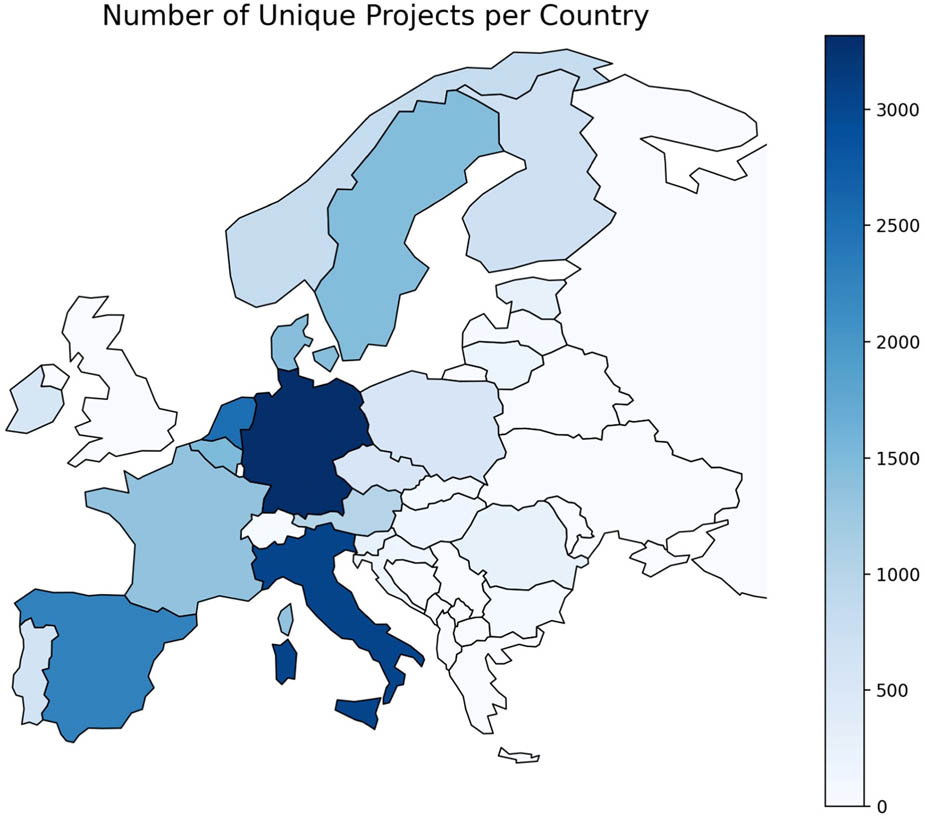
Figure 1
Choropleth map illustrating the number of unique projects per country. Darker blue indicates a higher volume of projects.
Source: Authors’ own research.
The map highlights why a simple correlation analysis would be flawed. An institution in Germany might have a higher probability of coordinating simply due to the national ecosystem (represented by the dark blue clustering). Therefore, our causal models explicitly control for “Country” as a confounder to isolate the true effect of institutional strategy from national advantage.
4. Methodology
To investigate the drivers of research performance, we employed an SCM framework. Unlike standard correlation analyses, this approach allows us to control for confounding variables and isolate direct effects. We utilized the DoWhy Python library (Sharma & Kiciman, 2020) to model the mechanisms, identify estimands via the Backdoor Criterion (Pearl, 2013), and estimate effects.
Model A: The Financial Impact of Coordination (Institutional Level)
Objective: To determine if the “coordinator” role causally increases total funding.
Unit: Individual HES institution.
Treatment ( T ): Share of coordinator projects. Defined as the ratio of coordinated projects to total projects (T ∈ [0, 1]).
Outcome ( Y ): Total funding (European commission contribution).
Confounders ( W ): Country (controlling for the disparity seen in Figure 1) and Average Project Cost (controlling for project scale).
Assumption: By conditioning on country and project size, the assignment of the coordination role is treated as effectively random regarding funding outcomes.
Model B: Regional spillover and leadership (project-organization level)
Objective: To assess if a region’s “culture of coordination” influences the probability of a local organization obtaining a coordinator role.
Unit: Organization-project pairs.
Treatment ( T ): Regional coordination intensity (leave-one-out). To avoid the “reflection problem” (Manski, 1993), we calculated the share of coordinators in a NUTS 3 region excluding the organization in question.
Outcome ( Y ): Is coordinator (Binary: 0/1).
Confounders ( W ): Country, activity type, SME status, consortium size, total project cost.
Estimation: Linear probability model via regression adjustment.
Model C: National multiplier effects (Country-year level)
Objective: To test if university participation acts as a driver for the entire national research system.
Unit: Country-Year (Panel data).
Treatment ( T t ): Number of HES Projects in year t.
Outcome ( Y t+1 ): Total National Projects in year t + 1.
Confounders ( W ): Country (Fixed effects), Year (Time trends), Average Funding (t).
Lag structure: A 1 year lag is introduced to respect temporal causality (cause must precede effect).
Robustness checks: We validated all estimates using two refutation tests.
Placebo treatment: Replacing the treatment with a random variable (expected effect: 0).
Data subset refuter: Re-estimating on random subsets to ensure stability against outliers.
5. Results
5.1. Premium of coordination (Model A)
The causal analysis reveals a substantial financial premium associated with the coordination role. After adjusting for the country of origin and project size, the causal estimate for the effect of share_coordinator on total_funding is €29,755,138.
Since the treatment variable ranges from 0 to 1, this coefficient implies that a theoretical shift from coordinating 0–100% of projects would increase funding by nearly €30 million. In more practical terms:
Finding 1: A 10 percentage point increase in the share of projects an HES institution coordinates (e.g., moving from 10 to 20%) is causally associated with an increase in total secured funding of approximately €2.97 million. Robustness: The Placebo test yielded a new effect of −0.0009 (p-value 0.0), confirming the original estimate is not noise. The Data Subset Refuter returned an estimate of €29.6 million (p = 0.86), indicating high stability.
5.2. Regional contagion of leadership (Model B)
We investigated whether leadership capabilities cluster geographically. The model identified a strong positive causal relationship between the regional environment and individual organizational behavior. The estimated coefficient is 0.633.
Finding 2: Regional leadership is contagious. For every 10% increase in the “coordination intensity” of a NUTS 3 region (the proportion of local peers acting as coordinators), the probability of an individual organization in that region acting as a coordinator increases by 6.3%. This suggests that organizations located in hubs where coordination is common are statistically more likely to assume leadership roles themselves, independent of their size or type. Robustness: Placebo effect: ∼0.0. Subset effect: 0.634.
HES as national engines (Model C): Finally , we analyzed the spillover effect of HES institutions on the broader national ecosystem over time. The analysis of Country-Year panel data yielded a causal estimate of 9.01.
Finding 3: HES institutions generate national multipliers. One additional project secured by an HES institution in a given year causes an increase of approximately 9 total projects for the country in the subsequent year. This indicates a powerful ecosystem effect where university activity likely triggers partnerships, spin-offs, or consortium inclusions for other national actors (SMEs, research centers) in the following cycle. Robustness: Placebo effect: −0.03 (insignificant). Subset effect: 8.92.
6. Discussion
6.1. Administrative burden vs financial reward
Finding 1 challenges the view that coordination is merely an administrative burden. While the administrative cost is high, the causal return (€3 M per 10% share increase) suggests that coordinators successfully leverage their position to secure larger budget shares. For secondary education institutions, which often possess smaller budgets than universities, this finding highlights a high-risk, high-reward strategy for financial sustainability.
6.2. “village” effect in research
Finding 2 supports the existence of localized knowledge spillovers. In regions with high coordination intensity, there is likely a transfer of “tacit knowledge” regarding proposal writing and consortium management. This supports the strategy of Smart Specialization Strategies (RIS3), investing in regional clusters creates a feedback loop where leadership skills propagate among neighbors.
6.3. HES as systemic drivers
Finding 3 has the most profound policy implications. It suggests that HES institutions are not just beneficiaries of funds but active engines of the national system. A multiplier of 9 implies that cutting funding to universities would disproportionately harm the wider national capacity to participate in EU programs. The lag effect (t + 1) confirms that this is a capacity-building mechanism: HES institutions anchor networks that other actors join later.
We would like to mention that while the estimated effect in Model C suggests a substantial national spillover, with increased university participation in year t being associated with more national projects in year t + 1 – this result must be interpreted cautiously. The temporal depth of the dataset is limited to only three effective year-to-year transitions (2022 → 2023, 2023 → 2024, 2024 → 2025), which restricts statistical power and may inflate effect sizes. Moreover, the number of HES projects and the total project volume are structurally correlated in many countries, meaning that large jumps in national participation (e.g., exceptional increases in some years) can dominate the estimation. Although the direction of the causal relationship is plausible and consistent with broader European R&I dynamics, the magnitude of the effect should therefore be considered indicative rather than definitive, pending analyses based on a longer multi-year panel.
6.4. Limitations
While the DoWhy framework explicitly controls for observed confounders (country, cost, year), unobserved confounders such as “institutional reputation” (which correlates with both coordination and funding) remain a potential source of bias. However, the consistency of the “Leave-One-Out” regional estimator suggests that peer effects are genuine and not merely reflective of reputation.
7. Conclusion
This study provides causal evidence for the mechanisms driving success in European research funding. We conclude that (1) Coordination is a highly lucrative strategy for HES institutions, far outweighing administrative costs; (2) Leadership is geographically clustered, suggesting that lagging regions need to import or cultivate “super-nodes” of coordination to spark local contagion; and (3) HES institutions act as the primary engine for national participation, with a high multiplier effect on the total project count. Policy interventions aiming to boost national performance should therefore prioritize administrative support for coordination teams and regional cluster development.
Acknowledgements
This article was co-financed by The Bucharest University of Economic Studies during the PhD program.
Funding information
This paper is also supported by: The project Causefinder-Causality in the Era of Big Data (CF268/29.11.2022, CN760049/23.05.2023); A grant of the Romanian Ministry of Research, Innovation and Digitalization, project CF 178/31.07.2023 – ‘JobKG – A Knowledge Graph of the Romanian Job Market based on Natural Language Processing.’
Author contributions
All authors jointly contributed to all aspects of the research and manuscript preparation, including conceptualization, methodology, analysis, and writing. All authors reviewed and approved the final version of the manuscript.
Conflict of interest statement
Authors state no conflict of interest.