
1. Introduction
Competitiveness is one of the most widely used terms in literature, and there is a large body of research that analyses this term in depth (Aiginger, 2006; Cho & Moon, 2000; Petrescu et al., 2025; Popescu et al., 2017). However, the application of this concept in the Romanian agri-food sector remains relatively unexplored, especially from an econometric perspective based on panel data.
Initially, Adam Smith explained international trade through the prism of absolute advantage, which conveyed the idea that countries export the goods produced most efficiently (Wells & Graafland, 2012). David Ricardo emphasizes the role that specialized technologies play, thus introducing the term comparative advantage (Walter, 2005). Later, neoclassical theories attempt to emphasize the importance of factors of production in determining trade. These theories were later challenged with the emergence of approaches to competitiveness, giving rise to the concept of competitive advantage (Sivaruban, 2024).
Many authors have tried to define this term, such as Barney (1991), who focused on the determinants that make a country competitive, such as the scarcity of resources, their value, or the inability of other countries to substitute certain goods or services produced. Prahalad and Hamel (1990) think that competitive advantage is determined by the ability to develop superior skills with the help of one’s own resources, and Porter (1990) is of the opinion that a state has a competitive advantage if firms within it prosper and succeed in international markets with substantial exports.
The research question addressed in this study is: To what extent does competitiveness (measured by comparative advantage and labor productivity) influence exports from Romania? This research question is relevant both from a theoretical point of view, for understanding the relationship between economic efficiency and the integration of Romanian agri-food products into international markets, and from a practical point of view, for guiding public policies and export strategies.
Although there are numerous studies on agri-food competitiveness in Romania (Constantin et al., 2023; Gavrilescu, 2018; Nedelcu et al., 2023; Petrescu et al., 2025), the gap in the literature identified in this research is the lack of analyses correlating comparative advantage and productivity with agri-food export performance, using an econometric approach with panel data.
To contextualize the chosen topic and highlight the current scientific interest in the competitiveness of agri-food products, a bibliometric analysis was performed. This aimed to identify the main concepts and research trends in the field, using the Web of Science (WoS) database database and VOSviewer software.
The most important Romanian agri-food products exported, and the main markets, were also analyzed. Using revealed comparative advantage (RCA) indices, the competitive advantages of these products were identified, which was the main objective of the research. In addition, a multiple linear regression model with panel data was applied to analyze the impact of competitiveness on exports in Romania between 2000 and 2023.
This study’s contribution to the literature lies in combining a bibliometric approach with an econometric analysis using panel data, providing an overview of agri-food competitiveness in Romania and its implications for commercial performance. In addition, it aims to present strategic directions that can be followed to increase the competitiveness of this sector in the future.
2. Literature review
The term “competitiveness” is frequently used in economics but does not have a universally accepted definition (Siudek & Zawojska, 2014). Competitiveness is a relative, multidimensional concept that can be analyzed at the microeconomic (company, product), mesoeconomic (sector, industry), and macroeconomic (region, country) levels (Bhawsar & Chattopadhyay, 2015).
In the literature on economics, competitiveness is often associated with productivity, innovation capacity, and the ability to generate long-term added value (Krugman, 1996; Porter, 1990).
In terms of international agri-food trade, competitiveness is influenced by both quantitative factors (price, productivity) and qualitative factors (added value, innovation, and quality) (Mizik et al., 2020). One of the most common ways to assess competitiveness is the comparative advantage index (RCA) proposed by Balassa (1965).
The literature highlights a positive correlation between labor productivity and competitiveness: productive economies and companies are more likely to be competitive in international markets (Bangun, 2017; Dong et al., 2020; Korkmaz & Korkmaz, 2017). In addition, Dora et al. (2013) emphasize the importance of added value and operational efficiency as important factors for success.
Studies focusing on Romania show that the country has significant agri-food potential (Boghiță et al., 2021; Giucă et al., 2023), but many factors affecting competitiveness are underutilized: lack of innovation, poor infrastructure, fragmentation of production, and difficulty in establishing a presence on foreign markets (Stamp et al., 2012). Compared to other European Union countries, Romania needs to improve its performance in terms of productivity per hectare, the technologies used, and integration into global value chains (Ionitescu et al., 2024).
A study analyzing Vietnam’s agri-food exports using RCA highlights that comparative advantages need to be strengthened through innovation, diversification, and integration into high-value-added markets (Toai, 2025).
3. Bibliometric analysis of the literature on agri-food competitiveness
Given the objective of this research, which is to understand the impact of competitiveness on Romanian agri-food exports, it is important to consider the level of scientific interest in this relationship. Thus, bibliometric analysis is justified by its ability to highlight the dominant directions of research and to outline the international context in which this article is framed.
This quantitative research method, bibliometrics, is considered a valuable tool to identify research trends and is very popular (Velez-Estevez et al., 2023).
This paper employs standard bibliometric research techniques, using the VOSviewer software, version 1.16.20, to determine researchers’ interest in the topic. This method is often used in the literature (Constantin et al, 2021; Istudor et al., 2024; Pătărlăgeanu et al., 2020). This research tool facilitates the creation of network maps based on correlation coefficients, which are represented visually (van Eck & Waltman, 2014).
In the present analysis, the database consulted was WoS, which was queried on April 05, 2025 based on the following words: competitiveness AND agri-food without using any filter for publication and indexing data; only publications containing the words entered in the title, abstract, or keywords were generated.
The result consists of 441 scientific papers that met the conditions outlined earlier. Table 1 includes the methodological fundamentals of bibliometric analysis.
Table 1
Methodological aspects of bibliometric analysis.
| Criteria | Results |
|---|---|
| Number of WoS-indexed publications | 441 Publications corresponding to the keywords |
| Number of keywords | 2,227 Keywords associated with the 233 publications |
| Required minimum occurrences of a keyword | 2 Occurrences |
| Number of keywords that meet the threshold | 433 Keywords met the occurrence threshold |
| Share of keywords that meet the threshold | 19.44% |
Source: Authors’ own research for the bibliometric analysis.
The results highlight five main areas of research: (1) competitiveness and export performance; (2) innovation and digital transformation in the agri-food sector; (3) public and regulatory policies; (4) rural development; and (5) sustainability and the circular economy.
These themes reflect the growing interdisciplinary interest in agri-food competitiveness and confirm the relevance of this topic.
To illustrate the main thematic areas present in the specialized literature, Figure 1 presents the co-occurrence map of keywords generated using the WoS database through VOSviewer software. The centralization of the terms “competitiveness,” “exports,” “comparative advantage,” and “productivity” confirms the relevance of these dimensions in the research.
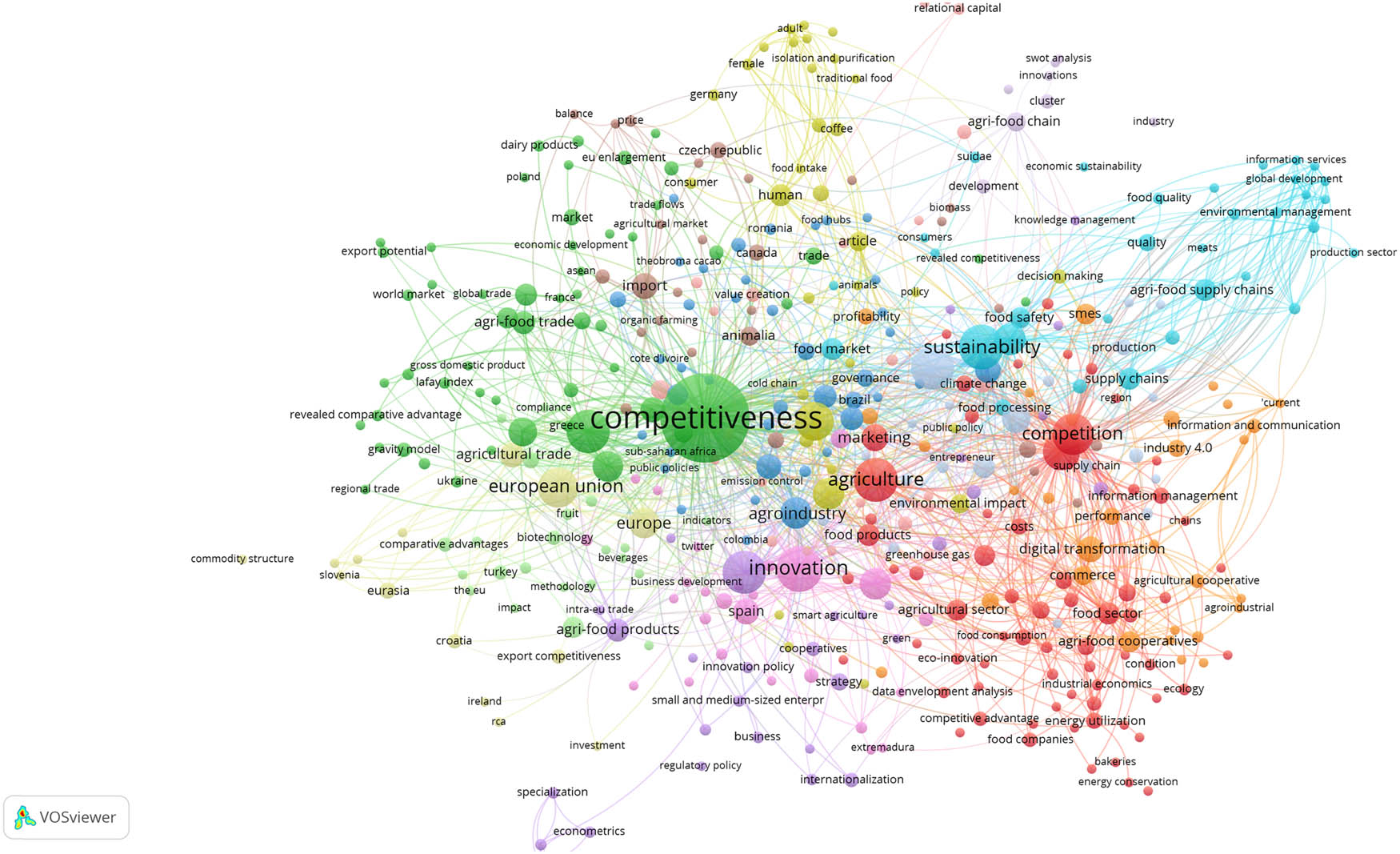
Figure 1
Mapping the concept of competitiveness.
Source: Author’s own computation in VOSviewer 1.9.20.
The conclusions of the bibliometric analysis reinforce the scientific relevance of competitiveness in the agri-food sector and support the choice of dimensions analyzed in the econometric analysis that precedes this chapter.
4. Methodology
To analyze the main agri-food export products, four datasets were downloaded from the FAO platform, covering Romania’s exports of agri-food products for the period 2019–2023.
Next, the International Trade Centre’s platform (https://www.trademap.org/) was accessed to present the main export markets for the following Romanian agri-food products: Live animals, Meat and edible meat offal, Cereals, Animal or vegetable fats and oils, Oil seeds and oleaginous fruits; industrial or medicinal plants. Also, for these agri-food products, the comparative advantage was determined using the RCA index, which has the following formula:
where X ij is the exports of good j from country i, X wj is the world exports of the good j, X it is the total exports of country j, and X wt is the total world exports.If the index has a value greater than 1, it means that the country for which it has been calculated is specialized in the production of that product or group of products. If the RCA is less than 1, the country is at a comparative disadvantage in the product or sector.
In addition, this research uses a multiple linear regression model with panel data. The main reasons that led to the choice of this method of use are the following: (a) it allowed to determine the proportion of the variation of the selected exogenous variables (specific to the competitiveness of Romanian agri-food products) that explain the variation of the endogenous variable (value of exports); (b) it facilitated the analysis of the impact of competitiveness on the value of exports over an extended period (2000–2023), by focusing on each observation (each year and each agri-food product) and their deviations from the linear model, thus highlighting discrepancies in competitiveness and variations in export performance.
The econometric model used considered the value of exports as a dependent variable, and as independent variables RCA and labor productivity (RLPR). Thus, the impact of competitiveness on the performance of Romanian agri-food exports over 23 years will be comprehensively assessed.
5. Analysis/Results interpretation
Table 2 shows the Romanian agri-food products, which, according to FAO, were exported in 2023 goods worth USD 12.08 billion, 65% more than in 2019.
Table 2
Evolution of agri-food exports (% change compared to 2019).
| 2020/2019 | 2021/2019 | 2022/2019 | 2023/2019 | |
|---|---|---|---|---|
| 01. Live animals | −6% | 20% | 2% | 16% |
| 02. Meat and edible meat offal | −17% | 6% | 26% | 31% |
| 03. Fish and crustaceans | 4% | 41% | 64% | 75% |
| 04. Milk and milk products; eggs; natural honey | 1% | 19% | 31% | 50% |
| 05. Other products of animal origin | −22% | 13% | 7% | −1% |
| 06. Live plants and floricultural products | −1% | 31% | 140% | 89% |
| 07. Vegetables, plants, roots and tubers | 2% | 19% | 39% | 34% |
| 08. Edible fruit | 34% | 71% | 69% | 45% |
| 09. Coffee, tea, spices | 7% | 27% | 24% | 52% |
| 10. Cereals | −15% | 48% | 59% | 54% |
| 11. Products of the milling industry | 12% | 66% | 428% | 609% |
| 12. Oil seeds and oleaginous fruits; industrial or medicinal plants | −9% | 49% | 77% | 89% |
| 13. Gums, resins and other saps | −33% | −32% | −22% | −31% |
| 14. Braiding materials | −14% | 56% | 51% | −11% |
| 15. Animal or vegetable fats and oils | −11% | 69% | 171% | 92% |
| 16. Meat and fish preparations | 9% | 20% | 33% | 45% |
| 17. Sugar and sugar confectionery | 6% | 0% | 76% | 281% |
| 18. Cocoa and Cocoa preparations | −6% | 11% | 15% | 26% |
| 19. Cereal-based preparations | 4% | 28% | 45% | 82% |
| 20. Preparations of vegetables, fruit | 11% | 49% | 72% | 71% |
| 21. Miscellaneous food preparations | 9% | 29% | 60% | 112% |
| 22. Alcoholic and non-alcoholic beverages | −3% | 25% | 74% | 122% |
| 23. Food industry residues | 0% | 29% | 53% | 52% |
| 24. Tobacco and tobacco substitutes | 48% | 50% | 46% | 71% |
| Total agri-food products | −1% | 41% | 57% | 65% |
| Total | −8% | 14% | 25% | 30% |
Source: Author’s calculations based on data provided by FAO STAT.
In other works (Constantin & Privitera, 2024; Dobre et al., 2023; Gâf-Deac et al., 2023), similar results can be observed, where Romania’s agri-food sector shows an increase in exports. A report by the National Institute of Romania (2024) shows an increasing share of agri-food exports in Romania’s GDP (+0.4% in 2023 compared to 2022), emphasizing the positive trend of international trade diversification.
As regards the Live animals category, Romania’s main export markets are Jordan, Israel, Hungary, and Saudi Arabia, where goods worth more than 341 thousand US dollars were exported in 2023.
In the Meat and edible meat offal category, Romania exports mainly to: United Kingdom, Bulgaria, France, and Hungary, these exports increased from the year 2019 from 124 thousand dollars to 184 thousand dollars for these markets.
The highest values of exported cereals are recorded in Saudi Arabia, Egypt, Italy, and Spain, where in 2023 these values amounted to 1,516 thousand US dollars.
The Animal or vegetable fats and oils category has as main export markets Bulgaria, Italy, Austria, and Hungary, with exports to these countries increasing from 119 thousand dollars to 163 thousand dollars.
The last category analyzed, oil seeds and oleaginous fruits; industrial or medicinal plants, shows that the following countries: Bulgaria, Netherlands, Germany, and Belgium are the main markets for Romania, with exports totaling 1,132 thousand US dollars in 2023.
The RCA was determined for these categories of agri-food products. This index has been modified by many researchers to refine it, thus considering several determinants, and to eliminate certain errors (Gutium, 2019).
The five categories of agri-food products selected reflect sectors of strategic importance for Romanian agri-food exports, in terms of either trade volume or the constant presence of a comparative advantage. This ensures a balanced analysis between the main branches of the agri-food sector.
According to Figure 2, live animals show the highest competitiveness of the 5 categories analyzed in this research, with an RCA index of 4.5. Meat and edible meat offal stands out with a competitiveness of 2.1, followed by animal or vegetable fats and oils (1.7), cereals (1.2) and oil seeds and oleaginous fruits; industrial or medicinal plants (1.1).
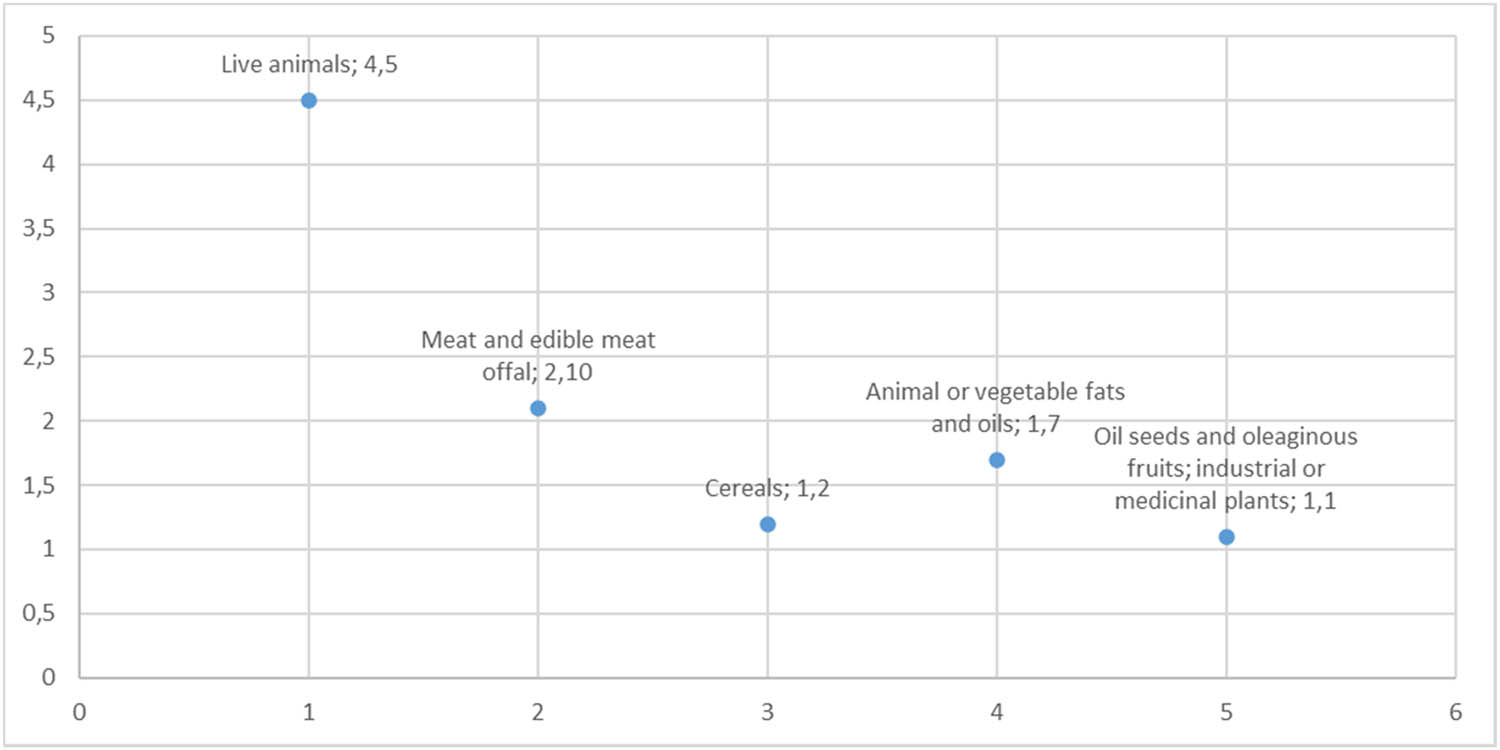
Figure 2
RCA values of key Romanian agri-food export categories (2023).
Source: Author’s calculations based on data provided by FAO.
These results are aligned with other studies present in the literature (Lădaru et al., 2024; Voinescu & Moisoiu, 2015), where the comparative advantage is emphasized in certain branches of agriculture.
Next, a linear regression model with panel data was applied to analyze the impact of RCA on exports for the period 2000–2023.
where Export it is the value of exports for product p in year t, α is the constant (intercept), β1 is the RCA (Revealed Comparative Advantage) coefficient, RCA pt is the Index of comparative advantage of product i in year t, β2 is the Coefficient of labor productivity (Prod), Prod pt is the Labor productivity in the agri-food sector in year t, ϒt is the fixed effects per period, Ɛ, and pt is the Random componentLabor productivity formula for the agri-food product categories analyzed:
The independent variables used in this econometric model (RCA and labor productivity) were selected based on their relevance, as highlighted in the literature. RCA captures the comparative advantage of products on international markets (Balassa, 1965; Serin & Civan, 2008), while productivity reflects internal efficiency (Zhang & Mia, 2020). This combination allows for a comprehensive assessment of competitiveness, considering both external and internal dimensions.
The data collected were entered into an Excel file and arranged for processing in the JASP software (Table 3).
Table 3
Descriptive statistics.
| Statistic | Exports | RCA | Prod |
|---|---|---|---|
| Mean | 253.263 | 11.654 | 288.621 |
| Std. deviation | 209.182 | 6.979 | 248.816 |
| skewness | 1.263 | 0.041 | 0.727 |
| Std. error of skewness | 0.249 | 0.221 | 0.221 |
| kurtosis | 1.713 | −1.207 | −0.394 |
| Std. error of kurtosis | 0.493 | 0.438 | 0.438 |
| Minimum | 5.449 | 0,02 | 2.732 |
| Maximum | 4.588.275 | 8,84 | 976.193 |
Source: Author’s own computation using JASP statistical software (version 0.19.3.).
In terms of exports, the highest value is recorded for cereals in 2021 of more than 4.5 million US dollars, the minimum being in 2021 for Meat and edible meat offal. In terms of CAR and productivity, the highest values are in 2023 for animal or vegetable fats and oils and oil seeds and oleaginous fruits; industrial or medicinal plants, and the lowest values are in 2001 for meat and edible meat offal, and in the same year for productivity and for this category.
From the Skewness indicator, RCA and Productivity show almost normal distributions, their values being close to 0 (0.041 in the case of RCA and 0.221 in the case of labor productivity), and for exports, the distribution has a longer right tail.
With respect to the Kurtosis indicator all 3 data series exhibit kurtotic distributions (Figure 3).
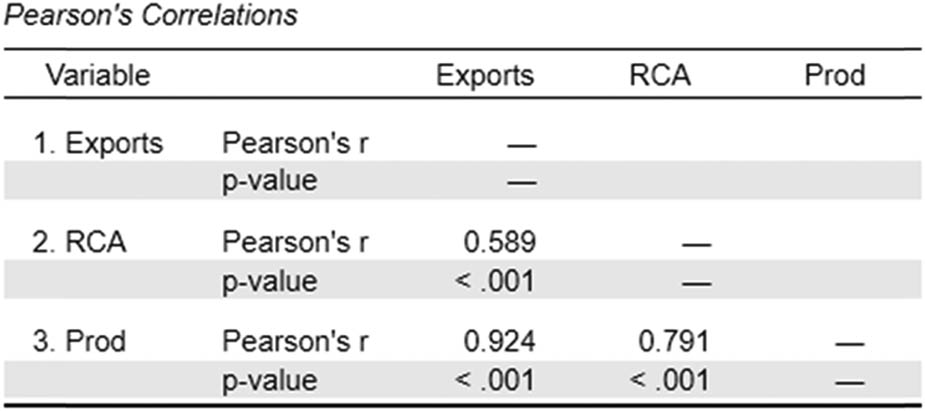
Figure 3
Pearson correlation matrix.
Source: Author’s own computation using JASP statistical software (version 0.19.3).
Regarding the correlation between variables, it can be observed that all Pearson coefficients are positive and statistically significant, thus confirming the existence of links between exports, RCA, and labor productivity.
Labor productivity has a very strong correlation with exports (r = 0.924), while RCA has a moderate positive correlation with exports (r = 0.589). There is also a high correlation between productivity and RCA (r = 0.791), suggesting an interdependence between economic efficiency and comparative advantage.
According to Table 4, the coefficient on RCA is 5.305, which means that a one unit increase in the comparative advantage leads, on average, to an increase of 5.305 thousand US dollars in exports, all other variables remaining constant. Labor productivity has a considerably larger impact, with an unadjusted coefficient of 1.200 and a standardized coefficient of 1.000, indicating a strong influence on exports.
Table 4
Coefficients of the panel data regression model.
| Model | Predictor | Unstandardized coefficient (B) | Standard error | Standardized coefficient (Beta) | t-value | p-value | 95% CI lower | 95% CI upper |
|---|---|---|---|---|---|---|---|---|
| M0 | Intercept | 253.263 | 21.575 | — | 11.738 | <0.001 | 210.418 | 296.107 |
| M1 | Intercept | 120.500 | 15.000 | — | 8.033 | <0.001 | 91.000 | 150.000 |
| M1 | RCA | 5.305 | 1.100 | 0.400 | 4.823 | <0.001 | 3.150 | 7.460 |
| M1 | Prod | 1.200 | 0.070 | 1.000 | 17.143 | <0.001 | 1.060 | 1.340 |
Source: Author’s own computation using JASP statistical software (version 0.19.3).
These results are in line with the conclusions of other studies in the field. For example, Serin and Civan (2008) analyzed Turkey’s agri-food exports and found that sectors with higher RCA (such as olive oil) performed better in the EU market. Their research supports the view that RCA is an important explanatory factor for success in agri-food exports.
In addition, Rodríguez-Rodríguez et al. (2011) identified a positive link between export intensity, firm efficiency, and productivity in the agri-food industry in south-eastern Spain. This link between efficiency and performance is also supported by Zhang and Mia (2020), who highlight that more productive firms with superior technological endowments are significantly more likely to export to emerging economies.
As shown in Figure 4, approximately 89.6% of the variation in exports is explained by the variation in other variables integrated into the model, specifically RCA and labour productivity. The adjusted R value also confirms the robustness of the model.
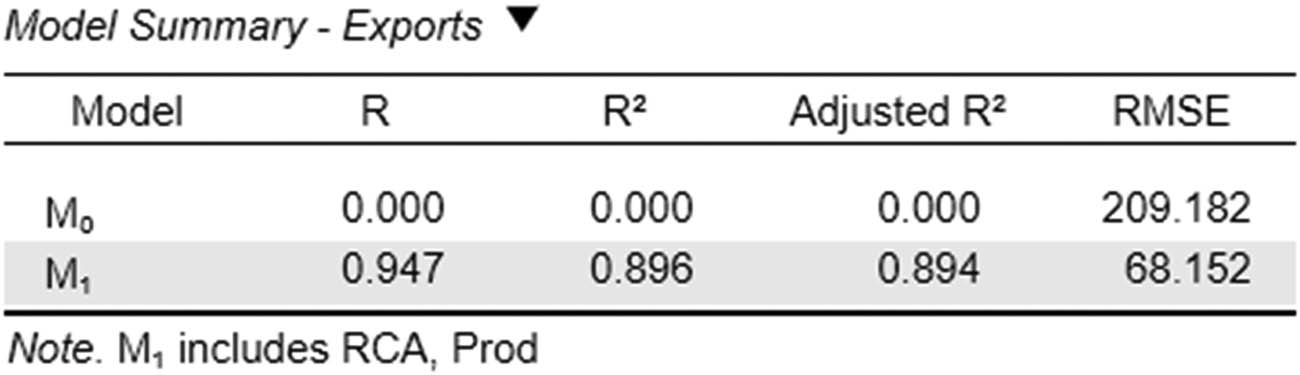
Figure 4
Model summary of the panel data regression.
Source: Author’s own computation using JASP statistical software (version 0.19.3).
These results are also congruent with the study conducted by Zhang and Sun (2022), which analyzed comparative advantage through the lens of agricultural products from several countries. They showed that this indicator plays an essential role in agricultural export performance. The study confirms that models including RCA can explain a large proportion of the variance in agri-food exports.
The ANOVA analysis shown in Figure 5 confirms the statistical significance of the regression model that includes the comparative index (RCA) and labor productivity (Prod) as explanatory factors for export performance. The value of F(392.571) and p-value <0.001 indicate that the model is statistically significant, and at least one of the exogenous variables contributes significantly to explaining the variation of the endogenous variable.
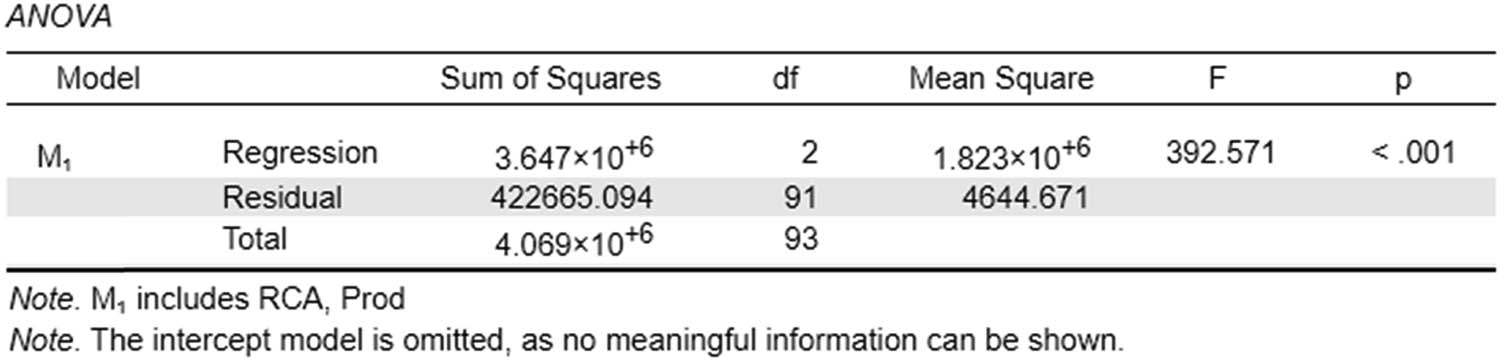
Figure 5
ANOVA results for the panel data regression model.
Source: Author’s own computation using JASP statistical software (version 0.19.3).
Another study, conducted by Khorajiya et al. (2018), showed that well-developed econometric models, which included RCA and labor productivity as macroeconomic factors, can provide robust explanations for the variation in exports.
Table 5 shows the potential collinearity diagnostics between the independent variables. The maximum value of the Condition Index is 3.536 in the third dimension, which is less than 4, indicating a weak collinearity. The model is stable without biased influences caused by strong correlations.
Table 5
Collinearity diagnostics.
| Variance proportions | ||||||
|---|---|---|---|---|---|---|
| Model | Dimension | Eigenvalue | Condition index | Intercept | Prod | RCA |
| M1 | 1 | 2.500 | 1.000 | 0.030 | 0.020 | 0.025 |
| M1 | 2 | 0.300 | 2.887 | 0.600 | 0.450 | 0.150 |
| M1 | 3 | 0.200 | 3.536 | 0.370 | 0.490 | 0.460 |
Source: Author’s own criteria for bibliometric analysis.
Although no formal stationarity test was applied, the annual nature of the data (2000–2023) and the absence of strong trends or structural breaks, confirmed by descriptive statistics and near-normal distributions, suggest stationary behavior of the variables used.
6. Conclusion
The present research aimed to highlight the role of competitiveness in the growth of Romanian agri-food exports, approaching several techniques to emphasize this role, combining data analysis on Romanian agri-food exports in the period 2019–2023, bibliometric analysis to determine the scientific interest on the competitiveness of agri-food products and, finally, an econometric analysis where a multiple linear regression model with panel data was used.
The analysis of foreign markets, using data obtained from the TradeMap platform, allowed the identification of the main export destinations and highlighted certain foreign markets.
The panel regression model, which integrates data from 2000 to 2023, was integrated to minimize possible model errors. The model results revealed that both comparative advantage and labor productivity significantly influence the exports of the analyzed agri-food products (Live animals, Meat and edible meat offal, cereals, animal or vegetable fats and oils, oil seeds and oleaginous fruits; industrial or medicinal plants). Notably, labor productivity had a stronger impact, suggesting the importance of investment in technology and innovation in the agri-food chain.
The results obtained show that an increase in productivity and comparative advantage can benefit agri-food exports.
Based on the results obtained, several recommendations can be made. For companies operating in the agri-food sector, the significant impact of labor productivity on exports highlights the need for investment in modern technologies (such as the digitization of certain processes), vocational training for the rural workforce, and the development of local processing capacities to increase added value. In addition, it is recommended to expand presence in foreign markets by obtaining product quality certifications and through commercial partnerships.
Regarding decision-makers in the public sector, the conclusions of this research support the development of policies that support digitization and innovation in the agri-food chain, the modernization of logistics infrastructure, and the formation of export clusters in high-performance sectors. At the same time, it is recommended that tax incentives and non-repayable grants be provided for the modernization of production units and to stimulate research and innovation. The limitations of the present research are the limited number of agri-food products included in the econometric model. Future research may include more or even all 24 agri-food categories. Also, other exogenous variables, in addition to labor productivity and the index of comparative advantage, degree of trade openness of the food sector, unit labor cost, degree of mechanization, etc., can be included.
Other valuable lines of research can compare Romania’s competitiveness with other countries in the region, thus identifying the relative positioning of Romanian agri-food products on the European market.
Acknowledgments
This paper was co-financed by the Bucharest University of Economic Studies during the PhD program. Part of this research was conducted during the Erasmus + mobility undertaken by Simona Roxana Pătărlăgeanu and Alina Florentina Gheorghe (Gavrilă) at the Catholic University of Valencia – San Vicente Mártir, between 18 and 25 May 2025.
Funding information
This research was co-financed by the Bucharest University of Economic Studies during the PhD program.
Author contributions
Conceptualization: Andreea Apetrei Kalveram, Simona Roxana Pătărlăgeanu; Methodology: Alina Florentina Gheorghe (Gavrilă), Simona Roxana Pătărlăgeanu; Validation: Andreea Apetrei Kalveram, Simona Roxana Pătărlăgeanu; Formal analysis: Simona Roxana Pătărlăgeanu, Andreea Apetrei Kalveram; Writing – original draft preparation: Alina Florentina Gheorghe (Gavrilă), Simona Roxana Pătărlăgeanu; Writing – review and editing: Alina Florentina Gheorghe (Gavrilă), Simona Roxana Pătărlăgeanu; Supervision: Andreea Apetrei Kalveram.
Conflict of interest statement
Authors state no conflict of interest.
Data availability statement
The data supporting the findings of this study are available from the corresponding author upon reasonable request.