
1. Introduction
Today, artificial intelligence (AI) has become very crucial to firms operating in a fast and competitive business environment. AI can be explained as a technology that can imitate human intelligence to execute tasks. It consists of tools and techniques such as machine learning, deep learning, and natural language processing. It has the capacity to perceive, reason, learn, predict, communicate as well as the capacity to plan and adapt (Ng & Alarcon, 2020). The technology cuts across various business and management disciplines including supply chain management, marketing, finance, and accounting. It has been anticipated that by 2030, AI may provide almost $15.7 trillion dollars to the world economy of which $1.2 trillion dollars could be generated in Africa (Anomah et al., 2024). It can offer businesses and individuals with significant contribution such as streamline administrative tasks, customer service experience, optimize the allocation of resources, labour productivity and error reduction (Wamba, 2022).
Scholars such as Anomah et al. (2024) have suggested that the accounting field is gradually being transformed by AI. Due to this, many firms have commenced employing AI-based accounting system (AS) to achieve the full benefits associated with it. The technology has enabled firms to replace manual methods with automatic processes and made accounting tasks simplified, less tedious, and user-friendly. Abdullah and Almaqtari (2024) in a study emphasized that the technology can process vast amount of financial data, identify patterns, anomalies, and enhance decision making. It can enable firms to uncover risky transactions during audits and perform accounting payable processing tasks. It enables firms to extract valuable information from different online document to enhance audit efficiency (Ng & Alarcon, 2020). It can enable accountants to deliver more insightful financial advice, forecast, and plan strategically to ascertain competitive edge to business (Odonkor et al., 2024). Despite these benefits, the implementation of AI-based AS is still at infancy and not widespread among small and medium enterprises (SMEs) in developing nations. Hence the aim of this study is to investigate the critical success factors that can enhance the acceptance of AI-based ASs among SME users in Ghana, as few studies have explored this topic in developing countries (Abdullah & Almaqtari, 2024).
SMEs are the backbone of the Ghanaian economy because they constitute over 85% of businesses, contributing 80% to employment and generate approximately 70% of the gross domestic product. However, many SMEs face noteworthy challenges in implementing the digital economy due to insufficient funds, technical expertise, and infrastructure. Addressing this critical gap, Ghana has introduced a Venture Capital Trust Fund through its Ghana Digital Acceleration Project to equip SMEs with tools and resources to thrive in the digital era. The Venture Capital Trust Fund empowers SMEs to embrace innovative technologies such as e-commerce platforms, cloud computing, digital payment systems, AI-powered chatbots, and virtual assistants. With the increasing dependence on AI and the speed at which innovative technology is being integrated into the business environment, finding the crucial factors that can drive the application of AI-based ASs continues to be a significant concern. Examining these factors can be crucial for service providers, policymakers, and SME managers to devise strategies to promote the acceptance and utilization of AI-based ASs.
The primary research concern has been the under-utilization and unsuccessful application of business analytics by SMEs in developing countries. Studies by scholars such as Sharma and Sharma (2019) have emphasized that under-utilization of business analytics will become a major issue if there is unavailability and unreliability of technical staff to assist users overcome the technological complexities related to the system. Similarly, when output produced by the system is inaccurate, non-transparent, and incomplete, it can hinder the acceptance of AI-based AS (Chatterjee et al., 2018). Also, some studies have claimed that AI-based systems possess unique characteristics such as algorithm opacity, bias, and explainability that have the tendency of eroding the trust that individuals and organizations may have in the system. Shin (2021) showed that if users can make sense of the workings or explanation of AI, they may have confidence and trust in its algorithm results. Also, Gyamerah et al. (2024) found that AI utilization can be dependent on its ability to effectively control and monitor business activities and assess risk processes that can hinder efficiency, innovation, and resilience.
To explain the critical success factors affecting the acceptance of information systems (ISs), many studies have adopted the updated DeLone and McLean information system success model (DM-ISSM) (Lutfi, 2023, Sharma & Sharma, 2019). Majority of studies have utilized the theory to explain IS implementation in different context. However, the DM-ISSM has scarcely been applied in the context of AI-based AS to evaluate factors that can affect its proper utilization by SMEs in developing countries. Also, internal control quality (ICQ) has widely been disregarded even though it is crucial for the proper and effective functioning of accounting information system (AIS). Thus, the aim of this study is to employ a modified DM-ISSM to examine factors such as system quality (SQ), information quality (IQ), service quality (ServQ), and ICQ and how they can drive the application of AI-based ASs among SME users in developing countries.
The study contributes to accounting literature by filling certain research gaps. To begin with, this study is one of the earliest studies to explore drivers affecting SMEs application of AI-based AS, providing valuable insights in the settings of developing nations. Also, a handful of empirical studies using DM-ISSM have reconceptualized SQ incorporating novel dimensions such as explainability and fairness that characterizes AI technologies. Incorporating these responsible AI attributes can broaden DM-ISSM by demonstrating that usage in AI context is contingent upon conventional quality dimensions and novel attributes of explainability, ethics, fairness, and trust, thereby elevating the framework’s applicability to evolving technologies. Despite the flexibility of DM-ISSM, some studies have proposed the introduction of significant institutional elements to address the weaknesses of the model (Sharma & Sharma, 2019; Vatanasakdakul et al., 2017). Even though ICQ is very essential in AIS context, there has been limited studies that have established the correlation between ICQ and AI-based AS utilization. Integrating ICQ into the ISSM can provide evidence that the construct is a strategic enabler of AI adoption success.
The subsequent sections outline the following. Section 2 outlines the theoretical framework and develops the hypotheses, while Section 3 outlines the methods. Section 4 outlines data analysis, Section 5 outlines discussion, Sections 6 and 7 outline the theoretical and managerial implications, respectively, and the conclusion outlines limits and direction for future studies.
2. Literature review
2.1. Modified DM-ISSM
The ISSM was developed by DeLone and McLean (2003) to assess the critical success factors that influence the implementation of ISs. The model has been applied by various studies to examine the implementation of IS at both the individual and organizational level (Akrong et al., 2022; Al-Okaily et al., 2023). The model has been characterized by three variables: SQ, IQ, and ServQ, which impact usage and satisfaction (SAT) in ISs. In addition, individual usage and user SAT lead to net impact (Jeyaraj, 2020; Petter & McLean, 2009). Previous literature have suggested that the model is well-recognized to provide insights and understanding into level of implementation and acceptance of IT systems (Lutfi, 2023; Wang & Liao, 2008). Conventionally, SQ has been defined in terms of its technical reliability, ease of use, and functionality (Lutfi, 2023). However, in the context of AI-based systems, limited studies have reconceptualized SQ to include responsible AI characteristics such as explainability and perceived fairness and their impact on the success of AI-based AS.
While many researchers have established ICQ as a significant adoption factor in the context of AIS, it has not been satisfactorily tested from the perspective of AI-based AS. While the original DM-ISSM theory emphasizes technical and IQ, the success of AIS depends on the system’s ability to safeguard data integrity, prevent fraud, and ensure compliance with regulatory requirements. By integrating ICQ into the IS success framework, the model becomes more representative of the practical realities of accounting in SMEs, where internal control is fundamental to both system effectiveness and organizational sustainability. Some scholars such as Monteiro et al. (2023) have emphasized that strong internal control is an enabler of AI-based accounting since it can provide reliable and risk mitigation mechanisms that can drive adoption. Hence, by integrating ICQ into the DM-ISSM, it would allow researchers to ascertain and explain the model’s predictive power that can enable SME users to successfully apply the technology in the context of developing nations. Also, the research evaluates the net impact of AI usage in accounting. Despite the extensive adoption of ISSM to evaluate IS success, the model has largely ignored firm performance when assessing technological usage in accounting in organizational settings (Lutfi et al., 2022a).
Studies have extended the DM-ISSM to examine drivers affecting the successful implementation of IS such as e-accounting (Al-Okaily et al., 2023; Lutfi et al., 2022b), enterprise resource planning (Campbell & Fogarty, 2021) in work settings and e-commerce (Angelina et al., 2019), Internet of Things (Chatterjee et al., 2018) in non-work settings. The model has been applied by prior studies in different countries to evaluate the critical success factors affecting IS implementation at both individual and organizational level (Lutfi, 2023; Madhala et al., 2024; Sharma & Sharma, 2019; Vatanasakdakul et al., 2017). Yet, there is extremely limited studies that have adopted the ISSM to explore SME users’ implementation of AI-based AS in the settings of developing nations such as Ghana. Some scholars such as Al-Hattami and Almaqtari (2023) have emphasized that assessing the framework across different context helps to promote the cross-cultural validity of the model.
Many prior studies have assessed the effect of SQ, IQ, and ServQ on the success of IS (Lutfi, 2023; Sharma & Sharma, 2019). Scholars such as Lutfi (2023) have evaluated SQ using variables such as functionality, usability, and reliability to assess their impact on ISs acceptance at the individual level. However, with the rise of AI-driven and algorithm decision systems, current studies have scarcely considered crucial AI attributes such as explainability, opacity and transparency as essential dimensions of SQ. Also, despite ServQ being a core construct of the DM ISSM, empirical findings from prior studies by scholars such as Saad (2023) and Lutfi (2023) have demonstrated that ServQ on system use and user satisfaction remain inconsistent. Based on the findings, it can be emphasized that ServQ may have different magnitudes depending on the technological context. Due to complexity and opaqueness of AI systems, quality service interactions can help SMEs build trust in the technology and vendor. However, the extent to which ServQ can affect user experience of AI-based AS among SME users have not been thoroughly studied.
Therefore, the study seeks to examine the critical success factors that can drive the application of AI-based ASs by SMEs in Ghana, employing a modified ISSM. The exogenous factors are firm performance and usage, and user SAT is considered as essential factor that is linked to firm performance. The endogenous factors such as SQ, ServQ, IQ, and ICQ are included into the proposed conceptual framework as seen in Figure 1.
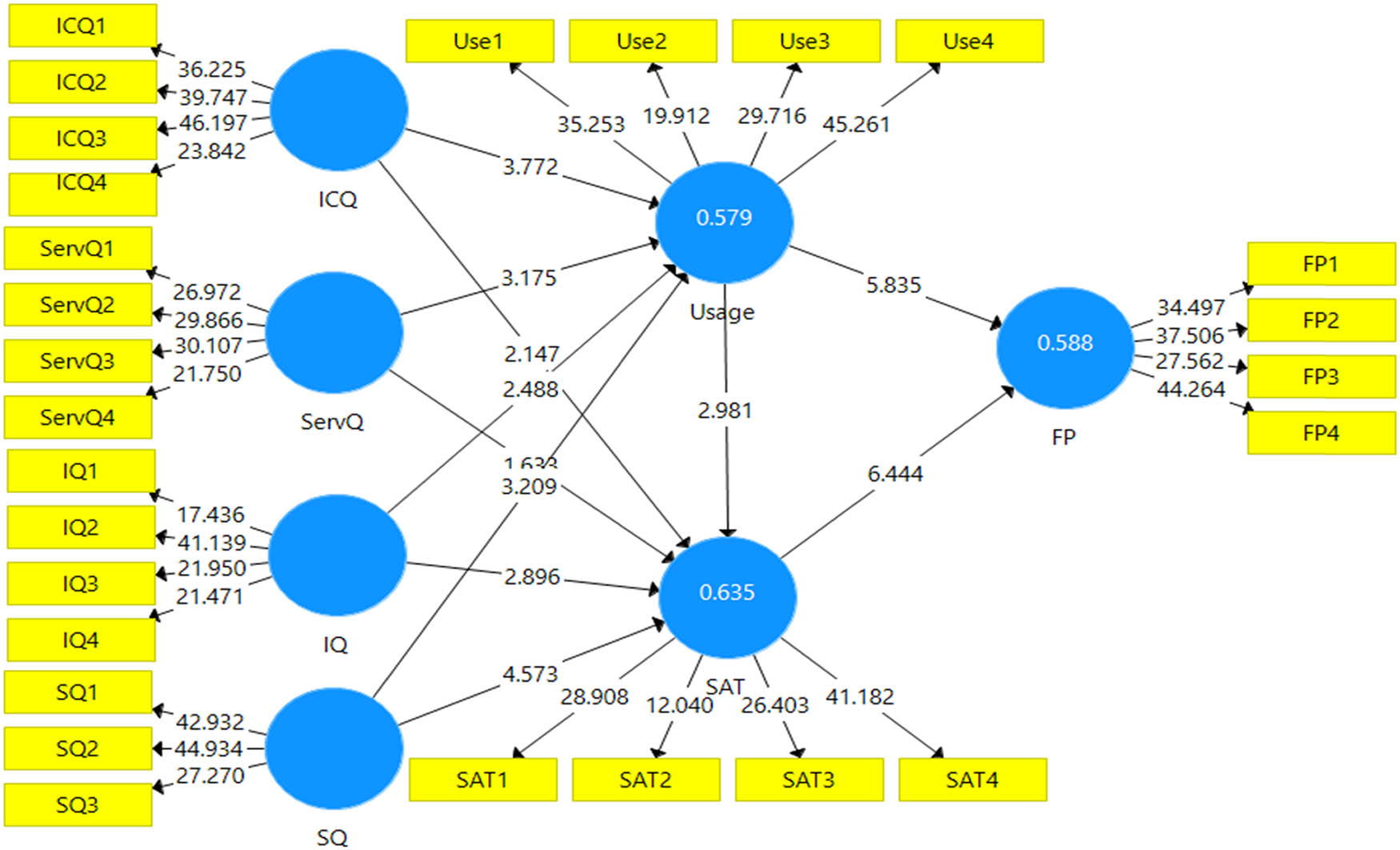
Figure 1
Structural path.
Source: Authors’ own research.
2.2. Hypothesis development
2.2.1. SQ
SQ denotes the degree to which the system characteristics can suitably and efficiently address user requirement (DeLone & McLean, 2003; Lutfi, 2023). This construct is an essential success factor in AI-based AS since it produces the information for effective decision making (Lutfi, 2023). In AI context, some of the factors that pertain to SQ include explainability, perceived fairness, personalization, and responsiveness of AI-based AS (Afroogh et al., 2024; Kokina et al., 2025; Lutfi, 2023; Shin, 2021). Users may be more willing to trust AI systems if they can understand how decisions are made. By providing clear interpretable explanations for AI decisions, explainable AI helps demystify complex models and makes them more accessible to non-expert users. Perceived fairness is another crucial factor. If users believe that AI algorithm is discriminatory or bias, their trust in the system may diminish. Also, users may perceive the system as useful and feel more confident to apply it if the information generated personalizes their needs (Shin, 2021). Liu et al. (2022) also emphasized AI system algorithms must have intuitive, user-friendly, and understandable interface. Some prior studies have attempted to establish the relationship between these SQ and AI usage (Liu et al., 2022; Shin, 2021). Shin (2021) found that SQ dimension such as explainability influences users’ trust and subsequent user behaviour. However, Liu et al. (2022) could not prove the causal relationship between explainability of AI and behavioural intention among users. Then again, Lutfi (2023) found that SQ has a significant effect on user satisfaction but has an insignificant effect on AIS usage. Despite these contradictions, there has been limited research in accounting domain on the impact of AI system’s quality dimensions on user experience among SMEs. Thus, the study predicts that
H1: SQ can positively affect the usage of AI-based AS.
H2: SQ can positively affect the SAT of AI-based AS.
2.2.2. IQ
IQ is a critical aspect of IS success and measures the output quality of the AI system. It is ascertained when the AI system produces information that is relevant, accurate, understandable, complete, timely, and usable (Petter et al., 2008). Some prior works have suggested that high IQ reduces errors in transaction (Lutfi et al., 2022c) and other studies have emphasized that it can enable SMEs to generate relevant insights for decision-making (Perdana et al., 2022). Similarly, Sharma and Sharma (2019) have emphasized that when there is a lack of IQ, users may exert much effort in understanding information, increase operational challenges, and minimize user satisfaction due to the system’s inability to meet user expectations. To meet user expectation, Chatterjee et al. (2018) indicated that AI systems must be capable of presenting information in a well-organized and concise manner. Previous research (Saad, 2023; Wang & Liao, 2008) have found significant effect between IQ and usage. In contrast, Angelina et al. (2019) found an insignificant effect between IQ and IS usage. Similarly, prior studies have found a significant effect between IQ and SAT (Sharma & Sharma, 2019). In contrast, studies by scholars such as Angelina et al. (2019) and Lutfi (2023) have found an insignificant relationship between IQ and SAT. Based on the above reason, the study predicts that
H3: IQ can positively affect the usage of AI-based AS.
H4: IQ can positively affect the SAT of AI-based AS.
2.2.3. ServQ
ServQ is an additional element incorporated into the original DM-ISSM (Petter & McLean, 2009). It measures the tangibility, responsiveness, reliability, empathy, assurance, and technical competence offered by service providers (Petter & McLean, 2009; Petter et al., 2008). SAT toward AI-based AS usage may arise from service providers proficiency to provide high quality services to improve system performance and enable users to respond to diverse needs and to fulfil their accounting and financial management requirement (Wang & Zhu, 2025). Chatterjee et al. (2018) emphasized that the extent to which service providers can offer users with current, up-to-date, and reliable software and hardware can affect their actual usage of AI-based ASs. Also, the degree of responsiveness and technical competence offered by service providers in handling technical issues faced by various users can affect their SAT levels. The study by Lutfi (2023) found a significant effect between ServQ and IS usage. Saad (2023) found an insignificant effect between ServQ and IS usage. Similarly, the study by Lutfi (2023) found a significant effect between ServQ and user SAT. In contrast, Akrong et al. (2022) found an insignificant effect between ServQ and SAT. Based on the above reason, the study predicts that
H5: ServQ can positively affect the usage of AI-based AS.
H6: ServQ can positively affect the user SAT of AI-based AS.
2.2.4. ICQ
ICQ involves practices and methods instituted by firms to safeguard their assets, identify risks, and maintain accurate and reliable financial records (Gyamerah et al., 2024). The main aim of ICQ is to achieve overall business objectives and strategy. It streamlines processes, reduces inefficiencies, and ensures effective utilization of resources thereby contributing to overall organizational success (Johri, 2025). It can also guarantee the authenticity of internal and external information communication, improve the level of corporate governance, and ensure integrity of information disclosures (Huang et al., 2022). Monteiro et al. (2023) emphasized that AI is a crucial aspect of AIS and ICQ development. AI performs internal control functions such as automating business transactions and thus, can reduce the likelihood of unplanned mistakes that may occur in financial statement. It is also proficient in preventing frauds, reducing misstatements, and ensuring timely preparation of financial reporting (Johri, 2025). Tan et al. (2025) emphasized that high ICQ compensates for higher inherent risk and controls risks and lower ICQ can seriously weaken the discovery of financial misstatement. The study by Gyamerah et al. (2024) discovered that firms with ICQ manage risk efficiently, are resilient, and accomplish organizational objective better. Some scholars have found that higher ICQ can influence the application of ISs and subsequently affect user experience (Lutfi, 2023; Monteiro et al., 2023). Despite these findings, there is still limited empirical evidence on the effect of ICQ on user experience towards AI-based AS. Based on the above reason, the study predicts that
H7: ICQ can positively affect the usage of AI-based AS.
H8: ICQ can positively affect the user SAT of AI-based AS.
2.2.5. Usage
Usage can be explained as the frequent use of an IS (Petter et al., 2008). Usage is one of the critical determinants of the ISSM and precedes SAT in a process sense (Petter & McLean, 2009) IS has become essential to most firms and which makes the extent to which it is being frequently adopted very significant (Akrong et al., 2022). Prior studies have thus attempted to find the relationship between IS usage and SAT. Previous studies (Lutfi, 2023; Saad, 2023) have found a significant influence between IS usage and SAT. Then again, past research have found that IS use has meaningful effect on firm performance (Lutfi et al., 2022b; Wang & Liao, 2008). Prior research by Abdullah and Almaqtari (2024) have emphasized that the adoption of AI-based AS can improve strategic decision making, increase productivity, cost reduction, allocate resources, and increase profitability of firms. Based on the above reason, the study predicts that
H9: The usage of AI-based AS can positively affect SAT.
H10: The use of AI-based AS can positively affect firm performance (FP).
2.2.6. SAT
SAT is also a crucial factor of the updated ISSM. Users gain SAT from IS when the final outcome arising from the system exceeds or meets the anticipated needs or expectation of users (Chatterjee et al., 2018). As suggested by DeLone and McLean (2003), when users become satisfied with the usage of technology, it can have positive effect on perceived FP. This is because SAT can lead to a continuous and efficient usage of the system, which can positively affect the benefits to be derived from IS (Vatanasakdakul et al., 2017). Empirical results have found that there is a significant effect between SAT and FP (Petter et al., 2008). Lutfi et al. (2022b) conducted research in Jordanian context and found that the SAT using e-AS positively influenced business performance. Similarly, Lutfi et al. (2022a) in a study in Jordanian context found that SAT using AIS enhances the sustainability of decision-making. Based on the above literature, the study hypothesizes that
H11: SAT of AI-based AS can positively affect FP.
3. Methodology
This study adopted a quantitative research approach to examine the critical success factors influencing AI-based AS acceptance and FP of SME users in Ghana. The study selected 385 SMEs from the database of the Association of Ghana Industries (AGI). The AGI has over 1,500 registered members across the regions of Ghana with approximately 85% belonging to SMEs category. A purposive sampling method was adopted to select the samples for the study. This sampling technique was selected to capture the perception of employees who are directly involved in accounting, finance, and decision-making within SMEs. Since it is a non-probability sampling method, the findings cannot be generalized to all SMEs in Ghana. Additionally, this sampling technique has the tendency of limiting the study’s findings from deriving diverse opinions among varying SMEs and conducting a similar study may generate dissimilar outcomes. The study, which spanned 3 months from October 2024 to January 2025, provided the researchers with 265 responses. However, 249 valid responses were employed for further analysis.
The data collection instrument employed was an online questionnaire developed using Google Forms. A content validity of the questionnaire was conducted by two IS professors with in-depth knowledge on empirical research. They checked for the appropriateness of the survey items as to whether they measured the constructs under consideration. Their suggestions helped reshape and modify the questionnaires with more clarity and simplification. To assess the reliability of the questionnaire, a pilot study was conducted with 30 senior staffs of SMEs utilizing various digital AIS and were later dropped after further modification of the questionnaire. The research instrument was made up of 2 sections containing 33 items. The initial section comprised 6 demographics, and the next section comprised 27 items to measure the constructs. The questionnaire items for SQ was modified from the study by Liu et al. (2022). The survey items for IQ and ServQ were modified from the studies by Chatterjee et al. (2018) and DeLone and McLean (2003). The survey items for ICQ were modified from the studies by Gyamerah et al. (2024) and Monteiro et al. (2023). The survey items for usage were modified from the studies by Chatterjee et al. (2018), Lutfi et al. (2022c), and DeLone and McLean (2003) and user SAT was modified from the studies by Chatterjee et al. (2018) and Lutfi et al. (2022a). The survey items for FP were modified from the studies by Angelina et al. (2019) and Lutfi et al. (2022c). All items were measured on a six-point Likert scale from 1 (strongly disagree) to 6 (strongly agree).
3.1. Demographic characteristics of the respondents
Table 1 shows the demographic characteristics of the respondents. The employees were made up of 74.30% males and 25.70% were females. 37.75% of the respondents were between the ages of 26–35 and form the majority, 19.28% were between the ages of 18–25, 16.87% between the ages of 36–45, 12.85% between the ages of 46–55, and 13.25% were more than 55 years. Accountants (32.93%) formed the majority of the study while others (4.42%) formed the minority. Majority of the respondents work in the retail sector (19.68%) and 6.43% that formed the minority were working in other sectors. 44.58% operate in medium firms, 38.55% in small firms, and 16.87% in micro firms. Majority of the firms have operated for more than 10 years and less than 1 year formed the minority.
Table 1
Demographics of respondents.
| Demographics | Category | Frequency | Percent (%) |
|---|---|---|---|
| Gender | Male | 185 | 74.30 |
| Female | 64 | 25.70 | |
| Age of respondents | 18–25 | 48 | 19.28 |
| 26–35 | 94 | 37.75 | |
| 36–45 | 42 | 16.87 | |
| 46–55 | 32 | 12.85 | |
| More than 55 | 33 | 13.25 | |
| Position in company | Owner | 54 | 21.69 |
| Manager | 60 | 24.10 | |
| Chief finance Officer | 42 | 16.87 | |
| Accountant | 82 | 32.93 | |
| Others | 11 | 4.42 | |
| Industry sector | Manufacturing | 23 | 9.24 |
| Retail | 49 | 19.68 | |
| Service | 42 | 16.87 | |
| Agriculture | 28 | 11.24 | |
| Banking and Finance | 36 | 14.46 | |
| Hospitality | 31 | 12.45 | |
| Mining and construction | 24 | 9.65 | |
| Others | 16 | 6.43 | |
| Firm size | Micro | 42 | 16.87 |
| Small | 96 | 38.55 | |
| Medium | 111 | 44.58 | |
| Years in operation | Less than 1 year | 23 | 9.24 |
| 1–5 years | 55 | 22.09 | |
| 6–10 years | 89 | 35.74 | |
| More than 10 years | 82 | 32.93 |
Source: Authors’ own research.
4. Data analysis
4.1. Composite reliability (CR) and convergent validity (CV)
We used the SmartPLS version 3.0 to measure the composite reliability and validity. Table 2 depicts statistical metrics relating to items within constructs, including factor loadings (FL), variance inflation factor (VIF), composite reliability (CR), and Cronbach alpha (CA). The FL demonstrates the magnitude of association linking items and their underlying constructs. Hair et al. (2020) suggested that for a one-tailed test at a 5% significance level, the acceptable loadings should be at least 0.708 with a t-statistic exceeding 1.96. The loadings of all indicators range between 0.711 and 0.891 demonstrating a robust loading. The study assessed the indicators’ VIFs to check whether they were below 3.0, which is the threshold that multicollinearity is unlikely to be a concern. The VIFs of all indicators, which range from 1.416 to 2.622, were within acceptable limits. The study also measured the internal uniformity of constructs using CA and CR. When both CA and CR exceed 7.0, the constructs are considered reliable. The constructs CR, which ranged from 0.879 to 0.919, and CA, which ranged from 0.816 to 0.883, were within acceptable limits. Then again, CV was measured via average variance extracted (AVE). This scale assesses the mean difference between the construct and its indicators. The AVE criterion must be at least 0.50. The constructs AVEs ranged from 0.645 to 0.759.
Table 2
CR and validity.
| Construct | Indicator | VIF | Load | CA | rho_A | CR | AVE |
|---|---|---|---|---|---|---|---|
| FP | FP1 | 2.103 | 0.846 | 0.877 | 0.880 | 0.916 | 0.731 |
| FP2 | 2.287 | 0.857 | |||||
| FP3 | 2.127 | 0.830 | |||||
| FP4 | 2.618 | 0.886 | |||||
| ICQ | ICQ1 | 2.322 | 0.864 | 0.876 | 0.878 | 0.915 | 0.730 |
| ICQ2 | 2.534 | 0.872 | |||||
| ICQ3 | 2.622 | 0.885 | |||||
| ICQ4 | 1.753 | 0.793 | |||||
| IQ | IQ1 | 1.702 | 0.774 | 0.816 | 0.824 | 0.879 | 0.645 |
| IQ2 | 1.988 | 0.853 | |||||
| IQ3 | 1.730 | 0.788 | |||||
| IQ4 | 1.713 | 0.796 | |||||
| SAT | SAT1 | 1.689 | 0.806 | 0.817 | 0.825 | 0.880 | 0.647 |
| SAT2 | 1.416 | 0.711 | |||||
| SAT3 | 2.044 | 0.841 | |||||
| SAT4 | 2.168 | 0.852 | |||||
| SQ | SQ1 | 1.858 | 0.869 | 0.841 | 0.848 | 0.904 | 0.759 |
| SQ2 | 2.210 | 0.890 | |||||
| SQ3 | 2.007 | 0.853 | |||||
| ServQ | ServQ1 | 2.218 | 0.824 | 0.838 | 0.839 | 0.892 | 0.673 |
| ServQ2 | 2.406 | 0.847 | |||||
| ServQ3 | 1.854 | 0.824 | |||||
| ServQ4 | 1.691 | 0.786 | |||||
| Usage | Use1 | 2.265 | 0.860 | 0.883 | 0.885 | 0.919 | 0.740 |
| Use2 | 2.154 | 0.837 | |||||
| Use3 | 2.429 | 0.852 | |||||
| Use4 | 2.852 | 0.891 |
Source: Authors’ own research.
4.2. Discriminant validity (DV)
DV measures a construct’s distinctiveness. It was measured using both the Fornell-Larcker and Heterotrait-Monotrait (HTMT) ratios (Gyamerah et al., 2024; Hair et al., 2020). In Fornell-Larcker’s estimation, it becomes established when a construct AVE surpasses its association with alternative constructs. However, when it falls below the relationship with other constructs, it means the constructs suffer from DV (Gyamerah et al., 2024). The Fornell-Larcker in Table 3 depicts that all constructs in the measurement model are free from DV. The HTMT ratio was also measured by the study to assess DV. A construct falls within the acceptable range when its HTMT does not exceed 0.85 or better still 0.90 (Hair et al., 2020). Table 4 establishes DV since the HTMT of the constructs falls within acceptable limits.
4.3. Structural model
Table 5 and Figure 1 show the hypothesis testing and the structural model. To examine the path relationship between the constructs, a structural model was established using the partial least square algorithms. We selected 5,000 subsamples to establish the implications of the path coefficients. Table 5 indicates beta values, t-statistics, and p-values of path connections. All hypotheses were accepted at a 95% confidence level. SQ has positive effect on AI usage ( = 0.219, t = 3.209, = 0.001) and SAT ( = 0.300, = 4.464, = 0.000). H1 and H2 have been sustained. IQ has a positive effect on AI usage ( = 0.159, = 2.488, = 0.006) and SAT ( = 0.183, = 2.896, = 0.002). H3 and H4 have been sustained. ServQ has positive effect on usage ( = 0.254, = 3.175, = 0.001) and had no effect on SAT ( = 0.112, = 1.633, = 0.051). H5 has been sustained and H6 unsustained. ICQ has positive effect on usage ( = 0.252, = 3.772, = 0.000) and SAT ( = 0.143, = 2.147, = 0.016). H7 and H8 have been sustained. Usage has positive effect on SAT ( = 0.200, = 2.981, = 0.001) and FP ( = 0.415, = 5.835, = 0.000). H9 and H10 have been sustained. SAT has positive effect on FP ( = 0.423, = 6.444, = 0.000). H11 has been sustained.
Table 5
Hypothesis testing.
| Hypothesis | Path | Beta | T-stats | P-values | Results |
|---|---|---|---|---|---|
| H1 | SQ → Usage | 0.219 | 3.209 | 0.001 | Sustained |
| H2 | SQ → SAT | 0.300 | 4.464 | 0.000 | Sustained |
| H3 | IQ → Usage | 0.159 | 2.488 | 0.006 | Sustained |
| H4 | IQ → SAT | 0.183 | 2.896 | 0.002 | Sustained |
| H5 | ServQ → Usage | 0.254 | 3.175 | 0.001 | Sustained |
| H6 | ServQ → SAT | 0.112 | 1.633 | 0.051 | Unsustained |
| H7 | ICQ → Usage | 0.252 | 3.772 | 0.000 | Sustained |
| H8 | ICQ → SAT | 0.143 | 2.147 | 0.016 | Sustained |
| H9 | Usage → SAT | 0.200 | 2.981 | 0.001 | Sustained |
| H10 | Usage → FP | 0.415 | 5.835 | 0.000 | Sustained |
| H11 | SAT → FP | 0.423 | 6.444 | 0.000 | Sustained |
Source: Authors’ own research.
The coefficient of determination, R-square, was adopted to establish the predictive ability of the model. From Figure 1, the study found that SQ, IQ, ServQ, and ICQ predict about 57.9% of the changes in usage and predict 63.5% of the changes on SAT when usage is included. Also, the study found that usage and SAT predict about 58.8% change in firm performance.
To assess the suitability of the model, the standardized root mean square (SRMR) was calculated. A model is said to be well-fitted when SRMR values are lower than 0.08. Establishing an SRMR value of 0.069, the model’s structural directions are revealed to be robust demonstrating that it accurately predicts the effect of the independent variables on mediating variables such as usage and SAT and dependent variable such as FP.
4.4. Effect size of the path relationship
Table 6 shows the direct, indirect, and overall effect sizes of the path relationships. The effect size of the path relationship can be measured as minor (0.02), moderate (0.15), and high (0.35). With a total effect of 0.50, usage was found to have the highest effect on FP as indicated in Table 6. These results signal that the usage of AI-based AS is a key determinant of firm performance. Next SAT exhibited the highest direct effect (0.423) on FP. This implies that when SMEs are satisfied, they may continuously utilize the system to improve their performance. On usage, ServQ was found to have the moderate direct impact of 0.254. The moderate effect demonstrates that while ServQ is a significant factor influencing usage, other factors such as AI explainability, interpretability, and transparency may also contribute to AI usage and should be considered. Also, ICQ was found to have a moderate effect size (0.252) on usage. The moderate effect suggests that ICQ can complement other constructs by influencing system explainability, data reliability, trust, and compliance. On SAT, SQ was found to have a moderate direct effect (0.300) on SAT. The findings contribute to DM-ISSM, highlighting that users’ SAT is not only based on SQ but also on its ability to provide reliable and accurate output. Also, AI usage was found to have a moderate direct effect (0.200) on SAT. This demonstrates that the more the users engage with the system or service, the more they are likely to experience SAT. Moreover, ServQ was discovered to have a small impact (0.112) on SAT. This implies that ServQ has a relatively smaller impact on SAT compared to other factors such as IQ and SQ.
Table 6
Direct, indirect, and total impacts of the research model.
| Direct impact | Indirect impact | Total impact | |||||||
|---|---|---|---|---|---|---|---|---|---|
| Use | SAT | FP | Use | SAT | FP | Use | SAT | FP | |
| ICQ | 0.252 | 0.143 | 0.050 | 0.186 | 0.253 | 0.193 | 0.186 | ||
| IQ | 0.159 | 0.183 | 0.032 | 0.156 | 0.159 | 0.214 | 0.156 | ||
| SAT | 0.423 | 0.423 | |||||||
| SQ | 0.219 | 0.300 | 0.044 | 0.236 | 0.219 | 0.344 | 0.236 | ||
| ServQ | 0.254 | 0.112 | 0.051 | 0.174 | 0.254 | 0.163 | 0.174 | ||
| Use | 0.200 | 0.415 | 0.085 | 0.200 | 0.500 | ||||
Source: Authors’ own research.
5. Discussion
The aim of the study was to investigate the critical success factors that can impact the implementation of AI-based ASs by SMEs in Ghana. The study employed DM ISSM and integrated ICQ as additional variable. The study found that SQ positively impacts SMEs usage of AI-based AS validating hypothesis H1. In addition, the study found that SQ has the highest and positive impact on SMEs SAT of AI-based AS and thus hypothesis H2 was validated. The findings partially agree with results from the study by Lutfi (2023), which found that SQ has significant effect on SAT but an insignificant effect on system usage. The study also aligns with findings of Shin (2021) who found that SQ such as explainability influences AI usage but disputes the findings of Liu et al. (2022) that there is no causal relationship between explainability of AI and usage intention. The findings demonstrate if AI algorithm can be simply be explained and interpreted, then it can easily be accessible by non-expert users in SMEs. The findings also show that SMEs are interested in an AI-based AS that is non-bias or non-discriminatory, personalizes their needs, intuitive, and has simple-to-apply interface that can minimize their cognitive load and performs functions more efficiently.
Again, the study found that IQ has a positive impact on usage and SAT among SME users and thus hypotheses H3 and H4 were validated. The finding shows that IQ can have a high but relatively lower effect on usage of AI-based AS. The study’s finding is consistent with past studies by Saad (2023) and Wang and Liao (2008). Further, the study found that IQ has positive impact on SAT. The results align with the findings by Sharma and Sharma (2019). It is possible that if AI-based AS delivers information that is precise, understandable, complete, dependable, and prompt, it can increase the SAT among users. With a low effect size on usage, it is also possible that SMEs may consider factors beyond IQ to increase their user experience.
Moreover, it has been discovered that ServQ has the largest positive impact on AI-based AS usage, which confirmed hypothesis H5. The finding corroborates with the outcome of a previous study by Lutfi (2023). However, the study discovered that ServQ has no effect on SMEs SAT toward the usage of AI-based AS. The findings also corroborate with a previous study by Banafo Akrong et al. (2022), which found an insignificant effect between ServQ and SAT contradicting hypothesis H6. This implies that when service providers can provide current and up-to-date hardware and software, exhibit technical competence, and are quick in resolving technical issues relating to systems, SME users may be motivated to frequently use the system. Also, the study’s findings suggest that improving ServQ would not noticeably change how satisfied users feel. Hence, managers of SMEs must focus on other external factors that can influence users to derive SAT using AI-based AS.
Also, the study demonstrated that ICQ has positive effect on usage and SAT of AI-based AS and thus hypotheses H7 and H8 were confirmed. The study’s finding aligns with prior studies (Lutfi, 2023). The positive impact signifies that ICQ serves as a facilitator rather than barrier to technology adoption by SMEs. This demonstrates that if internal controls can minimize perceived risk such as algorithm opacity, bias, and misuse of AI outputs, SME users may be more willing to adopt AI-based AS in more critical areas. Effective controls can ensure that the system is accurate, consistent, and timely and compliant making AI adoption more practical.
The study found that AI-based AS usage exhibited a moderate direct effect on SAT but highest total effect on FP. The findings confirmed hypotheses H9 and H10. The outcomes corroborate with previous studies by Saad (2023) and Lutfi (2023). The findings imply when SMEs use AI-based accounting, it can enhance user SAT. The findings also justify past studies by Abdullah and Almaqtari (2024), which revealed that AI-based AS can enable SMEs to enhance strategic decisions, allocate resources to improve productivity and profitability of their firms. The results also align with the findings of prior studies that AI-based AS can free employees of SMEs to focus on more strategic tasks rather than non-routine accounting tasks.
The study demonstrated that SAT can have highest and positive impact on FP and validated hypothesis H11. The findings align with a previous study by Lutfi et al. (2022b). The findings corroborate the outcome of the study by Lutfi et al. (2022a) that if users are satisfied, it can enable firms to enhance the sustainability of decision-making using AI-based AS. The findings also imply that when SMEs are satisfied with the SQ, they can provide accurate and timely financial information, enhance cost savings, and achieve long-term success. The usage and SAT toward AI-based ASs can enhance them for the efficient use of the system in SMEs to enhance operational efficiency, profitability, and achieve competitive advantage.
From the findings, the total effects of IQ, SQ, ServQ, and ICQ on usage were 0.252, 0.159, 0.219, and 0.254 and their effects on SAT were 0.193, 0.214, 0.344, and 0.163. These four constructs contributed to 57.9 and 63.5% of the changes in usage and SAT. This finding proposes that considering ICQ into modified DM-ISSM can be proficient to increase SMEs usage and SAT in AI-based AS.
6. Implication for theory
The study adds to present knowledge by adopting a modified DM-ISSM to investigate critical success factors that impact the acceptance of AI-based ASs by SME users. The modified DM-ISSM explained 57.90% of the variations in the usage of AI-based AS and 63.5% of the variation in user SAT. The results shows that the modified ISSM is more effective in explaining the application of AI-based AS. Likewise, the study affirms the power and relevance of ICQ and shows that system usage and user SAT are not only functions of SQ, IQ, and ServQ but also control quality. The findings also underscore the need to consider governance and accountability mechanism as core elements influencing IS effectiveness since businesses today operate in data-intensive and sensitive environments.
The study found an insignificant relationship between ServQ and SAT. The findings contravene the main assumption of DM-ISSM literature, which suggests that ServQ is a crucial antecedent of SAT. The findings suggest that SME users may consider other factors such as AI functionality and IQ as more useful than ServQ. There is the need for re-examination of ISSM in the context AI to unravel factors that can mediate or moderate the nuanced relationship between ServQ and SAT. The study also found a significant relationship between ICQ and usage and SAT. This shows that beyond technical and usability drivers, control and governance can significantly affect the actual and continuous usage and SAT of AI-based ASs and subsequently enhance firm performance. The significant relationship between IQ and usage and SAT confirms the main assumption in the DM-ISSM, confirming that relevance, accuracy, timeliness, and completeness of information are critical factors affecting AI-based accounting application. The findings also confirm the main prediction of SQ in the DM-ISSM. This shows that future studies in similar context must conceptualize SQ by including responsible AI attributes such as explainability and fairness that directly influence user behaviour.
7. Implication for practice
The study’s findings also present some practical implications. The significant effect of IQ on both usage and SAT suggests that there should be collaboration with software providers to improve the relevance, precision, completeness, and timeliness of information provided by the AI-based ASs. By improving the system outputs, AI-based AS can enable SMEs to improve their organizational turnover and profitability. Also, the significant effect of SQ on both usage and SAT also highlights the importance of building a system that is explainable. When service providers ensure that all crucial aspect of the AI system is explainable and transparent, it may enhance the experience of SME users. Also, when the system is user-friendly, users are more likely to apply it effectively to complete their tasks and minimize their cognitive and operational effort required, which in turn can lower the need for extensive training and support resources.
The significant effect of ServQ on AI-based AS use highlights the importance of a responsive, dependable, and empathetic services in enhancing the overall SMEs experience. Thus, we recommend service providers to collaborate and partner with SMEs to provide them with up-to-date hardware and software, technical support, and reliable services that can improve their user experience. We also recommend to service providers to provide an effective user-support mechanisms such as AI chatbots with human-like responsiveness, accessible help centres and adaptive feedback centres. Also, policymakers should promote standardized service protocols and certification systems to ensure that AI vendors meet minimum quality requirement.
Moreover, the significant impact of ICQ on both usage and user SAT suggests that if AI-based AS has effective governance and control mechanisms, SME users may build their trust and confidence in the system. When SME users become aware that there are established controls and regulations that ensure data protection and security by third parties, consultants, or vendors, there may be high likelihood that users would become satisfied and confident toward usage of the system.
8. Shortcomings and future study
First, the study was conducted among SME users in Ghana and future studies could replicate the studies in SMEs in other emerging countries with similar setting to validate or disprove the findings. Going forward, future research can investigate whether the critical success factors that can affect implementation of AI-based ASs in both SMEs and large firms are similar or differ slightly. Second, data were gathered to be utilized for a purposive sampling and there is a likelihood that bias may exist. There is also a high tendency that the findings cannot be generalized to all SME users in Ghana and conducting a similar study may generate dissimilar outcomes and diverse opinions. Therefore, future studies can focus on utilizing a simple random sampling method. Moreover, 42.1 and 36.5% of the variance in usage and SAT respectively were unaccounted for by the main factors. Thus, prospective research should evaluate the framework with additional external elements that could affect usage and SAT including trust and ethics. Moreover, future studies could establish whether ICQ has any indirect or moderating effect on usage and SAT through SQ, IQ, and ServQ. The study adopted a cross-sectional survey, which prevented the researchers from observing changes in the crucial factors over time. Hence, subsequent studies could undertake a longitudinal study by applying the recommended research framework for a lasting decision making. Also, the future research can establish the interrelationship between the original DM variables (such as SQ, IQ, ServQ) and ICQ since the current study failed to do so.
9. Conclusion
This study employed a modified DM-ISSM to predict the critical success factors that can impact SMEs implementation of AI-based ASs in Ghana. The research model consisted of four endogenous constructs: SQ, IQ, ServQ, and ICQ; two mediating variables: usage and SAT and exogenous variable: firm performance. The study found that SQ and ServQ are the crucial factors affecting SMEs usage and SAT in applying AI-based AS and in turn affect firm performance. This implies that high levels of system flexibility and better ServQ will enable effective utilization of AI-based AS to improve competitive advantage and profitability in SMEs. The study also found that when government establishes data management regulation, it can become a contributing factor toward SMEs usage and SAT of AI-based AS. Finally, the study found that IQ can be significant toward the usage and SAT of AI-based AS.
Acknowledgements
The researchers would like to express their sincere gratitude to our project guarantor doc. Ing. Miloslava Chovancová Csc for her invaluable support and contributions to this research.
Funding information
Financial support was received from Tomas Bata University. The Grant Numbers are IGA/FaME/2024/011 & IGA/FaME/2025/003.
Author contributions
Felix Buabeng-Andoh: writing – review & editing, writing – original draft, supervision, methodology, investigation, funding acquisition, formal analysis, conceptualization. Charles Buabeng-Andoh: writing – review & editing, writing – original draft, supervision, methodology, conceptualization. Drahomira Pavelkova: writing – review & editing, writing – original draft, supervision.
Conflict of interest statement
The authors state no conflict of interest.
Data availability statement
The data used for this study are available upon request.
Appendices
Appendix: Questionnaires
| Construct | Measurement items | References |
|---|---|---|
| SQ | AI-based AS must be easily understandable | (Liu et al., 2022) |
| AI-based AS must be explainable | ||
| AI-based AS must be transparent | ||
| IQ | Information derived from AI-based AS must be complete | (Chatterjee et al., 2018; DeLone & McLean, 2003) |
| Information derived from AI-based AS must be easy to understand | ||
| Information derived from AI-based AS must be relevant | ||
| Information derived from AI-based AS must be secured | ||
| ServQ | The service providers of AI-based AS must be reliable | (Chatterjee et al., 2018; DeLone & McLean, 2003) |
| The service providers of AI-based AS must be empathetic | ||
| The service providers of AI-based AS must be responsive | ||
| The service providers of AI-based AS must be competent | ||
| ICQ | AI-based AS must identify risks that affect achievement of firm’s objectivesAI-based AS must allow the company to present quality financial information | (Gyamerah et al., 2024; Monteiro et al., 2023) |
| AI-based AS must improve a firm’s operational effectiveness and efficiency | ||
| AI-based AS must ensure effective monitoring and evaluation | ||
| Use | Our firm will be using AI-based AS on daily basis | (Chatterjee et al., 2018; DeLone & McLean, 2003) |
| Our firm will be using AI-based AS to meet our daily requirements | (Lutfi et al., 2022c) | |
| Our firm will be using AI-based AS to execute number of business transactions | ||
| Our firm will depend highly on AI-based AS | ||
| SAT | Our firm will use data generated by AI-based AS for accurate and quick decision making | (Chatterjee et al., 2018; Lutfi et al., 2022a) |
| AI-based AS will provide us with IQ | ||
| AI-based AS will make our work easy | ||
| AI-based AS will free us from routine tasks to focus on more strategic tasks | ||
| FP | Using AI-based AS will lead to cost savings | (Angelina et al., 2019; Lutfi et al., 2022b) |
| Using AI-based AS will lead to time savings | ||
| Using AI-based AS will lead to productivity | ||
| Using AI-based AS will lead to profitability |