
Introduction
As a non-climacteric stone fruit, sweet cherry belongs to the genus Prunus and is commonly grown in temperate climatic zones. It is one of the most widely consumed and appreciated fruit for its exceptional organoleptic qualities, colour, and myriad of nutrients (Wani et al., 2014; Milinovic et al., 2016). Apart from their attractive appearance, rich nutritional content, and taste, cherries are also known for their wide range of bioactive compounds. Cherry extract or juice has been found to be effective in free radical scavenging, protection from cell oxidative damage, anti-inflammatory activity, pain relief, tumour inhibition, obesity control, reduction of diabetic symptoms, etc. Phenolics have been recognized as the main factor of these bioactivities (Cao et al., 2015). Not only the fruits, but also the stems, leaves, and flowers of Prunus avium are important sources of natural health-promoting compounds such as phenolics (Jesus et al., 2022).
Turkey ranks first in the world in cherry production with 689 834 metric tons followed by the United States and Chile (FAO, 2021). The most considerable sweet cherry cultivar grown in Turkey is ‘0900 Ziraat’. Because of very low rate of fruit skin cracking and high fruit quality, the cultivar is favourable for both Turkey and European markets. Almost 90% of Turkey’s sweet cherry exports consist of this cultivar (Aglar et al., 2016). The most widely used sweet cherry rootstocks in Turkey are Prunus mahaleb and Prunus avium which are vigorous rootstocks, and the most common training systems are modified leader or multiple leader systems applied to trees grafted on these rootstocks (Başkaya, 2011). In recent years, new training systems, such as tall spindle axe (TSA), super slender axe (SSA), upright fruiting offshoots (UFO), and Kym green bush (KGB), using higher densities of dwarf rootstocks, have been developed and tested for sweet cherry fruit yield and quality worldwide and in Turkey (Soysal et al., 2019). Many studies have been conducted worldwide to improve the fruit quality of sweet cherries. These studies dealth with measures such as using different rootstock and training systems (Whiting et al., 2005; Aglar et al., 2016), different levels of pruning with 15, 30 or 50 % removal of fruit wood (Von Bennewitz, 2011), thinning and management of crop load (Ayala and Andrade, 2009; von Bennewitz, 2010) and thinning of flowers (Milić et al., 2015). Effects of different rootstocks on standard fruit quality properties at harvest and postharvest (Dziedzic et al., 2016) and phenolic compounds at harvest were also investigated in sweet cherries (Milinović et al., 2016). Ates et al. (2022) reported that the training system in fruit trees not only affects the yield of the tree, but can also affect fruit quality and biochemical characteristics.
Köhl and Marchetti (2014) stated that trunk height is the distance between the base of the trunk at ground level and the base of the canopy which is the point where the lowest live main branch attaches to the trunk. Tijero et al. (2016) reported that the flavor and nutritional quality of sweet cherry is highly dependent on pre-harvest tree growth conditions and post-harvest treatments. Generally, cold treatments are used for postharvest to prevent fruit quality loss. In addition, they stated that the physiological and biochemical mechanisms underlying fruit ripening are still relatively unknown for sweet cherries. According to literature, the effects of trunk height (TH) on the physical and biochemical attributes of sweet cherry fruit seem to have been omitted because the studies were conducted without taking this factor into account. Therefore, the current work was undertaken to determine the effects of different trunk heights on fruit quality of 0900 Ziraat sweet cherry cultivar at harvest and post-harvest.
Material and methods
Plant material
This study was carried out in an experimental orchard of Eastern Anatolia Agricultural Research Institute in ‘ğdır’ province of Türkiye. Study area is located 880 m above sea level, 39° 56.295’ north latitude, 44 00.786’ east longitude. Average annual temperature, humidity and total precipitation were 13.9 oC, 54.6 % and 257.4 mm, respectively, in the research area in 2020, which is experimental year. The orchard is irrigated with drip-irrigation systems and conventional management practices such as pruning, fertilization and pest control are applied. The cherry cultivar “0900 Ziraat” grafted on Mazzard rootstock was used. The saplings were planted at 8 x 6 m and “modified leader” training system was applied. In order to create an experimental set up, trees were divided into four groups, based on trunk height (TH). The grouping was as follows: the first group comprised trunk heights between 45 and 50 cm (TH1), the second trunk heights between 60 and 65 cm (TH2), the third trunk heights between 75 and 80 cm (TH3) and the fourth trunk heights 90≤ cm (TH4). A completely randomized blocks design was performed with 3 replicates and one replicate consisting of three trees of each TH. In total, thirty-six sweet cherry trees were used in the trial. Fruit samples were harvested from each tree at commercial maturity stage according to colour status and organoleptic traits. About 270 fruit samples were taken for each TH (30 fruits per tree; 90 fruits per replicate). Standard quality parameters, phenolic compounds and organic acids of fruit samples were analysed immediately at harvest. After harvest, half of eachsample for each trial unit and per replicate was kept in food-grade polyethylene boxes (to prevent excessive respiration, boxes were perforated after samples had been placed inside). These samples were stored in a controlled environment of 3 °C temperature and 90 % humidity for 30 days. After cold storage, they were transported to the lab for analyses.
Fruit quality parameters
Standard quality parameters were determined of 90 fruits per each trial unit at harvest and postharvest and presented as mean. Fruit weight was determined with an electronic scale (0.01 g accuracy). Titratable acidity (TA), pH and soluble solids content (SSC) were assessed in juice pressed from the whole fruit (10 fruits per replicate × 3 replicates). TA was determined in 10 mL fruit juice by diluting with 10 mL distilled water and titrating with 0.1 N NaOH to pH 8.1 (AOAC, 1984), and expressed as g malic acid 100 mL−1. A digital table refractometer (WAY-2S, Seoul, South Korea) was used for SSC assessment, and data were given as °Brix. The pH of the fruit juice was determined using a portable pH meter (Jenco Instruments Inc., San Diego, USA). Vitamin C content was measured with a reflectometer (RQflex 10 plus, Merck, Darmstadt, Germany) using a 25-450 mg L−1 measuring range for ascorbic acid. The method consists of reducing yellow molybdophosphoric acid to molybdenum blue by the action of ascorbic acid. The results were interpreted as mg 100 g−1 of fruit juice. The assay of trolox equivalent antioxidant capacity (TEAC) was performed according to Re et al. (1999). ABTS`+ (2,2’-azino-bis(3-ethylben-zothiazoline-6-sulfonic acid)) was generated by oxidation of ABTS salt 7mM with K2S2O8 2.45 mM and keeping the mixture in the dark at room temperature for 12-16 h. For longer stability, the mixture was diluted in an acidic medium of 20 mM sodium acetate buffer (pH 4.5) with an absorbance of 0.700 ± 0.01 at 734 nm (Ozgen et al., 2006). After addition of 3 ml of diluted ABTS`+ solution to 30 μl of fruit sample (extracted with ethanol v 1:10) or trolox standards, the absorbance was measured in 1-10 min after initial mixing. The percentage inhibition of absorbance of ABTS`+ at 734 nm was then calculated and plotted versus concentrations of test/standard substances as a function of time or concentration. The TEAC value was finally calculated as the ratio of the slopes of the linear regression of the concentration-response curves of the test substances towards the reference substance (trolox). The results are defined as μmol trolox equivalent (TE) g−1 fresh weight (fw) basis. Fruit firmness was measured using a TA-XT Plus texture analyser (Stable Micro Systems Ltd., Godalming, Surrey, UK) equipped with a 5-kg load cell and a 2-mm cylinder aluminium probe (P2/R). The firmness is defined as the peak force of the first compression of the sample. Ten sweet cherries were measured individually for each treatment group. Hardness was defined as the force (g) per mm.
Colour parameters
Surface colour parameters (L *, a*, and b*) of sweet cherry fruit were determined based on the description by Doğan (2002). Hueo and chroma were calculated using the following formula, respectively; Hue° =arctan(b/a), chroma= . Images of the fruit surface were captured using a flatbed scanner (HP Scan Jet 3500c, Hewlett Packard Co., Palo Alto, CA, USA) at 600 dpi resolution and analyzed as grey-level images (16 bits). Image analysis was performed using software Adobe Photoshop 6.0 (Adobe Systems Incorporated, San José, USA).
Organic acids and phenolic compounds
Apparatus
A ‘High Performance Liquid Chromatography (HPLC)’ system included an LC-20 AT pump, a CTO-20A column oven, and a SPDM20A prominence diode-array detector equipped with a SIL-20A HT auto sampler (Shimadzu Corp., Kyoto, Japan) were used in the study. The LabSolutions LC (Shimadzu) software was utilized for collecting and processing data, obtained through reading different wavelengths.
Extraction and analysis of organic acids in fruit samples
The method of organic acid extraction and determination by Bevilacgua and Califano (1989) was carried out using some minor modifications. About 200 g samples from each trial unit were fragmented and 5 g was transferred into centrifuge tubes. The samples were supplemented with 10 ml of 0.005 N H2SO4 and were homogenized with a homogenizator (WiseTis HG-15D, Daihan Scientific Co., Weonju, South Korea). After that, the samples were mixed for an hour with an IKA KS 4000i shaker (IKA-Werke GmbH & Co. KG, Staufen, German) and centrifuged at 15,000 x g for 15 min with a Universal 320 R centrifuge (Hettich GmbH & Co., Tuttlingen, German). The supernatant was passed through coarse filter paper and a 0.45 μm membrane filter (Millipore Corp., Bedford, MA, USA) under vacuum twice, and last in the SEP-PAK C18 cartridge. Organic acid separation was carried out using an Agilent Hi-Plex H (8μm, 300mm x 7.7 mm i.d.) column (Agilent Technologies, Santa Clara, CA, USA). An isocratic mobile phase consisting of 0.005 N H2SO4 was delivered at a flow rate of 0.6 mL min−1. Column oven temperature was set to 55 °C. The mobile phase was filtered through membrane filter (47 mm, 0.45 mm) and was sonicated for 10 min in an ultrasonic bath (Wise Clean-WUC-A03H, Wertheim, Germany) to remove air bubbles before use. The injection volume was 20 μL and target compounds were detected at 210 nm. Chromatographic data were collected and processed. Organic acids (oxalic acid, citric acid, tartaric acid, succinic acid, and malic acid) were quantified from regression curves calculated for authentic standards purchased from Sigma-Aldrich (Steinheim, Germany).
Extraction and analysis of phenolic compounds in fruit samples
Phenolic compounds were extracted according to the method described by Aaby et al (2007), with some modifications. The removed seed and stalk, approximately 150 g of fruit, were diced, and 5 g of this material were weighted and sonicated for 10 min in 10 mL 80 % (v/v) acetone. The extract was centrifuged at 15,000 rpm at 4 °C for 10 min, and the supernatant was collected. The insoluble material re-extracted twice in 10 mL 80 % acetone, and the supernatants were pooled. Residual acetone was removed in a rotary evaporator (Heidolph, Hei-VAP G1, Schwabach, Germany) at 37 °C under reduced pressure. This procedure was carried out in triplicate per trial unit, at harvest and postharvest. Chromatographic data, obtained through reading at 273 and 370 nm, were collected and processed. An aliquot (20 μm) of each extract was filtered through a 0.45 μm nylon filter (Millipore Corp., Billerica, MA, USA) before injection. Chromatographic separations were performed on an Inertsil ® ODS-3V column (250 mm × 4.6 mm i.d., 5 μm particle size) (GL Sciences, Tokyo, Japan). Column temperature was 40 °C. The mobile phases were (A) acetic acid / water (2:98, v/v), (B) 50 % aqueous acetonitrile / 0.5 % aqueous acetic acid (1:1, v/v) and (C) acetonitrile, delivered at a flow of 1.2 mL/min. The total running time of gradient per sample was 61 min. Individual phenolic acids (chlorogenic acid, caffeic acid, syringic acid) and flavonoids (catechin, quercetin, rutin) were quantified from regression curves calculated for authentic standards purchased from Sigma-Aldrich (Steinheim, Germany).
For organic acids and phenolic compounds, validation of the assays including selectivity, linearity, lower limits of determination and quantification (LOD and LOQ), intra-and inter-day accuracy and precision of the methods were performed according to the ICH description (Guideline, 2005). All calibration curves showed a good linear relationship with correlation coefficients above 0.999. Identification was based on retention times and UV spectra. Compound concentrations were calculated by comparing peak areas with those of the standards. The concentrations of organic acids and phenolic compounds are given as g 100g−1 and mg kg−1 fresh weight (fw), respectively.
Statistical analysis
A factorial design with TH and cold storage period as factors was employed for statistical analyses. Data set was tested by two-way ANOVA with the JMP 17 program package (Trial; JMP Statistical Discovery LLC, Cary, USA), and averages were allocated by the Fishers’s Least Significant test at p<0.05. The correlations between studied parameters and factors were expressed by using principal component analysis (PCA).
Results and discussion
Standard fruit quality parameters
Fruit quality parameters were statistically significantly affected by different trunk heights (TH), both at harvest and after harvest (Tab. 1). There were also significant differences between harvest and post-harvest values; pH and antioxidant activity values increased while fruit weight, firmness, SSC, TA, vitamin C values decreased with increasing trunk height. According to Szpadzik et al., (2022), Wani et al., (2014) and Blažková et al., (2002), fruit weight is an important attribute for the commercial importance of sweet cherries. In addition, larger fruit size is significantly preferred by most consumers as they have superior visual appearance, better sweetness, and higher amounts of flesh.
Tab. 1:
The effects of trunk height (TH) in sweet cherry tree on investigated fruit quality parameters at harvest and postharvest (30 day)
| FRUIT QUALITY PARAMETERS | TRUNK HEIGHT (CM) | HARVEST | POSTHARVEST | ||
|---|---|---|---|---|---|
| FRUIT WEIGHT (G) | TH1 (45–50) | 6.73 B1 | A2 | 6.58 C | B |
| TH2 (60–65) | 7.88 A | A | 7.75 AC | A | |
| TH3 (75–80) | 8.30 A | A | 8.13 A | A | |
| TH4 (90 ≤) | 7.29 AB | A | 7.09 BC | B | |
| FIRMNESS (G MM−1) | TH1 (45–50) | 394.62 A | A | 303.11 A | B |
| TH2 (60–65) | 367.87 B | A | 313.86 A | B | |
| TH3 (75–80) | 376.28 AB | A | 304.64 A | B | |
| TH4 (90 ≤) | 369.15 B | A | 259.98 B | B | |
| SSC (°BX) | TH1 (45–50) | 16.49 A | A | 15.46 B | B |
| TH2 (60–65) | 15.79 D | A | 15.06 C | B | |
| TH3 (75–80) | 16.06 C | A | 15.44 B | B | |
| TH4 (90 ≤) | 16.27 B | A | 16.03 A | B | |
| PH | TH1 (45–50) | 3.80 A | B | 4.08 C | A |
| TH2 (60–65) | 3.87 A | B | 4.11 BC | A | |
| TH3 (75–80) | 3.85 A | B | 4.23 A | A | |
| TH4 (90 ≤) | 3.81 A | B | 4.12 B | A | |
| TITRATABLE ACIDITY (TA) (%) | TH1 (45–50) | 0.95 AB | A | 0.50 B | B |
| TH2 (60–65) | 0.98 A | A | 0.53 A | B | |
| TH3 (75–80) | 1.02 A | A | 0.47 C | B | |
| TH4 (90 ≤) | 0.90 B | A | 0.55 A | B | |
| VITAMIN C (MG 100 G−1) | TH1 (45–50) | 11.07 A | A | 2.57 C | B |
| TH2 (60–65) | 8.10 C | A | 3.83 B | B | |
| TH3 (75–80) | 9.97 B | A | 4.20 B | B | |
| TH4 (90 ≤) | 9.73 B | A | 5.20 A | B | |
| ANTIOXIDANT ACTIVITY (µMOL G−1) | TH1 (45–50) | 0.70 C | B | 1.67 A | A |
| TH2 (60–65) | 0.77 B | B | 1.41 B | A | |
| TH3 (75–80) | 0.76 B | B | 1.22 C | A | |
| TH4 (90 ≤) | 0.91 A | B | 1.41 B | A | |
In the current study, it was determined that TH had significant effects on the change of fruit weight in harvest and after storage. Fruit weight ranged between 6.73-8.30 g at harvest and 6.588.13 g after 30 days of storage. The highest fruit weight at harvest and after storage was in TH2 and TH3. The highest weight loss of cherry fruit of 2.73 % was in TH4, while the lowest loss of 1.65 % was in TH2. Some previous studies reported weight loss ratios of 1.84-7.78 % (Lara et al., 2015) and 1.73-6.05 % (Aglar et al., 2017). Some earlier research on fruit weight also described that fruit weight was affected by training system, scionrootstock combination, different ecological conditions, cultural practices, and genetic factors (Narandžić and Ļ¡ubojević, 2022; Soysal et al., 2019; Faniadis et al., 2010; Whiting et al., 2005). Ates et al., (2022) applied different training systems on ‘0900 Ziraat’ cherry cultivar and described fruit weight as ranging from 9.05-9.21 g. Tijero et al. (2016) reported that fruit weight decreased by 20 % at the end of cold storage for 10 days after harvest. Carvalho Filho et al., (2006) also found that some cover treatments (fruits covered with edible coatings based on zeina and carnaúba wax emulsion) decreased sweetcherry fruit weight loss ratio in cold storage. According to our results, fruit weight was positively affected by different TH both at harvest and postharvest, but this effect was slightly reduced under the influence of TH4 (Tab. 1).
According to our results obtained from the texture analyser, fruit firmness ranged between 367.87-394.62 g mm−1 at harvest and 259.98313.86 g mm−1 at the end of storage. The highest hardness values were obtained from TH1 at harvest and TH2 at the end of storage. SSC values varied with the effect of TH. At the end of storage, the highest decrease occurred at TH1 (from 16.49 to 15.46 Bx), the lowest in TH4 (from 16.27 to 16.03 Bx). Although the juice pH value at harvest was not statistically affected by TH, significant differences were observed at the end of storage (4.08-4.23). Titratable acidity was affected by TH both, at harvest (0,90-1.02 %) and the end of storage (0.47-0.55 %). Previously, Soysal et al., (2019) stated that fruit firmness, SSC, and titratable acidity values of ‘0900 Ziraat’ cherry variety were affected by different training systems. However, Aglar et al., (2016) reported that rootstock, training system and rootstock-training system interaction had no significant effect on acidity, soluble solids content (SSC), and fruit firmness. Szpadzik et al., (2022) examined fruit quality parameters of Kordia, Kasandra, Tamara, Fabiola, Horka, Helga and Jacinta cherry cultivars from an orchard located in central Poland and reported that fruit firmness (4.26-8.52 N), SSC (13.30-16.30 °Bx), TA (0.51-0.77 %) values varied among cultivars. In our study complying with the results of an earlier study (Wani et al., 2014), hardness (from 1.48 to 1.15 N) and acidity (from 0.91 to 0.44 %) decreased with softening in cherries, while SSC (from 16.57 to 16.58 %) increased due to water loss of the fruit at the end of cold storage.
Correia et al., (2017) stated that fruit cuticle composition is related to postharvest water loss and firmness changes due to fruit respiration. The water loss during postharvest storage can induce PacNCED1 transcription and ABA (Abscisic acid) accumulation, leading to ethylene production and subsequent fruit senescence. Aglar et al., (2017) found that pre-harvest Parka (stearic acid, cellulose and calcium based bio film provided by Cultiva, USA) and post-harvest modified atmosphere packaging (MAP) treatments affected weight loss, firmness, soluble solids content (SSC), titratable acidity, vitamin C, total phenolics and total antioxidant capacity of ‘0900 Ziraat’ sweet cherry variety during cold storage and shelf life and suggested that both treatments could be combined to maintain flesh firmness.
In the current study, Vitamin C content was significantly affected by TH. At harvest, the highest vitamin C content was obtained from TH1 (11.07 mg 100 g−1), while at the end of storage it was obtained from TH4 (5.20 mg 100 g−1). For TH1, Vitamin C content during storage decreased dramatically from 11.07 mg 100 g−1 to 2.57 mg 100 g−1. The highest antioxidant activity was obtained from TH4 (0.91 μmol g−1) and TH1 (1.67 μmol g−1) at the end of storage. It was determined that TH significantly changed the antioxidant activity in cherry fruits. Yilmaz et al., (2023) reported that different rootstocks and training systems affected the fruit quality parameters of some cherry varieties and determined that taking into account the factors rootstock-variety-training system-year, fruit weight was 5.60-7.79 g, SSC was 12.50-17.10 %, acidity was 0.51-1.01 g 100 mL−1, vitamin C content was 5.65-8.95 mg100 g−1 fw and antioxidant capacity was 2.10-4.15 μmol TEAC.g−1 fw. Ates et al., (2022) tested three different training systems on ‘0900 Ziraat’ cherry cultivar and determined SSC of 11.87-12.37 %, titratable acid content of 0.44-0.49 g 100 g−1, vitamin C content of 5.17-6.85 mg 100 g−1, DPPH of 1.65-1.95 μmol g−1 fw, FRAP of 9.46-15.34 μmol g−1 fw. Gündoğdu and Bilge (2012) found the content of vitamin C of 4.55-10.45 mg 100 g−1 with sweet cherry in the 0900 Ziraat, Beyrudi, Kısa sapand Uzun sap cultivars. Faniadis et al., (2010) found different results in terms of fruit weight (7.0-11.4 g), TSS (13.5-19.7 %), total acidity (2.912.2 g L−1), total phenolic content (91.7-265.4 mg of gallic acid equiv. 100 g−1 FW) and antioxidant capacity (65.0-209.3 mg of ascorbic acid equiv. 100 g−1 FW) in Burlat, Van, Tragana and Mpakirtzeika sweet cherry cultivars harvested from low (39-59 m), medium (216 m) and high (490546 m) areas.
In the previous studies mentioned above, it was reported that harvest or post-harvest fruit quality parameters were influenced by planting location, orchard altitude, cultivars, storage conditions, training systems and cultural practices. In addition, these different results may also be due to ecological factors and variety-ecology interaction. However, trunk height in sweet cherry cultivars has not been studied before. In this study where the effects of ecology, cultivar and training system were eliminated; we report that trunk height causes changes in fruit quality parameters.
Colour parameters
In this study, fruit samples collected from cherry trees with four different TH were measured for some chromatic parameters L *(the highest, 42.79 at harvest, 25.40 postharvest), a*(the highest, 45.14 at harvest, 32.84 postharvest), b*(the highest, 36.71 at harvest, 22.75 postharvest), Chroma (the highest, 58.19 at harvest, 39.96 postharvest), and hue angle (the highest, 39.12 at harvest, 34.71 postharvest) were shown in Tab. 2. The reddest fruits were obtained from TH1 and TH2 groups (a*=45.14 and a*=43.58) at harvest and TH2 application (a*=32.84) at the end of cold storage. The hue angle value of the fruit showed a significant difference between the TH at harvest and the values varied from 36.29 to 39.12. However, there were not significant differences between TH group at the end of cold storage. TH2 group was remarkable for having redder colour and brighter fruits both at harvest and postharvest. These results are consistent with previous studies, which refer that chroma and hueo of partially ripe cherries were always higher than of the ripe ones (Gonçalves et al., 2007; Silva et al., 2021).
Tab. 2:
The effects of trunk height (TH) of sweet cherry tree on fruit colour values at harvest and postharvest (30 day)
| Colour parameters | Trunk height (cm) | Harvest | Postharvest | ||
|---|---|---|---|---|---|
| L* value | TH1 (45-50) | 36.65 b1 | A2 | 21.97 a | B |
| TH2 (60-65) | 37.13 b | A | 25.40 a | B | |
| TH3 (75-80) | 35.34 b | A | 24.25 a | B | |
| TH4 (90 ≤) | 42.79 a | A | 22.58 a | B | |
| a* value | TH1 (45-50) | 45.14 a | A | 28.77 ab | B |
| TH2 (60-65) | 43.58 a | A | 32.84 a | B | |
| TH3 (75-80) | 37.16 b | A | 29.66 ab | B | |
| TH4 (90 ≤) | 42.42 a | A | 26.03 b | B | |
| b* value | TH1 (45-50) | 36.71 a | A | 18.38 ab | B |
| TH2 (60-65) | 33.93 a | A | 22.75 a | B | |
| TH3 (75-80) | 27.33 b | A | 19.60 ab | B | |
| TH4 (90 ≤) | 33.50 a | A | 17.15 b | B | |
| Hue° | TH1 (45-50) | 39.12 a | A | 32.35 a | B |
| TH2 (60-65) | 37.89 ab | A | 34.71 a | B | |
| TH3 (75-80) | 36.29 b | A | 33.47 a | B | |
| TH4 (90 ≤) | 38.32 a | A | 33.44 a | B | |
| Chroma | TH1 (45-50) | 58.19 a | A | 34.16 ab | B |
| TH2 (60-65) | 55.23 a | A | 39.96 a | B | |
| TH3 (75-80) | 46.14 b | A | 35.56 ab | B | |
| TH4 (90 ≤) | 54.01 a | A | 31.17 b | B | |
The current study showed that all investigated colour parameters were affected by TH at harvest. In the postharvest period, L and Hue values did not change statistically significantly, whereas a*, b* and Chroma values were affected by stem height. At the harvest, the brightest fruits (L *=42.79) were obtained from TH4, but no significant effect of TH on L * value was observed at the end of cold storage. All the colour parameters values at each TH were decreased after the storage period. Aglar et al., (2017) reported that L* value decreased from 40.37 to 32.84, Chroma value decreased from 43.54 to 34.66, and Hue angle value decreased from 28.47 to 20.17 in sweet cherry fruits (‘0900 Ziraat’ variety) after storage for 21 days at 1-2 degrees Celsius, which is consistent with our results. Skin colour is the most prominent indicator of quality and maturity of fresh sweet cherry which influence consumer acceptance. In sweet cherries, change of colour during ripening is mostly due to an increase in anthocyanin quantity (Serrano et al., 2009). While skin colour darkens, postharvest shelf-life decreases (Wani et al., 2014).
Organic acids
Affected by tree age, ecology and genetic factors, organic acids play an important role in nutrition, food processing, fruit consumption and quality (Canan et al., 2019). In this research five organic acids, namely oxalic, citric, tartaric, succinic and malic acids were determined in the ‘0900 Ziraat’ cherry cultivar known as Turkish cherry (Tab. 3). The effects of TH on organic acids were significant for both harvest and postharvest (P≤0.05). Organic acid levels for both harvest and postharvest were ranked as 1.21 – 1.16 g/100g malic acid, 0.258 – 0.286 g/100g citric acid, 0.219 – 0.296 g/100g succinic acid, 0.037 – 0.087 g/100g tartaric acid, and 0.019 – 0.085 g/100g oxalic acid, respectively. The content of organic acids changed during storage in which malic acid, a major organic acid, decreased in quantity, but oxalic, citric, tartaric, and succinic acids increased (Tab. 3). For example, malic acid decreased from 1.13 to 0.93 g/100g, but succinic acid increased from 0.203 to 0.208 g/100g, tartaric acid increased from 0.034 to 0.054 g/100g, citric acid increased from 0.224 to 0.243 g/100g and oxalic acid increased from 0.012 to 0.041 g/100g with TH2 group.
Tab. 3:
The effects of trunk height TH of sweet cherry tree on fruit organic acids at harvest and postharvest (30 days)
| Organic acids (g/100g) | Trunk height (cm) | Harvest | Postharvest | ||
|---|---|---|---|---|---|
| Oxalic acid | TH1 (45-50) | 0.013 b1 | B2 | 0.085 a | A |
| TH2 (60-65) | 0.012 b | B | 0.041 bc | A | |
| TH3 (75-80) | 0.011 b | B | 0.037 c | A | |
| TH4 (90 ≤) | 0.019 a | B | 0.053 b | A | |
| Citric acid | TH1 (45-50) | 0.240 b | B | 0.372 a | A |
| TH2 (60-65) | 0.224 d | B | 0.243 c | A | |
| TH3 (75-80) | 0.231 c | B | 0.242 c | A | |
| TH4 (90 ≤) | 0.258 a | B | 0.286 b | A | |
| Tartaric acid | TH1 (45-50) | 0.035 b | B | 0.087 a | A |
| TH2 (60-65) | 0.034 c | B | 0.054 c | A | |
| TH3 (75-80) | 0.034 c | B | 0.053 c | A | |
| TH4 (90 ≤) | 0.037 a | B | 0.061 b | A | |
| Succinic acid | TH1 (45-50) | 0.219 a | B | 0.296 a | A |
| TH2 (60-65) | 0.203 b | B | 0.208 b | A | |
| TH3 (75-80) | 0.214 ab | A | 0.200 b | A | |
| TH4 (90 ≤) | 0.186 c | B | 0.213 b | A | |
| Malic acid | TH1 (45-50) | 1.180 b | A | 1.160 a | B |
| TH2 (60-65) | 1.130 c | A | 0.930 c | B | |
| TH3 (75-80) | 1.210 a | A | 0.910 c | B | |
| TH4 (90 ≤) | 1.120 c | A | 1.060 b | B | |
In accordance with our results, Karagiannis et al., (2018) reported that there were changes in the metabolic activities of cherry fruits under cold storage conditions, accordingly organic acids were also affected and some of them increased – such as oxalic acid – while others decreased – such as malic acid. In the current study where the highest malic acid level at harvest was 1.21 g/100g (TH3), its highest concentration was 1.16 g 100 g−1 in TH1 at the end of storage. Gündoğdu and Bilge (2015) reported that the content of oxalic acid was 0.06-0.33 g kg−1, citric acid was 0.69-3.08 g kg−1, malic acid was 9.52-13.91 g kg−1, succinic acid was 3.69-7.89 g kg−1, and fumaric acid was 1.82- 3.63 mg kg−1 in some cherry cultivars including ‘0900 Ziraat’. We also found that malic acid content (at harvest 1.12-1.18 and postharvest 0.911.16 g/100g) was the highest among the others and was the dominant organic acid. In accordance with our findings, previous studies pointed out that there was variation in organic acid values of sweet cherry fruits according to varieties and genotype, and that malic acid was the highest, followed by citric, succinic, oxalic, fumaric and tartaric acids (Canan et al., 2019; Nawirska-Olszańska et al., 2017; Ballistreri et al., 2013; Hayaloglu and Demir, 2015).
Phenolic compounds
Under the influence of different trunk heights, we found that phenolic compounds reacted differently to each other (Tab. 4). At harvest, catechin and chlorogenic acid were affected by TH, but TH had no statistically significant effect on caffeic acid, syringic acid, rutin and quercetin (p≤0.05). In the postharvest period, phenolics were affected by different trunk height, except for rutin and quercetin. The content of rutin and quercetin did not change statistically in the postharvest period, while other phenolic compounds increased (p≤0.05). The highest amount of catechin was obtained from TH1, both at harvest (5.82 mg kg−1 fw) and postharvest (11.75 mg kg−1 fw).
Tab. 4:
The effects of trunk height TH of sweet cherry tree on some phenolics at harvest and ostharvest (30 days)
| Phenolics (mg kg−1 FW) | Trunk height (cm) | Harvest | Postharvest | ||
|---|---|---|---|---|---|
| Catechin | TH1 (45-50) | 5.82 a1 | B2 | 11.75 a | A |
| TH2 (60-65) | 3.99 b | B | 7.69 c | A | |
| TH3 (75-80) | 5.63 a | B | 8.60 b | A | |
| TH4 (90 ≤) | 4.06 b | B | 8.16 bc | A | |
| Chlorogenic acid | TH1 (45-50) | 8.44 a | A | 9.43 b | A |
| TH2 (60-65) | 8.13 a | B | 10.57 ab | A | |
| TH3 (75-80) | 7.01 b | B | 11.79 a | A | |
| TH4 (90 ≤) | 8.42 a | A | 9.72 b | A | |
| Caffeic acid | TH1 (45-50) | 3.53 a | B | 4.1 c | A |
| TH2 (60-65) | 3.38 a | B | 4.66 ab | A | |
| TH3 (75-80) | 3.36 a | B | 4.24 bc | A | |
| TH4 (90 ≤) | 3.49 a | B | 4.76 a | A | |
| Syringic acid | TH1 (45-50) | 34.18 a | B | 37.56 a | A |
| TH2 (60-65) | 34.13 a | B | 35.85 b | A | |
| TH3 (75-80) | 34.13 a | A | 35.65 b | A | |
| TH4 (90 ≤) | 34.14 a | A | 34.25 b | A | |
| Rutin | TH1 (45-50) | 20.96 a | A | 20.74 a | A |
| TH2 (60-65) | 20.94 a | A | 21.27 a | A | |
| TH3 (75-80) | 20.95 a | A | 21.49 a | A | |
| TH4 (90 ≤) | 20.92 a | A | 21.76 a | A | |
| Quercetin | TH1 (45-50) | 4.59 a | A | 4.56 a | A |
| TH2 (60-65) | 4.61 a | A | 4.57 a | A | |
| TH3 (75-80) | 4.59 a | A | 4.56 a | A | |
| TH4 (90 ≤) | 4.50 a | A | 4.67 a | A | |
The content of catechin (1.00-8.03 mg 100 g−1) and chlorogenic acid (1.08-3.55 mg 100 g−1) varied in different sweet cherry varieties according to Canan et al., (2019). Gündoğdu and Bilge (2015) reported that 1.76-5.02 mg 100 g−1 catechin, 1.59-0.98 mg 100 g−1 chlorogenic acid, 9.73-29.02 mg100 g−1 caffeic acid, 4.54-11.72 mg 100 g−1 syringic acid, 5.45-26.76 mg 100 g−1 rutin and 8.46-14.32 mg100 g−1 quercetin were identified in sweet cherry varieties from Mardin, Turkey. Even though some minor differences may be due to environmental conditions, cultural practices, and training systems, the results of previous studies are consistent with our findings. Aglar et al., (2017) determined that total phenolics increased from harvest to the end of storage (cold storage, Parka, MAP, Parka+MAP) in cv. 0900 Ziraat. Previously, some researchers also found that total phenolics showed significant differences with respect to scion/rootstock combination, training system, cultivar, and altitude (Faniadis et al., 2010; Milinović et al., 2016; Ates et al., 2022; Yilmaz et al., 2023). Distinct from others, for the first time, our study focused on the effects of trunk height and its effects on phenolics are given in Tab. 4. Nevertheless, the concentrations of total phenolics observed in the current study are in ranges comparable to previous studies, both at harvest and post-harvest.
PCA analysis
A schematic of the PCA analysis performed to identify the patterns in the data and group the dependent/independent variables is given in Fig. 1. In addition, the colour map obtained from the correlation analysis is shown in Fig. 2. In our study, the first three principal components (PC) reflected 83.54% of the total variation according to PCA (principal component analysis). The variation rate and eigen values of PC1, PC2 and PC3 were determined as 62.28 %, 14.99 % and 6.28 % and 14.32, 3.45 and 1.44, respectively. Malic acid, SSC, acidity, chroma, vitamin C, L *, a*, b* and Hueo scores were in the upper right PC quadrant with T4 group at harvest which is the reason for total variation. In addition, TH1 group was in the upper left PC quadrant, explaining the total variation of succinic, citric, oxalic, oxalic, tartaric, syringic, catechin and antioxidant activity scores in after storage period, and close relationships were observed in terms of correlation. In terms of explaining the total variation in the lower right PC quadrant, TH2 group was significant for fruit weight at harvest. Fruit juice pH, quercetin, caffeic, chlorogenic and rutin scores with TH3 group were associated with clarifying variability at the end of the cold storage in the lower left PC quadrant as shown in Fig. 1.
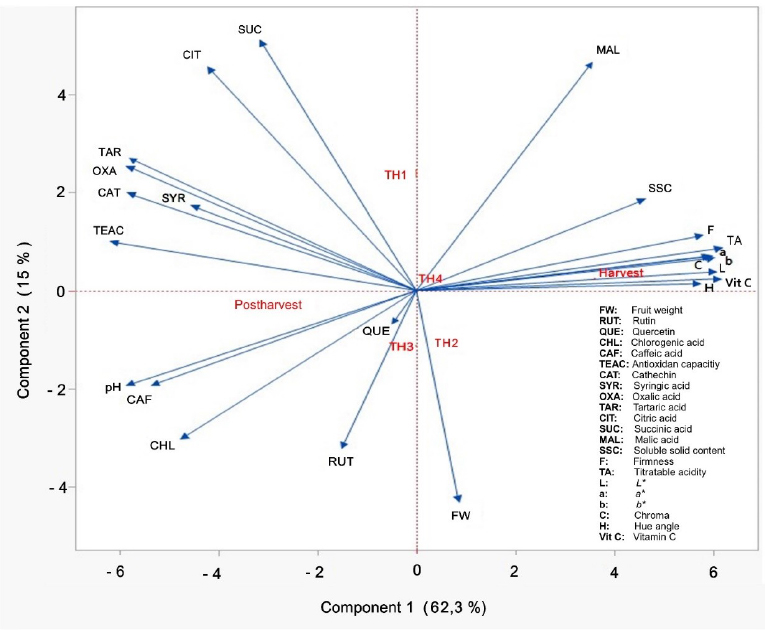
Fig. 1:
A visualization of biplot PCA for the relation between TH, harvest, postharvest and examined parameters. Red coloured variables represent the factors TH, harvest, and post-harvest, while black coloured variables represent the studied features.
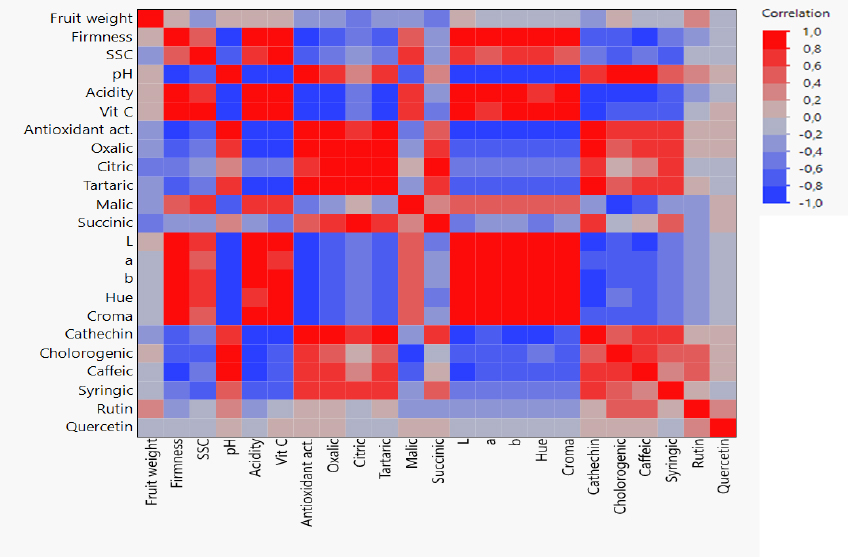
Fig. 2:
Correlation map visually illustrates interrelation between dependent variables. Red and blue colours reflect high correlation coefficient. Red colour indicates positive correlation and blue colour indicates negative correlation.
Conclusion
Most of evaluated fruit parameters were affected by different TH groups at harvest and after storage. Cherry fruits from TH2 exhibited the best quality after 30 days cold storage (+3), due to less fruit softening, proper acidity, and colour values (CIELab), low percent of weight losses, while TH4 showed satisfactory levels of SSC and Vitamin C. On the other hand, fruits of TH1 group were prominent in terms of antioxidant activity and organic acids at the end of cold storage. We suggested that the effects of different trunk hights on fruit quality, yield, and yield component at some training systems applied in both sweet cherry and other temperate fruit species should be investigated in more details for future studies.