
1. Introduction
Lamprophyre Clan Rocks (LCRs) are a diverse group of small volume, mantle-derived, volatile-rich, mafic-ultramafic, melanocratic, alkaline igneous rocks. They are characterized by a typical porphyritic panidiomorphic (holocrystalline) texture consisting of hydrous mafic silicates (mica and amphibole) with feldspars confined to the groundmass (Kamvisis & Phani, 2022, 2023; Rock et al., 1991; Woolley et al., 1996). The main categories of lamprophyres are calc-alkaline, alkaline and ultramafic varieties (Pandey et al., 2017b; Rock, 1987; Rock et al., 1991). In addition to their significance in deciphering geochemical characteristics of mantle; geodynamic evolutionary processes of a region and petrogenetic modelling of sub-continental lithospheric mantle (SCLM) (Downes et al., 2005; Rock, 1977; Rock & Paul, 1989) lamprophyres also act as carriers of diamonds (Lefebvre et al., 2005).
Until now diamonds in economic quantities are well known only from kimberlites, orangeites and peri-cratonic olivine lamproites. However, diamond finds in lamprophyres, lamproites, picrites, and analogous volcanic rocks were intensely discussed several decades ago, but now undoubtedly appear as a common phenomenon.
Some important examples are Nunavut (Kaminsky & Sablukov, 2002a, 2002b; Kaminsky et al., 2002; MacRae et al., 1996), Northern Ontario (Stefano et al., 2006; Wyman et al., 2015), Northern Quebec (Birkett et al., 2004) provinces of Canada and Dachine area in French Guyana (Smith et al., 2016). Further, diamonds have recently been discovered in lamprophyres and associated heterolithic breccias of Archaean age in the Michipicoten Greenstone Belt (MGB), in the Wawa area, and within the Abitibi Greenstone Belt (AGB), in the Cobalt area. These lamprophyres were emplaced in heterolithic breccias of the AGB (Ayer & Wyman, 2003; Wyman, 2025). Also, diamonds have been reported from para-lamproites of China (Woolley, 2019; Xiang et al., 2020); diamondiferous minnette of Arkluilak (Kaminsky et al., 2000) and aillikites of Greenland (Hutchison & Frei, 2009). Further, some unconventional occurrences of diamonds have been reported from Borneo, the Urals, New South Wales, California, Burma, Thailand, Victoria, Tasmania, Ireland, the Appalachians, North Algeria and Sumatra. This clearly indicates that conventional models for the genesis of these rocks, which place their origin shallower than 120 km, must be revised (e.g., Foley et al., 2002). It is to be noted that calc-alkaline lamprophyres are derived from shallower upper mantle depths typically from spinel-lherzolite field from a depth of 80 km. Nevertheless, if diamonds are found in lamprophyres, their source depths may be much deeper. The Philippi area in Macedonia of Greece evidenced several diamonds, however no kimberlites or lamproites were discovered. Nevertheless, some lamprophyre dykes were identified leaving speculations that the source of diamonds could be lamprophyres (Kamvisis & Phani, 2023).
In India, LCRs can be found in different tectonic environments, including off-craton areas. Diamonds were reported from lamprophyres (minette) of Jharia Coal Fields (JCF), Bihar in northern part of India (Kumar et al., 2025; Rock et al., 1992). In the JCF, a suite of ultramafic lamprophyre, minette and lamproites of lamprophyric affinity were intruded at ∼100 Ma into thick siliciclastic sequences deposited in five intracratonic basins which developed during Gondwana rifting in the eastern India (Jia et al., 2003). In the Eastern Dharwar Craton (EDC), lamprophyres occur all along the peripheries of Cuddapah Basin. The Prakasam Alkaline Province (PAP), Wajrakarur Kimberlite Field (WKF), western and northwestern parts of Cuddapah Basin within the EDC are important regions where several lamprophyres are reported. On the eastern flank of Cuddapah Basin, more than 100 lamprophyres occur within the PAP which were studied extensively by various researchers in the past three decades. Whilst the lamprophyres on the western margin of the Cuddapah basin have only been recently studied (Chalapathi Rao et al., 2020).
The mantle xenocrysts which act as indicator minerals in kimberlites are also found in lamprophyres which is an extremely rare phenomenon implying that lamprophyres are not an exception to host mantle xenocrysts that help not only in deciphering temperature and pressure conditions but also their diamond incidence. Cr-pyropes, Mg-olivine, Mg-picroilmenite, Cr-diopside were reported from minnette of Akuilak dyke system of North Western Territory (NWT) within the Churchill Province (Kaminsky et al., 2000). In India, for instance, Cr-diopsides have been reported for the first time in lamprophyre from Settupalle within the PAP (Sridhar et al., 2025). Cr-diopside xenocrysts entrained in the lamprophyre dyke have also been reported from Mysuru area in Western Dharwar Craton (WDC) which paves a path for extensive research (Raghuvanshi et al., 2022).
The lamprophyres on the southwestern margin situated in the WKF are believed to be cogenetic with the diamondiferous kimberlites (Chalapathi Rao et al., 2020). Extensive research has been carried out on various aspects such as geochemistry, petrology, diamond incidence, isotope studies, geodynamics, however, the diamond potentiality of lamprophyres has not been endeavored. Therefore, this investigation aims at raising few thoughts on the diamond potentiality of these rare and small volume rocks with the help of geochemical data.
2. Geological Setting
The Archaean Dharwar craton of the southern India is subdivided into the WDC and the EDC domains separated by NW–SE trending linear belt called Chitradurga Shear Zone bounded by Closepet Granite on the eastern side. (Meert & Pandit, 2015; Naqvi, 2005; Ramakrishnan & Vaidyanadhan, 2008). The Archaean lithology of EDC includes parallelly emplaced Late Archaean calc-alkaline granitoid belts, collectively called as Dharwar Batholith (2.5–2.7 Ga; Friend & Nutman, 1991; Meert et al., 2010). The granitoids comprise NW–SE to N–S trending schist belts that are intruded by syn- to post-tectonic felsic rocks (Chadwick et al., 2000). The Proterozoic is represented by the Cuddapah basin, mafic dyke swarms, lamproites and kimberlites of two different ages. The EDC is also cross-cut by a number of lamprophyre intrusions which are widely distributed in the eastern flank of the Cuddapah basin associated with syenite complexes, in the PAP (Leelanandam & Ratnakar, 1980; Madhavan et al., 1998; Ratnakar et al., 1992, 1996), with a few intrusions on the western and southwestern margins of the Cuddapah Basin within the WKF (Pandey et al., 2017a, 2017b) or as solitary occurrences in north and northwestern margin of the Cuddapah Basin (Chalapathi Rao et al., 2020; Meshram et al., 2015).
The EDC forms a favourable regime for emplacement of LCRs, the majority of which are distributed in the WKF (Phani & Raju, 2017; Phani & Sengupta, 2024; Smith et al., 2013). The EDC has recorded >150 kimberlites and related rocks distributed in different clusters known as WKF, Raichur Kimberlite Field (RKF), Narayanpet Kimberlite Field (NKF), Tungabhadra Kimberlite Field (TKF); and lamproite fields namely Krishna Lamproite Field (KLF), Ramadugu Lamproite Field (RLF), Vattikodu Lamproite Field (VLF), Somasila Lamproite Field (SLF), Chelima Lamproite Field (CLF), Banaganapalli Lamproite Field (BLF) (Phani & Sengupta, 2024).
In addition to kimberlites, there are lamprophyres intruding granites and greenstone belts in the WKF (Fig. 1). The WKF is further subdivided into Wajrakarur, Lattavaram, Anumpalli, Chigicherla, Kalyanadurgam, Brahmanapalli, Timmasamudram, Gooty kimberlite clusters (Phani, 2019). Some of the pipe rocks which were classified as Group-I kimberlites in the past were reclassified as lamproites in the light of enhanced understanding and few as ultramafic lamprophyres. The WKF is also intruded with several alkali syenites demonstrating heterogeneity of SCLM (Phani et al., 2020, 2021; Suresh et al., 2010).
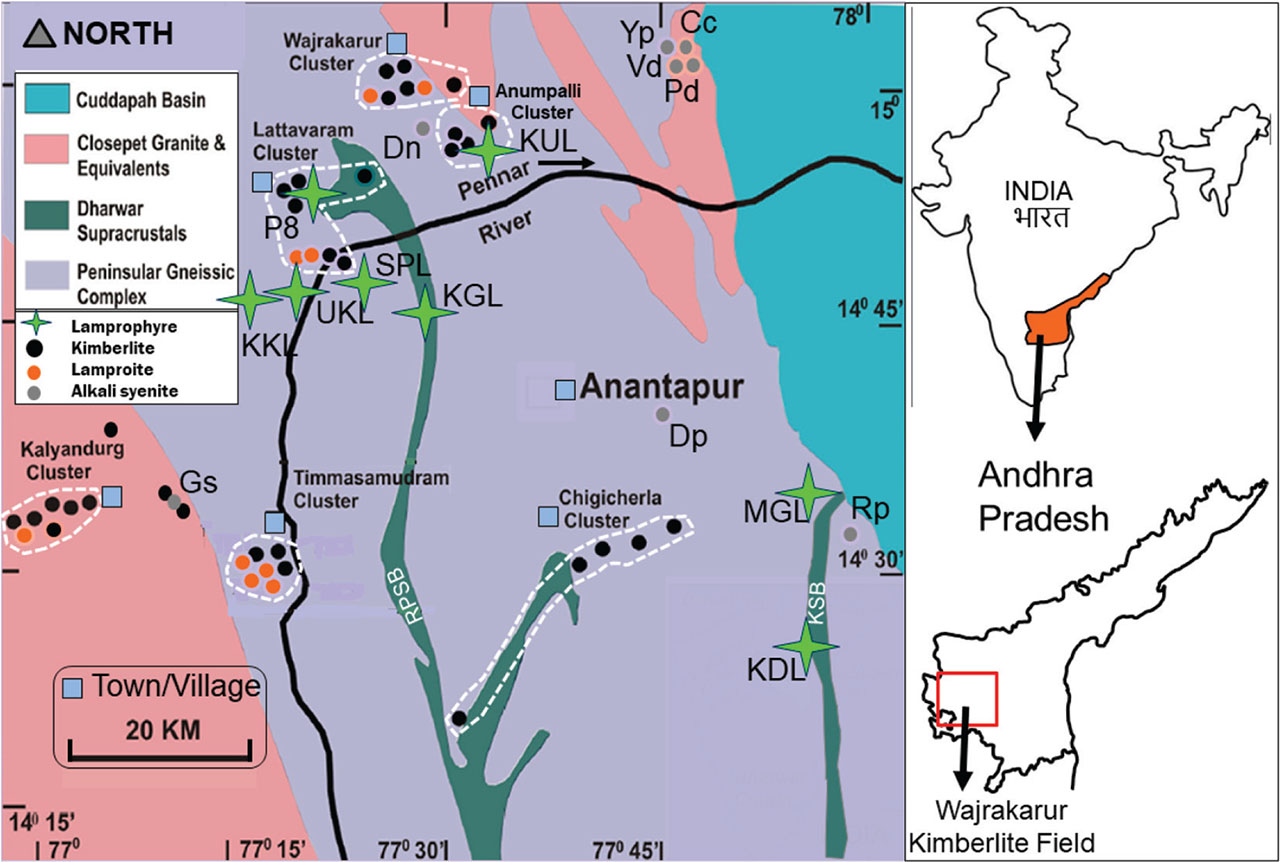
Figure 1.
Location of lamprophyres within the simplified geological map of WKF (modified after Nayak & Kudari, 1999) and disposition of various rare alkaline rocks. Lamprophyre outcrop abbreviations: KKL, Korrakodu (Raghuvanshi et al., 2019); SPL, Sivarampet (Khan et al., 2019; Phani et al., 2018); KGL, Kalagalla (Phani et al., 2020); MDL, Mudigubba (Pandey et al., 2017a); UKL, Udiripikonda (Pandey et al., 2017b); KUL, Khaderpet (Smith et al., 2013); P8, pipe 8 of Lattavaram (Phani, 2019). Alkali syenites (Suresh et al., 2010): Cc, Chintalacheruvu; Dn, Dancherla; Dp, Danduvaripalli; Vd, Vannedoddi; Pd, Pedavaduguru; Rp, Reddypalli; Yp, Yeguvapalli. Syenite- Gs- Golla (Phani et al., 2021); WKF, Wajrakarur Kimberlite Field.
2.1. Field and petrographic aspects
The field photographs, salient features and data sources are shown in Figure 2 and Table 1. The Korrakodu lamprophyre (KKL) is emplaced into younger Venkatapuram granitoids within the Peninsular Gneissic Complex (PGC). The lamprophyre is melanocratic showing porphyritic texture along with granitic xenoliths (Fig. 2a). The KKL suggests asthenospheric overprint on lithospheric mantle source with prominent indications for carbonatite metasomatism (Raghuvanshi et al., 2019).
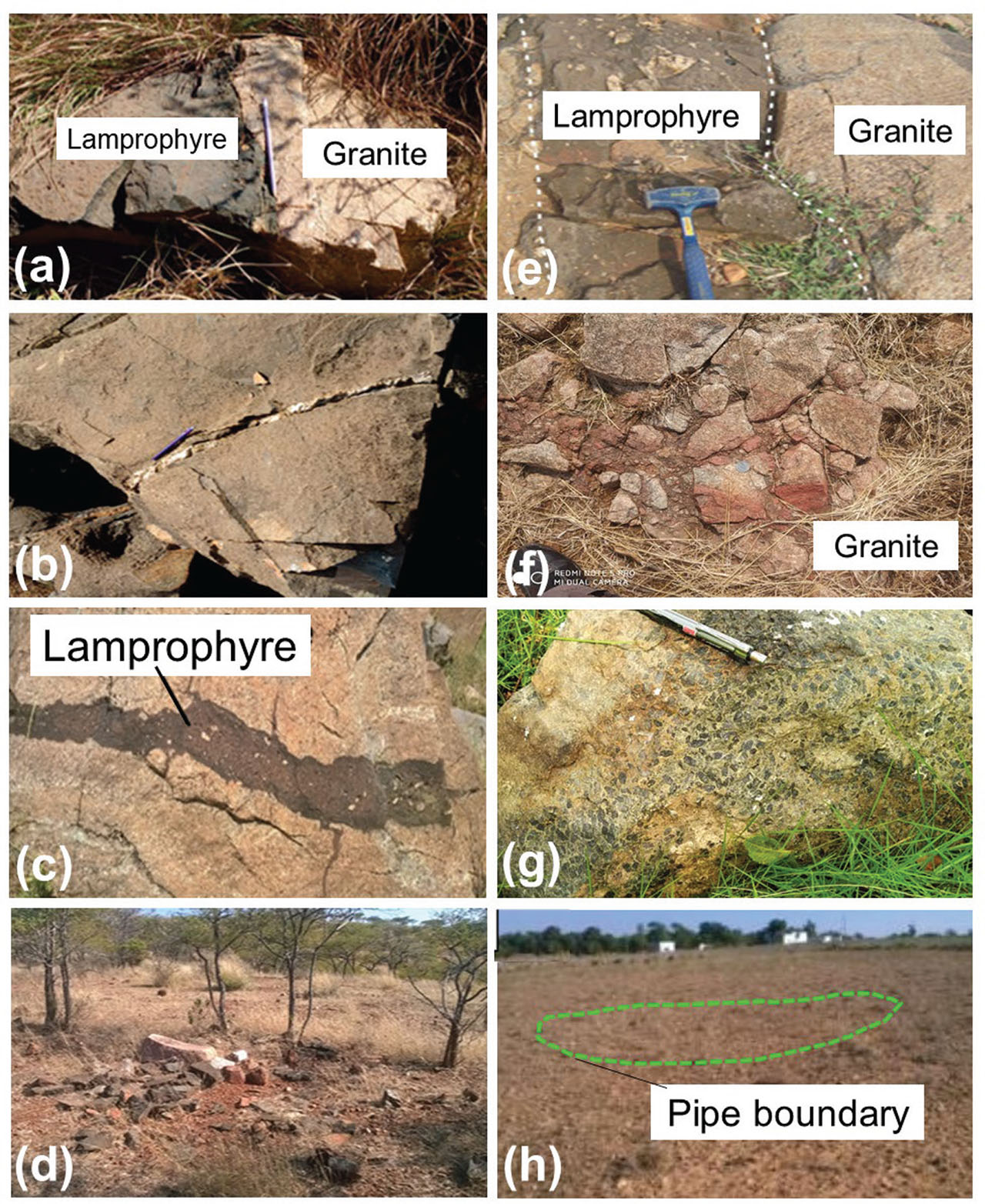
Figure 2.
Field photographs of lamprophyres of WKF. (a) Korrakodu (Raghuvanshi et al., 2019), (b) Kadiri (Pandey et al., 2018), (c) Sivarampet, (d) Kalagalla, (e) Udiripikonda (Pandey et al., 2017a, 2017b), (f) Khaderpet, (g) Mudigubba, (h) Pipe-8 (Lattavaram). See text for photo sources. WKF, Wajrakarur Kimberlite Field.
Table 1.
Some salient features of lamprophyres of WKF and data sources used in this study.
| Location | Outcrop | Mineral assemblage | Rock type | Reference |
|---|---|---|---|---|
| Korrakodu (KKL) | Dike | Dark mica (60%–70%) within groundmass of feldspars, sphene, apatite, carbonates, and zircon | Kersantite | Raghuvanshi et al. (2019) |
| Kadiri (KDL) | Dike | Amphibole (magnesio-hornblende), biotite and feldspar phenocrysts in groundmass of epidote, titanite and apatite | Spessartite | Pandey et al. (2018) |
| Sivarampet (SPL) | Dike | Pyroxenes, olivine and feldspar in groundmass of mica, ilmenite and secondary amphibole carbonate and chlorite | Kersantite | Phani et al. (2018), Khan et al. (2019), Pankaj et al. (2020) |
| Kalagalla (KGL) | Dike | Phlogopite-biotite, feldspar, amphiboles in fine grained felspathic pyroxene groundmass | Spessartite | Phani et al. (2020) |
| Udiripikonda (UKL) | Dike | Clinopyroxene megacrysts in olivine, mica in feldspathic groundmass | Kersantite | Pandey et al. (2017a, 2017b) |
| Khaderpet (KUL) | Plug | Olivine pseudomorphs altered to calcite or saponite, fine titanite in a saponite-carbonate or serpentine matrix. rare magnesiochromite with titanite rims | Ultramafic lamprophyre | Smith et al. (2013) |
| Mudigubba (MGL) | Dike | Amphibole, clinopyroxene, sphene, feldspar (albitised) | Spessartite | Pandey et al. (2017a, 2017b) |
| Lattavaram (P-8) | Pipe | Olivine, serpentinised olivine pseudomorphs, phlogopite, Cr-diopside, pyrope, chromite, ilmenite within groundmass of same composition | Ultramafic lamprophyre | Dongre et al. (2017) |
Three lamprophyre dikes occur at SSW of Kadiri (KDL), within the Kadiri Schist Belt. The rocks show porphyritic-panidiomorphic texture. Owing to their mineralogy, the rocks show calc-alkaline character (Fig. 2b). The dykes are free from xenoliths and exhibit mild deformation (Pandey et al., 2018).
Two lamprophyre dikes (MGL) occur at NNW side of Mudigubba (Kaul & Sisodia, 1976). The Sivarampet lamprophyre (SPL) occurs as a small intrusion emplaced within the PGC. The intrusion has no linear extensions confining to a small area and hence presumed to be a plug (Phani et al., 2018). The rock shows porphyritic-panidiomorphic texture (Fig. 2c). The lamprophyre exists in close proximity to Pipe-16 and Pipe-17 of Pennahobilam (Phani et al., 2023). Olivines are replaced by calcite with serpentinised rims. The rock shows glomeroporphyritic texture (Pankaj et al., 2020).
Thin dikes of lamprophyre occur at Kalagalla (KGL) emplaced in the greenschist rocks of Ramagiri-Penakacherla Schist Belt exposed in the walls of an old mine shaft excavated for gold mining. The boulders from excavation are piled upon surface (Fig. 2d) (Phani et al., 2020). The fine-grained rock shows pitted surface, the mineralogy and texture are obscured by metamorphism. The rock is classified as a calc-alkaline variety, spessartite (Phani et al., 2020).
A discontinuous lamprophyre dike is exposed towards west of Udiripikonda (UKL), emplaced within the granite-gneisses of the PGC (Ravi et al., 1998). The lamprophyre carries abundant clinopyroxene macrocrysts and is classified as calc-alkaline variety (Fig. 2e). Although this lamprophyre is co-spatial and coeval with the Wajrakarur kimberlites, the Udiripikonda lamprophyre shows a highly enriched mantle source that was modified by asthenospheric upwelling during the Mesoproterozoic (Pandey et al., 2017b).
The Khaderpet intrusion (KUL) is a unique association of ultramafic lamprophyre of aillikite affinity associated with carbonatite (sövite) (Chatterjee et al., 2008; Smith et al., 2013). The ultramafic rock crops out as a brecciated rock with angular fragments of crustal rocks resembling carapace of a tortoise (Fig. 2f). The cementing material of breccia is of ultramafic lamprophyric character on the surface; however, it grades into kimberlitic nature at depth which is confirmed by drilling (CRAE, 2004). The cementing material is dominated by olivine that is serpentinised and chloritized. The matrix to the breccia consists of calcite or saponite pseudomorphs after olivine and fine-grained titanite in a background of saponite-carbonate or serpentine. The rock contains pelletal lapilli made up of olivine pseudomorphs with rare magnesio-chromite at the core, and a matrix of saponite rimmed by fine titanite (Smith et al., 2013).
The Mudigubba lamprophyre (MGL) dikes show typical porphyritic-panidiomorphic texture with well-developed hornblende crystals (Fig. 2g). The MGLs are free from crustal xenoliths and proposed to be products of the post-collisional extension of the SCLM that was previously modified by subduction-related fluids (Pandey et al., 2017a).
The pipe-8 (P-8) of Lattavaram is of oval shape in surface morphology covering 0.5 ha area. The pipe is emplaced in the Archaean granitoids along EastNorthEast-WestSouthWest (ENE-WSW) fault that displaces Marutla Dome. The outcrop is expressed in scattered boulders of weathered serpentinised and carbonated melanocratic outcrops peeping through calcrete/soil cover for 1 m after which, hard and compact ultramafic lamprophyre is found. This pipe rock, classified as a Group-I kimberlite earlier, is now reclassified as an ultramafic lamprophyre owing to the presence of Ti-rich phlogopite, Ti-rich schorlomite garnet, high Na/K content in amphibole, Al- and Ti-rich diopside, a titanomagnetite trend in spinel and the presence of groundmass carbonates (Dongre et al., 2019). The rock contains ubiquitous olivine pseudomorphs with ferruginous stainings, crustal granite fragments giving rise to brecciated appearence (Fig. 2h).
3. Methodology
The cationic wt.% of Ti, K, Al and Fe were calculated from the published whole rock geochemical data of the WKF lamprophyres using the below standard formula.
The calculated cationic wt.% were plotted in various geochemical diagrams. The diamond grade (DG) values are calculated to understand the diamond prospectivity. Milashev (1965) proposed calculation of DG through an empirical equation using cationic wt.%, which is as shown below Eq. (1).
In addition, certain trace element data such as, Ta, Sc and Y (ppm) also has been considered from published literature.
4. Results and Discussion
4.1. Diamond indicator minerals in WKF lamprophyres
Diamond indicator minerals or kimberlite indicator minerals (DIMs or KIMs) in non-kimberlitic volcanic rocks could be the same as those present in kimberlites i.e., pyrope garnet, magnesiochromite; more rarely picroilmenite and Cr-diopside. Archean volcanic rocks such as lamprophyres can also contain these minerals in very small proportions (Kaminsky, 2007). KIMs are indicator minerals collected from surface samples such as stream sediments or loam which guide on presence of kimberlite while DIMs are same mineral species extracted from a known or identified kimberlite or LCR. DIMs act as path finders and guide the presence of exposed or concealed diamond source rocks or kimberlites in an area (Benz, 2006; McClenaghan, 2005; McClenaghan & Kjarsgaard, 2007; Muggeridge, 1995). Lamprophyres of WKF also recorded DIMs such as olivine, Cr-diopside, ilmenite, spinel, garnets and diamonds. In addition, few lamprophyres reported to contain titanite with high concentrations of light rare earth elements (LREE). However, in India, attempts to study the full suite of DIMs in lamprophyres of WKF or elsewhere, focused to assess their diamond potentiality through heavy mineral assemblages has not been exercised. Thus, data specific to KIMs in WKF lamprophyres is meagre or absent. Therefore, some insights from published literature pertaining to mineral chemistry available in some of the WKF lamprophyres is summarised here. Presence of DIMs in comparison with lamprophyres and kimberlites of WKF is shown Table 3. The DIMs in kimberlites and lamproites of WKF are studied in detail by various workers in diamond exploration (CRAE, 2004; Ravi et al., 2016). The results indicate that they can be very well used in depicting the possible diamond incidence and is demonstrated physically through assessment of drill core. Interestingly, in KUL and P-8 lamprophyres, diamonds are also reported, offering a wide scope to investigate lamprophyres at other locations of the WKF.
4.1.1. Chromite
In WKF lamprophyres, chromites are reported from KUL. The matrix of the KUL contains macrocrysts of Mg-chromite. The chromites show the characteristic twin “kimberlitic”-style trends of increasing Cr2O3, corresponding with a decrease in Al2O3, and a separate trend of TiO2 enrichment at lower Cr2O3 in the rims due to reaction with the aillikite melt (Smith et al., 2013).
4.1.2. Clinopyroxene
Generally, the clinopyroxenes (cpxs) in lamprophyres are characterized by high chromium oxide (Cr2O3) and sodium oxide (Na2O) contents, similar to those found in diamondiferous kimberlites (Brink, 1984; Stephens & Dawson, 1977). The presence of cpxs indicates similar depths of origin for both lamprophyre and kimberlite magma. In WKF lamprophyres, cpx is reported in MUL, SPL, UKL and KUL.
In MUL, cpx occurs as prismatic euhedral phenocrysts with depleted Al2O3 and TiO2 and showing diopsidic nature exhibiting a wide compositional variation. Its good correlation between Al and Ti shows the orogenic character (Pandey et al., 2017a, 2017b).
The SPL cpx also occurs in the form of prismatic euhedral phenocryst, occasionally twinned, zoned and often showing multiple growth aggregates. The cpx grains in SPL show plume-related origin similar to those of Deccan province with clear distinction from those of other Dharwar lamprophyres. They show a close chemical similarity to pyroxenes from shoshonitic lamprophyres with CaO of 12–21.5 wt.%. (Pankaj et al., 2020).
The UKL cpxs are also diopsidic in character exhibiting Mg-rich rims with reverse zoning composed of Fe- and Na- rich cores and Mg- rich rims (Pandey et al., 2017a, 2017b). The enrichment of Na in cores relative to the rims reflects their greater depth of formation i.e., mantle (Adam & Green, 1994). The presence of oscillatory zoning in UKL cpx, indicate multiple batches of melt unbalancing the equilibrium of magma chamber (Dongre et al., 2019).
Yet another lamprophyre, the KUL, contains Cr-diopsides in matrix with 2–5 wt.% Cr2O3 (CRAE, 2004; Smith et al., 2013).
The P-8 lamprophyre also recorded substantial populations of Cr-diopsides, which are Mg-rich with 16.33 wt.% MgO and low CaO (12.83 wt.%), SiO2-50.81 wt.% and Cr2O3-1.92 wt.% with enriched Fe2O3 (9.37 wt.%) (Ravi et al., 2016; Subba Rao, 1992).
4.1.3. Ilmenite
Ilmenites with high magnesium oxide (MgO) content and low iron (Fe3+/Fe2+) ratios suggest conditions favorable for diamond formation (Brink, 1984). In WKF, ilmenite is reported from SPL and KUL.
The SPL possesses unaltered ilmenite grains scattered in the groundmass. with TiO2 ranging from 51.81 wt.% to 50.28 wt.%; and FeO from 48.12 wt.% to 42.84 wt.% and very low MnO (1.33–3.42 wt.%), and Cr2O3 (0.14–0.20 wt.%) (Pankaj et al., 2020).
The KUL matrix of brecciated rock contains rare picroilmenite (CRAE, 2004; Smith et al., 2013).
In P-8 lamprophyre ilmenite occurs as Mg-variety occurring in minor quantity as small rounded to sub-rounded megacrysts (Ravi et al., 2016; Subba Rao, 1992).
4.1.4. Garnet
Garnets with high Mg and Cr, Cr-pyrope, which are grouped as G10, indicate deep mantle origin and hence indicate diamond incidence (Brink, 1984). In WKF, mantle derived pyrope garnets and Ti-poor andradite are reported from matrix of KUL and P-8 lamprophyres. The presence of andradite suggests its affinity with ultramafic lamprophyres (Rock et al., 1991; Tappe et al., 2006). The pyrope is predominantly lherzolitic (G9), but with a minor harzburgitic (G10) content (10%); 25% of the garnets are eclogitic (G3 and G4) (Smith et al., 2013).
The P-8 lamprophyre also reported pyrope garnets, classified as G9 variety (Ravi et al., 2016; Subba Rao, 1992). Garnets are not reported from other lamprophyres of the WKF.
In general, similar to lamprophyres, majority of the WKF kimberlites are dominated by lherzolitic (G9) varieties (CRAE, 2004). For example, in TK-4, the pyrope garnets are classified as lherzolitic (G9) (Chowdary et al., 2007).
The lack of garnet in SPL, indicated a shallow depth of melting than kimberlites of the WKF and hence thought to be formed from vertically heterogenous lithospheric mantle sources linked with thermal anomaly in a subduction environment (Khan et al., 2019).
4.1.5. Olivine
Olivine is the most important mineral in LCRs. It gives valuable information about depth and composition of mantle source region. Often, the olivine grains are zoned, providing information about magmatic evolution during the ascent of kimberlite. The aluminum content in olivine xenocryst cores can provide insights into the pressure and temperature conditions in the mantle, which are crucial for diamond formation (Abersteiner et al., 2022). In LCRs, olivine may be present as macrocrysts, phenocrysts, groundmass constituent and often contains xenocryst inclusions such as garnet, spinel, and clinopyroxene, which are ideal for drawing information on the processes of magma generation, transport, and eruption (Howarth et al., 2015). Olivine is found in lamprophyres namely SPL, UKL, KUL and P-8.
In SPL, olivine occurs as both macrocrysts and phenocryst. Although majority of the olivine grains are serpentinised, some pristine euhedral grains also exist. The grains lack compositional zoning reflecting their derivation from mantle peridotite and the grain boundaries possess polygonal cracks. The SPL olivine possesses a low Fo content in comparison with WKF kimberlites confining to mantle olivine array. (Khan et al., 2019; Pankaj et al., 2020). The olivine composition of SPL has similarity to that of Deccan volcanics. They show higher Mg# and fall in the upper limit of kimberlitic olivine (Khan et al., 2019).
In the UKL, the olivines are primary phenocrystic with Fo87–78 composition which is consistent with its CaO content with low Ni values i.e., <0.5 wt.% (Krmíček et al., 2016). The depletion of Ni in olivine is attributed to involvement of a peridotitic than pyroxenitic mantle source. However, the Ni content does not show correlation with Mg# indicating possible magma mixing in batch mode. Further, evolved nature of olivine evidenced by Fo% (78) shows olivine fractionation (Pandey et al., 2017a, 2017b)
In P-8 lamprophyre, the olivine of P-8 lamprophyre also has been studied. The olivine occurs as rounded megacrysts (1–15 mm) (Ravi et al., 1998; Subba Rao, 1992).
In WKF kimberlites and lamproites, olivine occurs in different types such as two generations i.e., macrocrystic and microphenocrysts in groundmass, lapilli and tuffisitic olivine. However, studies on olivine in WKF LCRs are sparse or nil, hence data on olivine is almost absent.
4.1.6. Spinel
Spinels also act as indicators for presence of diamond in LCRs and provide information on source region characteristic of LCR magmatism (Choudhary et al., 2020). In WKF lamprophyres, spinels are reported from UKL and P-8. In UKL, the spinels are classified as titanomagnetite, substantially enriched in both Fe2+/(Fe2++Mg2+) and Ti/(Ti + Cr + Al), and follow the trend-2 of Mitchell (1995). The spinels show the Fe-Ti trend of increasing Fe3+ and Fe2+ along with Ti due to fractional crystallisation of olivine and pyroxene in the melt (Barnes & Roeder, 2001; Pandey et al., 2017a, 2017b).
In Lattavaram P-8, spinels are rarely present as small subhedral crystals in the groundmass. Cr2O3 content in cores ranges up to 50 wt.%, Al2O3 up to 11.8 wt.%, TiO2 ranging from 0.67 wt.% to 6.32 wt.%. The spinels show a Cr depletion coupled with Fe-enrichment and define a titanomagnetic composition i.e., magmatic trend 2 which is common in ultramafic rocks and aillikites (Mitchell 1995; Tappe et al., 2006) as well as diamondiferous lamproites of Kaapvaal craton and other areas (Dongre et al., 2019).
In MGL, the presence of titanite crystals indicates a pre-existing Ca-rich metaluminous rock with higher oxygen activity which is a characteristic feature of calc-alkaline rocks (Frost et al., 2000).
4.1.7. Titanite
Titanite is not a primary DIM. However, it is present in lamprophyres sometimes; gives clues on the magmatic conditions and evolution. Titanite’s trace element composition reflects the temperature, pressure, and bulk composition of the magma from which it crystallized (Kohn, 2017). Among the WKF lamprophyres, KDL, and KGL contain titanite.
The KDL possesses titanite crystals within the groundmass carrying crystals carry rare earth elements (REEs) and high field strength elements (HFSEs). The Al2O3 and V2O3 content in the titanite ranges from 0.60 to 2.78 wt.% and 0.18 to 0.51 wt.%, respectively. The BaO content is also high in the titanite (1.09–1.33 wt.%) (Pandey et al., 2018).
In KGL, the titanites occur as irregular aggregates which are categorised as two types namely, (i) an Al- rich variety and (ii) a LREE and F- rich variety. (Phani et al., 2020).
4.1.8. Diamond
Diamond, the most obvious indicator of diamondiferous nature of an LCR, is reported from KUL (CRAE, 2004; Smith et al., 2013) and P-8 lamprophyres (Subba Rao, 1992).
4.2. Constraints of DIMs in lamprophyres
The DIMs in lamprophyres warrant a thorough trained eye as they are sparse and difficult to identify than those in kimberlites and lamproites. The identification of the DIMs is on one hand crucial aspect while on the other, confirming whether the lamprophyre is diamondiferous which requires detailed mineral chemistry of these grains than a traditional visual identification is also vital. The composition of DIMs plays a critical role in their classification than a traditional visual identification. Hence, comprehensive studies to recover, visually classify, determining their chemical composition through electron probe micro-analyser (EPMA) and their appropriate mineral classification in terms of diamond potentiality are certainly inevitable.
4.3. Diamonds in lamprophyres
Most natural diamonds are formed under high pressure within mantle rocks such as kimberlites and/or lamproites, where they interact with a deep-seated carbon-rich source (Shirey et al., 2013). Many factors influence the economic potential of LCRs including: (1) DG (i.e., the quantity of diamonds in a mass of the rock); (2) diamond quality, largely a combination of average diamond size recovered, clarity and colour; (3) size of the intrusive body; (4) local environment, including climate, local infrastructure and political stability (Kjarsgaard, 2007). With these complex factors, the estimation of the economic potential of a diamondiferous body is a very challenging task (Kjarsgaard, 2019).
The four Victory-Day dykes in Canada, pyropes of lherzolitic association (G9) and few picroilmenites and Cr-diopside were reported which led to the discovery of diamondiferous lamprophyres (Kaminsky et al., 2002). In the same area, the Thirsty Lake dyke samples revealed good results of diamond incidence- a 22 kg rock sample yielded 1509 micro- and 2 macrodiamonds; a 32.8 kg sample yielded 1157 micro- and 6 macrodiamonds and a 7.8 kg sample revealed 6677 micro- and 3 macrodiamonds with one stone of >1 mm in size. The average stone size varies from 0.8 mm to 0.5 mm with total estimated grade as 12 ct/ton. The Kyle Lake pipes, James Bay Lowlands, northern Ontario, suspected to be a type of lamprophyres, reported 0.6 ct/ton from 6.22 kg of rock sample. Aillikites in the Torngat Mountains, northern Quebec, recovered 2227 (>1 mm size) stones with 114 macrodiamonds (Kaminsky, 2007).
In India, comprehensive efforts to investigate the presence of DIMs and in turn diamonds in lamprophyres are yet to be exercised. The diamond potential of Gondwana lamprophyres and minnette of Jharia and Ranigunj was discussed (e.g., Basu et al., 1997; Rock et al., 1992). It should be admitted that no attempts for drilling the lamprophyres in particular, have been carried out for their detailed assessment. Therefore, it is very much necessary to carry out drilling followed by detailed assessment to test their diamond potentiality with the aid of latest diamond extraction methods such as caustic fusion. However, the KUL and the reclassified P-8, contain diamonds. The KUL yielded 58 stones from 485.8 kg of drill core material through caustic fusion process (CRAE, 2004). An assessment of a total of 1773 tonnes of rock material from 10 shallow pits over P-8 ultramafic lamprophyre has yielded 40 diamonds weighing 5.95 carats. This implies to ~0.5 cpht (Ravi et al., 2016; Subba Rao, 1992).
The WKF is a complex region where a variety of mantle derived diamondiferous alkaline, ultramafic, ultrapotassic rocks are emplaced. Extensive research and exploration have been carried out on diamondiferous kimberlites by various public and private organisations. However, no attempt has been made so far to assess the diamond potential of lamprophyres of the WKF or elsewhere in the country. The research carried out by many workers so far was focused on understanding the petrology, geodynamics and genetic significance to decipher the mantle systematics.
4.4. Geochemical aspects
The whole rock geochemical data and cationic wt. % data are shown in Table 2 in Table 2a and 2b respectively. The WKF lamprophyres are mostly calc-alkaline in character. The WKF lamprophyres are abundantly enriched in biotite and thus show elevated K2O content. The SiO2 vs MgO and Al2O3 vs TiO2 variations clearly show a mixed affinity to the global alkaline and calc-alkaline lamprophyres perhaps due to hybridisation. The Mg# ranges from 60 to 84 in WKF lamprophyres. The WKF lamprophyres host olivine and oscillatory zoned clinopyroxene phenocrysts that are silica-undersaturated. These clinopyroxenes show variable Ti content leading to their transitional or mixed orogenic - anorogenic geochemical behaviour, which is also reflected by their bulk-rock geochemistry. The U-Pb isotopic data of zircon using (Secondary Ion Mass Spectrometry (SIMS) provided an emplacement age 2511 ± 6.6 Ma for Udiripikonda lamprophyre, while the basement granites have an age of ~2.5 Ga (Khan et al., 2019). As the Udiripikonda dykes possess no cross-cutting relation, they are presumed to be coeval as they are emplaced in the vicinity of kimberlites, which is consistent with whole-rock Rb-Sr isochron age of 0.96 Ga. Trace element relations between Th/Yb, Nb/Yb, Mo/Pr, Ce/Pb and Nb/U along with abundant TiO2 content in these calc-alkaline lamprophyres show their affinity to the ocean island basalts (OIBs) (Khan et al., 2019; Pandey et al., 2017b).
Table 2.
Geochemical data of lamprophyres of WKF in comparison with Jharia lamprophyre.
| 2a. Representative major oxide compositions. | |||||||||
|---|---|---|---|---|---|---|---|---|---|
| KKL | KDL | SPL | KGL | UKL | KUL | MGL | P8 | Jharia | |
| SiO2 | 46.74 | 53.71 | 47.32 | 42.8 | 45.1 | 47.4 | 52.72 | 41.95 | 44.5 |
| TiO2 | 1.8 | 0.9 | 2.37 | 2.18 | 2.38 | 2.66 | 0.76 | 1.3 | 4.81 |
| Al2O3 | 17.64 | 12.24 | 13.94 | 9.02 | 14.19 | 7.51 | 9.14 | 5.18 | 8.38 |
| Fe2O3 | 8.52 | 10.32 | 9.89 | 16 | 11.27 | 8.47 | 7.05 | 0.1 | |
| MnO | 0.143 | 0.17 | 0.13 | 0.18 | 0.17 | 0.23 | 0.18 | 0.1 | 0.13 |
| MgO | 3.12 | 8.35 | 8 | 7.5 | 7.43 | 13.80 | 11.15 | 19.33 | 8.18 |
| CaO | 6.62 | 8.6 | 8.53 | 8.35 | 8.81 | 11.40 | 12 | 8.63 | 6.85 |
| Na2O | 3.32 | 2.49 | 3.1 | 1.1 | 2.1 | 1.43 | 2.21 | 0.35 | 0.33 |
| K2O | 6.63 | 1.31 | 3.09 | 3.73 | 4.73 | 0.83 | 1.13 | 0.57 | 5.52 |
| P2O5 | 0.95 | 0.28 | 0.48 | 0.43 | 0.67 | 0.28 | 0.37 | 0.3 | 1.6 |
| LoI | 3.42 | 1.52 | 2.7 | 8.54 | 2.37 | 10.9 | 1.58 | 14.5 | 10.88 |
| Total | 98.9 | 99.9 | 99.58 | 99.83 | 99.22 | 96.45 | 99.71 | 99.46 | 98.9 |
| Mg# | 63 | 60.2 | 58.24 | 77.4 | 62.39 | 71.5 | 76.8 | 84.5 | 62 |
| 2b. Selected cationic wt.% and trace element concentrations in ppm | |||||||||
|---|---|---|---|---|---|---|---|---|---|
| Location | Sample | Al | Fe | Ti | K | Na | Y | Ta | Sc |
| Karraokodu | KR1 | 9.33 | 6.62 | 1.08 | 5.5 | 1.64 | 22 | 6.2 | 9 |
| Karraokodu | KR2 | 9.55 | 6.08 | 1.08 | 5.41 | 1.87 | 22 | 6.1 | 9 |
| Karraokodu | KR3 | 9.16 | 6.63 | 1.08 | 5.52 | 1.57 | 4 | 6.3 | 9 |
| Karraokodu | KR4 | 9.49 | 6.6 | 1.02 | 5.42 | 1.59 | 25 | 6.3 | 7 |
| Kadiri | KD1 | 6.48 | 8.02 | 0.54 | 1.09 | 1.36 | 16 | 0.3 | 30 |
| Kadiri | KD2 | 6.48 | 7.51 | 0.45 | 1.79 | 2.35 | 15 | 0.3 | 29 |
| Kadiri | KD3 | 7.76 | 5.89 | 0.35 | 1.7 | 1.83 | 12 | 0.4 | 21 |
| Kadiri | KD4 | 7.31 | 6.96 | 0.47 | 1.57 | 1.40 | 15 | 0.3 | 25 |
| Sivarampet | SP1 | 6.77 | 7.07 | 0.97 | 2.97 | 1.40 | 22.33 | 2.12 | 15.82 |
| Sivarampet | SP2 | 6.19 | 6.74 | 1.02 | 2.82 | 1.31 | 24.5 | 2.32 | 13.2 |
| Sivarampet | SP3 | 6.99 | 7.79 | 0.9 | 2.66 | 1.42 | 25.3 | 2.34 | 14.45 |
| Sivarampet | SP4 | 6.78 | 7.16 | 0.97 | 3 | 1.56 | 22.33 | 2.12 | 14.82 |
| Kalagalla | KL1 | 4.77 | 8.24 | 0.71 | 2.27 | 0.82 | 17.3 | 2.01 | 17.09 |
| Kalagalla | KL2 | 6.25 | 7.38 | 0.72 | 2.16 | 0.67 | 12.5 | 1.89 | 16.4 |
| Kalagalla | KL3 | 6.46 | 8.56 | 0.72 | 2.49 | 0.66 | 15.7 | 1.94 | 15.8 |
| Kalagalla | KL4 | 5.45 | 8.21 | 0.84 | 2.15 | 1.29 | 17.04 | 2.04 | 15.5 |
| Udiripikonda | UD1 | 7.51 | 5.96 | 1.42 | 3.93 | 1.56 | 25 | 7.51 | 5.96 |
| Udiripikonda | UD2 | 7.07 | 5.95 | 1.37 | 3.96 | 1.27 | 23 | 7.07 | 5.95 |
| Udiripikonda | UD3 | 7.59 | 6.27 | 1.47 | 3.83 | 1.66 | 24 | 7.59 | 6.27 |
| Udiripikonda | UD4 | 7.62 | 3.15 | 1.44 | 3.46 | 2.08 | 25 | 7.62 | 3.15 |
| Khaderpet | KH1 | 0.68 | 2.74 | 0.4 | 0.68 | 0.31 | 9.15 | 1.3 | 6 |
| Khaderpet | KH2 | 0.78 | 2.74 | 0.33 | 0.78 | 0.53 | 9.65 | 1.3 | 8 |
| Khaderpet | KH3 | 0.8 | 2.78 | 0.41 | 0.8 | 0.37 | 10.9 | 2 | 8 |
| Khaderpet | KH4 | 1.11 | 2.66 | 0.32 | 1.11 | 0.74 | 13.8 | 1.8 | 8 |
| Mudigubba | MD1 | 4.84 | 8.47 | 0.46 | 0.41 | 1.63 | 16 | 0.1 | 54 |
| Mudigubba | MD2 | 5.13 | 7.49 | 0.4 | 0.65 | 1.87 | 15 | 0.1 | 50 |
| Mudigubba | MD3 | 4.4 | 7.6 | 0.4 | 0.38 | 1.59 | 17 | 0.1 | 56 |
| Mudigubba | MD4 | 4.1 | 7.66 | 0.41 | 0.47 | 1.57 | 17 | 0.1 | 55 |
| Pipe 8 | LV1 | 2.74 | 5.48 | 0.78 | 0.47 | 0.26 | 8.88 | 4.86 | 8.42 |
| Pipe 8 | LV2 | 2.75 | 5.79 | 0.82 | 0.5 | 0.33 | 9.7 | 5 | 10 |
| Pipe 8 | LV3 | 2.72 | 6.09 | 0.81 | 0.49 | 0.24 | 9.6 | 5.6 | 10 |
| Pipe 8 | LV4 | 2.7 | 5.87 | 0.08 | 0.48 | 0.33 | 10.2 | 4.9 | 10 |
| Jharia | JH1 | 4 | 8.24 | 3.58 | 4.31 | 0.69 | 41 | 11.4 | 21 |
| Jharia | JH2 | 2.6 | 7.66 | 1.97 | 3.42 | 0.19 | 26 | 0 | 11 |
| Jharia | JH3 | 3.46 | 7.32 | 2.94 | 4.01 | 0.5 | 35 | 7.01 | 40 |
| Jharia | JH4 | 3.66 | 7.31 | 3.47 | 3.92 | 0.56 | 40 | 0 | 24 |
[i] See Table 1 for data sources.
In due course of prospecting, if any LCR is discovered, its DIM populations are to be assessed for their chemistry which is used to envisage the diamond potential and in turn diamond incidence of each lithological facies is ascertained through analysis of samples collected from multidirectional drilling. The drill core or chip samples are subjected to latest methods like ‘caustic fusion’ to determine the diamond incidence in each facies (Rombouts, 2003). As it is a costly affair, many exploration geologists adopt geochemical approach for an initial diamond assessment. A number of geochemical components such as K2O/Na2O ratio (Krutoyarsky, 1959), the elevated concentrations of Cr and Mg and the decreased concentrations of Ti, Fe, and Al were considered as gauges of diamond potentiality of an LCRD KIMs such as magnesiochromite, Cr-diopside, pyrope, olivine, picroilmenite etc. in the LCRs (Muggeridge, 1995).
There are several geochemical indices which were used to predict diamond incidence. Exploration geologists adopt several techniques to envisage the diamond potentiality of positive catchment areas and interesting geological samples from the preliminary prospecting. Mantle xenocryst minerals which are called as KIMs are most common material to assess diamond potentiality of a catchment where stream or gully sediments are collected. The positive mineral chemistry results through EPMA represented by presence of KIMs plotting in ‘diamond inclusion’ field reflect initial diamond incidence (Oliver et al., 2011; Rombouts, 2003).
Certain elements such as Ni, Cr, Ba, Co, Sr, Rb, Nb, Mg, Ta, Ca, Fe, K, Ti and REE indicate the presence of kimberlite or LCR in a terrain (McClenaghan & Kjarsgaard, 2007). Birkett et al. (2004) had used trace elements to distinguish ‘prospective’ and ‘non-prospective’ kimberlites. A minimum of 45 ppm of Nb in soil indicates possible presence of a kimberlite in the near vicinity (Phani, 2019).
The cationic wt.% and the geochemical data were plotted in various geochemical diagrams to ascertain the diamondiferous nature of the lamprophyre rocks of the study area. The bivariant diagram between K and Al shows that KUL and P-8 samples are ‘diamondiferous’ while the rest of the lamprophyre samples plot in the ‘few + no diamonds’ field (Fig. 3a). In the Ti vs K diagram, in addition to KUL and P-8 samples, Mudigubba samples also plot in the ‘diamondiferous’ field while the rest of the samples plot in the ‘few + no diamonds’ field (Fig. 3b). In the Ti vs Al diagram the majority of the samples plot in the ‘few + no diamonds’ field except KUL and P-8. The MGL samples position in the border of ‘diamondiferous’ and ‘few + no diamonds’ fields reflecting possibility of diamond incidence. (Fig. 3c). In the K vs Fe diagram, majority of the WKF lamprophyres plot in the ‘few + no diamonds’ field. However, KUL and P-8 samples along with Mudigubba samples show ‘diamondiferous’ character (Fig. 3d). Even though the Jharia lamproite samples are reported to be diamondiferous, they plot in the ‘few + no diamonds’ or ‘no diamonds’ field in these diagrams.
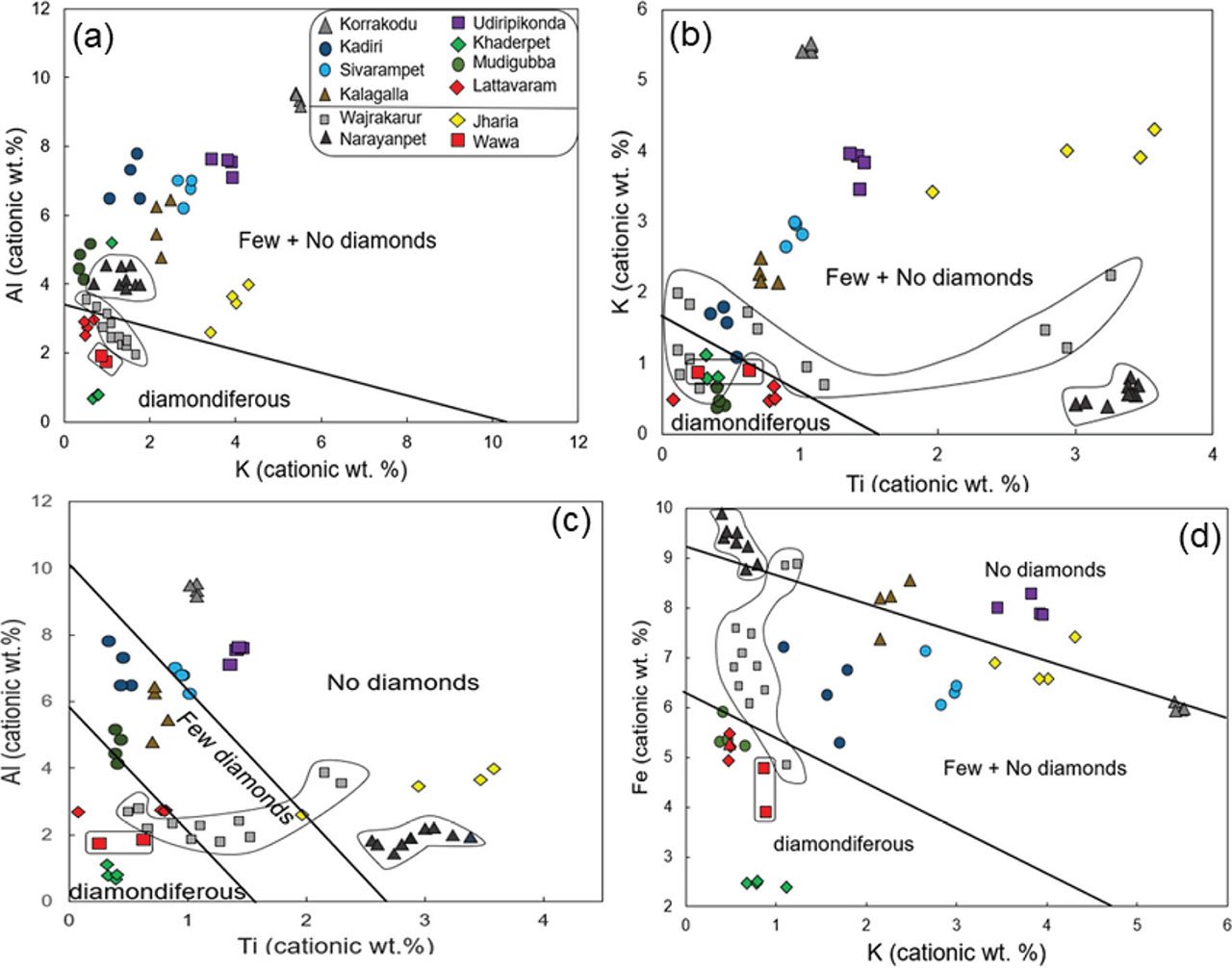
Figure 3.
Geochemical diagrams plotted using cationic wt.% (Ilupin & Lutz, 1971; Ilupin et al., 1974). (a) K vs Al diagram, (b) Ti vs K variation diagram, (c) Ti vs Al diagram, (d) K vs Fe diagram. Data used for comparison: Wajrakarur diamondiferous kimberlites (Phani & Raju, 2017), Narayanpet barren kimberlites (Dongre and Chalapathi Rao, 2012), Wawa diamondiferous lamprophyre (Lefebvre et al., 2005).
It can be observed from the cationic wt.% diagrams that majority of kimberlites plot in the ‘diamonds’ field, along with diamondiferous lamprophyres of Wawa while two kimberlites namely P-5 and P-13. The barren kimberlites of Narayanpet clearly plot in the ‘no diamonds’ field. This reflects that these plots are quite useful in assessing the possible diamondiferous nature of WKF lamprophyres.
In the Ta vs Sc plot, the KUL and P-8 samples plot in the field of ‘diamondiferous Al-kimberlites while rest of the samples are outside the prospective field (Fig. 4a). This variation diagram differentiates all other lamprophyres from KUL and P-8 ultramafic lamprophyres. The Narayanpet kimberlites plot in the ‘Fe-Ti barren kimberlites’ field.
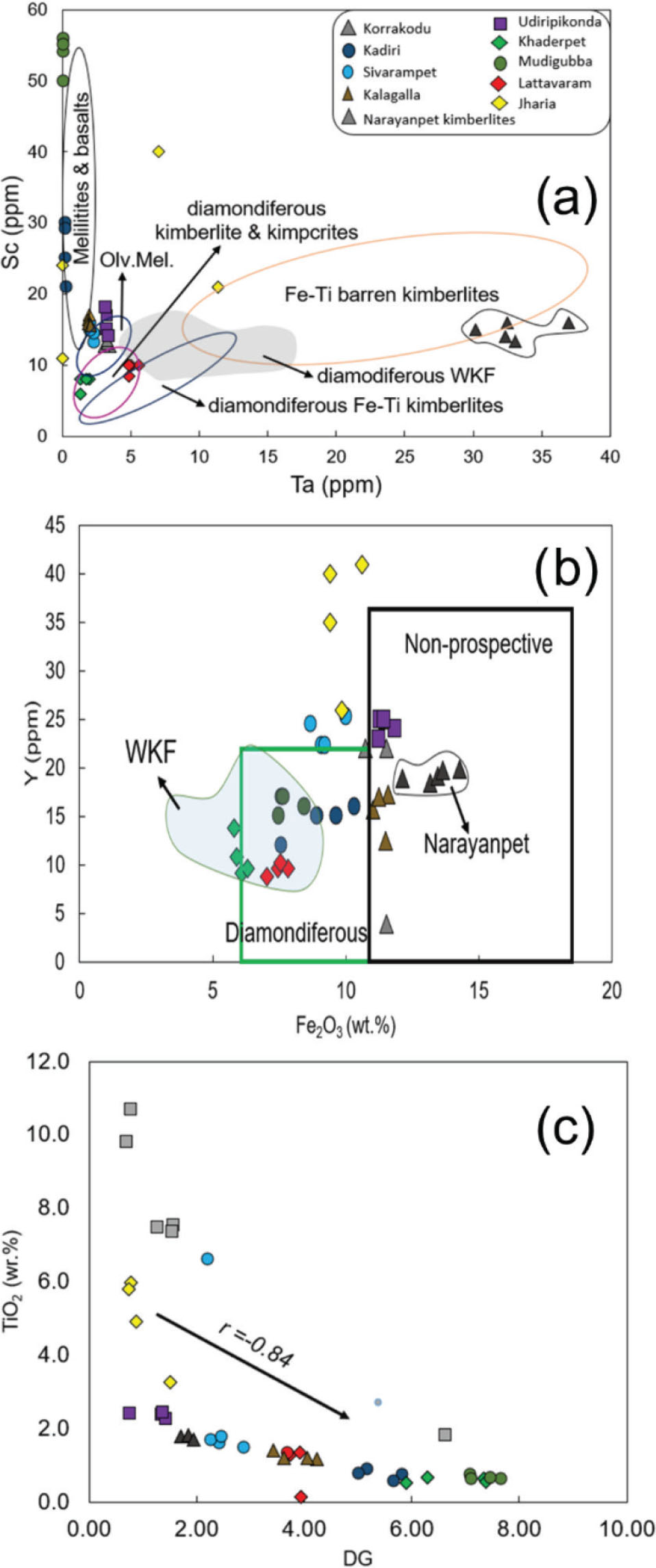
Figure 4.
Geochemical diagrams showing diamondiferous character of WKF lamprophyres. (a) Ta vs Sc variation diagram (Kaminsky et al., 2005) showing lamprophyres in comparison with other rock types. (b) Fe2O3 (wt.%) vs Y (ppm) diagram showing distinction between diamondiferous (prospective) and barren (non-prospective) kimberlites (Birkett et al., 2004). (c) Bivariant diagram between DG and TiO2 (wt.%) for lamprophyre samples of WKF showing inverse relation. Data for WKF kimberlites from Phani (2019). DG, diamond grade; WKF, Wajrakarur Kimberlite Field.
The Y vs Fe2O3 diagram shows that lamprophyre samples of KUL and P-8 plotting in the ‘prospecting’ zone (Fig. 4b). The diamondiferous kimberlites of WKF also plot in the ‘prospective’ zone. The Narayanpet kimberlites plot in the ‘non-prospective’ zone.
The ratio of cationic weight percentages of iron and titanium (Fe:Ti) plays a major role in diamond content of a kimberlite (Milashev, 1965). The DG values calculated for the WKF lamprophyres are shown Table 3. The petrochemical criterion for diamond is mainly governed by the inverse correlation of TiO2 and FeOT. Higher the TiO2, lower is the diamond content (Krivonos, 1999; Milashev, 1965). This is also evident in the lamprophyres of the present study. The TiO2 vs DG variation diagram clearly reflects that in KUL, MGL and KDL samples, the DG values are high (>5) with relatively less TiO2 content (Table 4). Thus, the bivariant plot between DG and TiO2 shows a strong inverse relation (r = −0.84). As TiO2 is increased, the DG values decrease (Fig. 4c). This aspect is consistent with the results of whole rock geochemistry of WKF kimberlites (Chalapathi Rao & Srivastava, 2009).
Table 3.
Summary of certain DIMs in lamprophyres in comparison with kimberlites and lamproites of WKF.
| Locality | CHR | CrDi | ILM | GRT | OLV | SPN | TTN | DIA |
|---|---|---|---|---|---|---|---|---|
| Lamprophyresa | ||||||||
| Korrakodu (KKL) | ||||||||
| Kadiri (KDL) | ||||||||
| Sivarampet (SPL) | X | X | X | |||||
| Kalagalla (KGL) | X | |||||||
| Udiripikonda (UKL) | X | X | X | |||||
| Khaderpet (KUL) | X | X | X | X | X | X | X | |
| Mudigubba (MGL) | X | |||||||
| Lattavaram (P-8) | X | X | X | X | X | X | ||
| Kimberlites and lamproitesc | ||||||||
| Muligiripalli (P-5) | X | X | X | X | X | X | X | X |
| Tummatapalli (P-13) | X | X | X | X | X | X | X | |
| Pennahobilam (P-16) | X | X | X | X | X | X | X | |
| Pennahobilam (P-17)e | X | X | X | X | X | X | X | |
| Lattavaram (P-4) | X | X | X | X | X | X | X | X |
| Venkatampalli (P-7) | X | X | X | X | X | X | X | X |
| Timmasamudram (TK-4)b | X | X | X | X | X | X | X | X |
| Chigicherla (CC-5) | X | X | X | X | X | X | X | X |
| Brahmanapalli (B1)d | X | X | X | X | X | X | X | X |
Table 4.
TiO2 and DG values of lamprophyres of WKF in comparison with kimberlites.
| Location | DG | TiO2 |
|---|---|---|
| Karraokodu | 1.85 | 1.80 |
| Karraokodu | 1.7 | 1.805 |
| Karraokodu | 1.86 | 1.81 |
| Karraokodu | 1.95 | 1.71 |
| Kadiri | 5.16 | 0.9 |
| Kadiri | 5.82 | 0.75 |
| Kadiri | 5.66 | 0.59 |
| Kadiri | 5.01 | 0.79 |
| Sivarampet | 2.43 | 1.62 |
| Sivarampet | 2.26 | 1.7 |
| Sivarampet | 2.87 | 1.5 |
| Sivarampet | 2.47 | 1.79 |
| Kalagalla | 4.25 | 1.18 |
| Kalagalla | 3.63 | 1.2 |
| Kalagalla | 4.06 | 1.2 |
| Kalagalla | 3.43 | 1.4 |
| Udiripikonda | 1.36 | 2.38 |
| Udiripikonda | 1.43 | 2.28 |
| Udiripikonda | 1.37 | 2.45 |
| Udiripikonda | 0.75 | 2.41 |
| Khaderpet | 7.35 | 0.66 |
| Khaderpet | 7.39 | 0.55 |
| Khaderpet | 6.3 | 0.68 |
| Khaderpet | 5.9 | 0.53 |
| Mudigubba | 7.08 | 0.76 |
| Mudigubba | 7.10 | 0.66 |
| Mudigubba | 7.65 | 0.66 |
| Mudigubba | 7.46 | 0.69 |
| Pipe 8 | 3.74 | 1.3 |
| Pipe 8 | 3.69 | 1.36 |
| Pipe 8 | 3.93 | 1.35 |
| Pipe 8 | 3.94 | 0.133 |
| Jharia | 0.77 | 5.97 |
| Jharia | 1.52 | 3.28 |
| Jharia | 0.88 | 4.91 |
| Jharia | 0.74 | 5.79 |
| WKF Kimberlitesa | ||
| Pipe-3 | 7.54 | 1.58 |
| Pipe-4 | 7.37 | 1.56 |
| Pipe-5 | 2.73 | 5.36 |
| Pipe-7 | 10.68 | 0.79 |
| Pipe-9 | 9.8 | 0.71 |
| Pipe-10 | 6.62 | 2.2 |
| Pipe-11 | 7.48 | 1.27 |
| Pipe-13 | 1.82 | 6.62 |
| Pipe-16b | 1.7 | 4.5 |
Chalapathi Rao (2008) opined that lamprophyre of PAP are non-diamondiferous due to their shallow derivation, primitive and evolved nature. In case of lamprophyres and olivine lamproites of Bokaro Coalfields also, rarity of harzburgite nodules and absence of garnets reflect shallower source (Basu et al., 1997) while Jharia minnette have reported diamonds (Rock et al., 1992. However, the WKF lamprophyres possess a different geochemical signature and have cogenetic origin with kimberlites of the region. The SPL is derived from a shallow (~100 km) depth which is supported by absence of garnet. Yet, the presence of extractable diamonds in KUL and P-8 lamprophyres infers that lamprophyre magmatism in this region has deeper source regions similar to diamondiferous kimberlites of this region. The presence of diamonds in KUL and P-8 lamprophyres implies their petrological significance representing closure of a magmatic cycle in this igneous domain (Rock, 1977). The lamprophyres of EDC share similar petrogenetic processes to those of kimberlites and lamproites (Chalapathi Rao, 2008). The observations of this study using geochemical plots, DG values and field exploration results, it can be stated that the WKF lamprophyres deserve a comprehensive study in terms of their diamond potentiality. The presence of diamonds in KUL and P-8 also gives a clue on their deeper derivation and portrays an evolutionary history of underlying mantle that requires a revisit.
5. Conclusions
Diamondiferous nature of eight lamprophyres of the WKF was attempted using geochemical data for the first time. Cationic wt.% calculated from whole rock geochemical data has been utilized for this purpose. The Khaderpet, Lattavaram, Mudigubba and Kadiri show diamondiferous nature while the rest of lamprophyres namely Korrakodu, Kalagalla, Udiripikonda and Sivarampet show ‘non-diamondiferous’ character. The Lattavaram (Pipe-8) which is reclassified from kimberlite to aillikite has a DG value of 3.84, however, proved diamondiferous as per drilling results. The DG values calculated in this study show that the Khaderpet, Mudigubba and Kadiri show higher values, i.e., 6.73, 7.32 and 5.42 respectively. The Khaderpet and Lattavaram rocks are already proven as diamondiferous. Therefore, in view of proven diamondiferous nature of some of these lamprophyres, detailed assessment of diamond incidence in rest of the lamprophyres, especially Mudigubba and Kadiri is necessary. An elaborative first-hand assessment of indicator minerals present in lamprophyres to evaluate and validate whether they can act as guides to their diamond potentiality is warranted. If these lamprophyres are proven to be diamondiferous, the understanding of petrology of SCLM and in turn mantle systematics beneath this part of the EDC will warrant a revision.
Acknowledgements
PRCP thanks Cyient Limited for support. The opinions in this article are those of the authors and not necessarily of the affiliated organisation. Thanks are due to the anonymous reviewers for their critical comments, which immensely enhanced the manuscript content and quality. This work did not receive any financial aid from any individual, agency, or organization.