
1. Introduction
Volcanic rocks in the Pieniny Klippen Belt (PKB) of the Western Carpathians have been the focus of geologists for over a century (e.g. Uhlig, 1890; Morozewicz, 1921; Małkowski, 1921), although their age and tectonic setting are still a matter of debate. In addition to common Miocene volcanism in PKB, infrequent occurrences of Cretaceous volcanic rocks are also present, including basalts at Hanigovce (Eastern Slovakia; Spišiak & Sýkora, 2009) and Biała Woda (Southern Poland; Oszczypko et al., 2012), as well as peperites at Vršatec (Western Slovakia; Spišiak et al., 2011), Velykyi Kamenets, and Vilkhivchyk (Western Ukraine; Krobicki et al., 2019). In this short communication, we report the first in situ U-Pb zircon ages of peperites from Vršatec and discuss their implications for future studies on PKB and the Carpathians in general.
2. Geological settings
The Pieniny Klippen Belt is a long complicated zone positioned at the boundary between two major parts of the Carpathian orogenic system, namely the Internal and External Western Carpathians (Fig. 1). It is a mélange-like zone, formed by sedimentary cover rocks of a former terrain called Oravicum and also by tectonic units derived from the Central Western Carpathians. Rocks of the PKB were formed during approximately 135 My of sedimentation. However, its effectual name, the Pieniny Klippen Belt, is owed to its subsequent tectonic evolution, as during the Alpine orogeny when the southern Penninic Piemont-Ligurian Ocean was closing, the sedimentary units were detached from their substratum and thrust over each other. Subsequently, transpressional and transtensional tectonic regimes disintegrated the thrust sequences into blocks, which resulted in its current configuration where the harder Upper Jurassic to Lower Cretaceous limestone klippen are surrounded by Lower Jurassic and Upper Cretaceous to Paleogene marls, shales and flysch deposits (Andrusov, 1945; Birkenmajer, 1977; Plašienka, 2012a; Plašienka et al., 2020). The PKB can be generally divided into two major groups. The emblematic Oravic units (Maheľ, 1980) with paleogeographical position of the sedimentary basin interpreted as an intra-oceanic continental ribbon, rimmed from both sides by oceanic domains – the South Pennine Piemont – Váh and the North Pennine Valais – Rhenodanubian – Magura oceanic realms (Plašienka, 2003, 2012b, 2018 and references therein). The Oravic units are represented by the Pieniny, Subpieniny and Šariš Unit. The non-Oravic units also called the “Periklippen Zone” (Maheľ, 1980) consist of the Drietoma, Klape and Manín units, which are rather affiliated with the Central Western Carpathians (Plašienka, 1995, 2012a; Plašienka et al., 2020).
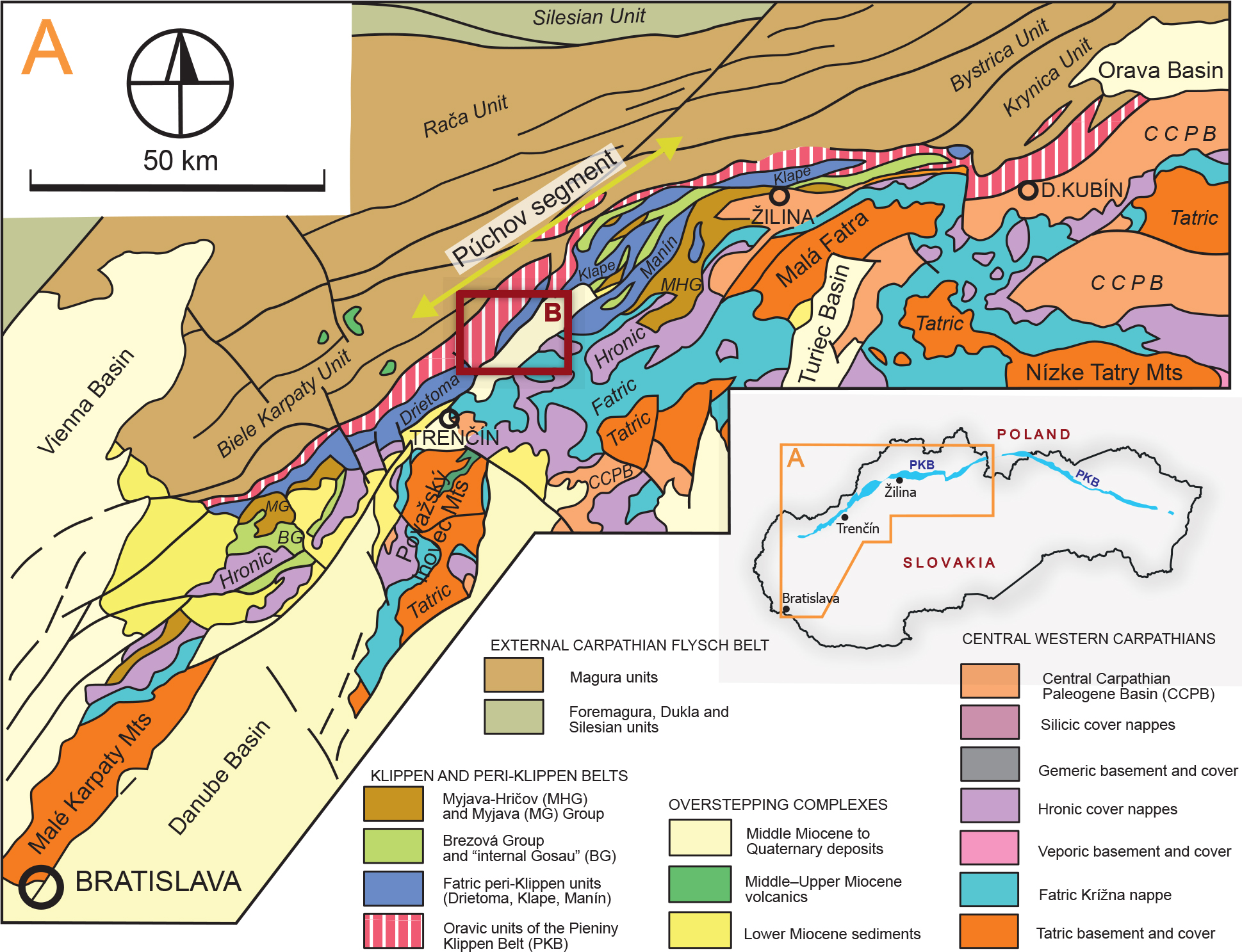
Figure 1.
General geological sketch of the northwestern part of the Western Carpathians (after Plašienka 2015, modified; orange polygon A) showing the position of the study area (red rectange B - Figure 2).
The lithological composition of the studied area around Vršatecké Podhradie (Fig. 2) mainly consists rocks from the Oravic units, which form a complex fold-fault structure. In the NW, the Šariš Unit is represented by calcareous sandstones of the Jarmuta and Proč Formation (Upper Cretaceous – Paleogene). To the SE, a thrust sheet of the Kysuca Succession (Pieniny Unit) follows, represented from the bottom by spotted limestones of the Harcygrund Formation, followed by green to red Czajakowa radiolarites. Younger red nodular limestones of the Czorsztyn Formation then continue in pinkish allodapic and bioclastic Horná Lysá limestones (Mišík et al., 1996). These are overlain by variegated marlstones of the Lalinok Formation.
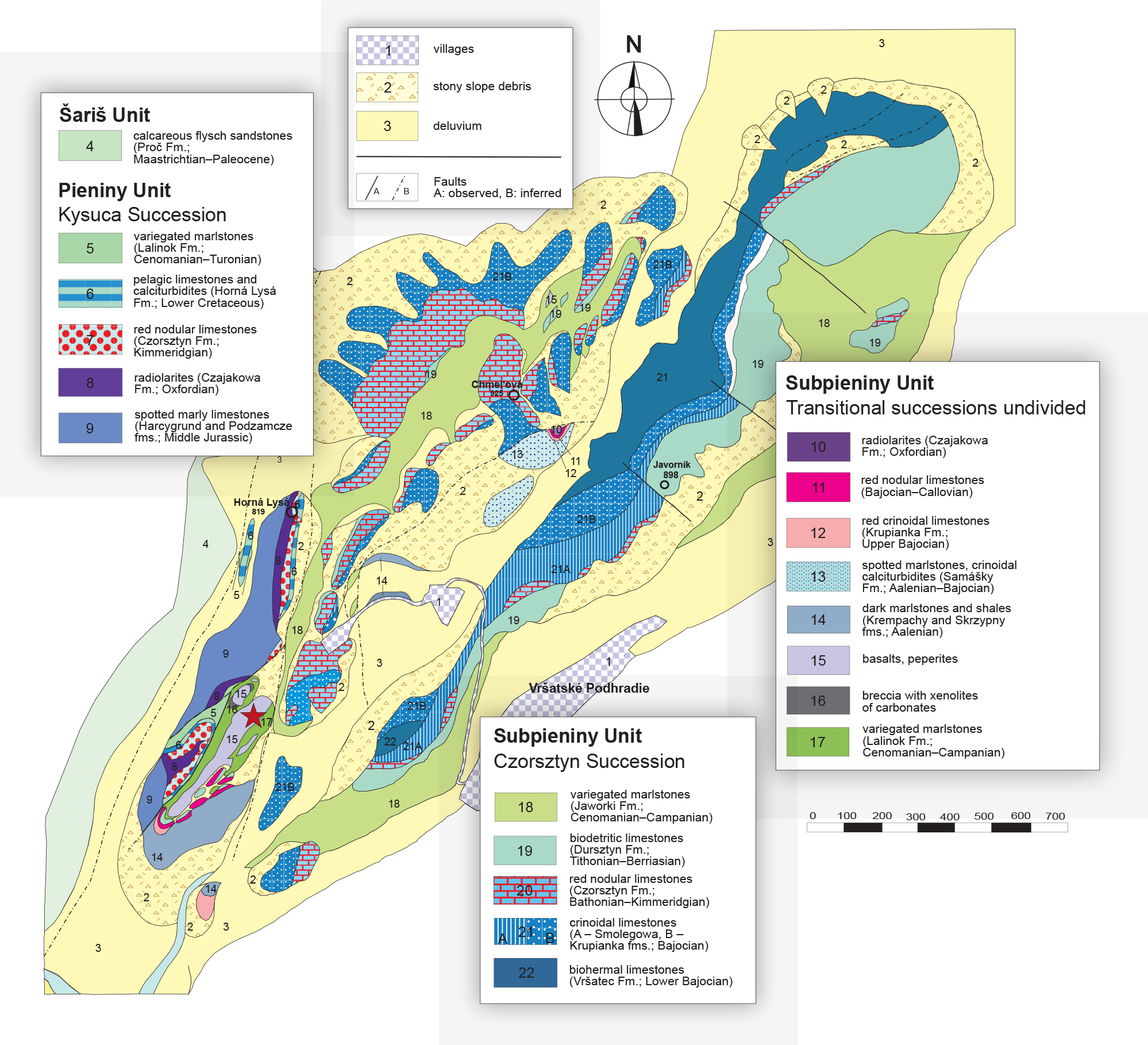
Figure 2.
Geological map of the Vršatec Klippen area (after Schlögl et al., 2009, modified) showing the position of the studied peperit (red star).
The most widespread unit in the area is the Subpieniny Unit comprising the transitional successions and the shallow water Czorsztyn Succession. The transitional successions crop out in two separate sheets that slightly differ from each other (Bučová et al., 2010). The first transitional unit can be associated with the Niedzica/Pruské Succession and it contains Aalenian dark shales and marlstones of the Krempachy and Skrzypny formations, followed by spotted marlstones with intercalations of sandy crinoidal limestones and spongolites of the Samášky Formation (Aubrecht & Ožvoldová, 1994). Subsequent Krupianka crinoidal limestones and nodular limestones of the Niedzica Formation are overlain by the Oxfordian radiolarites (Czajakowa Formation). The second transitional sedimentary succession cannot be assigned to any typical Oravic successions described in the literature so far (Bučová et al., 2010; Spišiak et al., 2011). It contains dark grey spotty limestones with intercalations of sandy crinoidal limestones which resemble either the Samášky Formation from the Pruské Succession (Aubrecht & Ožvoldová, 1994), or the Flaki Formation known from the Branisko (Kysuca) Succession (Birkenmajer, 1977). This member is overlain by radiolarites of the Sokolica and Czajakowa formations, followed by red nodular Czorsztyn limestones. The succession continues as the Horná Lysá limestones and the youngest member is represented by red marlstones of the Lalinok Formation. The Czorsztyn Succession is exemplary in the area around the Vršatecké Podhradie, where it also forms the vivid „dragon back“ Vršatec klippen, which are conspicuous from a distance. The klippen of the Czorsztyn Succession are in an overturned stratigraphic position (Bučová et al., 2010). The oldest member of this succession is represented by the Aalenian to Bajocian dark hemipelagic shales and marlstones (Skrzypny and Krempachy formations), followed by massive, white bioherm limestones (Vršatec Formation) of most probably Lower Bajocian age (Schlögl et al., 2006). These are followed by the white crinoidal Smolegova limestones and red crinoidal Krupianka limestones (Birkenmajer, 1977). In the overburden, typical “ammonitico rosso” limestone (Czorsztyn Formation) occurs, followed by pink biodetritic limestones of the Dursztyn Formation and by the youngest (Cenomanian – Campanian) variegated marlstones of the Jaworki Formation (“Púchov marls”).
The complicated structure of the PKB is underlined by the presence of volcanic rocks, which may provide significant information about the evolution of the western Púchov segment of the PKB (Fig. 1). Bodies of basic volcanic rocks were discovered in several localities within/overlaying the couches rouges type marlstones of the Lalinok Formation (Bučová et al., 2010), showing occasional thermal contact aureoles with the marls (Spišiak et al., 2008, 2011). Volcanic bodies consist of peperites corresponding to foidites and basalts. The textures are inhomogeneous, close to hyaloclastites or breccias containing a matrix with clasts of volcanic rocks or limestones. The main minerals in the volcanic clasts are clinopyroxene (diopside), amphibole, ilmenite, apatite, Fe-Ti spinel (ulvöspinel). In the matrix, volcanic glass, albite and zeolites are present. These rocks are characterized by low SiO2 content and are elevated in TiO2, P2O5 and incompatible elements. Based on different classification schemes, these rocks are classified as ultrabasites and picrobasalts (TAS) or melanephelinite (CIPW norm). In the previous research by Spišiak et al. (2011), an approximate Late Cretaceous age of the volcanics was determined by Cenomanian-Maastrichtian foraminifera found in the carbonate ooze that penetrated into the voids of the cracked lava body either during or shortly after peperite solidification. The geochemical patterns are similar to those of within plate (alkali) basalts and ocean island basalts (Spišiak et al., 2011). Also, Spišiak et al. (2011) suggest that this magmatism might have occurred along the passive rift arms of the Alpine Tethys (Penninic Ligurian–Piemont and Valais–Rhenodanubian–Magura) governed by an extensional tectonics related to the first phases of breakdown of Pangea.
3. Methodology
The studies on U-Pb zircon geochronology of peperite from Vršatec was conducted in the Micro-area Analysis Laboratory of the Polish Geological Institute – NRI. The rocks for zircon separation were crushed, cleaned and sieved under 350 μm. The heavy fraction was obtained using magnetic techniques (Nd magnet and Frantz Electromagnetic Separator) and conventional heavy liquid density separation using LST (lithium heteropolytungstates). Single zircon crystals were hand-picked from the concentrates and mounted in epoxy along with the reference materials (the TEMORA II standard 206Pb/238U = 0.06683; Black et al., 2003, 2004) and zircon reference 91500 for uranium concentration calibration (U = 82.5 ppm; Widenback et al., 1995, 2004). The mounts were polished and documented by optical microscope (reflected and transmitted light), then imaged by cathodoluminescence (CL) using a Hitachi SU3500 scanning electron microscope for selection of the locations for isotope analyses. The analytical procedures based on those described by Williams and Claesson (1987) were applied using the SHRIMP IIe/MC ion microprobe. The following analytical requirements were fulfilled: 3 nA negative O2 − primary ion stream centred on a ca. 23 μm spot; mass accuracy ca. 5500; isotope ratio quantification by single electron multiplier and periodic maximum stepping. Data were collected in six sets of mass scans (196Zr2O – 2s; 204Pb – 5s; 204.1background – 5s; 206Pb – 15s; 207Pb – 15s; 208Pb – 15s; 238U – 10s; 248ThO – 5s; 254UO – 2s), with TEMORA zircon examined after three consecutive analyses. The data were reduced in a manner similar to that described by Williams (1998, and references therein), using the SQUID Excel Macro of Ludwig (2000). The isotopic ratios for individual unknown were corrected for common Pb content using the measured 204Pb, and a Pb composition calculated using the single-stage Pb isotopic model (Stacey & Kremers, 1975) These results are presented in the data tables in terms of common 206Pb as a percentage of total measured 206Pb (206Pbc). The ages were calculated using the constants recommended by the IUGS Subcommission on Geochronology (Steiger & Jäger, 1977). The Tera-Wasserburg diagrams and calculation of concordia age were prepared using isotopic ratio with 2 sigma uncertainties by ISOPLOT/EX (Ludwig, 2003). Additionally, the obtained results filtered according to common Pb, discordance and isotopic ratios and age uncertainty.
4. Results
The peperite that is the subject of the research forms rather small isolated outcrops (Fig. 3A). The magmatic clasts as well as uncommon carbonate clasts are cemented by calcite (Fig. 3B). Only 14 zircon grains have been found in the preselected, best-preserved sample of peperite from Vršatec. The low number of separated zircon grains is not surprising due to the petrographic nature of these rocks. The recovered zircons constitute a nearly homogenous population. The size of the zircon crystals varies between 90 and 140 μm in length and up to 120 μm in width with an aspect ratio ranging from 1 up to 1.75. Generally, zircons are transparent with oscillatory zoning slightly visible in CL images. There are also crystals with distinctive inherited cores. The grains display internal oscillatory zoning of magmatic origin, the signs of corrosion on the grain rims as well as new overgrowths grew around the corroded edges.
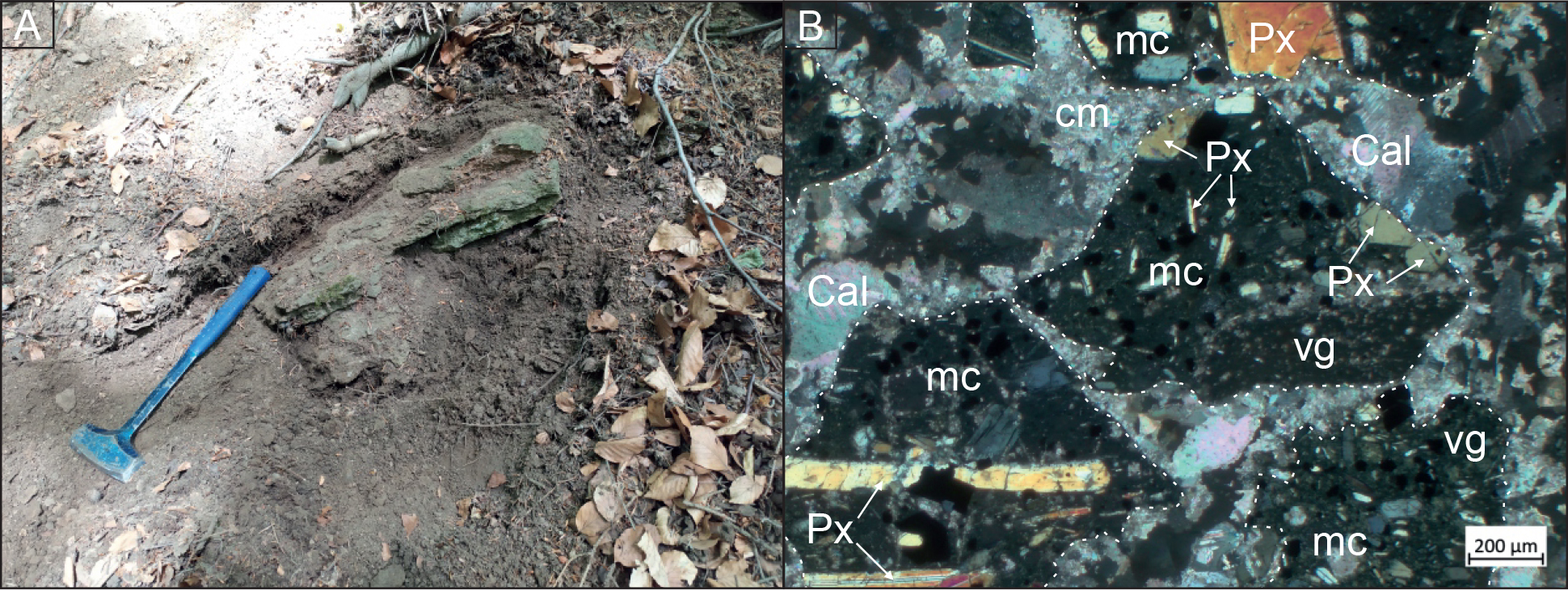
Figure 3.
The outcrop of the peperite from Vršatec (A) and photomicrographs of magmatic clasts cemented by calcite (B); Cal – calcite; Px – Pyroxene; cm - carbonate matrix; mc – magmatic clast; vg - volcanic glass.
The zircon dating revealed that only 6 grains yielded Cretaceous dates (Figs. 4 and 5A, Table 1). All data sets calculated by Squid software comprise zircons showing discordance (206Pb/238U - 207Pb/235U - 207Pb/206Pb apparent ages) of more than 88%. The very high discordance for quite young zircons is caused by the imprecise 207Pb/206Pb ages. However, the discordance recalculated using IsoplotR with the filters proposed by Vermeesch (2021) is much lower (Nawrocki et al., 2024). The lower intercept age for these zircons was calculated to 80.31±0.94 Ma (Fig. 5A). Based on 3 analyses, the concordia age of 81.81±2.3 Ma for the Vršatec magmatism has been established (Fig. 5B). The other analyzed grains exhibited either older ages (ca. 294 Ma and ca. 440 Ma; Table 1) or results that have very high, not acceptable common lead content.
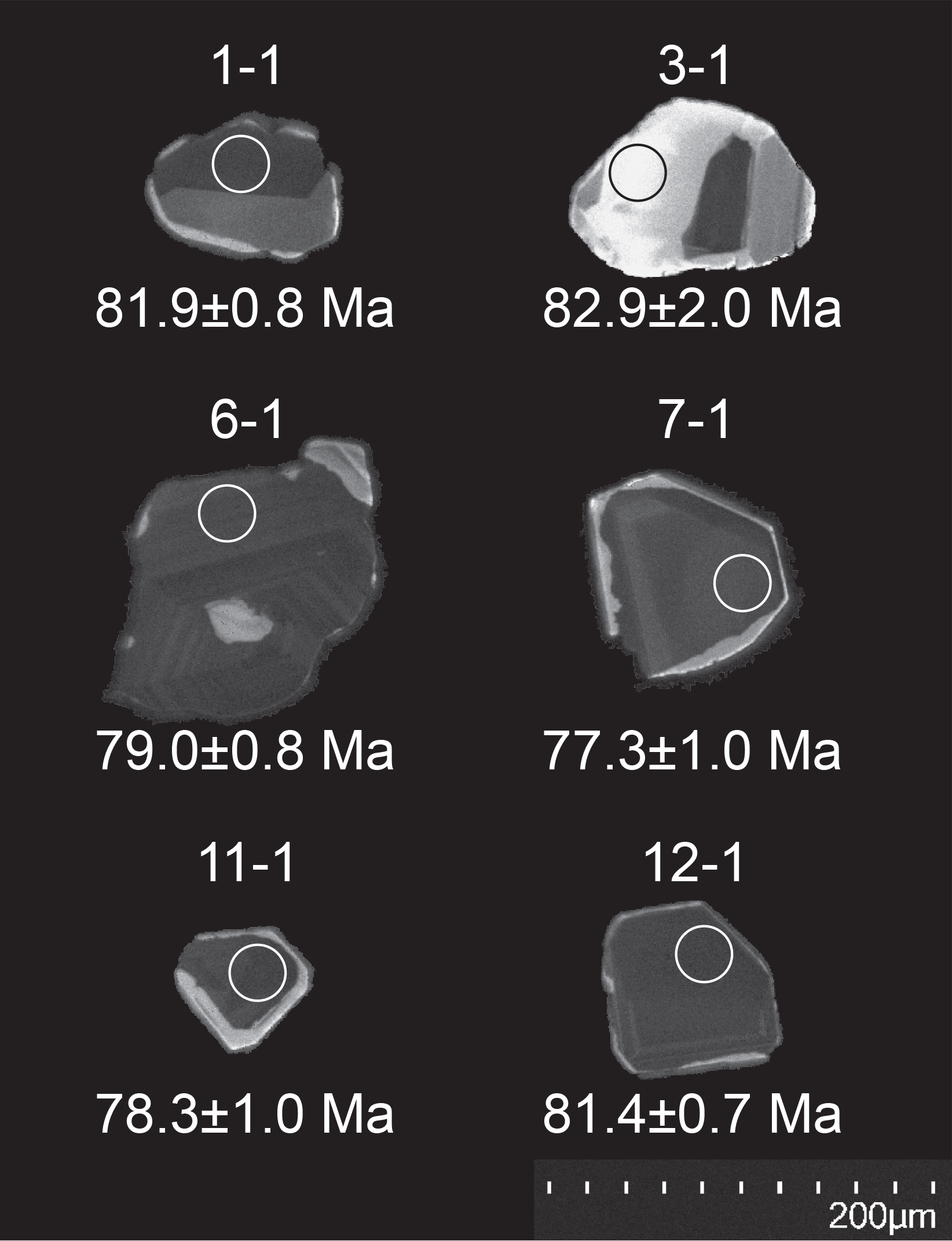
Figure 4.
Cathodoluminescence images of analyzed zircon grains.
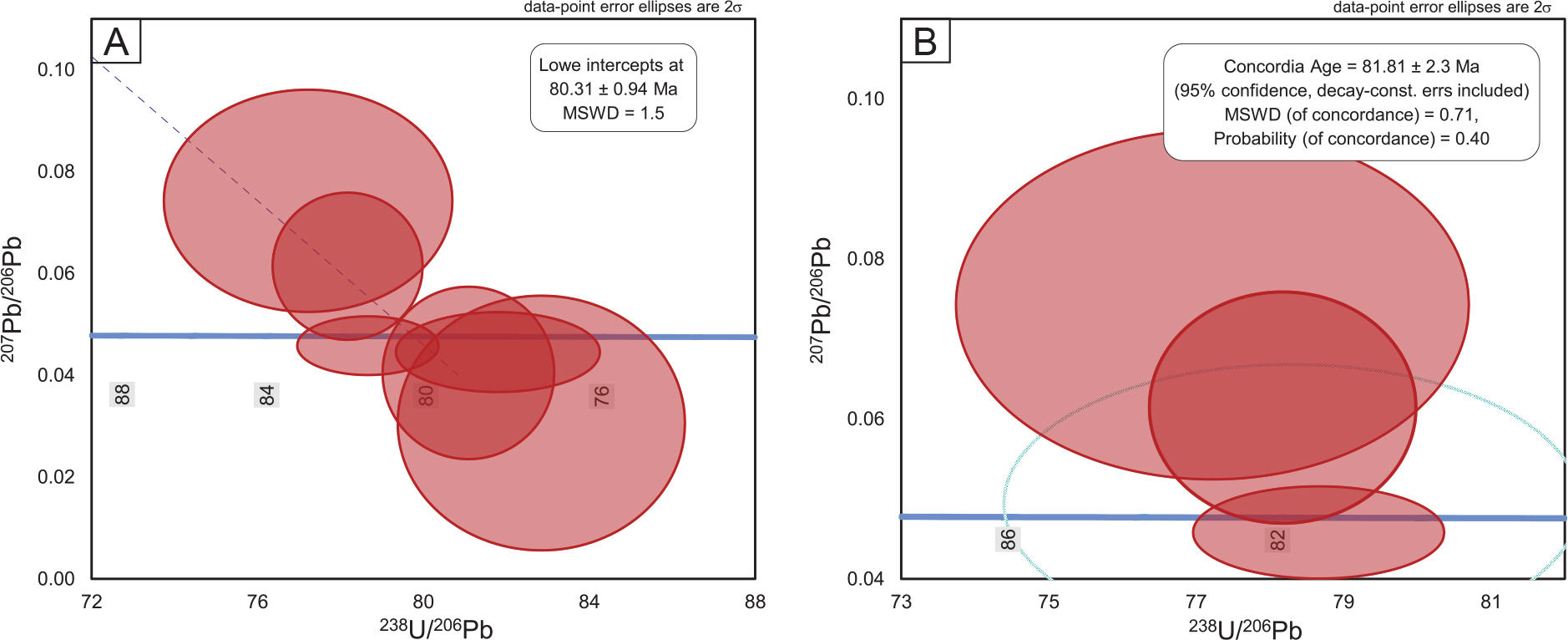
Figure 5.
Ion microprobe results. Lower Intercept age (A) and U-Pb Concordia (B) diagrams.
Table 1.
Ion microprobe zircon data of analyzed peperite.
| Sample | U(ppm) | Th (ppm) | Th/U | 204Pb/206Pb | (%) error | 206Pbc (%) | 238U/206Pb* | ±% | 207Pb*/206Pb* | ±% | 207Pb*/235U | ±% | 206Pb*/238U | ±% | error corr. | 206pb/238U age (Ma) | ±(Ma) |
|---|---|---|---|---|---|---|---|---|---|---|---|---|---|---|---|---|---|
| SFP22-90.7.1 | 253 | 306 | 1.21 | 1.1E-3 | 58 | 2.06 | 83 | 1.7 | 0.031 | 33 | 0.051 | 33 | 0.012 | 1.7 | 0.05 | 77.3 | ±1 |
| SFP22-90.11.1 | 491 | 785 | 1.60 | 1.8E-4 | 100 | 0.33 | 82 | 1.2 | 0.045 | 7 | 0.075 | 7 | 0.012 | 1.2 | 0.17 | 78.3 | 1.0 |
| SFP22-90.6.1 | 316 | 345 | 1.09 | 7.5E-4 | 58 | 1.39 | 81 | 1.0 | 0.040 | 17 | 0.069 | 17 | 0.012 | 1.0 | 0.06 | 79.0 | 0.8 |
| SFP22-90.12.1 | 626 | 1171 | 1.87 | 1.2E-4 | 100 | 0.23 | 79 | 0.9 | 0.046 | 5 | 0.080 | 5 | 0.013 | 0.9 | 0.17 | 81.4 | 0.7 |
| SFP22-90.1.1 | 454 | 1113 | 2.45 | -7.8E-4 | 50 | 0.00 | 78 | 0.9 | 0.061 | 10 | 0.108 | 10 | 0.013 | 0.9 | 0.10 | 81.9 | 0.8 |
| SFP22-90.3.2 rejected | 444 | 1269 | 2.85 | -2.0E-3 | 32 | 0.00 | 77 | 1.8 | 0.074 | 12 | 0.133 | 12 | 0.013 | 1.8 | 0.15 | 82.9 | ±2 |
| SFP22-90.3.1 | 6 | 3 | 0.51 | 1.6E-2 | 100 | 30.64 | 108 | 45.8 | 0.126 | 64 | 0.160 | 79 | 0.009 | 45.8 | 0.58 | 59.1 | ±27 |
| SFP22-90.5.1 | 11 | 8 | 0.66 | -8.7E-3 | 100 | 0.00 | 65 | 16.1 | 0.189 | 49 | 0.399 | 51 | 0.015 | 16.1 | 0.31 | 98.2 | ±16 |
| SFP22-90.2.1 | 375 | 134 | 0.36 | ---- | --- | 0.00 | 21 | 0.7 | 0.052 | 1 | 0.334 | 2 | 0.047 | 0.7 | 0.44 | 294 | ±2 |
| SFP22-90.9.1 | 319 | 102 | 0.32 | 3.7E-4 | 26 | 0.67 | 14 | 0.6 | 0.059 | 4 | 0.564 | 4 | 0.070 | 0.6 | 0.14 | 435 | ±3 |
| SFP22-90.4.1 | 517 | 28 | 0.06 | 7.4E-5 | 41 | 0.13 | 14 | 0.6 | 0.054 | 1 | 0.530 | 1 | 0.071 | 0.6 | 0.45 | 443 | ±3 |
| SFP22-90.8.1 | 253 | 19 | 0.07 | 1.4E-4 | 41 | 0.26 | 14 | 0.7 | 0.054 | 2 | 0.546 | 2 | 0.073 | 0.7 | 0.34 | 453 | ±3 |
5. Discussion and Conclusions
A new outcrop of Cretaceous magmatism was described at Vršatec in the PKB in the Slovak Western Carpathians by Spišiak et al. (2011). The magmatic body occurs within the Upper Cretaceous deep-marine pelagic variegated marlstones of the Lalinok Formation. The age of the hosting sedimentary rocks was previously determined by lithostratigraphy and biostratigraphy and estimated to the Upper Cretaceous, but younger than 100 Ma, which was supported by globotruncanas found in the peperite (Spišiak et al., 2011).
Our new U-Pb zircon dating confirms the Upper Cretaceous age of the analyzed magmatic rock suggested by litostratigraphical observations (Spišiak et al., 2011). The age of the magmatic event is estimated to be ca. 80 Ma based on the U-Pb zircon lower intercept. However, the small amount of analyzed zircon grains may cause some doubts about the interpretation of the obtained age. It remains possible that these youngest zircons could have been either delivered as detrital material during deposition of the sedimentary rocks, or incorporated into the magma from the surrounding rocks. Even if the zircons are detrital or inherited, the peperite must be younger or coeval to the age of the analyzed zircons. Moreover, the parental rocks to the peperites observed at Vršatec are intrusive igneous rocks s.s. that are not rich in zircon. Neither are the carbonates of Lalinok Formation that may have contained only a small amount of zircons (older than the igneous rocks though). Considering the above, there is no possibility that the analyzed peperite could be older than the age of the dated zircons found in them.
However, the signs of corrosion and the presence of overgrowths around the corroded grain edges in studied zircons may corroborate even their longer history. The presence of overgrowths may correspond to hydrothermal event of magmatism. Therefore, the obtained 80 Ma zircon age may not be assigned to basaltic volcanism but maybe earlier, deeper magmatic processes.
Detrital zircons of ca. 80 Ma are known from the sandstones of the Krosno Formation (Silesian Unit, Nawrocki et al., 2024). Their sources were interpreted to be located in the Apuseni Mountains, where magmatic rocks of this age occur (Balintoni et al., 2014). The obtained age of Cretaceous magmatism ca. 80 Ma (or younger) in the PKB sheds new light on the evolution and development of the Mesozoic Carpathian igneous rock complexes and the Pieniny Basin itself. This age can be used as a benchmark for the forthcoming provenance studies of the surrounding clastic rocks in the PKB and the Outer Carpathians flysch. However, more detailed studies on the precise age, geochemistry, and paleogeographic position of these rocks and their equivalents is required to build a more solid database. Nonetheless, the reported age of ca. 80 Ma can be treated as the most robust available so far.
Acknowledgement
The research is supported by the National Fund for Environmental Protection and Water Management project No. 22.2301.2001.00.1, by the Slovak Grant Agency for Science, project 1/0435/21 as well as the National Science Centre, Poland, project no. 2021/43/B/ST10/02312. We thank D. Gurba, P. Lampart and Z. Czupyt for substantial help in separation of zircons, CL investigation and isotope measurements. We express special gratitude to the reviewers for their constructive suggestions.
Notes
[4] Conflicts of interest Competing Interests
The authors declare no competing interests.