
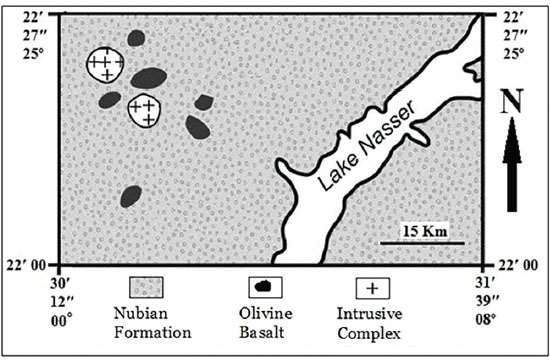
Figure 1.
Geological map of southwestern Egypt (modified from EGSMA 1981). The region is a hyperarid desert with maximum daily temperatures ranging from 16°C during December to 48°C in June and rains occurring rarely.
Table 1.
SEM-EDS analyses (wt%) of duplicate mineral spots (A and B) from GR1 and GR2; BDL—below detecton limit.
| A | B | ± 1σ | % Errors | |
|---|---|---|---|---|
| Britholite | ||||
| SiO2 | 17.10 | 15.90 | 0.60 | 3.64 |
| ThO | 7.00 | 8.34 | 0.54 | 8.73 |
| UO2 | BDL | BDL | ||
| ZrO | BDL | BDL | ||
| Al2O3 | 7.90 | 6.82 | 0.54 | 7.34 |
| La2O3 | 13.30 | 15.10 | 0.90 | 6.34 |
| Ce2O3 | 24.70 | 26.70 | 1.00 | 3.89 |
| Pr2O3 | 2.20 | 1.94 | 0.13 | 6.28 |
| Nd2O3 | 5.00 | 5.15 | 0.07 | 1.48 |
| Sm2O3 | BDL | BDL | ||
| Gd2O3 | BDL | BDL | ||
| FeO | 8.00 | 7.58 | 0.21 | 2.69 |
| Cr2O3 | BDL | BDL | ||
| MgO | 4.30 | 3.12 | 0.59 | 16.0 |
| CaO | 5.90 | 6.50 | 0.30 | 4.80 |
| Na2O | 1.24 | 0.65 | 0.30 | 31.22 |
| K2O | 0.53 | 0.80 | 0.13 | 20.30 |
| P2O5 | BDL | BDL | ||
| SO3 | 0.27 | 0.20 | 0.03 | 14.89 |
| F | 2.51 | 1.07 | 0.72 | 40.28 |
| Total | 99.95 | 99.87 | ||
| Magnetite | ||||
| SiO2 | 2.40 | 2.40 | 0.00 | 0.00 |
| Al2O3 | 0.60 | 0.80 | 0.10 | 14.28 |
| FeO | 93.80 | 94.70 | 0.45 | 0.48 |
| Cr2O3 | 1.14 | 0.74 | 0.20 | 21.28 |
| MgO | 0.30 | 0.40 | 0.05 | 14.29 |
| Na2O | 0.70 | 1.00 | 0.15 | 17.65 |
| Total | 98.94 | 100.04 | ||
| Zircon | ||||
| SiO2 | 29.80 | 28.30 | 0.75 | 2.58 |
| ZrO | 68.10 | 67.80 | 0.15 | 0.22 |
| Al2O3 | 0.30 | 0.30 | 0.00 | 0.00 |
| FeO | 0.70 | 1.30 | 0.30 | 30.00 |
| CaO | 0.60 | 0.30 | 0.30 | 33.33 |
| Na2O | 0.50 | 0.90 | 0.20 | 28.57 |
| Total | 100.0 | 98.90 | ||
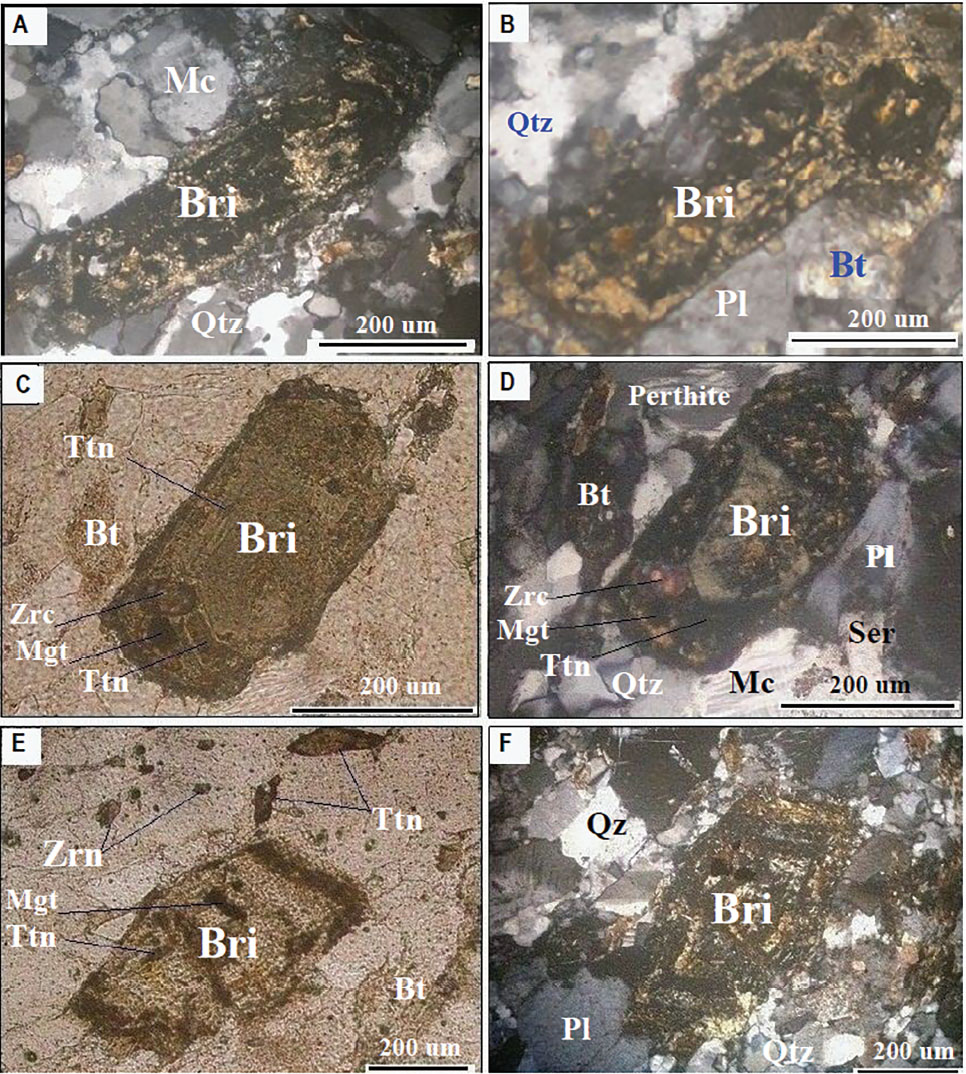
Figure 2.
Photomicrographs of samples GR1 and GR2. (A) Image of a britholite prism, taken under XPL. (B) Image of a platy tabular crystal of britholite, taken under XPL. (C-D) Images of a euhedral tabular britholite, taken under PPL and XPL, showing center zonation and a resobed border. (E-F) Images of another euheral britholite, taken under PPL and XPL, showing rims around a core. Mineral abbreviations are: Bt—biotite; Bri—britholite; Mgt—magnetite; Mc—microcline; Pl—plagioclase; Qtz—quartz; Ser—sericite; Zrn—zircon; Ttn—titanite.
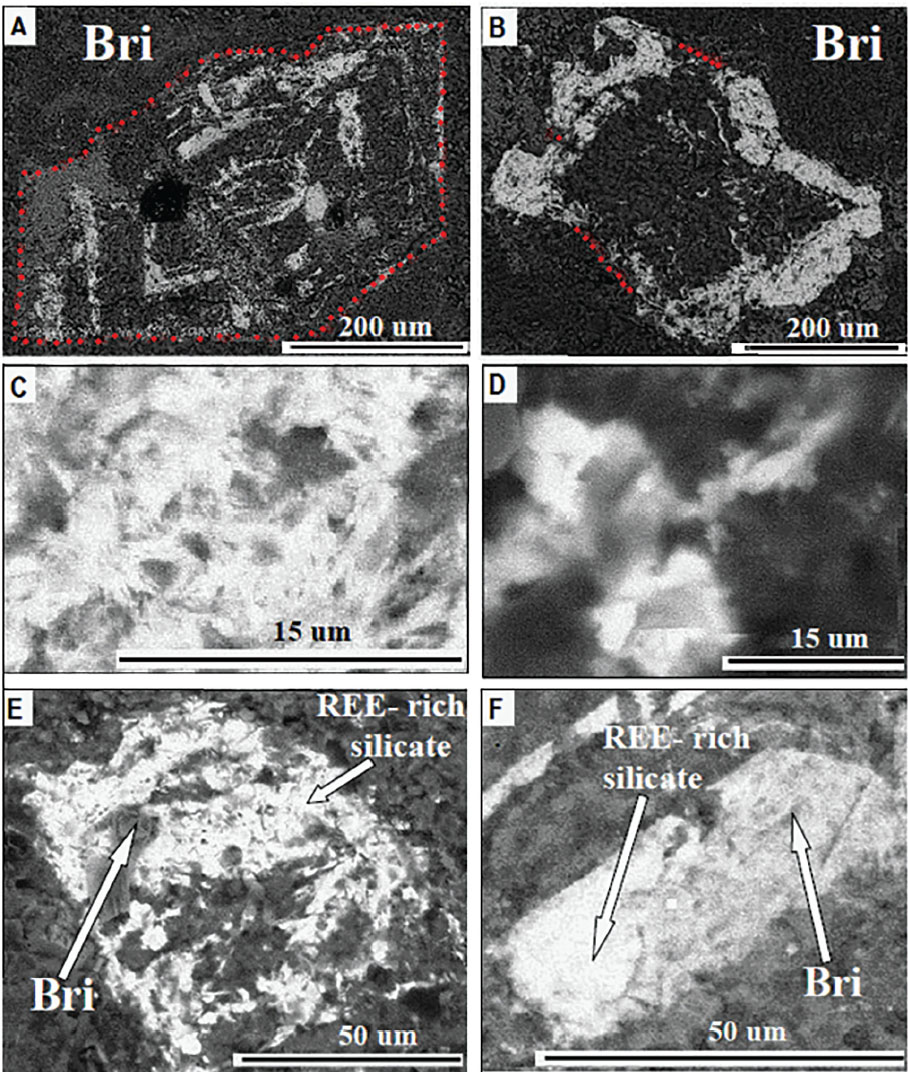
Figure 3.
BSE images of REE grains from samples GR1 and GR2. (A) BSE image of the britholite depicted in Fig. 2E, displaying compositional zoning. (B) BSE image of another britholite crystal. In (A) and (B) the dotted red lines partially mark the original crystal outline. (C-D) BSE images of britholite grains with different levels of brightness and, hence, different chemical composition. (E-F) BSE images of britholite partially changed to REE-rich silicate.
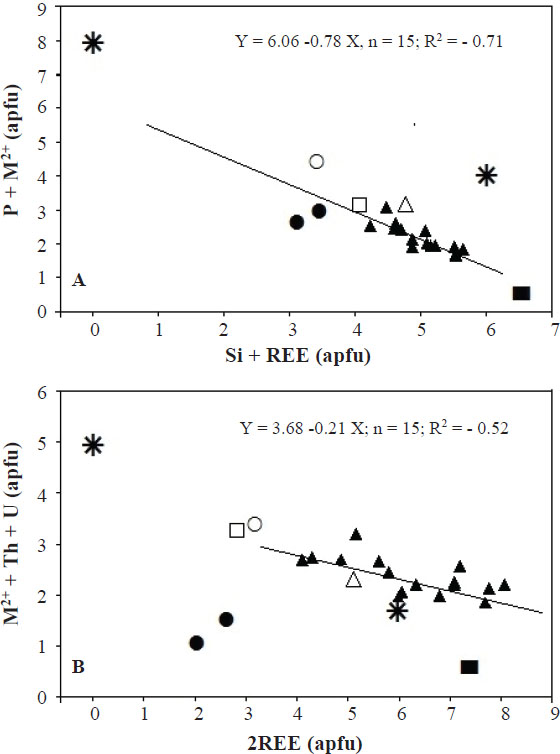
Figure 4.
Compositions of the analyzed britholite samples in the cationic diagrams (A) P + M2+ versus Si + REE and (B) M2+ + Th + U versus 2REE (n = number of samples; R2, coefficient of determination). The ideal apatite and britholite-(Ce) endmembers are plotted as stars. Symbols: filled rectangular, Vilalva et al. 2013; open triangular, Nash 1972; open rectangular, Orlandi et al. 1989; open circular, Mulluso et al. 2012; filled circulars, Kudrina et al. 1961; filled triangular, this work.
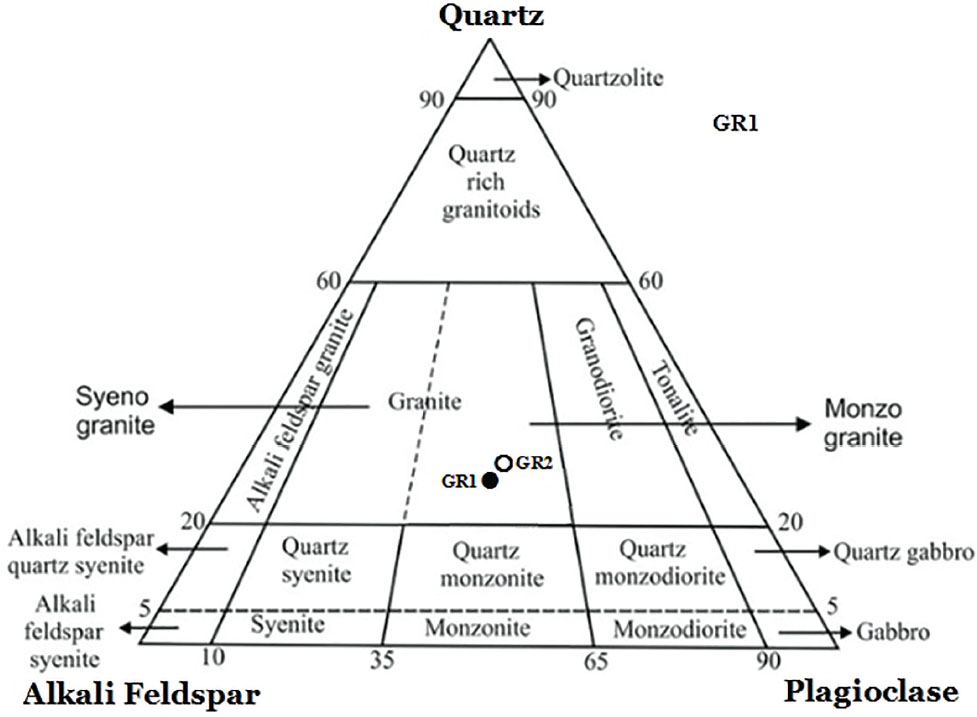
Figure 5.
Modal data of the samples GR1 and GR2 plotted on the IUGS quartz-alkaline feldspar-plagioclase diagram of the plutonic rocks.