
1. Introduction
In the 21st century, knowledge has become one of the most powerful drivers shaping influence, trust, and cooperation. Research organizations (ROs) are therefore increasingly visible not only as producers of research outputs, but as institutional actors operating in science diplomacy ecosystems, connecting scientific excellence with societal priorities and shaping agendas beyond the laboratory. In Europe, this shift is now formalized by the European Framework for Science Diplomacy (European Commission, 2025) (hereafter: the Framework), which signals that science diplomacy is not merely a soft-power narrative, but a policy-relevant capability that requires institutional capacity-building and alignment with a changing geopolitical environment (Royal Society & AAAS, 2023; Turekian, 2018; Flink, 2022).
Yet, implementation within ROs often remains fragmented, reactive, and person-dependent. Many institutions still treat diplomacy as external to their mission, confined to administrative units or international offices, rather than as an internal asset linked to competitiveness, resilience, and mission delivery. As a result, valuable international engagement can remain episodic and project-based, with limited governance, weak incentives, and little organizational learning about what works over time (Gluckman et al., 2017; Kotter, 1996; Teece, 2007).
In this paper, we take a deliberately practical stance: we provide a policy review and implementation roadmap for research organizations, and we translate the Framework into organization-level choices. Building on the idea that science diplomacy should be seen as a bridge between academic excellence and societal impact, we outline a capability-based architecture (capability stack, governance blueprint, and monitoring-evaluation-learning (MEL) logic) that helps ROs move from rhetorical commitment to institutionalized practice. In doing so, the roadmap also clarifies how science diplomacy can support strategic branding and positioning, policy and funding relevance, and stronger external collaboration, without becoming an “administrative add-on” or a symbolic gesture (Royal Society & AAAS, 2023; Flink, 2022).
The paper is structured into five sections. After introducing the problem, we review what the Framework implies for research organizations, translate it into an implementation architecture (capabilities, governance, and MEL), and propose a staged roadmap together with key adoption challenges, and conclude with implications for institutional positioning and the science-business interface.
2. Policy review: implications of the Framework for research organizations (ROs)
2.1. What the Framework is (and what it is not)?
The European Framework for Science Diplomacy can be understood as a strategic umbrella and shared vocabulary rather than a prescriptive implementation manual. It was developed by five EU Science Diplomacy Working Groups through a co-creation process involving scientists and diplomats, and it organizes its guidance into three families of instruments: strategic, operational, and enabling, with nine recommendations in total.
The Framework also sets out two boundary conditions relevant for research organizations. First, it notes that any allocation of roles must respect the subsidiarity principle and Member States’ sovereignty in foreign and security policy, which means science diplomacy cannot be implemented uniformly across the EU. Recent EU-focused scholarship frames science diplomacy as a contested space of multi-level governance: ambitions for coherence coexist with constraints rooted in shared competences, national foreign-policy prerogatives, and variable institutional capacity (Rüffin, 2020; López de San Román & Schunz, 2018). This “variable geometry” can be a strength, enabling adaptation, but it also increases the risk of fragmented implementation unless roles, interfaces, and coordination routines are defined at the organizational level (Rüffin, 2020; Schakel & Tatham, 2025; López de San Román & Schunz, 2018).
Second, it emphasizes academic freedom and scientific autonomy of academies, higher education institutions, and research-performing organizations, and notes that the proportionality of suggested actions to institutional capacity would need to be assessed in further steps. This is why a RO-level roadmap is needed, as the translation from policy to practice is often hindered by coordination deficits, discontinuities in political attention, and weak institutional memory, making person-dependence structurally likely rather than accidental.
2.2. What “science diplomacy” means in the policy context?
In practice, “science diplomacy” is a contested term, so the Framework’s value is partly that it makes the field more recognizable to European institutions by tying it to concrete objectives and instruments. In the canonical typology (Royal Society & AAAS, 2023), the term is often unpacked as: science in diplomacy (scientific evidence informing diplomatic decisions), diplomacy for science (diplomatic action enabling international scientific cooperation), and science for diplomacy (science building bridges and trust across borders).
We frame science diplomacy as a bridge between academic excellence and societal impact, and as a way for ROs to become not only knowledge producers but strategic actors in broader science diplomacy ecosystems. Scholars also note conceptual instability, as the same label is used for different rationales: influence, cooperation, evidence use, and security, which complicates coherent institutional design. A practical implication for ROs is to treat definitions as working distinctions tied to institutional choices rather than as purely academic categories (Rüffin, 2020; Turchetti & Lalli, 2020).
The Framework sharpens that broad idea into a set of European priorities. It argues that European science diplomacy should:
tackle geopolitical challenges in a fragmented, multipolar world,
make diplomacy more effective and resilient through evidence and foresight,
strengthen science diplomacy in delegations and embassies,
build capacity for science diplomacy across relevant communities.
For ROs, this implies a shift in mindset: international research collaboration is no longer only an international office function or a project-by-project activity. It becomes part of how an institution sustains relevance, resilience, and legitimacy, especially in mission-driven and geopolitically sensitive domains. This as a move from “doing diplomacy on the side” to treating science diplomacy as a defining feature of global relevance. In EU practice, “bridging” is frequently performed by science attachés and epistemic communities that translate, convene, and protect scientific standards against instrumentalization. This observation matters for ROs because it implies an internal need for comparable bridging roles and routines, not only external representation (Ruffini, 2023; Čavoški et al., 2025).
2.3. The Framework’s logic
The Framework’s architecture is helpful because it separates what must be decided (strategic instruments), what must be organized (operational instruments), and what must be developed (enabling instruments):
strategic instruments are about priorities, narratives, and the rules of engagement, including the trade-off between openness and restrictedness,
operational instruments are about structures and coordination: how science and diplomacy interfaces are staffed, connected, and supported in daily practice,
enabling instruments are about capability-building communities, professional development, and research that grows the field’s evidence base.
This distinction is useful because each family of instruments implies a different type of organizational work. Strategic instruments translate into mandate and positioning choices; operational instruments translate into coordination, roles and decision rights; enabling instruments translate into capability-building and professionalization. The nine recommendations can therefore be read as inputs to an RO implementation architecture, which we structure into (1) a capability stack, (2) a governance blueprint, and (3) a monitoring-evaluation-learning (MEL) logic. Table 1 summarizes the nine recommendations and translates each of them into RO-level implementation choices within the capability stack, governance blueprint, and MEL logic.
Table 1.
The European Framework for Science Diplomacy’s recommendations translated into RO-level implementation choices.
| Recommendations (R1-9) | RO-level meaning / implementation | Anchor & Stage |
|---|---|---|
| R1. Set strategic priorities (Strategic) | Convert “priorities” into an explicit institutional choice: where science diplomacy matters (themes/regions/platforms), why it matters (mission/legitimacy), and how it will be recognized internally. Position science diplomacy alongside research excellence and innovation in strategy and resource allocation so it becomes governable rather than person-dependent. | Capability Stack; Stage 1 |
| R2. Balance openness and restrictedness (Strategic) | Translate the openness–security tension into operational governance: partner due diligence, dual-use awareness, data/IP discipline, and clear escalation routes for politically sensitive cases. Stabilize decision rights and accountability to avoid oscillation between over-restriction (risk aversion) and under-protection (integrity/compliance risks), and communicate the rationale as protection of integrity, not politicization of science. | Governance blueprint; Stages 1–3 |
| R3. Tackle global challenges (Strategic) | Treat “global challenges” as a legitimacy design task: partnerships must make reciprocity auditable (who decides/benefits/whose knowledge counts), especially in North–South collaboration. Build this into partnership strategy and institutional narrative (shared responsibility rather than “exporting solutions”), because trust and reputation are implementation outcomes, not add-ons. | Capability Stack; Stages: 1–2 |
| R4. Establish structures needed for EU leadership (Operational) | Interpret “EU leadership” at RO level as interoperability: map relevant EU/national/diplomatic actors and build stable interfaces instead of relying on personal networks. Implement role clarity (who convenes, represents, translates science for policy) and internal coordination across international office, policy advice, legal/ethics, and communications. | Capability Stack; Stage 2 |
| R5. Foster science-for-policy and foresight ecosystems (Operational) | Make “science for policy” and “foresight” concrete by specifying interfaces and competencies for synthesis, co-creation and stakeholder negotiation, not only disciplinary expertise. Build routines for rapid evidence translation, scanning/monitoring and participation in advisory ecosystems as cross-boundary work that can be repeated and improved. | MEL; Stages 2–3 |
| R6. Strengthen science & technology in diplomatic representations (Operational) | Treat embassies/delegations as an interface design problem: secondments, joint labs, visiting roles and reliable channels connecting researchers with diplomatic stakeholders. Build “translation capacity” to frame research in policy-relevant ways without distorting integrity, with clear support routines and expectations. | Capability Stack; Stages 2–4 |
| R7. Create and connect communities (Enabling) | Build communities as institutional infrastructure for coordination and trust, not informal add-ons. Create internal champion networks across units/faculties and connect them to external peer-learning platforms/alliances, with cadence and ownership so the network survives turnover. | Capability Stack; Stages 2–4 |
| R8. Train and empower professionals (Enabling) | Professionalize science diplomacy through recognized roles and structured upskilling (stakeholder engagement, political sensitivity, intercultural competence, science–policy translation). Replace ad hoc, extracurricular learning with an interdisciplinary curriculum integrated into institutional strategy and incentives. | Capability Stack; Stages 2–4 |
| R9. Advance the frontiers through research & innovative approaches (Enabling) | Treat roadmaps as iterative and evidence-informed rather than static checklists. Build a learning logic that supports comparability, data-driven and network-aware approaches (“science diplomacy 2.0”), and cumulative improvement across cycles of projects and attention. | MEL; Stages 3–4 |
Overall, the Framework’s recommendations imply that ROs need to move from informal, person-driven engagement to institutionalized capability supported by leadership, new roles and structures, strategic communication, and learning routines. Two enablers can serve as implementation levers for ROs: digital tools for coordination and institutional memory, and explicit communication routines that reduce distrust and terminology gaps between scientific and diplomatic communities. In other words, institutionalization is not only about structures and mandates, but also about infrastructure and shared language (Salmons & Wilson, 2008; Ruffini, 2023).
The key implication is that the Framework provides the why and the what, but it leaves ROs with the how: how to design capabilities, how to govern openness-security trade-offs, how to connect science for policy and foresight with institutional routines, and how to make learning visible and cumulative. These are precisely the implementation questions addressed in the next section through a RO-level architecture (capabilities, governance, and MEL) and then converted into a staged roadmap with typical adoption frictions and implications for institutional positioning and the science-business interface. Figure 1 synthesizes this translation by linking the Framework’s recommendations to the proposed RO implementation architecture and the staged roadmap.
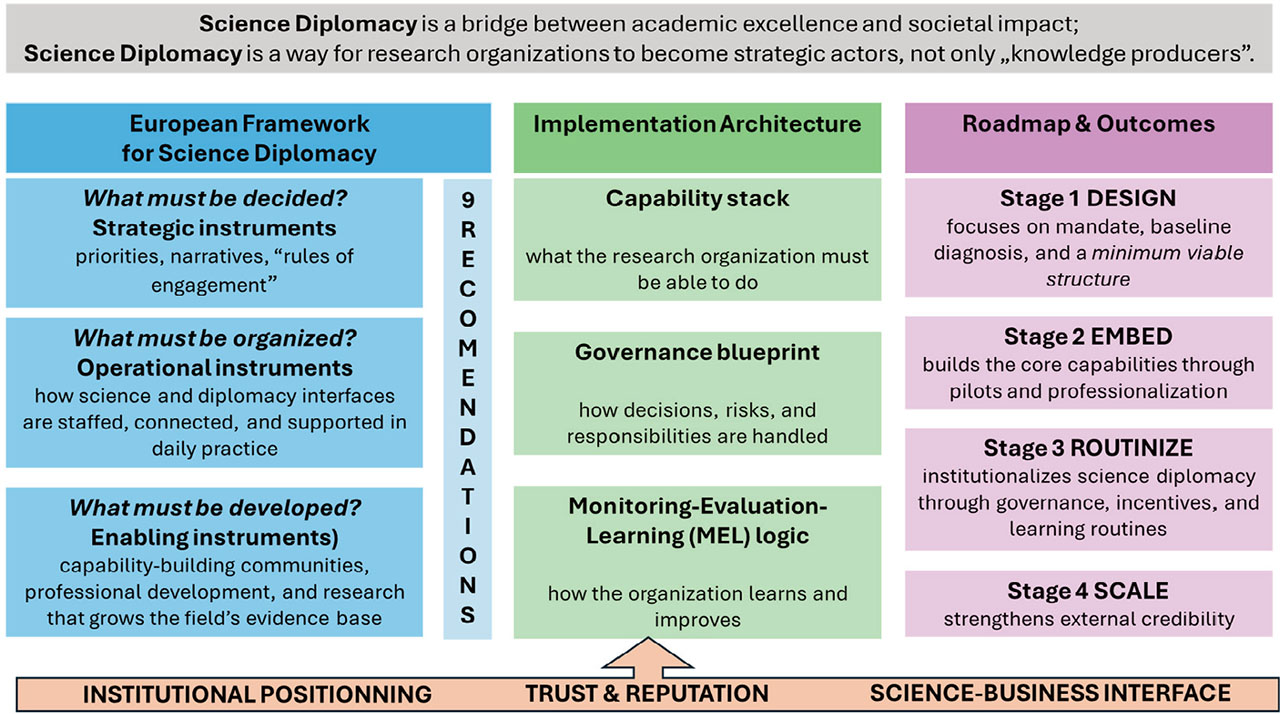
Figure 1.
From the European Framework for Science Diplomacy to practice in research organizations (own elaboration).
3. Implementation architecture: from policy guidance to organizational practice
EU-level guidance is intentionally broad: it must work across different national competences, institutional models, and capacity constraints. This is why, at the level of research organizations, implementation cannot be reduced to a list of activities. What is needed is the implementation architecture: a small set of repeatable design choices that makes science diplomacy governable and improvable over time. The architecture proposed here has three tightly connected components:
a capability stack (what the organization must be able to do),
a governance blueprint (how decisions, risks, and responsibilities are handled),
a monitoring-evaluation-learning (MEL) logic (how the organization learns and improves rather than merely reports).
The first component, the capability stack, translates the Framework’s recommendations into institutional “building blocks” that can be developed in stages. At the base lies strategic intent and positioning: science diplomacy requires an explicit mandate: why it matters to the organization, where it applies (themes, regions, partnerships), and how it relates to the organization’s mission and legitimacy. Without this, implementation remains reliant on key individuals and episodic. On top of mandate sits boundary-spanning capacity: people who can translate across scientific, policy, and diplomatic communities; convene stakeholders; and frame research in policy-relevant terms without distorting scientific integrity (Ruffini, 2023; Čavoški et al., 2025). A third layer is partnership and portfolio capability: the organization needs routines for selecting, governing, and renewing partnerships in ways that reflect both opportunity and risk, including reciprocity in North-South cooperation (Choquez-Millan et al., 2024). A fourth layer is science-for-policy and foresight capacity: the ability to produce synthesis, engage in advisory ecosystems, and anticipate emerging issues through structured scanning and scenario-informed reasoning. Finally, the stack includes strategic communication and institutional narrative: not marketing as promotion, but communication that builds trust, clarifies value, and reduces misunderstandings between communities. In this architecture, communication is part of implementation, because science diplomacy operates through credibility and relationships.
The second component, the governance blueprint, is the mechanism that keeps openness, collaboration, and values aligned with integrity, security, and feasibility. The Framework highlights the tension between openness and restrictedness (Rüffin, 2020); for an RO this tension becomes operational only when governance makes it discussable and decidable. Governance therefore starts with role clarity and decision rights. A workable blueprint includes: a visible executive sponsor; a coordinating function (often small) that connects international relations, research strategy, legal/ethics, and communications; and an escalation path for politically sensitive collaborations or dual-use concerns. Governance also covers incentives: science diplomacy work is often invisible in academic reward structures, which pushes it into the “extra work” category and locks in person-dependence. If ROs want a sustained function rather than heroic individual effort, they need at least minimal recognition mechanisms: time allocation, role descriptions, training pathways, and evaluation criteria that reflect boundary-spanning contributions (Mauduit & Gual Soler, 2020; Olšáková, 2024). Governance is also where institutional interfaces to external actors are formalized: embassies/delegations, ministries, EU networks, and peer organizations become part of the operating environment, not occasional contacts.
The third component, MEL, turns activity into institutional learning. Science diplomacy is inherently relational and context-dependent; without learning routines, organizations tend to repeat ineffective practices, rely on anecdote, and lose knowledge when key individuals move on. MEL is therefore not a reporting add-on but an internal discipline that answers three questions: what was attempted (monitoring), what changed and why (evaluation), and what should be adapted next (learning). For ROs, practical MEL logic typically combines short-cycle feedback (after-action reviews for engagements, partnership retrospectives, stakeholder pulse checks) with longer-cycle learning (annual portfolio review, capability maturity assessment, and documented lessons learned). Importantly, MEL must capture both tangible outputs (agreements, joint initiatives, training delivered) and relational outcomes (trust, access, legitimacy, reduced friction). This is also where digital tools matter: even lightweight systems for documenting contacts, decisions, and lessons can dramatically reduce the loss of institutional memory and support continuity across political cycles and staff changes (Salmons & Wilson, 2008).
These three components are designed to be used together: the capability stack defines what needs to be built, the governance makes choices and trade-offs explicit, and MEL ensures that implementation improves rather than ossifies.
In the next section, this architecture is converted into a staged roadmap, paired with recurring implementation barriers: capacity constraints, incentive misalignment, terminology gaps between communities, and the autonomy-security trade-off, so that research organizations can adapt the pathway to their maturity and context while staying aligned with European science diplomacy priorities.
4. Roadmap and adoption challenges
Operationalizing science diplomacy in a research organization is best treated as a staged build, not a one-off rollout. Research organizations differ in mandate, governance, risk exposure, and international footprint; the Framework also assumes diverse institutional settings and capacity constraints. A staged roadmap therefore focuses on making science diplomacy governable, learnable, and scalable, moving from person-dependent activity to a repeatable institutional function. For consistency with Figure 1, the stages correspond to Design (Stage 1), Embed (Stage 2), Routinise (Stage 3), and Scale (Stage 4).
Stage 1 focuses on mandate, baseline diagnosis, and a “minimum viable structure”. The starting point is a short, explicit institutional statement that clarifies why science diplomacy matters for the organization, what domains and geographies are in scope, and how core values relate to openness-restrictedness trade-off. In parallel, the organization conducts a rapid self-assessment: what is already happening (partnerships, policy engagement, missions, networks), where responsibilities sit, what risks recur, and which capabilities are missing. The immediate goal is not to create a new bureaucracy, but to end fragmentation by appointing a small coordinating function and naming decision rights and escalation routes for sensitive collaborations. At this stage, progress is visible when the organization can answer consistently: who represents the RO externally, who coordinates internally, what triggers review, and what “good practice” looks like.
Stage 2 builds the core capabilities through pilots and professionalization. Rather than attempting a full system redesign, the organization pilots a small number of priority use cases (e.g., an evidence-to-policy engagement with a national/EU actor, a partnership initiative linked to a global challenge, a targeted program with a diplomatic representation). Pilots are selected to generate learning quickly and to test coordination across strategy, international relations, legal/ethics, and communications. This stage also formalizes boundary-spanning roles and competencies: science diplomacy requires translation across scientific, policy, and diplomatic communities, and that translation is rarely intuitive. Training therefore becomes a practical instrument of implementation, covering policy literacy, negotiation and stakeholder engagement, intercultural competence, and communication under uncertainty (Mauduit & Gual Soler, 2020; Olšáková, 2024). In parallel, the RO begins to treat science diplomacy as a portfolio: mapping initiatives to strategic priorities, clarifying reciprocity principles, and introducing lightweight routines for partnership renewal and exit, because legitimacy and mutual benefit cannot be assumed (Choquez-Millan et al., 2024).
Stage 3 institutionalizes science diplomacy through governance, incentives, and learning routines. The purpose is reliability: the organization moves from informal coordination to repeatable processes. Role descriptions and decision rights are clarified; governance is strengthened around the openness-restrictedness tension, so the RO does not oscillate between over-restriction and under-protection (Rüffin, 2020). Incentives are addressed explicitly: if evaluations and workloads ignore bridging work, the function will remain dependent on a few motivated individuals and will not survive staff turnover. Practical steps include time allocation, recognition in performance criteria, and defined pathways for science diplomacy roles. Interfaces to external actors become routinised: embassies/delegations, ministries, EU platforms, and peer organizations are treated as part of the operating environment rather than occasional contacts; where relevant, secondments or structured liaison arrangements are used to strengthen two-way translation (Ruffini, 2023). This is also the stage where monitoring-evaluation-learning (MEL) becomes operational as an organizational discipline that captures what was attempted, what changed and why, and what should be adapted next. It combines short-cycle feedback with longer-cycle learning. Because science diplomacy is relational, MEL must include both tangible outputs and relational outcomes. Lightweight digital infrastructure for documenting contacts, decisions, and lessons is a strong enabler of continuity and institutional memory (Salmons & Wilson, 2008).
Stage 4 scales and strengthens external credibility without losing coherence. Once the internal function is stable, the organization can expand reach: participating more systematically in EU and transnational communities, co-creating initiatives with peer ROs, and sharing benchmarks that enable cross-organizational learning. At this stage, strategic communication becomes reputation management anchored in practice and values, demonstrating not only activity but governance, learning, and responsible partnership choices. Scaling also depends on analytical strengthening: networked and data-informed approaches are increasingly framed as part of what is sometimes termed “science diplomacy 2.0”, supporting better targeting, evaluation, and resilience in complex environments (Turchetti & Lalli, 2020).
Across all stages, adoption challenges are predictable and should be treated as design constraints. Capacity constraints mean implementation collapses when it relies on goodwill alone. Incentive misalignment keeps science diplomacy invisible and reinforces person-dependence. Terminology and culture gaps between scientific and diplomatic communities generate misunderstandings about evidence standards, time horizons, and acceptable ambiguity – one of the most common sources of friction in practice (Rüffin, 2020; Ruffini, 2023). The autonomy-security trade-off can derail implementation without explicit governance. Finally, community-building can remain superficial if it lacks cadence, ownership, and shared artefacts (e.g., templates, playbooks, partner dossiers, decision logs); stable coordination typically requires a small “core” that sustains continuity while participation stays flexible.
For these reasons, the roadmap should be treated as a maturity path rather than a checklist. The Framework provides shared direction and principles; the organizational task is to translate that guidance into stable capabilities, governance choices, and learning routines that survive political cycles and staff turnover. The following section draws out what this operationalization implies for institutional positioning, trust and reputation, and the science-business interface: areas where institutional positioning and innovation collaboration meet the everyday practice of science diplomacy.
5. Implications and conclusion
For research organizations, the internal transformation implied by science diplomacy means visibility, trust, reputational capital, and the ability to shape agendas in a geopolitical environment (Rüffin, 2020). First, science diplomacy strengthens institutional positioning by making an RO clearly positioned as a strategic actor in international policy and innovation ecosystems, not only as a producer of scientific outputs. When an organization can show that its international engagement is coherent, governed, and aligned with shared priorities, its narrative gains credibility and reach. Practically, this requires communication that is not promotion, but structured meaning-making: linking missions and portfolios to global challenges, clarifying what the organization stands for, and demonstrating responsible partnership choices. In Europe, where science diplomacy is frequently described as operating in multi-level governance and contested policy space, this clarity becomes part of competitive differentiation (Rüffin, 2020; López de San Román & Schunz, 2018).
Second, science diplomacy is a trust-building practice. Trust is an intangible asset that accumulates through consistent behavior: transparency, reciprocity, and integrity, and can be drawn upon during crises or periods of political sensitivity. This is where governance and learning become reputational instruments: an RO that can demonstrate decision rights, due diligence, and documented learning signals reliability to funders, governments, and partners. In EU practice, bridging roles, such as science counsellors/attachés and expert communities, often function as translators and stabilizers (Ruffini, 2023; Čavoški et al., 2025).
Third, the implications become most tangible at the science-business interface. For many ROs, technology transfer, commercialization, and innovation partnerships are precisely where international engagement either scales or breaks: cross-border projects raise recurring issues of IP, compliance, export controls, reciprocity, and legitimacy, while demanding translation between research logic and market logic.
The roadmap developed in this paper implies three practical moves:
The first is integration: science diplomacy coordination should connect with innovation and technology transfer functions so that partnership strategy, risk governance, and institutional communication are aligned rather than competing for ownership and priorities.
The second is portfolio discipline: science-business collaborations should be managed against explicit criteria for partner selection, renewal, and exit, especially where geopolitical sensitivities or power asymmetries are present and can undermine perceived fairness and long-term sustainability (Choquez-Millan et al., 2024).
The third is capability building: structured training and shared language are prerequisites for sustained collaboration and for avoiding person-dependent brokerage that disappears with staff turnover; education gaps and communication barriers are repeatedly flagged as persistent inhibitors of effective science diplomacy practice, which is why professionalization is not optional but foundational (Mauduit & Gual Soler, 2020; Olšáková, 2024).
Taken together, the European Framework for Science Diplomacy provides direction and shared vocabulary; implementation in ROs depends on building a core set of institutional capabilities, clarifying governance around openness and restrictedness, and embedding learning systems that preserve knowledge across cycles of projects, personnel, and political attention. The contribution of this paper is to translate policy guidance into an actionable RO-level architecture and staged roadmap that ROs can adapt to maturity and context while remaining aligned with European priorities.
Two implications follow for future work and for the broader evidence base. First, empirical studies comparing implementation pathways across different RO types (size, mission orientation, governance model, disciplinary mix) are needed to test which combinations of capabilities, incentives, and governance arrangements are most robust in Europe’s diverse institutional landscape. Second, emerging directions sometimes described as “science diplomacy 2.0” suggest that more data-driven and network-aware approaches, combined with stronger analytical frameworks, could improve resilience in complex environments (Turchetti & Lalli, 2020).
In conclusion, science diplomacy can be operationalized as an institutional capability that strengthens an RO’s external credibility, strategic positioning, and capacity to collaborate responsibly across borders and sectors. The decisive factor is not rhetorical ambition but disciplined translation of policy intent into roles, routines, and learning, so that science diplomacy becomes a repeatable bridge between excellence, impact, and partnership value in Europe’s research and innovation ecosystem.