Have a personal or library account? Click to login
Landscape changes following the eruption of the Tajogaite Volcano on La Palma, Canary Islands Cover

Landscape changes following the eruption of the Tajogaite Volcano on La Palma, Canary Islands

Open Access
|Oct 2025

Figures & Tables

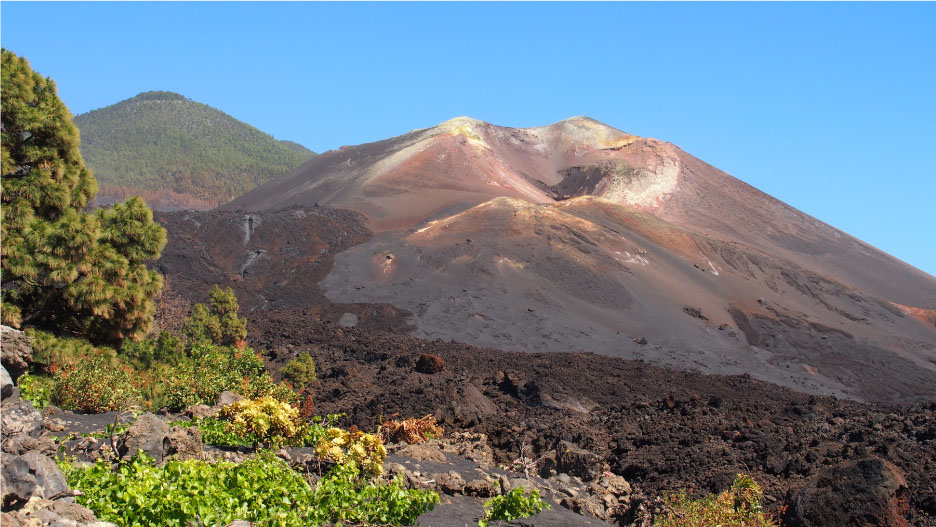
Figure 1.

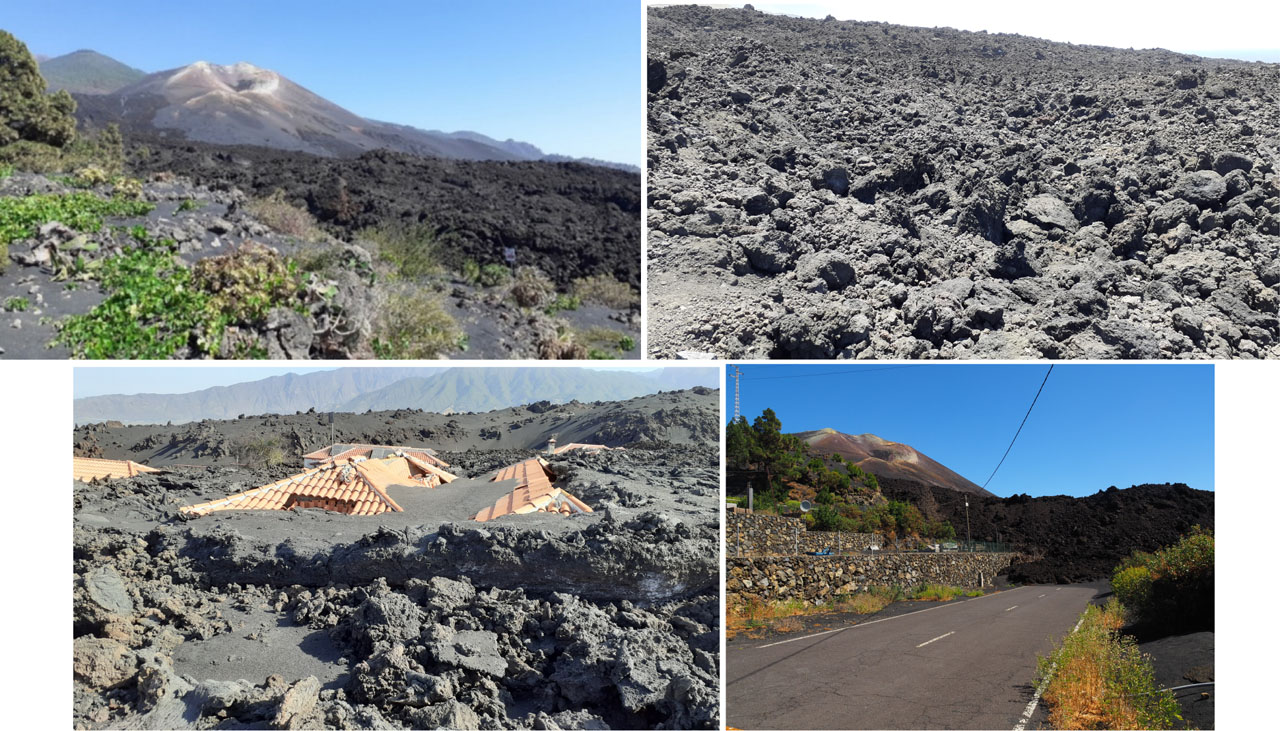
Cumbre Vieja Natural Park has the characteristics of a primaeval landscape, with numerous young volcanic cones and a cover of pyroclastic deposits. The landscape state after the eruption of TajogaiteSource: photos taken by Authors

Figure 2–5.

Tajogaite cone – a new element in the landscape of La Palma island – as of May 9, 2023 (28°37′40″N; 17°55′51″W)The photograph shows the structure of the surface of the lava cover. On May 8, 2023, when the photograph was taken, the stream of lava that had solidified on the surface emanated heat felt by the research team.A house buried partially under the lava flow, covered with volcanic ash.A road flooded with lava in the town of Los Llanos de Aridane (28°37′21″N; 17°52′25″ W).Source: photos taken by Authors

Figure 6.

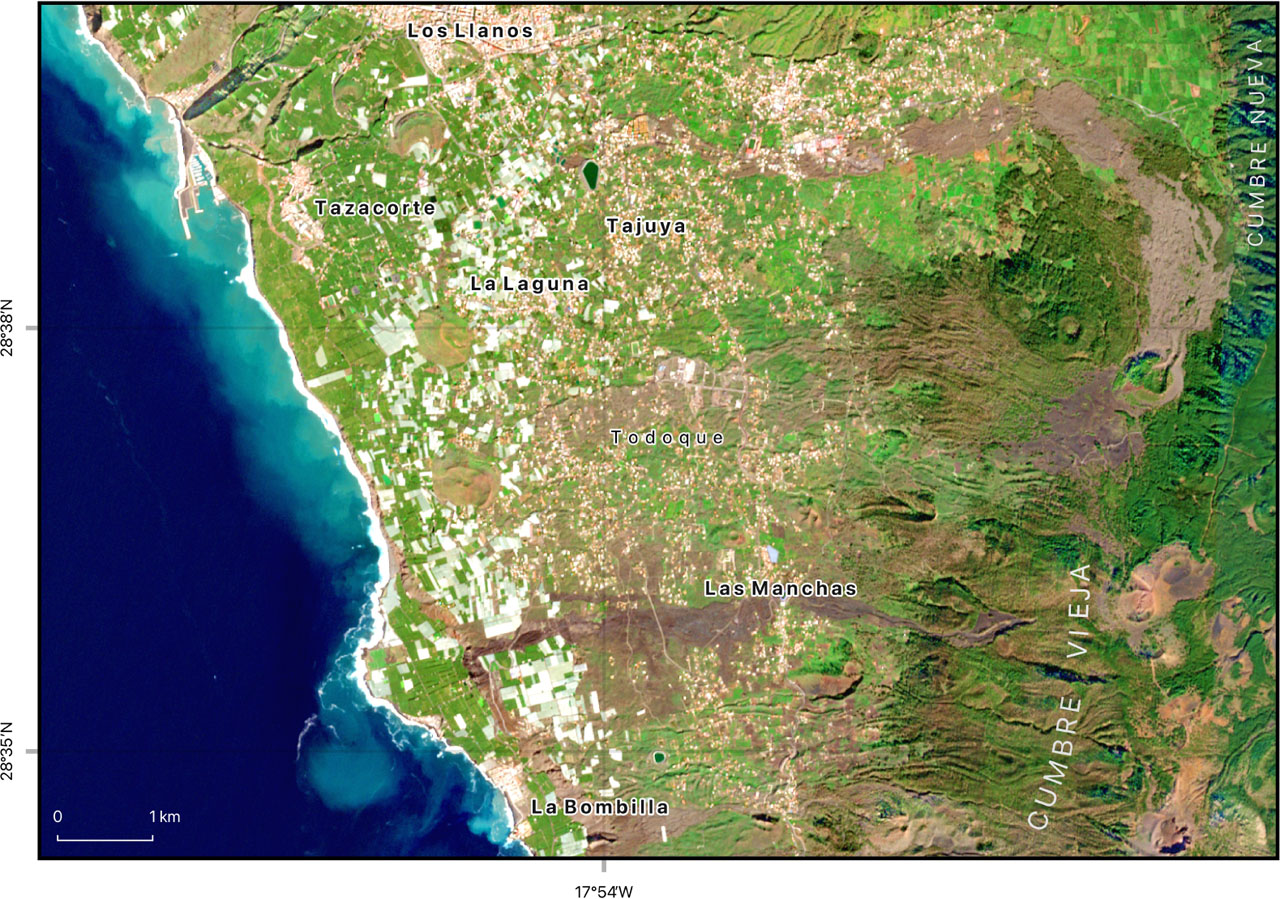
Contemporary image obtained from Sentinel-2A satellite. Photo was taken before the eruption of Tajogaite Volcano on 28.01.2021. The RGB composition of the photo contains three colour bands: red (Band 4), green (Band 3) and blue (Band 2)Source: own elaboration based on Copernicus Data Space Ecosystem, https://dataspace.copernicus.eu/
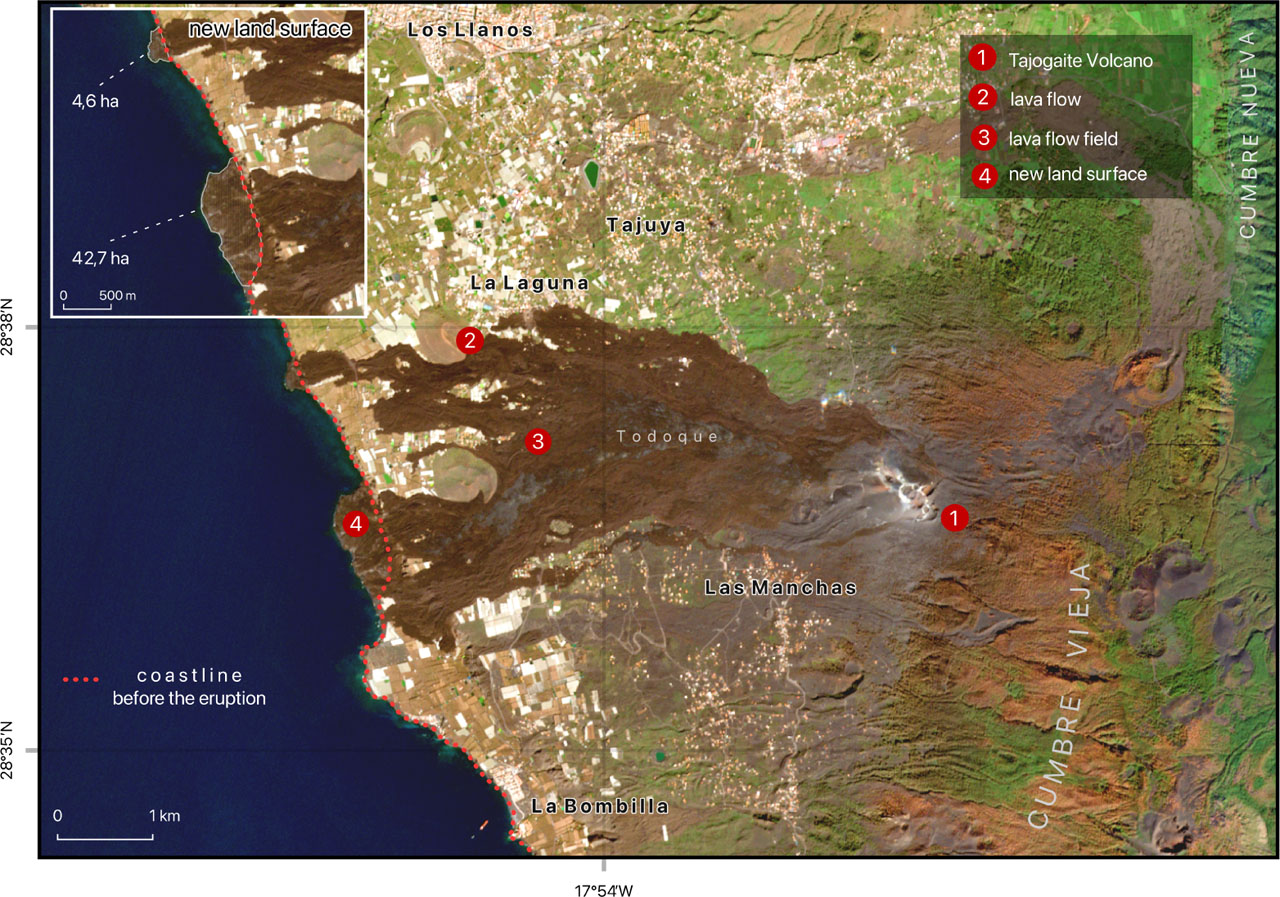
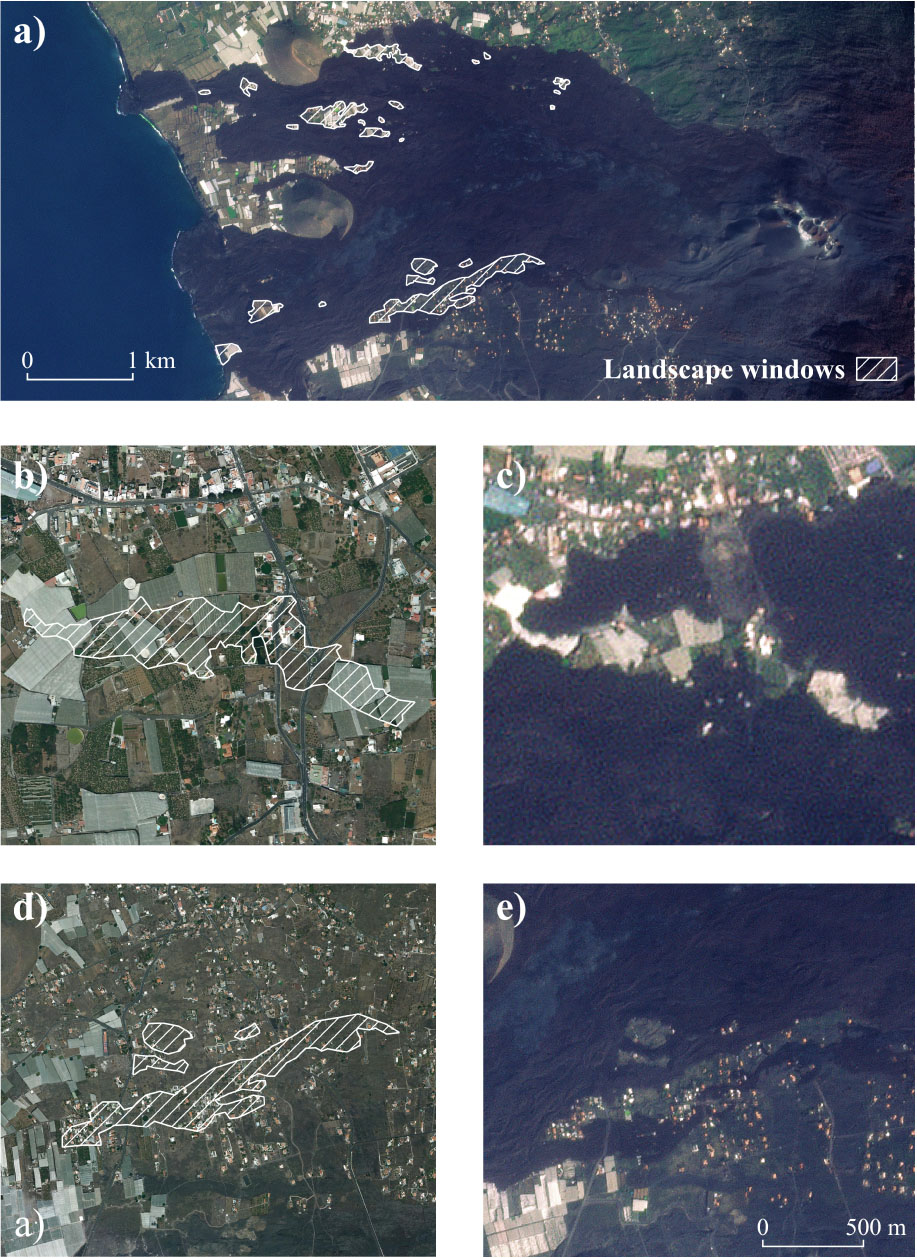
Figure 7.

Contemporary image obtained from Sentinel-2A satellite. Photo was taken after the eruption of Tajogaite Volcano on 17.02.2022. The RGB composition of the photo contains three colour bands: red (Band 4), green (Band 3) and blue (Band 2). Legend: 1 – Tajogaite Volcano, 2 –volcanic ash, 3 – lava flow, 4 – delta. The coastline before the eruption is an effect of vectorization of the Sentinel-2 imagery taken on 28.01.2021Source: own elaboration based on Copernicus Data Space Ecosystem, https://dataspace.copernicus.eu/

Figure 8.

a) – all landscape windows located within the area of interest, b) – first example of landscape window before the eruption, c) – after the eruption, d) – second example before the eruption and e) – after the eruptionSource: own elaboration based on the maps: ESRI World Imagery, DigitalGlobe, GeoEye, i-cubed, USDA FSA, USGS, AEX, Getmapping, Aerogrid, IGN, IGP, swisstopo, and the GIS User Community, Planet Labs PBC. [27 June 2024]
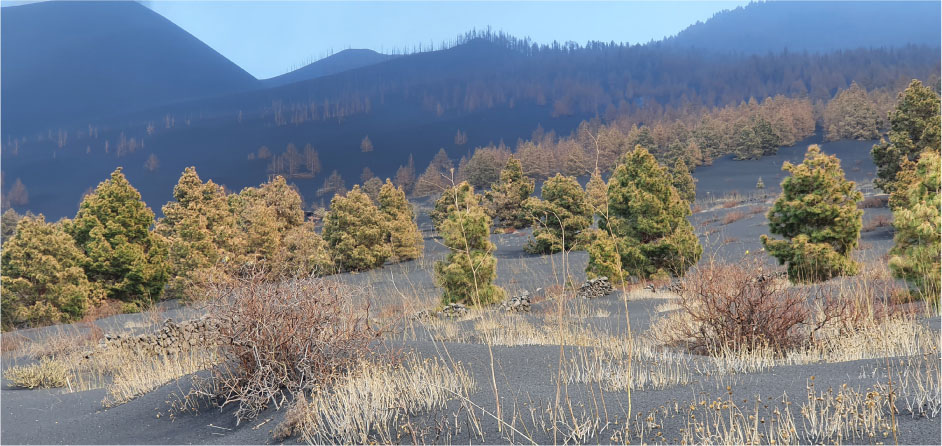

Figure 9.

Pinus canariensis forests damaged by pyroclastic showers on the Cumbre Vieja ridgeSource: photo taken by J.L. García Rodríguez
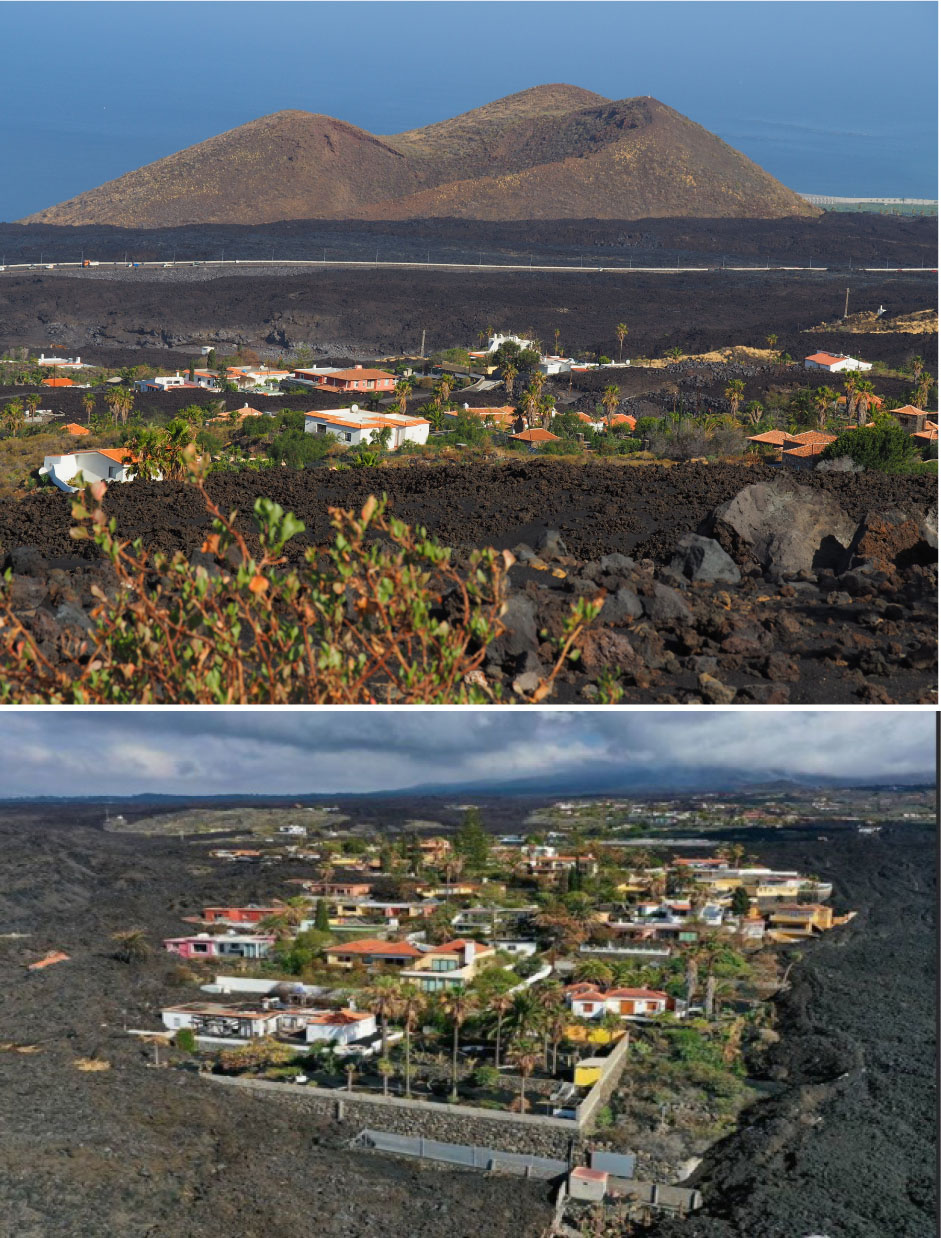

Figure 10–11.

“Landscape windows” in the form of remnants of the previous settlement and agricultural landscapesSource: photos taken by Authors and by R.U. Gosálvez (Fig. 11)
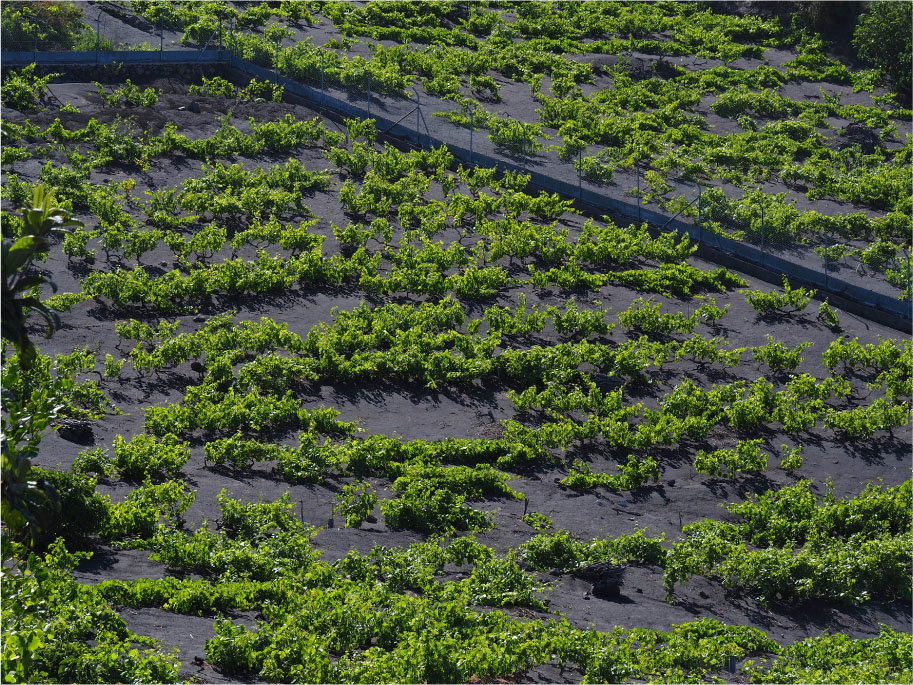

Figure 12.

A vineyard covered by volcanic ash, May 9, 2023Source: photos taken by Authors

Figure 13.

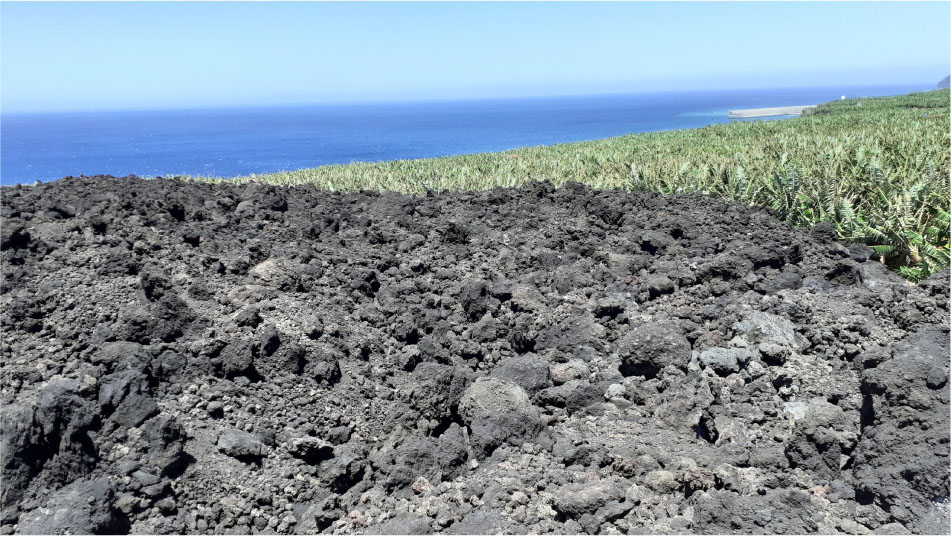
A solidified lava flow flooding a banana plantation, May 8, 2023Source: photos taken by Authors

Figure 14.

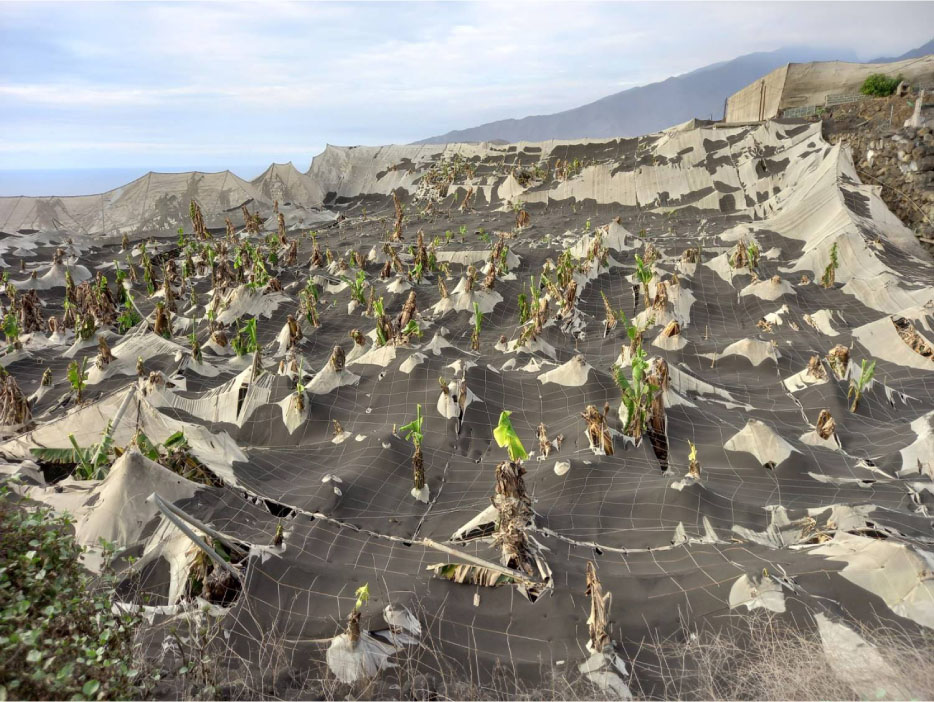
Protective nets over the banana plantations damaged by volcanic ashSource: photo taken by J. Dóniz-Páez
DOI: https://doi.org/10.2478/mgrsd-2025-0041 | Journal eISSN: 2084-6118 | Journal ISSN: 0867-6046
Language: English
Page range: 232 - 240
Submitted on: Mar 5, 2025
Accepted on: Jul 16, 2025
Published on: Oct 31, 2025
Published by: Faculty of Geography and Regional Studies, University of Warsaw
In partnership with: Paradigm Publishing Services
Publication frequency: 4 issues per year

© 2025 Anna Dudek, Maciej Jędrusik, Jerzy Makowski, Joanna Miętkiewska-Brynda, Oliwier Zając, published by Faculty of Geography and Regional Studies, University of Warsaw
This work is licensed under the Creative Commons Attribution 4.0 License.