
Introduction
Rainfall is one of the most critical climatic phenomena due to its direct impact on various aspects of life, as emphasized in the Qur’an: ‘…and we made from water every living thing’ (The Holy Quran - Surah Al-Anbiyaa. 30, n.d. ). This verse highlights that water is essential for the creation of all living beings on Earth, making it indispensable for the continuity and sustainability of life. Therefore, in this study, we examined the thermal characteristics of the summer season preceding the rainy season, aiming to determine whether temperature fluctuations, that is, increases or decreases, affect the amount of rainfall in the following season. Furthermore, we examined the statistical relationship between the two factors. The primary benefit of this study is to determine the potential of predicting wet and dry seasons that follow directly after the summer based on summer temperatures. Given the considerable importance of rainfall in various fields, especially agriculture, it is crucial to investigate the factors influencing rainfall, including temperature. In this study, we also aimed to determine whether the summer temperatures above or below the average affect the amount of rainfall the following season.
The current study examines the relationship between temperature and rainfall to determine whether the relationship is positive or negative. Al-Hathal (2001) predicted Iraq's rainfall with temperature data, proving that the relationship is negative. Lower maximum temperatures led to increased rainfall, and vice versa. Similarly, (Al-Sabhani (2002) found that maximum and minimum temperatures decrease during dry months preceding rainy seasons and increase during the dry months before dry seasons with relatively little rainfall.
Xoplaki et al. (2006) investigated the annual and decadal relationship between Mediterranean summer surface air temperature and rainfall during the rainy season (October–March), along with large-scale atmospheric circulation patterns, thickness patterns, and Mediterranean Sea surface temperatures from 1950 to 1999. The study found that the 1950s, 1980s and 1990s were characterized by warmer summers in the Mediterranean region. This resulted from the dominance of high-pressure systems, descending air, and stable weather conditions associated with a noticeable decrease in rainfall, especially during the 1980s and 1990s.
In contrast, from the mid-1960s to the mid-1970s, the summer temperatures were lower and the rainfall was higher than in the present. Nkuna and Odiyo (2016) examined the relationship between temperature and rainfall fluctuations in the Levubu Basin, South Africa, from 1964–1965 to 2009–2010. There was a long-term negative correlation between rainfall and temperature. When the temperature decreased, the amount of rainfall increased. Conversely, when the temperature increased, the amount decreased. This was statistically documented using the multiple correlation coefficient. Isaac and Stuart (1992) analyzed the relationship between temperature and rainfall at Canadian stations using daily data and found that increased rainfall on the eastern and western coasts and northern Canada was accompanied by warm winter conditions and Moderate summer conditions, and vice versa. Similarly, Aweda and Samson (2022) examined the relationship between air temperature and rainfall changes at selected sub-Saharan African stations and found a positive correlation between temperature and rainfall. This means rainfall increases when temperatures decrease, and vice versa. When temperatures rise, rainfall decreases. Additionally, Eltahir and Pal (1996) investigated the relationship between surface conditions, specific temperature and humidity and subsequent rainfall.
On this basis, to date, most prior studies have concluded that there is a negative relationship between temperature and rainfall. When temperatures rise above their general averages, rainfall decreases. In this study, we examined this relationship by analyzing the annual averages of summer temperatures and the subsequent seasonal rainfall totals and conducting a detailed analysis of selected case studies.
Data and Methods
Iraq is located in southwestern Asia, between 29° 5′ to 37° 22′ north and 38° 45′ to 48° 45′ east, covering a geographical area of 435,052 km². It is bordered to the north by Turkey, east by Iran, west by Syria, Jordan, and Saudi Arabia and to the south by the Arabian Gulf, Kuwait and Saudi Arabia (Republic of Iraq 2010–2011). Climate data for temperature, including the maximum, minimum, and average values, were used during the summer months of June, July and August. The total seasonal rainfall from October to May of the following year was analyzed to understand the impacts of summer temperatures on increasing or decreasing rainfall amounts. Ten climate stations were selected, geographically distributed across different regions of Iraq, as shown in Table (1) and Figure (1). They spanned the study period for temperature data from 1974 to 2021, while the rainfall data covered the rainy seasons from 1974–1975 to 2021–2022. Maps of pressure anomalies and geopotential height anomalies were sourced from the National Centre for Atmospheric Research 2024.
Table 1.
Details of the selected meteorological stations used in this study
| Station | Latitude (N) | Longitude (E) | Altitude (m asl) |
|---|---|---|---|
| Mosul | 36°19′ | 43°09′ | 222.6 |
| Sulaimaniya | 35°32′ | 45°27′ | 843 |
| Kirkuk | 35°28′ | 44°24′ | 330.8 |
| Khanaqin | 34°35′ | 45°38′ | 175 |
| Rutba | 33°02′ | 40°17′ | 615.5 |
| Baghdad | 33°29′ | 44°24′ | 34.1 |
| Hai | 32°10′ | 46°03′ | 17 |
| Diwaniya | 31°59′ | 44°59′ | 20.4 |
| Nasiriya | 31°01′ | 46°14′ | 3 |
| Basrah | 30°34′ | 47°47′ | 2.4 |
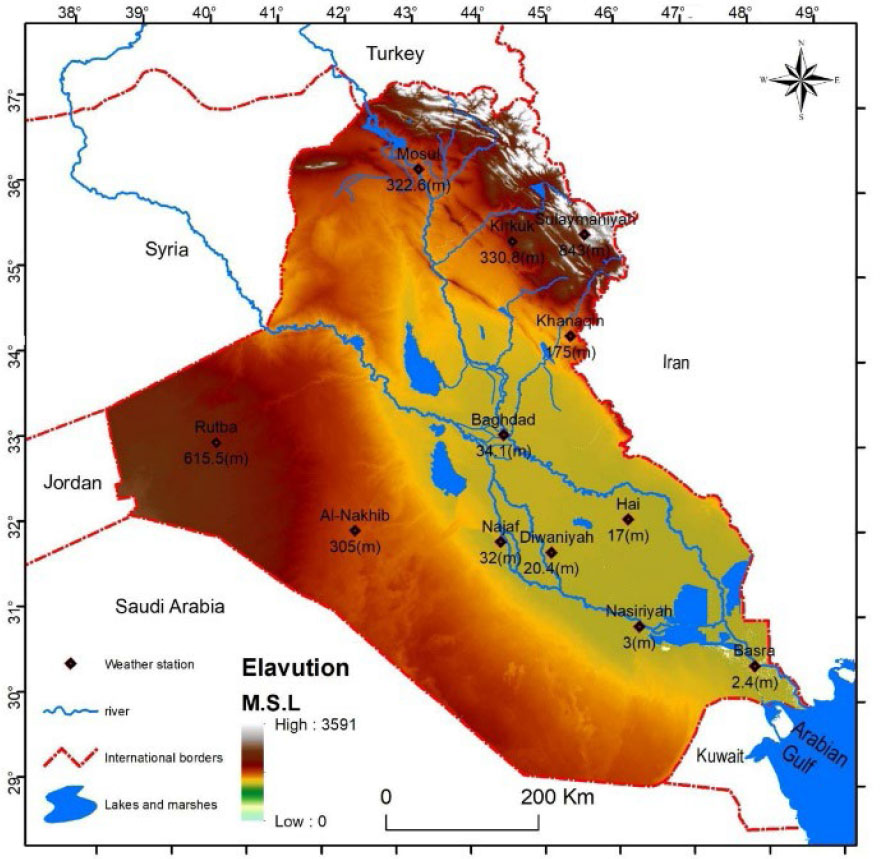
Figure 1.
Hypsometric map of Iraq with spatial distribution of meteorological stations used in the paper
Source: Republic of Iraq, Ministry of Water Resources, General Authority for Survey, Survey Department, 2021, and digital elevation model
Climate data obtained from the Iraqi Ministry of Transport and the General Authority for Meteorology and Seismology were used to determine the extent of change and the trends in summer temperatures and subsequent seasonal rainfall. The Mann–Kendall test is widely used for trend analysis in climatology and hydrological time series and was applied for this purpose. It is a non-parametric test, which means it does not require the data to be normally distributed and it has a low sensitivity to sudden interruptions caused by non-homogeneous time series. Data values are evaluated as an ordered time series (Alhaji et al. 2018). This test is commonly used to detect changes in climatic and hydrological time series (Hamed et al. 1998) and is based on two hypotheses. The first is the null hypothesis H0, which means that the data are independent and randomly distributed. The second is the alternative hypothesis HA, which means the monotony of values and the increase or decrease of the trend coefficient for the phenomenon under study. The Mann–Kendall test statistic S is calculated using the following equations (Muslih & Błażejczyk 2017):
Where: X = data value; k and j = Counters; n = Number of data; Sgn = An indicator function that takes on the values +1, 0, or −1 according to the sign of xj - xk: For n ≥ 10, statistic S is approximately normally distributed with the variance by the following equation: Where: q = Number of tied, tp = Number of data in the path group.Then, S and VAR (S) are used to compute the standard normal variable Z using the following equation.
The presence of a statistically significant trend is evaluated using the Z value. A positive value of Z indicates an upward trend, while a negative of Z value means a downward trend.
The simple correlation coefficient (Pearson correlation) was also used to determine the amount and strength of the statistical relationship and determine its significance based on the p-value. The p-value is a statistical measure that helps determine whether a given hypothesis is acceptable. The p-value is used to determine whether the results of an experiment are within the normal range (0.05). If the p-value is less than that, the null hypothesis is rejected, and vice versa, the alternative hypothesis is accepted. which was calculated using the following equations (Mohamed 2007)
Where: R = Pearson's correlation coefficient between X and Y, X = Dependent variable value Y = Independent variable value, N = Number of Views.The annual and monthly relationship between summer temperature (maximum, minimum, average) and rainfall was measured to determine the nature of that relationship and its direction and to determine which temperatures have the most influence on the rainfall of the following season. We also determined which months of the summer have the most influence on the rainfall in the following season. Data and maps published on the National Centre for Atmospheric Research (NCAR) website were used to obtain maps of various pressure levels, and particularly surface pressure anomalies at the 1000 hPa 1* level, geopotential height anomalies at the 850 and 500 hPa pressure levels, and wind speed anomalies at the 250 hPa level.
Results and Discussion
Summer temperature and seasonal total rainfall trends in Iraq
The impact of climate change on rainfall and air temperature has received considerable attention. These changes in temperature and precipitation have become evident on a global scale (Scatena & Neha 2015). Temperature is a primary climatic element that affects other factors and influences climatic phenomena. Iraq is one of the countries characterized by high-temperature averages due to its geographical location, the extensive low-lying areas of its territory, the limited vegetation cover, and its distance from the influence of water bodies, coupled with clear skies for most months of the year (Al-Dhizi 2013).
The annual temperature path in Iraq varies, as the temperature drops during the winter to below 0 °C, especially in northern Iraq for between 30–40 d. However, this rarely happens in southern Iraq. The lowest temperatures were recorded in January, then they gradually began to rise at the end of February and March until the summer. The highest temperatures were recorded in southern Iraq at Basra station in July, reaching more than 36 °C (Figure 2-a). Meanwhile, it was approximately 34 °C at Mosul station, indicating a difference of 2 °C between northern and southern Iraq due to the dominance of only one pressure system. This is represented by the Indian thermal depression, unlike the winter, which is affected by many surface pressure systems. This creates substantial temperature differences between northern and southern Iraq, reaching 5.4 °C (Muslih & Abbas 2024).
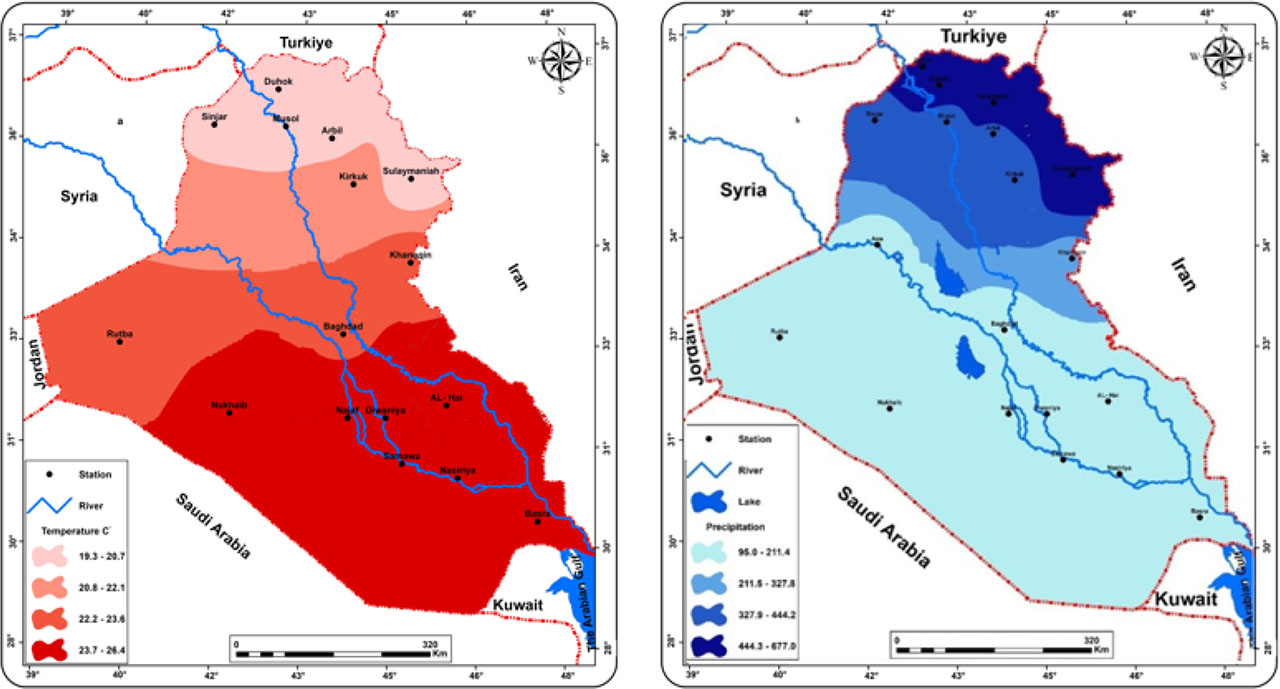
Figure 2.
Average annual air temperatures in Iraq from 1978 to 2020 (a): Mean annual precipitation in Iraq from 1978–2020 (b)
Source: adapted from Muslih & Abbas (2024)
The amount of rainfall in Iraq varies due to the diversity of its terrain, in addition to the variation in the frequency of Mediterranean depressions. The highest amount of rainfall was recorded in the northern and northeastern parts of Iraq, reaching 700 mm (Figure 2-b), before decreasing towards the south. In the undulating area represented by the Mosul station, the amount of rainfall reached 366 mm, then the western desert west of Iraq with a total rainfall of 112 mm. In southern Iraq, the rainfall decreased significantly, reaching 100 mm at the Basra station in the far south of Iraq. This is because of its location within flat lands, in addition to its distance from the areas where the rainy Mediterranean depressions pass (Muslih & Abbas 2024).
The scientific community has a consensus regarding climate change and the abnormal rise in global average surface temperatures. These changes have led to more frequent heatwaves on land and at sea (Magan et al. 2020). The increase in average surface temperatures during the twentieth century has been the subject of extensive research on whether the summers have become warmer and more extreme. Summer temperatures are increasing and are expected to continue due to the ongoing emissions of long-lived greenhouse gases (Alexander 2012; Rahmstorf & Coumou 2011).
In this section, we have examined the summer temperature trends over a 48-year study period for the climate stations in Iraq included in the study. Understanding the general trend of temperature and rainfall provides initial insights into whether their relationship is negative or positive.
The general trend of summer temperatures (maximum, minimum, and average) was extracted using the Mann–Kendall test. Temperatures showed a solid upward trend across all the studied stations at a high confidence level (99%). Table (2) shows that maximum temperatures have a clear upward trend from southern Iraq to northern Iraq, with Basra station showing the most change (0.137 °C). Changes began to decrease moving northward, with the Mosul station having the least change of 0.035 °C. However, the Khanquin station exhibited a deviation from the general pattern, recording a change of 0.082 °C due to its location in a lower altitude area than its surrounding regions.
Table 2.
The amount of annual change in maximum, minimum and average temperatures at a significance level of 99%, and the seasonal change in rainfall after a significance level of 95% with a bold line and the one below it with a line at a level of 90%)
| Station | Tmax | Tmin | Tmean | Rainfall |
|---|---|---|---|---|
| Mosul | 0.035 | 0.055 | 0.033 | −1.015 |
| Sulaimaniya | 0.046 | 0.042 | 0.028 | −1.909 |
| Kirkuk | 0.058 | 0.093 | 0.071 | −2.804 |
| Khanaqin | 0.082 | 0.084 | 0.081 | −2.245 |
| Rutba | 0.053 | 0.080 | 0.087 | −0.680 |
| Baghdad | 0.057 | 0.091 | 0.073 | −0.464 |
| Hai | 0.063 | 0.085 | 0.067 | −0.910 |
| Diwaniya | 0.058 | 0.103 | 0.067 | −0.509 |
| Nasiriya | 0.083 | 0.103 | 0.067 | −0.834 |
| Basrah | 0.137 | 0.106 | 0.120 | −1.360 |
The minimum temperature significantly changed more than the average and maximum temperatures in seven climate stations. Changes in the southern stations were higher than those in the northern stations, with Basra station recording the highest change of 0.106 °C. The changes decreased as we moved north, reaching Sulaymaniyah and Mosul stations, which recorded the lowest changes of 0.042 °C and 0.055 °C, respectively. Similarly, the average temperature change recorded the highest increase at Basra station (0.120 °C), with a decrease in changes moving northward to Sulaymaniyah station, which recorded the least change of 0.028 °C.
This shows that the general temperature trend (average, maximum, and minimum) has been rising, indicating that Iraq is experiencing a warming period. The findings align with the current trend of global warming, which has been confirmed by many studies, particularly global reports on climate change. The Fifth Assessment Report by the International Panel on Climate Change (IPCC) (IPCC 2013) stated that the average global surface temperature increase reached approximately 0.72 °C from 1951 to 2012. The report also suggests that more than half of the rise in average global surface temperature is attributed to human activities that have increased greenhouse gases. Muslih and Błażejczyk (2017) evaluated the differences between years and long-term trends in monthly temperatures at seven climatic stations using linear regression and the Mann–Kendall test. They found increasing trends, with the main warming trends occurring during the summer.
They also observed a general warming trend across all the studied stations in Iraq from 1941 to 2013, with warming beginning in the mid-1970s. Robaa and Al-Barazanji (2015) focused on assessing surface air temperature trends at eleven stations from 1972 to 2011, using the Mann–Kendall test, Sen's slope estimator and linear regression. They found an increasing trend in minimum and maximum annual temperatures at most stations in Iraq.
The general rainfall trend in Iraq shows that all study stations exhibited a general downward trend. This indicates a decrease in rainfall, with the highest changes occurring in the northern stations of Iraq compared to the south. This can be attributed to the northern stations being more affected by orographic depressions, where any changes in these depressions directly impact rainfall amounts. Three stations showed statistically significant trends, with Khanquin having the most prominent change at approximately −2.245 mm at a 95% confidence level, followed by Kirkuk and Basra with changes of −2.804 mm and −1.306 mm at a 90% confidence level. This aligns with the findings of the IPCC in its fifth assessment report (IPCC 2013). This indicated a decline in rainfall in the Middle East from 1951 to 2013, with changes ranging from (−5 to −25 mm) per decade. The results of this study are consistent with most local studies, including that of Al-Dhizi (2014), which examined the general trend of rainfall in Iraq and concluded that all stations in Iraq showed a downward trend in rainfall, except for the Basra station, which recorded an upward trend. Similarly, Al-Budeiri (2021) highlighted that the annual rainfall trend in the twelve stations included in the study was downward across all studied stations, except for Baghdad, which showed a positive but statistically insignificant upward trend.
The relationship between summer temperature and rainfall in the subsequent season is negative. This preliminary assumption arises from the general trends observed in temperature and rainfall. All the summer temperature averages are trending upward, while the rainfall for the following season is trending downward. This hypothesis has been statistically verified in the next section to confirm its validity.
The climatic correspondence and coupling between summer temperature and rainfall in Iraq
Through a matching analysis between the annual averages of all types of temperatures (maximum, minimum, and average) and the seasonal total of rainfall at the studied stations in Iraq, two patterns emerged regarding the correlation between summer temperature and subsequent season rainfall. Each of these patterns can be described as follows:
The opposite pattern
This pattern consists of two opposing trends. The first trend occurs when the average temperature of the summer exceeds its long-term average, leading to a decrease in the rainfall of the subsequent season below its long-term average. The second trend occurs when the average temperature of the summer is below its long-term average, increasing the rainfall of the subsequent season above its long-term average. Table (3) and Figure (3) show that the first trend, characterized by an increase in summer temperature and a decrease in total rainfall for the subsequent season, had higher occurrences than the second trend. The first trend recorded 148 occurrences with maximum temperature, 145 with minimum temperature, and 146 with the average summer temperature. This indicates that rainfall in the following season tends to decrease when summer temperatures rise above their long-term averages. This finding confirms previous studies on this topic and aligns with the statistical correlation relationships that point to the same result.
Table 3:
Recurrence of the opposite pattern resulting from the combination of increased temperature with decreased total rainfall and vice versa in Iraqi stations for 1974–2021
| Station | Increased temperature with decreased rainfall | Decreased temperature with increased rainfall | ||||
|---|---|---|---|---|---|---|
| Tmax | Tmin | Tmean | Tmax | Tmin | Tmean | |
| Mosul | 15 | 16 | 16 | 10 | 15 | 13 |
| Sulaimaniya | 15 | 13 | 14 | 15 | 13 | 12 |
| Kirkuk | 15 | 12 | 15 | 16 | 13 | 15 |
| Khanaqin | 16 | 15 | 15 | 16 | 14 | 15 |
| Rutba | 17 | 17 | 12 | 12 | 14 | 14 |
| Baghdad | 14 | 15 | 16 | 13 | 12 | 14 |
| Hai | 16 | 16 | 16 | 13 | 12 | 12 |
| Diwaniya | 12 | 13 | 13 | 15 | 9 | 12 |
| Nasiriya | 13 | 14 | 14 | 12 | 15 | 15 |
| Basrah | 15 | 14 | 15 | 11 | 16 | 12 |
| Sum. | 148 | 145 | 146 | 133 | 133 | 134 |
| Perc. | 33.7 | 33.0 | 33.3 | 33.25 | 33.25 | 33.5 |
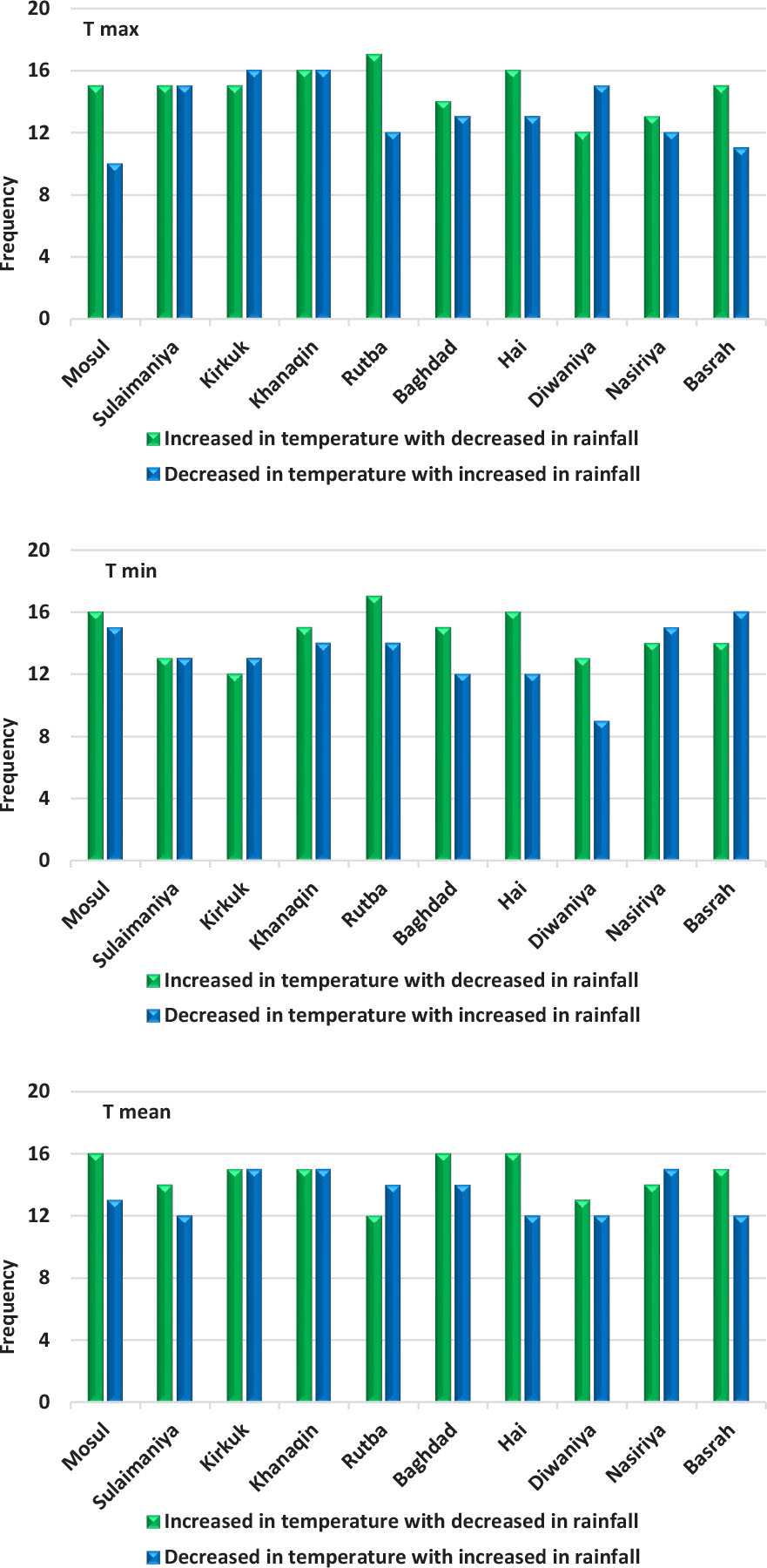
Figure 3.
Repetition of the opposite pattern resulting from the combination of increased temperature (maximum, minimum and average) with a decrease in total seasonal rainfall and vice versa in Iraq stations for 1974–2021
Source: Based on data from Table 3
The second trend, characterized by a decrease in summer temperatures and an increase in the total rainfall of the subsequent season, recorded fewer occurrences than the first trend. It had 133 occurrences with both the maximum and minimum temperature averages and 134 occurrences with the annual average summer temperature. This result aligns with the statistical findings, which indicate that a decrease in temperature averages below their long-term average leads to increased rainfall.
Second: Symmetrical pattern
This pattern consists of two trends that are positively correlated. The first trend occurs when summer temperatures rise above their long-term average, accompanied by increased rainfall for the subsequent season. The second trend is observed when summer temperatures drop below their average, decreasing rainfall for the following season. As shown in Table (4) and Figure (4), the first trend recorded a lower total frequency compared to the second trend, with occurrences of 83, 82, and 84 for maximum, minimum and average temperatures, respectively. Analyzing this trend indicates that it is one of the least frequent compared to the previous opposite trend. This leads to the conclusion that increased temperature averages result in decreased rainfall. The few occurrences recorded in this trend can be attributed to other factors, local or global, or a combination. In contrast, the second trend recorded frequencies of 116, 121 and 121 for maximum, minimum and average temperatures, respectively.
Table 4.
Repetition of similar patterns resulting from the combination of the increase in temperature with the increase in total rainfall and vice versa in the stations of Iraq for 1974–2021
| Station | Increase in temperature with increase in total rainfall | Decrease in temperature with decrease in total rainfall | ||||
|---|---|---|---|---|---|---|
| Tmax | Tmin | Tmean | Tmax | Tmin | Tmean | |
| Mosul | 11 | 6 | 8 | 12 | 11 | 11 |
| Sulaimaniya | 10 | 12 | 13 | 8 | 11 | 10 |
| Kirkuk | 5 | 8 | 6 | 12 | 15 | 12 |
| Khanaqin | 6 | 8 | 7 | 10 | 11 | 11 |
| Rutba | 6 | 4 | 4 | 13 | 13 | 18 |
| Baghdad | 7 | 8 | 6 | 14 | 13 | 12 |
| Hai | 7 | 8 | 8 | 12 | 12 | 12 |
| Diwaniya | 9 | 14 | 11 | 12 | 12 | 13 |
| Nasiriya | 10 | 7 | 10 | 13 | 12 | 12 |
| Basrah | 12 | 7 | 11 | 10 | 11 | 10 |
| Sum. | 83 | 82 | 84 | 116 | 121 | 121 |
| Perc. | 33.4 | 32.9 | 33.7 | 32.4 | 33.8 | 33.8 |
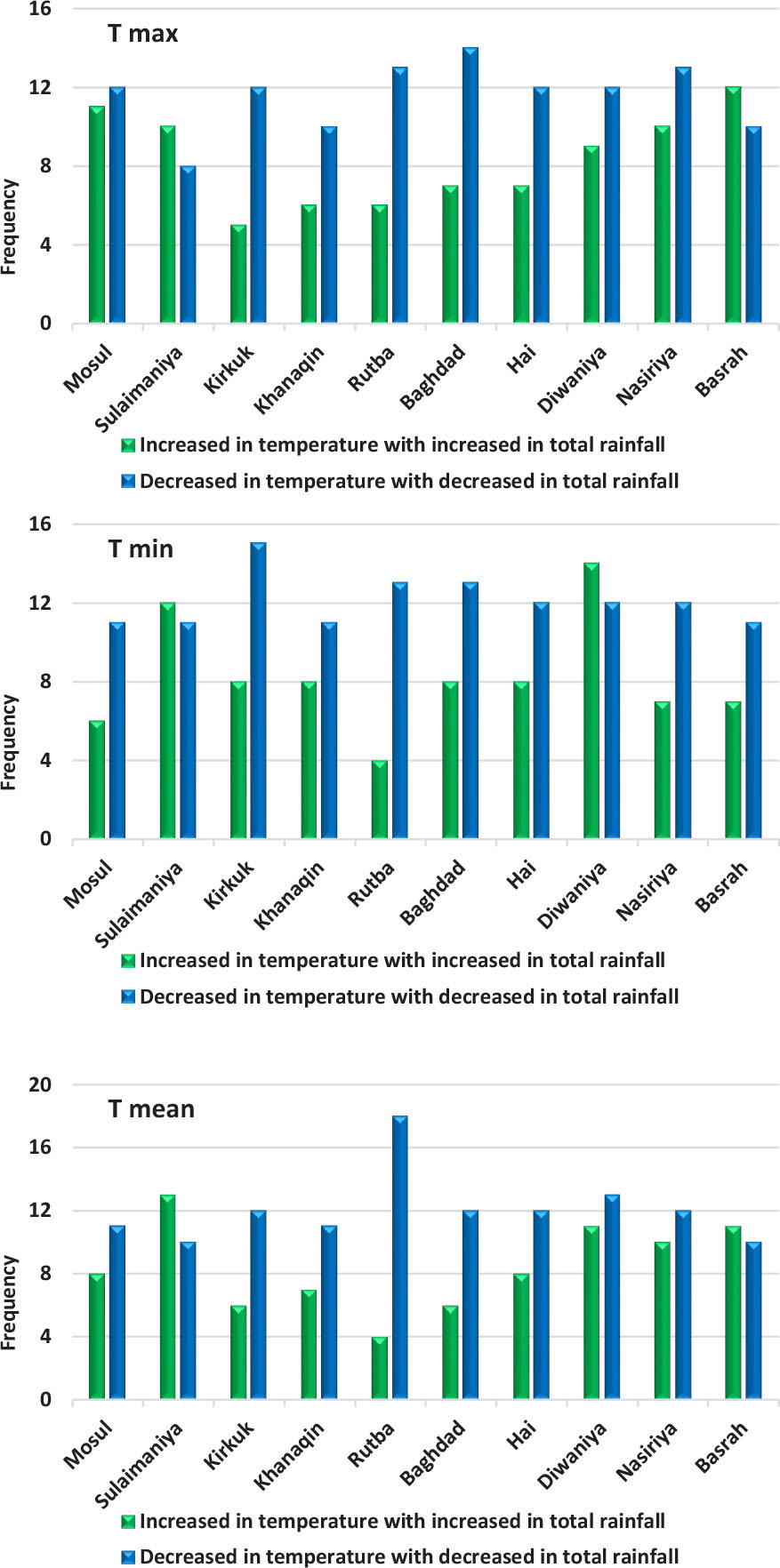
Figure 4.
Repetition of a similar pattern resulting from the coupling of the temperature increase (maximum, minimum and average) with the rise in the total seasonal rainfall and vice versa at the stations of Iraq for 1974–2021
Source: Based on data from Table 4
The correlation between summer temperature and rainfall
The correlation coefficient between summer temperatures (maximum, minimum, and average) and rainfall in the subsequent season was extracted. The statistical test for this relationship showed variability in the correlation coefficient's strength, as indicated in Table (5). The correlation with the average temperature was the most frequently significant in five meteorological stations, namely, Mosul, Kirkuk, Khanqin, Baghdad, and Basra. The strength of the correlation coefficient ranged from −0.320 in Mosul, that is, the strongest correlation, to −0.191 in Baghdad, that is, the weakest and least correlated. The correlations with maximum and minimum temperatures were ranked second, where significant correlations were found in only four stations. These were also less frequent in terms of significance, and all showed a negative relationship. This indicated that rainfall decreases with increasing temperature and vice versa. This result aligns with most local and global studies, most of which state that rainfall increases with decreasing temperature.
Table 5.
Simple correlation between annual summer temperature rates and total seasonal rainfall for 1974–2021
| Station | Tmax | Tmin | Tmean |
|---|---|---|---|
| Mosul | −0.354** | −0.347** | −0.320* |
| Sulaimaniya | −0.282* | −0.179 | −0.138 |
| Kirkuk | −0.266* | −0.231* | −0.276* |
| Khanaqin | −0.137 | −0.124 | −0.199* |
| Rutba | −0.101 | −0.054 | −0.025 |
| Baghdad | −0.187 | −0.234* | −0.191* |
| Hai | −0.049 | −0.157 | −0.050 |
| Diwaniya | 0.040 | −0.075 | 0.010 |
| Nasiriya | −0.070 | −0.070 | −0.044 |
| Basrah | −0.226* | −0.233* | −0.215* |
Although the other stations lacked statistical significance, they all recorded negative correlation relationships, except for the Diwaniya station, which recorded a non-significant direct correlation with maximum and average temperatures. As for monthly statistical relations, there was also a variation in the strength of the relationship and its statistical significance. Table (6) shows that most statistical relationships were inverse, and the most robust and most frequent significant relationships were found in June. The statistical relationships were significant in the Nasiriyah and Basra stations with maximum temperature and the Mosul and Kirkuk stations with minimum temperature. The average temperature in the Mosul, Baghdad, Nasiriyah and Basra stations showed negative relationships, indicating that rainfall decreases as temperatures increase.
Table 6.
Simple correlation between monthly summer temperature rates and total seasonal rainfall for 1974–2021
| Station | Maximum temperature | Minimum temperature | Mean temperature | ||||||
|---|---|---|---|---|---|---|---|---|---|
| Jun | July | August | Jun | July | August | Jun | July | August | |
| Mosul | −0.053 | −0.163 | 0.063 | −0.363* | −0.365* | −0.272* | −0.342* | −0.047 | −0.121 |
| Sulaimaniya | −0.194 | −0.174 | −0.160 | −0.215 | −0.099 | 0.147 | −0.200 | −0.169 | 0.055 |
| Kirkuk | −0.146 | −0.165 | −0.101 | −0.337* | −0.331* | −0.165 | −0.223 | −0.201 | −0.090 |
| Khanaqin | −0.039 | −0.058 | −0.040 | −0.205 | −0.177 | −0.145 | −0.145 | −0.145 | −0.089 |
| Rutba | −0.159 | 0.058 | −0.138 | 0.139 | 0.061 | 0.073 | −0.103 | 0.050 | −0.026 |
| Baghdad | −0.223 | −0.184 | −0.155 | −0.011 | −0.019 | −0.095 | −0.256* | −0.195 | −0.130 |
| Hai | −0.158 | −0.105 | 0.029 | −0.107 | −0.084 | 0.008 | −0.124 | −0.126 | 0.006 |
| Diwaniya | −0.194 | 0.084 | 0.192 | 0.104 | 0.012 | 0.126 | −0.140 | −0.093 | 0.039 |
| Nasiriya | −0.258* | −0.254* | 0.124 | −0.075 | −0.097 | −0.036 | −0.292* | −0.272* | −0.187 |
| Basrah | −0.318* | −0.188 | −0.223 | −0.162 | −0.122 | −0.055 | −0.263* | −0.213 | −0.220 |
In July, the correlation relationships were lower than in June, with only one significant relationship at the Nasiriyah station for maximum and average temperature and two significant relationships at the Mosul and Kirkuk stations for minimum temperature. August was the weakest and least significant month compared to the others, as no statistical relationships were recorded with maximum and average temperature. However, only a significant correlation was observed in the Mosul station with minimum temperature.
June is the summer most significantly correlated with rainfall. It is possible to predict the rainfall of the subsequent season based on the temperature of June in all its types (average, maximum, and minimum). The higher the temperature in June above the average, the more likely the subsequent rainy season will be dry, with rainfall below the average. Conversely, if the temperature drops below the average, the subsequent season may be wet. Temperature is just one of several contributing factors in determining rainfall, and this study focuses on the impact of temperature without considering other factors, especially the broader ones.
The synoptic correlation and coupling of the summer season in Iraq for the years (1993 and 2010): the two subsequent rainy seasons (193/994 and 2010/2011)
In this section, we have explored the overall correlation and association between summer temperatures and total rainfall in the subsequent season for two different years selected based on their comparison to the general averages. Moderate temperatures characterized the first year (1993) compared to the general average during the summer and the subsequent wet rainy season (1993/1994). In contrast, the second year (2010) experienced high summer temperatures and a dry rainy season (2010/2011), as shown in Table (7).
Table 7.
Characteristics of the years selected for interpretation during the summer and the following season in Iraq
| Year | Tmax | Tmin | Tmean | Rainfall | Year class | ||||
|---|---|---|---|---|---|---|---|---|---|
| Average annal temperature | General average | Average annual temperature | General average | Average annual temperature | General average | Annual rainfall rate | General average rainfall | ||
| 1993 | 42.1 | 42.6 | 25.6 | 26.2 | 34.1 | 34.6 | 379.6 | 242.7 | Wet |
| 2010 | 44.0 | 28.0 | 36.0 | 224.8 | Dry | ||||
The analysis of the synoptic maps for 1993 showed a temperature below average and the total rainfall for its subsequent season (1993/1994) was above average. A temperature above average and the rainfall for its subsequent season (2010/2011) below average was recorded for 2010.
First: The overall situation in the summer in Iraq in 1993 and 2010
There is a variation in the surface pressure level (1000 hPa) in the dominance of pressure systems and the amount of surface pressure anomaly. In the summer of 1993, complete and absolute dominance of a surface high-pressure system was influenced by several factors. From the north, there were extensions of the European high. From the northeast, there were extensions of the Siberian high. From the west, there were extensions of the subtropical high.
This indicates descending air from above and the dominance of atmospheric stability. In contrast, the negative pressure anomaly over most parts of Iraq in the summer of 2010 shows a clear dominance of a surface low-pressure system and a state of surface instability resulting from air accumulation at the surface, its ascent and its dispersion above, as shown in Figure (5). At the pressure level of 850 hPa, which allows for the inference of the strength or weakness of the pressure system at the surface level (1000 hPa), the maps indicate a complete dominance of a high-pressure system over Iraq in the summer of 1993. This suggests a deepening of the surface high-pressure system during that year, as the air uplift movements at the surface level corresponded to similar movements at the 850 hPa level.
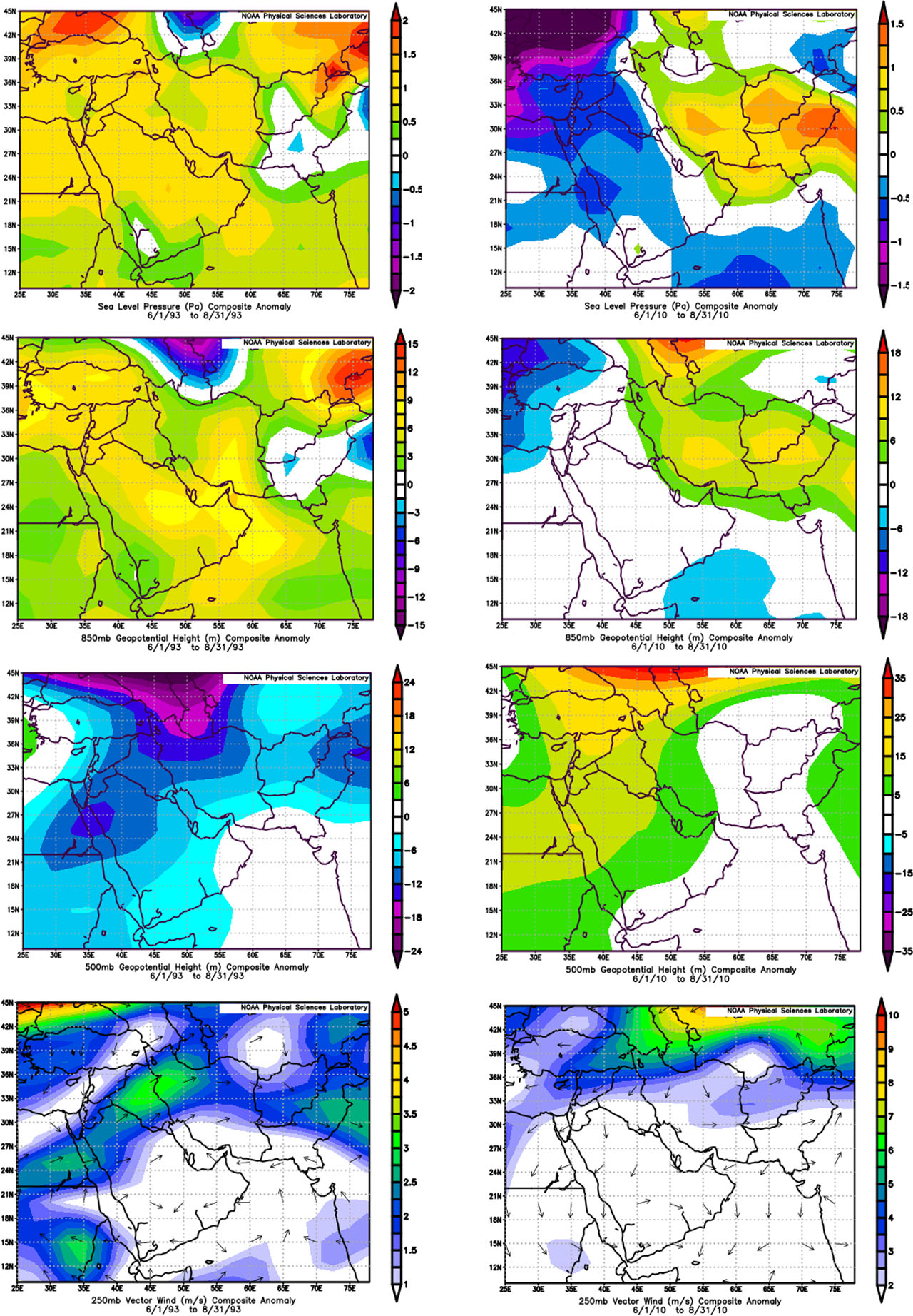
Figure 5.
Summer synoptic coupling patterns in Iraq for 1993 and 2010, (from left to right respectively). Pressure anomaly at sea level (hPa) (top panels); pressure height anomaly at 850 hPa (top second row panels); pressure height anomaly at 500 hPa (Third row panels from top); and wind speed anomaly (m/s) at 250 hPa (bottom panels).
This led to an increase in the strength of the pressure system, significantly enhancing the state of surface atmospheric stability. In contrast, during the summer of 2010, a surface low-pressure system was evident on the eastern side of Iraq, extending as a band from the northern to the southern part of the country. The withdrawal of the surface low-pressure system to the north, away from Iraq, indicates the shallowness of the surface low-pressure system.
A clear zonal anomaly was observed between the two years at the pressure level of 500 hPa, which is crucial due to its key role in the strength and activity of surface pressure systems. In the summer of 1993, a north–south trough dominated, bringing cold air down toward Iraq and affecting all its regions. This, in turn, significantly reduced summer temperatures in Iraq, making it a mild summer, with temperatures recorded below average for all categories (maximum, minimum, and average). In contrast, the summer of 2010 exhibited a positive zonal anomaly, characterized by the influx of warm tropical air masses toward Iraq from the south, originating from hot and dry areas, particularly the Arabian Peninsula and North Africa. This resulted in elevated temperatures across Iraq, with all categories of temperature recorded above average as well.
At the 250 hPa level, the horizontal wind movement and the dominance of the polar jet stream were the prevailing conditions, confirming the overall situation observed in the previously mentioned pressure levels. The polar jet stream extended and formed a secondary centre during the summer of 1993. This centre was positioned directly over Iraq, extending transversely from west to east, with a sloping trough from north to south. This facilitated the advance of polar air masses toward Iraq, resulting in a decrease in temperature. In contrast, during the summer of 2010, the polar jet stream only extended into limited areas of northern Iraq. Meanwhile, the subtropical jet stream dominated the rest of the country. This led to the influence of tropical conditions reaching other parts of Iraq through the trough at the 500 hPa pressure level.
At the 100 hPa level, the condition for both years is evident. In the summer of 1993, there is oscillation and a weakening of the polar vortex toward the lower latitudes, with its influences reaching the Middle East and particularly Iraq. The vortex divides into several cells, with one of its cells extending into Iraq and covering it entirely, as shown in Figure (6). This indicates the arrival of a relatively cold air mass to Iraq, which substantially adjusted the summer temperature. In contrast, during the summer of 2010, the polar vortex only affected the pole and its surrounding areas. In Iraq, this year saw the advancement of warm tropical air masses, especially in the Mediterranean Basin, with their extensions reaching Iraq, resulting in an increase in temperatures above average.
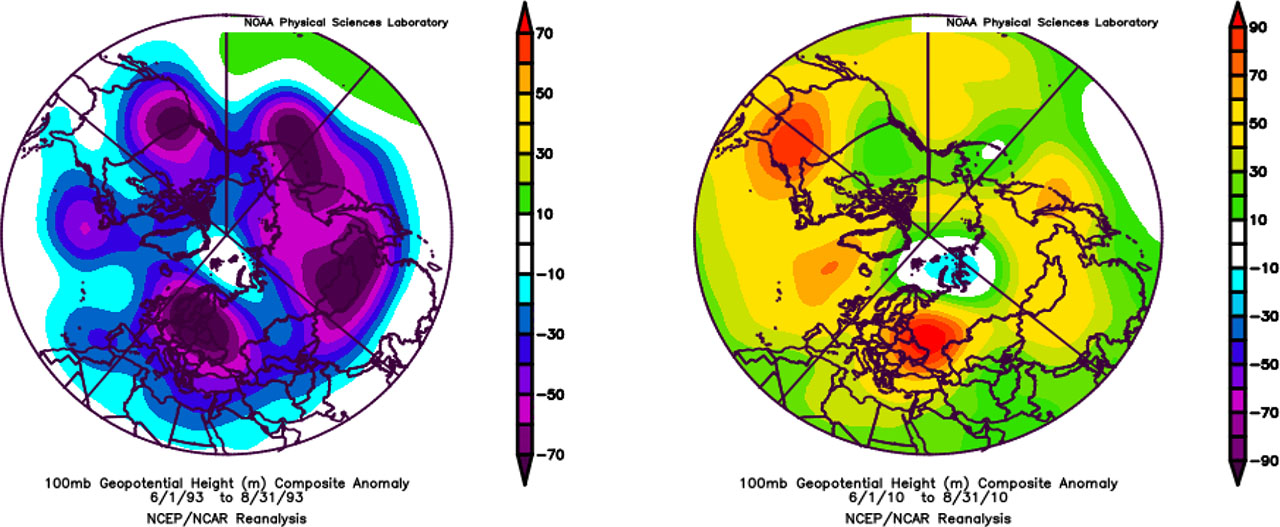
Figure 6.
Anomaly of the pressure rise of the 100 hPa level from the left for the summer of 1993 and from the right for the summer of 2010
The overall situation of the rainy season in Iraq for the two seasons (1993/1994 and 2010/2011)
The analysis of the maps of the dry and wet rainy seasons in Iraq show that at the surface pressure level (1000 hPa), the pressure anomaly during the wet rainy season (1993/1994) was within the general averages, with a slight negative pressure anomaly covering a small part of eastern Iraq. A high-pressure ridge was noted extending from the north to the south towards the Red Sea. In contrast, during the dry rainy season (2010/2011), Iraq was influenced by a negative pressure anomaly below the average. Iraq became a pathway for low-pressure systems and a convergence zone, particularly for the Indian monsoon low and the Mediterranean low, as shown in Figure (7).
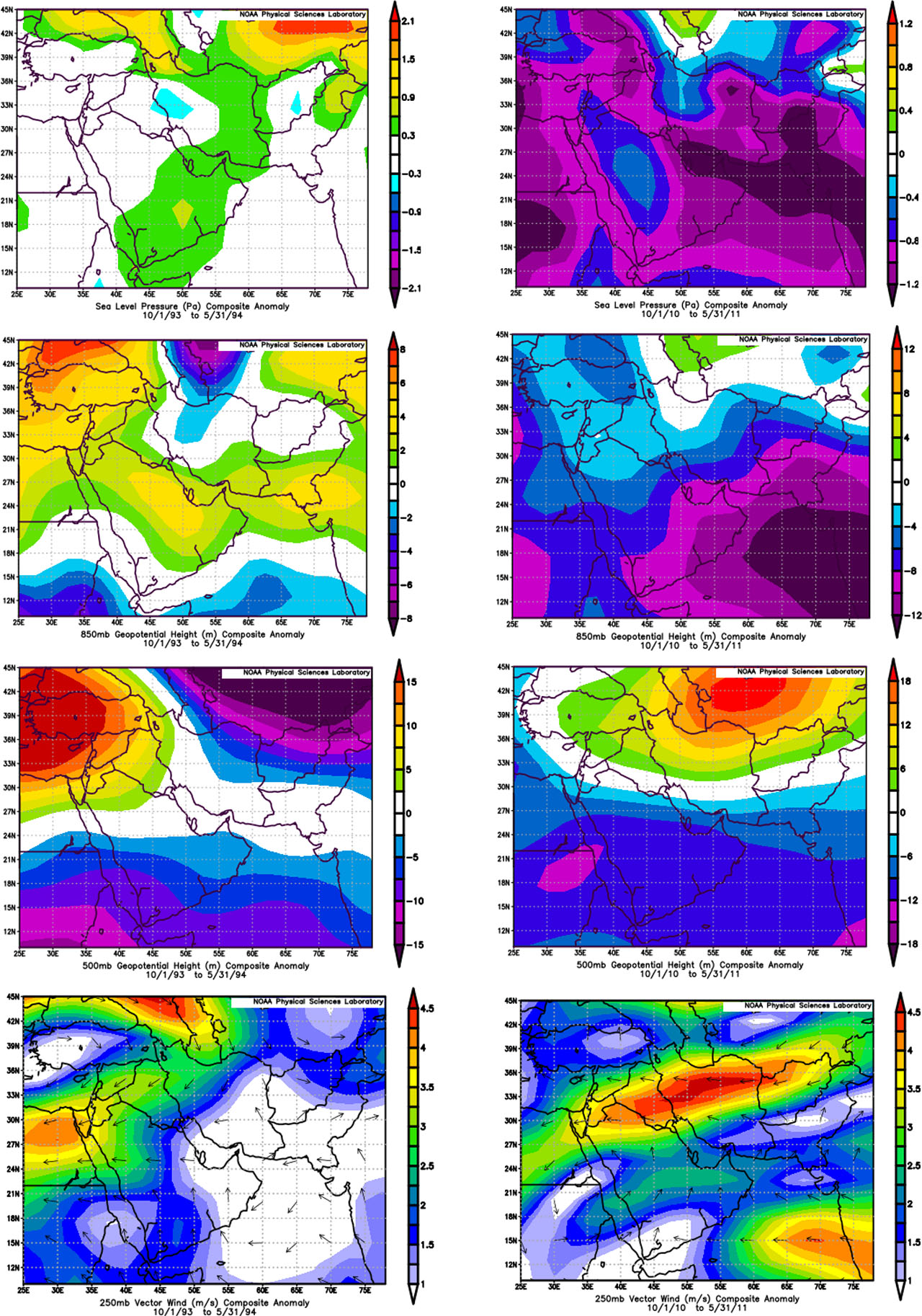
Figure 7.
synoptic coupling patterns for the rainy season in Iraq (1993/1994 and 2010/2011), from left to right respectively. Pressure anomaly at sea level (hPa) (top panels); pressure anomaly at 850 hPa (top second row panels); pressure anomaly at 500 hPa (top third row panels); and wind speed anomaly (m/s) at 250 hPa (bottom panels)
At the pressure level of 850 hPa, there is a clear anomaly in the geopotential height of the pressure systems affecting Iraq. During the wet rainy season (1993/1994), a high-pressure system is observed at the surface, which deepened the surface system. In contrast, the dry rainy season (2010/2011) exhibited the opposite situation, where a low-pressure system was present, resulting in a deep surface system. During the wet season, the pressure anomaly increased. Meanwhile, in the dry season, the pressure anomaly decreased, which is contrary to previous studies. This difference will be further investigated in the upper-pressure levels.
At the pressure level of 500 hPa, a high-pressure system was observed during the season (1993/1994), although the rainfall in this season was above average, categorizing it as a wet season. This high-pressure system significantly influenced the conditions at this pressure level. However, when moving up to the level of 250 hPa, a blocking pattern was evident over the Mediterranean Sea, leading to a split in the polar jet stream into two branches.
The first branch headed towards northern Europe, while the second moved towards the eastern shores of Europe, continuing its trajectory to reach Iraq before reuniting with the first branch of the jet stream. The downward movement of the jet stream over Iraq contributed to increased rainfall by enhancing the frequency of surface low-pressure systems and lowering temperatures. This resulted in a significant increase in condensation processes and higher-than-average rainfall.
In the season (2010/2011), there was an influence of an upper high-pressure system was observed, which caused air to descend and stabilize over Iraq, resulting in a complete cessation of rainfall in the region. At the 250 hPa level, there is a clear effect and dominance of the subtropical jet stream over Iraq, which hinders the progression of surface low-pressure systems, redirecting their paths northward and away from Iraq. Despite the presence of a surface low-pressure system and its deepening at the 850 hPa level, this did not lead to rainfall during this season due to the presence of a trough at the 500 hPa level, along with the subtropical jet stream at the 250 hPa level. These factors prevented upward air movements, thus inhibiting condensation processes and the occurrence of rainfall.
At the 100 hPa level, which illustrates the polar vortex and the flow of cold air from high latitudes towards the mid and low latitudes, during the wet season (1993/1994), Iraq was influenced by the extension of one of the cold polar vortex cells towards the region. This effect was significant, accompanied by a pressure barrier over the Mediterranean Sea. The cold air contributed to a decrease in temperature initially, followed by an increase in condensation processes. In contrast, during the dry season (2010/2011), Iraq was significantly affected by a clear inflow of tropical air, with polar influences moving far away from the region. This atmospheric condition during the season contributed to making the rainy season dry, with precipitation levels below the average, as shown in Figure (8).
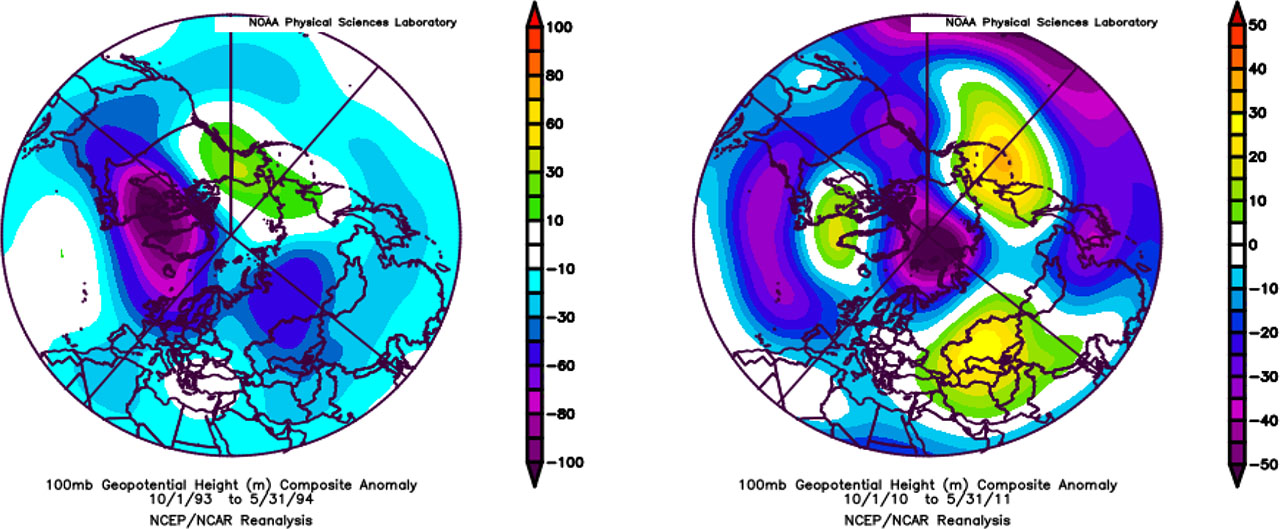
Figure 8.
Anomaly of the (100) (hPa) level from the left for the rainy season (1993/1994) and from the right for the rainy season (2010/2011)
Conclusion
The study findings showed that the general temperature trends over 48 years have been increasing across all monitoring stations in the study area. This result aligns with global reports from the International Panel on Climate Change (IPCC), which indicated that parts of Iraq – specifically the far south, including Basra and neighbouring areas in Iran and Kuwait – are among the hottest regions worldwide. The change in precipitation showed an opposite trend to that of temperature, showing a decline across all stations in Iraq.
Two clear patterns showed the relationship between summer temperature and rainfall, that is, the opposite pattern and the symmetrical pattern. The first pattern occurred more frequently than the second. The average summer temperature was more significant than the average maximum and minimum temperatures. If the summer in which the temperature in June is higher than the general average, the following rainy season will be a dry season.
As for the cases of synoptic coupling, two years were selected for analysis. The first was 1993, which had a mild summer and a wet rainy season, with temperatures below average, followed by a rainy season (1993/1994) that was above average. The second year, 2010, had a hot summer and a dry rainy season, with temperatures above average, and the subsequent rainy season (2010/2011) was below average. Analysis of the summer maps for both years showed that the mild year exhibited positive pressure anomalies at the surface and height anomalies at the 850 hPa level, a trough was present, bringing cold air. In contrast, in 2010, there was an influence from a tropical depression that ridge the warm air masses to Iraq, raising its temperatures, and the subtropical jet stream dominated at the 250 hPa level.
During the rainy season, the wet season (1993/1994) was within the general averages, with a negative pressure anomaly extending and deepening at the 850 hPa level. In contrast, during the dry rainy season (2010/2011), Iraq was affected by a negative pressure anomaly below average, deepening also at the 850 hPa level.
At the 500 hPa level, there was a high-pressure system during the season (1993/1994) although the rainfall for this season was above average and classified as a wet season, along with being influenced by a high-pressure system at this level. However, as one moves to the 250 hPa level, a blocking pressure pattern was observed over the Mediterranean Sea, leading to a split in the polar jet stream. This descended over Iraq and contributed to increased rainfall by enhancing the frequency of surface low-pressure systems. In contrast, during the dry season (2010/2011), an upper-level high-pressure system was influenced by air descending and stabilizing over Iraq, resulting in a lack of rainfall. At the 250 hPa level, the influence and dominance of the subtropical jet stream over Iraq hindered the advancement of surface low-pressure systems. They altered their trajectory northward, distancing them from Iraq.