
Introduction
Dam construction has both positive and negative social impacts (Kirchherr et al. 2016). In this respect, people evaluate all phenomena according to their usefulness to themselves (Napier et al. 1986). Therefore, an individual’s evaluation of a dam project depends on the number of benefits and losses they associate with it. Social perception of dam reservoirs is further affected by emotional and economic variables and can differ significantly depending on whether a person belongs to a resettled or non-resettled population group. Displaced people view dam projects more negatively than people who did not have to move. Personal variables, including gender, do not influence the perception of dam reservoirs (Piróg 2019; Wiejaczka et al. 2020).
Perceptions of the social ramifications of dams have largely been shaped by the scientific literature that has addressed them (Kirchherr et al. 2016). The relationship between dam projects and social and economic development is not completely clear. This is because dam reservoir development often contribute to socioeconomic development. However, they can result in stagnation or make socioeconomic conditions worse (Chen et al. 2016; Shi et al. 2019; Fan et al. 2022). An increase in economic development around dam reservoirs can mean that residents are satisfied with them. However, socioeconomic deterioration may lead to dissatisfaction in the community. However, to date, no prior studies have been conducted to examine the relationship between these variables, that is, between socioeconomic development around reservoirs and the level of social satisfaction or dissatisfaction. Examining the relationship between economic activity from reservoir construction and the satisfaction levels of residents can generate key information on planning new reservoirs and increasing the positive impact of existing dams on local populations (Mathur 2011). This research can also inform economic growth planning from dam reservoir construction in a way that prolongs their positive impact. Analyzing the positive and negative impacts of reservoirs and their associated infrastructure means that infrastructure can be better aligned with local community needs. Unmet expectations and undelivered promises are another issue requiring additional, multi-dimensional research. Promises made and not kept, and investments that are inadequately implemented, can completely change the perception of a new reservoir. This was demonstrated with the Alqueva Dam in Portugal twelve years after the facility was opened (Dias-Sardinha & Ross 2015). Therefore, the balance between positive and negative perceptions of projects depends on a number of overlapping environmental, socioeconomic and personal factors (Abdullah & Rahman 2021; Dopico et al. 2022).
The purpose of this study was to capture the relationship between the way the community views – either positively or negatively – the construction of a dam reservoir and the plan for the local development around it. The research hypothesis tested assumes that residents’ expectations of socioeconomic development around the dam reservoir determine whether they are satisfied with the project. Studying the development of areas in the vicinity of dams are best conducted in relation to newly constructed dams because allows monitoring of long-term changes in perceptions as the structure ages. This is why our research has focused on the Mucharz reservoir on the Skawa River in the upper Vistula River basin in Polish Carpathians, which was opened in 2017 (Fig. 1). Given that it has been in operation for several years, we were able to form an impression of the different views of the initial local socioeconomic development plan held by the different stakeholders affected by the project.
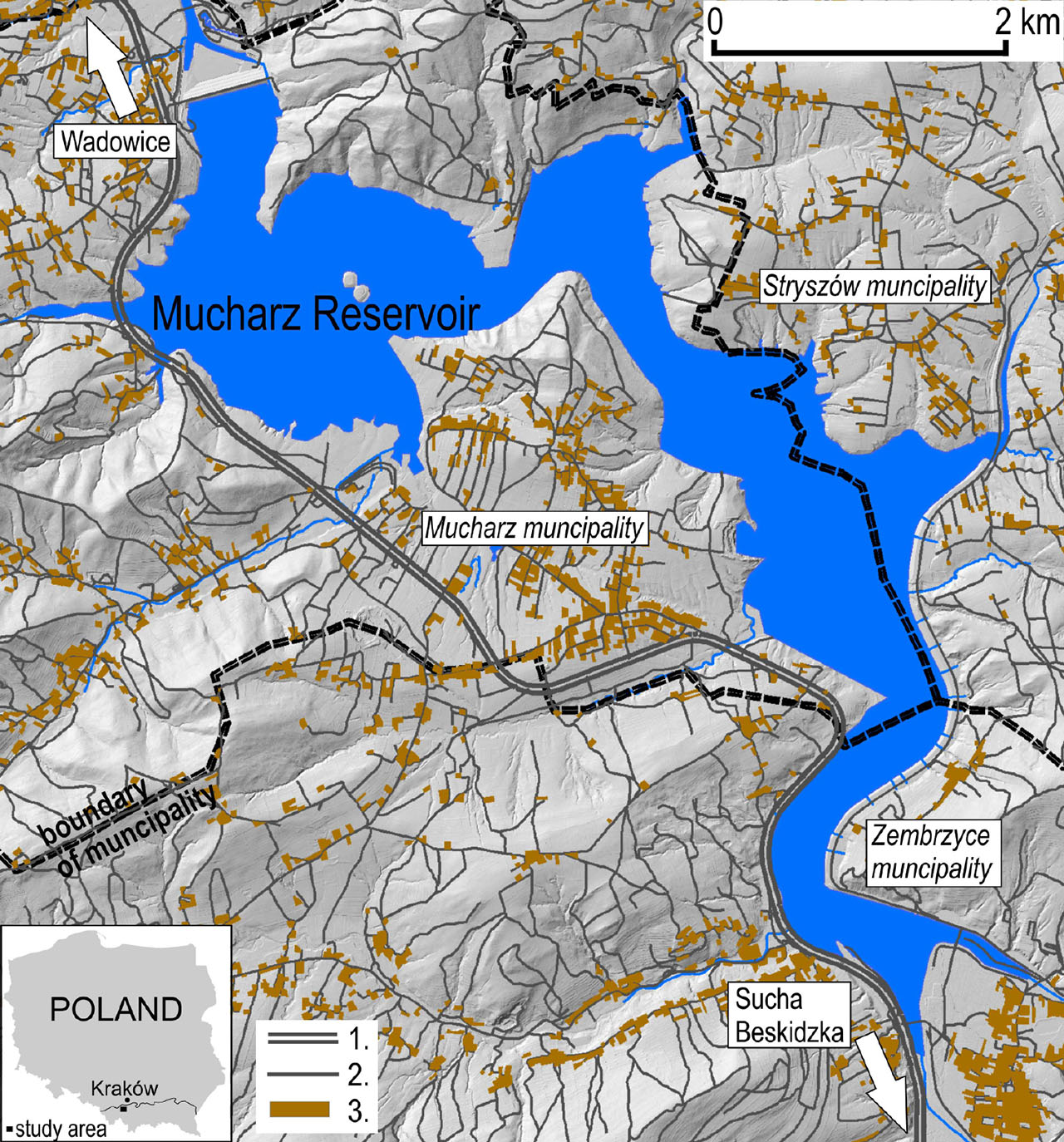
Figure 1.
Location of Mucharz Reservoir within three municipalities. Explanatory note: main national road (1), other public roads (2), housing developments (3). (Data source: geoportal.gov.pl).
Source: own elaboration
Data and methods
The respondents were selected randomly from households in the municipalities near the dam reservoir. We used simple random selection which guaranteed that each individual from the general population has an equal chance of being included in the sample. This ensured that the sub-population selected in this way was representative of the entire population and allowed us to draw more general conclusions (Babbie 2003; Jabkowski 2015). The largest proportion of respondents – greater than one-third – came from the municipality of Zembrzyce and the smallest from Stryszów. We conducted fifty-nine in-depth interviews between September 2020 and January 2021. There were more women (66%) among the surveyed population and as many as 73% of the respondents had completed tertiary education. In terms of age structure, the largest group, to which one in three of the respondents belonged, was 30–40 years old (Tab. 1).
Table 1.
Descriptive characteristics of the surveyed population. Data collected by the authors between September 2020 and January 2021.
| Community | Zembrzyce | (n) | 37 | (%) | 63 |
| Mucharz | 16 | 27 | |||
| Stryszów | 6 | 10 | |||
| Gender | Female | 39 | 66 | ||
| Male | 20 | 34 | |||
| Education level | Higher | 43 | 73 | ||
| Secondary | 15 | 25 | |||
| Primary | 1 | 2 | |||
| Age | >60 | 7 | 12 | ||
| 50–60 | 14 | 24 | |||
| 40–50 | 11 | 19 | |||
| 30–40 | 21 | 36 | |||
| 20–30 | 6 | 10 |
To investigate the views of the local community regarding the dam reservoir, we asked the question Are you content that you live in the vicinity of the dam reservoir? We then followed it up by asking respondents to give reasons for their answers. Depending on the answers given to the first part of the question, we divided them into three subgroups, that is, people that were content (YES); uncontent (NO) and hesitant (I DON’T KNOW) about living close to the reservoir.
Most of the respondents – almost three-quarters of them – were content with life in the vicinity of the reservoir. Meanwhile, approximately one in five (19%) were hesitant. Those dissatisfied with living close to the reservoir represented the smallest proportion (8%). In terms of educational level, most were people with a positive attitude towards the reservoir who had also completed higher education (53%). The largest group of respondents were people aged 30–40 with a positive attitude to the new investment.
The respondents gave reasons for their attitudes to living near the reservoir in the form of longer, free narratives. These were transcribed and processed to form a database of text documents. The literature review indicated that text mining is the most effective means of statistically advanced, quantitative text analysis. This includes the discovery of dominant patterns of word uses and relationships between words (Nisbet et al. 2018; Piróg & Hibszer 2022). For these reasons, this method was optimal for achieving our research objective. We selected two text mining tools to examine the collected data, namely, cluster analysis and hierarchical cluster analysis with dendrograms. Both can be used to examine mathematical and graphical relationships between words and groups of words in the content of the analyzed documents, that is, a specific database of words. Cluster analysis is used to recognize phrases and relationships between words. Meanwhile, dendrograms go one step further by finding and indicating the strongest relationships between words and word pairs. Using both enables in-depth text analysis that captures all the key information in the analyzed texts.
After transcribing the interviews, and before analysis and data visualization using scatterplot and dendrograms, we created text files for each of the fifty-nine documents and processed them using Statistica software version 13.3. After stemming and removing ‘stop words’, a single word bank was created from the transcripts. Further analyses were carried out separately for each of the responses: ‘YES’, ‘NO’ and ‘I DON’T KNOW’. We then created variables with values corresponding to the number of words for each interview from the word lists in each of these subgroups. Next, words with no relevance to the contents of the texts were removed from this list. Further analyses were based on similar word lists, which served as variables. Scatterplots and dendrograms were developed for each of the response subgroups: ‘YES’, ‘NO’ and ‘I DON’T KNOW’.
Results
Positive views of local development from text mining analyses
The word construction bears high relevance, including when used as a phrase with development, neighbourhood, content, change and protection, in the set of answers given by people who are content living near the reservoir. A further phrasal relationship was discovered for area, protection, sport and summer. Meanwhile, the third cluster includes municipality, road, do and nice (Fig. 2)
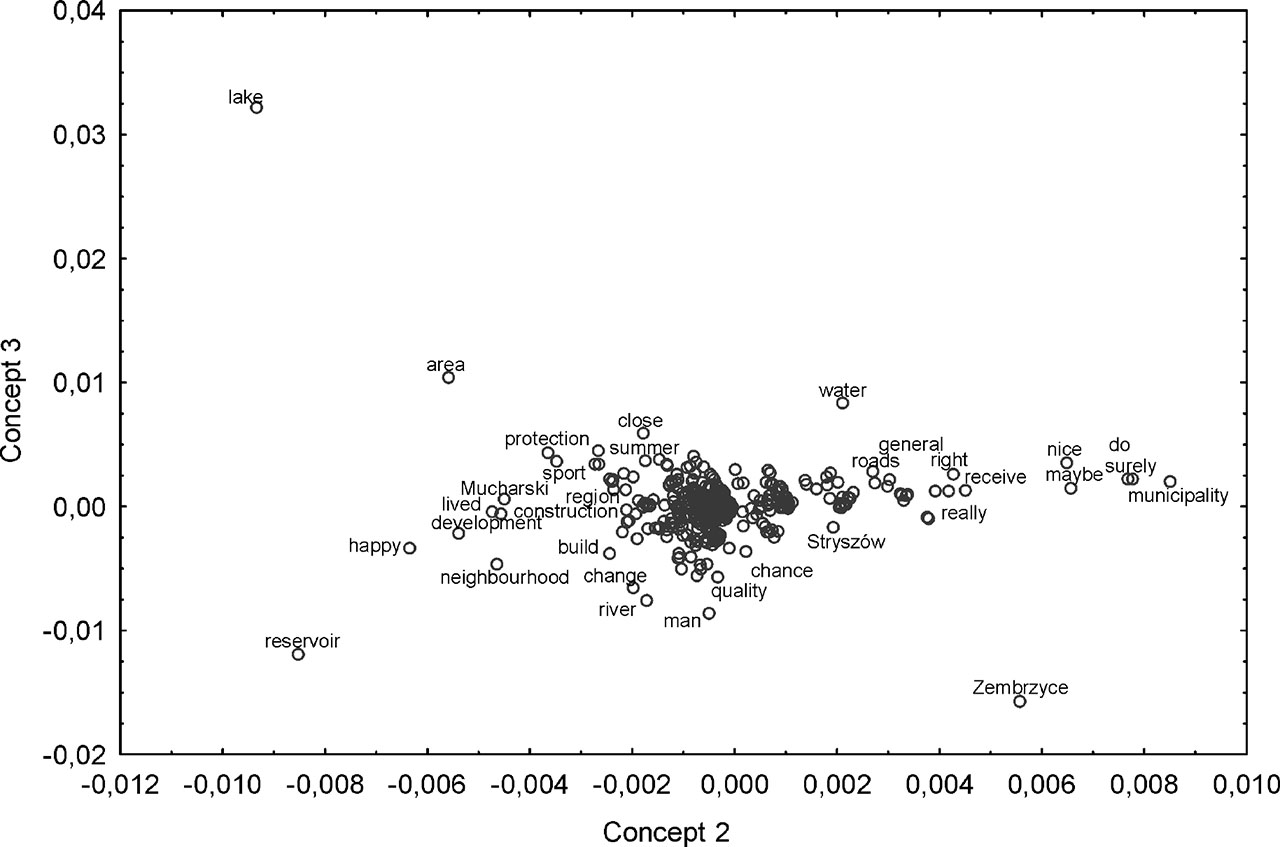
Figure 2.
Scatterplot for ‘YES’ responses
Source: own elaboration
Consequently, the diagram 2 demonstrates that people content with the reservoir construction hold this point of view primarily because they see positive changes in the development of infrastructure as being driven by the dam project. Above all, they see positive changes in the road network and the infrastructure for summer water sports. Furthermore, they recognize that the local authorities have taken steps towards further development of the areas in the vicinity of the dam reservoir. It is important to them that the area close to the reservoir is developed and offers a life of greater ease and convenience to residents – even if its potential to attract tourists has not yet been fully used. Respondents who are content with the dam project supported their opinions by saying that their quality of life had improved, that is, that they now have better access to road infrastructure, beautiful views, and more options for recreation, relaxation and hobbies. This can be illustrated by the following statements:
‘I used to ride my bike along the Skawa River but now I ride along the reservoir some of the way. Seeing all the small boats, canoes, motorboats and yachts on the lake I sometimes feel like I’m at the seaside and it is a wonderful feeling’
(female respondent, 30–40 years old, Zembrzyce).
‘For me and my family it is a great place for a bike ride, a walk and camping on “wild beaches”, I also like fishing, so I appreciate that I have more fishing spots now’
(male respondent, 30–40 years old, Zembrzyce).
The respondents acknowledge that although the landscape has changed due to the reservoir construction, that is, due to anthropogenic activities, the development has fitted in perfectly with the landscape or enhanced it by creating beautiful views:
‘I have a view of the whole lake here; my friends think I am in Norway when I show them pictures. Because really, in some places the rocks look like fjords, truly stunning. There is peace and quiet on the Mucharz reservoir. I appreciate it very much’
(male respondent, 40–50 years old, Mucharz)
The findings from the scatterplot analysis support the results of the dendrogram analysis. Here, the strongest relationship was discovered between the word pairs plot–region, improved–excursion and fishing–appreciate. The word relationships above indicate that –besides being affected by opportunities for recreation and hobbies – residents’ satisfaction with the construction of the reservoir is greatly influenced by the increase in quality of their properties and, potentially, by their rising monetary value (Fig. 3.).
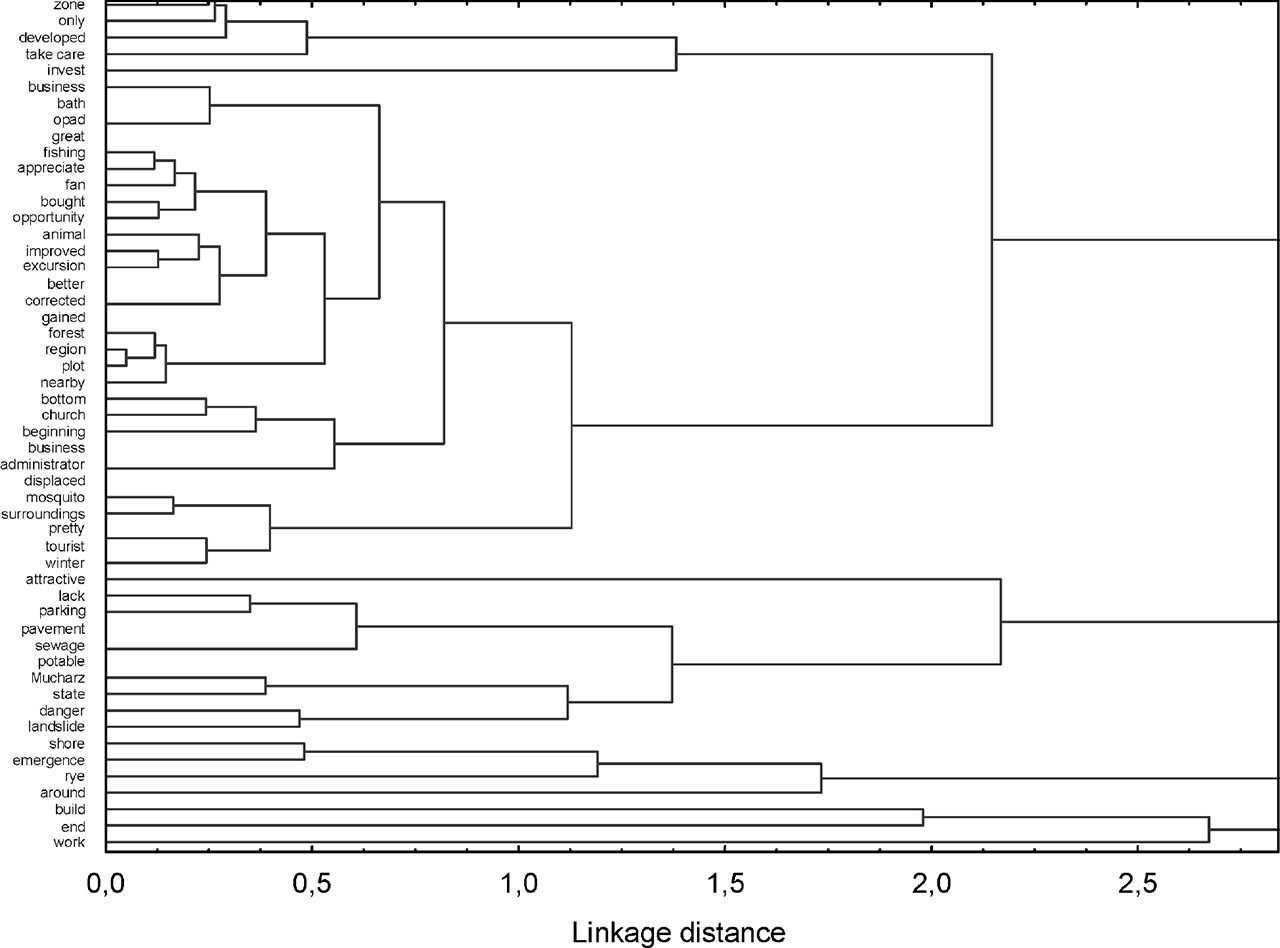
Figure 3.
The dendrogram fragment with the strongest relationships between words in the ‘YES’ group of responses
Source: own elaboration
Negative views of local development in the light of text mining analyses
We discovered that the word weather, including when combined with the words fog, precipitation, humid and abundant, was of considerable relevance among respondents uncontent about living in the vicinity of the reservoir. This suggests that their views are largely the result of negative changes in the microclimate of the area, which are a natural consequence of increasing humidity near a large water reservoir. The following statement illustrates this: ‘However, when it rains it is cold and foggy, and in winter it is very cold and humid’ (female respondent, 50–60 years old, Zembrzyce). The second cluster includes the words: potable, sewage, bath and give access. These are connected with the problems some residents face with access to potable water and sewage systems, as demonstrated in the following passages:
‘Moreover, in the course of several years of work at the bottom of the reservoir, the groundwater level went down and, as a result, we, the residents, had to individually dig deep wells in order to get access to potable water. Unfortunately, the level of water sources, which we used so far, has decreased and the existing wells were filled only with rainwater. Unfortunately, the municipality did not take any steps in order to provide the residents of our estate with access to potable water. As people living in the area in the immediate vicinity of the lake, we are deprived of access to the sewage system despite the fact that the municipality has a sewage treatment plant’
(female respondent, 30–40 years old, Zembrzyce).
‘The municipality does not care about our residential estate at all. We have no sewage system. We were lacking drinking water. The residents had to dig deep wells’
(female respondent, 50–60 years old, Zembrzyce).
The third word occurrence pattern, which demonstrates that the dissatisfaction of some residents results from the risk of landslides and associated concerns for the safety of people and property, concerns the words ‘origin’ and ‘landslide’ (Fig. 4).
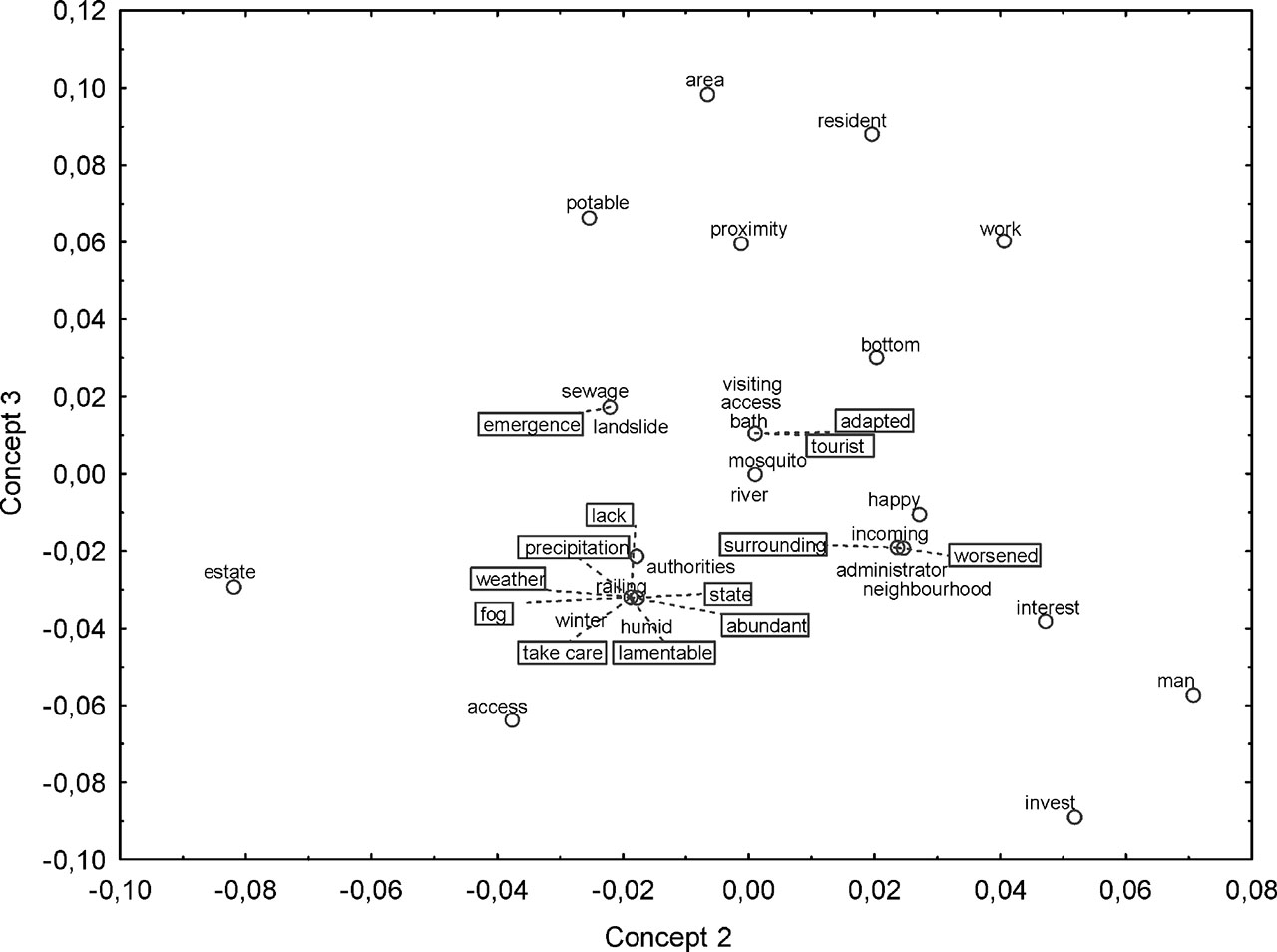
Figure 4.
Scatterplot for ‘NO’ responses
Source: own elaboration
The dendrogram for this group of words indicates that the strongest relationships occur in the following word pairs: state–authorities, potable–area and man–interest. Respondents’ feelings that their quality of life had decreased due to potable water shortages and no access to the sewage system can be understood as an example of incompetent local development management and that the authorities’ focus is exclusively on safeguarding the interests and only meeting the needs of selected local community members (Fig. 5).
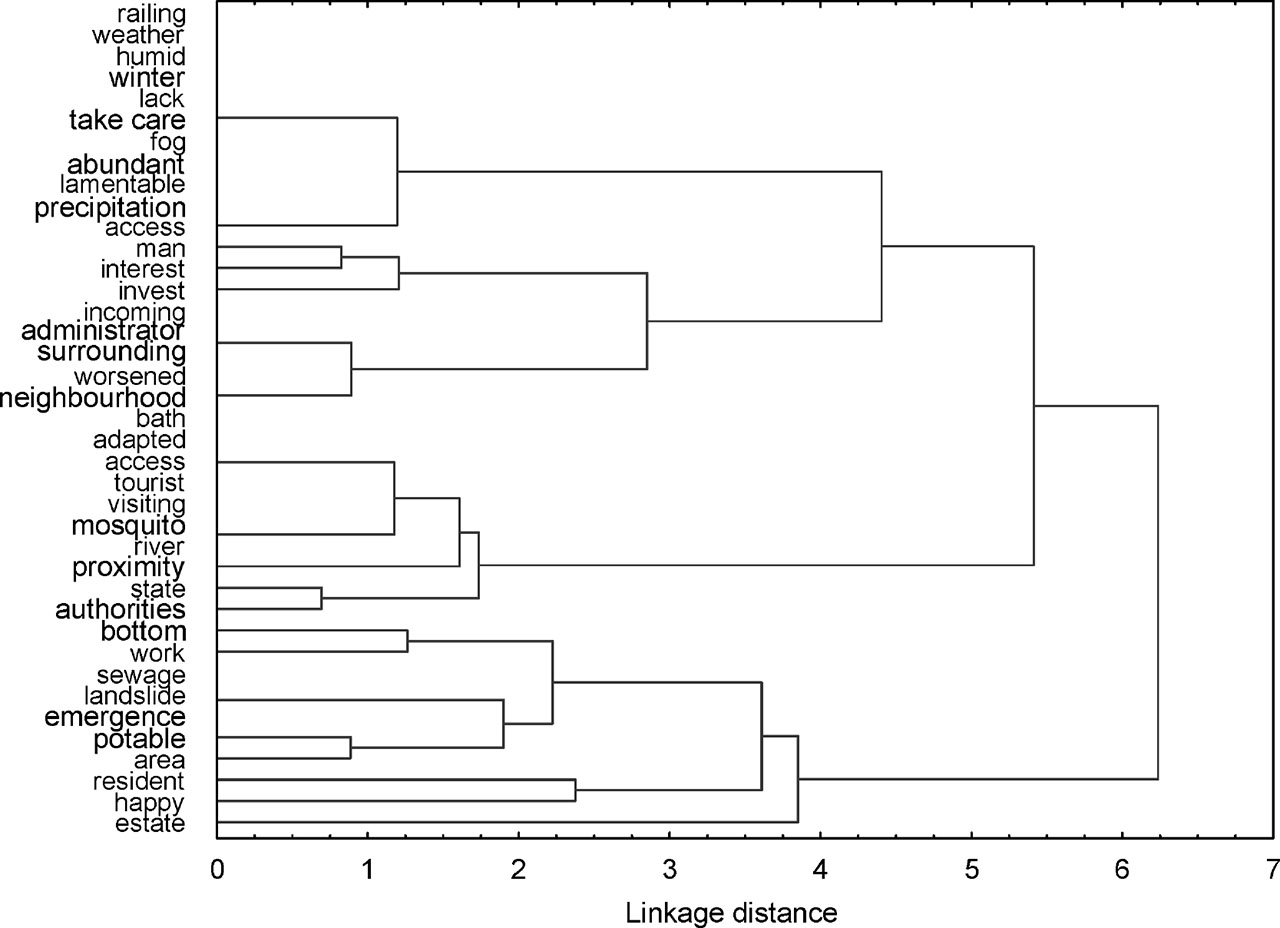
Figure 5.
Dendrogram for relationships between words in the ‘NO’ response group
Source: own elaboration
As with the positive responses, the opinions of residents, in this case, were also determined by their perceptions of their individual quality of life, not by the directions and pace of development, or lack thereof, of the entire region – as driven by the reservoir construction. The inconveniences they experienced obscure the positive aspects of the investment and resulted in a negative attitude towards the dam project. The following statement is one example of such an approach: ‘The views there may be stunning, but...’ (female respondent, 50 years old, Zembrzyce).
Ambivalent views of local development in the light of text mining analyses
In the set of answers given by undecided respondents, the scatterplot reveals relationships between words such as ‘resident’ and ‘charming’, ‘development’ and ‘neighbourhood’, ‘rubbish’, ‘danger’, ‘tourism’, ‘counted’ and ‘walk’. While the relationships indicate that the respondents recognize the positive impact of the reservoir on the surrounding landscape, they also reveal disappointment in hopes for greater development of tourism infrastructure and that the residents take a negative view of the area’s unpreparedness for higher tourist traffic, such as the lack of rubbish bins and parking (Fig. 6).
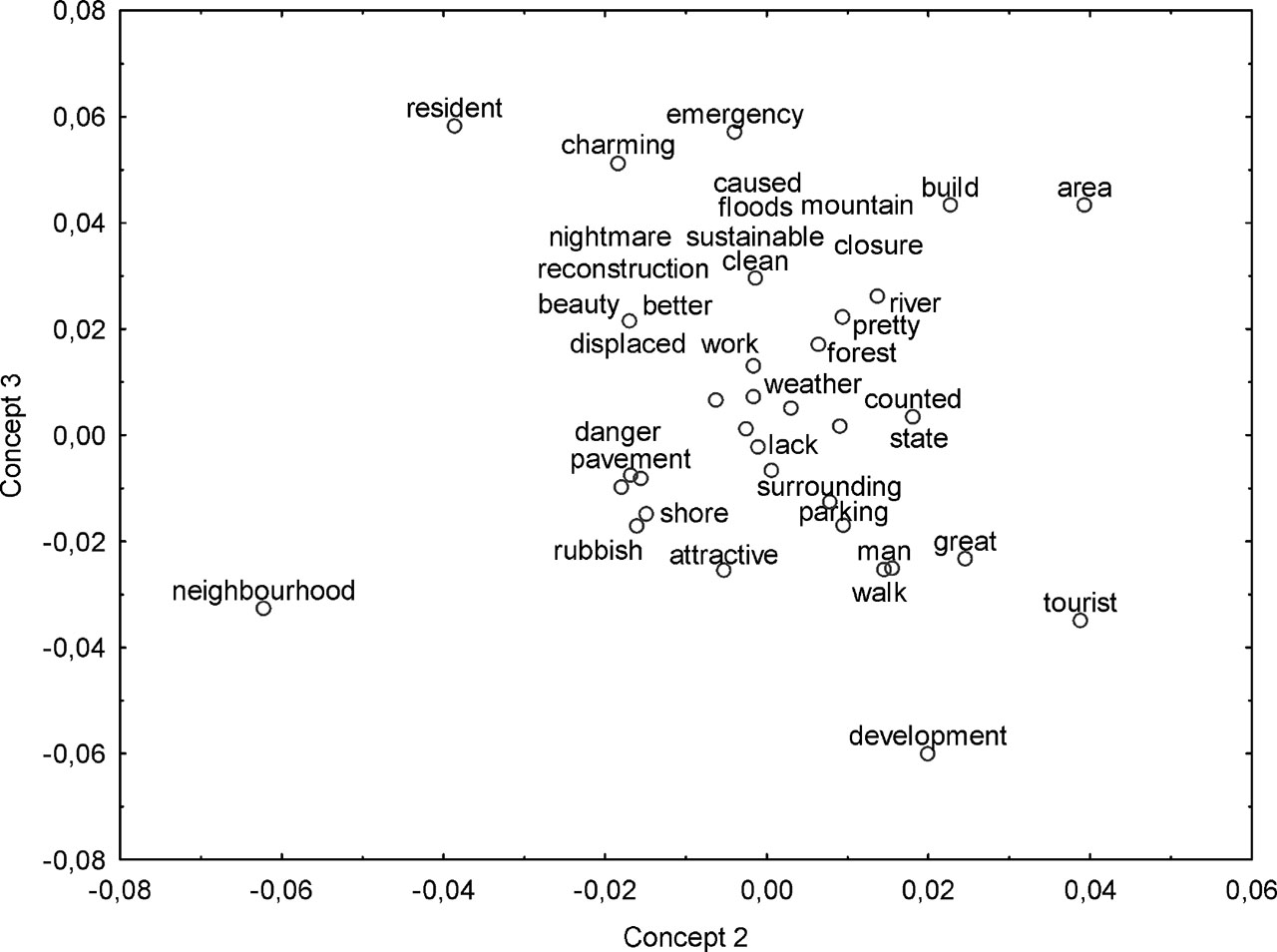
Figure 6.
Scatterplot for ‘I DON’T KNOW’ responses
Source: own elaboration
Because the strongest word co-occurrence patterns were found between the word pairs man–walk, shore–rubbish and parking–surrounding, the relationships shown by the dendrogram further support this conclusion (Fig. 7).
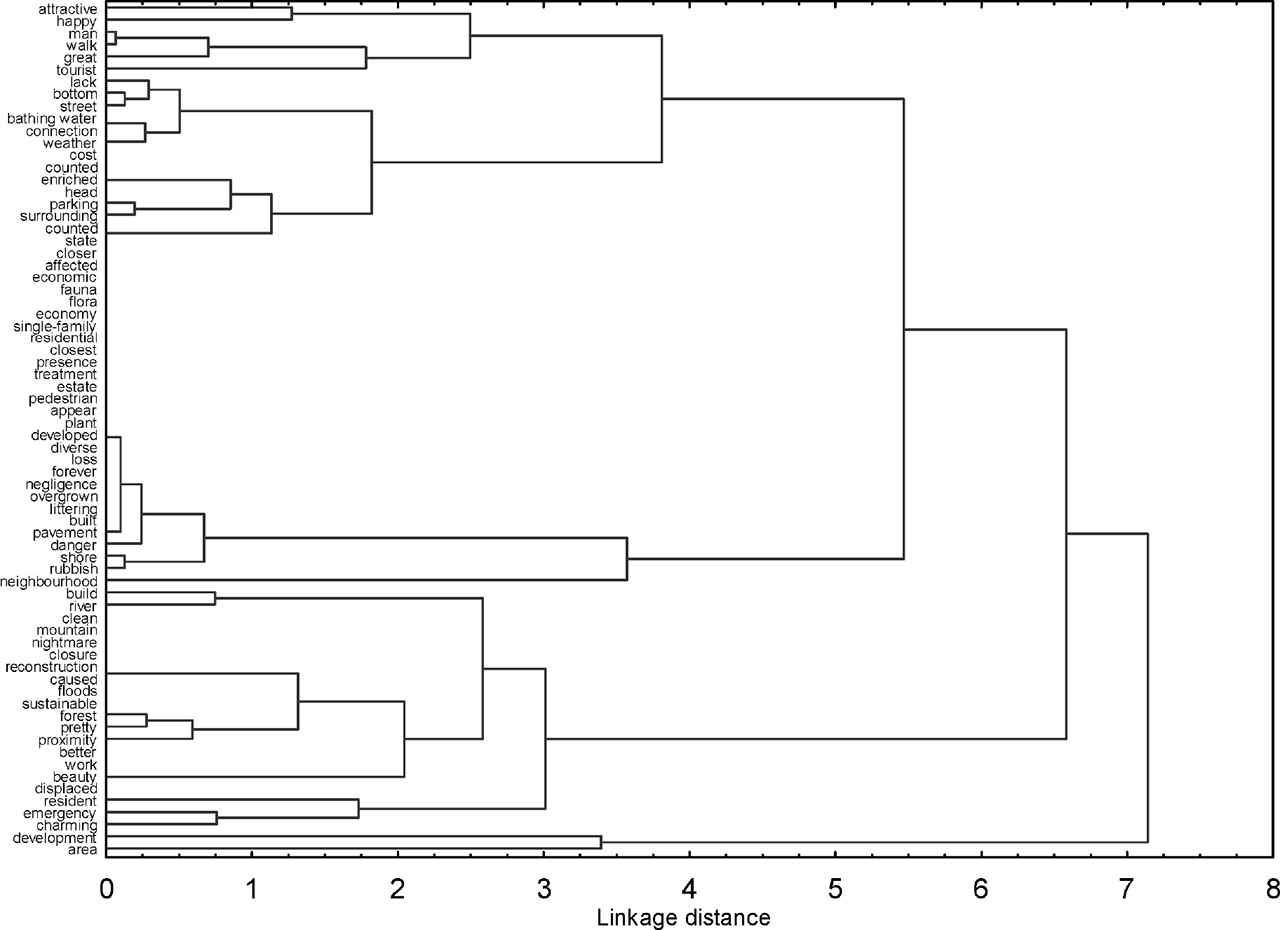
Figure 7.
Dendrogram for relationships between words in the ‘I DON’T KNOW’ response group
Source: own elaboration
The ambivalent attitude of the respondents results from the fact that, while people see the increased landscape value produced by the reservoir’s construction and the area’s improved recreational potential, they do not think that the local authorities have exploited it to its full potential. The following statements exemplify these views:
and:‘All this time we counted on our village becoming an attractive tourist destination. However, this has not been the case so far’
(female respondent, 50–60 years old, Zembrzyce),
‘The advantages of living near the lake include mainly recreational opportunities, relaxing by the water, living close to nature. The disadvantage is the large number of tourists who come on weekends, despite the lack of any facilities. No car parking, toilets or food stalls causes a lot of problems. Tourists leave lots of rubbish behind which ends up on the shores of the lake and even floating in the water’
(female respondent, 50–60 years old, Zembrzyce).
Discussion
Perceptions of and attitudes to newly built dams depend on a variety of factors (Piróg 2019; Wiejaczka et al. 2020; Abdullah & Rahman 2021; Dopico et al. 2022). Constructing new hydraulic structures usually leads to the development of accompanying infrastructure and often increases tourist potential. This can increase hopes and expectations for improvements in a local community’s economic prospects (Dias-Sardinha & Ross 2015). This is particularly so in rural areas, where the lack of prospects for quality of life improvements caused by prolonged stagnation in development means that local populations tend to migrate (Sujud & Hamieh 2018).
Studies on social perception of dam reservoirs have been conducted for several decades in different regions worldwide. However, in Central and Eastern Europe, there is a lack of in-depth research on social perceptions of dam reservoirs. The exceptions are the Carpathian reservoirs, for which more detailed studies have been conducted (Wiejaczka et al. 2014; Piróg 2019). Interest in such research may increase the need to build reservoirs necessitated by increasing demand for water. In Poland, for example, the construction of a further 100 reservoirs have been planned to increase the runoff retention from 6.5% to 15%.
Our work continues to fill this research gap on the social perception of reservoirs in the Central and Eastern European areas. In our research approach, we have distinguished respondent groups with different perceptions of the dam reservoir. The results indicate that respondents taking a positive view of the reservoir did not form their opinions by observing the dynamic development of the local area and analyzing the potential economic benefits. Instead, their positiveness stemmed from an appreciation of the increased aesthetic and landscape value of the area. Living near the reservoir became more pleasant because of improved landscape quality. While they recognize that the tourist potential of the area has not yet been sufficiently used, the satisfaction the respondents derive from living close to the reservoir is sufficient to determine their positive perceptions of the facility. This group of respondents includes people in employment who do not plan to seek alternative employment in connection with the reservoir. However, they also expect the investment and tourism development to create more jobs for the local community. Meanwhile, these respondents are so used to their peace and quiet and to having the lake all to themselves to enjoy, that they do not consider the dynamic development of tourism to be a key factor in increasing the area’s attractiveness. However, people who are already content living near the reservoir see the need for further development of the surrounding infrastructure where this involves opportunities to enjoy recreational activities and pursue summer sports. They include a particularly important group of passionate people who recognize the value of the region and have an idea of how it could develop and of how various activities might be initiated. The ‘Jaszczur’ Mucharz Sailing Club Association, which was established in 2021 for people with a passion for sailing is one example. It aims to promote, develop and practise sailing as a sport and as a form of recreation, and other water sports (www.mkzjaszczur.pl). The areas it manages are thoughtfully developed in terms of infrastructure, which fits well into the landscape. Major investment projects are restricted by the absence of clear and stable rules governing reservoir use. Rules of this kind should be established no later than when a facility is first opened.
The statements given by the population that perceived the reservoir negatively show that people can take a broader view of local development when their well-being is ensured. However, where the community needs are not met, people tend to focus on shortcomings and deficits. This overshadows or undermines the advantages of an investment. Abdullah & Rahman (2021) have confirmed that when people’s basic needs are met and their living conditions improve, they are more likely to take a positive view of reservoirs, which corroborates these conclusions. According to Dopico et al. (2022), the perception of reservoirs may also vary depending on the natural conditions of a given area, as shown by research conducted in two areas of Spain with different climates. In the dry area, where dam reservoirs provide them with safe access to water, respondents were more accepting and had a more positive perception of them than people living in higher rainfall areas.
Those with an ambivalent attitude towards the reservoir, who see both the advantages and disadvantages of living in its vicinity, make up the most interesting group from a scientific viewpoint. While appreciating that the reservoir blends well into the landscape, improves the area’s tourism potential and makes it more attractive, they are unhappy that the potential of the reservoir has not been fully used, that is, that there is insufficient tourist infrastructure. As well as generating litter and noise, this can mean that visitors are disappointed and do not return.
The comments and reflections the respondents shared during the interviews are particularly valuable because they are based on many years of observation and stem from a deep involvement in, and continuous care for, the day-to-day surroundings they live and operate in. Local authorities interested in dynamic development that meets the needs and expectations of local communities and contributes to greater satisfaction among residents living near to dam reservoirs can benefit by taking careful note of the study’s conclusions, which can be put to valuable and practical use. It can be assumed that the perception of the reservoir in each of the groups of residents surveyed can improve if the surrounding area develops in line with people’s expectations. Infrastructure development around the reservoir has so far proceeded slowly, with long-term changes and responding to the needs of local communities being the main issues (Żakowski 2018). One example is the development of a new road and rail network – but with no provision made for bicycle lanes from the Zembrzyce side – which was an item of infrastructure the local community very much expected. To avoid repeating the dissatisfaction and disillusionment this caused among residents, it would be advisable for future development plans to take account of the needs of local people, who contribute to investments as taxpayers.
The study findings can be useful in elaborating tools and research methods to perform in-depth investigation of social perception of large dams at different stages of their life cycle and allow the development of guidelines to facilitate future management of social space affected by large dam construction. They also revealed further areas for in-depth research into public perception of dam reservoirs. Given that research on the social perception of dam reservoirs is mainly concerned with single projects, it would be important to conduct research for a larger number of reservoirs in a selected area to illustrate temporal and spatial changes in the social perception of such hydrotechnical facilities.
Conclusions
The interviews conducted with residents and the text mining analysis helped to confirm the hypothesis set out at the outset that residents’ expectations regarding socio-economic development around the dam reservoir are determined by their satisfaction with the project.
Based on the analysis the following conclusions can be drawn:
Economic benefits resulting from investments, such as the creation of new jobs or the intensive development of tourism, do not always determine whether a local community perceives a dam project positively. In many cases, the fact that a structure has blended well into the local landscape, or improved it, is more decisive in this respect.
Residents take a broader view of local development when their well-being is ensured. If the needs of the community are not met, people tend to either ignore or not see the advantages of an investment.
At the initial operation stage of new recreational facilities, it is extremely important to establish clear and stable conditions of use. In this way, it is possible to prepare long-term land development plans, to build and upgrade auxiliary infrastructure and to adapt it to users’ needs. When the development of areas surrounding new investments, such as water reservoirs, is sustainable and well-designed, the local community’s perception of the relevant facility can be substantially improved.
Cluster analysis and hierarchical cluster analysis with dendrograms captured all the significant information provided by the respondents during the study are effective methods for the in-depth analysis of transcribed interviews.