
Table 1
The association between education and SWB, and the psychological dimension
| Term | Context | Source |
|---|---|---|
| Expectations | “education may improve well-being only if expectations are exceeded, but may decrease well-being if they are not met (…)” | Kristoffersen 2018, p. 66 |
| Aspirations | “education leads to both higher reported happiness and desired happiness. This suggests that a significant part of the happiness effect of education is cancelled out by higher aspirations: education then does raise actual happiness but also raises expectations or aspirations about what the individual should receive (…)” | Clark et al. 2015, p. 527 |
| Higher-level need fulfillment | “higher-level need fulfillment is perceived to be more important and bears more strongly on SWB in wealthier samples than in poorer ones” | Howell and Howell 2008, p. 555 |
| Opportunity | “[p]eople may dislike inequality if they suffer from it, or when they consider incomes are not based on merits, but could be more tolerant if they have prospects of improving their life conditions (…)” | García-Muñoz et al. 2019, p. 2 |
| Self-determination theory (psychological needs fulfillment) | “the needs for competence (…), relatedness (…), and autonomy (…) appear to be essential for facilitating optimal functioning of the natural propensities for growth and integration, as well as for constructive social development and personal well-being.” | Ryan and Deci 2000, p. 68 |
| Absolute/relative economic status | “for wealthier individuals, SWB is impacted by relative economic status (…) rather than absolute economic status (…)” | Howell and Howell 2008, p. 537 |
| Perception of living conditions | “People's perceptions, thoughts, feelings, and actions (…) have an impact on their own and others’ living conditions.” | Michalos 2007, p. 4 |
[i] Source: own elaboration
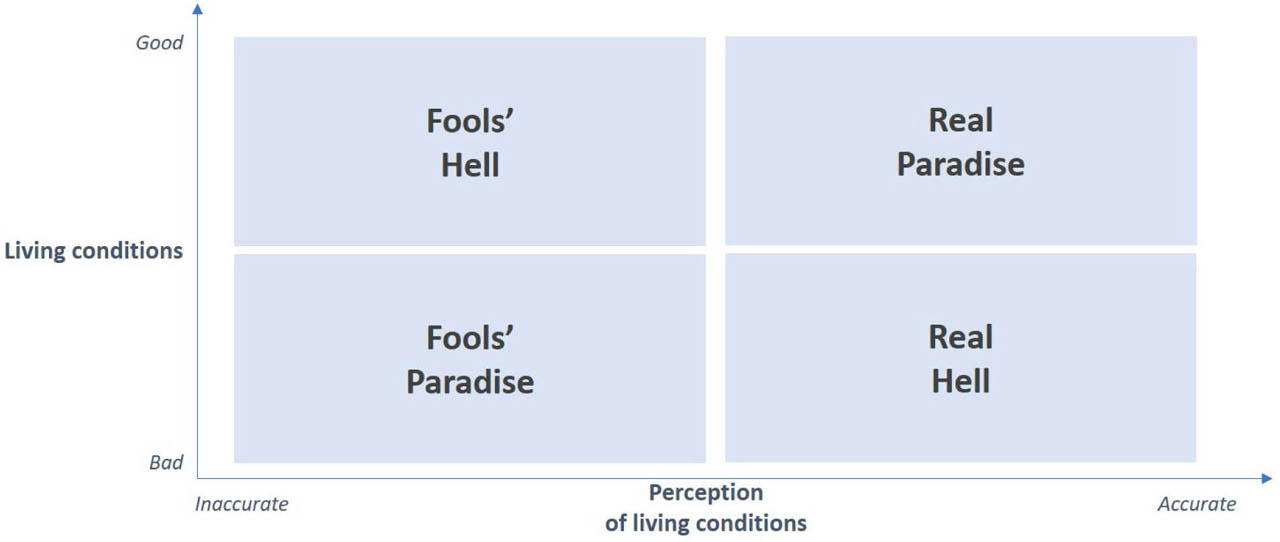
Figure 1
Michalos’ living conditions matrix
Source: own elaboration based on Michalos (2007)
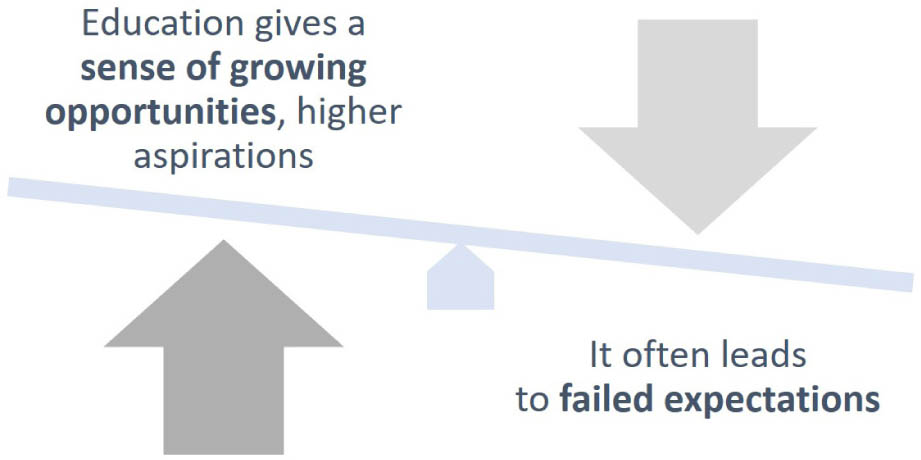
Figure 2
Education and SWB in developing countries. Negative association
Source: own elaboration
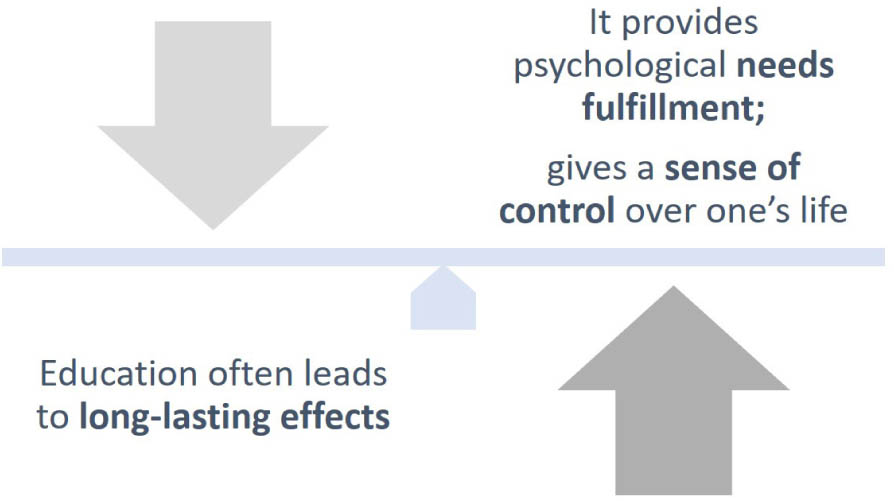
Figure 3
Education and SWB in developing countries. Positive association
Source: own elaboration