
Introduction
The landscape of entrepreneurship in Ghana has changed dramatically over the last few decades, and the small-scale manufacturing industry has contributed significantly to economic and industrial growth and employment creation (Essel et al., 2019). This sector is an important source of value addition, revenue and acts as a cornerstone for general industrialisation in emerging economies, such as Ghana (Oduro, 2019). The performance of small manufacturing firms is, however, erratic in Ghana, indicating continued problems relating to access to finance, technology and market dynamism (Addae-Korankye & Aryee, 2021). These limitations and challenges place greater demand on entrepreneurs to make efficient strategic decisions that will match internal capabilities to external environmental requirements (Mumbe & Njuguna, 2019). Hence, examining the influence of strategic management modes of entrepreneurs on manufacturing performance has increasingly become a critical but scantily researched issue in Ghana (Akomea et al., 2023).
Strategic management practices are highly associated with firm growth, competitiveness and survival in the long run especially for small and medium-sized enterprises operating in an environment with resource scarcity (Obaje, 2020). In the small-scale manufacturing industry in Ghana, strategic management is not an exercise of formal planning alone; rather, it serves as a process which entrepreneurs employ to manage uncertainty and competitive pressures (Donkor et al., 2018). Previous studies indicate that efficient strategic frameworks lead to better performance through the facilitation of coordination, efficient resource deployment and adaptability to environmental change (Amaglo, 2019; Eaton et al., 2021).
Ghanaian manufacturing entrepreneurs generally use a variety of strategic management modes, such as rational, adaptive and entrepreneurial orientations, which are all linked to different assumptions and performance implications (Deku et al., 2021). The rational mode of strategic management is the formal planning, systematic analysis and goal orientation perspective that allows organisations to streamline production and make optimal use of their scarce resources (Rabetino et al., 2021). The adaptive strategic mode favours flexibility and learning to the extent that firms can respond quickly to changes in the market environment and changing customer tastes (Alzoraiki et al., 2024). Strategic entrepreneurship orientation also focuses on innovativeness, risk taking and proactiveness in identifying opportunities that can improve competitiveness in dynamic environments (Zaato et al., 2021). While these strategic management modes co-exist in Ghana's manufacturing industry, there is little empirical evidence related to the interaction between them and their combined influence on small-scale manufacturing performance (Tuffuor et al., 2025).
Additionally, the extant research is limited on how strategy adopted as a mediator connects strategic management modes to small-scale manufacturing performance (Akomea et al., 2023). Studies have indicated that strategies associated with innovation, marketing, sustainability, cost efficiency and operational flexibility are some of the pathways through which managerial orientations facilitate performance (Indriyani et al., 2025; Larabi, 2025; Quaye & Mensah, 2019). Firms that have managed to adopt and implement the strategies tend to present better positioning in the market as well as better operational efficiency compared with their competitors (Kumar et al., 2020). Notwithstanding, limited empirical studies in Ghana combine strategic management modes and strategy adoption within a single analytical framework to explain SME performance. This study therefore seeks to address two core research gaps comprising the lack of empirical research on the composite effect of strategic management modes on small-scale manufacturing performance, and the under-researched mediating role of strategy adopted in this relationship in the context of Ghana. Accordingly, the purpose of the study is to explore the relationship between strategic management modes and small-scale manufacturing performance; assess the relationship between strategic management modes and adopted strategies; investigate the impact of the strategies adopted on small-scale manufacturing performance and to examine the mediating role of strategy adopted in the association between strategic management modes and small-scale manufacturing performance.
The study is pertinent to the contemporary Ghanaian context, because small-scale manufacturing firms in this emerging context operate within a period of economic turbulence, escalating costs of inputs, severe competition and limited access to finance and technology (Anipa et al., 2025). In such an environment, the entrepreneurs' capacity for the handling of strategy and turning managerial orientations into actionable strategies is a critical skill for developing and expanding business. Hence, the study contributes to managerial practice by presenting knowledge on how different strategic management modes and strategy adoption affect performance which can be used in practice by firms to enhance efficiency, competitiveness, and resilience. The study results are relevant to policymakers and development organisations supporting Ghana's industrialisation and SME development agenda, aiding them to better target interventions that improve managerial competence and by extension the longevity of small-scale manufacturing firms. Beyond Ghana, this study has implications for small-scale manufacturers in volatile situations and resource-constrained and institutionally weak emerging markets internationally. The study contributes to discussions in the global literature on strategic fit and SME competitiveness by exploring how strategic management modes affect performance through strategy adoption. International policymakers and development partners can use the results of this study to develop tailored capacity-building, industrial upgrading, and SME support programmes that enhance strategic decision-making and long-term manufacturing resilience.
Literature review and hypotheses development
Theoretical framework: Contingency theory
According to contingency theory, organisational effectiveness is a function of the fit between managerial practices and situational variables rather than general prescriptions (Csaszar & Ostler, 2020). Proponents of the contingency theory stress that strategic choices lead to performance gains when they match environmental uncertainty, technology and organisational capabilities (Araral, 2020). One of the main contingency theory assumptions is that organisations function in heterogeneous environments with varying structural and strategic needs (Safari & Saleh, 2020). The theory suggests that managers must respond to structures, processes and strategies to contextual contingencies if they are to be effective (Yu et al., 2020). Additionally, the theory implies that a mismatch between strategy and context leads to inefficiency and performance degradation (Niemand et al., 2021). Contingency theory is used by researchers to apply to strategic management and emphasise the effect of contextual variations impinging on overarching results from planning and control systems (Lartey, 2020).
The contingency theory is suitable for this study, as it posits performance results as being contingent upon the match between manager strategic practices and situational forces. Small-scale manufacturing companies in Ghana function within heterogeneous situations of resource scarcity, market dynamics and the variety of technologies that do not have a single appropriate strategic management dominant mode. Contingency theory offers a rationale for investigating why different strategic management modes are associated with manufacturing performance under various context demands. It also facilitates the examination of the relationship between modes of strategic management and adopted strategies, since strategic choices are determined by environmental and organisational contingencies. In addition, the theory is strongly appealed to examine the mediating role of strategy adoption since performance occurs if strategic orientations are transformed into contextually suitable strategies that link managerial intentions to operational realities in Ghana.
Strategic management mode
The strategic management mode of entrepreneurs refers to the approaches used in planning, adapting and responding to environmental pressure for a sustained small-scale manufacturing performance (Fazli et al., 2023). In small-scale manufacturing, entrepreneurs work in turbulent and competitive environments that may require varying strategic management modes to improve performance and flexibility (Kunc, 2024). Deliberate strategy mode focuses on planned structures, clear goals and vision, and is said to have a positive impact on small and medium enterprises' performance (Osinde et al., 2019). Emergent strategy mode focuses on adaptability and learning, allowing organisations to be receptive towards market shifts, and seizing real-time opportunities (Alenzy, 2018). Reactive strategy mode often arises as reactions to unexpected difficulties and could signal low-level readiness or resource limitations. However, when managed effectively, reactive strategies can lead to favourable outcomes in asymmetric or crisis contexts (Short & Pfarrer, 2023). In the context of small and medium scale manufacturing firms in Ghana, entrepreneurs' strategic management mode is defined as the mode through which firms' owners plan, adapt and react to the environment to sustain performance. Within small-scale manufacturing, deliberate strategies enable planned production processes, emergent strategies allow for adaptability and learning, and reactive strategies are used to respond to unplanned market circumstances.
Strategy adopted
Entrepreneurs' adopted strategy refers to how firms deploy competitive and operational methods for efficiency, customer satisfaction, and sustainable firm performance in a dynamic environment (Salam, 2021). In small-scale manufacturing, strategy adopted consists of four dimensions, namely cost, delivery, flexibility and quality (Kumar et al., 2020). Cost strategy refers to the reduction of production and operation costs through effective resource usage, processing efficiency, waste reduction, economies of scale but acceptable product quality (Kharub et al., 2022). Delivery strategy is concerned with how fast orders are fulfilled and delivered, delivery reliability, lead-time reduction and the ability to respond to customer schedules which in turn are important for customers' satisfaction and loyalty (Phan et al., 2019). Flexible strategy refers to the ability to set volume production, product customization, process change and resource adjustment according to market variation and demand uncertainty (Gerald et al., 2020). Quality strategy focuses on consistency, prevention of defects, product reliability and continuing improvement in satisfying customer needs (Sen et al., 2023). In small-scale manufacturing firms in Ghana, strategy adopted is defined as the set of competitive and operational decisions that a firm consciously adopts to utilize its resources efficiently and link internal activities with those contained in the market for performing competitively over time. It includes cost effectiveness, delivery reliability, operational flexibility and quality management decisions by which firms try to adapt themselves to environmental conditions, satisfy customers and keep a sustainable competitive advantage.
Small-scale manufacturing firm performance
Performance of small-scale manufacturing firms is the extent to which manufacturing enterprises maximise their resources and operate effectively and efficiently while producing quality output in a sustainable manner (Huang & Badurdeen, 2018). Performance is commonly measured in terms of key operational factors, such as production yield, cycle time and defect rates which together constitute process efficiency and operational effectiveness (Huang & Badurdeen, 2018). Increased productivity and reduced cycle time indicate better resource usage and optimization of the production process (Tortorella et al., 2019). Quality performance is considered a key aspect of manufacturing performance and includes product reliability, process consistency, and conformance to customer requirements which are important for competitiveness and sustainable success in small-scale manufacturing environments. Within the context of small-scale manufacturing firms in Ghana, performance refers to the ability to use limited resources efficiently and still be able to produce quality products and sustain operations. High production efficiency and short cycle times are very important, considering the constraints from capital, technique and technology. These priorities reflect persistent constraints on capital, technology and the availability of skilled labour.
Strategic management mode and small-scale manufacturing performance
Research has shown that the use of deliberate strategic mode, manifested in more formalized planning and clearer goal setting, is related to higher performance in terms of profit and operational efficiency under conditions that are relatively stable or moderately dynamic (Kraus et al., 2020). However, in times of high uncertainty, including during and after the COVID-19 pandemic, emergent strategies have been important for SMEs as they facilitate faster learning, adaptation and recognition of opportunities, all of which are conducive to innovation and sales growth (Herbane, 2019; Teasdale et al., 2023). Furthermore, research indicates that the combination of these two types of strategies — deliberate and emergent — provides better performance benefits (Ragazou et al., 2022). This is because SMEs potentially benefit as they balance structured planning and adaptive capabilities, which enhance their ability to achieve resilience, innovation capacity, and competitive advantage (Ragazou et al., 2022). Based on studies conducted by Teasdale et al. (2023), Ragazou et al. (2022), Herbane (2019) and Kraus et al. (2020), the study hypothesizes that:
H1: There is a significant positive relationship between entrepreneur's strategic mode and small-scale manufacturing performance.
Strategic management mode and strategy adopted
Empirical studies reveal that strategic management modes play a significant role in the way small manufacturing firms adopt and implement strategies related to cost, quality, delivery, and flexibility (Katic & Agarwal, 2018). Studies have found that firms which operate in deliberate modes of management are more effective in their ability to systematically adopt cost-efficient and quality-focused philosophies through planned procedures and standardised actions (Nimeh et al., 2018). Emerging management modes on the other hand have been empirically linked to flexibility strategies particularly in high-variety, low-volume manufacturing environments where agility is relevant (Singh & Kumar, 2020). Extant studies also show that quality and flexibility resources are effective only when matched with the right strategic management modes, since misalignments lead to performance trade-offs (Qamar et al., 2020). Research also finds that reactive and hybrid management modes allow small manufacturing companies to respond to the environmental uncertainty by incorporating resilience into their strategic decisions (Wang et al., 2018). Research validates that the integration of lean and agile approaches in their balanced management styles results in strengthening strategic competitiveness for small manufacturers (Rana, 2025; Suifan et al., 2019). Dwelling on studies conducted by Rana (2025), Wang et al. (2018), Singh and Kumar (2020), Nimeh et al. (2018) and Katic and Agarwal (2018), the study hypothesizes that:
H2: There is a significant positive relationship between entrepreneurs' strategic mode and strategy adopted.
Strategy adopted and performance of SMFs
A study by Baah et al. (2021) observed that SMEs using deliberate modes of strategic management had better performance results when resources were aligned with long-term goals over time. This result highlights that deliberate strategies and systematic operations enable organisations to deploy resources towards sustainable performance (Baah et al., 2021). A study by Mudau et al. (2024) found that organised manufacturing positively influenced the success of SMEs by enhancing the efficiency of resource use, and operational efficiency, a proof that a deliberate strategy can increase both productivity and competitiveness. Another study by Pertheban et al. (2023) indicated that ambidextrous competencies — exploiting current capabilities while simultaneously exploring new opportunities — were necessary for SME performance. This result indicates that emergent strategies are adaptable to market turbulence (Pertheban et al., 2023). Similarly, Supardi and Hadi (2020) demonstrated that proactive and adaptive responses fostered the resilience that SMEs need to innovate and respond flexibly to unpredictable external pressures, ensuring good long-term performance. Based on studies conducted by Mudau et al. (2024), Pertheban et al. (2023), Baah et al. (2021) and Supardi and Hadi (2020), the study hypothesizes that:
H3: There is a significant positive relationship between strategy adopted and performance of small-scale manufacturing firms.
Mediating role of the strategy adopted
Research indicates that the relationship between strategic management modes and firms' performance in small-scale manufacturing is enhanced through the strategies adopted, which include cost, delivery, flexibility and quality strategies (Ochele, 2025). Research suggests that explicit strategic management may be beneficial for firm performance when transformed into well-defined cost and quality strategies, because formal planning and standardised processes allow firms to operate efficiently and produce a stable performance output (Mutambo et al., 2022). On the other hand, an emerging strategic management mode enhances firm effectiveness by enabling firms to adopt flexibility and delivery strategies to respond effectively to market variability and customer-specific demands (Chand et al., 2022). In uncertain environments, nuanced performance results become evident as firms adapt delivery and flexibility configurations to buffer against operational perturbations and competitive pressures (Adim & Unaam, 2022). Empirical results also indicate that companies that adopt strategic management modes fitted to competitive strategies perform better than those who practice management modes independently (Hartani et al., 2021). Dwelling on studies conducted by Ochele (2025), Mutambo et al. (2022), Chand et al. (2022), Adim and Unaam (2022) and Hartani et al. (2021), the study hypothesizes that:
H4: Strategy adopted mediates the relationship between strategic management mode and small-scale manufacturing performance.
Conceptual framework
The conceptual framework as shown in Figure 1 dwelled on empirical literature to predict three (3) direct relationships and one (1) mediating relationship. The direct relationships comprised: effect of entrepreneurs' strategic management mode on small-scale manufacturing performance (H1), effect of entrepreneurs' strategic management mode on strategy adopted (H2) and the effect of strategy adopted on small-scale manufacturing performance (H3). Hypothesis 4 focused on the mediating role of strategy adopted on the relationship between entrepreneurs' strategic mode and small-scale manufacturing performance.
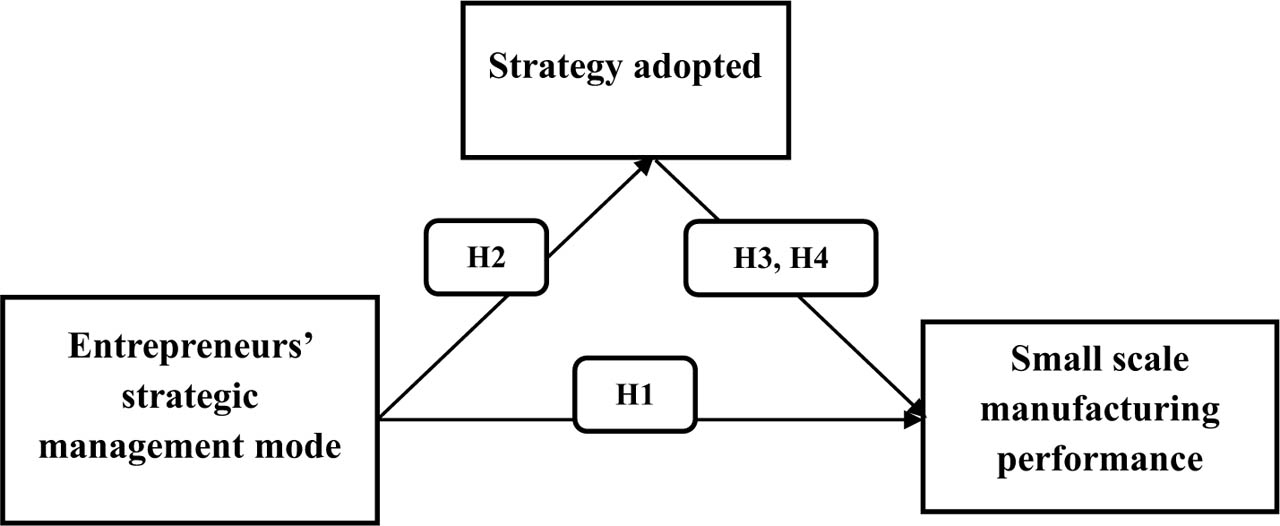
Figure 1.
Conceptual framework of the study
Source: own processing
Methodology
This study dwelled on the positivist research paradigm, which views reality as an objective, observable and measurable situation and presupposes that valid knowledge is obtained from systematic empirical investigation and quantitative analysis (Masuku, 2023). The positivist paradigm was relevant in the light of the study's focus on testing theory-derived hypotheses with quantifiable data and for its generation of generalizable and empirically sound conclusions. A deductive research method was used by using the contingency theory as an established theoretical framework to develop and empirically test hypotheses about the impact of entrepreneurs' strategic mode, strategy adopted and small-scale manufacturing performance. Direct and mediating relationships between study variables were explored at one specific time point using an explanatory cross-sectional research design (Liu, 2024; Cummings, 2017).
The population of interest comprised 3,000 small-scale manufacturing firms that were registered with the NBSSI drawn across the Southern, Middle and Northern geographical belts of Ghana. The addition of these zones aimed to capture diversity in socio-economic statuses, industrial districts and market accessibility. Random stratified sampling was used to allow a proportional allocation within larger manufacturing subsectors followed by simple random sampling for selection of clusters within each stratum to minimise bias and enhance generalizability (Saunders et al., 2019). According to Yamane's (1967) sample size estimation formula, a sample size of 353 firms was adequate. To address the threat of non-response error, a total of 450 questionnaires were distributed with 435 usable responses returned which are adequate for exploratory factor analysis and structural model estimates (Hair et al., 2019).
Data were obtained by a pre-validated structured questionnaire based on the previously validated measurement scales. Strategic management modes, strategy adopted and small-scale manufacturing performance were operationalized using items adopted from previous studies to enhance content validity. All constructs were rated on a six-point Likert-type scale ranging from 1 (strongly disagree) to 6 (strongly agree), which increased response spread and reduced central tendency effects. Data were analysed through a rigorous, multi-stage process. Respondents' information was initially downloaded from Google Forms to Microsoft Excel for preliminary testing, coding, and cleaning of data and then analysed with SPSS version 27. We calculated descriptive statistics to profile respondents and assess the distributions of data. Composite indicators for the latent constructs were then created, as required for SEM (Hair et al., 2021). The final step of analysis, conducted in Smart PLS 4, used Partial Least Squares-Structural Equation Modeling (PLS-SEM), due to the nature of the model's complexity and prediction-driven purpose. The analytical process included an exclusive examination of the measurement model for internal consistency reliability, convergent validity and discriminant validity, in addition to a subsequent analysis of the structural model. Bootstrapping procedures were used to test for the significance of both direct and mediating paths, allowing for reliable estimation of path coefficients.
Results
Demographic data
The demographic profile provides valuable information on the structural and functional aspects of small manufacturing SMEs (Table 1). In the sampled survey, 59.8% are male and 40.2% female, data showing a continued imbalance between genders. The age profile is determined by economically active ages, with 40.9% of the respondents belonging to 30–45 years age group and 29.2% to 26–35 years, indicating that young and mid-career entrepreneurs dominate the sector. The low proportion of those under 25 years (8.0%) could mean barriers to entry, including the need for capital, mentorship and industry experience, are high.
Table 1.
Demographic characteristics
| Gender | Frequency | Percentage (%) |
|---|---|---|
| Male | 260 | 59.8 |
| Female | 175 | 40.2 |
| Total | 435 | 100 |
| Age | Frequency | Percentage (%) |
| Up to 25 years | 35 | 8 |
| 26–35 years | 127 | 29.2 |
| 30–45 years | 178 | 40.9 |
| 46–55 years | 86 | 19.8 |
| 56 years and above | 9 | 2.1 |
| Total | 435 | 100 |
| Educational Qualification | Frequency | Percentage (%) |
| No formal education | 31 | 7.1 |
| Junior (SS) | 107 | 24.6 |
| Senior (SS) | 114 | 26.2 |
| Technical Certificate | 81 | 18.6 |
| Diploma/HND | 59 | 13.6 |
| Bachelor's Degree | 40 | 9.2 |
| Postgraduate Degree | 3 | 0.7 |
| Total | 435 | 100 |
| Position in business | Frequency | Percentage (%) |
| Owner/Founder | 276 | 63.4 |
| Manager | 90 | 20.7 |
| Supervisor | 69 | 15.8 |
| Total | 435 | 100 |
| Years of business operations | Frequency | Percentage (%) |
| Less than 1 year | 11 | 2.5 |
| 1–3 years | 94 | 21.6 |
| 4–7 years | 153 | 35.2 |
| 8–10 years | 104 | 23.9 |
| More than 10 years | 73 | 16.8 |
| Total | 435 | 100 |
| Number of employees | Frequency | Percentage (%) |
| Up to 5 | 199 | 45.7 |
| 06–Oct | 137 | 31.5 |
| Nov–20 | 74 | 17 |
| 21–50 | 23 | 5.3 |
| 51–100 | 2 | 0.5 |
| Total | 435 | 100 |
| Primary industry | Frequency | Percentage (%) |
| Food and beverage | 151 | 34.7 |
| Textile and clothing | 124 | 28.5 |
| Automotive | 26 | 6 |
| Machinery | 51 | 11.7 |
| Chemicals | 72 | 16.6 |
| Plastics | 11 | 2.6 |
| Total | 435 | 100 |
| Ownership structure | Frequency | Percentage (%) |
| Sole proprietorship | 275 | 63.2 |
| Partnership | 92 | 21.1 |
| Company (Limited Liability) | 41 | 9.4 |
| Incorporated (Private Partnership) | 1 | 0.2 |
| Joint Venture | 23 | 5.3 |
| State Owned Enterprise | 3 | 0.7 |
Education is focused on secondary level with junior secondary (24.6%) and senior secondary (26.2%) being high but supported by technical certificate awards (18.6%) and diploma/HND award qualifications (13.6%). Degree-level education on the other hand remains low (9.2% bachelor's; 0.7% postgraduate) and may signal deficiencies in higher order managerial skills and technical capacity. The sector is dominated by owner- and founder-managed companies (63.4%), suggesting decision-making structures that are likely to limit the professionalization and scale of operations.
As seen above, in relation to firm maturity, most of the new ventures have between 4–7 years (35.2%) or between 8–10 years (23.9%), which indicates that survival in other phase is different than the start-ups, while there are fewer new ventures with over ten years' experience (16.8%), which represents some sustainability problems. Most of the level of employment is in the micro-category, with 45.7% of firms having fewer than five (5) employees and only 0.5% have over 50 employees. Industry activities are dominated by the following sectors: food and beverages (34.7%) and textiles and clothing (28.5%), while ownership structures, primarily as sole proprietorship (63.2%), can create a barrier for access to formal finance and long-term growth opportunities.
Construct validity
Result from Table 2 shows good construct validity for small-scale manufacturing performance, strategic management mode and strategy adopted. All small-scale manufacturing performance indicators strongly loaded on their construct (0.773–0.807), demonstrating strong construct validity. Strategic management mode indicators namely deliberate, emergent and reactive strategies also display strong factor loadings (from 0.736 to 0.807) supporting their construct validity. For the strategy adopted indicators (cost, delivery and flexibility), considerable validity was supported by the factor loadings between 0.800–0.851. However, the loading for quality strategy was 0.664, which was less than the estimated preferred threshold of 0.70 but over that of 0.60 which is considered acceptable (Hair et al., 2021).
Table 2.
Construct validity
| Variable | Small-scale manufacturing firm performance | Strategic Management Mode | Strategy adopted |
|---|---|---|---|
| SSMP1 | 0.807 | ||
| SSMP2 | 0.773 | ||
| SSMP3 | 0.804 | ||
| SSMP4 | 0.791 | ||
| Deliberate Strategy | 0.736 | ||
| Emergent Strategy | 0.792 | ||
| Reactive Strategy | 0.807 | ||
| Cost Strategy | 0.800 | ||
| Delivery Strategy | 0.851 | ||
| Flexibility Strategy | 0.824 | ||
| Quality Strategy | 0.664 |
Reliability and convergent validity
Table 3 presents the reliability and convergent validity results for study constructs. Small-scale manufacturing performance exhibits satisfactory internal consistency as the Cronbach's alpha of 0.805 exceeds the acceptable threshold of 0.70. Convergent validity was considered satisfactory with the AVE of 0.631.
Table 3.
Reliability and convergent validity
| Variable | Cronbach's alpha | Composite reliability (rho_a) | Composite reliability (rho_c) | Average variance extracted (AVE) |
|---|---|---|---|---|
| Small-scale manufacturing performance | 0.805 | 0.805 | 0.872 | 0.631 |
| Strategic Management Mode | 0.677 | 0.684 | 0.822 | 0.607 |
| Strategy adopted | 0.797 | 0.820 | 0.867 | 0.621 |
For strategic management mode, Cronbach's alpha of 0.677 was attained, which is marginally acceptable as a Cronbach's alpha value of 0.60 is considered good (Hair et al., 2021). However, an AVE value of 0.607 for strategic management mode confirms convergent validity since it is greater than the threshold of 0.5. Strategy adopted demonstrates good reliability, with Cronbach's alpha of 0.797. The AVE value of 0.621 provides evidence of reasonable convergent validity. As such, all constructs satisfy the test of acceptable reliability and convergent validity - suggesting that the measurement model is sound and ready for subsequent analysis using structural models to be employed in empirical hypothesis testing.
Discriminant validity using Fornell-Larcker Criterion
Table 4 presents the discriminant validity assessment using the Fornell–Larcker criterion. The square roots of the AVE values, shown on the diagonal, are 0.794 for small-scale manufacturing performance, 0.779 for strategic management mode, and 0.788 for strategy adopted. Between-construct correlations are smaller than those of diagonal values in rows and columns. This suggests that more variance in the constructs is shared by their own indicators than with other constructs in the model. Hence, the findings offer sufficient proof for discriminant validity that assures that the constructs are empirically distinct and their measurement items adequately reflect observational knowledge with respect to theoretical expectations in the proposed research model.
Table 4.
Discriminant validity using Fornell-Larcker criterion
| Variable | Small-scale manufacturing performance | Strategic Management Mode | Strategy adopted |
|---|---|---|---|
| Small-scale manufacturing performance | 0.794 | ||
| Strategic management mode | 0.617 | 0.779 | |
| Strategy adopted | 0.676 | 0.679 | 0.788 |
The R2 statistics in Table 5 show that 50.3% of the variance in small-scale manufacturing performance is explained by entrepreneurs' strategic management modes (deliberate, emergent and reactive). Moreover, the r-square value of 0.461 indicates that 46.1% of the variation in strategy adopted is explained by entrepreneurs' strategic management mode.
Effect size (F2) of the structural relations in the model is presented in Table 6. The direct impact of strategic management mode on small-scale manufacturing performance is small (F2 = 0.093). By comparison, the strategic management mode has an extremely strong effect on strategy adopted (F2 = 0.855). Furthermore, strategy adopted has a moderate effect on small-scale manufacturing performance (F2 = 0.247) thereby signifying its critical role in strengthening performance outcomes.
Table 6.
F2 statistics
| Path | F2 |
|---|---|
| Strategic Management Mode -> Small-scale manufacturing performance | 0.093 |
| Strategic Management Mode -> Strategy adopted | 0.855 |
| Strategy adopted -> Small-scale manufacturing performance | 0.247 |
The finding from Table 7 presents the collinearity statistics analysis which was evaluated with variance inflation factor (VIF) values. All the above indicators result in VIFs that are lower, with a range of 1.263 to 1.969, than the widely acknowledged threshold of 5 and more conservative threshold of 3.3. These findings suggest that there is no multicollinearity problem among measurement items. The low VIF value indicates that the indicators make distinct contributions to their respective constructs.
Direct and mediating effects
The results (see Table 8) indicate a significant positive relationship between strategic management mode and small-scale manufacturing performance (β=0.293, p<0.05). This finding implies that the type of strategy mode (deliberate, emergent, or reactive) applied by small manufacturers exerts a strong effect on their manufacturing performance outcomes. Hypothesis 1 was therefore accepted.
Table 8.
Direct and mediating effects
| Hypothesis | B-value | t-statistics | p-values |
|---|---|---|---|
| H1: Strategic Management Mode -> Small-scale manufacturing performance | 0.293 | 4.790 | 0.000 |
| H2: Strategic Management Mode -> Strategy adopted | 0.679 | 13.564 | 0.000 |
| H3: Strategy adopted -> Small-scale manufacturing performance | 0.477 | 7.602 | 0.000 |
| H4: Strategic Management Mode -> Strategy adopted -> Small-scale manufacturing performance | 0.324 | 6.618 | 0.000 |
The findings also indicate that there is a significant positive relationship between strategic management mode and strategy adopted (β=0.679, p<0.05). The implication is that the strategic management modes significantly influence the strategy adopted by small-scale manufacturing firms which include cost, delivery, flexibility and quality. Hypothesis 2 was therefore accepted. A significant positive relationship was also found to exist between strategy adopted and small-scale manufacturing performance (β=0.477, p<0.05). This gives the implication that the effective implementation of strategies plays a significant role in improving the performance of small-scale manufacturing firms. Hypothesis 3 was therefore accepted. Strategy adopted mediated the relationship between strategic management mode and small-scale manufacturing performance (β=0.324, p<0.05). This validates the idea that strategic management modes influence firm performance predominantly through the strategies that firms adopt and implement. Hypothesis 4 was therefore accepted.
Discussion
The first result reveals that strategic management mode has a positive and significant effect on the manufacturing strategies of small-scale manufacturing firms. In simple terms, how entrepreneurs think about and approach strategy directly shapes the types of production and competitive strategies their firms implement. This finding is consistent with empirical evidence that a deliberate strategy mode (characterised by formal planning and precise goal formulation) is associated with efficiency and profitability in comparatively stable environments (Kraus et al., 2020). Previous research has also demonstrated that emergent strategy modes allow SMEs to cope well with environmental uncertainty due to learning and flexibility, which enhance innovation and sales growth as well as adaptive capacity (Herbane, 2019; Teasdale et al., 2023). Furthermore, the finding reinforces the claim that firms balancing between deliberate intent and emergent adaptation through strategic ambidexterity can achieve better performance since they enable tapping into resources while being flexible to change (Ragazou et al., 2022). This finding is in line with the contingency theory that there does not exist a single “best” strategy mode of management. Rather, the efficiency of a strategic management style is contingent upon its correspondence with the firm-internal resources and external business situation. Companies that integrate formal planning and flexibility are better placed to achieve superior results (Ragazou et al., 2022). For small manufacturers, this means having a strong focus on clear production goals and the ability to be responsive quickly to shifts in customer needs or changes in input prices.
The second result indicates that strategic management mode has a significant impact on the firms' strategies adopted (e.g., cost, delivery, flexibility and quality strategy) by small-scale manufacturing firms. This finding is consistent with previous literature as studies suggest that deliberate strategy modes promote efficiency-based strategies through normative control, whereas emergent modes enable human flexibility and delivery-based strategies by allowing experimentation (Katic & Agarwal, 2018; Nimeh et al., 2018). Studies further attest that reactive and hybrid modes enable businesses to combine agility and resilience in their strategic actions when reacting to environmental turbulence (Singh & Kumar, 2020). From the contingency theory standpoint, this result confirms strategic fit relevance by asserting that the competitive strategy pursued should match the management style and environmental status. In practice, small-scale manufacturers that operate in stable markets may gain by relying on cost and quality strategies guided by formal planning while firms in volatile markets might focus attention and resources on flexibility and cycle time supported by adaptive decision making.
The third result indicates that small-scale manufacturing firms' performance results are positively influenced by the strategies adopted. This indicates that the companies which consciously practice a clear cost, quality, delivery or flexibility strategy get better results in performance and competitiveness and are more sustainable. This finding is also consistent with previous empirical literature. There is empirical evidence to show that firms pursuing well-aligned cost, quality, delivery, or flexibility strategies are in a better position to allocate resources rationally to enhance operational effectiveness and attain sustained performance (Baah et al., 2021; Mudau et al., 2024). Research also indicates that adaptive entrepreneurial strategies strengthen firm resilience and innovation in uncertain environments, enabling SMEs to continue performing amid market turbulence (Pertheban et al., 2023; Supardi & Hadi, 2020). Contingency theory provides a useful explanation as performance improves not because a particular strategy is inherently superior, but because it fits the firm's capabilities and external conditions. For practitioners, this means regularly assessing whether their chosen strategies match their available resources, technology level, workforce skills, and market demands. When this alignment exists, performance gains are more likely to be sustained.
Finally, the results confirm the mediating role of strategy adopted in the relationship between strategic management modes and small-scale manufacturing performance. This means that strategic management modes do not influence performance directly in isolation; rather, their impact is transmitted through the specific strategies firms implement. Empirical evidence shows that strategic management modes enhance performance of firms through strategies adopted by firms (Mutambo et al., 2022; Chand et al., 2022). In cost and quality strategies, deliberate modes perform better when translated, whereas emergent and reactive modes provide higher pay-off when combined with flexibility and delivery strategies in dynamic environments to achieve firm performance (Adim & Unaam, 2022). The result contributes to contingency theory by confirming the need for managerial orientation and competitive strategy to be aligned strategically in order to realise performance. The implication is straightforward for small-scale manufacturing firms: entrepreneurs should not only decide regarding how to cope strategically but also need to ensure that preferred competitive strategies are consistent with a managerial approach. From a policy perspective, this finding implies that government agencies and industry support organisations need to develop training and capacity-building programmes aimed at assisting SME owners to understand how strategic thinking can be transformed into practical operational strategies. Support programmes may concentrate on competence in strategic planning, market analysis, production efficiency and adaptive decision-making activities to improve industrial performance in general.
Conclusions
This study concludes by providing an enriched understanding of the manner in which strategic management modes and strategy adoption interact to influence the performance of small-scale manufacturing firms. Taking a contingency-based approach to strategy and providing additional evidence to overcome the deterministic perspective on strategy, the study shows that performance does not result from strategies in isolation but rather by consensus between managerial orientation and strategic content or process. By so doing, the research offers a context particularistic account of performance heterogeneity in small manufacturing enterprises characterised by dynamism and resource limits.
The study also reinforces the strategic choice as a fundamental process of transformation through which managerial hopes are turned into operational and competitive realities. Instead of positioning strategy as a static choice, the study emphasises its dynamic role that it plays as an adaptive linkage between internal activities and environmental pressure. In this way, the study supports the view that strategic success of small manufacturing companies is a function of their ability to merge strategic managerial modes with competitive priorities based on environmental and market dynamics.
The study also contributes to the integration aspect of strategic management modes, strategy adoption and firm performance in small manufacturing firms by empirically relating them together within one analytical framework. It further stresses that superior performance derives from fitness, alignment, and consistent strategy rather than universally optimal strategies.
Theoretical implications
The findings of this study add to the theory base in strategic management and manufacturing strategy by drawing upon a contingency view of firm performance in small-scale manufacturing. Firstly, the reported relatively high impact of strategic management modes on companies' choices of manufacturing strategies is additional evidence in favour of contingency theory's central tenet that managerial effectiveness depends on the fit between managerially "prescribed" practices and the context at hand, rather than some universal best practice. Through empirical evidence that deliberate, emergent and reactive management approaches influence different types of manufacturing strategy choices, the study advances contingency theory by detailing how managerial approach influences operational strategy in small-scale manufacturing firms.
Second, the significant association between strategic management mode and strategy adopted (cost, quality, delivery, flexibility) contributes to contingency theory by identifying strategic management modes as an important internal contingency variable. This result extends current theory by not recasting strategic management mode as a mere contextual variable, but as an influencing active force in strategic decisions, providing further elaboration for contingency-based models that tend to emphasise external environmental factors.
Third, the observed positive relationship between adopted strategy and firm performance enriches contingency theory by supporting that good or bad performance resulted from fit/unfit strategies employed, rather than resulting from a single best strategy. This is consistent with a contingency representation of performance that suggests synergetic fit between strategic intent and operational activities.
Finally, the mediating role of strategy adopted provides strong theoretical evidence that strategic management modes influence performance indirectly through strategic alignment mechanisms. This extends contingency theory by empirically validating the process through which strategic fit is achieved, demonstrating that performance in small-scale manufacturing firms arises from coherent configurations of management mode and strategy rather than isolated managerial actions. Collectively, the study advances contingency theory by offering a more nuanced, mechanism-driven explanation of performance heterogeneity in small manufacturing firms.
Practical implications
The finding that strategic management modes have a significant impact on strategy adoption and performance implies that managers should not make ad hoc decisions but rather reflect their dominant strategic management mode consciously. Managers should make a conscious choice as to whether their context is better served by a deliberate, emergent, or reactive strategy and then reflect this in their organisation's manufacturing and competitive strategies.
Second, the influential role of strategy adopted emphasises the importance for management to translate intentions into understandable operational strategies. That is, small-scale manufacturers should systematically and clearly express their cost, quality, delivery or flexibility priorities consistently into production planning, process control and resource allocation. Sustainable performance enhancements may be obtained if a company's strategic management mode matches with an appropriate competitive strategy.
Third, implications are drawn for policymakers and SME support institutions. Support programmes should not provide generic strategic or entrepreneurship training but rather combine a top-down approach of strategic management thinking with the ability for manufacturing strategy development. Training should be directed to enable managers of the SMEs to better understand how different strategic modes of management shape the effectiveness of cost, quality, delivery and flexibility strategies under various contexts.
Finally, the findings have practical implications for consultants and industry associations to change to a contingency-driven model. Advisory suggestions made to small-scale manufacturers must thus be more closely related to the management-level orientation, the operational capacity and environmental context of this category of firms and should increase relevance and improve potential success rates of strategic implementations.
Recommendations
First, owner–managers of small-scale manufacturing firms should consciously evaluate their dominant strategic management mode and ensure that it is deliberately aligned with the strategies they adopt. Instead of making ad hoc decisions, owners and managers should decide explicitly if their business environment warrants one approach or the other and then translate this into coherent cost, quality, delivery, or flexibility strategies. Owners and managers could thereby mitigate strategic misalignment and improve performance outcomes by pursuing increased strategic fit.
Second, operational managers and supervisors should ensure adopted strategies are integrated into the daily work on the manufacturing line. This means translating strategic thrusts into operations-based routines, production timetables, quality assurance technologies and deliveries. In order to do so managers need to make sure that the manufacturing practice consistently delivers the firm's chosen strategic direction, thus closing the gap between managerial intentions and operational reality.
Third, policy makers and SME development agencies should design support programmes that integrate strategic management orientation with manufacturing strategy development. Instead of offering generic entrepreneurship or management training, support interventions should help small manufacturing firms understand how different strategic management modes condition the effectiveness of cost, quality, delivery, and flexibility strategies. Such targeted programmes can enhance the strategic capabilities of SMEs and improve their long-term performance.
Finally, business practitioners and consultants must provide step-by-step performance-based advice to small-scale manufacturers. Thus, providing advisory services to be fitted to firms' management orientations, operational capabilities as well as environmental conditions rather than promoting ‘one-size-fits-all’ best practices solutions.
Limitations and direction for future studies
Although the study makes several contributions, there are limitations and potential areas for future research. First, the cross-sectional design of the study constrains causal inference and hampers understanding of how entrepreneurs' strategic modes and performance develop over time. Future researchers may consider longitudinal methods to explore dynamic strategic modes and their performance implications over time. Second, the study used self-report survey data possibly resulting in response biases. Future research might incorporate more objective performance measures, or cross-validate questionnaire responses with archival or observational information. Third, the study of small manufacturing firms in Ghana limits the transferability of findings to other sectors and national settings. Cross-industry or cross-country comparative research would add to the external validity of this study. Furthermore, future studies may also consider other moderating variables such as environmental turbulence, digital capability and institutional support and mediation variables such as innovation capability and learning orientation which could clarify how strategic management modes affect SME performance.
Acknowledgments
The paper is developed based on an unpublished wider PhD thesis submitted to the Central University of Technology, Free State, South Africa, titled “Entrepreneurial competency and the performance outcomes of small manufacturing firm's manufacturing capability, strategic mode and strategy adoption”.