
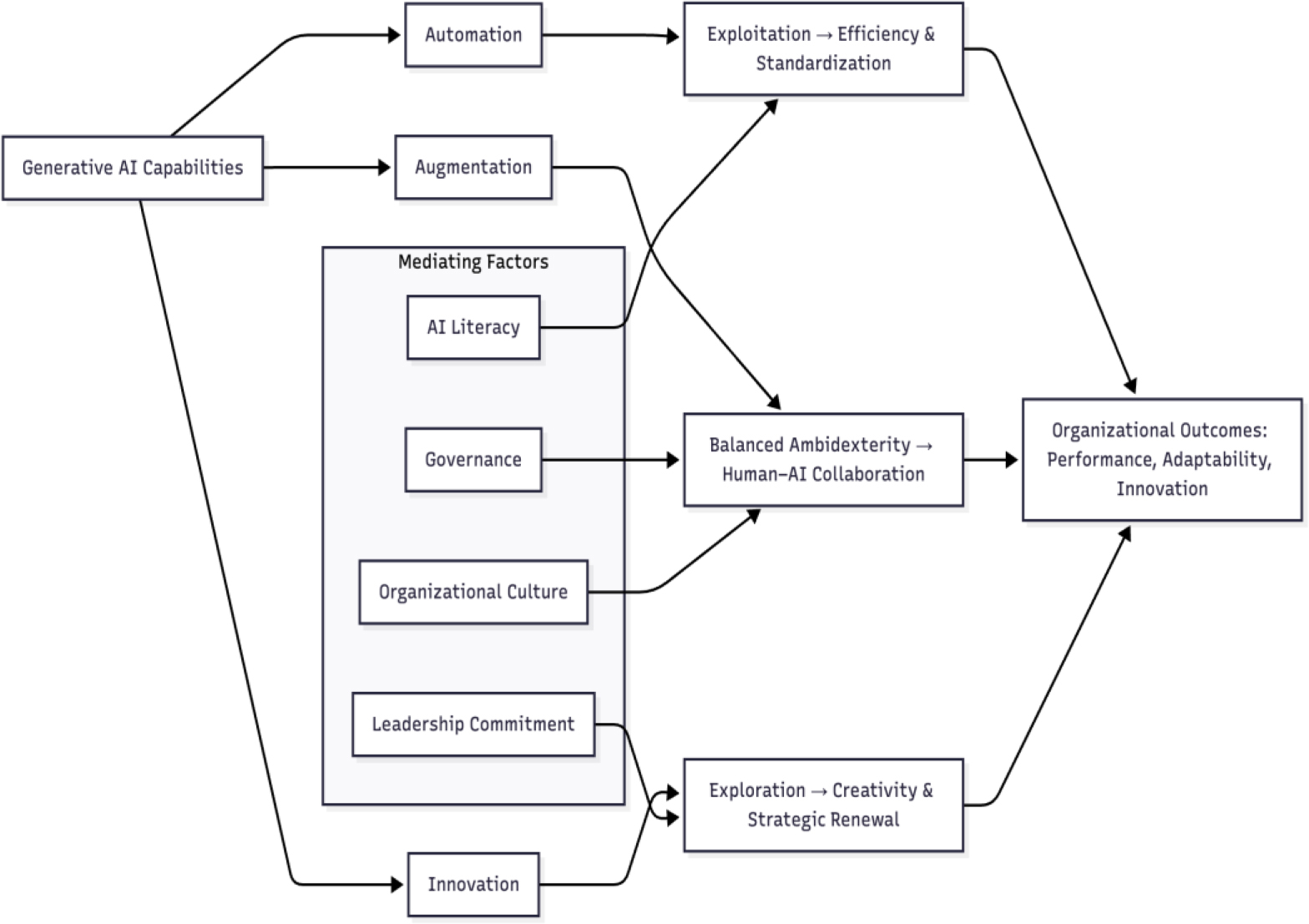
Figure 1.
Generative AI and organizational ambidexterity framework
Source: own processing
Table 1.
Illustrative examples of Generative AI applications in business workflows
| Industry/Sector | Specific workflow/Process impacted | Type of GenAI impact | Concrete example/benefit |
|---|---|---|---|
| Legal Services | Legal document drafting, workflow automation | Automation | Drafting time cut from 40 hours to minutes; saves up to 25 hours/case |
| Healthcare | Medical appeal processing | Automation | Saves 11,000 nursing hours; 99% approval rate for letters |
| Manufacturing | Standard Operating Procedure (SOP) creation | Automation | Creation time cut from 1 hour to 10 minutes for 1,000 SOPs |
| Financial Services | Credit report generation | Automation | Up to 25% time savings in report generation |
| Government | Police report writing | Automation | 82% reduction in time officers spend on reports |
| Customer Service | Customer inquiries, virtual assistants | Automation | Automates over 50% of interactions; handles millions of queries/month |
| Software Development | Code generation, refactoring, debugging | Augmentation | Increases productivity by 10%; boosts delivery volume by 25% |
| Marketing | Content drafting, personalized campaigns | Augmentation | Drafts copy for blogs, emails; real-time personalized content |
| Management | Report, summary, projection generation | Augmentation | Streamlines administrative burdens; frees time for strategic analysis |
| Innovation/R&D | New product compound discovery | New Process/Innovation | Reduces development time from days to minutes for new compounds |
| Customer Engagement | Hyper-personalized interactions | New Process/Innovation | Enables hyper-personalized campaigns at scale; proactive actions |
| Research & Development | Scientific problem-solving, data synthesis | New Process/Innovation | Proposes novel solutions; synthesizes medical images for training |
Table 2.
Changes in job roles and required skills due to GenAI
| Category of impact | Examples of job roles | Nature of change/impact | Key skills affected/required |
|---|---|---|---|
| Fully Replaced Roles | Bill and Account Collectors, Data Entry Keyers, Word Processors and Typists | Automation of routine data entry, document processing, and administrative tasks. | Mundane/repetitive tasks (decreased), Technical ICT skills (decreased) |
| Partially Replaced/Augmented Roles | Customer Service Representatives, Computer Network Support Specialists | AI handles common queries and initial troubleshooting; humans focus on complex, nuanced issues. | Technical ICT skills (decreased for routine, increased for complex), Critical thinking (increased), Social skills (increased) |
| New/Enhanced Roles | AI Ethics Specialist, AI Solutions Architect, AI Trainer | Oversees AI system development, ethical compliance, data analysis, and human-AI collaboration. | AI literacy (new), Problem-solving (increased), Ethical reasoning (increased), User experience design (new) |