
Introduction
The rapid advancement of Generative Artificial Intelligence (GenAI) represents a transformative milestone in the evolution of the knowledge economy (Zavrazhnyi et al., 2024). Beyond its technical sophistication, GenAI functions as a strategic enabler of new forms of organizational learning, innovation, and value creation (Kanitz et al., 2023). As enterprises transition to knowledge-driven ecosystems, GenAI provides unprecedented capabilities to generate content, insights, and solutions across multiple business functions—reshaping workflows, roles, and decision-making processes. This shift demands a reconceptualization of how organizations balance operational efficiency with innovation agility, a dynamic tension traditionally captured by the concept of organizational ambidexterity (March, 1991).
Organizational ambidexterity refers to an organization’s ability to simultaneously pursue exploitation—refining and optimizing existing competencies—and exploration— experimenting with new knowledge, ideas, and opportunities (O’Reilly & Tushman, 2013). Within the contemporary digital and knowledge economies, this balance has become increasingly dependent on technology-enabled knowledge creation and dissemination (Vial, 2019). Generative AI, with its ability to automate routine tasks while stimulating creativity and innovation, embodies both exploitative and exploratory potentials. It not only accelerates productivity through automation but also empowers human ingenuity by augmenting decision-making, knowledge generation, and problem-solving capabilities (McKinsey Global Institute, 2023).
While existing studies explore the role of AI in automation and analytics, few have systematically examined how Generative AI enables organizational ambidexterity, that is, how it helps organizations exploit existing resources while simultaneously exploring novel business models and organizational forms (Dwivedi et al., 2021). Addressing this gap, this paper adopts a systematic literature review approach to synthesize and integrate findings from recent academic and industry research (2020–2025). It examines how GenAI influences business workflows and organizational structures, categorizing its effects into automation, augmentation, and innovation.
The purpose of this study is threefold: (1) to conceptualize how GenAI capabilities support the dual imperatives of exploitation and exploration; (2) to identify managerial mechanisms and governance structures that facilitate ambidextrous adoption of GenAI; and (3) to propose an integrative framework that links technological advancement with organizational transformation. In doing so, this paper contributes to both theory and practice by situating GenAI within the broader discourse on digital transformation and the knowledge economy, offering insights that can guide managers, policymakers, and scholars navigating this evolving landscape (Brynjolfsson & McAfee, 2016).
In addition to reshaping internal organizational processes, Generative Artificial Intelligence (GenAI) is emerging as a key driver of national innovation systems and socioeconomic competitiveness (OECD, 2023). Governments and industries increasingly recognize that GenAI adoption signals a country’s digital maturity and its ability to leverage knowledge as a strategic resource (World Economic Forum, 2020). At the organizational level, GenAI facilitates knowledge diffusion by reducing informational bottlenecks and accelerating decision cycles. At the macro level, its influence extends to ecosystem innovation, where firms, universities, and public institutions collaborate to build AI-enabled learning networks (Brynjolfsson & McAfee, 2016).
This dual role situates GenAI not only as a technological artifact but as a socio-technical infrastructure shaping how knowledge economies evolve (Teece, 2018). For example, firms with advanced AI adoption exhibit greater absorptive capacity and innovation efficiency—traits central to competitive advantage (Cohen & Levinthal, 1990). Consequently, organizations that strategically embed GenAI into knowledge creation and sharing systems become active contributors to national innovation capacity. This contextual understanding reinforces the need for managerial strategies that align GenAI implementation with broader knowledge-economy objectives and sustainable digital-transformation goals.
The remainder of this paper is structured as follows. Section 2 provides the systematic literature review and develops the theoretical framework for organizational ambidexterity in the context of GenAI. Section 3 details the research methodology. Section 4 presents the findings concerning automation, augmentation, and innovation. Section 5 discusses these findings, proposes an integrative model, and addresses ethical and governance considerations. Finally, Section 6 offers managerial and policy implications, outlines limitations, and suggests avenues for future research.
Literature review
The knowledge economy, digital transformation, and organizational ambidexterity
The rise of the knowledge economy has redefined the sources of competitive advantage for modern organizations (Vial, 2019). Value creation now depends less on physical capital and more on intangible assets such as knowledge, innovation, and learning capacity (Teece, 2018). Digital transformation acts as a catalyst for this shift by integrating advanced technologies that enable rapid knowledge creation, dissemination, and utilization (Zavrazhnyi et al., 2024). Generative Artificial Intelligence (GenAI) stands at the forefront of this transformation, accelerating organizational capabilities for creativity, adaptability, and decision-making. As firms navigate increasingly volatile markets, the ability to harness GenAI for both operational efficiency and innovation becomes central to sustaining growth and competitiveness (Brynjolfsson & McAfee, 2016).
Organizational ambidexterity—the capacity to balance exploitation and exploration—has long been recognized as essential for navigating dynamic environments (March, 1991; Raisch & Birkinshaw, 2008). In the digital era, this balance extends beyond structural arrangements to include technological and cognitive mechanisms. Digital tools, particularly those powered by AI, allow organizations to exploit efficiencies through automation while simultaneously exploring new capabilities through experimentation and innovation. Generative AI’s dual nature amplifies this potential by supporting routine optimization and creative ideation within the same technological ecosystem (Kanitz et al., 2023). Consequently, ambidexterity becomes less about rigid organizational design and more about developing dynamic capabilities (Teece, 2018), thereby enabling continuous learning and adaptation.
Studies highlight that GenAI contributes to three transformative mechanisms: Automation, streamlining repetitive, knowledge-intensive processes to enhance operational efficiency; Augmentation, enhancing human cognition and creativity by providing contextual insights and adaptive support; and Innovation, enabling the discovery of new business models and services through generative problem-solving.
Theoretical foundations: dynamic capabilities and knowledge management
The intersection between knowledge management theory and dynamic capabilities offers a valuable lens for understanding GenAI’s organizational impact. Knowledge management focuses on how organizations create, share, and apply knowledge, while dynamic capabilities emphasize the ability to reconfigure resources in response to environmental change (Teece, 2018). Generative AI bridges these domains by automating knowledge codification and accelerating the generation of new insights. This integration allows organizations to sense emerging opportunities, seize innovations, and transform structures in ways that align with both exploitative efficiency and exploratory learning (Brynjolfsson & McAfee, 2016).
Beyond dynamic capabilities and knowledge management, absorptive capacity theory (Cohen & Levinthal, 1990) provides additional explanatory power for understanding how organizations internalize and exploit GenAI-driven insights. Absorptive capacity refers to a firm’s ability to recognize the value of new knowledge, assimilate it, and apply it to commercial ends—an ability amplified by GenAI’s generative and analytical functions. Through its identify ability to mine unstructured data and generate novel patterns, GenAI enhances firms’ capacity to absorb and recombine external knowledge into innovative solutions (Dwivedi et al., 2021).
Moreover, the framework of organizational learning theory (Argyris & Schön, 1997) underscores how GenAI supports double-loop learning, enabling continuous feedback between technological outputs and managerial reflection. When combined with digital transformation capabilities, these theories illustrate how GenAI transforms organizations from static knowledge repositories into adaptive learning ecosystems (Vial, 2019). Finally, the literature indicates that GenAI’s impact on ambidexterity is contingent upon contextual factors such as data infrastructure, leadership vision, and ethical governance (Santoni de Sio, 2024). Integrating these theoretical perspectives yields a richer understanding of how GenAI fosters exploration, exploitation, and sustainable knowledge-based innovation.
Research gap and conceptual rationale
Despite a growing body of research on AI and digital transformation, limited attention has been given to how GenAI specifically drives ambidexterity through changes in workflows, structures, and knowledge processes (Dwivedi et al., 2021). Most studies address AI’s efficiency benefits or ethical risks but overlook its role as a strategic mechanism for balancing innovation and stability. This study fills that gap by synthesizing recent multidisciplinary evidence and proposing an integrative framework illustrating how GenAI capabilities enable organizations to thrive in the knowledge economy. The review highlights that success depends not only on adopting technology but also on fostering a culture of learning, responsible governance, and human–AI collaboration.
Research methodology
Research design
This study employs a systematic literature review to synthesize and interpret academic and industry research on the relationship between Generative Artificial Intelligence (GenAI) and organizational ambidexterity in the context of the knowledge economy. This design was chosen to integrate multidisciplinary insights across management, information systems, and artificial intelligence, ensuring comprehensive coverage of both theoretical and applied perspectives. Following the Preferred Reporting Items for Systematic Reviews (PRISMA) framework (Moher et al., 2009), the review emphasizes transparency, reproducibility, and methodological rigor.
Search strategy and data sources
A total of 85 sources were initially identified through database and industry searches, of which 42 met the inclusion criteria and were analyzed in depth. This explicit count clarifies the scale and robustness of the review. The literature search was conducted across major academic databases, including Scopus, Web of Science, IEEE Xplore, and Google Scholar, supplemented by industry sources such as the World Economic Forum, McKinsey & Company, and OECD digital economy reports. The search covered publications from 2020 to 2025, reflecting the period of accelerated GenAI development and adoption. Keywords combined thematic and contextual terms such as “Generative AI,” “organizational ambidexterity,” “digital transformation,” “knowledge economy,” and “workflow redesign.” Boolean operators and truncations were applied to capture conceptual overlaps across management and technology literature.
Inclusion criteria encompassed peer-reviewed journal articles, conference proceedings, and reputable industry reports that: (a) examined the impact of GenAI on organizational processes or structures; (b) discussed ambidexterity, innovation, or digital transformation; and (c) provided empirical or conceptual contributions relevant to the knowledge economy. Studies focusing solely on technical model development without organizational implications were excluded, as were papers lacking methodological transparency or published before 2020.
Selected papers were systematically coded using thematic analysis. Each source was evaluated for research objectives, context, theoretical framework, and key findings. Codes were grouped into higher-order categories—automation, augmentation, and innovation—reflecting GenAI’s core contributions to organizational transformation. These categories were then mapped onto the dual dimensions of exploitation (efficiency, optimization) and exploration (innovation, creativity) that define organizational ambidexterity.
Analytical procedure
The analysis proceeded in three distinct phases. First, a descriptive synthesis was conducted to identify publication trends, research contexts, and methodological diversity. This was followed by a thematic synthesis that integrated recurring concepts across studies to uncover patterns in GenAI-enabled workflow transformation. Finally, the research culminated in the development of a framework, in which an integrative conceptual model was constructed to link GenAI capabilities with ambidexterity mechanisms, supported by cross-sectoral illustrative examples.
To enhance reliability, two researchers independently reviewed each stage of data selection and coding, and discrepancies were resolved through discussion. Methodological triangulation—drawing on both academic and practitioner sources—ensured balanced representation of theoretical and applied perspectives. The resulting synthesis provides a robust and credible foundation for understanding how GenAI fosters organizational ambidexterity in the digital age (see Figure 1).
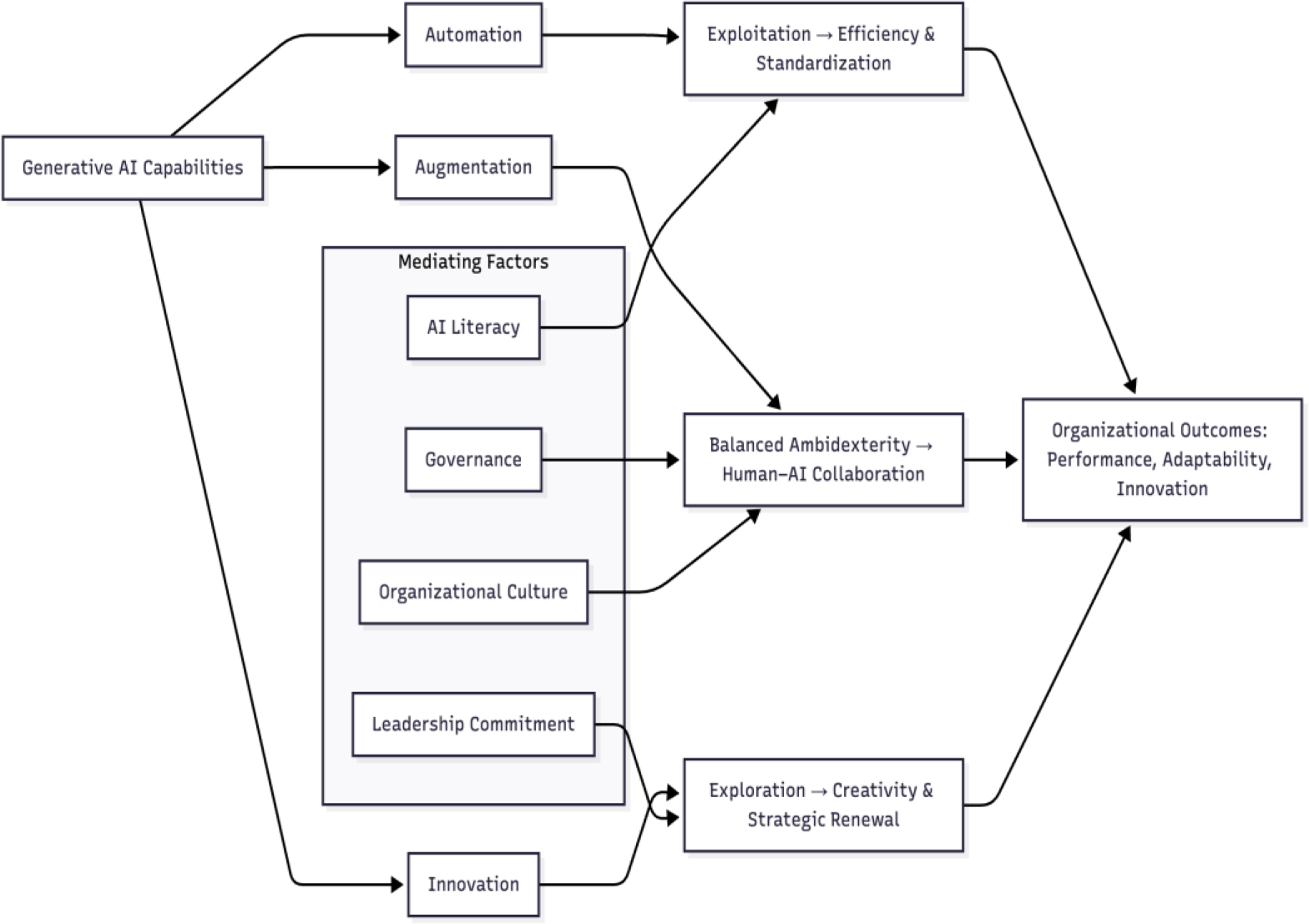
Figure 1.
Generative AI and organizational ambidexterity framework
Source: own processing
Findings
The review findings reveal that Generative Artificial Intelligence (GenAI) has a multifaceted influence on organizational workflows, structures, and learning processes. Across the 42 analyzed studies, three dominant patterns emerge: (1) automation of existing processes and workflows, (2) augmentation of human capabilities and collaboration, and (3) innovation-driven transformation of business models and structures. These three mechanisms align with the dual dimensions of organizational ambidexterity, exploitation and exploration, that underpin sustainable competitive advantage in the knowledge economy (March, 1991; O’Reilly & Tushman, 2013).
GenAI as a driver of automation (exploitation)
Automation represents the exploitative dimension of GenAI adoption. The technology enables organizations to streamline repetitive, knowledge-intensive tasks, thereby improving efficiency and consistency. Case evidence from finance, legal services, and manufacturing demonstrates productivity improvements of 20–50% when GenAI systems automate document drafting, report generation, or design processes. This reflects GenAI’s capacity to codify organizational knowledge and reuse it efficiently—key traits of exploitation. Moreover, automation enhances standardization and accuracy, freeing human resources for higher-order cognitive work. However, the reviewed studies also warn of potential over-reliance on automation, which can lead to skill erosion and reduced human oversight if governance mechanisms are not robust.
GenAI as a mechanism for human augmentation (balanced exploitation–exploration)
Augmentation lies between efficiency and innovation. GenAI enhances human decision-making by providing contextual intelligence, summarizing complex data, and generating creative alternatives. For example, in software development and marketing, GenAI tools assist teams in idea generation, prototyping, and content creation, accelerating project cycles while preserving human oversight. This collaborative relationship—termed human–AI symbiosis—allows employees to focus on strategic thinking and creativity, improving organizational learning capacity. Augmentation thus contributes to ambidexterity by balancing the optimization of existing processes with the exploration of new approaches. To maximize value, firms must invest in user training and cultivate a culture of critical evaluation, ensuring employees treat AI as a co-creator rather than a replacement.
The cross-sector synthesis reveals that organizational readiness—measured by digital maturity, leadership commitment, and data quality—moderates the effectiveness of GenAI (Dwivedi et al., 2021). Firms with robust knowledge infrastructures and formal AI governance frameworks experience faster and more consistent returns on GenAI investment. By contrast, small and medium-sized enterprises often face challenges in integrating GenAI due to resource constraints, limited AI literacy, and weak change-management systems (McKinsey Global Institute, 2023).
Compared with the private sector, the public sector exhibits a slower adoption trajectory, constrained by regulatory rigidity and ethical accountability obligations (Santoni de Sio, 2024). Nevertheless, pilot programs in e-governance and education indicate that GenAI can enhance service personalization and policy modeling when implemented responsibly (World Economic Forum, 2020). These findings emphasize that successful ambidexterity requires more than technological adoption—it depends on alignment between human, structural, and technological capital (Teece, 2018).
Furthermore, the results suggest that GenAI drives organizational resilience by transforming traditional hierarchical decision-making into agile, data-driven learning loops (O’Reilly & Tushman, 2013). In sectors such as healthcare and finance, human–AI collaboration has proven to enhance diagnostic accuracy and fraud detection while stimulating process innovation (Kanitz et al., 2023). These cross-contextual insights confirm GenAI’s pivotal role in shaping adaptive, knowledge-based organizations that balance stability with innovation (please see Table 1).
Table 1.
Illustrative examples of Generative AI applications in business workflows
| Industry/Sector | Specific workflow/Process impacted | Type of GenAI impact | Concrete example/benefit |
|---|---|---|---|
| Legal Services | Legal document drafting, workflow automation | Automation | Drafting time cut from 40 hours to minutes; saves up to 25 hours/case |
| Healthcare | Medical appeal processing | Automation | Saves 11,000 nursing hours; 99% approval rate for letters |
| Manufacturing | Standard Operating Procedure (SOP) creation | Automation | Creation time cut from 1 hour to 10 minutes for 1,000 SOPs |
| Financial Services | Credit report generation | Automation | Up to 25% time savings in report generation |
| Government | Police report writing | Automation | 82% reduction in time officers spend on reports |
| Customer Service | Customer inquiries, virtual assistants | Automation | Automates over 50% of interactions; handles millions of queries/month |
| Software Development | Code generation, refactoring, debugging | Augmentation | Increases productivity by 10%; boosts delivery volume by 25% |
| Marketing | Content drafting, personalized campaigns | Augmentation | Drafts copy for blogs, emails; real-time personalized content |
| Management | Report, summary, projection generation | Augmentation | Streamlines administrative burdens; frees time for strategic analysis |
| Innovation/R&D | New product compound discovery | New Process/Innovation | Reduces development time from days to minutes for new compounds |
| Customer Engagement | Hyper-personalized interactions | New Process/Innovation | Enables hyper-personalized campaigns at scale; proactive actions |
| Research & Development | Scientific problem-solving, data synthesis | New Process/Innovation | Proposes novel solutions; synthesizes medical images for training |
GenAI as a catalyst for innovation (exploration)
The exploratory dimension of GenAI lies in its ability to generate novel ideas, business models, and operational paradigms. Across multiple industries, GenAI is used to prototype new products, simulate business scenarios, and personalize customer experiences. In R&D, GenAI accelerates innovation cycles by generating synthetic data and predicting design outcomes, dramatically reducing time-to-market. These capabilities foster a culture of experimentation, enabling organizations to pursue radical innovation while managing uncertainty. Empirical studies show that GenAI adoption correlates with increased innovation output and cross-functional collaboration, both of which are critical for organizational exploration. The challenge for managers lies in balancing this creative potential with ethical, legal, and strategic boundaries to prevent misuse or misalignment with corporate objectives.
Discussion and theoretical contribution
To mitigate the potential bias acknowledged in the Limitations section (7.1), a critical contrast of the literature reveals divergence in tone and emphasis between academic and industry sources. Peer-reviewed academic sources often provide a more cautious and nuanced view, focusing on the prerequisites (e.g., human–AI literacy, ethical frameworks) necessary for successful augmentation. These sources emphasize that while GenAI enables human–AI collaboration, the transformation is contingent on addressing challenges such as skill erosion and the complexities of double-loop learning. In contrast, industry reports from organizations such as McKinsey and the World Economic Forum tend to be more optimistic about the scale and speed of productivity gains. These reports position augmentation as the next productivity frontier, often highlighting immediate time savings and the massive economic potential across sectors. While industry data provides robust, quantitative examples of efficiency gains (exploitation), the academic literature more thoroughly debates the necessary cultural and ethical transformation required to ensure sustainable exploration and long-term human relevance.
Synthesizing GenAI, ambidexterity, and organizational workflows
Synthesizing the findings, the review proposes an integrative framework that maps the three GenAI mechanisms—automation, augmentation, and innovation—onto the ambidexterity dimensions of exploitation and exploration. The framework illustrates that automation drives efficiency and standardization, thereby reinforcing exploitative stability, while augmentation bridges the gap between exploitation and exploration through enhanced human-AI collaboration. Furthermore, innovation expands exploratory capacity by fostering creativity, flexibility, and strategic renewal within the organization. This triadic structure highlights how GenAI simultaneously strengthens operational performance and stimulates innovation, provided that enabling factors like AI literacy and leadership commitment mediate the relationship (see Table 2).
Table 2.
Changes in job roles and required skills due to GenAI
| Category of impact | Examples of job roles | Nature of change/impact | Key skills affected/required |
|---|---|---|---|
| Fully Replaced Roles | Bill and Account Collectors, Data Entry Keyers, Word Processors and Typists | Automation of routine data entry, document processing, and administrative tasks. | Mundane/repetitive tasks (decreased), Technical ICT skills (decreased) |
| Partially Replaced/Augmented Roles | Customer Service Representatives, Computer Network Support Specialists | AI handles common queries and initial troubleshooting; humans focus on complex, nuanced issues. | Technical ICT skills (decreased for routine, increased for complex), Critical thinking (increased), Social skills (increased) |
| New/Enhanced Roles | AI Ethics Specialist, AI Solutions Architect, AI Trainer | Oversees AI system development, ethical compliance, data analysis, and human-AI collaboration. | AI literacy (new), Problem-solving (increased), Ethical reasoning (increased), User experience design (new) |
From a theoretical standpoint, this study extends ambidexterity theory by introducing Generative AI as a dual enabler that facilitates both exploitation and exploration through its generative, adaptive, and collaborative capacities. Practically, it offers a roadmap for organizations aiming to align GenAI with strategic objectives. The analysis demonstrates that the success of GenAI adoption depends not merely on technology but on organizational culture, leadership, and knowledge governance. In the knowledge economy, these human-centered factors determine whether GenAI becomes a source of sustainable innovation or a mechanism for short-term efficiency.
The transformative power of Generative Artificial Intelligence (GenAI) brings not only opportunity but also ethical, governance, and social challenges that organizations must address to ensure sustainable and responsible implementation (Floridi et al., 2018). In the knowledge economy, where data and intellectual capital serve as primary assets, the ethical management of GenAI systems directly influences organizational legitimacy, trust, and long-term competitiveness (Brynjolfsson & McAfee, 2016). This section consolidates insights from the reviewed literature to examine three central domains—governance, workforce transformation, and digital inequality—through a managerial lens.
As organizations increasingly integrate GenAI into strategic and operational processes, establishing robust governance structures becomes imperative. Effective AI governance requires clear allocation of responsibilities, ethical guidelines, and transparent mechanisms for oversight. Leaders must define how decisions generated by AI systems are validated and who holds ultimate accountability for their outcomes. The literature consistently emphasizes the role of AI governance boards and cross-functional ethics committees in balancing innovation with accountability. These structures promote compliance with privacy regulations (such as GDPR) and prevent reputational risks associated with unethical AI deployment.
From a managerial standpoint, governance should extend beyond compliance to proactive value alignment. Organizations must articulate guiding principles that reflect their mission and stakeholder expectations, ensuring that AI-generated outputs adhere to both legal and moral standards (Brynjolfsson & McAfee, 2016). Transparency, explainability, and traceability of GenAI systems are essential in maintaining stakeholder trust, particularly when AI is used for decision-making that affects employees or customers.
Bias and fairness represent persistent challenges in AI adoption. Because GenAI models learn from extensive datasets that may contain historical or cultural biases, their outputs can unintentionally perpetuate inequality or discrimination. The reviewed studies highlight that algorithmic audits, diverse data sourcing, and bias-mitigation training are critical interventions. Management scholars emphasize the importance of embedding fairness throughout the AI lifecycle—from data acquisition to model deployment.
To address these risks, managers must implement data governance policies that ensure representativeness and accuracy. Establishing data stewardship roles helps safeguard data integrity, while inclusive teams can identify and correct biased assumptions during model training. Ethical leadership plays a pivotal role here: leaders should cultivate awareness and responsibility for bias mitigation as part of the organization’s culture rather than treating it as a technical afterthought.
Workforce transformation and inclusion in the knowledge economy
One of the most significant ethical and managerial implications of GenAI adoption concerns its effect on employment structures and skill requirements. Automation of routine cognitive tasks creates efficiency but simultaneously disrupts traditional job roles. However, rather than viewing AI as a threat to employment, forward-looking organizations see it as an opportunity to redefine work and augment human capabilities. The transition toward human–AI collaboration demands investment in continuous learning and reskilling programs to prepare employees for hybrid cognitive environments (Davenport & Kirby, 2016).
The review identifies three managerial imperatives for effective workforce adaptation. These include reskilling and upskilling through structured programs that enhance AI literacy and creative problem-solving; job redesign that reallocates tasks between humans and machines based on comparative advantage; and ethical change management, which involves transparent communication regarding AI's purpose to reduce employee resistance. Organizations that adopt these measures position themselves to achieve both productivity and inclusivity, reinforcing the dual goals of exploitation and exploration central to ambidexterity.
The global diffusion of GenAI technologies has revealed stark disparities in access and capability across organizations, industries, and regions. This AI divide risks exacerbating existing inequalities in the knowledge economy. Theoretically, this divide fundamentally undermines the development of ambidextrous capabilities in resource-constrained firms. Smaller enterprises and emerging economies that struggle with limited computational capacity, weak data infrastructure, and reliance on proprietary AI platforms are effectively locked into cycles of low-value exploitation. Lacking the capital and expertise to pursue widespread GenAI-driven augmentation and innovation, these firms are unable to engage in meaningful exploration. Conversely, dominant firms leverage their advanced AI adoption to monopolize the creation of new knowledge, rapidly seizing innovative opportunities and contributing to national innovation systems. This imbalance restricts knowledge transfer and innovation equity, highlighting that GenAI adoption must be managed inclusively to ensure it does not reinforce the concentration of knowledge and strategic advantage, but rather contributes to shared prosperity.
From a corporate ethics perspective, inclusion should be treated as a strategic priority. Initiatives such as open-access data repositories, public–private partnerships, and affordable AI education can help democratize the benefits of technology. Companies operating in developing regions bear an additional responsibility to invest in local capacity building, ensuring that GenAI contributes to shared prosperity rather than reinforcing power concentration.
Emerging economies face a dual challenge: limited computational capacity and dependency on proprietary AI platforms from advanced economies (Acemoglu & Restrepo, 2019). This imbalance perpetuates a digital divide that restricts knowledge transfer and equity in innovation. Recent international frameworks, such as UNESCO’s Recommendation on the Ethics of Artificial Intelligence (2022), advocate for global cooperation to ensure that AI technologies serve inclusive and sustainable purposes. Integrating these principles into corporate strategy enables firms to align local initiatives with global ethical standards (Floridi et al., 2018). Managers play a critical role in operationalizing these commitments by forming partnerships with local academic institutions, investing in open-source AI ecosystems, and promoting culturally sensitive AI design (World Economic Forum, 2020). Such collaborative initiatives not only democratize access to GenAI but also reinforce trust and legitimacy across global knowledge networks—key prerequisites for responsible ambidexterity in the knowledge economy.
Managerial and policy implications
Managerial strategies for responsible ambidexterity
The findings underscore the need for managers to treat GenAI adoption as an organizational design challenge rather than a purely technological upgrade. Effective deployment requires adaptive structures that support cross-functional collaboration, iterative learning, and ethical oversight. Managers should view GenAI not merely as a cost-saving tool but as a strategic capability for designing resilient, learning-oriented organizations.
To effectively manage the inherent tension between the speed required for exploration and the safety necessary for exploitation, we propose specific mechanisms for responsible governance. First, leaders should establish a Dynamic AI Governance Board (AIGB)—a cross-functional body including technology, legal, and strategy experts—to balance autonomy with accountability and integrate GenAI into strategic planning. Second, the use of Adaptive Regulatory Sandboxes is recommended to create internal, low-stakes environments in which GenAI exploration can occur rapidly, with temporarily relaxed oversight, contingent on strict, time-bound ethical review checkpoints. This approach facilitates strategic renewal while maintaining necessary ethical oversight. Finally, Ethical Change Management serves as a vital pillar, requiring proactive workforce strategies and continuous employee reskilling to maintain employability and creativity in an AI-driven environment.
Policy frameworks for inclusive knowledge economies
At the policy level, governments and regulators should develop adaptive frameworks that ensure fair access to AI technologies while safeguarding data privacy and mitigating bias. Collaborative public–private initiatives are necessary to bridge skill gaps and ensure equitable participation in the knowledge economy. To address the risks of the AI divide, inclusion must be treated as a strategic priority. Initiatives such as open-access data repositories, public–private partnerships, and affordable AI education can help democratize the benefits of technology. Policymakers and corporate leaders must ensure that GenAI contributes to shared prosperity rather than reinforcing power concentration, and align local initiatives with global ethical standards, such as UNESCO’s Recommendation on the Ethics of Artificial Intelligence.
The integration of ethical and governance considerations into GenAI strategy represents a defining competency for organizations. Ethical management of GenAI is about creating long-term value through responsible innovation. Managers should adopt a 'human-centered AI' mindset that positions technology as a tool for empowerment, focusing on three critical directions for future practice. These directions include governance innovation, characterized by the development of dynamic models that evolve alongside AI maturity; ethics-by-design, which emphasizes the integration of ethical principles directly into AI system design and decision-support tools; and the cultivation of inclusive ecosystems through the expansion of cross-sector partnerships to ensure GenAI benefits extend to the broader society. Collectively, these practices enable organizations to achieve responsible ambidexterity by balancing innovation with integrity in the knowledge economy.
Limitations and future research directions
Generative Artificial Intelligence (GenAI) remains a rapidly evolving field that offers substantial opportunities for expanding both theoretical and practical understanding of digital transformation in the knowledge economy. Based on the findings of this review, several research trajectories warrant further exploration.
The limitations of this systematic literature review stem primarily from the nascent nature of Generative Artificial Intelligence (GenAI) as an academic field. First, by narrowing the search window to publications from 2020 to 2025, the study necessarily synthesizes a body of knowledge that is still in its emergent stages. Consequently, the findings are largely based on conceptual, theoretical, and early industry reports (e.g., from McKinsey and the World Economic Forum) rather than longitudinal empirical studies, which are essential for establishing long-term organizational outcomes and causal links related to ambidexterity. Second, although a rigorous systematic methodology was followed, the study is inherently constrained by the scope of the included academic and practitioner databases, potentially introducing a selection bias. Finally, consistent with providing a management-centric perspective, the review deliberately excluded studies that focus solely on the technical model development of GenAI without explicit organizational implications, which means the synthesis may not fully capture the most recent, cutting-edge technological advancements impacting workflows. These limitations underscore the necessity for future empirical research to validate the proposed framework with longitudinal organizational data as it becomes available.
Future studies should further integrate GenAI into organizational ambidexterity theory by examining how generative models influence the balance between exploitation and exploration across different organizational contexts (March, 1991; O’Reilly & Tushman, 2013). Building on the dynamic capabilities’ framework (Teece, 2018), scholars can investigate how GenAI enables sensing, seizing, and transforming capabilities that drive long-term competitiveness in volatile environments. The intersection of GenAI with knowledge management theory also deserves deeper examination to understand how machine-generated knowledge complements human creativity and decision-making (Vial, 2019).
Empirical research should validate the conceptual frameworks proposed in this review by analyzing longitudinal case studies of organizations that have adopted GenAI across diverse industries and regions (Dwivedi et al., 2021). Comparative research between emerging and developed economies could reveal contextual differences in adoption outcomes (World Economic Forum, 2020). Quantitative studies measuring GenAI’s effects on innovation output, employee performance, and organizational learning will further substantiate its impact on ambidextrous performance.
Given the ethical and governance challenges identified, future research should explore ethics-by-design approaches that embed fairness, transparency, and accountability into GenAI systems (Floridi et al., 2018; Santoni de Sio, 2024). Investigating how different governance models—centralized, federated, or participatory—affect organizational outcomes would deepen understanding of responsible AI management. Moreover, comparative policy research could assess the effectiveness of national and regional AI governance frameworks in fostering ethical innovation (Brynjolfsson & McAfee, 2016).
Further work is needed to understand how GenAI transforms skill requirements, work design, and patterns of human–AI collaboration. Future research could investigate how organizations cultivate AI literacy and support continuous learning to maintain employability and creativity (Davenport & Kirby, 2016; McKinsey Global Institute, 2023). Studies on leadership styles that foster trust and collaboration between humans and AI systems would also contribute valuable managerial insights.
Research should address the digital divide and disparities in access to AI technologies that risk exacerbating inequality (Acemoglu & Restrepo, 2019). Cross-sector and international collaborations could be examined as mechanisms for ensuring inclusive AI-driven growth. Future studies might assess the roles of open-access platforms, shared data infrastructures, and public–private partnerships in democratizing the benefits of GenAI (World Economic Forum, 2020).
Methodologically, the integration of AI-augmented research methods represents an emerging frontier (Dwivedi et al., 2021). Scholars can explore how GenAI tools can assist in literature analysis, data coding, and hypothesis generation while maintaining academic rigor and transparency. Mixed-method and participatory research designs can capture the nuanced socio-technical dynamics of GenAI adoption.
Future research must move beyond evaluating GenAI’s immediate efficiency gains to examining its deeper implications for organizational learning, governance, and social equity. By bridging the divide between technological capability and ethical responsibility, scholars can contribute to a more sustainable and human-centered digital transformation. This agenda aligns with Management Dynamics in the Knowledge Economy's mission to advance knowledge that connects innovation, management, and societal well-being (Vial, 2019; Floridi et al., 2018). Additionally, research should advance interdisciplinary frameworks that bridge computer science, management, and ethics (Floridi et al., 2018). Collaboration among AI developers, organizational theorists, and policymakers can produce holistic models that link algorithmic design principles to management practices. For instance, integrating insights from behavioral science can improve understanding of trust formation in human–AI interactions (Davenport & Kirby, 2016). Likewise, partnerships between academia and industry can enhance transparency in GenAI experimentation, facilitating socially responsible innovation (Vial, 2019). Such integrative approaches will enable future scholarship to address both the technological depth and social complexity of AI-driven transformation in the knowledge economy.
Conclusions
Generative Artificial Intelligence (GenAI) represents a transformative force in the knowledge economy, fundamentally reshaping how organizations learn, innovate, and compete. This study’s systematic review consolidates academic and industry insights to demonstrate how GenAI fosters organizational ambidexterity by simultaneously enabling exploitation and exploration. Through its mechanisms of automation, augmentation, and innovation, GenAI enhances process efficiency, stimulates creativity, and accelerates strategic renewal—key pillars for long-term organizational resilience.
From a managerial perspective, the findings highlight that GenAI adoption transcends technological integration. It requires robust governance structures, ethical leadership, and adaptive learning cultures to balance innovation with accountability. Organizations that cultivate AI literacy, transparent decision frameworks, and inclusive workforce strategies will be better positioned to harness GenAI’s potential responsibly. By embedding fairness, transparency, and inclusivity into AI practices, leaders can ensure sustainable value creation while mitigating risks of bias, job displacement, and digital inequality.
Theoretically, this research advances ambidexterity and knowledge management literature by framing GenAI as both a technological and strategic enabler of dynamic capabilities (in line with Teece, 2018 and Vial, 2019). Practically, it offers a roadmap for managers to design ambidextrous, data-driven organizations that thrive in rapidly changing digital environments. For policymakers, the study underscores the need for adaptive governance frameworks and cross-sector collaboration to promote equitable AI diffusion (as also posited World Economic Forum, 2020).
In conclusion, Generative AI is not merely an operational tool—it is a transformative capability that redefines how organizations create knowledge, innovate, and sustain competitive advantage in the digital age. By aligning technology with human values and strategic intent, organizations can achieve responsible ambidexterity, driving both economic performance and societal progress. This synthesis provides a foundation for ongoing inquiry and managerial practice to ensure that the future of AI remains both innovative and inclusive.