
Introduction
The evolution of environmental consciousness in industrial operations presents a paradigmatic shift in organisational thinking and strategic implementation. Historically, the environmental ramifications of industrial activities remained peripheral to organisational decision-making, with business leaders and policy architects operating under the presumption of minimal ecological impact (Tao et al., 2022). This perspective has transformed as empirical evidence increasingly demonstrates the intricate relationship between industrial operations and environmental degradation. Contemporary discourse recognises the multifaceted nature of environmental challenges, encompassing climate volatility, atmospheric and hydrological contamination, resource diminution, and the proliferation of hazardous materials in industrial processes (Wang et al., 2025). The intensification of stakeholder advocacy has catalysed organisational responses toward environmental stewardship, marking a transition from voluntary initiatives to strategic imperatives. This paradigm shift is evidenced by the proliferation of sustainability-oriented strategies across industrial sectors, reflecting normative pressures and instrumental motivations. The academic trajectory has evolved from broad theoretical conceptualisations to granular analyses of specific environmental dimensions, including green supply chain management (Khan, Chen, & Hung, 2021), environmentally conscious consumer behaviour (Tao et al., 2022), and ecological innovation frameworks (Khan, Chen, & Hung, 2021). In the contemporary business landscape, environmental performance (EP) has transcended its traditional classification as a peripheral consideration to become a central determinant of organizational competitiveness. This transformation is particularly salient in the manufacturing sector, where environmental performance metrics increasingly influence stakeholder evaluations and market positioning. The convergence of competitive dynamics and environmental imperatives necessitates a deeper understanding of the antecedents and mechanisms that drive EP.
Given its substantial contribution to global environmental degradation through resource consumption and waste generation, the manufacturing sector emerges as a critical focal point in environmental discourse. Contemporary empirical evidence indicates that manufacturing-derived pollutants and waste streams pose unprecedented challenges to ecological systems and human welfare (Chen et al., 2024). This environmental imperative necessitates a comprehensive examination of EP metrics and their determinants in manufacturing contexts. Concurrent with these environmental concerns, the evolving Corporate Social Responsibility (CSR) paradigm has fundamentally transformed organisational strategic imperatives. Contemporary business entities face mounting pressure to integrate environmental, social, and economic considerations into their operational frameworks (Khuong et al., 2021). The theoretical conceptualization of CSR has evolved from a peripheral consideration to a central tenet of organisational strategy, with its scope continuously expanding to encompass emerging stakeholder expectations and environmental imperatives (Sung & Lee, 2023). The trajectory of CSR research reveals a significant scholarly emphasis on financial performance metrics, while the environmental dimension has received comparatively limited attention (Su et al., 2020). Although empirical evidence suggests that CSR initiatives correlate positively with organisational performance metrics (Kim et al., 2019), the nature and magnitude of this relationship remain subject to scholarly debate. The extant literature presents conflicting empirical findings regarding the CSR-performance nexus, particularly in environmental domains (Soomro et al., 2024; Susilawati et al., 2024). This theoretical ambiguity is particularly pronounced in the manufacturing sector, where the complexity of environmental impacts intersects with diverse stakeholder expectations. The inconclusive nature of previous research findings necessitates a more nuanced examination of the mechanisms through which CSR initiatives influence environmental performance. This study addresses this theoretical gap by proposing and empirically testing a comprehensive framework delineating the relationship between CSR and EP, incorporating direct effects and mediating mechanisms.
The conceptual intersection of CSR and Social Capital (SC) represents a critical domain in organisational theory, particularly in understanding how social interactions and stakeholder relationships influence organisational outcomes. Contemporary scholarship increasingly recognizes the symbiotic relationship between CSR initiatives and SC development, acknowledging their mutual reinforcement in organisational contexts (Zhao et al., 2021). The emergence of Second-Order Social Capital (SOSC) within this theoretical framework offers a more nuanced understanding of indirect mechanisms for acquiring resources and knowledge through extended stakeholder networks. SOSC transcends traditional conceptualizations of social capital by encompassing resources and knowledge accessed through indirect relationships, manifesting primarily through customer-derived and supplier-derived channels (Khan et al., 2021a, 2021b). This theoretical extension is fundamentally grounded in Social Exchange Theory (SET) (McLeod et al., 2021), which posits that social interactions generate reciprocal obligations and resources through network relationships. The bifurcation of SOSC into customer-centric and supplier-centric dimensions provides a more granular framework for analysing indirect resourceacquisition and knowledge-transfer mechanisms. The limitations inherent in first-order social capital necessitate exploring extended network resources through SOSC. This cascade effect in social capital transfer, in which resources and knowledge flow from a focal firm through intermediaries to ultimately benefit the original organisation, represents a sophisticated mechanism for value creation and resource acquisition (Khan, Chen, & Hung, 2021). This network-based perspective illuminates how organisations can leverage indirect relationships to enhance their resource base and operational capabilities. The dynamic interplay between CSR initiatives and SOSC development merits particular attention. Previous empirical evidence suggests a significant association between SOSC and environmental outcomes (Zhou et al., 2020), indicating the presence of complex mediating mechanisms. This study extends existing theoretical frameworks by examining the relationship between SOSC and EP.
The present study addresses important theoretical and practical limitations by developing a comprehensive framework that connects CSR, SOSC, and EP in manufacturing industries. Building on foundations from SET and the resource-based perspective, this work develops an innovative conceptual model in which SOSC serves as an intermediary pathway linking CSR activities to environmental outcomes. This research examines three essential connections: how CSR directly affects EP, how CSR influences SOSC, and how SOSC’s mediation connects CSR with EP. By empirically testing these associations in manufacturing environments, this work addresses a notable knowledge gap on how companies can effectively leverage broader stakeholder relationships for EP. These findings equip manufacturing executives with practical approaches for creating CSR strategies that amplify environmental benefits through deliberate relationship management while providing policymakers with support for encouraging collaborative environmental models.
Theoretical background and hypotheses development
CSR and environmental performance
Contemporary organizational scholarship increasingly focuses on CSR, particularly its role in addressing evolving consumer demands for environmentally sustainable products and services. The emergence of eco-industrial expertise necessitates a comprehensive understanding of environmental considerations across diverse sectors, coupled with profound insights into sustainability-driven innovations within competitive market dynamics (Shahzad et al., 2020). Organizations face multifaceted pressures from various stakeholders—competitors, clients, employees, and leadership—to identify and address community welfare and environmental imperatives (Khaddage-Soboh et al., 2024). The imperative to align organizational strategies with public expectations, particularly concerning environmental stewardship, has elevated CSR from a peripheral consideration to a central determinant of corporate reputation and market success (Tao et al., 2022). While empirical evidence has established positive correlations between CSR initiatives and financial performance metrics, scholarly attention to integrating environmental benefits within CSR frameworks remains notably limited (Chen et al., 2021). This research endeavors to address these theoretical gaps in the extant literature. A critical distinction emerges in the relationship between CSR and organizational benefits: resources are strategically allocated toward research and development initiatives rather than emphasizing promotional expenditures. This strategic orientation underscores the importance of implementing targeted policies to enhance EP (Susilawati et al., 2024). Contemporary scholarship emphasizes the need for organizations to adopt analytical frameworks that facilitate strategic adaptation to improve environmental outcomes (Soomro et al., 2024). Previous empirical investigations have indicated a significant association between CSR initiatives and EP metrics (Khaddage-Soboh et al., 2024; Susilawati et al., 2024). Consequently, the following hypothesis is proposed:
H1: CSR significantly impacts EP.
CSR and SOSC
The conceptualisation of SC is grounded in the fundamental premise that collaborative social engagement inevitably fosters enduring relational networks. These networks serve as conduits for resource distribution and for moral support. However, the limitations of first-order SC in accessing resources and expertise beyond immediate organisational boundaries have become increasingly apparent (Xie et al., 2021). This recognition has led to theoretical advances in SOSC, firmly grounded in SET. SET provides the theoretical underpinning for understanding how organisations can leverage resources and expertise beyond their immediate social networks. SOSC manifests in two distinct dimensions: customer-derived and supplier-derived capital, reflecting the diverse nature of stakeholder interactions. Empirical evidence suggests that the knowledge and expertise flowing from these stakeholder relationships catalyse organisational innovation and growth trajectories (Zhao et al., 2021). In the manufacturing sector, suppliers’ and customers’ implementation of sustainability initiatives is significantly influenced by external stakeholder pressures, particularly concerning EP enhancement and environmental compliance. Within this context, CSR, viewed through the lens of SOSC, emerges as a strategic advantage derived from stakeholder capital, built on mutual trust relationships that require continuous nurturing for sustained stakeholder engagement and commitment. Contemporary market dynamics reveal an increasing consumer consciousness regarding production environments and a growing preference for sustainably manufactured products (Khan, et al., 2021a). This shift in consumer behaviour underscores the strategic importance of integrating environmental considerations into organisational practices:
H2: CSR significantly impacts SOSC.
SOSC and environmental performance
The conceptualisation of SC emerged from sociological discourse, with Granovetter’s seminal work providing the initial theoretical framework. The World Bank’s Social Capital Initiative subsequently formalised the concept, defining it as the collective endeavours of governmental and civil society entities toward organisational benefit (Zhou et al., 2020). This definition aligns with the broader understanding of SC as a cooperative network operating within and across group boundaries, encompassing shared norms, values, and mutual understanding among network participants. SOSC extends this conceptualisation by representing the intricate web of interpersonal and intergroup connections, incorporating social networks, reciprocity norms, and trust that emerge from these social structures. Empirical evidence suggests a positive correlation between SOSC and economic outcomes (Khan et al., 2021a, 2021b). Moreover, SOSC has been theorised to enhance community cooperation and participation, fostering collectivist orientations and strengthening commitment to natural resource preservation. The literature establishes a positive association between social capital and achievement of environmental objectives, primarily through its influence on individual and organisational perceptions of the costbenefit analysis of EP enhancement (Mao et al., 2022). Organisations with robust SOSC demonstrate a greater propensity to pursue environmental protection initiatives, operating under the expectation of reciprocal engagement from peer organisations. Recent research has illuminated the contextual nature of SOSC’s influence on environmental behaviours, emphasising the moderating effects of governance quality, institutional framework robustness, and corruption levels (Khan, Chen, & Hung, 2021). This contextual complexity is further emphasised by findings indicating an inverse relationship between corruption and energy policy effectiveness (Soomro et al., 2024). The multifaceted nature of SOSC and its environmental implications necessitate continued scholarly investigation. Previous empirical work has established a significant relationship between SOSC and EP (Zhou et al., 2020), providing the theoretical foundation for the following hypothesis:
H3: SOSCsignificantly impacts EP.
Mediating role of SOSC
Drawing from SET and network resource perspectives, organisations cultivate intricate webs of relationships that extend beyond immediate stakeholder connections. While the extant literature has established direct associations between CSR and EP, the mechanisms underlying this relationship remain inadequately explored (Khaddage-Soboh et al., 2024). Contemporary scholarship suggests that SOSC – encompassing resources embedded in indirect network relationships – may serve as a crucial intermediary mechanism (Khan et al., 2021a, 2021b). This theoretical proposition aligns with recent empirical evidence demonstrating how organisations leverage extended stakeholder networks to enhance their environmental initiatives (Yankovskaya et al., 2022). When firms engage in CSR activities, they strengthen direct stakeholder relationships and cultivate valuable second – order connections through customer and supplier networks (Zhao & Detlor, 2023). These cascading network effects enable organisations to access diverse knowledge repositories and environmental expertise that may remain inaccessible through direct relationships alone. Recent empirical investigations have revealed that firms with robust SOSC demonstrate superior capability in implementing environmental initiatives, primarily due to their enhanced access to technical knowledge and best practices disseminated through extended network channels (Zhou et al., 2020). The transformation of CSR initiatives into environmental outcomes appears to be significantly amplified when organisations effectively utilise their second-order network resources. This sophisticated interplay between CSR, SOSC, and EP suggests a more nuanced understanding of how organisations translate social responsibility initiatives into tangible environmental improvements. Based on these theoretical arguments and empirical observations, this study proposes:
H4: The relationship between CSR and EP is mediated by SOSC.
A theoretical framework for the research is presented in Figure 1.
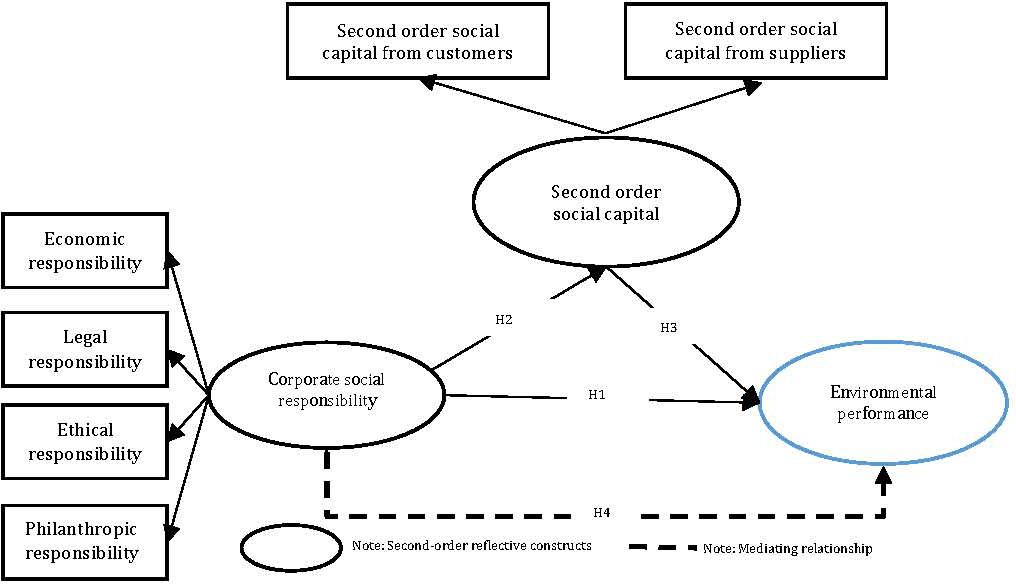
Figure 1.
Theoretical framework of the study
Source: own processing
Methodology
This study employed a systematic online data collection approach targeting middle and senior-level managers in manufacturing industries. The sampling frame comprised manufacturing firms listed on the Taiwan Stock Exchange, ensuring comprehensive representation of the manufacturing sector. Selecting Taiwan as the research context is particularly relevant given its significant role in global manufacturing and its progressive stance on corporate environmental initiatives. A structured online questionnaire was distributed via a professional survey platform, using stratified random sampling to ensure proportional representation across manufacturing sub-sectors. Several procedural remedies were implemented during data collection to enhance response quality and minimise common method bias. The questionnaire included attention-check questions to identify and exclude careless responses, and clear instructions were provided to ensure respondents understood key concepts. Additionally, respondents were assured of confidentiality and anonymity in their responses, encouraging honest and accurate responses. The survey was conducted over three months to avoid temporal bias.
The sample size satisfies the recommended threshold for PLS-SEM analysis. To account for potential invalid responses and ensure adequate representation, the survey was distributed to 450 potential respondents. After eliminating incomplete responses and failing attention checks, 307 valid responses were obtained, representing a response rate of 68.2%. The final sample demonstrated balanced representation across different manufacturing sub-sectors, encompassing various organisational positions and departments to capture diverse perspectives on CSR initiatives and environmental performance. Non-response bias was assessed by comparing early and late respondents across key constructs, revealing no significant differences. These methodological considerations ensure the sample’s representativeness and enhance the generalizability of findings within the manufacturing context.
This study employed Harman’s Single-Factor method to address common method bias. To conduct this analysis, this research loaded all measurement items into an exploratory factor analysis (EFA) without rotation. The results indicated that the first factor accounted for 34.2% of the total variance, well below the 50% threshold suggested by Podsakoff et al. (2003). This suggests that common method bias is not a significant concern in this study.
The research instrument was developed rigorously, beginning with an extensive literature review to identify validated measurement scales for each construct. All measurement items were adapted from established scales in previous studies and modified to fit the research context. The questionnaire used a seven-point Likert scale (1 = “strongly disagree” to 7 = “strongly agree”) to capture sufficient response variance while maintaining measurement precision and reliability.
This research employed the items from Chen et al.’s (2021) research to measure CSR. Moreover, the items to measure SOSC were modified from Khan, Chen and Hung (2021). Lastly, the items to measure EP were employed and modified from Benzidia et al.’s (2021) study. This research used a 7-point Likert scale as its instrument to effectively measure respondents’ attitudes.
Data analysis
A partial least squares (PLS) analytical framework guided the data examination process through two sequential stages. Initial evaluations focused on establishing construct validity and reliability metrics, and on systematically determining path coefficients and causal directionality among constructs (Hulland, 1999). The selection of the PLS methodology stems from its demonstrated capability to maintain theoretical relationship integrity while accommodating sophisticated research frameworks (Petter et al., 2007). This analytical approach proves particularly valuable when addressing non-normal distribution patterns, as it incorporates specialised indicators for managing data randomisation effects. The investigation implemented progressive analytical procedures, leveraging PLS-SEM’s capacity to handle intricate model structures (Ringle et al., 2024).
Convergent and discriminant validity
The assessment of convergent validity incorporated multiple measurement criteria. Factor loadings and Cronbach’s alpha provided internal consistency estimates, while rho_A and CR were key indicators of reliability. The rho_A coefficient evaluates instrumental reliability through weight-based analysis rather than load considerations (Henseler et al., 2014). Statistical credibility thresholds establish 0.7 as the minimum acceptable value for rho_A and Cronbach’s alpha measurements (Van Nguyen & Habók, 2021). The empirical results in Table 1 demonstrate that all constructs exceeded the established 0.7 thresholds for both Cronbach’s alpha and rho_A. Additionally, CR values surpassed the 0.70 criterion (Chin, 1998), confirming the instrument’s internal validity. Convergent validity was assessed using AVEs for each construct, with values exceeding 0.5 indicating significant convergent validity (Fornell & Larcker, 1981). The analysed constructs exhibited AVEs ranging from 0.503 to 0.761, indicating robust convergence.
Table 1.
Convergent validity
| Constructs | Cronbach Alpha | Rho_A | CR | AVE |
|---|---|---|---|---|
| CSR | 0.928 | 0.931 | 0.937 | 0.503 |
| ECO | 0.828 | 0.831 | 0.887 | 0.664 |
| EP | 0.920 | 0.921 | 0.933 | 0.581 |
| ETHI | 0.889 | 0.889 | 0.923 | 0.751 |
| LEG | 0.839 | 0.843 | 0.903 | 0.756 |
| PHI | 0.795 | 0.805 | 0.869 | 0.628 |
| SOC | 0.864 | 0.864 | 0.908 | 0.711 |
| SOS | 0.843 | 0.844 | 0.905 | 0.761 |
| SOSC | 0.909 | 0.909 | 0.927 | 0.646 |
1 Note: CSR = Corporate Social Responsibility, ECO = Economic Responsibility, ETHI = Ethical Responsibility, LEG = Legal Responsibility, PHI = Philanthropic Responsibility, EP = Environmental Performance, SOC = Second-order Social Capital from customers, SOS = Second-order Social Capital from Suppliers, SOSC = Second-order Social Capital.
Discriminant validity assessment quantifies the distinctiveness between theoretical constructs. The evaluation employed the Fornell and Larcker methodology, which utilises square root calculations of AVE values to examine latent variable relationships (Fornell & Larcker, 1981). As demonstrated in Table 2, the analysis reveals superior construct differentiation, with AVE square root values (indicated in bold) exceeding cross-construct correlations, confirming that each component accounts for greater variance within its designated construct than across other constructs.
Table 2.
Fornell and Larcker criterion
| Constructs | ECO | EP | ETHI | LEG | PHI | SOC | SOS |
|---|---|---|---|---|---|---|---|
| ECO | 0.815 | ||||||
| EP | 0.134 | 0.762 | |||||
| ETHI | 0.858 | 0.098 | 0.866 | ||||
| LEG | 0.459 | 0.325 | 0.426 | 0.870 | |||
| PHI | 0.707 | 0.273 | 0.633 | 0.571 | 0.793 | ||
| SOC | 0.280 | 0.278 | 0.243 | 0.280 | 0.346 | 0.843 | |
| SOS | 0.206 | 0.270 | 0.211 | 0.254 | 0.316 | 0.762 | 0.873 |
In addition, according to Table 3, the HTMT analysis demonstrates adequate discriminant validity across most construct pairs, meeting the conservative threshold of 0.85 (Henseler et al., 2015) and the liberal criterion of 0.90 (Gold et al., 2001). Notably, the ECO-ETHI (0.881) and PHI-ETHI (0.753) pairs approach but remain below the 0.85 threshold, indicating acceptable discriminant validity. The SOC-SOS relationship (0.871) marginally exceeds 0.85 yet falls within the 0.90 criterion, suggesting these constructs, while related as second-order social capital dimensions, maintain sufficient distinctiveness. All other construct pairs demonstrate HTMT values well below 0.85, confirming robustdiscriminant validity and supporting the measurement model’s psychometric integrity for subsequent structural analysis.
Table 3.
Heterotrait-monotrait ratio (HTMT)
| Constructs | ECO | EP | ETHI | LEG | PHI | SOC | SOS |
|---|---|---|---|---|---|---|---|
| ECO | |||||||
| EP | 0.161 | ||||||
| ETHI | 0.881 | 0.111 | |||||
| LEG | 0.551 | 0.366 | 0.491 | ||||
| PHI | 0.878 | 0.323 | 0.753 | 0.714 | |||
| SOC | 0.333 | 0.309 | 0.277 | 0.332 | 0.416 | ||
| SOS | 0.248 | 0.304 | 0.243 | 0.304 | 0.386 | 0.871 |
The discriminant validity was further analysed using the confidence intervals (CI) analysis. The 95% CIs for the correlations between constructs were estimated via bootstrapping with 5000 resamples. Table 4 shows none of the confidence intervals included 1.0, with the highest upper bound being 0.907 between SOS2 < – SOS. These results support discriminant validity among the constructs (Torkzadeh et al., 2003).
Table 4.
Confidence intervals
| Relationships | Path coefficient (ß) | CI Lower | CI Upper |
|---|---|---|---|
| SOC1<-SOC | 0.852 | 0.821 | 0.879 |
| SOC2 <-SOC | 0.844 | 0.806 | 0.876 |
| SOC3 <-SOC | 0.840 | 0.803 | 0.872 |
| SOC4 <-SOC | 0.835 | 0.791 | 0.872 |
| SOS1<-SOS | 0.860 | 0.826 | 0.888 |
| SOS2 < – SOS | 0.881 | 0.850 | 0.907 |
| SOS3 < – SOS | 0.875 | 0.848 | 0.899 |
| PHI1 < – PHI | 0.848 | 0.814 | 0.877 |
| PHI2 < – PHI | 0.853 | 0.819 | 0.882 |
| PHI3 < – PHI | 0.831 | 0.792 | 0.863 |
| PHI4 < – PHI | 0.612 | 0.513 | 0.697 |
| LEG1<-LEG | 0.878 | 0.849 | 0.902 |
| LEG2 <-LEG | 0.879 | 0.850 | 0.903 |
| LEG3 <-LEG | 0.851 | 0.810 | 0.885 |
| ETHI1 < – ETHI | 0.873 | 0.845 | 0.897 |
| ETHI2 < – ETHI | 0.872 | 0.839 | 0.900 |
| ETHI3 < – ETHI | 0.875 | 0.848 | 0.900 |
| ETHI4 < – ETHI | 0.844 | 0.812 | 0.873 |
| ECO1<-ECO | 0.864 | 0.832 | 0.890 |
| ECO2<-ECO | 0.855 | 0.821 | 0.883 |
| ECO3<-ECO | 0.844 | 0.807 | 0.875 |
| ECO4<-ECO | 0.685 | 0.599 | 0.756 |
| EP1<-EP | 0.765 | 0.711 | 0.811 |
| EP2 < – EP | 0.715 | 0.649 | 0.773 |
| EP3 < – EP | 0.772 | 0.720 | 0.817 |
| EP4 < – EP | 0.783 | 0.734 | 0.826 |
| EP5 < – EP | 0.763 | 0.705 | 0.811 |
| EP6 < – EP | 0.763 | 0.709 | 0.812 |
| EP7 < – EP | 0.803 | 0.755 | 0.843 |
| EP8 < – EP | 0.782 | 0.736 | 0.821 |
| EP9 < – EP | 0.707 | 0.642 | 0.763 |
| EP10 <-EP | 0.753 | 0.701 | 0.798 |
The proposed research model demonstrates excellent fit according to established PLS – SEM criteria. The SRMR value of 0.097 falls within the acceptable threshold of 0.10 or lower recommended by Hu and Bentler (1999) and Hair et al. (2019), indicating minimal discrepancy between observed and model-implied correlations. While marginally above the stringent 0.08 cutoff, this value remains appropriate for complex structural models in social science research.
Hypotheses results
The analytical framework was evaluated using stepwise regression procedures in SmartPLS (Ringle et al., 2024). This analytical phase focused on inner-model computations, with hypothesis verification based on t – and p-values. The statistical outcomes of this analysis are presented comprehensively in Table 5 and Figure 2. According to the results of this study, CSR significantly impacted EP (ß = 0.147, t-value = 2.584) and SOSC (ß = 0.333, t-value = 6.911). SOSC impacted EP significantly (ß = 0.248, t – value = 4.502). Lastly, CSR indirectly impacted EP, with SOSC (ß = 0.083, t-value = 3.541) as a mediating variable (Table 5).
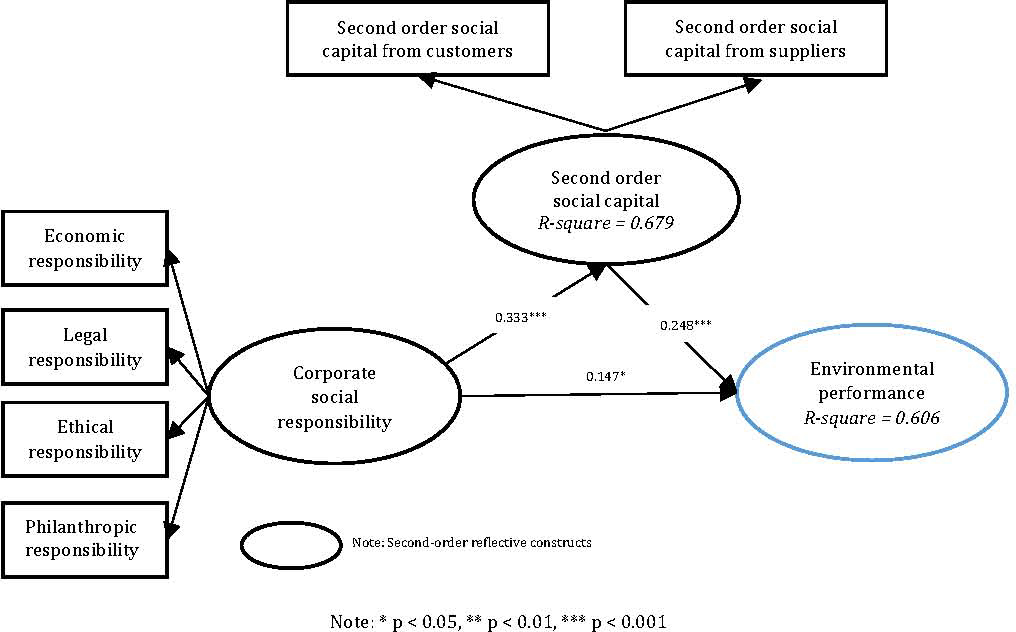
Figure 2.
Structural model
Source: own processing
Table 5.
Hypotheses results
| Hypotheses | Path coefficient (ß) | T values | P values |
|---|---|---|---|
| H1: CSR -> EP | 0.147 | 2.584 | 0.010 |
| H2: CSR -> SOSC | 0.333 | 6.911 | 0.000 |
| H3: SOSC -> EP | 0.248 | 4.502 | 0.000 |
| H4: CSR -> SOSC -> EP | 0.083 | 3.541 | 0.000 |
The structural model demonstrates strong explanatory power across both endogenous constructs. Second-order social capital achieves a substantial R2 of 0.879, indicating that 87.9% of its variance is explained by corporate social responsibility dimensions, substantially exceeding Cohen’s (1988) threshold of 0.26 for large effect sizes.
Environmental performance exhibits a robust R2 of 0.504, explaining 50.4% of variance through CSR and social capital pathways, which Hair et al. (2019) classify as moderate to substantial. These findings confirm the model’s strong predictive validity, demonstrating that CSR practices and relational capital effectively account for organisational environmental outcomes in this theoretical framework (Figure 2).
Discussion of the findings
Corresponding to the conclusions implied by this research. CSR is indicated to impact EP significantly. This result can be compared to an earlier study by Bhat et al. (2024). According to their study, the RBV framework explores the link between CSR and EP. Their research employed a survey methodology and revealed significant relationships between CSR, EP, and green innovation (GI). Their research provided valuable insights for industry leaders and stakeholders, helping them to enhance EP and guiding decision-makers in developing internal strategies for sustainable profitability.
The present study uncovered a notable connection between CSR efforts and the evolution of SOSC. This discovery resonates with earlier work by Lv and Yang (2024), whose investigation delved into the fundamental interrelations that bind CSR practices to SOSC. Working within sustainable development paradigms, these researchers put forward three fundamental elements—specifically “trust mechanisms, normative frameworks, and rational choice processes”—as tools for understanding how businesses manage their CSR commitments alongside capital development activities, while simultaneously mapping the inherent links between these processes. Their examination indicated how the intricate connections between CSR execution and SOSC growth shape long-term organisational viability. Consequently, their study recommended that manufacturing firms experiencing periods of change should embrace analytical methodologies rooted in factual observations rather than relying on opinion-based judgments.
Moreover, according to the last hypothesis of this study, SOSC significantly impacts EP. This association is similar to that reported in an earlier study by Zhou et al. (2020). Their study investigated the impact of provincial SC on EP. The data for their study were collected from Chinese provinces. Their findings indicated that a relationship exists between SC and EP, but the effect of social capital varies across different regions. The connection was stronger and more consistent in the eastern and southwestern regions, while it was less stable in other parts of the country. Lastly, this research found that SOSC significantly mediated the relationship between CSR and EP. This result can be somewhat comparable to an earlier study by Khan, Chen and Hung (2021). Their study investigated the indirect role of SOSC in the relationship between CSR and GI. Their study focused on senior managers from various manufacturing companies. The findings revealed that SOSC significantly mediated the relationship between CSR and GI.
Conclusions
The present investigation enhances scholarly understanding of the intricate pathways by which corporate social responsibility programs foster environmental performance improvements in manufacturing sectors. Empirical evidence substantiates that CSR exerts substantial influence on environmental outcomes through both direct channels and indirect mechanisms via second-order social capital, thereby corroborating the theoretical model anchored in social exchange theory and resource-based viewpoints. The intermediary role of SOSC reveals how enterprises can harness broader stakeholder ecosystems—including customer and supplier alliances—to extend their environmental efforts beyond immediate operational constraints. These outcomes highlight the tactical significance of nurturing indirect relational assets as conduits for superior environmental achievements.
Manufacturing leaders should consider that CSR allocations require strategic configuration to reinforce primary stakeholder bonds alongside second-tier connections, generating multiplicative effects that expand environmental advantages across comprehensive networks. This research enriches stakeholder theory by elucidating the methods by which organisations may systematically employ network-derived resources to achieve sustainability goals. Subsequent investigations should examine the temporal patterns of these associations and assess their relevance across varied industrial environments and cultural frameworks to strengthen these theoretical insights. This study employed a cross-sectional approach that limits the ability to establish definitive causal links within the CSR-SOSC-EP framework. Hence, it is suggested that future researchers should employ a longitudinal approach to offer a richer understanding of how these relationships unfold and their underlying causal processes.
Theoretical implications
Theoretical contributions require specific breakthroughs in research that provide novel insights into issues crucial for enhancing managerial relevance. This study offers several theoretical contributions. It delves into stakeholder theory in the context of EP, presenting new perspectives on the relationship between CSR and EP. Stakeholder theory deepens understanding of how CSR can strategically address stakeholder needs (Yankovskaya et al., 2022). This research introduces stakeholder theory into the domain of EP, uncovering previously unrecognised assumptions about the significant influence of CSR on EP.
The study also enhances comprehension of the importance of SC by advancing SET and social capital theory. Furthermore, it explores the impact of CSR on SOSC, encompassing SOSC from suppliers and customers (Khan, Chen, & Hung, 2021). Furthermore, the research assesses the mediating role of SOSC in the relationship between CSR and EP. This work broadens the analysis of how CSR can enhance EP and SOSC within manufacturing companies. Moreover, it acknowledges methods that manufacturing firms can use to manage their CSR activities effectively to achieve EP. While this study traverses well – established CSR-EP terrain, its theoretical novelty lies in operationalising the SOSC mechanism for practical application in manufacturing contexts. The research adapts existing SOSC measurement scales to capture both supplier and customer dimensions, quantifying the mediated pathways through which CSR influences EP. This research employed SOSC as a second-order construct, comprising two first-order constructs, namely, customer-oriented and supplier-oriented social capital, to measure its combined impact with other variables. This study offers actionable theoretical guidance that extends beyond incremental contributions, enabling managers and regulators to strategically allocate CSR resources toward stakeholder relationships that yield the highest environmental returns.
Practical implications
The results indicate that companies looking to enhance SOSC should focus on CSR initiatives. SOSC obtained from customers can give companies important insights into customer expectations and preferences (Zhao et al., 2021). Knowledge acquired through SOSC from suppliers can help companies learn about environmental sustainability practices and adopt innovative materials (Khan et al., 2021a, 2021b). Company leaders or managers can allocate resources to philanthropic initiatives, such as implementing diverse volunteer social welfare programs, experiences, and educational strategies to enhance CSR. Moreover, to enhance EP, companies can focus on CSR initiatives by establishing clear guidelines for corporate actions, striving to reduce disparities, and ensuring equitable treatment for all stakeholders.
Manufacturing executives can draw valuable lessons from this study on how CSR programs drive EP through strategic relationship-building with key stakeholders. Companies would benefit from investing in stronger SOSC development, particularly by cultivating meaningful connections with customers and suppliers, since these extended relationships function as vital channels for sharing environmental expertise and resources. By adopting comprehensive CSR approaches that build customer trust and strengthen supplier alliances, manufacturing organisations can generate ripple effects extending EP well beyond their immediate operational scope.
Regulatory authorities could establish reward systems for manufacturing enterprises that spearhead sector-wide environmental programs, leveraging their supplier and customer connections to deliver broader ecological benefits. Public sector organisations might explore creating collaborative platforms where manufacturing companies and their stakeholder communities can exchange knowledge and combine resources, acknowledging that EP frequently results from joint efforts rather than individual initiatives. Financial incentives and compliance advantages could be designed to encourage CSR programs that demonstrate quantifiable SOSC growth, especially those that generate EP that spreads throughout supply networks.
This investigation’s setting within Taiwan’s manufacturing landscape offers distinctive perspectives that require careful examination for broader applicability. The nation’s industrial framework exhibits extensive supplier interconnectedness and robust collaborative arrangements among enterprises, potentially magnifying second-order social capital’s influence on ecological outcomes. East Asian business traditions, particularly the prominence of relationship-centric commercial practices (guanxi) and shared accountability principles, likely reinforce the documented association between corporate responsibility initiatives and extended network capital. Conversely, executives operating in Western commercial environments, typically characterised by transaction – focused exchanges, might require greater investment in cultivating trust-anchored partnerships to realise equivalent ecological benefits through indirect stakeholder networks. Additionally, Taiwan’s comprehensive environmental regulatory framework, coupled with its export-driven economic structure, creates institutional pressures that could strengthen the relationship between corporate sustainability and performance. Industrial organisations located in territories with emerging environmental oversight mechanisms should integrate structured ecological management frameworks alongside network capital development to achieve parallel outcomes.
Research limitations and future research directions
Several constraints in this investigation open pathways for subsequent scholarly work. This study’s cross-sectional approach limits the ability to establish definitive causal links within the CSR-SOSC-EP framework, suggesting that longitudinal studies would offer a richer understanding of how these relationships unfold and their underlying causal processes. Hence, future research should focus on a longitudinal approach. While concentrating on manufacturing contexts delivers valuable industry-specific insights, this narrow scope limits applicability to service-oriented businesses or newer sectors where stakeholder interactions follow different patterns. The reliance on survey-based data also raises concerns about response bias, despite this study’s implementation of statistical safeguards. Moving forward, researchers should investigate how SOSC varies in effectiveness across different industries, particularly how emerging technologies and digital innovations reshape stakeholder network behaviours. Another worthwhile pursuit involves determining the best timing and sequence for implementing CSR programs to optimise SOSC growth. The academic inquiry could also benefit from examining how cultural backgrounds and institutional environments shape the CSR-SOSC connection across countries.