
Introduction
Innovating solutions and maintaining quality products and services have helped Indian start-ups penetrate the global market. Expect to see 40% of Indian start-ups raising seed money between USD 500,000 and USD 5 million by 2022, aiming to build for global markets. Over 50% of new start-ups launched in India are likely to be global from day one. Venture capital investments have exploded to USD 7.4 billion in India's startup ecosystem and are projected to contribute 4% to the country's GDP over the next three to five years (Chandra & Ghosh, 2024). In India, the 2,260 climate tech companies offer great potential in renewable energy, electric vehicles, battery storage, green consumer products, green construction materials, recycling and waste management, low-carbon agriculture, and green hydrogen. Success stories of Indian innovations will define global innovation and economic prosperity in the future (Chandra & Ghosh, 2024). From 350 start-ups in 2014 to 92,000 today, India has raised USD 141 billion in start-up capital. Over 1,000 start-ups have arranged Mergers and Acquisitions deals for corporations. Revolutionary technologies like Zomato, PhonePe and NetMed have changed the market, and corporations can partner with startups to create new technologies related to their products or services. By 2030 the Indian Greentech industry could generate USD 212 billion in revenue. Business incubators, portfolio diversification and mergers and acquisitions deals can help corporations keep up with trends, maintain a market position and manage risk. Start-ups concentrate on technological advancements, simplify consumer issues, and enhance market share in underserved areas. Its work culture and agility make it an attractive proposition for corporate investment (T-hub, 2023).
Policymakers and researchers are increasingly focusing on technology entrepreneurship and innovation hubs worldwide. Cities like Bangalore, India, are becoming popular start-up centers; Bangalore is the country's leading start-up center and one of the largest worldwide. A key driver is a robust innovation ecosystem that supports start-ups. Such ecosystems require exploring the role of innovation hubs in India. Defining these hubs, their impact across the life cycle of a start-up from inception to scaling and whether they sustainably support emerging ventures are key issues discussed herein. Insights from successful innovation hubs like Bangalore can help replicate this effect across the country (Subrahmanya, 2017). This era of technology has altered the conception, development and survival of entrepreneurship in the global economy. Dynamic interactions among technologies, entrepreneurial activities and the ecosystems that support them have created new possibilities and challenges. A high-tech start-up generally begins with a founder identifying an idea or opportunity.
In the age of technology, entrepreneurship must be resilient and agile with unmatched potential for innovation. Entrepreneurs have developed new tools, methodologies, and business models for economic growth and innovative responses to global challenges. An entrepreneur in the digital age must navigate ecosystems where start-ups share resources and knowledge and collaborate (Fatema & Raza, 2024). This research focuses on how innovation hubs create, nurture, and sustain opportunity constructs that foster start-up development in the Indian entrepreneurial ecosystem. Identifying key enablers such as access to mentorship, funding, infrastructure and collaborative networks provides a strategic framework that can help policymakers, incubators and entrepreneurs optimize hub functions. This study fills a knowledge gap by contextualizing innovation hub dynamics within the unique socio-economic and technological landscape of India thereby providing actionable insights for start-up viability, scalability and regional economic growth.
While start-up development and entrepreneurship have received considerable literature review, little research has been done specifically on the role of innovation hubs in facilitating and accelerating start-up growth in the Indian context. This study fills that gap by exploring how innovation hubs foster the emergence, development, and sustainability in India. This work investigates how these hubs provide start-ups with infrastructure, mentorship, funding and networking to overcome early-stage challenges and scale up. This paper also describes how innovation hubs can contribute economically and strategically to an active start-up ecosystem focusing on long-term growth, competitiveness and regional development.
Literature review
Blue Ocean strategy
The Blue Ocean Shift (BOS) concept developed by Kim and Mauborgne, 2004 questions incumbent business models and creates new, more competitive ones. The pursuit of differentiation and low cost opens up new market spaces and creates new demand in the BOS. It pushes companies out of intense competition into new uncontested blue oceans that ignore competition. Existing industries occupy the red ocean, with industry boundaries defined and accepted (Alam & Islam, 2017). The Blue Ocean Strategy suggests that start-ups and innovation hubs look for uncontested market spaces rather than saturated "red ocean" markets. This provides benefits of early entry, pricing flexibility, and marketing efficiency as new demand is targeted. Innovation hubs provide resources, mentoring, and networks to help entrepreneurs create unique value propositions for long-term viability (Čirjevskis, 2017).
Through the Blue Ocean Strategy, innovation hubs help start-ups create uncontested market spaces. These hubs give start-ups critical infrastructure, mentorship, and technology to redefine customer value, meet unmet needs, and tap into new markets. This approach helps companies escape saturated markets, pursue value innovations for sustainable growth, and integrate technological and social advancements to build resilience and adaptability for start-up development in India (Mirghaderi et al., 2023). The Blue Ocean Strategy suggests that start-ups and innovation hubs look for uncontested market spaces rather than saturated "red ocean" markets. This provides benefits of early entry, pricing flexibility, and marketing efficiency as new demand is targeted. Innovation hubs provide resources, mentoring, and networks to help entrepreneurs create unique value propositions for long-term viability (Mansa, 2024).
From the author’s perspective, Blue Ocean Strategy helps start-ups in India to find new market opportunities outside of the saturated, highly competitive spaces. Start-ups can create new demand in uncontested markets instead of intense rivalry. All the more so in India, where big players dominate the traditional food delivery, ed-tech, and e-commerce sectors. BOS supports value innovation by reducing costs while delivering added customer value, enabling start-ups to identify consumer pain points and offer unique solutions. For example, Paper Boat and BYJU'S both succeeded in creating products that met emotional and functional needs rather than copying models. BOS also targets untapped customers, as well as underserved rural or informal segments, which remain largely untapped in India. Such tools as the Strategy Canvas and the Eliminate-Reduce-Raise-Create (ERRC) Grid assist start-ups in creating offerings that defy industry standards and create entirely new value curves. In general, Blue Ocean Strategy lets start-ups take risks, differentiate themselves & scale up by creating demand rather than fighting for it.
Diffusion of Innovation Theory
The Diffusion of Innovation Theory developed by Gabriel Tarde and Everett Rogers explains how new ideas and products spread in a population. Key concepts include adopter categories defined by Ryan and Gross, as well as the roles of opinion leaders and followers. It is a change model for technological innovation that stresses communication and peer networks. They argue that early adopters influence others, resulting in mass adoption and saturation. Rogers separated adopters into five groups: innovators, early adopters, early majority, late majority, and laggards typically represent a bell curve (Kaminski, 2021). Four elements drive Innovation Diffusion Theory (IDT): the innovation itself, communication channels, time, and social systems. An innovation is adopted depending on its relative advantage, compatibility, complexity, trial ability, and observability. Over time, diffusion occurs through an innovation-decision process and across adopter categories typically following an S-curve. In this process, media and interpersonal communication spread this message, but the social system's structure and culture, particularly its opinion leaders, are also important factors. IDT has been integrated with other theories and applied across different domains to understand adoption and guide innovation promotion strategies (Guo & Huang, 2024).
Start-ups' survival and growth depend on the effective diffusion of their innovations into the market, which is interconnected with the product/service life cycle. In the Diffusion of Innovation Theory (2003), Everett Rogers defines the stages of innovation diffusion and the various adopter categories. For young enterprises this model reveals the temporal evolution of consumer adoption, providing important information for identifying early adopters, speeding up market acceptance & mitigating failure risks (Juliana Sipahutar et al., 2020).
From author’s perspective, start-ups can use Rogers' Diffusion of Innovation Theory to navigate market introduction and growth. This theory separates consumers into innovators and laggards that take innovation at different paces, so start-ups can target early adopters to gain momentum and credibility. Important theoretical axes like relative advantage, compatibility, and trial ability help start-ups develop products that meet consumer needs and reduce adoption barriers to improve market positioning, penetration, and sustained growth.
Critical growth opportunities through innovation hubs for start-ups in India
Entrepreneurial ecosystems thrive on factors like digital transformation, access to capital, human capital, and supportive infrastructure (Vijayakumar & Davidova, 2025). Capital, skilled talent, and world-class universities are crucial for growth and innovation. Government policies and regulations also encourage innovation and risk-taking. Sustainability and green innovation are becoming central components of thriving ecosystems, aligning with global climate goals and opening new market opportunities for start-ups. Innovation hubs can nurture start-ups that contribute to economic growth while addressing environmental and social challenges (Gupta, 2024). The study identifies two major opportunity constructs within innovation hubs that influence start-up development in India. The first construct, Digital Transformation, comprises three sub-factors: Innovation Services, E-commerce Expansion, and Remote Work Enablement. The second construct, Sustainability and Green Innovation, includes the sub-factors: Eco-Friendly Products, Renewable Resource Solutions, and Waste Management Technologies. Figure 1 below depicts start up opportunities in India in the context of innovation hubs covering digital transformation, sustainability, and access to funding. Important opportunity constructs include innovation, e-commerce expansion, green product adoption, etc.
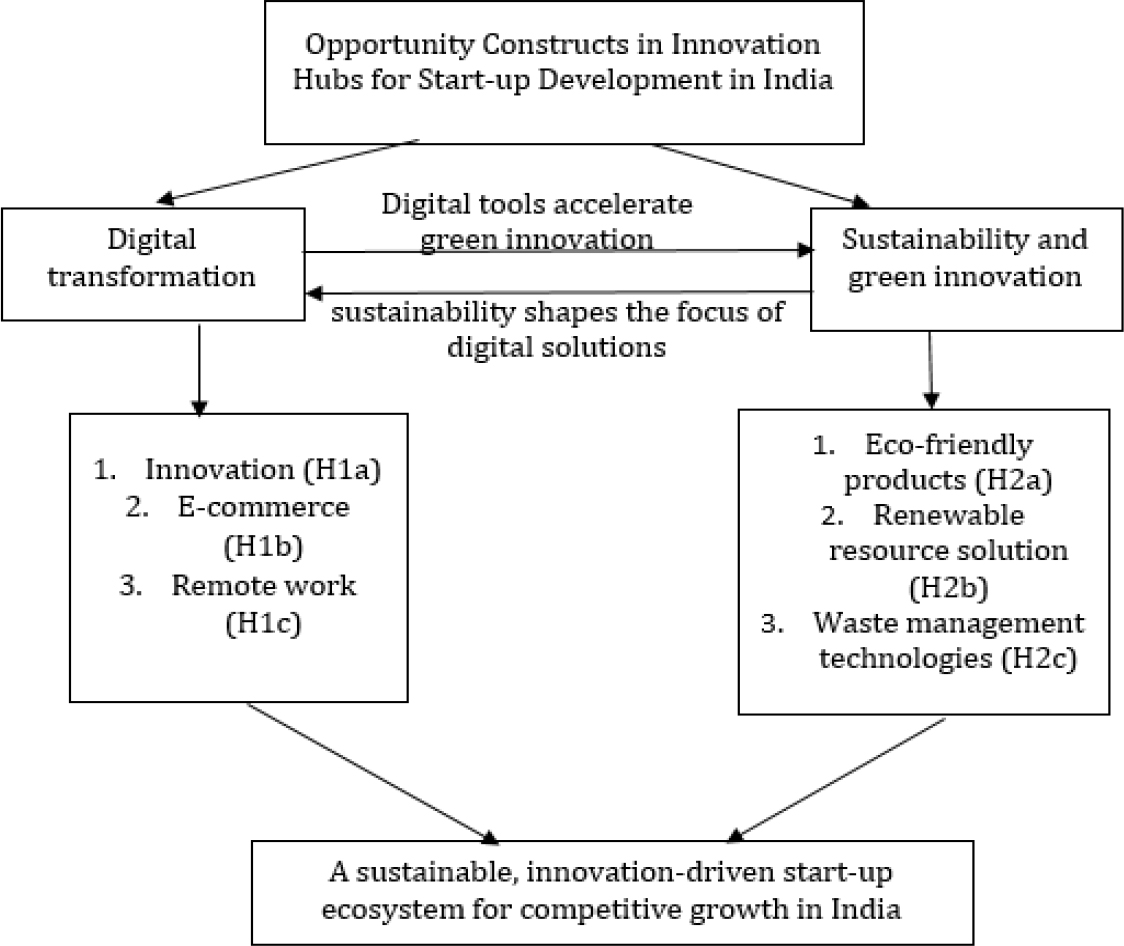
Figure 1.
Framework of opportunity constructs in innovation hubs for fostering sustainable start-up development in India
Source: own processing
The Figure 1 shows the conceptual framework for opportunity constructs within innovation hubs supporting start-up development in India. It pinpoints two drivers - digital transformation and sustainability as key enablers of entrepreneurial opportunities. Digital Transformation yields three constructs: H1a Innovation, H1b E-Commerce and H1c Remote Work - examples of how technology enables business growth. Simultaneously, sustainability and green innovation produce eco-friendly products (H2a), renewable resource solutions (H2b), and waste management technologies (H2c) highlighting the importance of environmentally responsible entrepreneurship. These six constructs work together to build a green, competitive start-up ecosystem in India.
Digital transformation related opportunities of innovation hubs
Digital transformation of India is a strategic imperative for economic growth, social inclusion and environmental sustainability. It has a projected digital GDP of US$1 trillion by 2025 under the Digital India initiative. This initiative aims at creating a robust digital infrastructure, making government services accessible to all citizens and promoting digital literacy in people and Indian start-ups are driving that change with locally relevant solutions. India has fostered a supportive environment for start-ups through the initiative known as Start-up India. Digital transformation in the corporate sector is bringing efficiency gains, digital literacy gaps, and resource management together. Businesses are using digital technologies to develop personalized products and services to build brand loyalty and competitive advantage (Indiabriefing, 2024). Technology influences organizational structure and form, and digital technologies are an asset for organizational transformation. Digital transformation may involve changes in core business processes, resource exchange, process reconfiguration and structure changes, leadership changes and digital culture adoption. Such a process involves businesses and society rather than just an organizationally focused action. Digital transformation refers to a more inclusive adoption of new business models and digital platforms, where digital elements are included in product or service offerings (Sreenivasan & Suresh, 2025). Innovation hubs drive digital transformation by offering key opportunities such as innovation support services (e.g., R&D access, mentorship, and networks), enabling e-commerce expansion, and facilitating remote work through digital infrastructure and collaborative tools. These functions help start-ups adapt, grow, and remain competitive in a digitally driven economy.
Start-ups drive innovation and technological advancement in India through their emphasis on research, start-ups focus on development, experimentation, and collaboration with academic institutions. Start-ups and research centers provide solutions, products and services. Addressing existing market needs and societal challenges is essential. Whether it is artificial intelligence, machine learning, block chain, or biotechnology, start-ups bring new ideas to life and bring digital transformation and India's competitiveness to the global stage (Chopra, 2024). Innovation services contribute to the digital transformation of start-up development by combining advanced technology infrastructure, supportive public policies, entrepreneurial initiatives, and a growing digital economy. Innovation hubs provide advantages to innovators, policymakers, entrepreneurs, administrators, and investors. Innovation services in digital transformation drive a culture of continuous innovation and help start-ups scale up and meet market demands. Along with its economic advantages, such a transformation involves major social costs in terms of targeted programs, institutional support, and strategic reforms. By strengthening the foundational pillars of innovation hubs, innovation services can accelerate start-ups' growth and sustainability in a dynamic environment (Mitra et al., 2022).
One such transformation mechanism is the innovation hub, a platform linking key actors of the Quadruple Helix Model government, industry, academia, and citizens. Such a model recognizes that innovation is not produced isolated from other activities but occurs in collaborative processes across institutional and social boundaries. The interactions are realized through innovation hubs that structure these interactions by providing structured support services such as access to R and D infrastructure, expert mentorship and collaborative networks. Such services assist start-ups with technology adoption, product innovation and scaling up in a digitally driven business environment. Experiments such as surveys among Indian Information and Communication Technology (ICT) sector start-ups highlight the value of such alliances in building entrepreneurial ecosystems and creating technological knowledge through co-creation. As such, start-up productivity and innovation capacity are directly related to the performance of support systems embedded in innovation hubs (Das & Pattnaik, 2023). In this context, innovation hubs serve as enablers of digital transformation by offering critical innovation support services such as access to R and D infrastructure, expert mentorship, and collaborative networks. These services help early-stage ventures overcome barriers related to technological adoption, product development, and scaling. By facilitating access to such resources, innovation hubs enhance the capacity of start-ups to innovate, adapt, and improve productivity in a digitally driven economy. Thus, the success of digital transformation in India is closely linked to the effectiveness of support systems embedded within its innovation ecosystem (Bora, 2025). E-commerce expansion within innovation hubs can help support start-up growth in India. This gives new ventures wider market access, operational efficiency and faster scalability.
As digital transformation and innovation hubs help India's e-commerce sector grow rapidly, so does its expansion. Widespread internet access, cheap smartphones, low data costs and growing consumer trust in online transactions are driving sales that are expected to exceed USD 200 billion by 2027. Security features, streamlined payment systems, and easy return policies have made digital platforms easier to use and led to increased online shopping for electronics, fashion, and groceries. In this transition, innovation hubs are helping start-ups get the tools, infrastructure, mentorship and funding they need to compete in the digital marketplace. That sector will grow by 25% in 2024, with a 30% rise in fashion and 20% in groceries. The COVID-19 pandemic further accelerated this shift, as consumers turned to e-commerce for essential goods during lockdowns. This boom in digital retail opens up huge doors for tech-driven start-ups and highlights the role of innovation hubs in driving entrepreneurial growth and shaping the future of India's digital economy (Brinson, 2025).
E-commerce is increasingly driving the digital transformation of start-ups when coupled with innovation hubs. These are digital infrastructure hubs that provide mentoring, funding and collaboration for e-commerce startups to scale quickly and disrupt established business models. Advancement of technologies and new digital strategies allow these start-ups to remake consumer experiences and create new market spaces. Such ventures create job opportunities and economic growth in India, firmly cementing its position as a center of digital innovation. These innovation hubs draw investments and talent, foster collaboration and increase knowledge sharing among entrepreneurs such an environment supports innovative e-commerce solutions that improve efficiency, convenience and sustainability. Integrating e-commerce and digital transformation means innovation hubs support start-ups to meet consumer demands while contributing to a more connected and competitive digital economy (Kumar & Kishna, 2024). The next key opportunity is the rise of remote work within innovation hubs, supporting start-up development in India by enhancing flexibility and broadening access to talent.
Fast technological advancement and an entrepreneurial landscape have made virtual work solutions an important driver of digital transformation for start-ups in India. This part discusses how virtual work tools can be applied in India's start-up ecosystem for better productivity, collaboration and innovation. The document defines virtual work, including remote collaboration platforms, cloud project management, and digital communication tools - and its impact on business operations. Here innovation hubs offer digital infrastructure, mentorship and tools for virtual work environments. They help start-ups adopt flexible work models combining physical and digital operations. Gaps in digital infrastructure and data security aside, virtual work solutions give start-ups an edge. Those solutions require strategies like virtual incubators, remote mentoring & digital accelerators. Accepting virtual work also positions start-ups for a changing business landscape and for a digitally connected economy (Khuntia, 2024). Virtual work as part of digital transformation supports start-up development with flexibility, scalability, and innovation via innovation hubs. Such hubs offer essential digital infrastructure, mentorship, and collaborative tools for start-ups to adopt virtual work environments effectively. Combining remote collaboration platforms, cloud-based project management systems, and digital communication tools, innovation hubs enable start-ups to work outside of their physical boundaries and respond to market demands. Furthermore, virtual work enables inclusive and distributed teams, increases productivity, and lowers operational costs, allowing entrepreneurs to innovate quickly. Innovation hubs also fund research into critical requirements for virtual work - including technological requirements, mental well-being, collaborative efficiency, and ethical issues - in order to support responsible and sustainable remote working models. So virtual work changes the way start-ups work as well as positions them at the cutting edge of a digitally connected future economy (Mahindru et al., 2024). The following hypotheses statements are developed based on this section:
H1a: Access to innovation support services such as R&D infrastructure, expert mentorship, and collaborative networks through innovation hubs positively influences start-ups′ development and improves productivity in a digitally driven environment.
H1b: Access to digital infrastructure, e-commerce training, and market linkage support through innovation hubs positively influences start-ups' development and improves customer reach and business scalability in a digitally driven environment.
H1c: Access to virtual work technologies through innovation hubs positively influences startups’ development and improves productivity in a digitally driven environment.
Sustainability and green innovation related opportunities of innovation hubs
The Indian start up ecosystem is embracing innovation and environmental responsibility across renewable energy, waste management, sustainable agriculture, and green transport. Green start-ups want funding from sources that meet environmental, social, and governance criteria, like impact investors, sustainable investment funds, and green bonds. Start-ups that develop electric vehicles, charging infrastructure, and alternative modes of transport are creating sustainable transportation. Organic agriculture start-ups are promoting food waste reduction. Challenges include funding constraints, regulatory hurdles, and market penetration (Keshavachar, 2024).
Entrepreneurship and innovation are essential for economic and social progress, but for long-term growth, a resilient, innovation-driven, and sustainability-oriented ecosystem is needed. Despite a surge in start-up activity, India has not yet produced a proportional number of unicorns, suggesting that start-ups need more structured, innovation-enabling environments to thrive. The 2017 Global Start-up Ecosystem Report confirms that many Indian start-ups struggle for survival, highlighting the urgency for ecosystem strengthening. In this context, access to green design support and sustainable product development labs via innovation hubs is proving vital. These hubs form the backbone of the start-up ecosystem by enabling entrepreneurs to develop environmentally conscious, market-responsive products. By integrating sustainability through the triple bottom line approach balancing environmental, economic, and social outcomes start-ups are empowered to create eco-friendly and scalable innovations that meet both market demand and climate goals (Chillakuri et al., 2020).
Start-ups actively contribute to the sustainable commerce landscape by designing, developing, and marketing products with reduced environmental impact, utilizing eco-friendly materials, conserving resources, and adopting circular economy models. Such access to green product development labs enhances their capacity to innovate in a digitally driven environment, aligning product design with both environmental goals and market differentiation. These innovation hubs support this transition by offering infrastructure, technical mentoring, funding, and product development facilities that are specifically tailored for sustainable product innovation. Because they concentrate on sustainable industrial design, digital prototyping, production optimization, and resource-efficient distribution, hubs enable start-ups to emerge as leaders in eco-conscious innovation. This not only stimulates economic development and employment but also positions India as a global leader in green entrepreneurship and sustainable business practices (Gurav, 2023). India is actively building a start-up ecosystem that champions sustainable innovation and green employment. Ranked third globally for start-up activity, national programs such as Start-up India, Aatmanirbhar Bharat, and Make in India aim to establish India as a hub for sustainable production and exports. However, the gap in entrepreneurial penetration—only around 5% compared to 16.5% in the U.S. reflects an untapped potential that innovation hubs can unlock through sustainable design support. Sustainable start-ups are increasingly acknowledged for addressing environmental challenges while driving economic growth via green capital formation and responsible innovation. Faced with high unemployment and a shortage of highly skilled youth, the Indian government has initiated several policies to support green entrepreneurship. One such initiative, the Start-up India Seed Fund Scheme, offers early-stage capital specifically to foster green innovation and sustainable product development (Sonar, 2023).
The renewable energy sector has increasingly adopted public-private partnerships (PPPs) as a key investment model for clean energy generation, recognizing that government funding alone is insufficient to support such capital-intensive projects. PPPs provide critical infrastructure and financial frameworks that complement the innovation ecosystem, offering start-ups the enabling environment needed to scale renewable energy solutions. The most successful renewable initiatives have emerged from PPP arrangements that attract private capital while enhancing service quality and operational efficiency. Additionally, international collaboration and the transfer of renewable technologies enrich the innovation environment and help accelerate clean energy capacity development. Since sectors like energy and transport offer predictable demand and long-term investment potential, PPPs are particularly effective in these domains more so than in healthcare or education.
In this context, this chapter investigates how PPP-supported renewable resource solutions can serve as platforms that, when linked with innovation hubs, enable start-ups to access incubation and technical integration support thus strengthening their capacity to scale clean energy innovations that foster sustainability and inclusive development (Sivasubramanian, 2025). In parallel, India’s innovation hubs are emerging as critical enablers of start-ups' success in the renewable energy sector. These hubs offer access to advanced R&D facilities, technical mentorship, and financial support resources that are essential for building scalable, clean energy technologies, especially in a developing economy. For example, Uravu Labs, a Bengaluru-based start-up, demonstrates how innovation hubs facilitate the integration of renewable technology into viable solutions. The company generates drinking water from air using 100% renewable energy solar power, industrial waste heat, and biomass without consuming water, unlike conventional reverse osmosis systems. Such innovations are made possible due to the incubation support that allows start-ups to experiment, validate, and implement resource-efficient solutions (Bhat, 2023).
Moreover, innovation hubs actively support the creation of renewable energy ecosystems that respond to localized needs, particularly in rural and underserved regions. Technologies in solar and wind energy when developed through this ecosystem enhance energy accessibility and contribute to socio-economic development. These hubs foster collaboration between entrepreneurs, researchers, and local communities, resulting in inclusive innovation models that integrate clean technology with developmental goals. Leveraging ecological and industrial ecosystem frameworks, these platforms promote green entrepreneurship and offer incubation services that boost start-ups’ ability to develop and scale solutions tailored for low-resource environments. This not only supports energy security for marginalized populations but also drives environmental sustainability and economic empowerment. Therefore, renewable energy initiatives enabled by innovation hubs directly align with the hypothesis that such access enhances start-ups’ capacity to scale technologies and drive inclusive, sustainable development (Surie, 2020). A growing opportunity is the development of waste management technologies through sustainability and green innovation, supported by innovation hubs that drive start-up growth in India.
Start-ups are increasingly leveraging access to smart waste management technologies and circular economy training infrastructure provided by innovation hubs, which significantly enhances their capacity to innovate in waste reduction and recycling. These hubs enable the integration of advanced digital tools such as AI, IoT, and 5G into smart city and e-governance frameworks, particularly in urban services like waste collection, segregation, and treatment. By fostering a supportive ecosystem of research, mentorship, and pilot testing, innovation hubs are empowering start-ups to deliver scalable, tech-enabled solutions that address modern urban waste challenges (Subrahmanyam, 2025). This alignment directly supports the hypothesis that access to such innovation infrastructure contributes to both environmental sustainability and operational efficiency. Public-private partnerships have further accelerated the adoption of these innovations by integrating them into smart city projects.
Despite policy gaps, funding limitations, and implementation barriers, start-ups are transforming waste management into a platform for innovation. This shift is especially urgent as Indian urban and peri-urban regions grapple with rising volumes of solid waste, plastics, e-waste, biomedical, and hazardous materials challenges that threaten traditional environmental values and community health (Gaurav et al., 2019). To address these systemic issues, innovation hubs serve as catalysts, offering circular economy training and access to R&D infrastructure that promotes source segregation, reuse, and decentralized, eco-friendly disposal methods. Their role in inducing behavioral change and enabling closed-loop systems underscores their influence on waste-sector innovation. Furthermore, the deployment of advanced technologies like GPS-based material traceability, digital twin systems, and AI-driven waste flow prediction is being supported by these hubs, making it possible to optimize collection schedules, track recycling progress, and design data-informed solutions. For example, Zecomy, a start-up tackling the e-waste crisis, showcases how hub-supported innovation leads to scalable, low-impact waste solutions. This demonstrates how innovation hubs directly influence start-ups’ innovation capabilities in waste reduction and recycling, fulfilling both sustainability and operational targets (Chidambaram, 2025). The following hypotheses statements are developed based on this section:
H2a: Access to green design support and sustainable product development labs via innovation hubs helps start-ups develop sustainable products with increased environmental impact and market differentiation in a digitally driven environment.
H2b: Access to clean energy incubation facilities and renewable technology integration support through innovation hubs positively influences start-ups’ capacity to develop and scale renewable energy solutions, promoting energy sustainability and inclusive development.
H2c: Access to smart waste management technologies and circular economy training infrastructure through innovation hubs positively influences start-ups' ability to innovate in waste reduction and recycling, supporting environmental sustainability and operational efficiency.
Research methodology
The study employs a quantitative methodology. Descriptive studies report study variables, whereas correlational studies report relationships. Experimental research tests hypotheses with statistics. Quantitative research standardizes data collection and generalizes results via replication, direct comparisons, large samples and hypothesis testing. It may, however, be inadequate in explaining complex topics because of superficiality, narrow focus, structural bias, and lack of context (Bhandari, 2020). This survey collected primary data from stakeholders in Kerala, India, between 27 March and 10 April 2025. The survey, generated using Google Forms, included 15 Likert scale questions and received 234 responses, far larger than the intended sample size and collected data was done in MS Excel. The literature review identifies three key opportunity areas: digital transformation, sustainability, and green innovation, each with distinct subcategories. Within digital transformation, the main opportunities include access to innovation, the expansion of e-commerce, and the adoption of remote work solutions (Mitra et al., 2022). Sustainability and green innovation encompass key subcategories such as sustainable products, renewable energy solutions, and waste management technologies. These areas represent vital opportunities for advancing environmentally responsible and economically viable start-up development (Ahtesham, 2024).
To effectively explore these areas, the questionnaire is structured into three sections. The first section captures demographic details of the respondents, while the second section is designed to gather insights related to start-up development. In the third section, here discuss start-up development opportunities in India, focusing on digital transformation and sustainability through green innovation. Startup ecosystem has great growth potential, with supportive government policies, shifting consumer preferences, and rapid technological advancements that highlight favorable conditions for emerging ventures in both countries (Thangavel & Munda, 2024).
Research sample and analysis
The sampling method used in this study is convenience sampling, which was chosen because it is practical and accessible to respondents and allows quick data collection within the allotted time and resources. Convenience sampling selects respondents from readily available sources, such as peers, colleagues, or individuals in public places. It may have some biases due to the over-representation or under-representation of certain demographic groups, but it is particularly useful for studying innovation hubs and start-up development in India. Because it was exploratory research with short time constraints, convenience sampling enabled data collection from a large pool of stakeholders involved in or knowledgeable about start-up ecosystems. This approach facilitated the collection of diverse insights, attitudes, and perceptions regarding digital transformation and sustainability in start-up development, yielding preliminary findings that will guide future, more rigorous research (Golzar et al., 2022).
This study employs a quantitative research design to ensure a systematic and structured approach based on relevant prior literature and empirical methods. Developed a questionnaire using Google Forms for primary data collection targeting start up founders, entrepreneurs, investors, financial experts, industry business experts, technology innovation experts and academic researchers and professors. Those selected were chosen for their direct involvement in India's start-up ecosystem. Their combined insight reveals how innovation hubs create and support start-up development through practical experience, market knowledge, funding perspectives, regulatory insight, and academic analysis. Survey participation was sought through direct invitations via email and social media outreach. Geographically, the research was focused on Kerala in South India a state known for its growing start pup system and supportive policy for innovation-driven enterprises. Data collected was analyzed in Microsoft Excel (Table 1).
Table 1.
Overview of questionnaire
| Sections | Variable | Reference | Question number |
|---|---|---|---|
| 1 | Consent form | 1 | |
| 2 | Demographic details | ||
| Age | 2 | ||
| Gender | 3 | ||
| Profession | 4 | ||
| Work experience | 5 | ||
| 3 | Awareness and engagement of innovation hub | (Chandra & Ghosh, 2024) | 6-9 |
| 4 | Opportunity constructs | ||
| Innovation services | (Das & Pattnaik, 2023) | 10 | |
| E-commerce expansion | (Brinson, 2025) | 11 | |
| Remote work | (Khuntia, 2024) | 12 | |
| Eco-friendly products | (Gurav, 2023) | 13 | |
| Renewable energy solutions | (Bhat, 2023) | 14 | |
| Waste Management Technologies | (Chidambaram, 2025) | 15 | |
The data was analyzed using Chi-square tests and Spearman’s rank correlation, employing SPSS version 29 for statistical processing. A high response rate of 234 out of 241 invited participants confirmed the statistical reliability of findings and also indicated relevance and interest in the research topic among targeted professionals in the community. The respondent pool is diverse in age, gender, professional background and experience, enhancing the data and generalizability of findings. An overview of the survey questions, along with the corresponding variables and constructs, is presented in Table 1 below, providing a clear structure of the questionnaire design and its alignment with the study objectives.
As Table 1 outlines, this survey is segmented into three sections to assess participants' experiences and perceptions of Innovation hubs in India, based on the framework proposed by Chandra and Ghosh (2024) with corresponding questions ranging from 5 to 8. A few variables are drawn from recent scholarly references: Questions 9 and 10 on innovation services are based on Das and Pattnaik (2023). Question 10: E-commerce expansion - Brinson (2025); question 11: Brinson (2025). Questions 12 and 13: Remote work (Khuntia, 2024). In the episode Eco-Friendly Products, Gurav (2023) informs viewers about question 13 about eco-friendly products. Questions 14 and 15 are based on renewable energy solutions proposed by Bhat (2023). And waste management technologies (Question 15) are based on Chidambaram (2025). These variables together define the multifaceted function of innovation hubs for tech-driven and market-responsive start-up growth.
The demographic profile of the survey respondents is summarized in Table 2 below. It highlights key variables such as age group, gender, professional role and work experience within the start-up and innovation ecosystem, and years of experience, providing insight into the diversity and composition of the participant group.
Table 2.
Demographic overview of participants in the start-up and innovation ecosystem
| Category | Subcategory | Percentage (%) |
|---|---|---|
| Age Group | 18–25 years | 32.1 |
| 26–35 years | 28.0 | |
| 36–45 years | 22.7 | |
| 46–55 years | 17.2 | |
| Gender | Male | 48.8 |
| Female | 40.1 | |
| Other | 9.8 | |
| Prefer not to say | 1.3 | |
| Profession | Start-up Founders | 31.4 |
| Entrepreneurs | 19.6 | |
| Academic Researchers and Professors | 23.8 | |
| Technology Innovation Experts | 11.7 | |
| Industry Business Experts | 10.9 | |
| Investors and Financial Experts | 2.6 | |
| Work experience | 2-4 years (Freshers) | 38.5 |
| 5–7 years | 24.6 | |
| 8–10 years | 20.3 | |
| More than 11 years | 17.3 |
A demographic profile of survey respondents reveals something about the participant composition highlighted in Table 2 above. Most are 18-25 years old (32.1%), 26-35 (28.0%), 36-45 (22.7%), and 46-55 (17.2%), indicating early and mid-career involvement with start-ups and innovation activities. The distribution of genders is fairly even, with males at 48.8% and females at 40.1%, with 9.8% identifying themselves as other and 1.3% choosing not to say. Start-up founders accounted for 31.4% of the participants, followed by entrepreneurs at 19.6%, academic researchers and professors at 23.8%, technology innovation experts at 11.7%, industry business experts at 10.9%, and investors and financial experts at 2.6%. Concerning experience, the participant pool is mixed in terms of expertise. This is followed by freshers (2-4 years of experience) who make up the largest cohort at 38.5%, suggesting high interest from early-career people. Participants with 5-7 years of experience represent 24.6% and those with 8-10 years represent 20.3%, respectively. Just 17.3% of the sample is over 11 years old, which balances the sample.
This distribution points to a preference for younger entrants in the start-up and innovation space but still reflects a broad spectrum of professional backgrounds. In general, demographic data represents a fairly broad range of experience levels, but it would benefit from better balanced representation across the spectrum. Details of the survey questionnaire are provided in Appendix 1.
Results and discussion
Data analysis
Respondent feedback has guided the prioritization of key opportunity constructs within innovation hubs for start-up development in India, leading to the identification of these constructs (Table 3) lists the most important questions from each section of the survey, determined from analyses of the responses. For this purpose, prioritization was achieved by aggregating the best responses—strongly agreeing and agreeing to identify the items that were most popular with stakeholder groups. Ranking the questions by agreement level identifies opportunity areas that most respondents consider important. This analytical rigor permits a close focus on digital transformation, e-commerce expansion, remote work enablement, sustainable product innovation, renewable energy solutions and waste Management technologies. These priority constructs indicate the most promising frontiers in which innovation hubs can foster start-up growth and national economic development. Deep dives into these focus areas allow targeted discussions about how innovation hubs can support start-ups with infrastructure, mentorship, funding access, and sustainable business models. And this process is in line with the overarching study objectives to find out how innovation hubs can be used to build entrepreneurial ecosystems, promote sustainable development and create inclusive economic growth in India. Rather than focusing on the opportunity construct that most closely reflects stakeholder consensus, the study retains its relevance and practical applicability for policymakers, innovators, entrepreneurs, and development strategists.
Table 3.
Key opportunity areas for start-up development identified through positive response analysis
| Major factors | Priority Index (Combined positive responses) | Eligibility threshold (Priority Index > 55%) |
|---|---|---|
| Opportunities | ||
| Digital Transformation | Innovation services-50.7% | E-Commerce Remote work |
| E-Commerce-56% | ||
| Remote work-55.3% | ||
| Sustainability and Green Innovation | Eco-FriendlyProducts-53.4% | Renewable resource solution Waste management technologies |
| Renewable resource solution-56.8% | ||
| Waste management technologies-55.6% | ||
Table 3 highlights analysis of prioritized start-up development opportunities reveals two main focus areas: digital transformation and sustainability and green innovation. For digital transformation, e-commerce (56%) and remote work (55.3%) both surpassed the eligibility threshold, indicating broad stakeholder support and recognition of their growth potential. Innovation, though important, lags at 50.7%, suggesting room for engagement and development. In terms of sustainability and green innovation, renewable resource solutions (56.8%) and waste management technologies (55.6%) were considered high-priority areas, indicating a strong preference for environmentally conscious business models. Eco-friendly products came in slightly below the threshold of 53.4%, but they were still of great importance. These findings reveal that stakeholders see the greatest opportunities for scaling sustainable solutions and leveraging digital advancements through innovation hubs, balancing economic progress with environmental progress in India's start-up ecosystem.
The reliability of the survey instrument used for start-up development in India was assessed using Cronbach's alpha. This statistical measure assesses the internal consistency of items capturing key dimensions of digital transformation, sustainability, and green innovation, as well as the role and function of innovation hubs in supporting start-up development. High internal consistency means items are orientated correctly and contribute to a coherent evaluation of the underlying concepts. Cronbach's alpha was 0.738, acceptable and indicative of good reliability. It confirms that survey responses can be used confidently to gain insight into how innovation hubs enable digital transformation, promote sustainable products & practices and foster more start-ups in the Indian entrepreneurial ecosystem.
The reliability analysis of the survey constructs pertaining to opportunities through innovation hubs for start-up development in India shows high internal consistency across all measured dimensions (Table 4). Cronbach's alpha values for start-up development range from 0.728 to 0.743 across three items, indicating the questions accurately reflect responses about early-stage growth, scalability, and overall support from innovation hubs. A Cronbach's alpha of 0.750 for the innovation services indicates consistency in assessing the role of hubs in research and development, expert mentorship, and collaborative innovation. With e-commerce expansion, the alpha value is 0.732, indicating consistent views on digital infrastructure, market linkage, and training support for online business growth. Remote work scores of 0.738 indicate that respondents reliably assess the role of hubs in facilitating access to virtual work technologies and flexible digital workspaces. The first planet, Alpha, for sustainable products and renewable energy solutions, is consistently measured. This indicator confirms the role of the hubs in supporting eco-friendly innovation and clean energy ventures. Among these, waste management technologies have the highest reliability, indicating broad agreement on how innovation hubs support technological solutions for effective waste handling and circular economy practices. High Cronbach's alpha values (all above 0.7) usually show that the survey tool is dependable and strong for evaluating the various effects of innovation hubs on start-up growth in India.
Table 4.
Reliability assessment of opportunity constructs in innovation hubs for start-up development in India
| Impacts | Cronbach’s alpha |
|---|---|
| Awareness and engagement of innovation hub (Q6) | 0.731 |
| Awareness and engagement of innovation hub (Q7) | 0.743 |
| Awareness and engagement of innovation hub (Q8) | 0.728 |
| Awareness and engagement of innovation hub (Q9) | 0.726 |
| Innovation services (Q10) | 0.750 |
| E-commerce Expansion (Q11) | 0.732 |
| Remote Work (Q12) | 0.738 |
| Sustainable products (Q13) | 0.731 |
| Renewable energy solutions (Q14) | 0.734 |
| Waste Management Technologies (Q15) | 0.759 |
The Pearson Chi-Square, Likelihood Ratio, and Linear-by-Linear Association tests each produced p values below the 0.05 significance level and showed statistically significant relationships between the variables investigated. Analyses were robust because they used a sufficient number of valid cases; refer to (Table 5) below. Besides, the Spearman correlation test was applied to evaluate associations' strength and direction of variables, suitable for ordinal data or when assumptions of parametric tests are not met. They highlight the existence of meaningful associations that are crucial to evaluate the impact of innovation hubs on start-up development.
Table 5.
Chi-Square and Spearman correlation analysis of key impacts in family business development
| Variables | Chi-square analysis | Sig. (2-tailed) (p=<0.05) | Spearman correlation analysis | Sig. (2-tailed) (p=<0.05) | Correlation Strength | Hypothesis Status |
|---|---|---|---|---|---|---|
| Innovation | 26.712 | .000 | 0.627 | .000 | Strong | Accepted |
| E-Commerce | 32.492 | .000 | 0.751 | .000 | Strong | Accepted |
| Remote work | 24.615 | .000 | 0.596 | .000 | Moderate | Accepted |
| Eco-Friendly Products | 33.031 | .000 | 0.655 | .000 | Strong | Accepted |
| Renewable resource solution | 23.802 | .000 | 0.675 | .000 | Strong | Accepted |
| Waste management technologies | 45.987 | .000 | 0.732 | .000 | Strong | Accepted |
The chi-square analysis conducted on the selected variables reveals statistically significant associations across all factors, as all p-values are less than 0.05. Notably, variables such as E-Commerce (Q9 & Q10), Waste Management Technologies (Q14 & Q15), and Eco-Friendly Products exhibit high chi-square values of 32.492, 45.987, and 33.031, respectively, indicating strong relationships with the observed data. Similarly, innovation (26.712), remote work (24.615), and renewable resource solutions (23.802) also show statistically significant chi-square results, confirming their relevance in the context of opportunity constructs in innovation hubs.
The Spearman correlation analysis further supports the findings by revealing strong positive correlations for most variables, with coefficients ranging from 0.596 to 0.751. E-commerce displays the highest correlation (0.751), followed by Waste Management Technologies (0.732), Renewable Resource Solutions (0.675), Eco-Friendly Products (0.655), and Innovation (0.627), all indicating strong relationships. Remote work, though slightly lower at 0.596, still reflects a moderate positive correlation, suggesting a meaningful but slightly weaker relationship compared to others.
These statistical outcomes accepted all hypotheses related to the variables, indicating that each factor significantly contributes to opportunity creation within innovation hubs. The consistent strength of correlations and chi-square significance levels confirm that innovation-driven domains such as e-commerce, green technologies, and remote work practices are actively shaping the development landscape for start-ups in India. These results illustrate the value of focusing on these key areas to enhance strategic planning and resource allocation in start-up ecosystems.
Discussion of the findings
In the current study, opportunity constructs in innovation hubs for start-up development in India are based on empirical analysis; the findings are consistent with the observation that innovation hubs can be very effective in driving start-up growth through targeted digital transformation and sustainability-led opportunities. Pearson's chi-squared and Spearman's correlation using SPSS 29 software analysis revealed statistical significance for all examined opportunity constructs (p=0.05). The strongest Spearman correlation value for the six constructs was for sustainable products (0.732), followed by waste management technologies (0.705) and renewable energy solutions (0.657). These results suggest start-ups increasingly consider sustainable innovation drivers essential to long-term success. Those high correlation coefficients confirm that sustainability and circular economy practices are also environmentally responsible and competitively relevant (Pais, 2024).
On the digital transformation side, e-commerce expansion, remote work technologies, and innovation also had strong relationships with start-up development. These results align with India's ongoing digitization efforts and the growing digital economy in Tier 2 and Tier 3 cities (Kumar, 2020). Innovators can use innovation hubs as enablers providing infrastructure, technical support and digital tools for scaling operations and entering new markets. The prioritization analysis revealed that constructs like e-commerce and remote work both exceeded the 55% eligibility threshold for positive responses and ranked among the highest in terms of strategic value – crucial levers for enabling digital-first business models in start-ups (Maheshwari, 2022).
It also demonstrates that innovation hubs can be useful in transferring sustainability-linked incentives, promoting cross-sector collaboration and providing green tech access to emerging entrepreneurs. The consistency of Cronbach's alpha scores across constructs (0.728-0.759) supports the internal reliability of the measures. Using AI, IoT, and block chain-enabled green technologies, innovation hubs in India are creating an entrepreneurial ecosystem that is balancing profitability with environmental boundaries. Such hubs enable resilient business models, carbon-conscious innovation and ventures focused on environmental issues (see Figure 2).
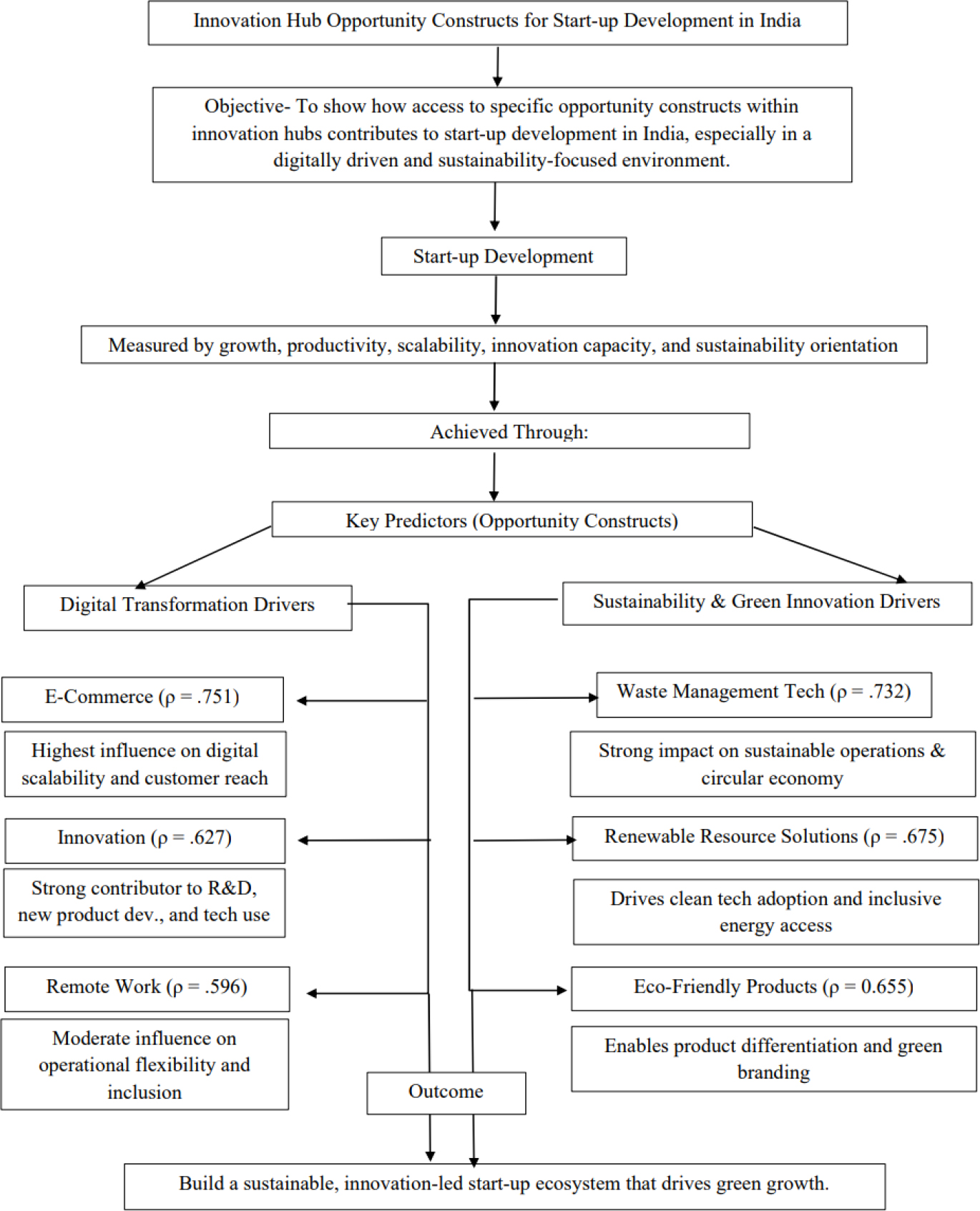
Figure 2.
Strategic prioritization of opportunity constructs in innovation hubs for advancing sustainable start-up development in India
Source: own processing
Future research could look at what policies and local strengths help connect start-up ecosystems with India's digital public infrastructure and goals for reducing carbon emissions (Mitra et al., 2022). Taking advantage of these findings, the author presents a strategic framework encompassing key opportunity constructs such as access to digital infrastructure, e-commerce enablement, remote work technologies, sustainable products, renewable energy solutions and waste management technologies. All these elements together support start-up development within the framework of innovation hubs in India by driving digital transformation and enabling sustainability-driven business practices,
The Figure 2 illustrates the conceptual framework developed from the study’s Spearman correlation analysis, highlighting key opportunity constructs within innovation hubs that support start-up development in India. The model categorizes these constructs under two main driver’s digital transformation and sustainability & green innovation and demonstrates their collective influence on start-up growth, scalability, and sustainability. This integrated framework provides a strategic perspective on how innovation hubs can act as catalysts for building a resilient, innovation-led start-up ecosystem aligned with India’s digital and environmental objectives.
The Figure 2 presents a comprehensive conceptual model illustrating how opportunity constructs within innovation hubs contribute to start-up development in India. It identifies two primary drivers Digital Transformation and Sustainability & Green Innovation each encompassing key constructs with empirically supported Spearman correlation values. High-impact constructs such as E-commerce (ρ=0.751) and Waste Management Technologies (ρ=0.732) emphasize the dual importance of technological scalability and environmental sustainability. These constructs collectively foster growth, scalability, and innovation, ultimately enabling the creation of a sustainable, innovation-led start-up ecosystem aligned with India’s digital and green growth ambitions.
Conclusions
The research explored how innovation hubs can become key start-up development catalysts in India, with special attention paid to sustainability, technology integration, and green transformation. Empirical results indicated that the most impactful opportunity constructs were identified by statistical tests such as Chi-square and Spearman correlation analysis for innovation, e-commerce expansion, remote work, and sustainable products. High correlations indicate strong relationships between these constructs and strategic start-up ecosystem enhancement. Results notably show that robust digital infrastructures, clean technologies and eco-friendly policies are essential for scaling start-ups sustainably. Data shows that a total of 264 valid responses were collected across different demographics and professional backgrounds to enhance the generalizability and relevance of the insights.
The research also concludes that green growth and environmental challenges require addressing renewable energy solutions and waste management technologies within innovation hubs. These findings help to build a green start-up ecosystem supporting India's clean energy transition and waste reduction goals. Also, while environmentally friendly products ranked slightly lower than others, their strategic inclusion remains critical for circular economy practices and environmentally conscious entrepreneurship. This research points out the need for stakeholder collaboration, access to R&D, digital tools for remote work and targeted funding for innovation and long-term sustainability. In conclusion, innovation hubs in India must become agents of digital empowerment and green entrepreneurship for inclusive and future-ready start-up development.
To build upon these results, this study demonstrates that innovation hubs are not just physical places but dynamic ecosystems that nurture opportunities necessary for start-ups to survive and grow in India. These high Spearman correlation coefficients for innovation, e-commerce expansion, and sustainable product adoption reinforce that technology-driven, green infrastructure is crucial for entrepreneurial ecosystems. Such factors lead to increased market access, operational efficiency, and lower environmental impact.
The very high survey participation rate (264 out of 268) confirms the topic relevance and demonstrates interest from start-up founders, financial experts, policy regulators, and academics. Diverse representation also ensures that identified opportunities are inclusive and grounded in real-world insights. Consistent significance across chi-square and Spearman analyses supports robust associations between the constructs and start-up growth. Particularly, renewable resource solutions and waste management technologies indicate the potential of clean energy and circular economy practices being incorporated into start-up ecosystems. Such strategies reduce operations costs and place start-ups in sync with global ESG (environmental, social, and governance) trends, thereby making them more attractive to investors. Medium-priority areas like eco-friendly products are still important, but they need focused interventions such as mentorship, green R&D access, and market linkages to turn environmental consciousness into commercial advantage.
The study thereby concludes that digital infrastructure development, targeted green funding and cross-sectoral collaboration can create a resilient, scalable and environmentally responsible start-up ecosystem in India. Such a vision is in line with national sustainability goals and global climate commitments and places innovation hubs as engines of inclusive green growth.
Practical and theoretical implications
In this work, major practical and theoretical implications are drawn for the Indian start-up ecosystem in terms of digital transformation and sustainability-led growth. Its conceptual framework illustrates how access to key opportunity constructs within innovation hubs can influence start-up development in terms of growth, productivity, scalability, innovation capacity, and sustainability orientation. In terms of practice, the findings call for a multi-stakeholder approach including innovation hubs, private investors, sustainability advocates. Investing heavily in digital infrastructure, especially in underserved tier-2 and tier-3 cities, will be critical to unlock the full potential of e-commerce and remote work as enablers of digital scalability, operational flexibility and workforce inclusion. Furthermore, targeted support should be given to entrepreneurial capacity building programmes in digital platform optimization, secure payment ecosystems, virtual collaboration and innovation management.
Meanwhile, sustainability has to be embedded in start-up ecosystems. Building constructs including waste management technologies, renewable energy solutions, and eco-friendly products have strong predictive power for environmentally responsible innovation. Start-ups having access to green R and D labs, circular economy mentorship, and eco-certification may be practical measures to promote clean technologies and green branding. Innovation hubs have to evolve too - offering not only co-working space but also green infrastructure and collaborative support systems for environmental accountability and resource sharing among start-ups.
In theory, this work extends the literature to empirically validate which opportunity constructs predict start-up performance in innovation hubs. It reinforces that these hubs are also dual-function accelerators for digital transformation and sustainable innovation. Positive correlations between constructs and developmental outcomes confirm the theoretical proposition that innovation hubs are systemic enablers linking technological advancement with environmental stewardship. In addition, this framework provides a more nuanced picture of how tailored support across digital and green innovation domains can build resilient and future-ready entrepreneurial ecosystems in emerging markets such as India. These implications suggest a path to build a resilient, innovation-driven start-up ecosystem for economic competitiveness and green growth in line with India's broader digital inclusion and environmental sustainability goals.
Limitations
Firstly, even though this study offers some useful insights on opportunity constructs in innovation hubs for start-up development in India, some limitations must be acknowledged. Secondly, the results of convenience sampling are not generalizable because participants may not represent the larger set of Indian start-up stakeholders. A geographic lens on Kerala narrows the scope further and may omit regional differences in innovation hub effectiveness across other Indian states.
Moreover, although the survey gathered perspectives from professionals in finance, technology, academia, and business, the self-reported nature of the data may induce respondent bias or social desirability effects. Furthermore, the use of quantitative methods, while appropriate for measuring patterns and relationships, limits the depth of understanding that qualitative insights might have provided, particularly around the workings of innovation hubs in practice. Even though tools such as Chi-square and Spearman correlation show significant associations between key opportunity constructs, they do not establish causality. For future research, a mixed-methods approach, a longitudinal design, and a broader sampling could confirm and build on these findings to get a more nuanced picture of India's fast-growing start-up ecosystem.
Future research directions
Although this study focused on identifying opportunity constructs driving start-up development in innovation hubs, further research should identify additional dimensions driving long-term sustainability and competitive growth. Possibly one promising direction is to examine how combining digital transformation metrics with environmental and financial performance indicators reveals the strategic value of innovation hubs in driving green entrepreneurship. Key questions for further research: How do entrepreneurs engage with sustainability-focused innovation hubs? Which leadership models work best in fostering innovation-led, eco-conscious start-up cultures in these hubs? Furthermore, what policy limitations prevent innovation hubs from unlocking their full potential for sustainable ventures, and how can these be changed to support more inclusive, tech-enabled start-up ecosystems? Such questions would help refine the strategic framework for innovation hubs in India to become engines of economic growth as well as of environmentally responsible entrepreneurship. It will also enable policymakers, researchers, and ecosystem enablers to design more adapted interventions to close policy-practice gaps and build a national innovation infrastructure in line with sustainable development goals. These questions will illuminate significant parameters and guidelines that can aid in building a sustainable and competitive circular economy.
Appendices
Appendix
Consent form
Please inform us if you have agreed for us to proceed with the research. Click Yes if you want to continue giving feedback or No if you do not wish to participate in the survey.
Yes, I agree to participate and provide feedback.
No, I prefer not to participate in the survey
Demographics
2. Age
18-25 years
26-35 years
36-45 years
46-55 years
3. Gender
Male
Female
Prefer not to say
Other
4. Job title
Start-up Founders
Entrepreneurs
Academic Researchers and Professors
Technology Innovation Experts
Industry Business Experts
Investors and Financial Experts
5. Work experience
2-4 years (Freshers)
5–7 years
8–10 years
More than 11 years
Awareness and engagement of innovation hub
6. The role of innovation hubs in supporting start-up development is well recognized
Strongly disagree
Disagree
Neutral
Agree
Strongly agree
7. Start-ups actively collaborate with innovation hubs to access resources, mentorship, and networks
Strongly disagree
Disagree
Neutral
Agree
Strongly agree
8. Engagement with innovation hubs enhances the growth and competitiveness of start-ups.
Strongly disagree
Disagree
Neutral
Agree
Strongly agree
9. Innovation hubs provide adequate awareness programs that inform start-ups about available opportunities and resources.
Strongly disagree
Disagree
Neutral
Agree
Strongly agree
Opportunities in Start-up Development in India
10. The startup ecosystem in India provides sufficient support for innovation and new technological advancements.
Strongly disagree
Disagree
Neutral
Agree
Strongly agree
11. E-commerce offers significant growth opportunities for startups in India.
Strongly disagree
Disagree
Neutral
Agree
Strongly agree
12. Remote work culture has positively impacted startup operations in India.
Strongly disagree
Disagree
Neutral
Agree
Strongly agree
13. Consumers in Sri Lanka prefer startups that focus on sustainability
Strongly disagree
Disagree
Neutral
Agree
Strongly agree
14. Startups have ample opportunities to invest in renewable energy solutions.
Strongly disagree
Disagree
Neutral
Agree
Strongly agree
15. Startups in India are innovating in waste management solutions
Strongly disagree
Disagree
Neutral
Agree
Strongly agree