
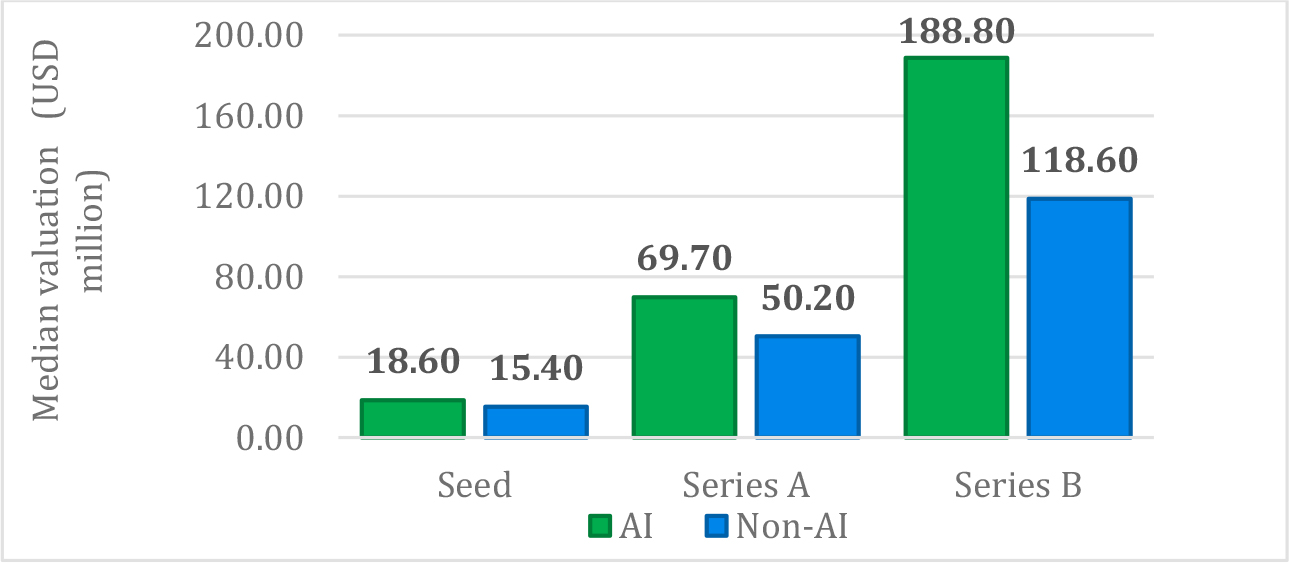
Figure 1.
Median valuations of AI and non-AI startups worldwide by funding stage in 2023
Source: own processing based on CB Insights (2024)
Table 1.
Business Model Canvas of Barclays
| Key partners | |
|---|---|
| Regulatory and government bodies (FCA, PRA) | |
| Traditional financial institutions and insurance firms | |
| Technology suppliers (for core banking systems) | |
| Investment partners and capital markets | |
| Partnerships within ESG initiatives and communities | |
| Key activities | |
| Provision of retail and corporate banking services | |
| Development of financial products and digital solutions | |
| Risk management and regulatory compliance | |
| Digital transformation and modernisation of banking processes | |
| Investment banking and asset management | |
| Relationship management | |
| Customer segments | |
| Individuals | Corporations |
| Small and medium-sized enterprises | High-net-worth individuals |
| Large enterprises | Government institutions (UK, USA, India) |
| Value propositions | |
| Simpler banking | Credibility |
| Supporting communities | Digital banking |
| Comprehensive investment services | ESG and sustainable investing |
| Global reach | |
| Customer relationships | |
| Relationship managers and personal bankers | |
| Long-term and conservative relationships | |
| Increasing trust through transparency and brand reputation | |
| Traditional customer service over the phone and in branches | |
| Promoting financial literacy | |
| Distribution channels | |
| Physical branches | Global ATM network |
| Digital platforms (web, mobile) | Telephone and video banking |
| Partnerships with UK Post Offices | |
| Key resources | |
| Financial capital (capital stability and reserves) | |
| Human capital (bankers, analysts, managers) | |
| Physical branches and vending machine network | |
| Technology solutions for digital banking | |
| Strong brand and long-lasting reputation | |
| In-house know-how and regulatory expertise | |
| Cost structure | |
| Operating costs (rent, utilities, maintenance) | Innovation and digital transformation |
| Salary costs (including training and benefits) | Technological investments |
| Costs of compliance and regulatory oversight | Marketing and communication |
| Revenue streams | |
| Revenue (mainly interest income and fees from retail and corporate accounts) | |
| Income from investment and premium services | |
| Diversified returns from complex financial products | |
| Fees for services provided to institutions | |
| Asset management | |
Table 2.
Business Model Canvas of Revolut
| Key partners | |
|---|---|
| Fintech and API partners (e.g. Plaid, Wise) | |
| Global banking and card networks (e.g. Visa, Mastercard) | |
| Technology partners (e.g. cloud services such as AWS) | |
| Marketing and brand partnerships (e.g. NBA) | |
| E-commerce and travel partners (e.g. Booking.com, Apple Pay) | |
| Key activities | |
| Development of digital banking and investment products | |
| Continuous innovation of the app and UX design | |
| Expansion into new markets and localisation of services | |
| Ensuring regulatory compliance and licensing | |
| Building fintech partnerships and ecosystem | |
| Automation of services and integration of new technologies | |
| Customer segments | |
| Retail customers | Digital nomads |
| Entrepreneurs | Young digital users (Gen Z, M) |
| Freelancers | Global companies |
| Value propositions | |
| Intuitive services | Free foreign payments |
| Removing barriers | Flexible insurance and travel benefits |
| RevPoints | Personalised spend reports and analysis |
| Cryptocurrency and stock trading | Multi-currency holding and exchange |
| Customer relationships | |
| Chatbots and AI support 24/7 | |
| UX personalisation | |
| Community forums and peer-to-peer support | |
| Online in-app support (real-time) | |
| Constant testing and introduction of new communication channels | |
| Relationship gamification (usage rewards, referral programs) | |
| Distribution channels | |
| Digital platforms (web, mobile) | E-commerce partnerships |
| Referral programmes | Social media and community channels |
| Integrations with fintech companies | API integrations for business clients |
| Key resources | |
| Technology infrastructure (applications, cloud systems, automation) | |
| Development teams (internal agile teams, IT development) | |
| Licences and regulatory approvals in different countries | |
| Partnerships with banks and fintech companies | |
| Adaptability (fast scaling without physical infrastructure) | |
| Cost structure | |
| Operational costs (e.g. cloud services) | Marketing and digital campaigns |
| Administration and customer support | Development and IT teams |
| Security expenses (e.g. fraud detection) | Labour costs |
| Revenue streams | |
| Revenue (interest income and fees, including premium accounts - Premium, Metal) | |
| Proceeds from trading cryptocurrencies and shares | |
| Insurance income (travel, equipment, health) | |
| FX margin revenues | |
| Fees for premium services (e.g. instant withdrawals, fast transfers) | |
Table 3.
Business Model Canvas of Ford
| Key partners | |
|---|---|
| Independent distributors and dealers (main sales channel) | |
| Component suppliers - classic tiered supply chain (e.g. Bosch, Denso) | |
| Technology partners (cooperation with companies like Google) | |
| Financial partner (Ford Credit provides leases, loans and sales support) | |
| Governments and regulatory authorities (e.g. emissions regulations) | |
| Alliances (e.g. with Volkswagen in the field of electric vehicles and self-driving cars) | |
| Key activities | |
| Vehicle development and production (focusing on IC engines and hybrids) | |
| Distribution (strong network of independent dealers and resellers) | |
| Marketing and brand (emphasis on tradition, strong reputation and American roots) | |
| After-sales services (service contracts, extended warranties, customer support) | |
| Financial services (proprietary Ford Credit system for sales support) | |
| Customer segments | |
| Individual consumers | Government institutions (military in US) |
| Corporate fleets (vans, utility vehicles) | Global sales through dealer network |
| Rental and leasing companies | Customers preferring combustion engines |
| Value propositions | |
| Mobile solutions (e.g. FordPass) | Focus on performance and utility |
| Quality, safety, reliability and design | Flexibility of powertrain choice |
| Financial services through Ford Credit | Broad accessibility |
| Customer relationships | |
| Customer loyalty and long-term relationship through FordPass Rewards | |
| Extended warranty and service programs | |
| Digital vehicle services (e.g. FordPass App) | |
| Tailor-made vehicle sales services for corporate clients and fleets | |
| Traditional personal communication through dealers and service advisors | |
| Distribution channels | |
| Traditional network of authorised dealers (thousands of branches globally) | |
| Independent distributors and partners in more than 100 countries | |
| Direct sales to specialised clients (corporate fleets, rental companies, government) | |
| Online vehicle configurators with vehicle booking | |
| Distribution of spare parts through official channels and authorised service | |
| Key resources | |
| Brands and reputation (Ford, Lincoln - strong tradition, customer trust) | |
| Production capacity (plants in the USA, Europe and Asia) | |
| Distribution infrastructure (global network of dealers and service centres) | |
| Finance Division (Ford Credit as an internal source of customer financing) | |
| Intellectual property (patents on technology, design, security systems) | |
| Cost structure | |
| Production costs | Distribution network operation |
| Research and Development | Marketing and advertising |
| Warranty and after-sales costs | Supply chain costs |
| Revenue streams | |
| Sales of new Ford and Lincoln vehicles (various classes, including SUVs and pick-ups) | |
| Sale of spare parts and accessories | |
| Financial services through Ford Credit (leasing, loans, insurance) | |
| Charges for digital services (e.g. navigation, FordPass connectivity) | |
| Revenue from sales to corporate fleets and government institutions | |
| Revenues from international markets, including licensing and franchise agreements | |
Table 4.
Business Model Canvas of Tesla
| Key partners | |
|---|---|
| Suppliers - especially for batteries (Panasonic, CATL, LG Energy Solution) | |
| Infrastructure partners (cooperation in the construction of Supercharger stations) | |
| Regulatory bodies (particularly important in the areas of FSD and autonomy) | |
| Collaboration with cities and communities (Tesla Energy projects for public buildings) | |
| Research partners - cooperation with universities and technology centres | |
| Key activities | |
| Electric vehicle production (focus on scaling up production) | |
| Research and development (especially in batteries, AI and FSD) | |
| Production of energy solutions (Powerwall, Megapack) | |
| Building infrastructure (Supercharger network as a competitive advantage) | |
| Global expansion (increasing presence in markets outside the US) | |
| Customer segments | |
| Technology-oriented consumers | Generation Z and millennials |
| Environmentally conscious customers | Clients in the higher segment |
| Customers looking for energy solutions | Customers who prefer to buy online |
| Value propositions | |
| Long range and high performance | Ecosystem of complementary services |
| Technological innovations | Direct distribution without intermediaries |
| Reducing total cost of ownership | Brand status and community |
| Customer relationships | |
| Digital self-service relationship (customer communicates primarily through app) | |
| Over-the-Air Updates (Continuous vehicle upgrades without a service visit) | |
| Full Self-Driving (customer participation in testing autonomous functions) | |
| Automated technical diagnostics (vehicle itself detects problems) | |
| Direct-to-customer communication (no dealers, but a direct relationship with Tesla) | |
| Community around the brand (strong fan base, user forums, online community) | |
| Distribution channels | |
| Direct sales through own sales outlets (Tesla locations and showrooms) | |
| Online ordering and vehicle purchase via the web | |
| Tesla Delivery Centers (centers for picking up the ordered vehicle) | |
| Tesla mobile service fleet and Supercharger network | |
| Key resources | |
| Manufacturing plants (Gigafactories) | Supercharger network |
| Battery and energy technologies | Development and innovation teams |
| Software capabilities | Intellectual property |
| Cost structure | |
| Production costs | Service and support |
| Research and Development | Marketing and communications |
| Expansion costs | Software development |
| Revenue streams | |
| Sales of electric vehicles (Model 3, Y, S, X, Cybertruck) | |
| Sale of software functions (Autopilot, FSD, infotainment packages) | |
| Supercharger network and sales of storage solutions | |
| Income from services and other markets (sale of used vehicles, sale of parts) | |
| Selling emission credits (regulatory credits to other car companies) | |
| Subscription (software updates and advanced features based on monthly payments) | |
Table 5.
Business Model Canvas of H&M
| Key partners | |
|---|---|
| Textile suppliers and manufacturers from developing countries | |
| Partners in raw materials and certifications (e.g. BCI - Better Cotton Initiative) | |
| Technology partners for retail digitalisation | |
| Sustainability initiatives and NGO partnerships (e.g. with circular fashion foundations) | |
| Design collaborations and campaigns with celebrities | |
| Key activities | |
| Design and development of collections in in-house design teams | |
| Global supply chain management (production, quality, lead time) | |
| Investments in new sales formats (e.g. second-hand platforms, fashion rental) | |
| Operation of brick-and-mortar stores and online shops | |
| Customer service and communication on social networks | |
| Sustainable initiatives (recycling, green materials) | |
| Technological innovations in e-commerce and logistics | |
| Customer segments | |
| General public across age groups | Customers looking for affordable fashion |
| Fashion-oriented customers | Customers interested in sustainability |
| Customers from many markets | Multi-channel shoppers |
| Value propositions | |
| Fashion for everyone | Focus on design and quality |
| Wide range of clothing and accessories | Responsible approach |
| Affordability as a key brand value | Multi-channel approach |
| Customer relationships | |
| Inspiring shopping environment (emphasis on experiential selling in stores) | |
| Customer experience across physical and digital channels | |
| H&M Member loyalty programme (personalised offers and discounts) | |
| Support via app and customer centre | |
| Presence and communication on social networks (Instagram, TikTok, Pinterest) | |
| Customer surveys and feedback (using data to improve collections and services) | |
| Distribution channels | |
| Stone stores (main sales channel) | Digital platforms (social networks) |
| Online shops | Flagship stores (e.g. Paris, London) |
| Mobile apps | Marketplace collaboration |
| Key resources | |
| Brand portfolio (e.g. H&M, COS, Weekday, Monki), covering different segments | |
| In-house design teams - in-house development of collections and styles | |
| Global network of suppliers and manufacturing partners - especially in Asia | |
| Know-how in fast fashion | |
| Sustainable materials and environmental certifications (e.g. Conscious Collection) | |
| Stone stores and strong retail network | |
| Cost structure | |
| Purchasing and production of goods | Marketing and advertising campaigns |
| Operation of shops and warehouses | Labour costs |
| Logistics and transport | Sustainability costs |
| Revenue streams | |
| Sale of products (clothing, accessories, footwear, home decoration, cosmetics) | |
| Special collections and limited editions (e.g. collaborations with designers) | |
| New growth segments (H&M Home, H&M Move) | |
| Loyalty programs and bonus purchases (cross-selling) | |
Table 6.
Business Model Canvas of Zalando
| Key partners | |
|---|---|
| Partner fashion brands selling through the platform | |
| Technology partners for AI development, personalisation and cloud solutions | |
| Logistics partners for fulfillment and delivery (e.g. DHL, DPD, GLS) | |
| B2B partnerships within Zalando Marketing Services and Fulfillment Solutions | |
| Sustainability initiatives - e.g. with E.ON (sustainable energy for warehouses) | |
| Key activities | |
| Digital platform and mobile app development | |
| Development and management of algorithms for personalisation | |
| Sourcing and integration of goods from partner brands | |
| Logistics and fulfillment services for brands (Zalando Fulfillment Solutions) | |
| B2B services operation (marketing, distribution and technology for brands) | |
| Customer analytics and preference data management | |
| Investing in AI, machine learning and predictive analytics | |
| Customer segments | |
| Digital shoppers | Customers requiring personalisation |
| Customers primarily from the EU | Convenience-sensitive customers |
| Customers looking for inspiration | Influencers and fashion creatives |
| Value propositions | |
| Curated wide range of fashion | ZEOS platform for automated ordering |
| Personalised recommendations via AI | Supporting new brands and creators |
| Sustainable shopping options | Inclusivity and diversity |
| Seamless digital experience (UX) | Inspiration through stories and outfits |
| Customer relationships | |
| Personalisation of content and offers (AI recommendations, Zalando Algorithm) | |
| Customer service available 24/7 (chat, email, hotline, fast returns) | |
| Zalando stories and influencer content (using influencer content to engage customers) | |
| Zalando Plus programme (faster delivery, special promotions, exclusive content) | |
| Digital engagement through the app (styling outfits, voting, wishlists) | |
| Feedback loop (collecting reviews that improve algorithmic recommendations) | |
| Distribution channels | |
| Online platform (main sales channel) | Outlets (in Germany) |
| Mobile apps (enhanced with AI) | Logistics infrastructure (Zalando logistics) |
| Multi-channel partnerships | Zalando Zircle (second-hand platform) |
| Key resources | |
| Technology platform (the foundation of their business model) | |
| Big data and algorithms for offer personalisation | |
| Customer data (purchase preferences, behaviour, personalised recommendations) | |
| Partnerships with fashion brands (retail and B2B model) | |
| Logistics infrastructure (own fulfillment centers, delivery optimisation) | |
| AI and machine learning (used for recommendations and demand forecasting) | |
| UX and development teams (continuously improving the customer experience) | |
| Strong brand and trust among the younger digital generation | |
| Cost structure | |
| Platform and IT infrastructure | Labour costs |
| Logistics costs | Investment in innovative technologies |
| Marketing and personalised content | Environmental costs |
| Revenue streams | |
| B2C sales of fashion and accessories (clothing, footwear, cosmetics, lifestyle) | |
| Revenue from premium brands and private labels (Zalando Essentials, Anna Field) | |
| B2B revenue - Zalando Marketing Services (ZMS), Zalando Fulfillment Solutions (ZFS) | |
| Subscription services (e.g. Zalando Plus - faster delivery, exclusive content) | |
| Affiliate programs and affiliate commissions | |