Have a personal or library account? Click to login
Institutional Health Voids, Learning Myopia, and Counter-Knowledge: Unveiling Blind Spots in Healthcare Decision-Making Cover

Institutional Health Voids, Learning Myopia, and Counter-Knowledge: Unveiling Blind Spots in Healthcare Decision-Making

Open Access
|Jun 2025

Figures & Tables

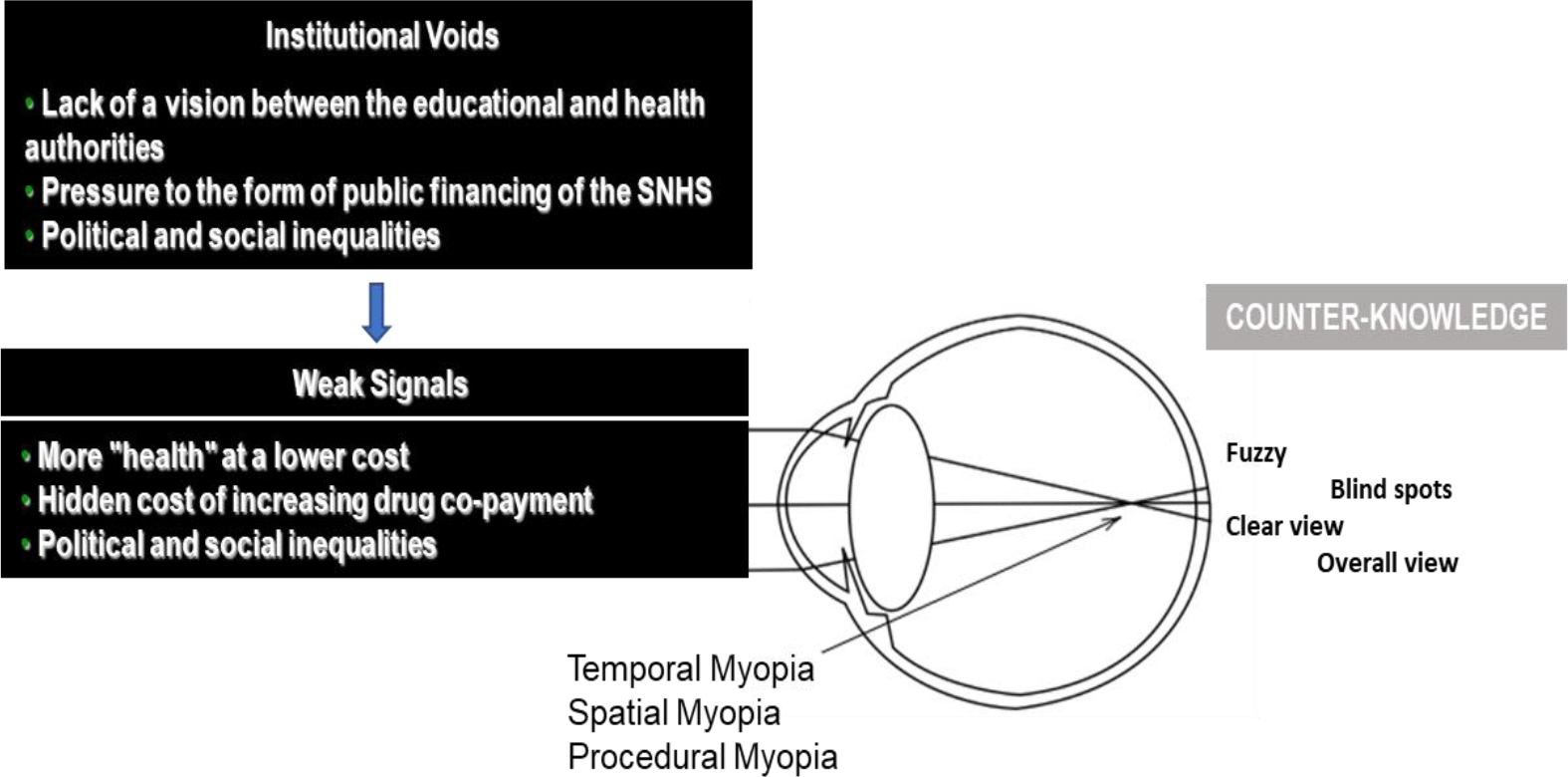
Figure 1.

The influence of weak signals on the formation of counter-knowledge
Source: own processing
The influence of weak signals on the formation of counter-knowledge Source: own processing

Blind spots in the Spanish national healthcare system

ActorsBlind spotsReferences
Users
  • -

    Excessive delays in care delivery, with waiting times frequently surpassing two weeks.

  • -

    Shortages of medical professionals in both primary and hospital care, largely stemming from politically driven selection and hiring processes.

  • -

    Overburdened emergency services and an increasingly burdensome medication co-payment scheme.

  • -

    Structural and systemic inefficiencies affect the overall functioning of the healthcare system.

  • -

    Limited awareness and enforcement of data privacy, resulting in obstacles to accessing personal health information.

(Coventry et al., 2020; Fotaki & Hyde, 2015; Gillespie & Reader, 2018; Morsø et al., 2022; O’Dowd et al., 2022)
Doctors and Nurses
  • -

    Low public sector salaries have led to significant dual employment, with many healthcare professionals working simultaneously in both public and private sectors.

  • -

    An aging medical workforce, combined with precarious employment conditions for younger doctors, often limited to temporary contracts, has resulted in high staff turnover.

  • -

    Diminished patient engagement, with reduced time allocated per patient, negatively affects communication and the speed and accuracy of diagnoses.

  • -

    Inadequate data privacy awareness, limiting effective protection and management of personal health information.

(Coventry et al., 2020; Kruse et al., 2017; Latukha et al., 2022)
Administrators
  • -

    The duplication of medical records and documentation contributes to poor coordination between primary care and specialized services.

  • -

    Poor management of public hospitals and lack of resources.

  • -

    Existence of individual interests.

  • -

    Inadequate attention to organization culture.

  • -

    Lack of awareness about patients’ data protection.

(Coventry et al., 2020; Denis et al., 2021; O’Malley et al., 2010; Papadimos et al., 2020)
Policymakers
  • -

    Politicizing the process.

  • -

    General complacency.

  • -

    Poor essential infrastructure and public works.

  • -

    Weak legal frameworks.

(Adebowale et al., 2020; Motta et al., 2020; Papadimos et al., 2020; Scopelliti et al., 2015, 2017)

Institutional health voids, weak signals, and corresponding counter knowledge

Institutional Health Voids (IHVs)Weak signalsCounter-knowledge
Inter-institutional coordinationCost-based serviceRumors regarding healthcare quality
Public financingUnclear proceduresConfusion regarding the final price of medications
Social power systemsDiscrepancy based on community-affiliationImpression of bias toward political or economic interests
DOI: https://doi.org/10.2478/mdke-2025-0007 | Journal eISSN: 2392-8042 | Journal ISSN: 2286-2668
Language: English
Page range: 105 - 119
Submitted on: Apr 6, 2025
Accepted on: May 25, 2025
Published on: Jun 25, 2025
Published by: Scoala Nationala de Studii Politice si Administrative
In partnership with: Paradigm Publishing Services
Publication frequency: 4 issues per year

© 2025 Juan-Gabriel CEGARRA-NAVARRO, Aurora MARTINEZ-MARTINEZ, Raghda EL EBRASHI, Anthony WENSLEY, published by Scoala Nationala de Studii Politice si Administrative
This work is licensed under the Creative Commons Attribution-NonCommercial-NoDerivatives 4.0 License.