
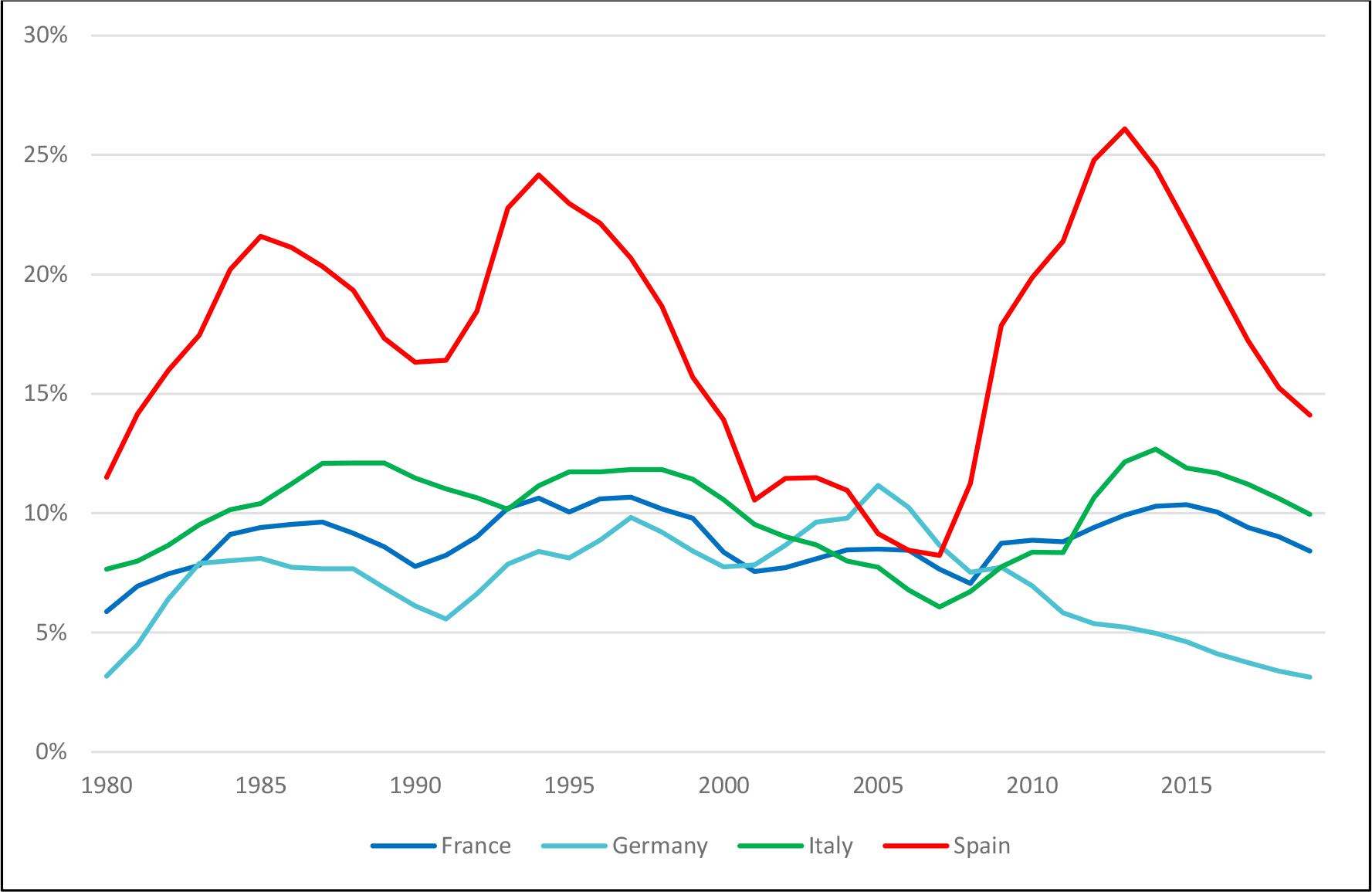
Fig. A.1.
Unemployment rates (U%) 1980-2019: France Germany, Italy and Spain.
Source: Own elaboration based on OECD data‥ https://data-explorer.oecd.org/ (last access September 2025). Data for Germany before 1991 corresponds to the Federal Republic of Germany
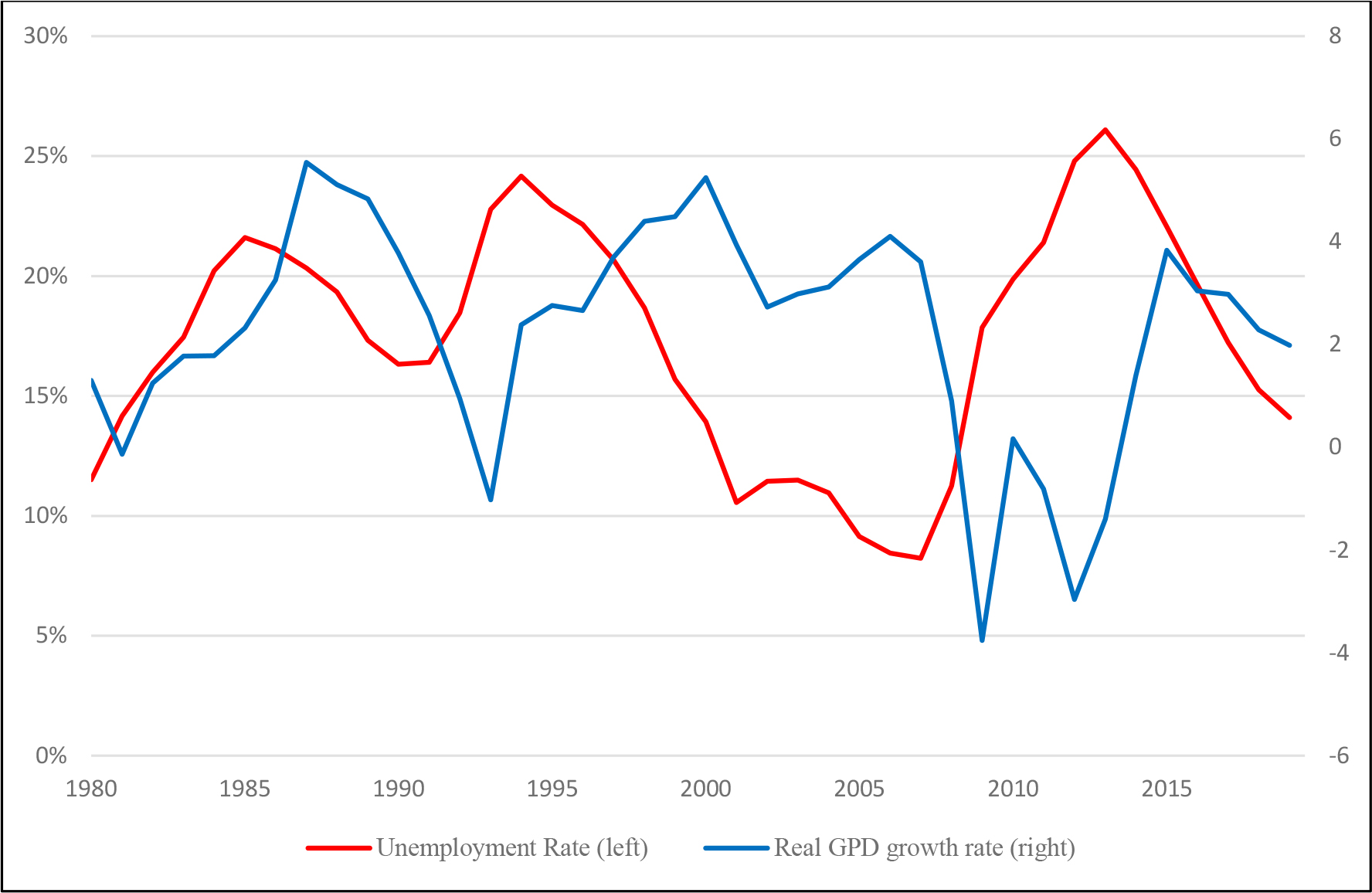
Fig. A.2.
Evolution of the Unemployment Rate and GDP real growth.
Source: Own elaboration based on OECD GDP and unemployment data. https://data-explorer.oecd.org/ (last access September 2025)
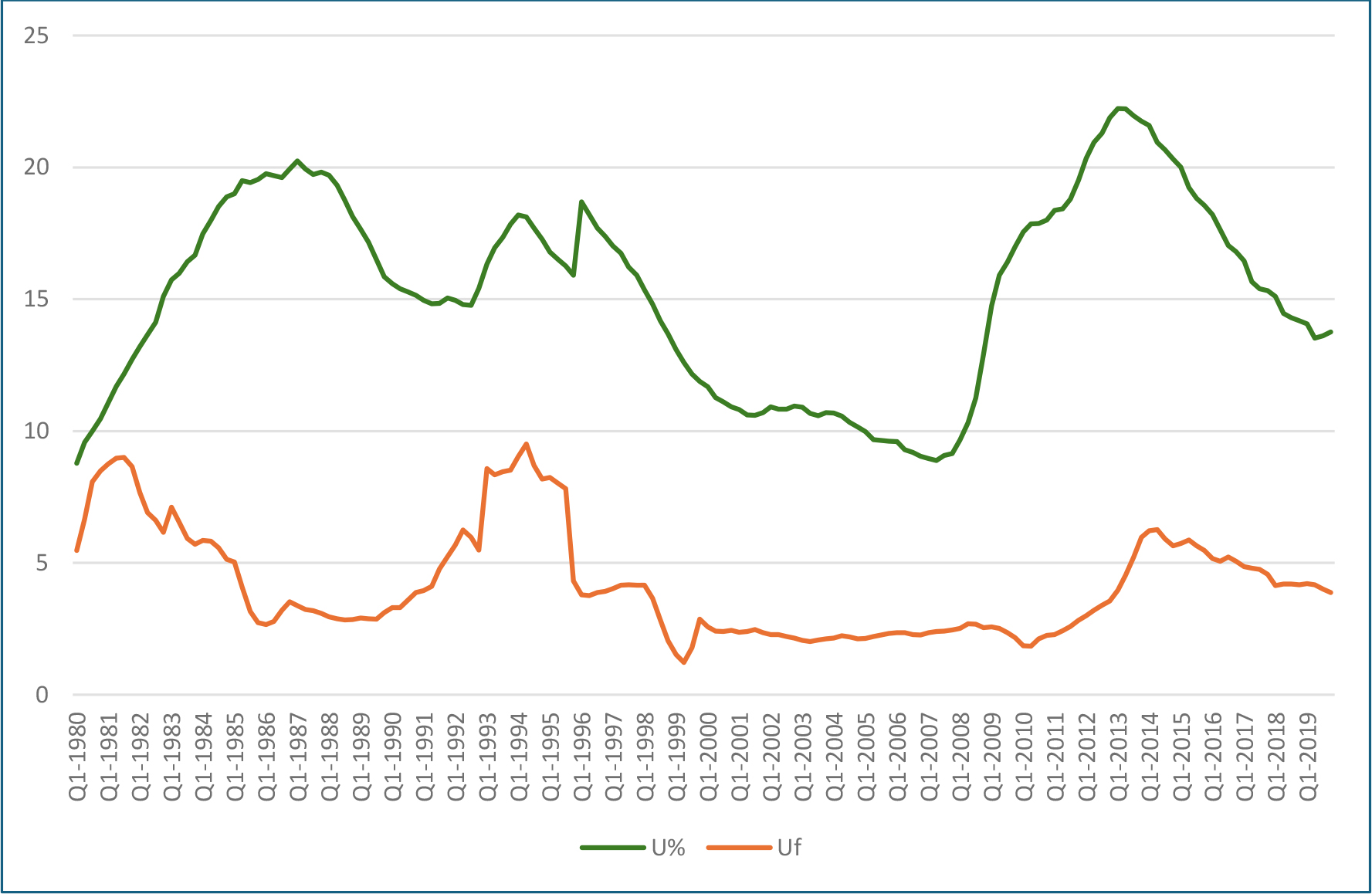
Fig. A.3.
Evolution of total (U%) and frictional (Uf%) unemployment rates.
Source: Estimated series using EPA data.
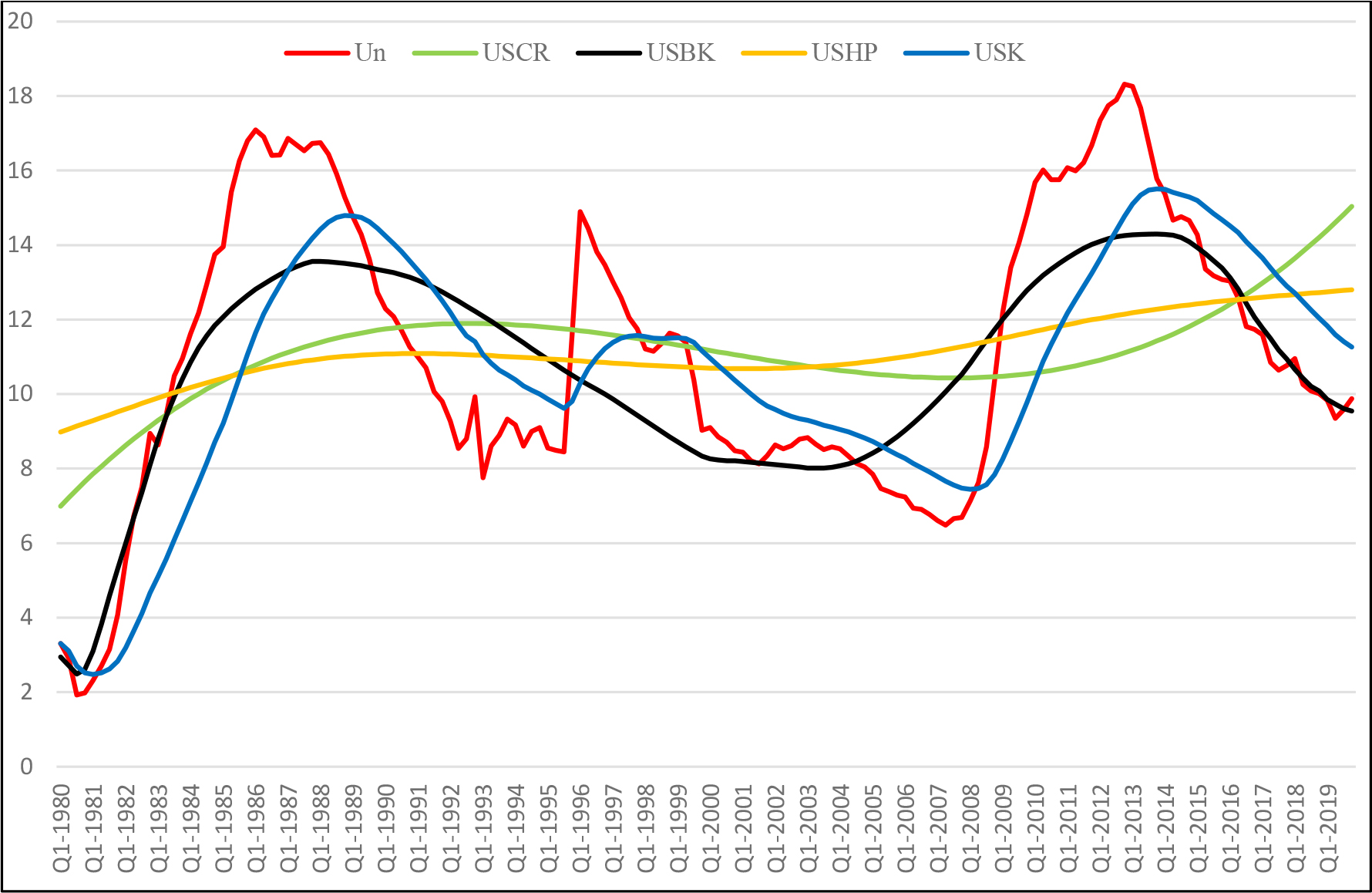
Fig. A.4.
Structural unemployment rate by each method. Comparison with the unemployment rate after subtracting the frictional component (Un). Structural unemployment rate with cubic regression (USCR), BK filter (USBK), HP filter (USHP) and Kalman filter (USK).
Source: Estimated series using EPA data.
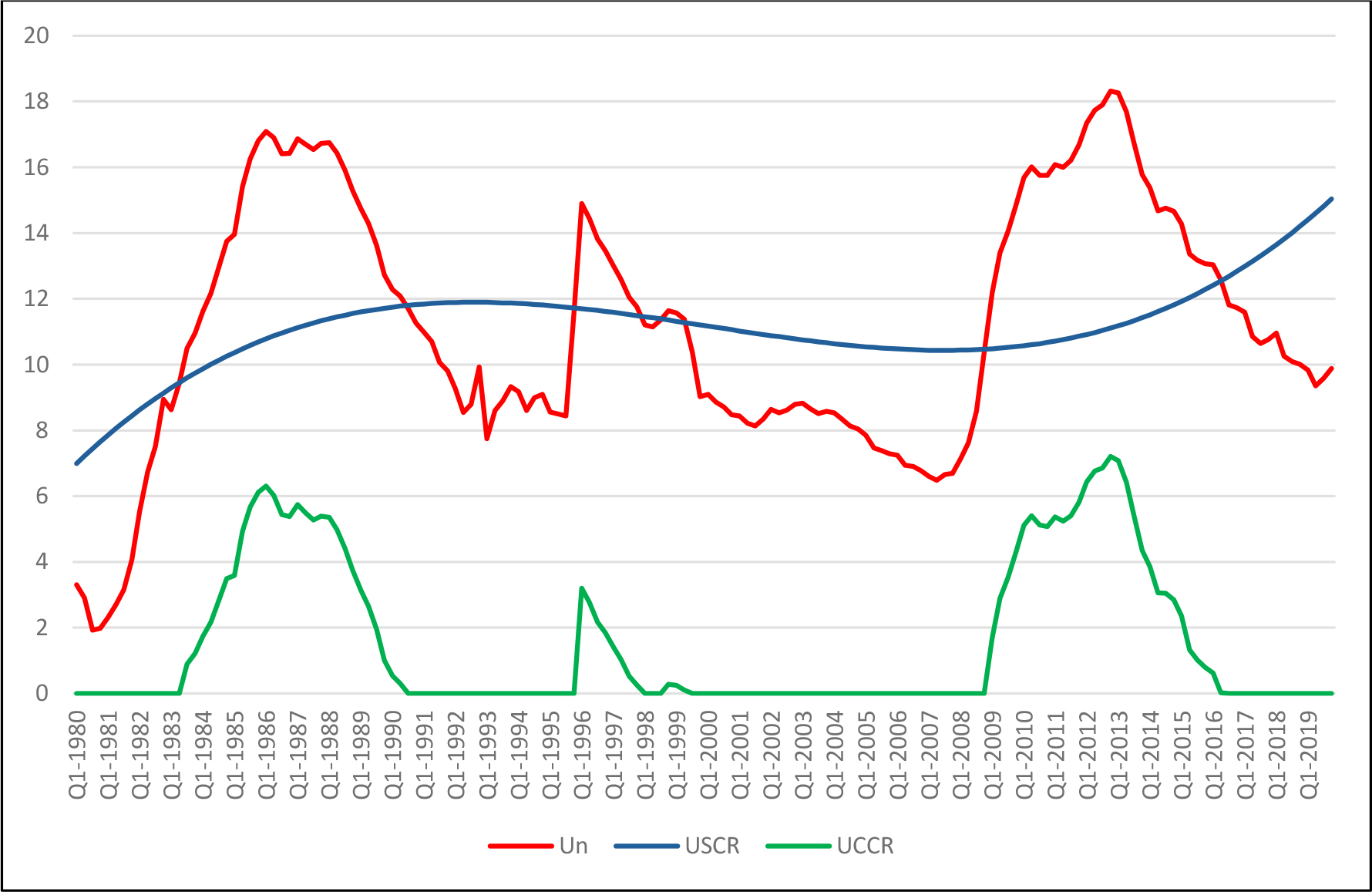
Fig. A.5.
Decomposition of Un into Structural (USCR) and cyclical (UCCR) unemployment rates as estimated with cubic regression.
Source: Estimated series using EPA data.
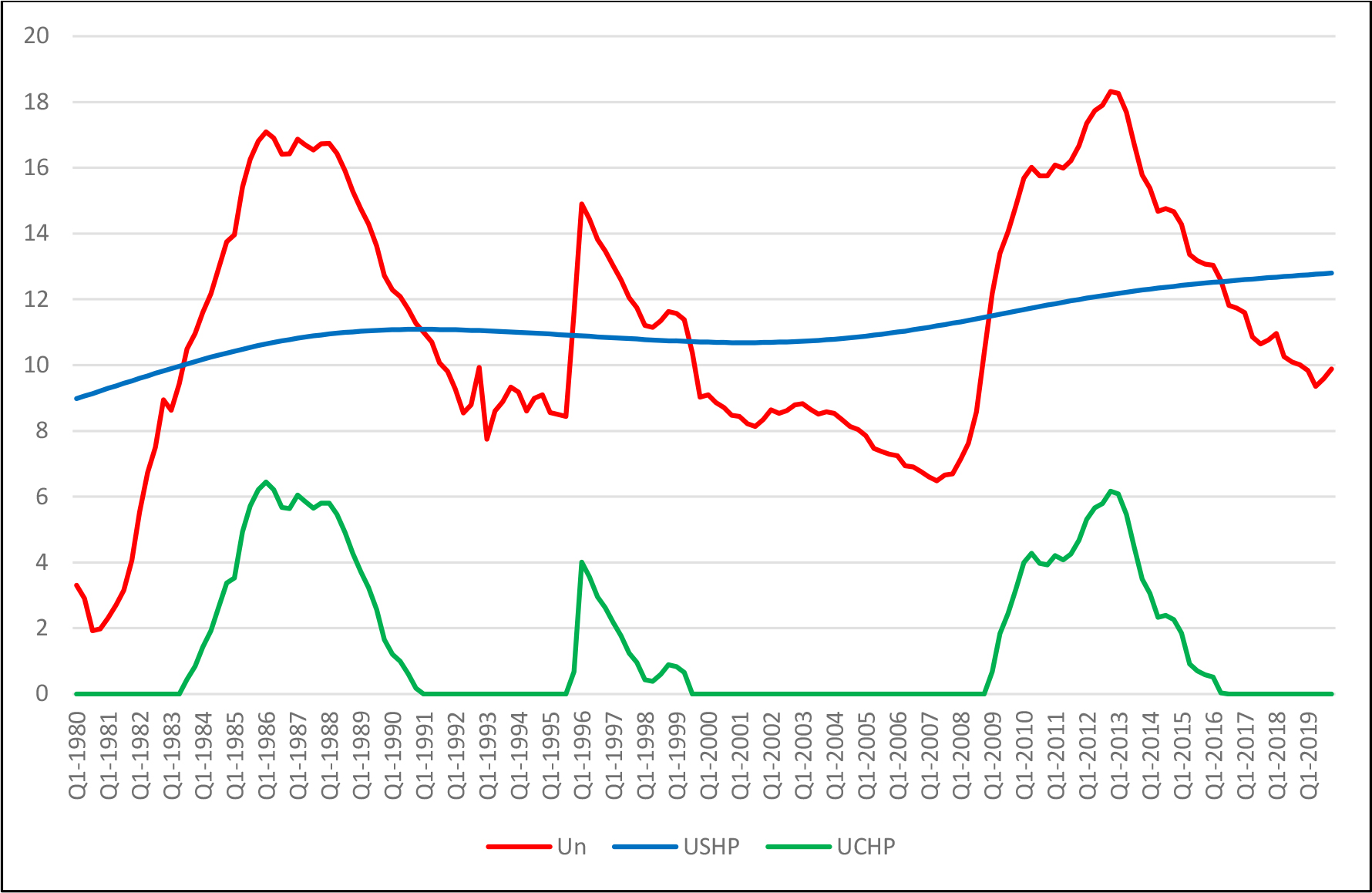
Fig. A.6.
Decomposition of Un into Structural (USHP) and cyclical (UCHP) unemployment rates as estimated with the Hodrik-Prescott filter.
Source: Estimated series using EPA data.
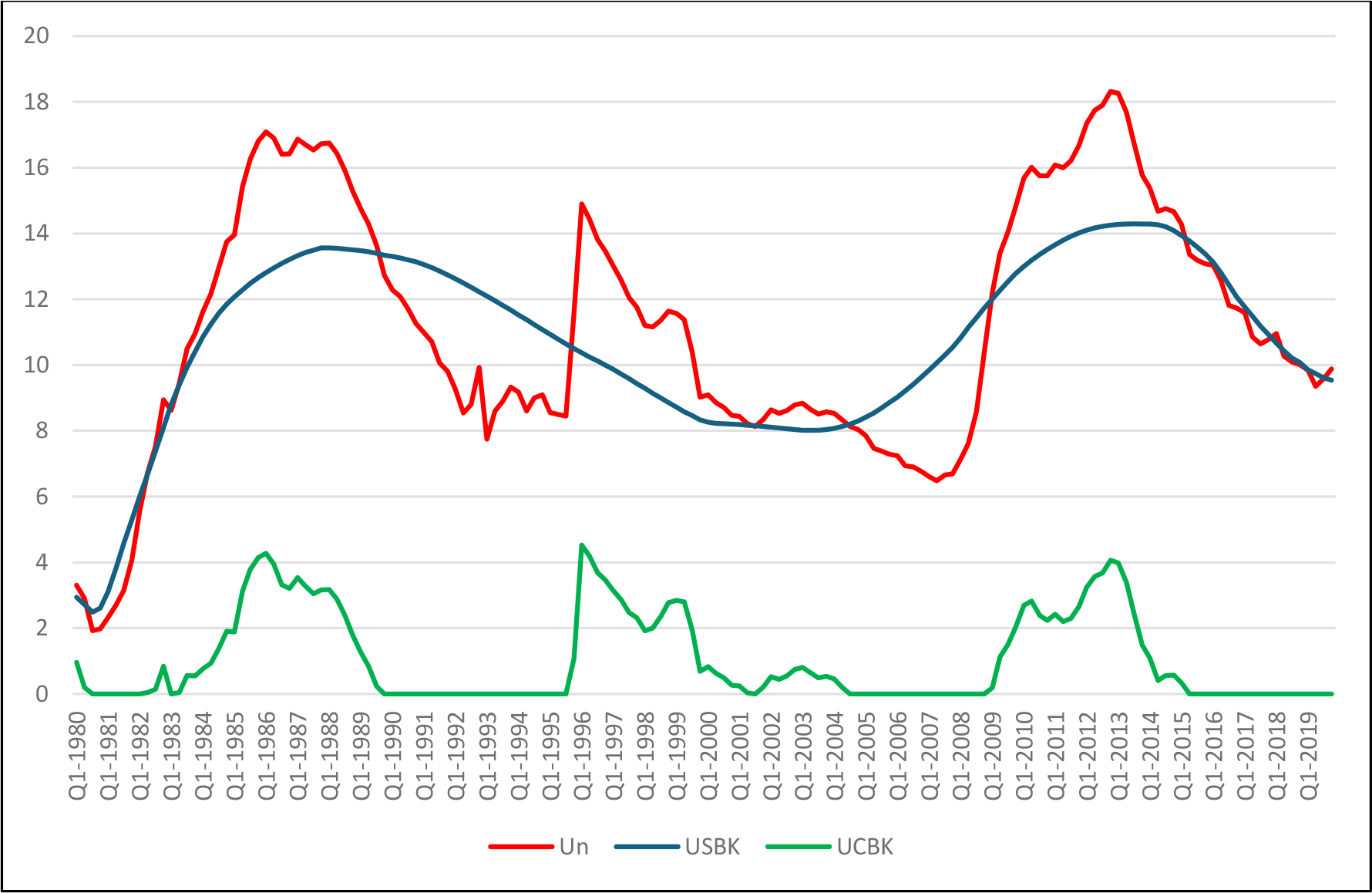
Fig. A.7.
Decomposition of Un into Structural (USBK) and cyclical (UCBK) unemployment rates as estimated with the Baxter-King filter.
Source: Estimated series using EPA data.
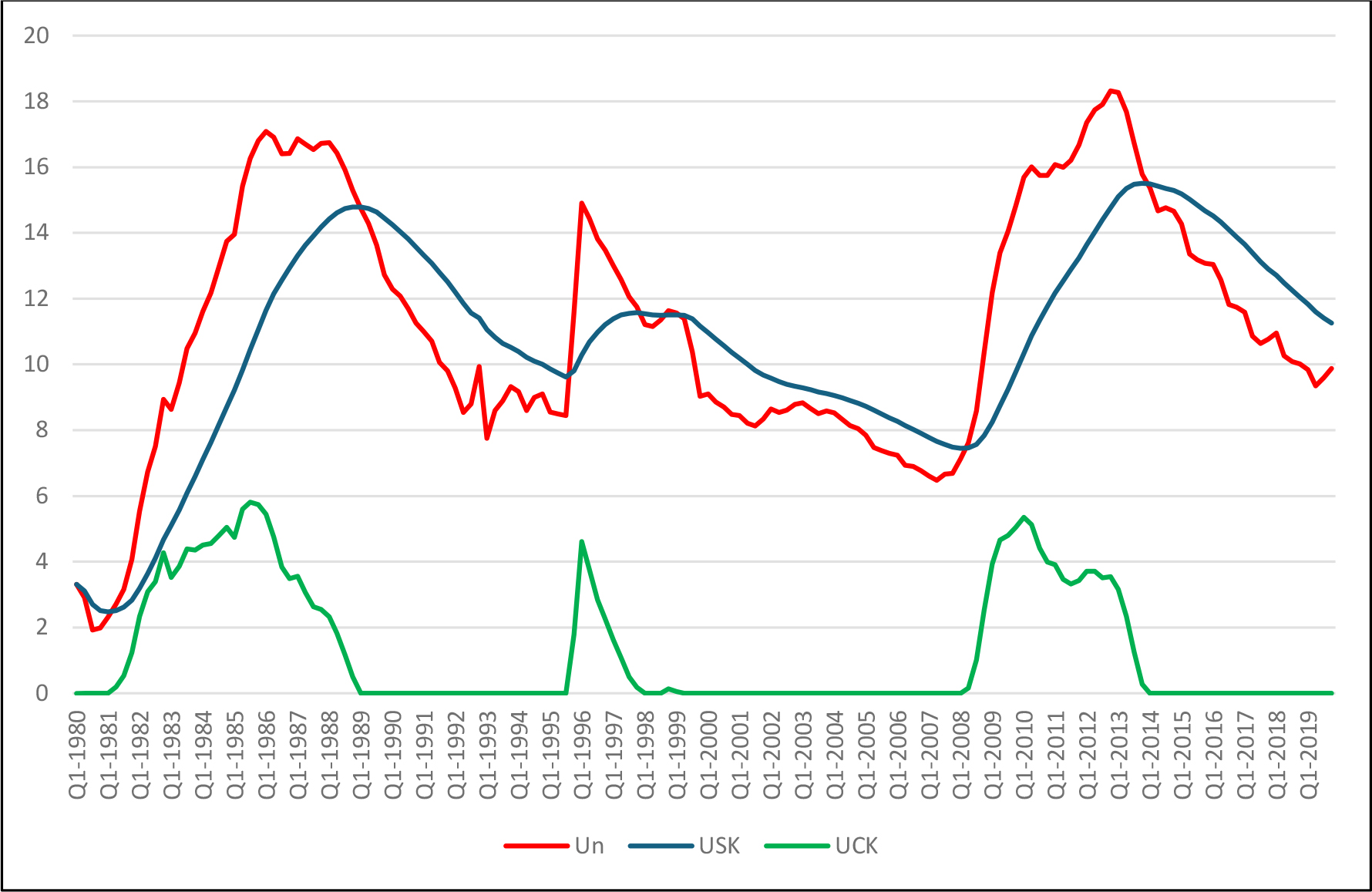
Fig. A.8.
Decomposition of Un into Structural (USK) and cyclical (UCK) unemployment rates as estimated with the Kalman filter.
Source: Estimated series using EPA data.
Table B.1.
Vacancy data
| 1980 to 2005 | OECD, public and private sector | OECD | VactOECD |
| 2001 to 2012 | Eurostat, without public sector | EURO | VactEURO |
| 2010 onwards | Eurostat, public and private sector | EURT | VactEURT |
Table B.2.
Error components frontier results. Estimation of equation E.10.
Table B.3.
The average rate of frictional unemployment
| 1980-1989 | 1990-1999 | 2000-2009 | 2010-2019 |
| 5.06% | 5.13% | 2.33% | 4.26% |
Table B.4.
Decomposition of the average unemployment rate with cubic regression model: total (U%), frictional (UF%), structural (USCR%) and cyclical (UC%) unemployment rates.
| Time | U% | UF% | USCR% | UCCR% |
|---|---|---|---|---|
| 1980 - 1989 | 16.49 | 5.06 | 9.98 | 2.62 |
| 1990 - 1999 | 15.80 | 5.13 | 11.69 | 0.37 |
| 2000 - 2009 | 10.90 | 2.33 | 10.66 | 0.31 |
| 2010 - 2019 | 18.12 | 4.26 | 12.20 | 2.80 |
| 1980 - 2019 | 15.33 | 4.20 | 11.13 | 1.53 |
Table B.5.
Decomposition of the average unemployment rate: total (U), frictional (UF) and structural unemployment as estimated with HP (USHP), BK (USBK), and Kalman (USK) filters; and cyclical unemployment, with HP (UCHP), BK (UCBK) and Kalman (UCK) filter
| Time | U% | UF% | USHP% | UCHP% | USBK% | UCBK% | USK% | UCK% |
|---|---|---|---|---|---|---|---|---|
| 1980 - 1989 | 16.49 | 5.06 | 10.26 | 2.75 | 10.07 | 1.54 | 8.87 | 2.68 |
| 1990 - 1999 | 15.80 | 5.13 | 10.93 | 0.67 | 10.99 | 1.13 | 11.45 | 0.47 |
| 2000 - 2009 | 10.90 | 2.33 | 10.98 | 0.20 | 9.25 | 0.32 | 8.90 | 0.55 |
| 2010 - 2019 | 18.12 | 4.26 | 12.35 | 2.26 | 12.74 | 1.21 | 13.50 | 1.36 |
| 1980 - 2019 | 15.33 | 4.20 | 11.13 | 1.47 | 10.76 | 1.05 | 10.68 | 1.27 |
Table B.6.
Correlation coefficients between estimates obtained by each method. The unemployment rate (U) and the structural unemployment rate with cubic regression (USCR), HP filter (USHP%), BK filter (USBK%) and Kalman filter (USK%).
| USCR | USHP | USBK | USK | |
|---|---|---|---|---|
| U | 0.288 | 0.377 | 0.770 | 0.626 |
| USCR | 1 | 0.792 | 0.510 | 0.731 |
| USHP | 1 | 0.642 | 0.727 | |
| USBK | 1 | 0.810 |