
1. Introduction
Spain's high unemployment rate stands out notably when compared to close countries within the European Union (EU) and the Organization for Economic Co-operation and Development (OECD). As illustrated in Figure A.1 (Appendix A), unemployment has consistently been double or triple those of its European counterparts.1 Moreover, high unemployment rates have persisted for long periods (Romero-Ávila & Usabiaga, 2007).
Addressing this anomaly requires identifying and estimating the predominant type of unemployment to understand its causes. Following the literature (Aysun et al., 2014; Cuéllar-Martín et al., 2019; Pissarides, 2000), total unemployment can be decomposed into three components: frictional, structural and cyclical. Frictional unemployment refers to short-term unemployment arising from job search difficulties under imperfect information. Structural unemployment reflects mismatches between labor demand and worker skills, often linked to geographic or demographic imbalances, wage disparities, or labor regulations. Together, these two components form the natural unemployment. Cyclical unemployment denotes short-term fluctuations tied to economic cycles, inversely related to GDP growth. Figure A.2 shows the relationship between economic cycles and unemployment rate. This study aims to estimate structural unemployment in the Spanish economy over 1980-2019 by calculating the relative weights of each type of unemployment. It follows methodologies previously employed in the literature.
First we estimated frictional unemployment and then decomposed the remaining unemployment into structural and cyclical components. The estimation of frictional unemployment requires a consistent series of vacancies. One of the contributions of this article is to present a new series of vacancies. The last decomposition is carried out applying time series filters and regression models. The prevailing component is identified once the three components have been separated. This sequential approach allows each unemployment component to be analyzed separately, enabling a more in-depth analysis of the underlying factors.
The rest of the article is organized as follows. Section 2 reviews the theoretical framework, Section 3 examines the empirical literature and Section 4 assesses the methodology and data. Section 5 presents the results of the decomposition and Section 6 discusses the findings and main conclusions.
2. A brief theoretical review
Unemployment, defined as the inability of working-age individuals to find a job, has major economic and social costs, reducing income, consumption and savings. Economic theory has proposed multiple models, none fully explanatory, but each offering partial perspectives that contribute to understanding its causes and to design policies (Martín-Román et al., 2023).
From a neoclassical perspective, unemployment is seen as a disequilibrium between labor supply and demand, typically arising from excessive wages. Other models emphasize imperfect information and matching difficulties giving rise to frictional unemployment (Pissarides, 2000). From a Keynesian view, unemployment results from insufficient aggregate demand, producing involuntary unemployment. Countercyclical policies stimulate demand and reduce unemployment, while in the long run, capital accumulation is highlighted as crucial (Heimberger, 2021).
Since Smith, Ricardo and Marx, an institutionalist tradition has stressed that labor markets differ from others, with unions and regulations shaping wages and working conditions; the labor market is a social institution characterized by rules, regulations and power relations. Institutions can create rigidities that rise structural unemployment. Labor market deregulation has often been proposed to reduce structural unemployment and has been promoted by international organizations (Blanchard & Wolfers, 2000; Nickell & Layard, 1999). However, empirical studies question whether deregulation is always optimal, particularly in contexts with high product-market liberalization (Heimberger, 2021).
The disaggregation of unemployment into its frictional, structural and cyclical components continues to be an essential framework in studying the labor market. It is widely accepted and extensively applied in the literature, as evidenced by studies such as Aysun et al. (2014), Bande & Martín-Román (2018), Boscá et al. (2017), Cuaresma (2003), Cuéllar-Martín et al. (2019), Martín-Román et al. (2023) and Mocan (1999).
3. A review of estimation methods
One strand of empirical literature estimates structural unemployment through the NAIRU, defined as the unemployment level consistent with stable inflation (Romero & Fuentes, 2017). Alternatively, other authors have used the natural rate of unemployment, the sum of frictional and structural components derived from the Phillips curve. It reflects long-term equilibrium unemployment determined by labor market institutions and productive structures, representing a maximum employment limit beyond which wage pressures trigger inflation (Pissarides, 2000).
In the specific case of Spain, several authors have applied the NAIRU to estimate structural unemployment: Cuadrado & Moral-Benito, (2016) and Romero & Fuentes, (2017). Others, such as Bande & Karanassou (2013) and Cuéllar-Martín et al. (2019) have used the natural rate of unemployment.
Debates on the Phillips curve’s instability (Del Negro et al., 2020, Stiglitz & Regmi, 2023) have led to the estimation of the unemployment’s cyclical component (Cuaresma, 2003). This approach, adopted by Bande & Martín-Román (2018), applies Okun’s Law, linking inversely short-term GDP fluctuations to unemployment.
Time series models provide an alternative: decomposing unemployment into trend (structural) and cycles (cyclical). These methods have been applied in diverse contexts: Cuaresma (2003) applies the Hodrik-Prescott (HP) filter to US. Doménech & Gómez (2005) combine HP and Baxter-King (BK) filters for Spain. Mocan (1999) combines HP with the Kalman filter (K) and estimates regressions for US. Marinkov & Geldenhuys (2007) use the HP, Band-Pass (BP), and Beveridge-Nelson (BN) filters. Finally, Moosa (1999) combines Okun’s coefficient with K filter. Filters yield diverse decompositions: the BN approach allows flexible trend estimation, HP, BK, and BP rely on predefined rules, and the K filter adapts well to data noise. These methods have been applied to Spanish unemployment by Corrales et al. (2002), Maravall & Del Río (2001) and Marcet & Ravn (2003).
Another strand of literature decomposes unemployment into its components to analyze the structural component. Aysun et al. (2014) estimated frictional unemployment in the US, following Aigner et al. (1977), Lipsey (1960) and Warren (1991). They then separated the frictional component of total unemployment to subsequently decompose structural and cyclical unemployment, using a Phillips Curve augmented with adaptive expectations. Cuéllar-Martín et al. (2019) estimate Spain's natural unemployment through a stochastic frontier with cyclical unemployment measured as deviations from this equilibrium benchmark.
In this study, we follow the first part of the Aysun et al. (2014) method. We first estimated frictional unemployment, creating a new series of vacancies for the entire period. In the second stage, we applied filters and regression models to separate the structural and cyclical components of the remaining unemployment.
3.1. The estimation of vacancies
The decomposition of unemployment requires vacancy series. Due to the lack of long-term harmonized data we reviewed the methods used in the literature.
Antolín (1994), Brossa & Sanromà i Meléndez (1991) and Castillo et al. (1998) used INEM vacancy data, correcting for private-sector undercoverage by estimating a proportion of total registrations. This adjustment, capturing unfilled monthly vacancies, was also applied by López-Bazo et al. (2005) and Fonseca & Muñoz (2003).
Some regional studies have examined vacancies using administrative data from employment offices, such as Andalucia (Álvarez de Toledo et al., 2014) or Asturias (Baños et al., 2019). Núñez et al. (2011) used employer-survey data for firms located in Andalusia, offering an alternative micro-based perspective. At the national level, Bouvet (2012) employed INEM data up to 2004 and subsequently constructed vacancy series using the Continuous Sample of Working Lives following Álvarez de Toledo et al. (2017).
Some studies use alternative sources to INEM. Hobijn & Şahin (2013) contrasted Eurostat and INEM data, while Bonthuis et al. (2016) employed the European Commission survey on labor shortages2. Villaverde et al. (2015) and Ruesga et al. (2015) used the Labor Situation Survey (ECL). Others constructed hybrid series: Bentolila et al. (2012) linked the OECD data used by Bouvet (2012) with the data from the ECL. The reason is that OECD data for Spain was only available until 2004, while ECL data is available from 2000 onwards. Analogously Bonthuis et al. (2013) and Arpaia et al. (2014) linked the series published by Eurostat with that of the European Commission survey. Similarly, Boscá et al. (2017) linked the series published by the OECD for 1980-2005 and the Eurostat series since 2010.
Vacancy data lack a homogeneous public–private series for 2005–2010. To address this gap, OECD data (1980–2005) are extrapolated forward and Eurostat data (post-2010) backward to cover the 1Q2005-4Q2009 period. We used a Eurostat series without public vacancies, available for the 2001-2012 period as a bridge.
4. Methodology and data
This section presents the methodology used to estimate structural unemployment in the Spanish labor market. We developed an exhaustive decomposition analysis to obtain the three fundamental components of unemployment over 1980–2019.
We estimated frictional unemployment using a new vacancy series and applying a stochastic frontier analysis, following Warren (1991) and Aysun et al. (2014). This estimation requires data on total numbers of employees, unemployed, and the labor force, for which quarterly series from the Spanish Economically Active Population Survey (EPA) were used3. OECD unemployment rates were only used in Figures A.1 and A.2 for descriptive purposes, while all empirical estimations rely on EPA data.
After estimating frictional unemployment, we subtracted it from total unemployment and applied regression models and filters to separate structural and cyclical components.
4.1. Homogenization of vacancy series
Given the absence of a homogeneous vacancy series for Spain covering the period 1980–2019, a regression-based linking procedure was implemented, following Boscá et al. (2017).
Three quarterly vacancies series are available. First, the OECD vacancy series , for 1980–2005, that covers both public and private sectors. Second, the Eurostat vacancy series excluding the public sector , derived from the ECL, that covers the 2001–2012 period. Third, the Eurostat total vacancy series , including public and private sectors, available from 2010 onwards.
There is no temporal overlap between the OECD series and the Eurostat total vacancy series. The series is used as an intermediate (bridge) series, overlapping with the OECD data during 2001-2005 and with the Eurostat total data during 2010–2012. It was used to estimate a linking series and does not enter in the final vacancy series (see Table B.1).
To carry out this process, a regression model was estimated that relates the series to the series , obtaining an estimate of the parameters of the equation
The second relates the series to the same reference series
Using the estimated parameters, two adjusted series are constructed. The OECD vacancy series is projected forward beyond its observed endpoint, generating an adjusted series covering 1980–2012. Conversely, the Eurostat total vacancy series is projected backward prior to its first observed date, generating an adjusted series covering 2001–2019.
The period without public sector vacancies, from 1Q/2005 to 4Q/2009, is reconstructed by combining both adjusted series using the mixed linking method proposed by De la Fuente (2014). Given that this interval spans 20 quarters, the reconstructed series is obtained as a moving weighted average:
The final vacancy series used in the decomposition thus consists of observed OECD data (1980–2005), the reconstructed segment (2005–2009), and Eurostat total vacancy data from 2010 onwards. Once completed, the series is seasonally adjusted and corrected for outliers using the TRAMO-SEATS procedure (Gómez & Maravall, 1998), ensuring consistency across data sources.
4.2. Methodology for estimating frictional unemployment
The estimation of frictional unemployment is based on the occupational friction model developed by Lipsey (1960) and later expanded by Warren (1991), to account for potential measurement errors in unemployment due to random disturbances derived from the job search process and to potential technical inefficiencies. The methodology employed by Aysun et al. (2014) is followed.
Initially, the number of job positions (Jt) for each period is considered, as the sum of job vacancies (Vt) and employed positions (Et). Second, the labor force for each period (Lt) equals the sum of employed (Et) and unemployed (Ut) individuals
The imperfect information governing the labor market introduces frictions in the jobfinding process. Workers must assess job offers that meet their wage and working conditions expectations while firms must evaluate candidates for the vacant position. Thus, the number of workers finding employment (Ft) is defined through a constant return to scale Cobb-Douglas matching function, widely used in the literature (Lucas & Prescott, 1974; Pissarides, 2000):
where Ft represents the number of workers who find employment in each period, and β is the rate at which workers find jobs, also called entry rate by Aysun et al. (2014).
In the labor market, employed individuals and those who lose their jobs due to layoffs, contract terminations or voluntary resignations coexist. Regardless of the reason, total number of individuals losing their jobs forms the separations, denoted by γEt, where γ represents the separation rate. This rate is computed as the proportion of unemployed individuals who either lose or voluntarily leave their jobs among the total employed individuals for the same period. Therefore, the dynamics of employment are determined by the balance between the creation and destruction of new job positions. Considering the steady state of the model, where Et+1 = Et, the frictional unemployment rate (uf) over the total labor force (L) can be expressed accordingly
The labor market often experiences measurement errors and job search is subject to random disturbances and inefficiencies, Warren (1991), following Aigner et al. (1977), expanded the model proposed by Lipsey (1960), incorporating stochastic variables. Measurement errors and random shocks are represented by ωt. Technical inefficiencies in the job search process are captured by a perturbation term, μt. Incorporating these two stochastic variables, the number of workers finding employment Fta, once equation E.6 is standardized as regards to the total number of workers, can be computed as:
Finally, to compute the frictional unemployment rate (uf) in equation E.8, we estimated the separation rate γ, and the entry rate β. Using a stochastic frontier model on equation E.7, replacing Ft with and introducing a time trend t to account for long term employment growth, the estimated model was:
where γ = λ0 + λ2 t and β = λ1Table B.2 presents the error components frontier results of the estimated model from equation E.10. Using the estimated coefficients λ0,λ2, λi we computed an average frictional unemployment rate (utf) of 4.2% for the whole period. The average for each decade is presented in Table B.3.
4.3. Methodology for estimating structural and cyclical unemployment
Once frictional unemployment had been estimated, it was subtracted from total unemployment to obtain an estimation of the remaining unemployment, which was decomposed into structural and cyclical components.
This work used time series filters and regression models to isolate trends and cycles: the trend is interpreted as structural unemployment and cycles, variations around the trend, as cyclical unemployment. The HP, BK and K filters are applied. Additionally, linear, quadratic and cubic regression models are estimated following Mocan (1999) suggestions.
For the estimation of structural unemployment with a regression model we considered a linear time trend (t) with a white-noise disturbance. The quadratic regression model also included a quadratic time trend (t2) to capture the acceleration or deceleration of the dependent variable. A cubic time trend (t3) component was also tested to assess the explaining capacity of the models. These three models were estimated by OLS.
Before presenting the results, it is important to clarify the economic interpretation of the cyclical component and the treatment of potential negative values. From a microeconomic theoretical perspective of the labor market, none of the unemployment components can be negative, nor can their sum exceed total observed unemployment. Therefore, cyclical unemployment is interpreted as excess unemployment associated with demand shortfalls. However, the cyclical component is estimated as a deviation from a trend and takes negative values during expansionary phases, surges in demand giving rise to tight labor markets and inflationary pressures rather than “negative unemployment ”. Following this interpretation, negative estimated values are set to zero ex post. This is a limitation of this work. Following the ex-post correction, the sum of the components may occasionally exceed observed unemployment. Similar results are shown, for instance in Table A5 and Figure A2 in the appendix of Martín-Román et al., (2023). Note that stochastic frontier models incorporate non-negativity in the perturbation term (Aysun et al., 2014; Warren, 1991).
5. Results
This section presents the results of unemployment decomposition. First, it describes unemployment and GDP growth dynamics. Then, it reports frictional unemployment, followed by structural and cyclical components.
Figure A.2 shows different stages in unemployment dynamics. The first stage records a continuous rise, with the rate exceeding 20% in 1987. Despite GDP growth, industrial restructuring (iron, steel, shipbuilding) drove massive job losses, as the Spanish economy adjusted to international competition. In the second stage, strong GDP growth reduced unemployment, though only to 16% in 1990. A third stage in the mid-1990s brought a short crises, pushing unemployment back to 24% in 1994. Afterwards, from the late 1990s until 2008, Spain entered its longest expansion, with annual GDP growth above 2.5% between 1994 and 2007, peaking at 5%. This expansion reduced the unemployment rate to the minimum of the series (8.2% in 2008). Yet it was driven by a real estate bubble and rising debt, which culminated in the financial crisis during the Great Recession. During this fifth stage, the unemployment rate expanded rapidly to 26% (2013). The austerity policy promoted by international bodies and the EU deepened and extended the effects of the crisis. Since 2014, a sixth stage with a reduction in the unemployment rate has been observed. Even in 2019, the unemployment rate was close to 14%. The average unemployment rate for the entire period was 15.33%, ranging from a maximum of 26% to a minimum of 8.2%.
5.1. The frictional component of unemployment
This subsection presents the frictional unemployment results from section 4.2. Figure A.3 shows the evolution of total and frictional unemployment rates throughout the period.
The estimation results highlight the presence of technical inefficiencies in the Spanish labor market, as indicated by the significant value of γ =σμ2 / μ2 (0.858). The proportion of total variance attributed to the effectiveness of matching is high. The significant estimate of μ2 (2.477) underscores the magnitude of observed deviations, while the correlation between total and frictional unemployment is positive but weak (0.234).
The average frictional unemployment rate was 4.20% (28.2% of total unemployment rate). It reached 5.06% in the 1980s (35%) and 5.13% in the 1990s (31.8%), fell to 2.33% in the 2000s (21.95%), and rose again to 4.26% in the 2010s (24%). These high levels indicate inefficiencies in the matching process and suggest scope for improving vacancy information and worker-job matching.
5.2. The structural and cyclical components of unemployment
This section reports results from regression models and HP, BK, and K filters. After estimating three models, the cubic specification was selected: it yielded higher R2 (0.121) and significant coefficients at 1%. The estimated model is:
The fitted values represent the structural component, while deviations capture the cyclical component. Table B.4 reports average values by decades and for the full period.
The structural component accounted for 76% unemployment over the entire period. During the first three stages, the share was lower (61%, 71%, 69%, respectively), peaked at 95% during the fourth stage expansion, and fell to 70% and 77% in the subsequent stages. The regression model accentuates the structural share during expansionary phases.
Table B.5 reports the results of the HP, BK, and K filters for the whole period and by decades. The structural share ranges between 71% and 77% overall, with HP and K filters yielding the highest values during the fifth stage expansion.
The results obtained by each method are highly correlated, as shown in Table B.6. Furthermore, the structural component estimated by the BK and K filters is highly correlated with the unemployment rate. The significant, positive but low correlation between the cubic estimation and the unemployment rate stands out.
Figure A.4 complements the analysis, showing the estimated structural unemployment rate by each method and comparing it with the unemployment rate after subtracting the frictional component to the unemployment rate (Un). It allows us to observe the different profiles corresponding to the different methods. The K and BK filters capture more closely their evolution.
Figures A.5, A.6, A.7 and A.8 shows the decomposition of the remaining unemployment rate (Un) between the structural and cyclical components by each method. All four methods show three stages with cyclical unemployment. These three stages coincide with the stages when the unemployment rate surged. That is, the first half of the 1980s, the second half of the 1990s, and from the outbreak of the Great Recession until 2014. The figures for this cyclical unemployment vary depending on the method. The cubic regression and H-P estimates reach 6% of cyclical unemployment while B-K and K methods reduce these values to 5-4%.
6. Discussion and conclusion
The primary aim of this article is to provide a comprehensive analysis of unemployment patterns in the Spanish labor market from 1980 to 2019. A secondary objective is to assess the relative weight of the structural component, providing a basis for understanding its determinants. The findings enhance knowledge of unemployment dynamics.
We first applied a stochastic frontier technique to isolate frictional unemployment. The remaining unemployment was then decomposed into structural and cyclical components using regression models and filters (Hodrick-Prescott, Baxter-King, Kalman), methods widely used in the literature with strengths and limitations.
Our results indicate a predominant presence of structural unemployment, which consistently prevailed throughout the study period. The structural component accounts, on average, for approximately 71% to 77% of the total unemployment rate over the period, depending on the method used. In contrast, the cyclical component of unemployment rises sharply during periods when the unemployment rate increases rapidly, typically reaching historically high levels. These trends align with the economic stages described in Section 5: the early 1980s, characterized by both GDP growth and rising unemployment during Spain’s transition to democracy; the mid-1990s, when recession pushed the unemployment rate close to 18%; and the post-2008 period, when the global financial crisis particularly impacted the Spanish economy. It is important to note that even during these periods of economic downturn, the structural component remained the main contributor to unemployment.
Regarding frictional unemployment, its average contribution to the total unemployment rate is 28%. In certain periods, such as earlies 1980s and mid-1990s, when unemployment reached historical peaks, frictional unemployment contributed to 50% of total unemployment. However, in recent decades, it has generally stabilized around its average share.
Understanding the persistence of structural unemployment requires further research into its determinants. This study provides a foundation for subsequent and more detailed analyses of the causes of high structural unemployment. The literature points to factors that should be tested to guide effective labor policies in Spain. The main limitations concern the lack of a consistent long-term vacancy series and incomplete data on labor market transitions. Despite this, the findings yield valuable insights into Spanish unemployment and underline the need to address its structural component.
Notes
[1] Declarations
This research did not receive any grant from funding agencies in the public, commercial, or not-for-profit sectors.
[2] OECD (2024), Unemployment rate (indicator). https://doi.org/10.1787/52570002-en (Last access, September 2025)
[3] https://economy-finance.ec.europa.eu/economic-forecast-and-surveys/business-and-consumer-surveys/download-business-and-consumer-survey-data/subsector-data_en (last access, September 2025)
[4] https://www.ine.es/dyngs/INEbase/en/operacion.htm?c=Estadistica_C&cid=1254736176918&menu=ultiDatos&idp=1254735976595 (last access, September 2025)
Appendices
Appendix A. Figures
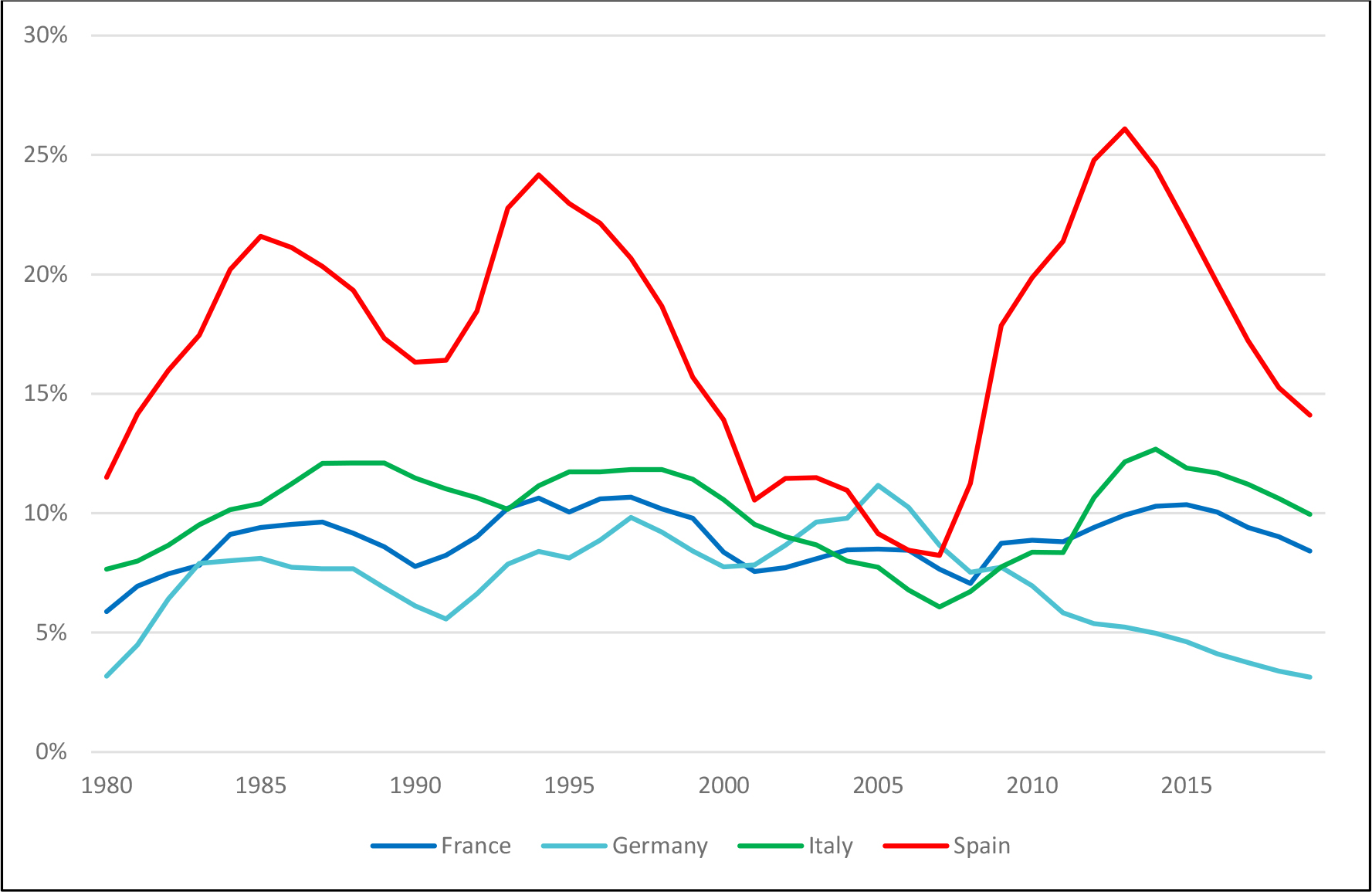
Fig. A.1.
Unemployment rates (U%) 1980-2019: France Germany, Italy and Spain.
Source: Own elaboration based on OECD data‥ https://data-explorer.oecd.org/ (last access September 2025). Data for Germany before 1991 corresponds to the Federal Republic of Germany
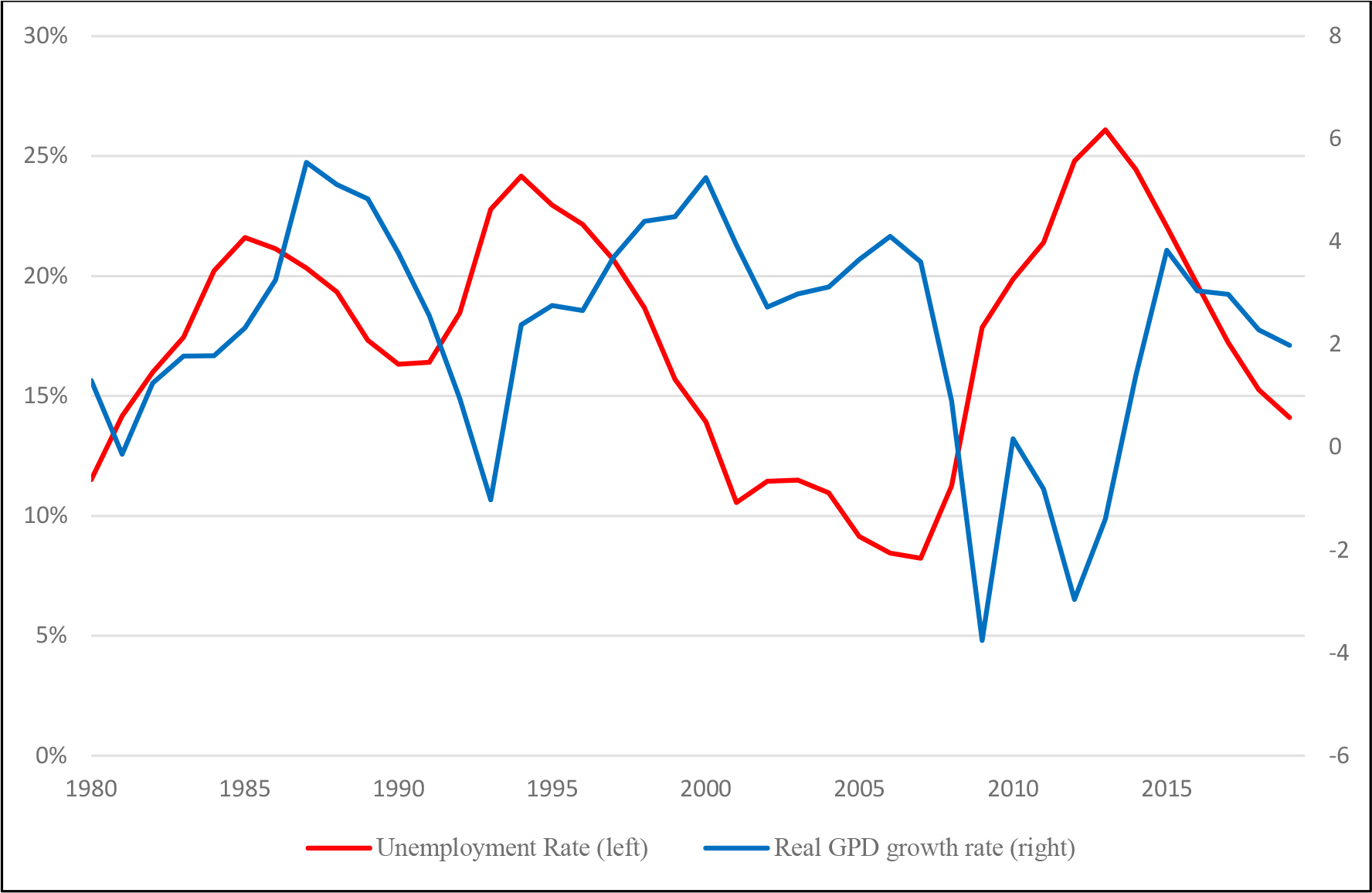
Fig. A.2.
Evolution of the Unemployment Rate and GDP real growth.
Source: Own elaboration based on OECD GDP and unemployment data. https://data-explorer.oecd.org/ (last access September 2025)
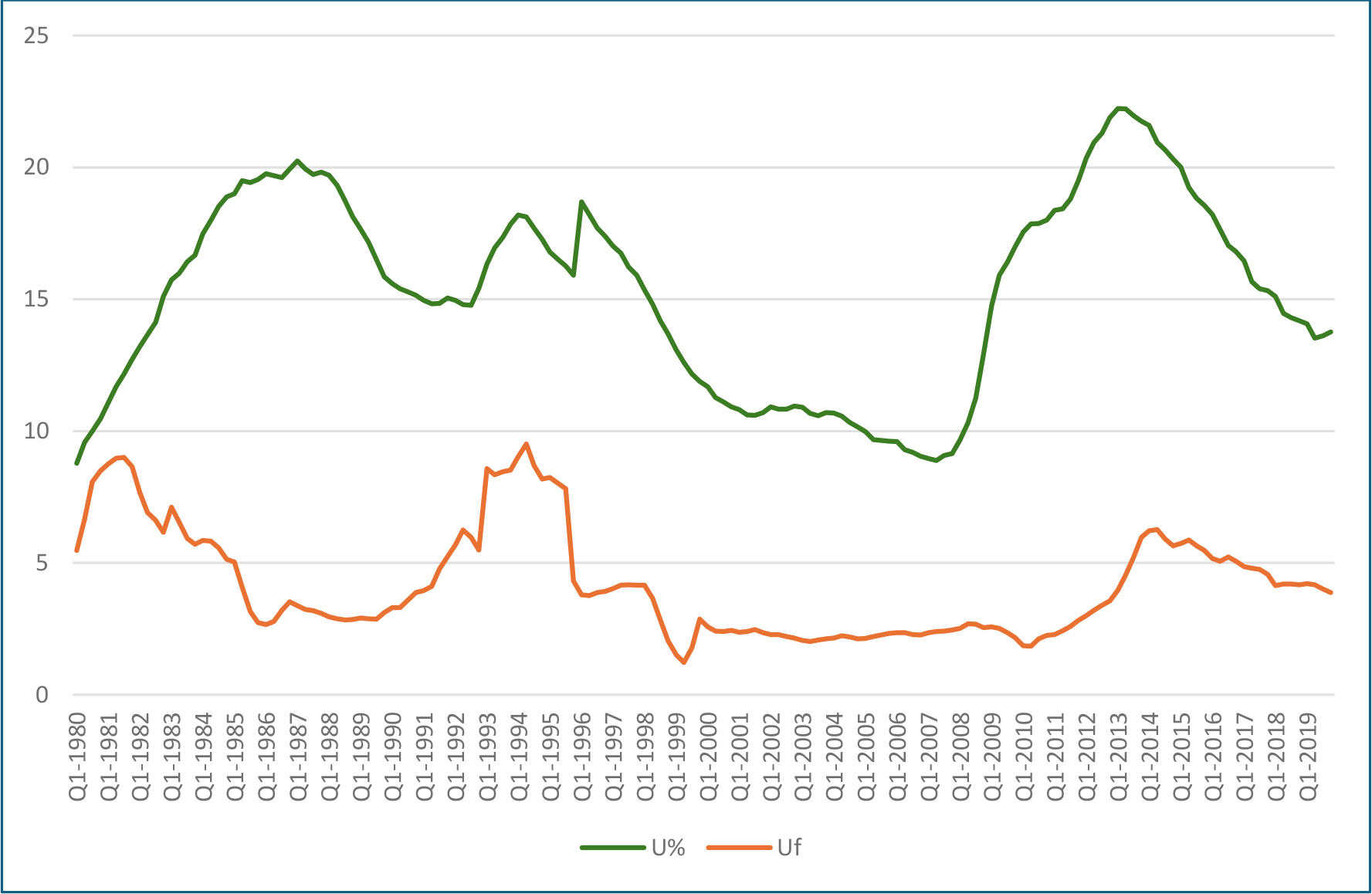
Fig. A.3.
Evolution of total (U%) and frictional (Uf%) unemployment rates.
Source: Estimated series using EPA data.
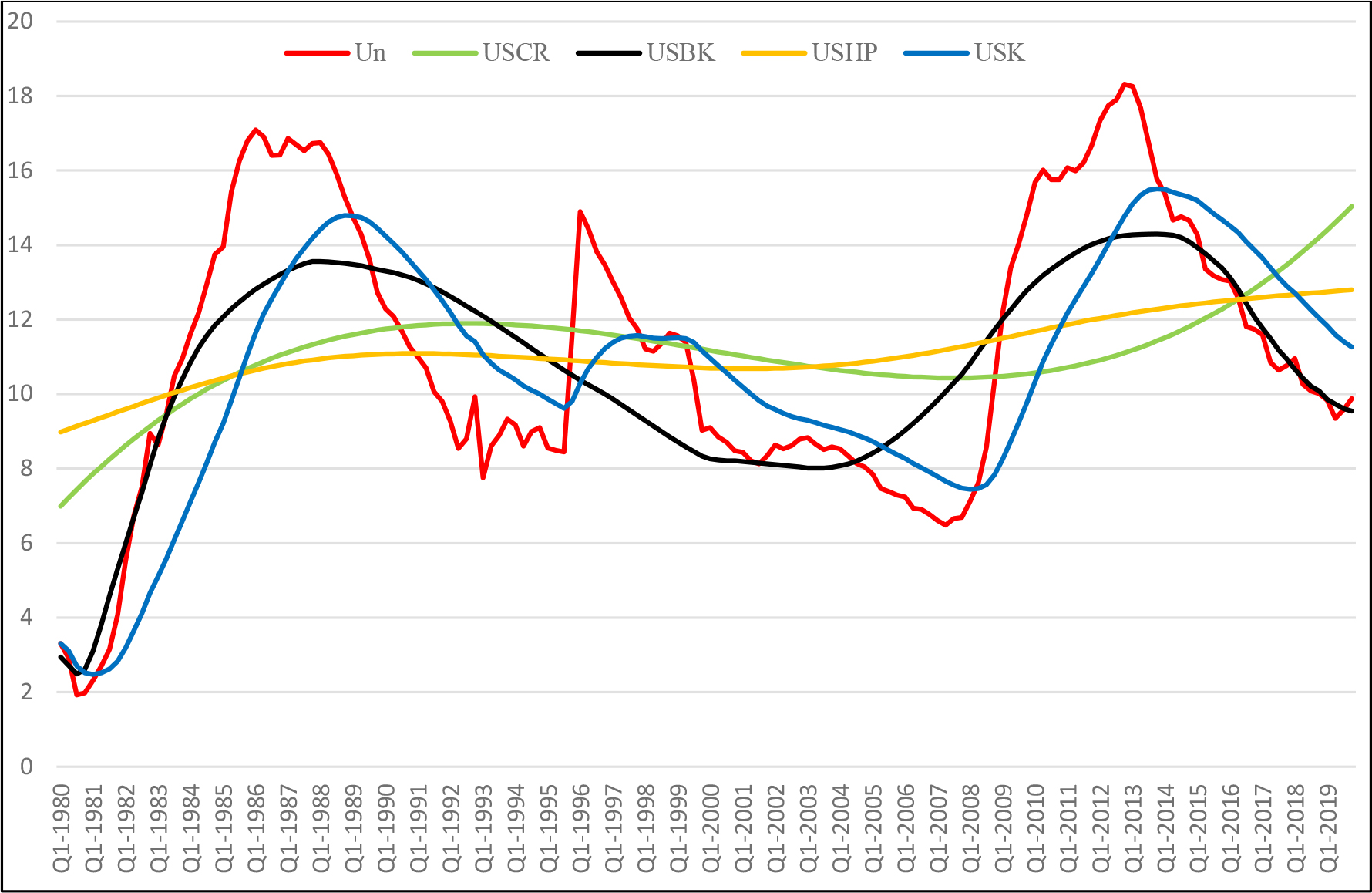
Fig. A.4.
Structural unemployment rate by each method. Comparison with the unemployment rate after subtracting the frictional component (Un). Structural unemployment rate with cubic regression (USCR), BK filter (USBK), HP filter (USHP) and Kalman filter (USK).
Source: Estimated series using EPA data.
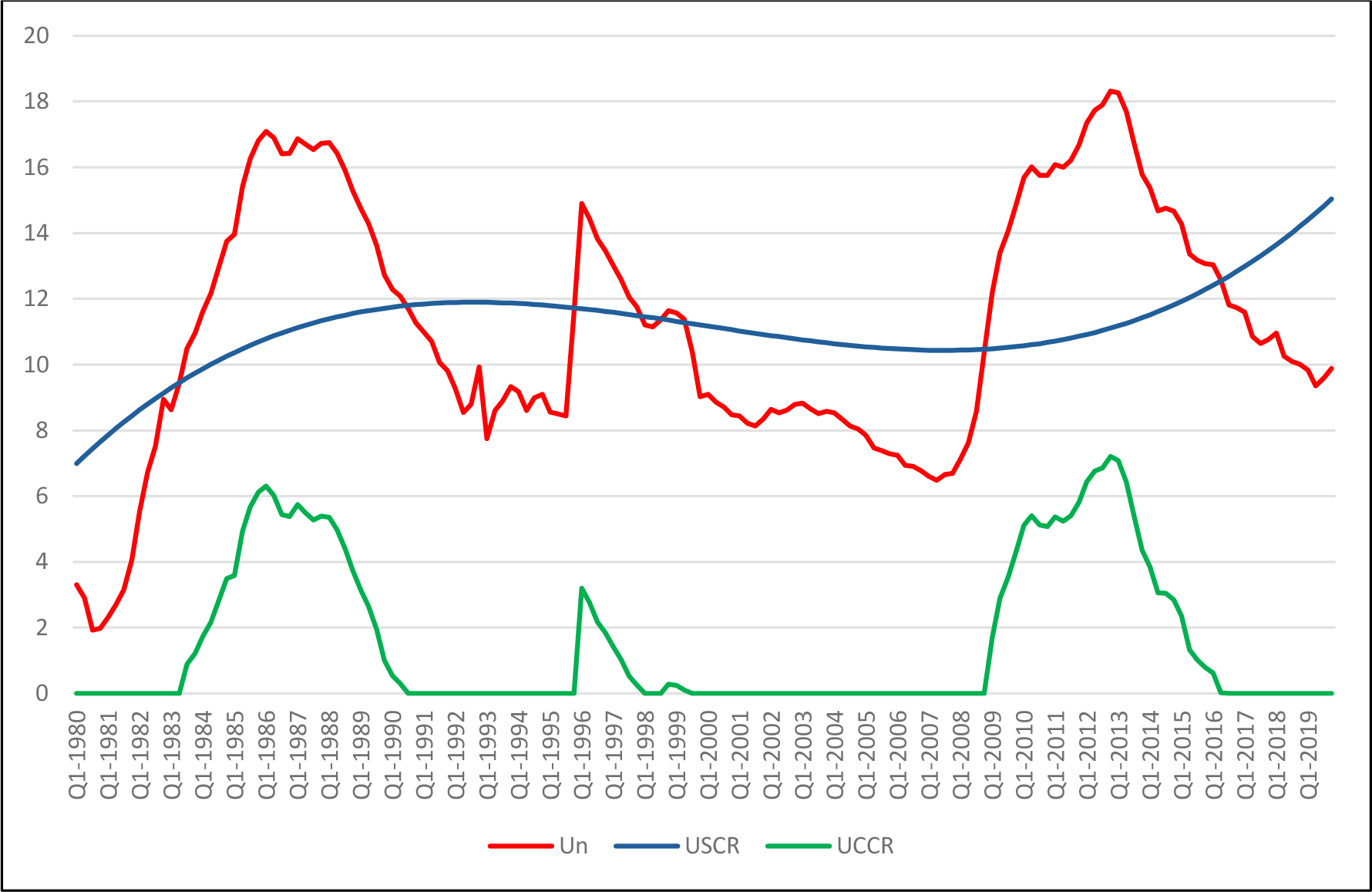
Fig. A.5.
Decomposition of Un into Structural (USCR) and cyclical (UCCR) unemployment rates as estimated with cubic regression.
Source: Estimated series using EPA data.
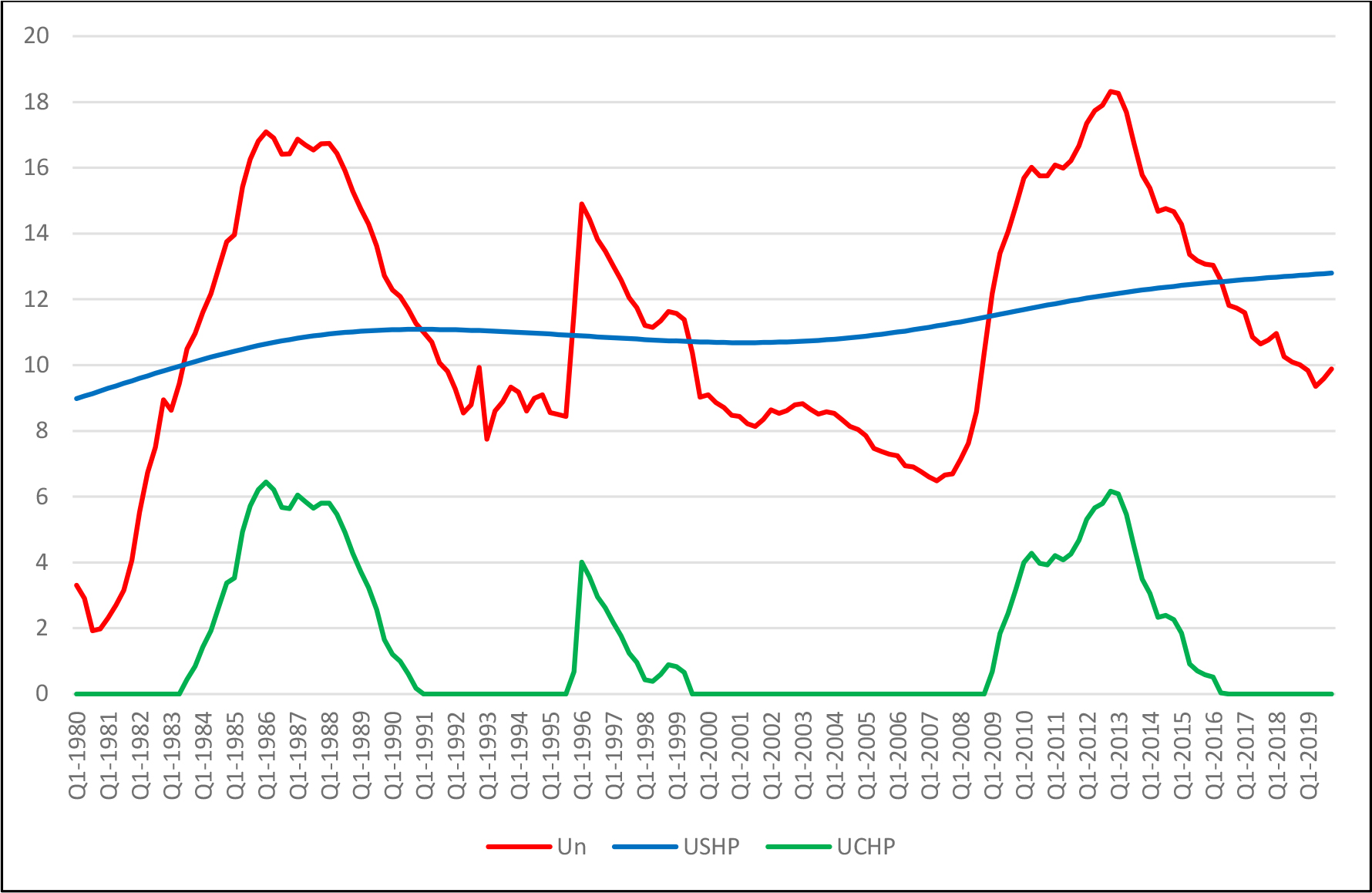
Fig. A.6.
Decomposition of Un into Structural (USHP) and cyclical (UCHP) unemployment rates as estimated with the Hodrik-Prescott filter.
Source: Estimated series using EPA data.
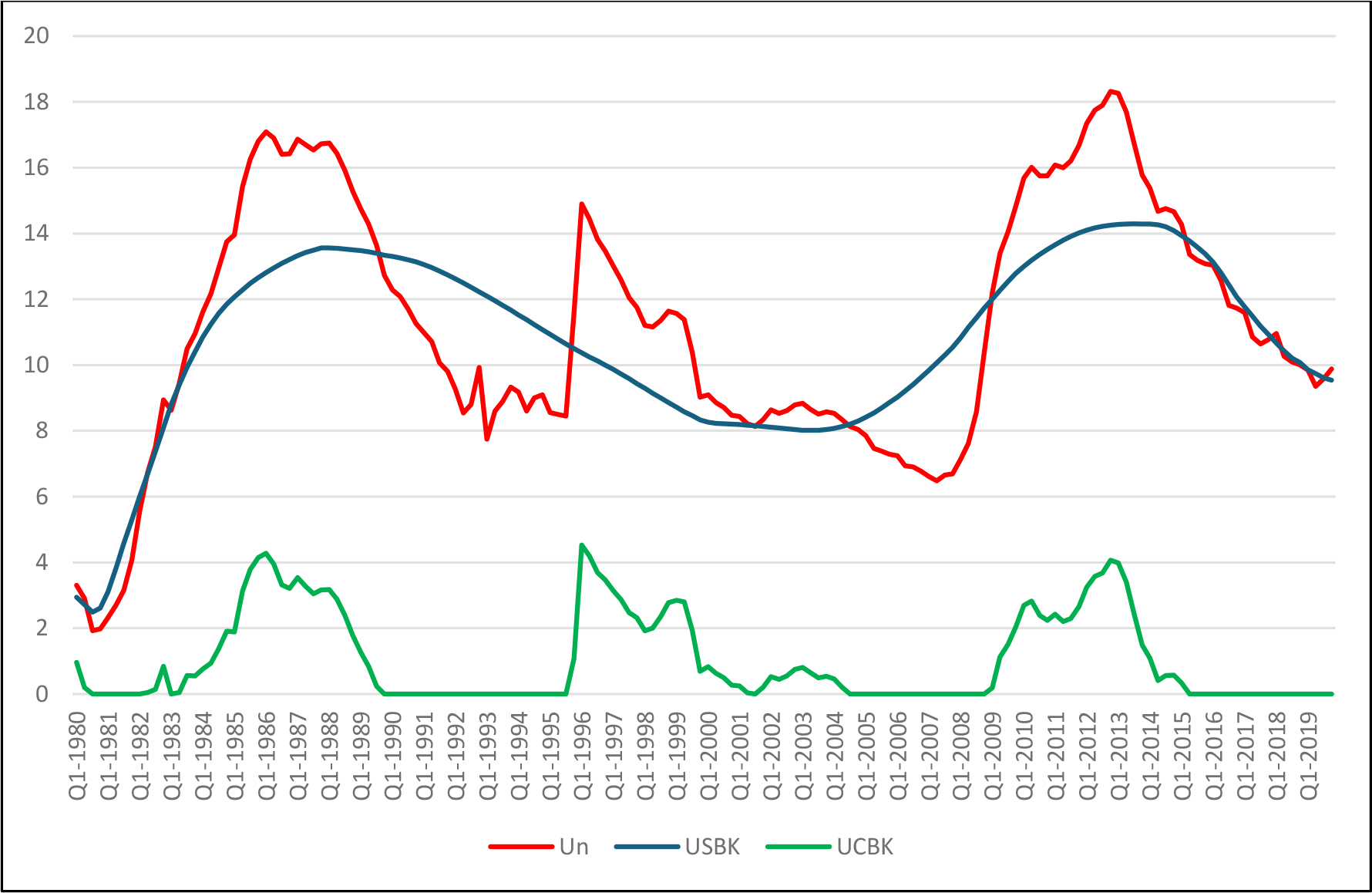
Fig. A.7.
Decomposition of Un into Structural (USBK) and cyclical (UCBK) unemployment rates as estimated with the Baxter-King filter.
Source: Estimated series using EPA data.
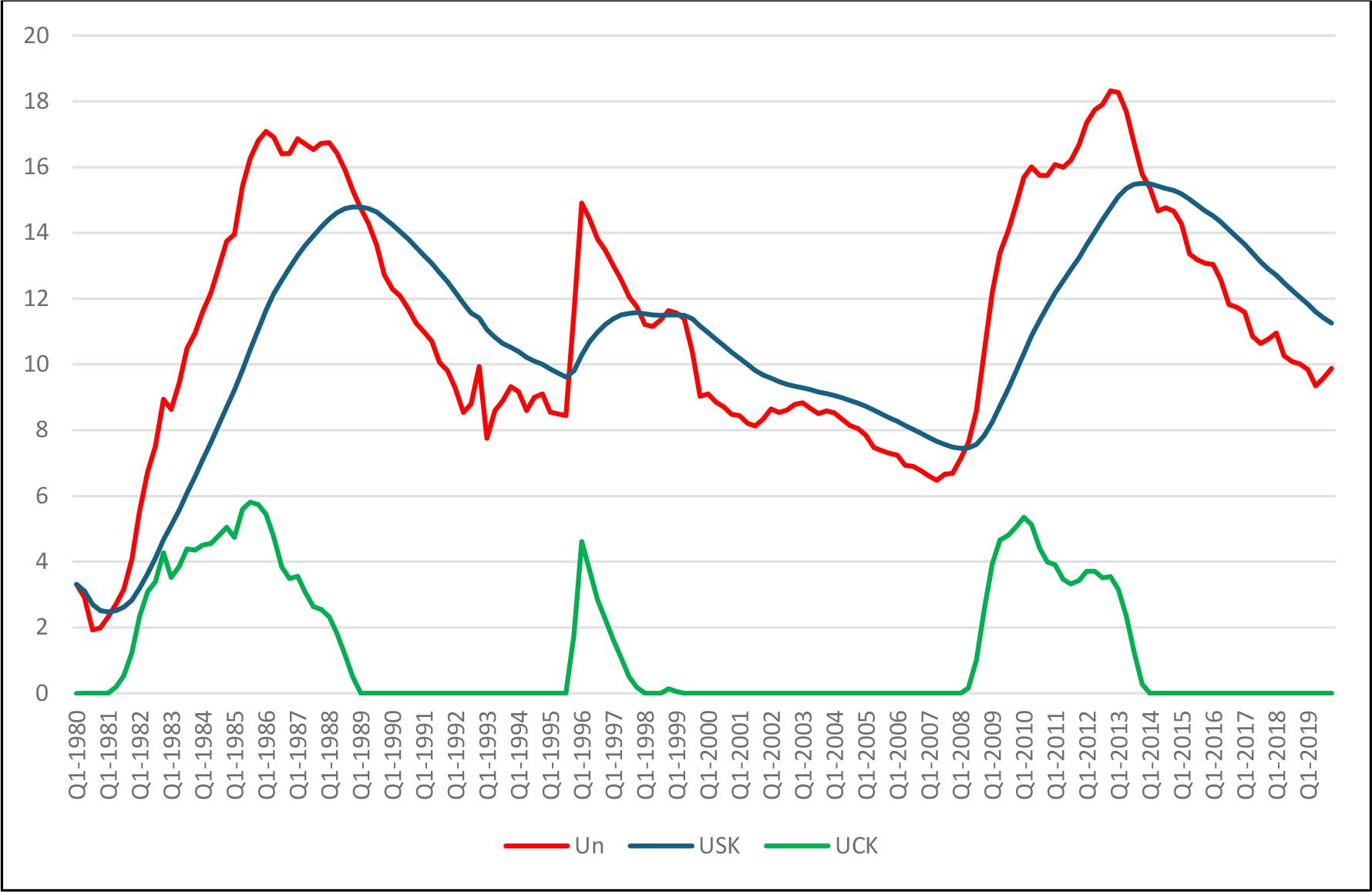
Fig. A.8.
Decomposition of Un into Structural (USK) and cyclical (UCK) unemployment rates as estimated with the Kalman filter.
Source: Estimated series using EPA data.
Appendix B. Tables
New table
Table B.1.
Vacancy data
| 1980 to 2005 | OECD, public and private sector | OECD | VactOECD |
| 2001 to 2012 | Eurostat, without public sector | EURO | VactEURO |
| 2010 onwards | Eurostat, public and private sector | EURT | VactEURT |
Table B.2.
Error components frontier results. Estimation of equation E.10.
| λ0 | 0.415 |
| λ1 | 35.235* |
| λ2 | 0.001 |
| σ2 = σω2 + σμ2 | 2.477*** |
| σ = σμ2/γ2 | 0.858*** |
| Meaning codes: 0 '*** ' 0.001 '** ' 0.01 '* ' 0.05 '. ' 0.1 | |
Table B.3.
The average rate of frictional unemployment
| 1980-1989 | 1990-1999 | 2000-2009 | 2010-2019 |
| 5.06% | 5.13% | 2.33% | 4.26% |
Table B.4.
Decomposition of the average unemployment rate with cubic regression model: total (U%), frictional (UF%), structural (USCR%) and cyclical (UC%) unemployment rates.
| Time | U% | UF% | USCR% | UCCR% |
|---|---|---|---|---|
| 1980 - 1989 | 16.49 | 5.06 | 9.98 | 2.62 |
| 1990 - 1999 | 15.80 | 5.13 | 11.69 | 0.37 |
| 2000 - 2009 | 10.90 | 2.33 | 10.66 | 0.31 |
| 2010 - 2019 | 18.12 | 4.26 | 12.20 | 2.80 |
| 1980 - 2019 | 15.33 | 4.20 | 11.13 | 1.53 |
Table B.5.
Decomposition of the average unemployment rate: total (U), frictional (UF) and structural unemployment as estimated with HP (USHP), BK (USBK), and Kalman (USK) filters; and cyclical unemployment, with HP (UCHP), BK (UCBK) and Kalman (UCK) filter
| Time | U% | UF% | USHP% | UCHP% | USBK% | UCBK% | USK% | UCK% |
|---|---|---|---|---|---|---|---|---|
| 1980 - 1989 | 16.49 | 5.06 | 10.26 | 2.75 | 10.07 | 1.54 | 8.87 | 2.68 |
| 1990 - 1999 | 15.80 | 5.13 | 10.93 | 0.67 | 10.99 | 1.13 | 11.45 | 0.47 |
| 2000 - 2009 | 10.90 | 2.33 | 10.98 | 0.20 | 9.25 | 0.32 | 8.90 | 0.55 |
| 2010 - 2019 | 18.12 | 4.26 | 12.35 | 2.26 | 12.74 | 1.21 | 13.50 | 1.36 |
| 1980 - 2019 | 15.33 | 4.20 | 11.13 | 1.47 | 10.76 | 1.05 | 10.68 | 1.27 |
Table B.6.
Correlation coefficients between estimates obtained by each method. The unemployment rate (U) and the structural unemployment rate with cubic regression (USCR), HP filter (USHP%), BK filter (USBK%) and Kalman filter (USK%).
| USCR | USHP | USBK | USK | |
|---|---|---|---|---|
| U | 0.288 | 0.377 | 0.770 | 0.626 |
| USCR | 1 | 0.792 | 0.510 | 0.731 |
| USHP | 1 | 0.642 | 0.727 | |
| USBK | 1 | 0.810 |