
1. INTRODUCTION
The value of statistical life (VSL) is familiar as a tool for monetizing benefits in applied welfare analysis of interventions that affect mortality risk, but it also has noteworthy potential to provide quantitative insight into costs and net benefits (the difference between benefits and costs) when a market is affected by this type of policy intervention. Because an especially prominent subset of the VSL literature focuses on compensating wage differentials—reflecting occupational risk— this paper highlights a VSL-derived scoping exercise for net benefits of an intervention that focuses on workplace safety.
Estimates of VSL differ for job-switchers and non-switchers, thus providing evidence of safety-relevant frictions in the labor market. Calculating the resulting gap between VSL amounts allows for quantifying the scope of potential net benefits when a policy intervention hastens achievement of a safety level that would otherwise be slowed by such frictions.
The labor market often provides the setting for not just VSL estimation but also for some particularly salient outcomes of policy interventions—job losses or gains. A further contribution of this paper is to draw connections between welfare estimates associated with these employment effects
Labor market equilibria and disequilibria are key concepts for linking the welfare effects just introduced and thus are explored next, in the paper’s Section 2. Section 3 features application of the Section 2 results to analysis of occupational safety interventions. Section 4 concludes.
2. EQUILIBRIUM AND DISEQUILIBRIM IN LABOR MARKETS
Illustration of VSL-relevant wage premia begins with Fig. 1, which consolidates Figures 9.1, 9.2 and 9.3 in Kniesner and Leeth (2014) and a key diagram in Viscusi and Aldy (2003). Worker i faces a tradeoff between higher pay and lower risk, with an iso-utility curve represented by Өiequilibrium — while employer j faces a tradeoff between higher pay and higher cost for risk-reducing workplace activities, with iso-profit curve Фj. An equilibrium wage is determined by tangency between the two curves, and VSL amounts are observed along a locus of such tangencies, W(z).
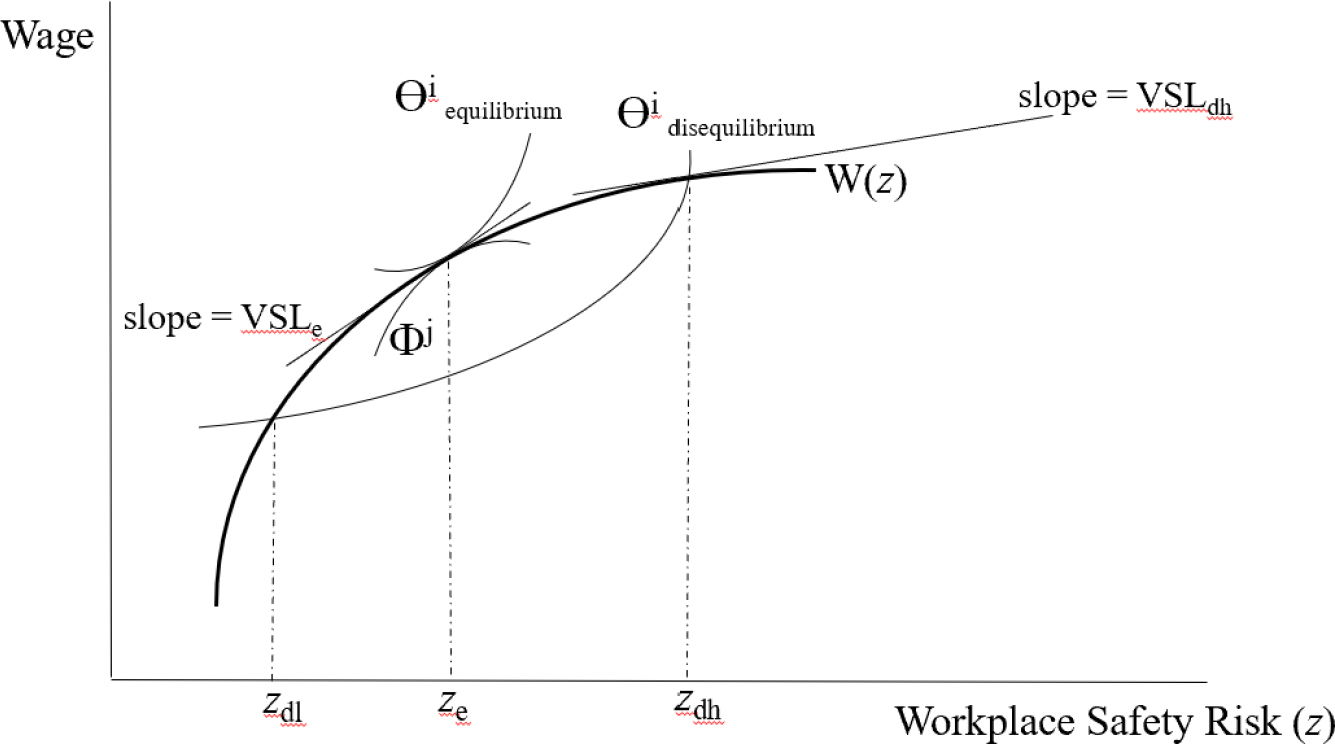
Figure 1.
Hedonic Labor Market Equilibrium and Disequilibrium
Figure 1 illustrates a potential disequilibrium outcome in which worker i accepts a wage-risk combination at an intersection of iso-utility curve Өidisequiiibrium and W(z), rather than the wage-risk combination at the tangency of more-preferred Өiequiiibrium with W(z). Various types of distortion found in labor markets may interact to yield a temporary disequilibrium. For example, risk-related information asymmetry between employers and workers may be especially noteworthy at the time a worker accepts a job, and the worker then tolerates that risk level at a suboptimal premium for some period of time—until job-specific human capital has improved bargaining position with the original employer sufficiently to allow for negotiation of a higher wage or, alternatively, until tenure has reached a length adequate for the worker to avoid a reputation for hasty job-switching that would harm hiring prospects with other potential employers. These time-decaying forms of imperfect competition are embedded in the notion of disequilibrium. (More persistent market conditions, including potential deviation from perfect competition, will be addressed later in the paper.)
With there being two intersections of W(z) and Өidisequilibrium, it becomes an empirical question as to which set of conditions tends to hold outside of equilibrium—high risk, high wage and (given the flattening of the slope of W(z) as risk and wages rise) low VSL, or the reverse. Another empirical possibility is for frictions in the labor market to be insufficient for either of these disequilibrium outcomes to be observed. This possibility is not, however, borne out by labor literature. Manning’s (2011) review indicates that frictionlessness merits skepticism across a variety of countries and occupations, and Kerndler (2023) and Liu et al. (2024) find, using data from the United States, that labor-market friction contributes to workplace risk.
Moreover, research on compensating wage differentials shows safety-related wage premiums manifesting themselves more extensively over time. Herzog and Schlottmann (1990) estimate higher values of statistical life when VSL is derived from job-switching data than when estimated using worker earnings data.1 Similar quantitative comparisons are generated by more recent U.S. evidence and by data from Spain, as reported by Kniesner et al. (2012) and Martínez Pérez and Méndez Martínez (2009), respectively. Kniesner et al.’s VSL estimates range from $6.1 million to $10 million (in 2001 dollars2) when developed using data from individuals who switch occupations or industries. The results are substantially lower—between $4.4 million and $5.5 million—when calculated as a weighted average including workers who did or did not switch jobs during the eight-year span tracked in this study. Other Kniesner et al. specifications also indicate that longer-run evidence (with more potential for job-switching) produces higher VSL estimates than shorter-run evidence.
Although the VSL literature is large, the papers just discussed are the primary studies within that literature distinguishing between job-switchers and non-switchers, thus providing quantitative evidence on the relationship between occupational risk and frictions that might cause the labor market to be in disequilibrium for a substantial period of time—specifically, a disequilibrium characterized by risk labeled in Figure 1 as zdh. At zdh, employers are only spending VSLdisequilibrium for the marginal unit of worker i’s occupational risk reduction, even though i’s optimal risk reduction unit would be located at ze, valued at VSLequilibrium. Movement toward equilibrium would decrease, and eventually eliminate, these risk and spending differences, but quite a few years might be necessary for achieving equilibrium; Table I, below, shows that Kniesner et al.’s (2012) various specifications indicate that at least six years, and possibly up to 20 years, may be necessary for labor-market equilibrium to be reached.
Table I.
Worker Welfare Comparisons Between Equilibrium and Disequilibrium, Derived from VSL and Expressed per Statistical Fatality (2001 dollars)
| (ii) | (iii) | (iv) | (v) | (vi) | (vii) | (viii) | (ix) | ||
|---|---|---|---|---|---|---|---|---|---|
| (a) | VSL for Occupation-or Industry-Switchers a | $6.1 million | $7 million | $8.8 million | $10 million | ||||
| (b) | Switcher and Non-Switcher Weighted Average VSL b | $4.4 million | $5.1 million | $4.8 million | $5.5 million | ||||
| (c) | Short-Run VSL c | $5.8 M | $6.6 M | $8.2 M | $8.6 M | $6.7 M | $7.6 M | $9.5 M | $9.8 M |
| (d) | Long-Run VSL c | $6.2 M | $7.6 M | $9.2 M | $10.4 M | $7.2 M | $8.7 M | $10.5 M | $12 M |
| (e) | In Year 0, Disequilibrium-vs-Equilibrium Worker Welfare Harm (per Statistical Fatality): (f) + [(d)-(c)] | $2.5 M | $3.7 M | $3.9M | $5.5 M | $5.0 M | $6.2 M | $6.5 M | $8.9 M |
| (f) | In Year 2: (g) + [(d)-(c)] | $2.1 M | $2.7 M | $2.9 M | $3.7 M | $4.5 M | $5.1 M | $5.5 M | $6.7 M |
| (g) | In Year 4: (a) – (b) | $1.7 M | $1.7 M | $1.9 M | $1.9 M | $4.0 M | $4.0 M | $4.5 M | $4.5 M |
| (h) | In Year 6: (g) – [(d)-(c)] | $1.3 M | $0.7 M | $0.9 M | $0.1 M | $3.5 M | $2.9 M | $3.5 M | $2.3 M |
| (i) | In Year 8: (h) – [(d)-(c)] | $0.9 M | FWI | FWI | FWI | $3.0 M | $1.8 M | $2.5 M | $0.1 M |
| (j) | In Year 10: (i) – [(d)-(c)] | $0.5 M | $2.5 M | $0.7 M | $1.5 M | FWI | |||
| (k) | In Year 12: (j) – [(d)-(c)] | $0.1 M | $2.0 M | FWI | $0.5 M | ||||
| (l) | In Year 14: (k) – [(d)-(c)] | FWI | $1.5 M | FWI | |||||
| (m) | In Year 16: (l) – [(d)-(c)] | $1.0 M | |||||||
| (n) | In Year 18: (m) – [(d)-(c)] | $0.5 M | |||||||
| (o) | In Year 20: (n) – [(d)-(c)] | FWI | |||||||
1a Source: Kniesner et al. (2012) Table 4 (various exploratory specifications).
1b Source: Author calculations using Kniesner et al. (2012) Table 4.
1c Source: Kniesner et al. (2012) Table 6.
Table II reports the present values of the per-fatality flows in Table I’s rows (e) through (o), assuming ze equals 6.415 annual fatalities per 100,000 workers (as reported by Kniesner et al. for their data set). In order to check the plausibility of these results within the context of related literature, I compare with estimates from Kuminoff et al. (2015).3 This paper also quantifies labor-market frictions, but it takes a very different approach—highlighting spatial characteristics of housing and labor market interactions, including housing prices, commute times, and air and school quality, and exploring how the business cycle affects duration of unemployment. (Unemployment-focused estimates are relevant comparators for the VSL-derived results because a worker could avoid occupational risk by leaving the labor force until an optimally safe job becomes available.) Additional differences between the demographics and time period featured in the two papers’ data sets include:
Kuminoff et al. (2015): San Francisco and Sacramento region, California, 2002-2012, household primary earners, ages 16 and above.
Kniesner et al. (2012): U.S., 1993-2001, male heads of household, ages 18-65.
Table II.
Employment-Related Welfare Effects
| (ii) | (iii) | (iv) | (v) | (vi) | (vii) | (viii) | (ix) | |
|---|---|---|---|---|---|---|---|---|
| Friction cost of job risk (could be avoided with voluntary unemployment), derived from Table I, * | $830 | $850 | $930 | $1,120 | $2,270 | $1,940 | $2,290 | $2,240 |
| Friction cost of job loss, per Kuminoff et al.’s (2015) Table 1, panel C | Expansion | Normal Conditions | Recession | |||||
| Rehired at identical job after temporary layoff | $1,230 | $1,620 | $2,490 | |||||
| Layoff leads to worker moving house | $7,000 | $7,300 | $7,950 | |||||
1* Other inputs: fatality risk of 6.415 × 10⁻⁵ (per Kniesner et al., 2012); 7% discount rate (for comparability with Kuminoff et al., 2015); linear interpolation between rows (e) and (f), (f) and (g), etc., of Table I. Non-fatal short-term risks and occupational exposure to fatal and non-fatal long-term health hazards introduce uncertainty into the estimates; the probable consequence, especially for the leftmost columns, is a tendency toward underestimation.
Despite the differences in methods and data between Kuminoff et al.’s estimates and the other estimates listed in Table II (those using the results from Kniesner et al., via Table I), they are largely consistent. Kuminoff et al.’s highest estimates—which are the largest in Table II— reflect situations in which laid-off workers’ optimal employment-housing combination involves a housing move. The estimates derived from Table I are lower, which is to be expected because they do not distinguish between job-switches that do and do not involve residential relocation.
Because Kniesner et al. do not control for non-fatal risks, the Table II application of their results may embed, at least approximately, both fatal and non-fatal risks.4 However, as noted previously, Kniesner et al.’s VSL estimates are within the central part of meta-analysis-derived ranges; as a result, the lack of separate addition of non-fatal risks into the calculations underlying Table II may yield underestimation, especially when using the lower Kniesner et al. VSL estimates as inputs. This possibility seems to be borne out in columns (ii) through (v) of Table I, which report estimates below Kuminoff et al.’s lower bounds (the welfare loss to workers of temporary layoffs after which they are hired at identical jobs). By contrast, the use of higher VSL estimates from Kniesner et al.—perhaps roughly offsetting the general tendency toward underestimation—yields estimates of $1,940 to $2,270, well within Kuminoff et al.’s range from $1,200 to just below $8,000.
3. BOUNDING COSTS AND NET BENEFITS OF OCCUPATIONAL SAFETY INTERVENTIONS
The enveloping of the various iso-profit curves by W(z), as illustrated in Figure 1, indicates that VSL is a lower bound on the tradeoff for an individual firm between wages and the cost of safety-improving practices. This bounding is relevant to the analysis of a mortality-related government intervention that operates through the labor market—for instance, the issuance of a regulation requiring employers to perform actions that reduce the risk of fatal injury or illness for their employees. In a labor market modeled as frictionlessly achieving equilibrium, the same VSL would be used for benefits monetization (that is, for multiplying by the estimate of avoided statistical fatalities among workers with iso-utility curve Өiequiiibrium5) and for calculating the lower bound on per-worker cost (specifically, cost per worker characterized by Өiequilibrium) of achieving the risk reduction.6 The result would be non-positive net benefits.7 Worker pay would instantaneously decrease along with safety increasing, and the full value of the intervention would accrue to employers as reduced wage payments.
These conclusions are oversimplified in the presence of frictions. An occupational safety intervention that limits risk to a level between zdl and zdh could be welfare-improving from the perspective of worker i. More specifically, when considering the range of potential interventions that are small in scope—such that W(z) does not meaningfully change8—the optimal regulation limits risk to ze. A limit between ze and zdh is welfare-improving for worker i in the short run, while having no effect in the longer-run (due to its non-binding level, relative to ze), and a limit between zdl and ze is welfare-improving in the short run but welfare-reducing once the time period is reached in which worker i would otherwise experience ze. The lack of change of W(z) leaves employers, and workers dissimilar to i, indifferent to the intervention.
Hence, the estimates in Table I have an additional meaning, related to but beyond what was presented in Section 2; rows (e) through (o) indicate an approximate extent of the mortality-related labor-market distortion that a government intervention could address, and thus are upper bounds on the flows of its net benefits per avoided occupational fatality.9 Regarding their nature as upper bounds, I note that if the intervention is not optimally calibrated, with risk limited to ze, then less than all of the potential benefits will be realized.
As is explored in more detail next, if estimates of occupationally-related net benefits exceed the results in Table I (on a year-specific basis or, more particularly, when summarized as a present value—and without the net benefits being derived from a more specifically tailored analysis of underlying distortions), the analysis should be subject to further checking. Possibilities worth examining include overoptimistic estimation of fatality avoidance, undercounting of risk-risk tradeoffs or difficult-to-quantify costs, and unreasonable assumptions about employers’ private discount rates.
A simple illustration may be found in Chen et al.’s (2024) assessment of a New York City requirement for safety training among construction workers; this study concludes that the benefits of the requirement exceed its costs by 42 percent. For some of the specifications in Table I, 142 percent exceeds the ratio between row (a) and row (b), thus prompting the above recommendation for additional scrutiny of the analysis. Chen et al.’s cost estimates only include registration fees for training, not the opportunity cost of time for workers being trained; correcting the omission of just this one category of cost would likely change the overall estimate from positive to negative net benefits.
HYPOTHETICAL CASE STUDY
To further explore the practical consequences of this paper’s findings, I construct a hypothetical case study that focuses on a prospective benefit-cost analysis of a jurisdiction’s contemplated new exemption to at-will employment, applicable when a worker reports a violation of that jurisdiction’s occupational safety rules or files for worker compensation. Whereas an employer would typically have the right to terminate employment, doing so would not be permissible as retaliation for such worker reporting or filing—if the exemption is adopted.
The hypothetical jurisdiction considers itself sufficiently similar to U.S. states with public-policy exemptions to at-will employment that, for analytic purposes, it extrapolates from Johnson et al.’s (2022) empirical study of the effect of such an exemption on workplace injuries. In addition to primarily estimating an approximately 13-percent reduction, Johnson et al.’s confidence intervals indicate that an upper bound on such effects could be two or three times the lower bound, and the jurisdiction inclines toward presenting its benefit-cost analysis accordingly10 When applied to the jurisdiction’s baseline workplace fatalities, the Johnson et al. estimates yield a primary estimate of ten avoided fatalities per year, and a surrounding uncertainty range of between five and fifteen.11
Table I implies that per-fatality employer wage savings may be estimated for a particular point in time by subtracting a year-specific estimate, found in row (e) through row (o), from the analogous column’s row (a). Applying, for example, the rightmost column of Table I to ten fatalities yields an estimate that employers would experience $11 million in wage savings in the first year after regulatory implementation, rising linearly until the savings reach the full benefit of $100 million by the tenth post-implementation year and continuing at that level annually thereafter. Over ten years, employers are estimated to save $0.59 billion in (undiscounted) wage payments. As a simple starter comparison, costs incurred by employers—as they improve safety practices in response to the incentives generated by a new exemption from at-will employment— should be estimated to be at least this amount.
Because wage savings rise over time but costs are reasonably likely to start high and then decline, more nuance can be added to this type of comparison by accounting for employers’ time value of money. Suppose that the hypothetical jurisdiction has preliminarily estimated upfront costs to affected employers of $80 million and ongoing annual costs of $40 million. Using these inputs, I calculate threshold discount rates (for employers’ private decision-making) above which it would not be profit-maximizing for these entities to revise safety practices voluntarily. With a ten-year time horizon, the threshold discount rates, when applying the eight specifications of Table I to ten fatalities, range from 3.6% to 25%; with a twenty-year time horizon, they range from 14% to 32%. This increase of the threshold rates in response to extension of the time horizon conforms with intuition, as does the pattern of threshold rates generally rising along with increases in the VSL used (across the VSL range set forth in Table I). With the lowest rate results being at or below the interest rates a U.S. employer is likely to face in financial markets, that end of the range is consistent with employer cost-minimization; in other words, setting forth this combination of cost estimates, estimates of avoided fatalities, and low-end inputs from Table I, the hypothetical jurisdiction does not imply that employers are forgoing cost savings in the absence of the jurisdiction’s potential new intervention.12 Toward the higher end of the Table I range, the plausibility of the threshold discount rates (as parameters for employers’ internal decision-making) is more ambiguous.
Next, I consider the uncertainty range, from 5 to 15, around the primary estimate of 10 annual avoided fatalities. Results of a search for threshold discount rates are as follows:
Annual avoidance of 15 fatalities. For seven of the eight specifications listed in Table I, the threshold discount rates for employers’ internal decision-making would need to be between 37% and 99%. (For the other one, it would need to be even higher and thus not economically interpretable.) Given how high these rates are, it appears that all eight Table I specifications indicate firms forgoing voluntary cost savings in the state of the world without the at-will employment exemption.
Annual avoidance of 5 fatalities. There is no discount rate that prevents estimated costs from exceeding employer wage savings.
Although the estimates of between 5 and 15 avoided fatalities had already represented a moderately wide range, these opposing employer-savings results offer an even starker contrast. The estimate of 5 fatalities yields a cost-and-savings comparison that is generally consistent with standard economic assumptions, whereas the estimate of 15 fatalities does not, and thus the high end of the effectiveness range would prompt more analytic effort toward upward-expanding the estimated cost range.
4. DISCUSSION
This paper brings the value of statistical life back toward its conceptual origin. Although recently it has become easy to oversimplify VSL as only a number, or range of numbers, that can readily be used as inputs to benefits analysis where mortality risk changes, the underlying notion connects observable monetary tradeoffs, opportunity cost to individuals or entities choosing (or choosing to refrain from) safety practices, and value to workers or other individuals who ultimately experience risk.
The quantitative results in this paper focus on data from the United States. A common practice in cases where country-specific VSL estimates are lacking is to use income elasticity to adjust estimates from the U.S. or other jurisdictions that are well-represented in the literature (Robinson et al., 2019; Hammitt et al., 2022). There would be value in future assessment of the validity for costs and net benefits of this type of relatively simple extrapolation that has been regularly used for benefits applications of VSL. In some cases, direct extension of this paper’s method may be possible for contexts outside the U.S., perhaps by building on the type of empirical work that Martínez Pérez and Méndez Martínez (2009) perform using Spanish data.
Much of the hedonic wage premium literature, including the cited studies that allow for VSL estimates that vary as a function of job-switching, focuses on avoidance of sudden injuries, and the preceding extrapolations are framed accordingly. It is left for further research to estimate the magnitude and timing of incomplete internalization by workers of occupational exposures that are more typically fatal after a latency period, perhaps following chronic illness. More generally, there may be valuation heterogeneity across types of risk (as explored by, among others, Cameron and DeShazo, 2013, and Singleton, 2024), thus potentially implying variability in the underlying distortions.
Another potentially promising area for future research would be exploration of friction-cost estimates to reflect policy implementation of varying lengths in time (a parameter over which policy-makers often have discretion). Intuitively, the effect on job-related welfare effects would be dampened with a longer-term implementation, as it allows for more coordination between job-switching occurring in the presence of the intervention and job-switching that would happen regardless; extension of this paper’s preliminary quantification of these differences could enrich a policy analysis.
Notes
[6] These authors interpret their findings as evidence of distortion in the labor market, and an analysis published by the U.S. Administration for Children and Families (ACF, 2021) presents the Herzog and Schlottmann extrapolation accordingly, thus serving as a precursor to this paper’s Section 3. The U.S. Occupational Safety and Health Administration (OSHA, 2024) briefly touches on related points, regarding the use of switcher and non-switcher VSL estimates.
[7] The Kniesner et al. estimates range from $9.7 million to $15.9 million when inflated to 2022 dollars, putting them within Robinson and Hammitt’s (2016) recommended range of $5.3 million to $17.1 million. Other VSL meta-analyses—such as Viscusi (2018) and Banzhaf (2022)—yield similar results. Some of Herzog and Schlottmann’s (1990) VSL estimates are substantially greater than the upper bound suggested by meta-analyses, so their results will receive less emphasis through the rest of this paper than Kniesner et al.’s.
[8] This study is part of a symposium with several papers addressing the same question, of harm to workers associated with job loss. Rogerson’s (2015) macroeconomic modeling, in which the primary specification features roughly offsetting leisure and earnings changes, yields negligible net welfare effects. By contrast, the permanence of the job losses examined by Bartik (2015) leads to high-magnitude cost estimates—possibly at least $80,000 to $100,000. Outside the symposium, notable quantification of employment-related welfare effects appears in Walker (2013).
[9] Controlling for risk of non-fatal injury can substantially affect VSL estimates and is of sufficient importance that some meta-analyses (such as Robinson and Hammitt, 2016) only include studies that incorporate such controls.
[10] VSL has been used to monetize avoided fatalities for both workers and non-workers (e.g., passengers)—sometimes in the same analysis, such as in the assessment of a U.S. Federal Aviation Administration Airport Safety Management System regulation (FAA, 2013) and in the break-even comparisons presented by Stewart and Mueller (2013). In describing the transition toward using VSL, rather than the sum of lost future earnings or other previously-preferred estimates, Viscusi (2015) highlights a regulatory analysis relating to occupational hazard communication.
[11] A very similar concept underlies Cohn and Wardlaw’s (2016) comparison between, on one hand, their estimate of the reduction in employer-firm value in response to worker injury and, on the other hand, literature-derived estimates of the value of statistical injury (analogous to VSL but estimated for all occupational injuries, most of which are non-fatal). Such a comparison is characterized by noteworthy uncertainty due to the wide variety in severity of harm across all workplace injuries.
[12] General equilibrium analysis can indicate otherwise. See, for example, some of the cases simulated by Kniesner and Leeth (1988).
[13] In some respects, this condition is restrictive; however, application of this section’s results should be grounded in the same appropriate practices as for more familiar VSL use. Hammitt and Treich (2007) and Cardoso and Dahis (2024) note the marginal nature of VSL estimates, which would give them a tendency toward overstatement of the value of non-marginal changes in mortality risk, and Hammitt (2020, p. 20) suggests a threshold risk change “on the order of 1/1000… for which the smaller rates of valuation for non-marginal risk reductions become important.”
[14] The upper bounds on an intervention’s net benefits may need reduction below what is presented in Table I if there are costs borne by parties other than employers or workers; such costs could take the form of other distortions being exacerbated by the intervention. Analogously, additional net benefits may be accrued beyond Table I’s suggested upper bounds if improved longevity is experienced by non-workers or if other distortions are successfully addressed by the intervention. (General discussion of conducting benefit-cost analysis in the presence of multiple distortions appears in Ashley, 2024.) Material in Section 2, above, draws a distinction between time-decaying and persistent forms of imperfect competition in the labor market, with the former being embedded in the disequilibrium concept that is quantified using VSL gaps, but the latter (examples include worker oligopoly due to unionization or employer oligopsony) handled separately. The interactions among labor-market competition (i.e., persistent market conditions), occupational safety, and VSL are not straightforward; for example, Cramer et al. (2025) estimate that, even as wages fall, VSL can rise as a function of employer market power.
[15] For an example of a range with similar relative proportions, please see OSHA’s (2016) discussion of ratios derived from Seong and Mendeloff (2004).
[16] To maintain simplicity of this case study, I refer only to fatalities; however, non-fatal injuries could be weighted to derive fatality-equivalents, potentially by using estimates of the value of statistical injury (VSI). Although I am unaware of any studies that estimate job-switcher and non-switcher differences in the value of reduced risk of non-fatal injury, the VSI literature generally reflects similar concepts as the VSL literature—and, to the extent feasible, follows similar practices. Examples of VSI studies include Viscusi and Gentry (2015), Gentry and Viscusi (2023), and Mridha and Khan (2023).