
Table 1.
Comparative stability of allicin under different solvent, temperature and pH conditions
| Condition category | Specific condition | Observed stability of allicin | Notes and mechanistic considerations | Representative references |
|---|---|---|---|---|
| Solvent | Water (neutral pH) | Low | Rapid hydrolysis; formation of diallyl disulphide and diallyl trisulphide; strong reactivity with thiols. | (14, 23, 33, 45) |
| Ethanol (70–95%) | Moderate–high | Reduced water activity slows decomposition; widely used for stabilisation in extracts. | (14) | |
| Oils / lipid solvents | Moderate | Lipophilic environment partially stabilises allicin but promotes conversion to oil-soluble sulphides. | (14, 55) | |
| 4°C | High | Slower decomposition; recommended for short-term storage. | (23, 24) | |
| Temperature | 20–25°C | Moderate | Gradual degradation over hours to days; temperaturesensitive thiosulphinate bond. | (14) |
| 37°C | Low | Rapid decomposition; unsuitable for long-term assays. | (14, 55) | |
| ≥50°C | Very low | Heat accelerates breakdown; explains loss of allicin upon cooking. | (14, 55) | |
| Acidic (pH < 4) | Moderate | Increased stability in acidic matrices; slower decomposition kinetics. | (14, 23) | |
| pH | Neutral (pH 6–7.5) | Low | Major instability zone; fastest conversion into alk(en)yl sulphides. | (14) |
| Mildly alkaline (pH 8–9) | Low | Base-catalysed decomposition accelerates thiosulphinate breakdown. | (14) | |
| Strongly alkaline (pH > 10) | Very low | Rapid, near-complete degradation; thiosulphinates unstable in alkaline environments. | (14) |
Table 2.
Some examples of the antimicrobial action of allicin matched to allicin source
| Species or type of bacteria | Source of allicin |
|---|---|
| Gram-positive bacteria | |
| Bacillus spp. | extracted, pure allicin synthetic allicin |
| Streptococcus spp. | extracted, pure allicin synthetic allicin |
| methicillin-sensitive Staphylococcus aureus | synthetic and garlic-derived extract |
| methicillin-resistant Staphylococcus aureus | extract derived from garlic |
| Gram-negative bacteria | |
| Salmonella spp. | extracted, pure allicin enzymatically synthesised from alline |
| Agrobacterium tumefaciens | extract derived from garlic |
| Escherichia coli | extract derived from garlic |
| Pseudomonas spp. | extract derived from garlic |
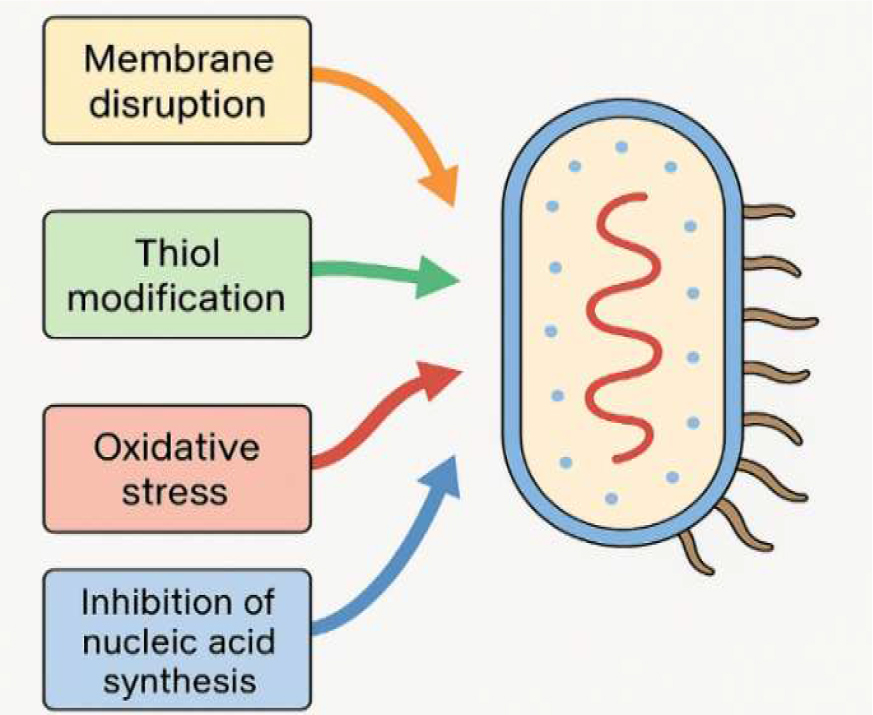
Fig. 1.
Antimicrobial mechanisms of allicin
Table 3.
Summary of the effects of allicin supplementation in poultry, ruminants and rabbits
| Species (effect category) | Observed effects | Notes and proposed mechanisms | Reference |
|---|---|---|---|
| Poultry (broilers) | ↑ Growth rate; ↑ Feed intake; ↑ Body weight gain | Stimulation of appetite; enhanced digestive enzyme secretion; improved nutrient utilisation | (19, 51) |
| Poultry (broilers – haematology) | ↓ Diarrhoea incidence; altered globulin, MCH, RBC and HDL levels | Modulation of immune response; improved metabolic homeostasis | (2) |
| Poultry (lipid metabolism) | ↓ Cholesterol; ↓ Triglycerides; improved lipid profile | Inhibition of malic enzyme, glucose-6-phosphate dehydrogenase, and fatty acid synthase | (18, 54) |
| Poultry (egg production) | ↑ Egg production; improved yolk polyunsaturated fatty acid profile; ↑ albumen quality | Antioxidant activity; improved nutrient assimilation; modulation of lipid metabolism | (20, 38) |
| Ruminants (microbiome modulation) | Changes in rumen microbial populations (↓ Prevotella spp.) | Antimicrobial action on proteolytic bacteria; influence on rumen fermentation | (13) |
| Ruminants (general productivity) | Possible improvement in feed efficiency and nutrient utilisation | Modulation of rumen microbiome linked to growth, digestibility | (10, 11, 34) |
| Ruminants (antiparasitic potential) | Activity against gastrointestinal parasites | Action of sulphur-containing compounds (including allicin) | (21, 52) |
| Rabbits (growth & carcass traits) | ↑ Body weight; ↑ Feed conversion efficiency; improved carcass characteristics | Improved gut microbiology; enhanced digestion | (39) |
| Rabbits (immune response) | ↑ Antibody titres to C. perfringens toxoid; ↑ lymphocyte activity | Immunomodulatory effect of allicin; stimulation of cytokine responses | (1) |
| Rabbits (meat quality) | Better microbial quality; improved moisture retention, tenderness | Antimicrobial properties; antioxidant effects | (42) |
| Rabbits (caecal fermentation) | ↓ Total gas and CO2; altered fermentation metabolites | Modification of microbial communities; reduced activity of fermentative bacteria | (30) |
| Rabbits (antimicrobial efficacy) | Strong inhibition of Escherichia coli strains | Activity of thiosulphonate-rich garlic compounds | (8) |