
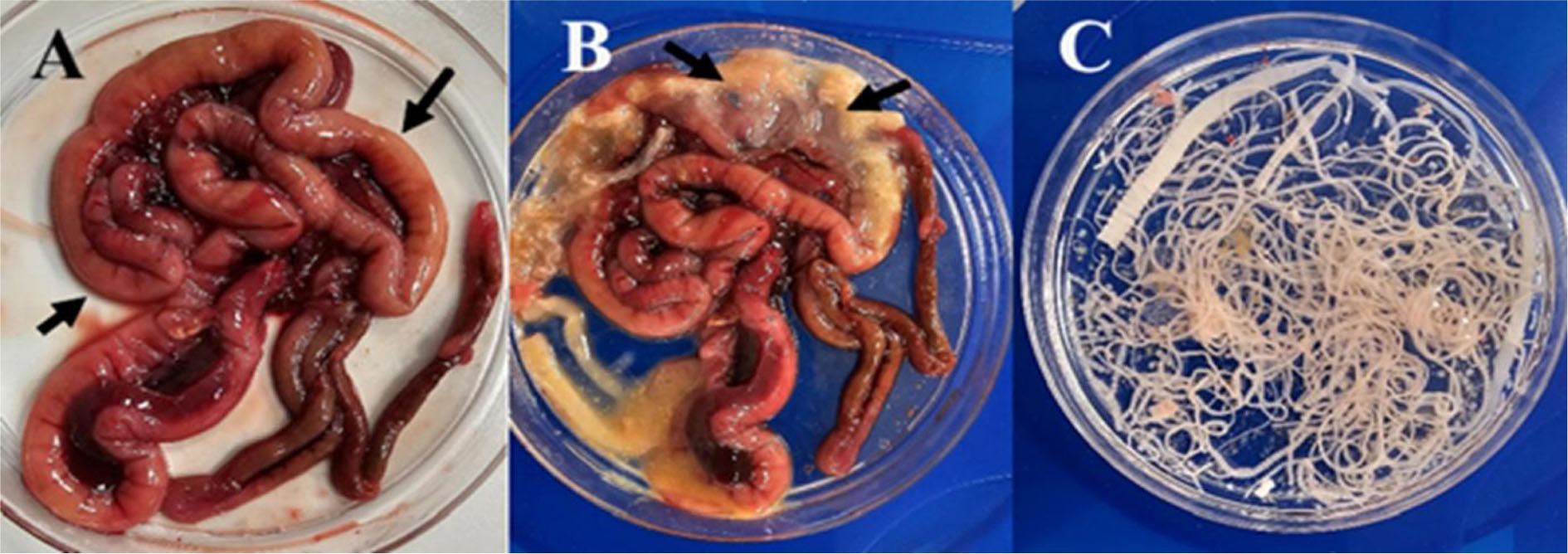
Fig. 1.
Intestinal tract from Columbia livia collected in Al Ain, UAE. A – upper intestine showing cestode infection (yellowish white); B – opened upper intestine displaying cestodes; C – cestodes recovered from a heavily infected C. livia
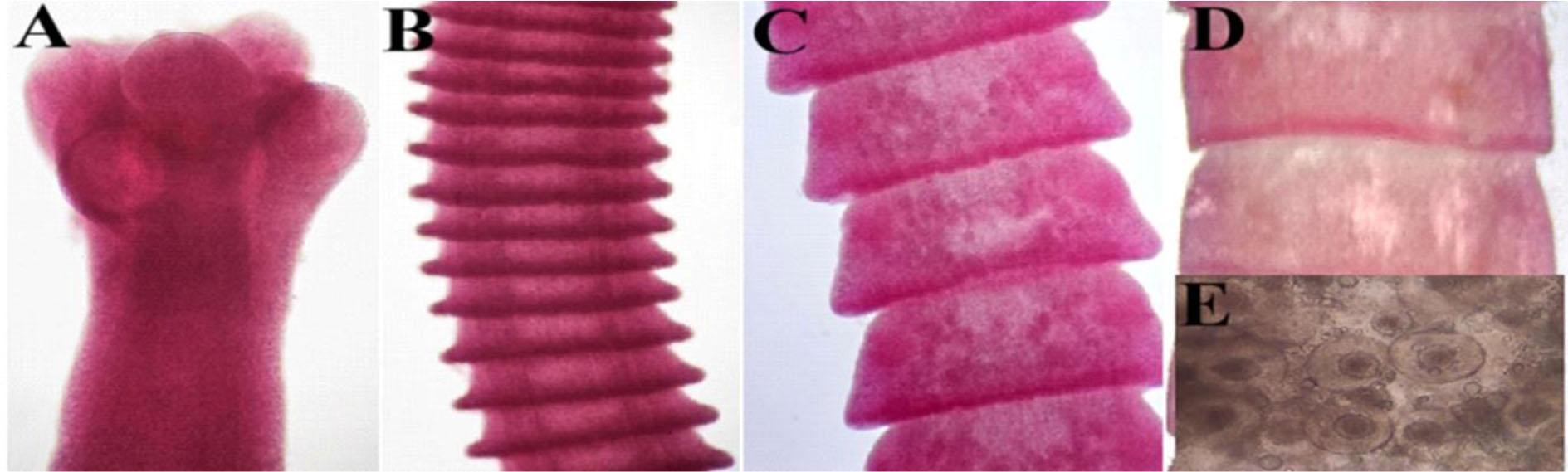
Fig. 2.
Light micrographs of Cotugnia digonopora specimens obtained from Columbia livia in Al Ain, UAE. A – scolex (100×); B – immature proglottid series (100×); C – mature proglottids (100×); D – gravid proglottids (100×); E – eggs (400×)
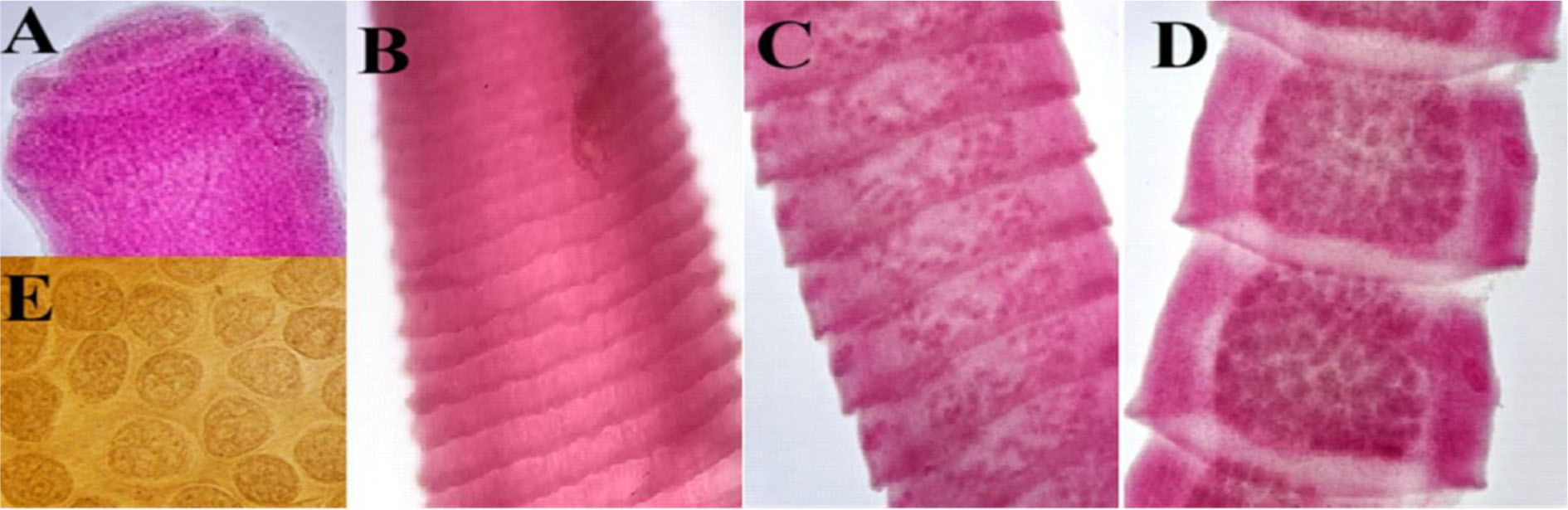
Fig. 3.
Light micrographs of Raillietina echinobothrida specimens obtained from Columbia livia in Al Ain, UAE. A – scolex (100×); B –immature proglottid series (100×); C – mature proglottids (100×); D – gravid proglottids (100×); E – eggs (400×)
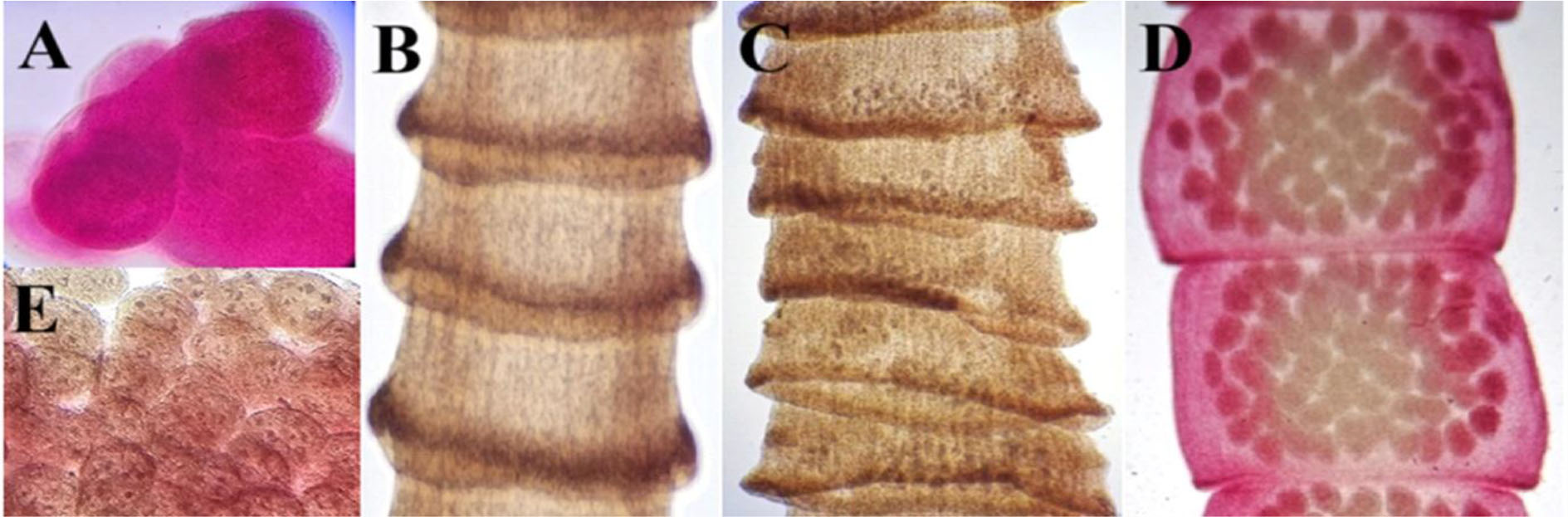
Fig. 4.
Light micrographs of Raillietina tetragona specimens obtained from Columbia livia in Al Ain, UAE. A – scolex (100×); B – immature proglottid series (100×); C – mature proglottids (100×); D – gravid proglottids (100×); E – eggs (400×)
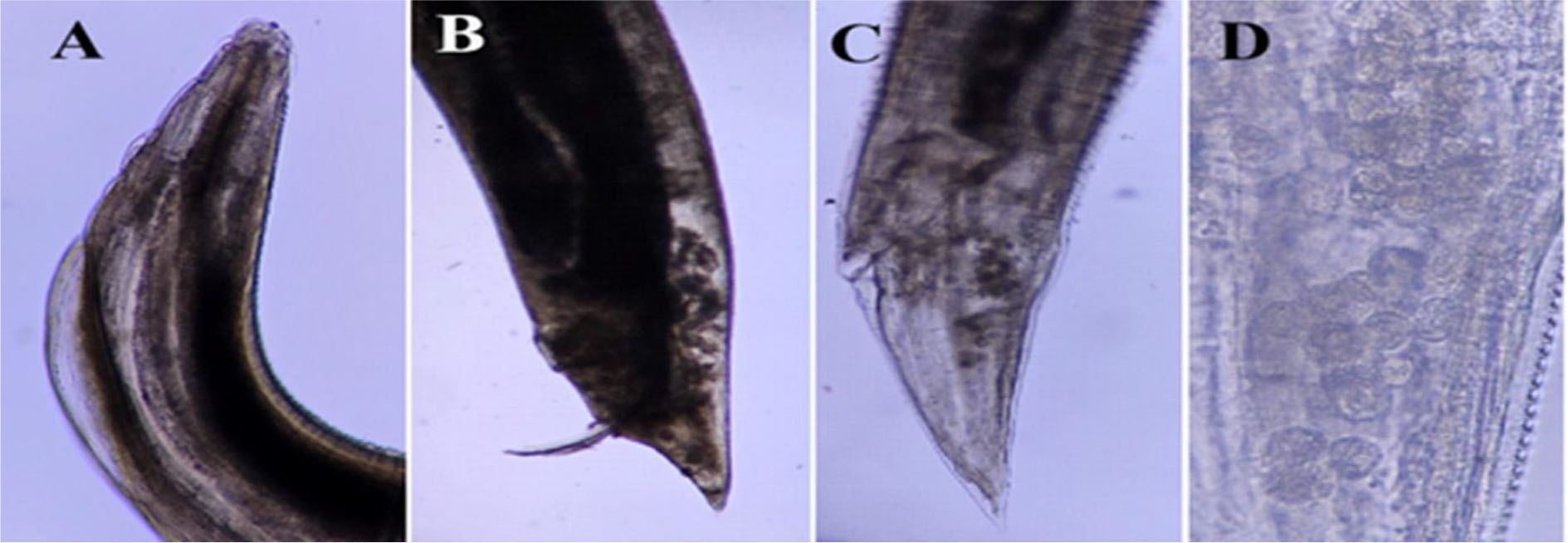
Fig. 5.
Light micrographs of Ascaridia galli specimens obtained from Columbia livia in Al Ain, UAE. A – male and female anterior end (300×); B – male posterior end (120×); C – female posterior end (300×); D – uterus containing eggs (1,200×)
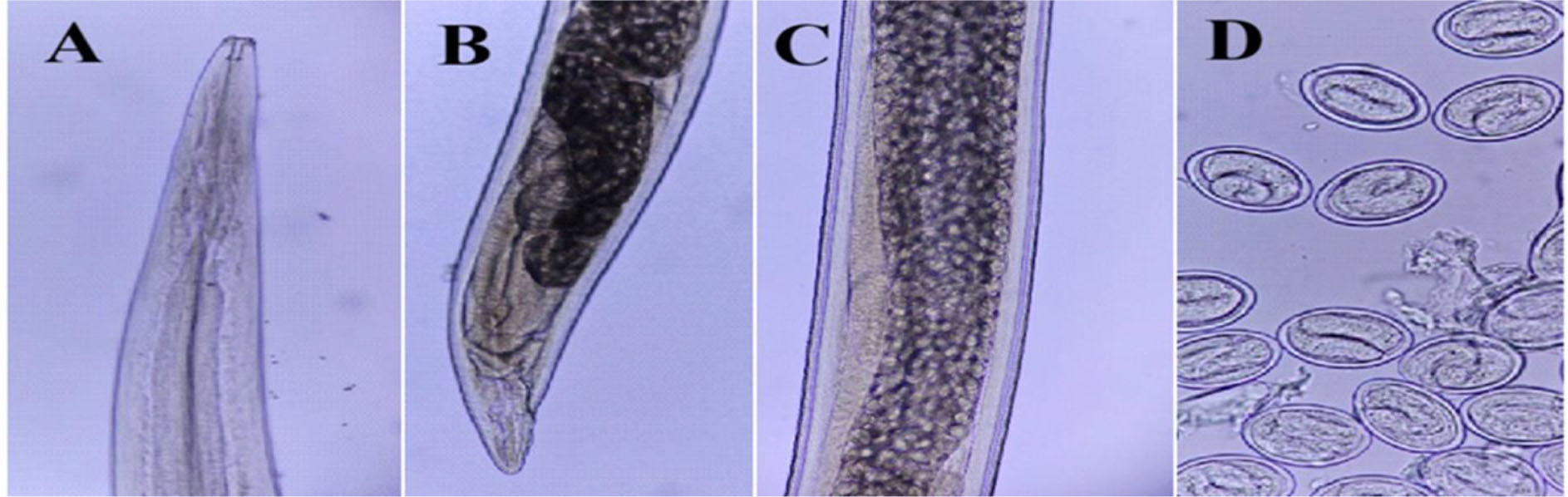
Fig. 6.
Light micrographs of Dispharagus nasutus specimens obtained from Columbia livia in Al Ain, UAE. A – male and female anterior end (300×); B – female posterior end (300×); C – uterus filled with eggs (300×); D – eggs (1,200×)
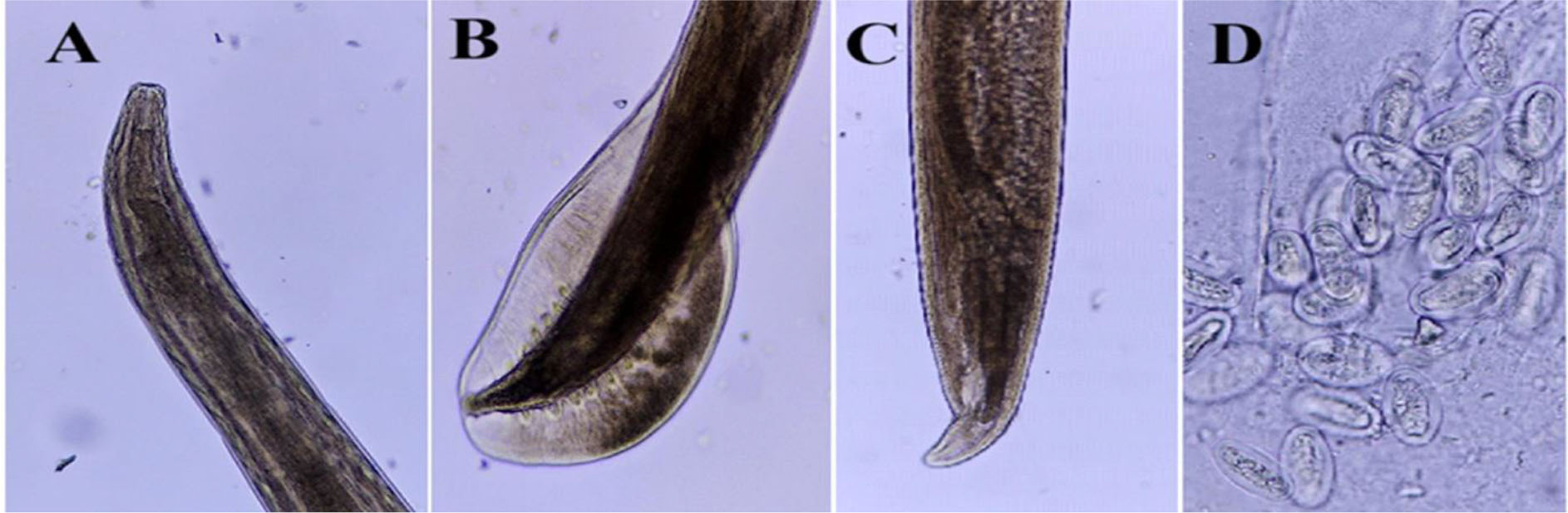
Fig. 7.
Light micrographs of Gongylonema sp. specimens obtained from Columbia livia in Al Ain, UAE. A – male and female anterior end (300×); B – male posterior end (300×); C – female posterior end (300×); D – eggs (1,200×)
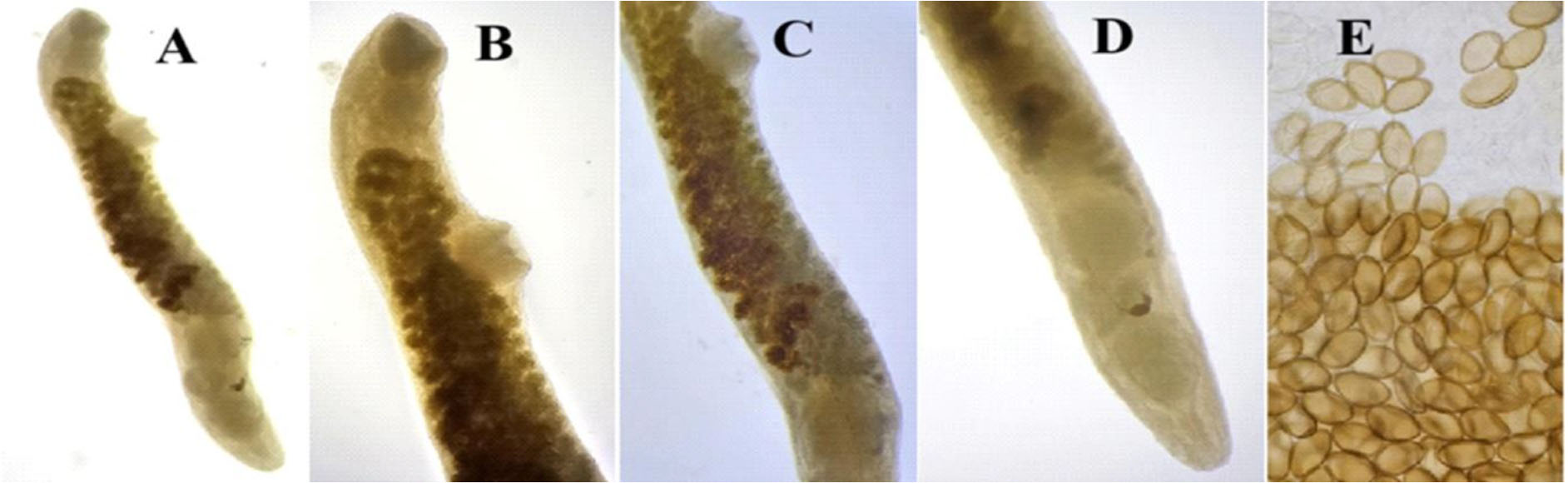
Fig. 8.
Light micrographs of Brachylaima sp. specimens obtained from Columbia livia in Al Ain, UAE. A – whole mount (40×); B – anterior body (100×); C – central body (100×); D – posterior body (100×); E – eggs (400×)
Table 1.
Helminth infection parameters and infection sites identified in pigeons (n = 100) sampled in Al Ain between August 2023 and October 2024
| Helminth species | Number of infected birds | Prevalence % | Mean intensity ± SE | Intensity range | Infection site |
|---|---|---|---|---|---|
| Cestoda | |||||
| Raillietina echinobothrida | 57 | 57 | 4.5 ± 0.5 | 1–17 | Duodenum and ileum |
| R. tetragona | 9 | 9 | 3.6 ± 0.9 | 1–10 | Duodenum and ileum |
| Cotugnia digonopora | 21 | 21 | 3.5 ± 0.4 | 1–8 | Duodenum and ileum |
| Trematoda | |||||
| Brachylaima sp. | 5 | 5 | 7.4 ± 1.7 | 3–12 | Rectum |
| Nematoda | |||||
| Ascaridia galli | 5 | 5 | 4 ± 0.6 | 2–5 | Ileum |
| Dispharagus nasutus | 1 | 1 | 4 | 4 | Gizzard |
| Gongylonema sp. | 1 | 1 | 18 | 18 | Gizzard |
| Overall | 69 | 69 | 6.4 ± 0.3 | 1–18 | |
Table 2.
Prevalence of pigeon helminth infections and comparative analysis by bird sex and lifestyle (n = 100) for sample pigeons from Al Ain between August 2023 and October 2024
| Helminth species | Prevalence (%) | |||||||
|---|---|---|---|---|---|---|---|---|
| Male (n = 56) | Female (n = 44) | χ2 | P-value | Feral (n = 50) | Domestic (n = 50) | χ2 | P-value | |
| Cestoda | ||||||||
| Raillietina echinobothrida | 58.9 | 54.5 | 9.3 | 0.8 | 84 | 30 | 15.3 | 0.3 |
| R. tetragona | 10.7 | 6.8 | 3.5 | 0.5 | 16 | 2 | 9 | 0.06 |
| Cotugnia digonopora | 28.6 | 11.4 | 6.6 | 0.4 | 28 | 14 | 11.8 | 0.08 |
| Trematoda | ||||||||
| Brachylaima sp. | 8.9 | 0 | - | - | 10 | 0 | - | - |
| Nematoda | ||||||||
| Ascaridia galli | 3.6 | 6.8 | 2.2 | 0.3 | 6 | 4 | 2.2 | 0.3 |
| Dispharagus nasutus | 0 | 2.3 | - | - | 0 | 2 | - | - |
| Gongylonema sp. | 1.8 | 0 | - | - | 2 | 0 | - | - |
| Overall | 71.4 | 65.9 | 0.4 | 0.6 | 92 | 46 | 24.7 | 0.001 |
Table 3.
Intensity of pigeon helminth infections and comparative analysis by bird sex and lifestyle (n = 100) for sample pigeons from Al Ain between August 2023 and October 2024
| Helminth species | Mean intensity ± SE | |||||||
|---|---|---|---|---|---|---|---|---|
| Male (n = 56) | Female (n = 44) | t | P-value | Feral (n = 50) | Domestic (n = 50) | t | P-value | |
| Cestoda | ||||||||
| Raillietina echinobothrida | 5.2 ± 0.8 | 3.5 ± 0.5 | 1.6 | 0.004 | 5.4 ± 0.7 | 2.1 ± 0.4 | –2.9 | 0.001 |
| R. tetragona | 4.3 ± 1.2 | 2 ± 0.6 | 1.3 | 0.2 | 3.9 ± 0.9 | 1 | –1.0 | 0.2 |
| Cotugnia digonopora | 3.4 ± 0.4 | 3.8 ± 0.9 | 0.04 | 0.6 | 4.1 ± 0.5 | 2.3 ± 0.7 | –2.3 | 0.9 |
| Trematoda | ||||||||
| Brachylaima sp. | 7.4 ± 1.7 | - | - | - | 7.4 ± 1.7 | - | - | - |
| Nematoda | ||||||||
| Ascaridia galli | 4 ± 1 | 4 ± 1 | 0 | 0.5 | 4.3 ± 0.7 | 3.5 ± 1.5 | -0.5 | 0.12 |
| Dispharagus nasutus | 0 | 4 | - | - | 0 | 4 | - | - |
| Gongylonema sp. | 18 | 0 | - | - | 18 | 0 | - | - |
| Overall | 5.1 ± 0.8 | 3.5 ± 0.4 | 2.1 | 0.02 | 2.7 ± 0.3 | 2.3 ± 0.3 | –1.2 | 0.12 |