
Introduction
Pigeons (Aves: Columbidae) are globally distributed birds closely associated with urban environments (22). Certain species have been domesticated and utilised for food, ornamental purposes, entertainment, and more recently, as laboratory models (10, 37). However, most pigeons live free, constructing nests on buildings (particularly under eaves), in public parks, woodlands and rocky outcrops (16). Their prolific droppings soil many man-made structures, leading to aesthetic degradation, structural damage and material deterioration (19). Additionally, pigeons are recognised as agricultural pests, causing significant crop damage to grains and seeds (22).
This species is susceptible to diverse pathogen infections, including protozoans (e.g. Trichomonas gallinae, Eimeria columbae, Toxoplasma gondii and Cryptosporidium spp.), nematodes (e.g. Capillaria spp., Syngamus spp., Ascaridia spp. and Hadjelia truncata), platyhelminths (e.g. Raillietina spp., Hymenolepis spp. and Echinostoma spp.) and ectoparasites such as ticks, mites and lice (2, 27, 32). The epidemiology of these parasites is shaped by host-related factors (e.g. age, sex and foraging behaviour) and parasite traits such as environmental resilience and transmission dynamics (44). Investigating the risk factors and their association with parasite prevalence is essential for designing targeted prevention and control measures.
Pigeons’ capacity for long-distance flight and frequent interactions with diverse avian populations elevate their potential to transmit parasites across species barriers, posing risks to both wildlife and humans (20, 35). Such parasite transmission threatens poultry and economically valuable avian species, often resulting in weakened immunity, impaired development, reduced body condition and declining health (11). In severe cases, infestations can escalate to fatal outcomes if left untreated (47).
Columba livia, known as the common pigeon, is the predominant free-living avian species across the United Arab Emirates (UAE), thriving in urban habitats such as public parks, commercial markets and mosque courtyards. Listed as Least Concern (LC) on the IUCN Red List (21), this species sustains robust populations in the city of Al Ain, where substantial feral flocks persist without human management. Despite their ecological prominence, parasitic infections in these birds remain understudied. This study addresses this knowledge gap by assessing the prevalence and infection intensity of helminth parasites across wild and domestic pigeon populations.
Material and Methods
Study area
Al Ain, the second-largest city in the Abu Dhabi Emirate, UAE (24°12′27″N, 55°44′4l″E), has an estimated population of 666,000 residents. Located approximately 160 km east of Abu Dhabi and 120 km south of Dubai, the city experiences a hot desert climate characterised by extremely high summer temperatures, mild winters and an average annual rainfall of 96 mm, with relative humidity averages around 60%.
Sampling and parasite identification
Between August 2023 and October 2024, a total of 100 pigeons (C. livia) were collected, comprising 50 domestic and 50 feral individuals. Domestic birds were sourced from Al Ain’s local pet market, while feral pigeons were captured using traps placed across public squares, parks and market areas. All specimens were transported in ventilated boxes to the laboratory at the Department of Biology, UAE University, where they were humanely euthanised using diethyl ether.
During necropsy, birds were clinically assessed, sexed and dissected. Internal organs (the oesophagus, crop, proventriculus, gizzard, duodenum, ileum, rectum, pancreas, liver, lungs and heart) were excised, placed in Petri dishes containing 0.9% saline for 10 min and examined under a stereomicroscope. Detected parasites (cestodes, trematodes and nematodes) were isolated using fine forceps or Pasteur pipettes, counted and preserved in 70% ethanol containing 5% glycerin.
Cestodes and trematodes were stained with acetocarmine, dehydrated in a graded ethanol series (70%–100%), cleared in xylol-methyl salicylate and permanently mounted on slides. Nematodes were examined as temporary wet mounts. Identification to genus or species level was carried out under a light microscope using standard taxonomic keys (5, 25, 45). Photomicrographs were taken using a Samsung SM-S918B/DS camera (Seoul, South Korea) adapted to an Olympus CX33 light microscope (Tokyo, Japan).
Ethical considerations
Sampling was conducted under the supervision of Barari Natural Resources, Environment Agency–Abu Dhabi, UAE (Scientific research no-objection certificate No. 200100118). All animal handling procedures adhered to the guidelines of the Ethics Committee on Animal Use, UAE University (approval code: ERA_2024_5106).
Data analysis
Data were analysed using SPSS 29.0 (IBM, Armonk, NY, USA). Infection prevalence (P) and mean intensity (MI) were calculated as P = n/Z × 100 and MI = N/n, where n = infected birds, Z = total birds examined and N = total parasites (9). Prevalence differences were assessed via chi-squared tests, and intensity variations were analysed using paired t-tests. Significance was set at P-value < 0.05.
Results
Prevalence, intensity and diversity of infection
Of the 100 adult pigeons (C. livia) examined (56 males and 44 females), 69 were infected with at least one helminth species, with a mean infection intensity of 6.4 parasites per bird. Clinical symptoms observed in infected individuals included weight loss, diarrhoea and intestinal wall inflammation. Seven helminth species were identified in the internal organs: three cestodes (Raillietina echinobothrida, R. tetragona and Cotugnia digonopora (Figs 1–4), three nematodes (Ascaridia galli, Dispharagus nasutus and Gongylonema sp. (Figs 5–7) and one trematode (Brachylaima sp. (Fig. 8). The cestode R. echinobothrida was the most prevalent species, followed by C. digonopora, while the nematodes D. nasutus and Gongylonema sp. were the least common (Table 1). However, Gongylonema sp. exhibited the highest infection intensity, in contrast to C. digonopora, which had the lowest (Table 1). Single-species infections were detected in 42% of pigeons, while 27% harboured mixed infections involving two helminth species.
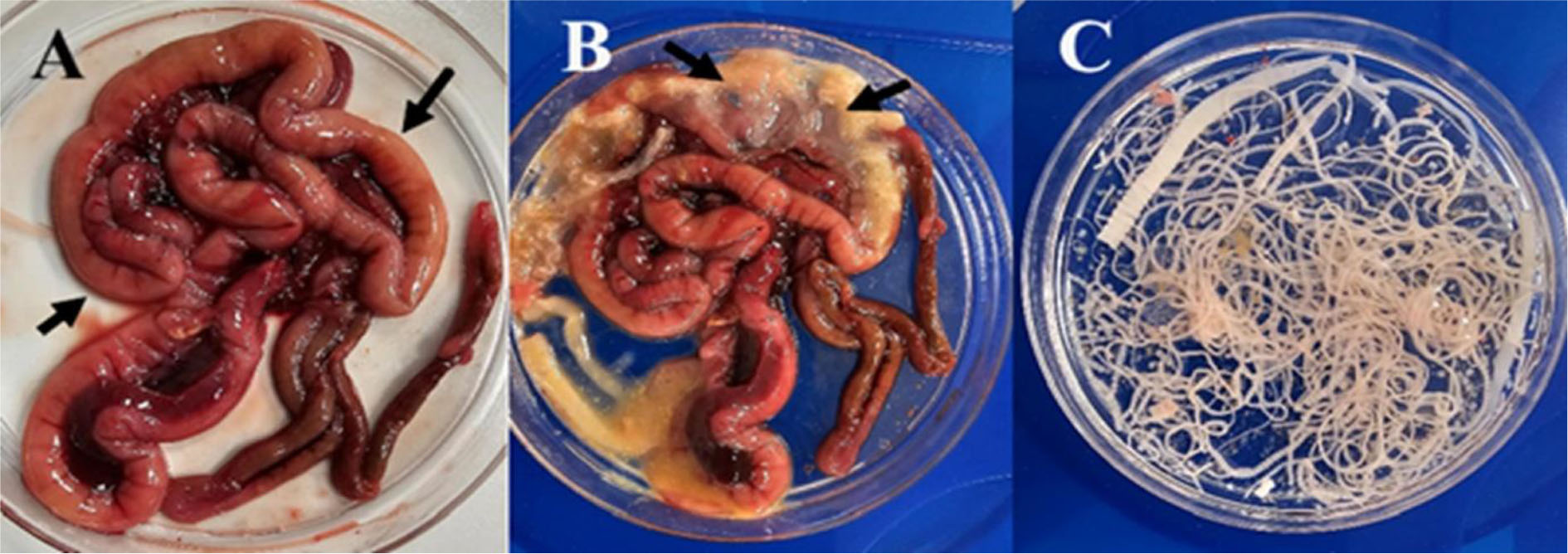
Fig. 1.
Intestinal tract from Columbia livia collected in Al Ain, UAE. A – upper intestine showing cestode infection (yellowish white); B – opened upper intestine displaying cestodes; C – cestodes recovered from a heavily infected C. livia
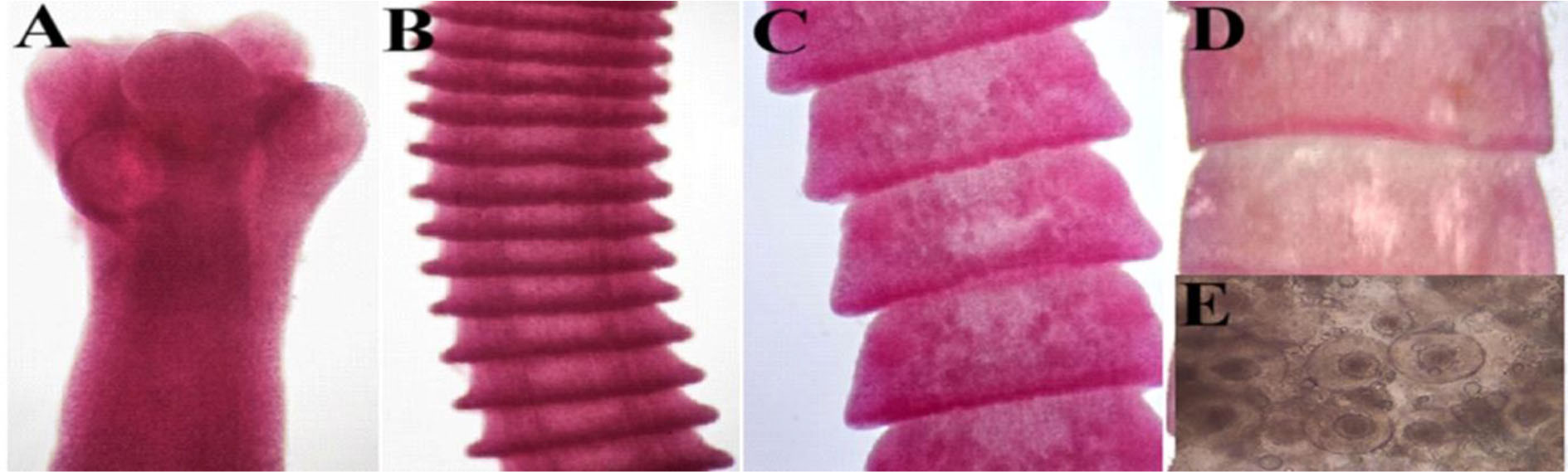
Fig. 2.
Light micrographs of Cotugnia digonopora specimens obtained from Columbia livia in Al Ain, UAE. A – scolex (100×); B – immature proglottid series (100×); C – mature proglottids (100×); D – gravid proglottids (100×); E – eggs (400×)
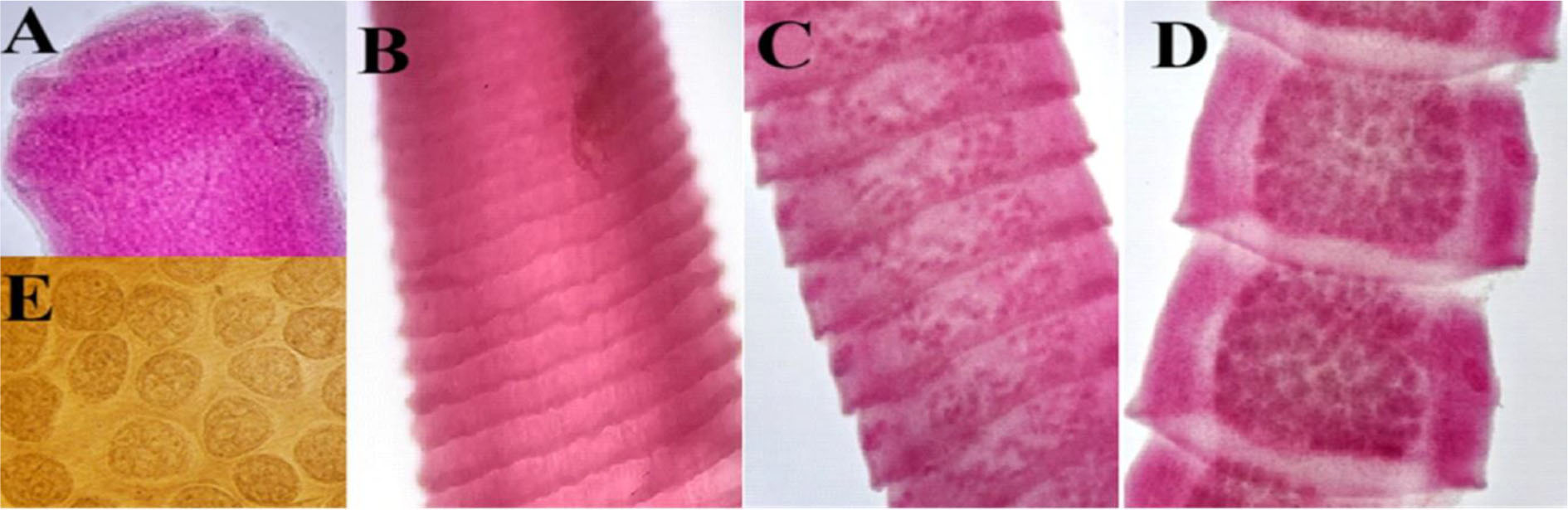
Fig. 3.
Light micrographs of Raillietina echinobothrida specimens obtained from Columbia livia in Al Ain, UAE. A – scolex (100×); B –immature proglottid series (100×); C – mature proglottids (100×); D – gravid proglottids (100×); E – eggs (400×)
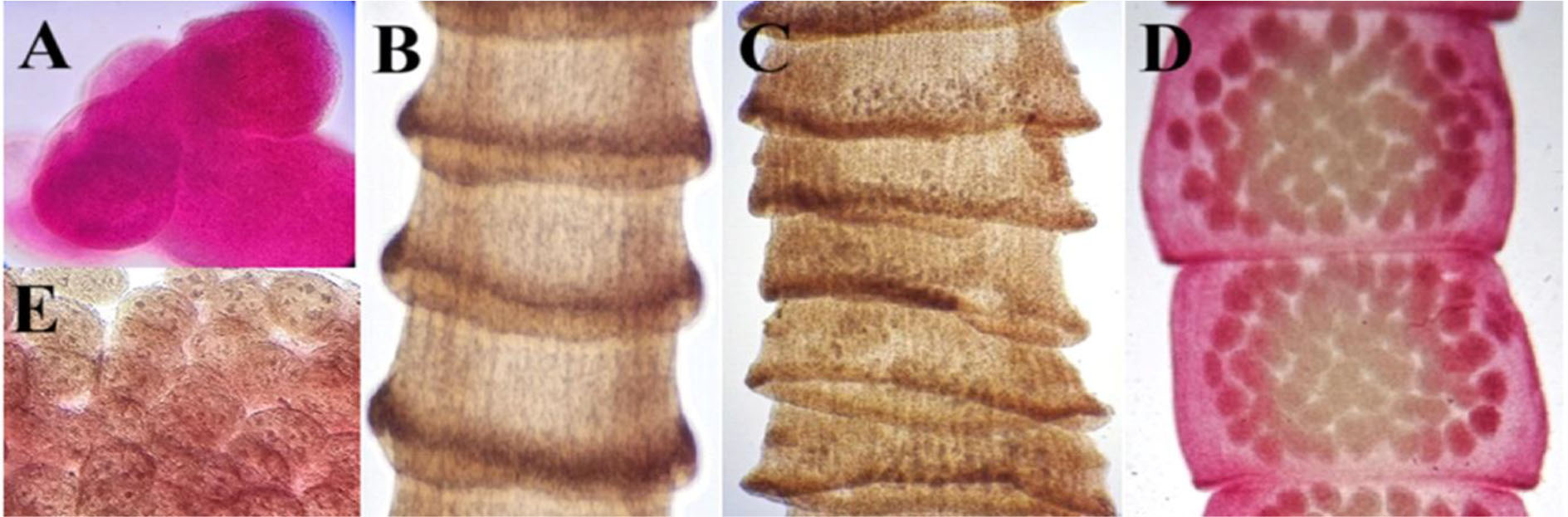
Fig. 4.
Light micrographs of Raillietina tetragona specimens obtained from Columbia livia in Al Ain, UAE. A – scolex (100×); B – immature proglottid series (100×); C – mature proglottids (100×); D – gravid proglottids (100×); E – eggs (400×)
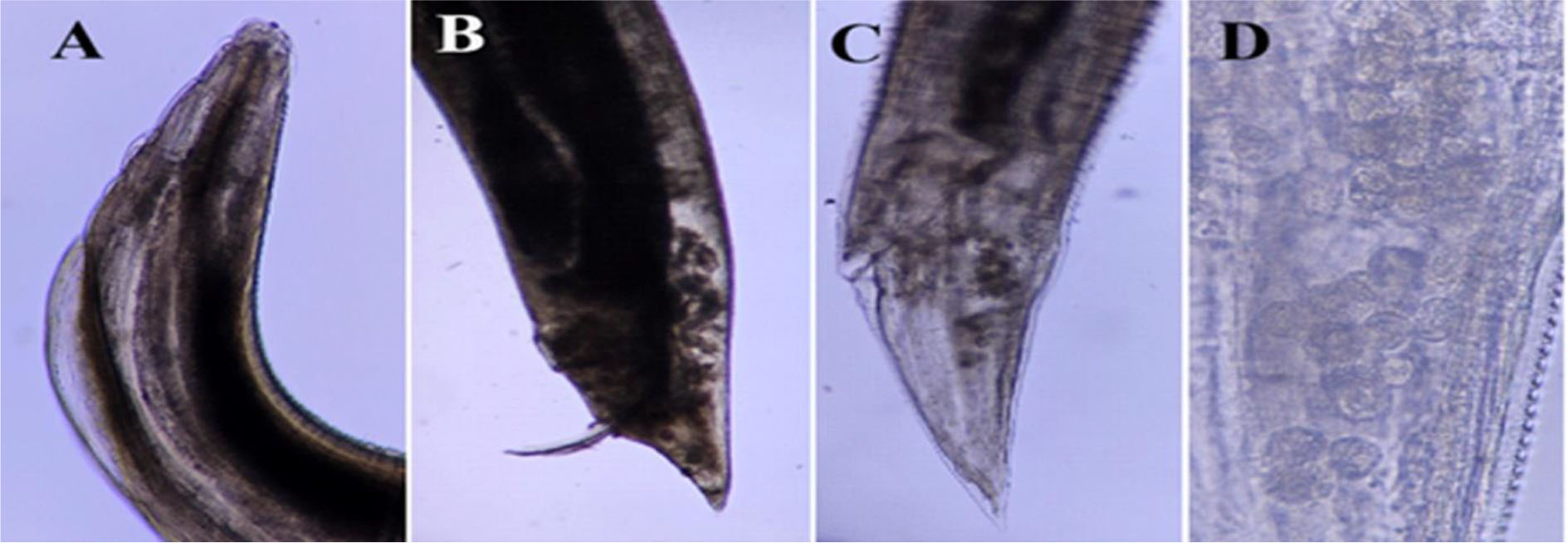
Fig. 5.
Light micrographs of Ascaridia galli specimens obtained from Columbia livia in Al Ain, UAE. A – male and female anterior end (300×); B – male posterior end (120×); C – female posterior end (300×); D – uterus containing eggs (1,200×)
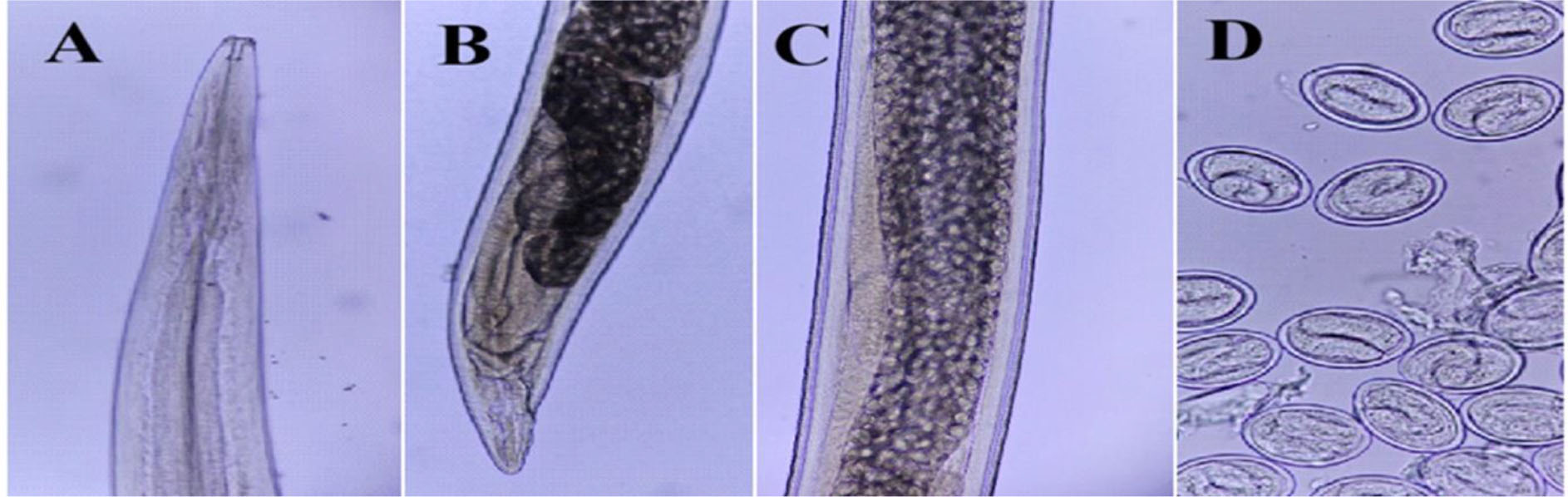
Fig. 6.
Light micrographs of Dispharagus nasutus specimens obtained from Columbia livia in Al Ain, UAE. A – male and female anterior end (300×); B – female posterior end (300×); C – uterus filled with eggs (300×); D – eggs (1,200×)
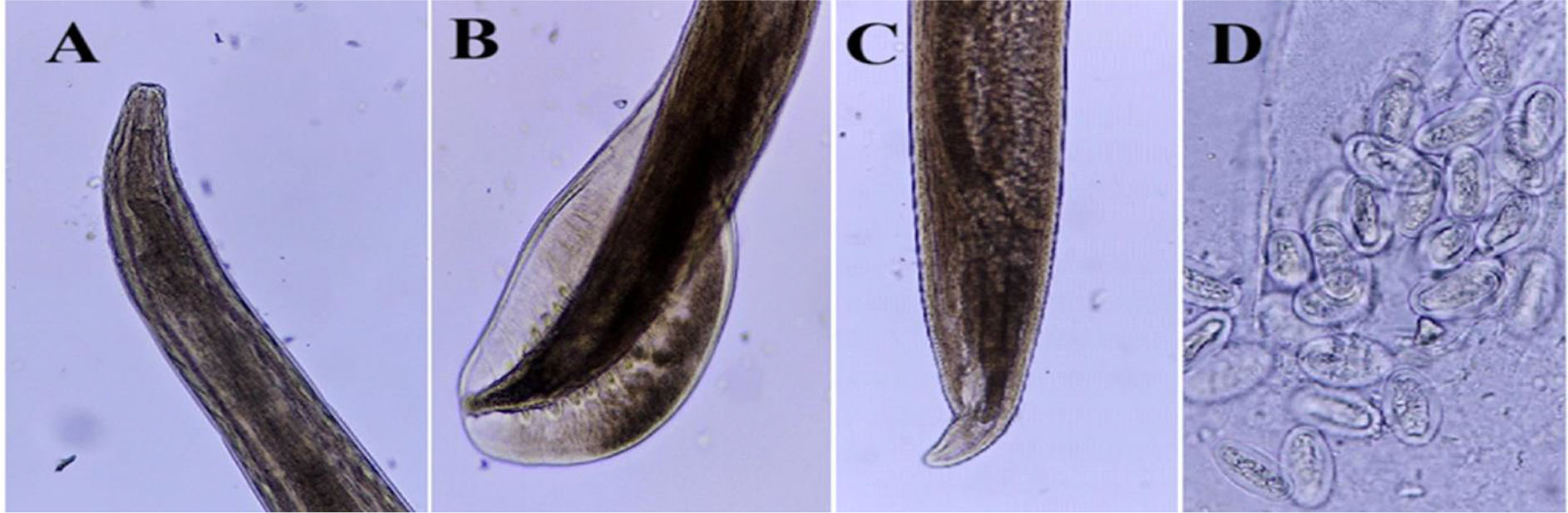
Fig. 7.
Light micrographs of Gongylonema sp. specimens obtained from Columbia livia in Al Ain, UAE. A – male and female anterior end (300×); B – male posterior end (300×); C – female posterior end (300×); D – eggs (1,200×)
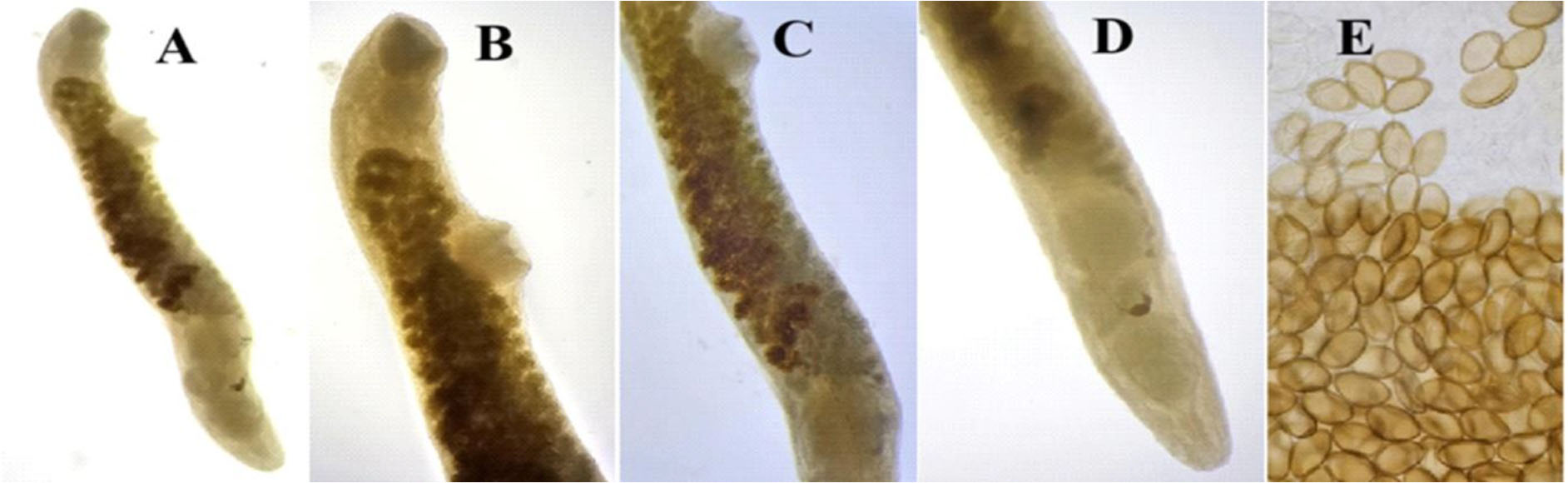
Fig. 8.
Light micrographs of Brachylaima sp. specimens obtained from Columbia livia in Al Ain, UAE. A – whole mount (40×); B – anterior body (100×); C – central body (100×); D – posterior body (100×); E – eggs (400×)
Table 1.
Helminth infection parameters and infection sites identified in pigeons (n = 100) sampled in Al Ain between August 2023 and October 2024
| Helminth species | Number of infected birds | Prevalence % | Mean intensity ± SE | Intensity range | Infection site |
|---|---|---|---|---|---|
| Cestoda | |||||
| Raillietina echinobothrida | 57 | 57 | 4.5 ± 0.5 | 1–17 | Duodenum and ileum |
| R. tetragona | 9 | 9 | 3.6 ± 0.9 | 1–10 | Duodenum and ileum |
| Cotugnia digonopora | 21 | 21 | 3.5 ± 0.4 | 1–8 | Duodenum and ileum |
| Trematoda | |||||
| Brachylaima sp. | 5 | 5 | 7.4 ± 1.7 | 3–12 | Rectum |
| Nematoda | |||||
| Ascaridia galli | 5 | 5 | 4 ± 0.6 | 2–5 | Ileum |
| Dispharagus nasutus | 1 | 1 | 4 | 4 | Gizzard |
| Gongylonema sp. | 1 | 1 | 18 | 18 | Gizzard |
| Overall | 69 | 69 | 6.4 ± 0.3 | 1–18 | |
Infection parameters by sex
Although male pigeons showed a higher prevalence of infection (71.4%) than females (65.9%), this difference was not statistically significant (P-value > 0.05). However, males exhibited significantly greater infection intensity compared to females (P-value < 0.05) (Tables 2 and 3).
Table 2.
Prevalence of pigeon helminth infections and comparative analysis by bird sex and lifestyle (n = 100) for sample pigeons from Al Ain between August 2023 and October 2024
| Helminth species | Prevalence (%) | |||||||
|---|---|---|---|---|---|---|---|---|
| Male (n = 56) | Female (n = 44) | χ2 | P-value | Feral (n = 50) | Domestic (n = 50) | χ2 | P-value | |
| Cestoda | ||||||||
| Raillietina echinobothrida | 58.9 | 54.5 | 9.3 | 0.8 | 84 | 30 | 15.3 | 0.3 |
| R. tetragona | 10.7 | 6.8 | 3.5 | 0.5 | 16 | 2 | 9 | 0.06 |
| Cotugnia digonopora | 28.6 | 11.4 | 6.6 | 0.4 | 28 | 14 | 11.8 | 0.08 |
| Trematoda | ||||||||
| Brachylaima sp. | 8.9 | 0 | - | - | 10 | 0 | - | - |
| Nematoda | ||||||||
| Ascaridia galli | 3.6 | 6.8 | 2.2 | 0.3 | 6 | 4 | 2.2 | 0.3 |
| Dispharagus nasutus | 0 | 2.3 | - | - | 0 | 2 | - | - |
| Gongylonema sp. | 1.8 | 0 | - | - | 2 | 0 | - | - |
| Overall | 71.4 | 65.9 | 0.4 | 0.6 | 92 | 46 | 24.7 | 0.001 |
Table 3.
Intensity of pigeon helminth infections and comparative analysis by bird sex and lifestyle (n = 100) for sample pigeons from Al Ain between August 2023 and October 2024
| Helminth species | Mean intensity ± SE | |||||||
|---|---|---|---|---|---|---|---|---|
| Male (n = 56) | Female (n = 44) | t | P-value | Feral (n = 50) | Domestic (n = 50) | t | P-value | |
| Cestoda | ||||||||
| Raillietina echinobothrida | 5.2 ± 0.8 | 3.5 ± 0.5 | 1.6 | 0.004 | 5.4 ± 0.7 | 2.1 ± 0.4 | –2.9 | 0.001 |
| R. tetragona | 4.3 ± 1.2 | 2 ± 0.6 | 1.3 | 0.2 | 3.9 ± 0.9 | 1 | –1.0 | 0.2 |
| Cotugnia digonopora | 3.4 ± 0.4 | 3.8 ± 0.9 | 0.04 | 0.6 | 4.1 ± 0.5 | 2.3 ± 0.7 | –2.3 | 0.9 |
| Trematoda | ||||||||
| Brachylaima sp. | 7.4 ± 1.7 | - | - | - | 7.4 ± 1.7 | - | - | - |
| Nematoda | ||||||||
| Ascaridia galli | 4 ± 1 | 4 ± 1 | 0 | 0.5 | 4.3 ± 0.7 | 3.5 ± 1.5 | -0.5 | 0.12 |
| Dispharagus nasutus | 0 | 4 | - | - | 0 | 4 | - | - |
| Gongylonema sp. | 18 | 0 | - | - | 18 | 0 | - | - |
| Overall | 5.1 ± 0.8 | 3.5 ± 0.4 | 2.1 | 0.02 | 2.7 ± 0.3 | 2.3 ± 0.3 | –1.2 | 0.12 |
Infection parameters by lifestyle (feral vs domestic)
Feral pigeons exhibited a markedly higher infection prevalence (92%) than domestic pigeons (46%), a difference that was statistically significant (P-value < 0.05). Feral birds also showed higher infection intensity than domestic individuals, although this difference was not statistically significant (P-value > 0.05) (Tables 2 and 3).
Discussion
To the authors’ knowledge, this study represents the first documented investigation of helminth parasites in Al Ain’s pigeon populations, addressing a critical gap in regional parasitological research. The observed overall helminth prevalence of 69% aligns with reports from Tanzania of 79.5% (32), Botswana of 92% (33) and India of 100% (8), but contrasts with lower rates in Egypt of 11.8% (14), Turkey of 29% (17) and Iran of 42% (30). On the other hand, infection intensity (6.4 helminths per host) was markedly lower than Nigeria’s reported 15.4 helminths per host (2), although limited comparable data preclude broader conclusions. The dominance of cestodes likely reflects the abundance of arthropod intermediate hosts (e.g. insects) in urban ecosystems. Disparities in prevalence and intensity across regions may stem from multiple factors, including methodological variations in parasite detection, ecological availability of intermediate hosts or vectors and local climatic influences (31, 44).
In the current study, pigeons exhibiting clinical signs of diarrhoea and weight loss carried higher parasitic loads. These findings align with prior studies suggesting that parasitic infections compromise intestinal nutrient absorption, leading to such clinical manifestations (1, 45). The diverse internal and external parasites to which pigeons are vulnerable detrimentally affect their health and may culminate in death (47).
This investigation identified seven helminth species parasitising pigeons: three cestodes (R. tetragona, R. echinobothrida and C. digonopora), three nematodes (A. galli, D. nasutus and Gongylonema sp.) and one trematode (Brachylaima sp.). Cestodes dominated the parasitic load, with a collective prevalence of 67%. This last result parallels studies from Greece presenting 70.6% (13), India with 60% (26) and Pakistan indicating 60% (49), but contrasts with a lower rate in Egypt of 7.3% (14) and in Iran of 20% (41). The trematode Brachylaima sp. (5%) and nematodes A. galli (5%), D. nasutus (1%) and Gongylonema sp. (1%) exhibited the lowest prevalence. These findings align with trematode records from Egypt, where 0.14% trematode prevalence was reported (14), and Switzerland, where 2.9% was established (18), as well as with nematode prevalence in India of 5% (29) and in Pakistan of 6.7% (26).
The high prevalence of cestode infections in the examined pigeons likely stems from dietary exposure to intermediate invertebrate hosts. While pigeons predominantly consume grains and seeds, their opportunistic feeding behaviour may include taking invertebrates such as beetles, ants and termites, which serve as intermediate or reservoir hosts for cestodes (4, 7). In contrast, the sporadic occurrence of trematode infections raises questions about transmission pathways, as trematodes typically require freshwater snails as intermediate hosts (12), for which the habitats are notably scarce in the arid UAE environment. Some artificial freshwater lakes have been constructed in the country and have abundant populations of Melanoides spp. snails (15); these could provide ample opportunities for some trematode life cycles to persist. While Brachylaima species circumvent this by utilising terrestrial snails and slugs as intermediate hosts (48), the UAE’s environment similarly fails to sustain significant populations of these organisms, complicating explanations for infection pathways. Surprisingly, nematodes exhibited low prevalence despite their frequent dominance in other regions, where they are often transmitted via contaminated food or water (40, 43). This discrepancy may reflect limited environmental suitability for nematode transmission in the UAE. Collectively, the reduced prevalence of both nematodes and trematodes may be attributed to the region’s extreme climatic conditions, where elevated temperatures and aridity likely hinder the survival, development and dispersal of their infective stages.
Single-species helminth infections predominated over mixed infections, a pattern consistent with some prior findings (13, 31) but also one contrasting with earlier reports of higher mixed-infection rates (6). The dominance of single infections may reflect ecological competition among parasites: initial colonisers often monopolise microhabitats within the host, limiting opportunities for subsequent species to establish themselves (28). Additionally, host dietary habits may shape parasite community structure, as resource availability and foraging behaviour influence exposure to specific parasite taxa (24, 42). These factors suggest that infection patterns arise from a complex interplay of parasite interactions and host ecology.
This study revealed a higher prevalence of helminth infections in male pigeons (71.4%) than in females (65.9%), aligning with prior studies indicating greater male susceptibility to parasitic infections (31, 49). Such disparities may stem from intrinsic biological differences between sexes that influence host–parasite interactions (36). Behavioural patterns and physiological responses, such as males’ broader roaming ranges or females’ exposure to physiological stress during brooding periods, may further contribute to infection susceptibility. Elevated infection rates in females could also reflect stress-related impacts on immune function, as parasite development often correlates with host stress levels and immune resilience (23, 46). However, some studies suggest that sex may not be a decisive factor in infection risk (3, 26), highlighting the need for context-specific analyses.
Notably, feral pigeons exhibited substantially higher helminth infection rates (92%) than their domestic counterparts (46%). This divergence likely arises from ecological and management factors: feral populations occupy diverse environments and move around unrestrictedly (39), increasing their exposure to pathogens, and they also receive no veterinary care nor are managed for good health. In contrast, domestic pigeons benefit from human intervention, including preventive healthcare and regulated living conditions, which mitigate infection risks.
The study also observed elevated helminth infection rates in adult pigeons, which were likely to be the results of prolonged environmental exposure. Adult birds’ capacity for long-distance flight and access to diverse habitats may increase interaction with infected conspecifics or contaminated environments, thereby amplifying transmission opportunities. In contrast, earlier studies reported higher infection prevalence in juvenile birds, potentially a consequence of their underdeveloped immune defences (34, 38).
Conclusion
While this study provides foundational data on helminth infections in pigeons in Al Ain, several considerations warrant attention to guide future research. The focus on adult pigeons offers insight into the longer-term accumulation of parasites, but inclusion of juvenile birds in future work could help clarify age-related susceptibility patterns. Although clinical signs such as diarrhoea and weight loss were noted in infected individuals, future studies could quantify these effects more precisely and explore correlations with parasite burden. The identified helminths include species with potential zoonotic significance, particularly in urban settings, and further investigation into public health implications is encouraged. While seasonal trends were not specifically analysed in this study, the extended sampling period provides a representative overview and lays the groundwork for more targeted temporal analyses. Lastly, the use of necropsy-based identification ensured accurate parasite detection, offering a robust baseline for comparison, even as methodological differences across studies remain an important consideration in interpreting prevalence variations.
Acknowledgments
The authors gratefully acknowledge Barari Natural Resources and the Environment Agency-Abu Dhabi, UAE, for supplying the wild pigeons examined in this study. Likewise, the authors extend their sincere appreciation to local bird vendors for granting access to domestic pigeon specimens. Special thanks go to Prof. Sabir Bin Muzaffar (Department of Biology, UAE University) for reviewing an earlier version of the manuscript.
Notes
[1] Conflicts of interest Conflicts of Interests Statement: The authors declare that there is no conflict of interests regarding the publication of this article.
[2] Financial disclosure Financial Disclosure Statement: This study was conducted without dedicated financial support.
[3] Animal Rights Statement: Sampling was conducted under the supervision of Barari Natural Resources, Environment Agency–Abu Dhabi, UAE (Scientific research no-objection certificate No. 200100118).
[4] CRediT Authorship Contribution Statement: Yassir Sulieman: research concept and design, collection and assembly of data, data analysis and interpretation, writing the article, critical revision of the article, final approval of the article. Nighat Perveen: research concept and design, collection and assembly of data, writing the article, final approval of the article. Mohammad Ali Al-Deeb: writing the article, critical revision of the article, final approval of the article. Theerakamol Pengsakul: collection and assembly of data, writing the article, critical revision of the article, final approval of the article.