
Introduction
Neospora caninum is an obligate intracellular protozoan parasite within the Apicomplexa phylum (9). It is an organism with a two-host life cycle: dogs (or wild canids) are the definitive host and cattle (other ruminants) are the intermediate hosts (12). Although it can cause severe disease in dogs of all ages, infections are most frequently observed in puppies (26). The infection often presents as neuromuscular disorders, including encephalomyelitis and myositis, which can lead to paralysis and premature mortality in affected puppies (3).
Neosporosis is predominantly recognised as a cattle disease and is a significant contributor to substantial economic losses on cattle farms (14). Neosporosis is a globally distributed abortigenic disease (13), with reported cases in Europe, Canada, the USA, Australia, Costa Rica, South Africa and Japan (11). Infections in dogs have been documented in numerous countries, such as Brazil (22), Portugal (5), Turkey (35), Iran (21, 25) and Iraq (18, 24).
Since the clinical signs of N. caninum infection are not sufficient for establishing its diagnosis, serological tests have been used including immunofluorescence antibody tests, nucleic acid testing, Western blotting and ELISAs paired with molecular techniques to give accurate diagnoses in dogs (31, 35). The high level of sensitivity of PCR made it a viable alternative to morphological methods in the detection of N. caninum infection (27) and also useful in the detection of other parasites both in dogs and intermediate hosts.
This study aimed at the evaluation with a molecular technique of the prevalence of neosporosis in Sulaymaniyah, Kurdistan, Iraq and characterisation of the genetic diversity of the N. caninum Nc5 gene in isolates from that region. To the best of our knowledge, this study is the first to report the molecular detection of N. caninum in the area’s dogs. It is an initial molecular investigation using PCR amplification and partial sequencing of the Nc5 gene of N. caninum in this region and includes an assessment of associated risk factors in dogs for infection.
Material and Methods
Study region and sampling
Blood specimens were taken from 258 dogs in Sulaymaniyah province, Kurdistan Region, northeastern Iraq (35°04′–36°30′N, 44°50′–46°16′E) between July and December 2024. The sampled population comprised 124 dogs and 134 bitches which were 131 juveniles (12 months or younger) and 127 adults (over 12 months old), and included both stray (n = 141) and domestic (n = 117) animals. Risk factors for neosporosis considered in this study included lifestyle differences between stray and domestic dogs, age-related variations in immune response, and sex differences as hormonal and behavioural factors. Buffy coats were extracted from the blood samples and stored at -20°C until analysis for N. caninum infection.
Molecular analysis
Genomic DNA was extracted from the buffy coat samples of all 258 dogs using FavorPrep blood genomic DNA extraction kits (Favorgen Biotech Corp, Pingtung City, Taiwan) according to the manufacturer’s protocols. Amplification of the Nc5 gene in a PCR was performed using NP6 (5′-CAGTCAACCTACGTCTTCT-3′) and NP21 (5′-GTGCGTCCAATCCTGTAAC-3′) primers as described by Yamage et al. (34). The amplification was conducted using f-Pfu DNA polymerase (SBS Genetech Co., Beijing, China) applying the conditions described by Hariri et al. (21). Amplified products were visualised on 1.5% agarose gels stained with GelRed (Biotium, Fremont, CA, USA), revealing the expected 328 bp fragment.
Ten PCR amplicons were selected for sequencing. Fragments of the DNA were purified from agarose gels using the SiMax PCR Products/Agarose Gel Purification Kit (SBS Genetech, Beijing, China). Partial Sanger sequencing was performed using the upstream primer (Macrogen, Seoul, South Korea). The obtained sequences were edited and aligned using the ClustalW multiple sequence alignment algorithm. All sequences were subsequently deposited to GenBank.
Sequence similarity analysis was performed using BLAST to compare our N. caninum Nc5 gene sequences with previously published sequences in GenBank. Phylogenetic analysis was conducted by aligning the coding sequences with reference N. caninum sequences (Table 1) using the maximum likelihood method. The phylogenetic tree was constructed using MEGA 11 software (32), with genetic distances calculated using Kimura’s two-parameter model. Tree topology reliability was evaluated through 1,000 bootstrap replicates.
Table 1.
Global Neospora caninum GenBank sequences and accession numbers used for phylogenetic analysis and multiple sequence alignment
| Protozoan species | GenBank accession No. | Geographical origin | Host organism | Citation |
|---|---|---|---|---|
| N. caninum | OP244818 | Iraq | Sheep | Essa (17) |
| MT955657 | Cattle | Gharekhani et al. (19) | ||
| MT955656 | Iran | |||
| MT709298 | ||||
| MT709296 | Dog | |||
| MT346029 | Italy | Red fox | Zanet et al. (36) | |
| KP715569 | Italy | Deer | Zanet et al., 2015, unpublished | |
| LN714476 | UK | - | Ramaprasad et al. (29) | |
| KF649845 | USA | Wolf | Dubey et al. (10) |
Statistical analysis
A chi-squared (χ2) test was used to determine significance at P-value < 0.05.
Results
Molecular prevalence of N. caninum
Amplification of the Nc5 gene in a PCR produced a 328-bp fragment, although sequencing analysis revealed a 305-nucleotide sequence. Among the 258 dog blood samples tested, N. caninum DNA was detected in 10, representing a prevalence of 3.87%. Risk factors associated with neosporosis were investigated by analysing infection rates based on lifestyle, age and sex (Table 2).
Table 2.
Association of risk factors with N. caninum infection in dogs from Sulaymaniyah Province, Iraq
| Number of dogs examined | Number (%) of dogs infected | X2 (P-value) | ||
|---|---|---|---|---|
| Overall | 258 | 10 (3.87) | ||
| Lifestyle | Stray dogs | 141 | 9 (6.38) | 0.022 (<0.05) |
| Domestic dogs | 117 | 1 (0.85) | ||
| Sex | Male | 124 | 8 (6.45) | 0.039 (<0.05) |
| Female | 134 | 2 (1.49) | ||
| Age | Young (≤12 months) | 131 | 2 (1.52) | 0.047 (<0.05) |
| Adult (>12 months) | 127 | 8 (6.30) |
The study revealed that these were significant risk factors for N. caninum infection in dogs. Specifically, stray dogs exhibited a significantly higher infection rate (6.38%) than domestic dogs (0.85%; P < 0.05). The study also found a significantly higher N. caninum infection rate in dogs (6.45%) than in bitches (1.49%; P < 0.05). Additionally, adults showed a significantly greater infection rate (6.30%) than juveniles (1.52%; P < 0.05).
Sequence analysis of N. caninum
Sequence editing and trimming yielded a 293-bp PCR product. Sequence analysis and alignment revealed six distinct N. caninum isolates with variations, including several mutations (Fig. 1). The Nc5 gene in this study comprised ten isolates which were assigned GenBank accession Nos PQ850578–PQ850587. The isolates from this study fell into two groups. Four isolates (PQ850584–PQ850587), found only in the research area, presented six novel mutations: at positions 58 (C > G) and 258 (A > T) in PQ850584 and PQ850585, positions 48 (G > C) and 207 (T > A) in PQ850586 and positions 33 (A > T) and 169 (C > A) in PQ850587. The other six isolates (PQ850578–PQ850583) had 97.38%–100% identity with the previously identified sequences with accession numbers MT 709296, MT709298, MT955656 and MT955657 from Iran, and OP244818 from Iraq (Fig. 1). Analysis by BLAST demonstrated that all sequences exhibited high similarity (95.41% to 100%) to N. caninum sequences available in GenBank, the output of closest sequences being examples from Iran, Iraq, Italy, the UK and the USA (Fig. 1). Phylogenetic analysis of the Nc5 sequences showed that the N. caninum isolates sequenced in the present research were distributed across different clades, reflecting genetic diversity within the country (Fig. 2).
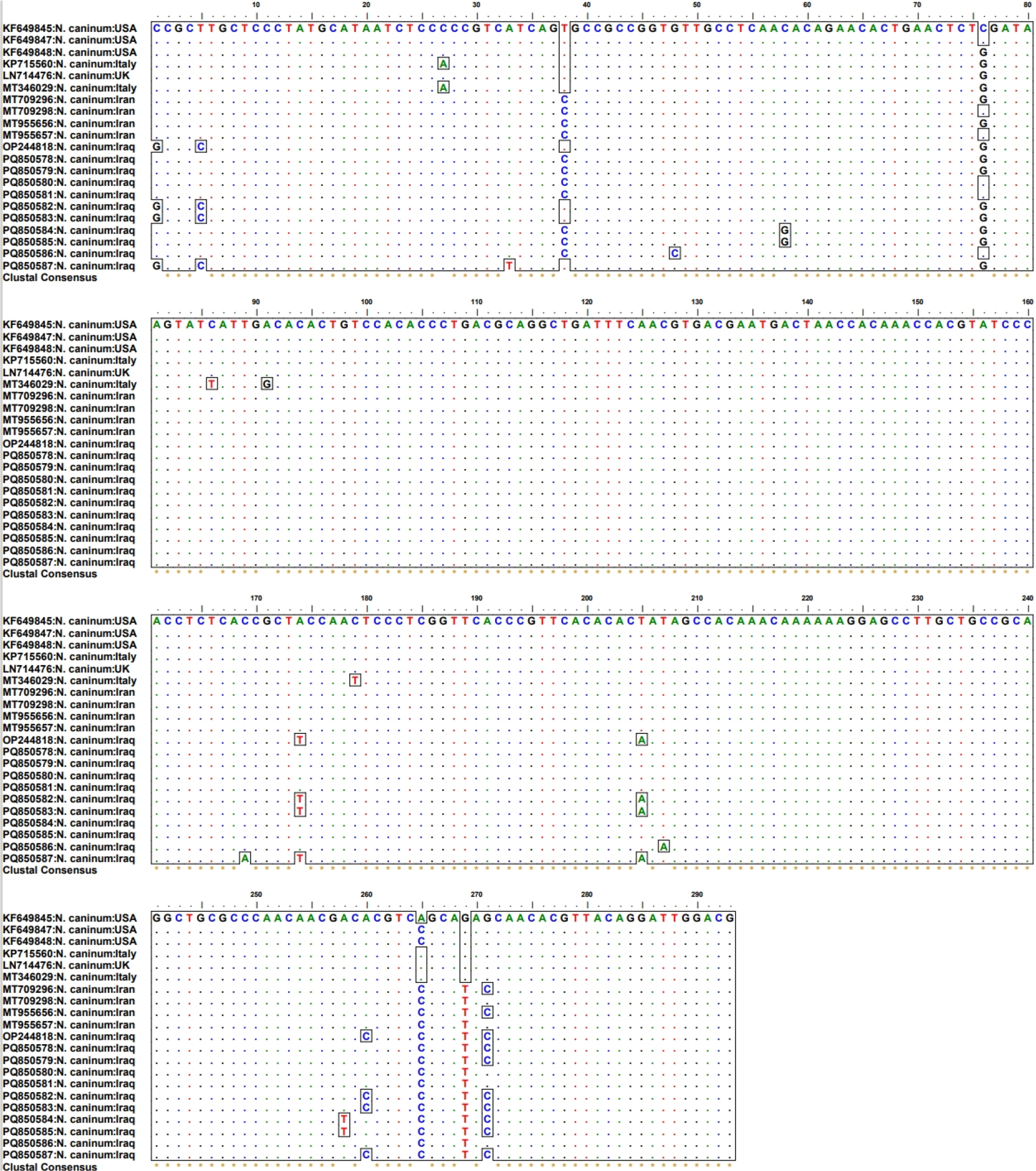
Fig. 1.
Multiple sequence alignment of Neospora caninum isolates from dogs in Sulaymaniyah, Iraq, alongside other GenBank isolates. The alignment was conducted using the ClustalW algorithm on partial Nc5 gene sequences. The nucleotide sequences from this study are assigned accession Nos: PQ850578–PQ850587
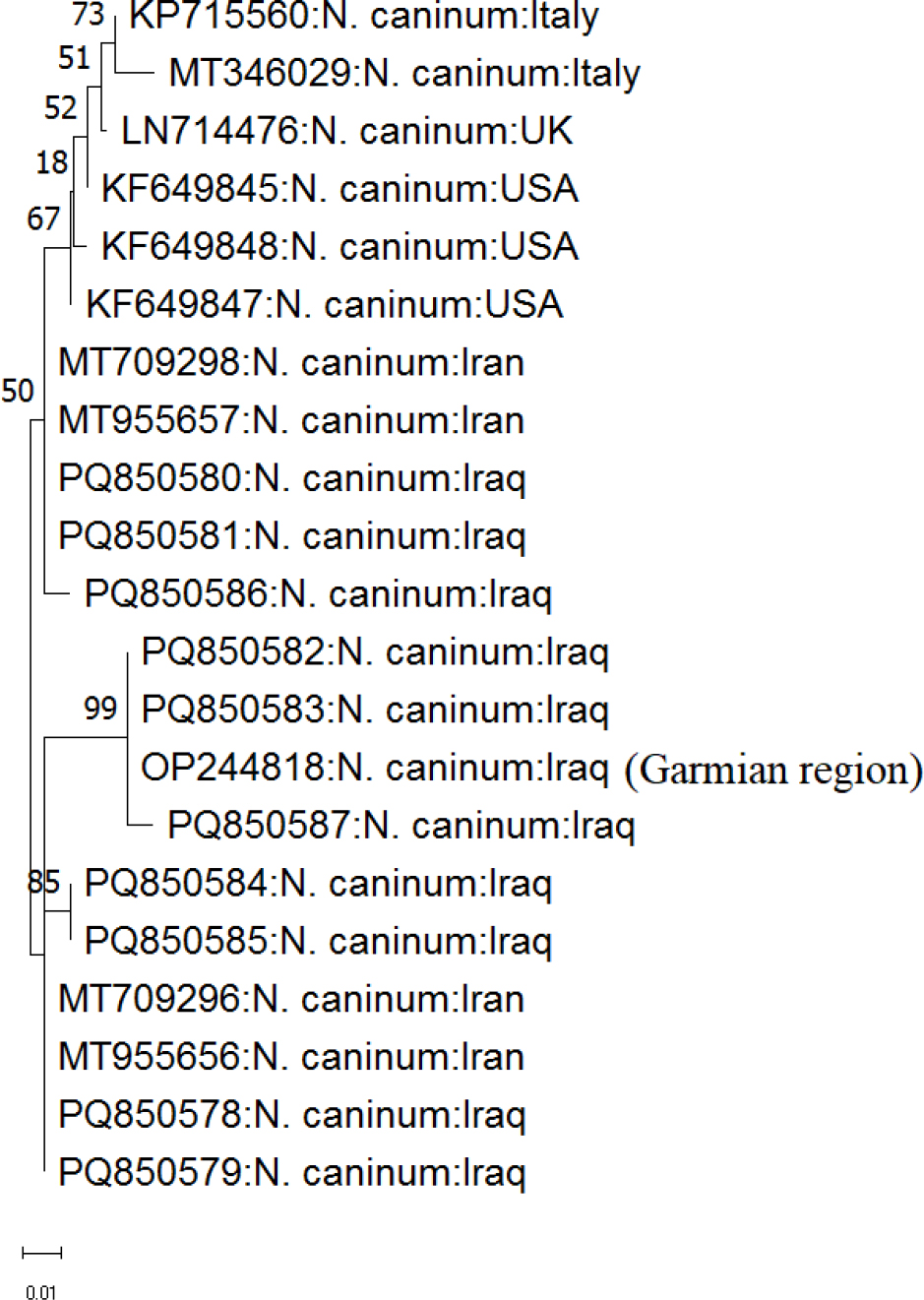
Fig. 2.
Phylogenetic tree of Neospora caninum isolates from dogs in Sulaymaniyah, Iraq, constructed using the maximum-likelihood method based on Nc5 gene sequences. The accession Nos: PQ850578–PQ850587 represent the sequences analysed in this study. The scale bar indicates a 1% nucleotide difference
Discussion
Over the past three decades, N. caninum has been extensively researched as a significant veterinary pathogen (8). However, limited data is available on its occurrence in dogs and foxes, which are the parasite’s definitive hosts. Dogs, in particular, play a critical role in the epidemiology of neosporosis as the primary definitive hosts of N. caninum (31).
In this study, the overall molecular detection rate of N. caninum in dog blood specimens was 3.87% (10/258), which is similar to what a study recorded in Turkey (3.80%) (15). This rate is lower than those reported in Baghdad, Iraq (10%) (18); Tehran, Iran (35%) (28); Isfahan, Iran (24.40%) (25); and Botucato, Brazil (42.90%) (22). However, it is somewhat higher than the rates documented in the Al-Muthana province of Iraq (1.60%) (24) and the Van province of Turkey (2%) (35). Variations in molecular prevalence rates could be attributed to several associated risk factors, such as sex, breed, age, coinfections, intermediate host involvement, diet and climatic conditions. These elements can significantly influence transmission dynamics, such as the sporulation and viability of oocysts (4, 7, 31).
We also studied the effect of risk factors including life style, sex and age. Stray dogs had a significantly higher infection rate than domestic dogs (6.38% versus 0.85%, P < 0.05). This result agrees with the findings of Wang et al. (33), and Fanokh and Al-Rubaie (18). These notable findings may be attributed to consumption of raw meat containing tissue cysts, welfare conditions and living environment (33). Neosporosis was significantly higher in dogs than in bitches (6.45% versus 1.49%, P < 0.05). The results are in agreement with the earlier observations of Wang et al. (33), Adhami et al. (1) and Fanokh and Al-Rubaie (18). In contrast, Al-Amery et al. (2) in Iraq reported that the infection rate in female buffaloes was higher than that in male ones; also, our data are in disagreement with those of Gozdzik et al. (20) in Poland and Dwinata et al. (16) in Indonesia. The incidence rate of neosporosis was significantly higher in adults (6.30%) than in juveniles (1.52%; P < 0.05). This finding corroborates the results of the previous studies showing that the rate of neosporosis increased with dog age (18, 20, 33). This is plausibly due to transmission dynamics, immune response and the symptomatic nature of the diseases.
Genotyping with PCRs has become indispensable for genetic analysis because it requires minimal DNA but makes strain identification, tracking of genotype frequencies and the determination of alleles possible. These benefits have established investigation of genetic markers as the preferred approach for detecting genomic variations in eukaryotic organisms (23). Regidor-Cerrillo et al. (30) were the first to report the presence of repetitive sequences within the N. caninum genome, and further studies by Calarco et al. (6) have identified more than 100 distinct N. caninum strains. Molecularly, this study analysed the genetic diversity of N. caninum based on Nc5 gene nucleotide sequences isolated from the blood of Iraqi dogs. The PCR analysis successfully amplified a 328-bp fragment of the target N. caninum gene in dog blood samples. and exposed its sequence to show genome arrangements typical of N. caninum sequences in GenBank. Sanger sequencing of the Nc5 gene in our samples was used to confirm the PCR results; and it was substantiated that all the positive samples tested were N. caninum.
Next, we used multiple sequence alignment and a phylogenetic tree to look for sequence variations and the presence of single nucleotide polymorphisms. This study identified novel N. caninum isolates with unique mutations not previously reported from anywhere in the world. These isolates exhibited the greatest similarity to sequences from Iraq, Iran, Italy, the UK and the USA. These results demonstrate that the samples from different geographic areas may vary genetically. Phylogenetic analysis revealed intraspecific variations among all canine-hosted sequences obtained in this study. This contrasts with the findings of Fanokh and Al-Rubaie (18), who reported a lack of variation in N. caninum sequences isolated from Iraqi dogs.
The molecular alignment and phylogenetic tree analysis performed in this study indicate a strong relationship between Iraqi isolates and Iranian isolates. This finding likely reflects the long shared border and frequent trade between the countries, including the import of sheep and animal products, and carnivore movement between Iraq and Iran (17). The findings showed that the N. caninum isolates obtained in this research and from GenBank varied genetically, and are a foundation for further research to accrue regional data against which to validate the explanation of Al-Qassab et al. (3) of clades by geographical distribution, host range, and the parasite’s capacity for sexual reproduction.
Conclusion
The outcomes of this research demonstrate that N. caninum is present among dogs in Sulaymaniyah province, Iraq. These infected dogs are likely to be a source of N. caninum transmission to cattle, potentially leading to bovine abortions. This research is the first to document molecularly N. caninum infection in dogs from this province and gives useful data on N. caninum in dogs in Iraq using barcode Nc5 genomic sequences. Our results showed a close association between N. caninum from Iraq and N. caninum from different countries, although limited sequences were included in the dataset. The findings of the research show the usefulness of the Nc5 gene as a diagnostic molecular marker for identifying and characterising N. caninum species. Further research is needed to better understand the epidemiology of neosporosis in this region and develop effective N. caninum infection prevention strategies.
Notes
[1] Conflicts of interest Conflict of Interests Statement: The authors declare that there is no conflict of interests regarding the publication of this article.
[2] Financial disclosure Financial Disclosure Statement: This study received no financial support from any funding organisation.
[3] Animal Rights Statement: This study was conducted in accordance with the ethical guidelines established by the Ethics Committee of the College of Veterinary Medicine, University of Sulaimani.
[4] CRediT Authorship Contribution Statement: Aram Ahmad Mohammed: research concept and design, collection and assembly of data, data analysis and interpretation, writing the article, final approval of the article. Taib Ahmed Hama Soor: collection and assembly of data, data analysis and interpretation, critical revision of the article, final approval of the article.