
Table 1.
The clinical data of horses suffering granulomatous enterocolitis and the results of laboratory investigations
| Clinical and laboratory data | Horse No. 1 | Horse No. 2 | Horse No. 3 |
|---|---|---|---|
| Age | 3 months | 10 months | 3 years |
| Sex | Male | Male | Female |
| Duration of illness | 2 months | 7 months | 1.5 years |
| Symptoms: | |||
| Diarrhoea | + | + | + |
| Weight loss | + | + | + |
| Gastric ulcers | + | + | + |
| Serum biochemistry: | |||
| Hypoalbuminaemia | - (10.7 g/L) | - (12.1 g/L) | - (9.8 g/L) |
| Parasitological findings after examination of faecal samples | - | Parascaris univalens, Cryptosporidium sp. and Giardia sp. | - |
| Ultrasonographic findings | Thickened intestinal wall | Hyperechoic mass in the lower left area (12-14 intercostal spaces), presence of free fluid in the abdominal cavity, thickened small intestinal wall | Free fluid present in the abdominal cavity, thickened intestinal wall |
Table 2.
Starter and probe sequences used in the reaction to screen equine tissue samples for Mycobacterium tuberculosis complex species
| Name | Sequence 5′–3′ |
|---|---|
| Starter F6110 | GGT AGC AGA CCT CAC CTA TGT GT |
| Starter R6110 | AGG CGT CGG TGA CAA AGG |
| Pr6110 | FAM-CAC GTA GGC GAA CCC-MGB NFQ |
Table 3.
Components in the PCR reaction to screen equine tissue samples for Mycobacterium tuberculosis complex species
| Reagent | Concentration | Volume (μL) |
|---|---|---|
| Nuclease-free water | - | 7.5 |
| QuantiFast mix | 5× | 5 |
| Assay internal control | 10× | 2.5 |
| Internal control DNA | 10× | 2.5 |
| F6110 | 5 pmol/μL | 1 |
| R6110 | 5 pmol/μL | 1 |
| Pr6110 | 5 pmol/μL | 0.5 |
| DNA | - | 5 |
| Total volume | 25 |
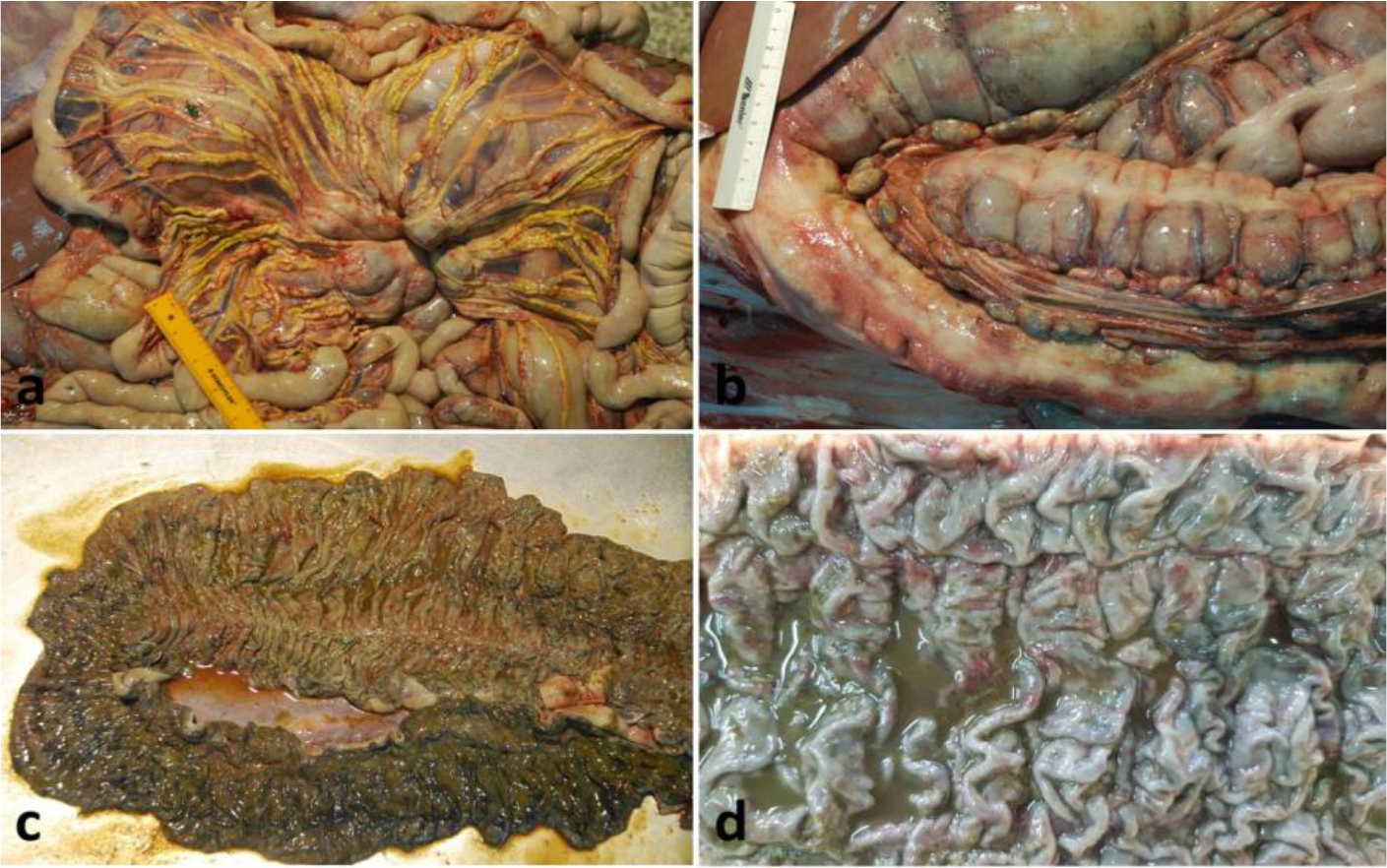
Fig. 1.
Gross pathology photographs of tissue sections from Polish horses with granulomatous enterocolitis. a – Markedly enlarged mesenteric lymph nodes, the segment of the small intestine drained by thick, dilated mesenteric lymphatic vessels (mesenteric lymphangitis/lymphangiectasia); b – Large colon (sternal/diaphragmatic flexure): colonic lymph nodes enlarged to a size of 1–3 cm in diameter; c – Large colon (pelvic flexure) with diffusely, markedly thickened mucosa; d – Large colon, irregularly transversely folded mucosal rugae with multifocal superficial erosions
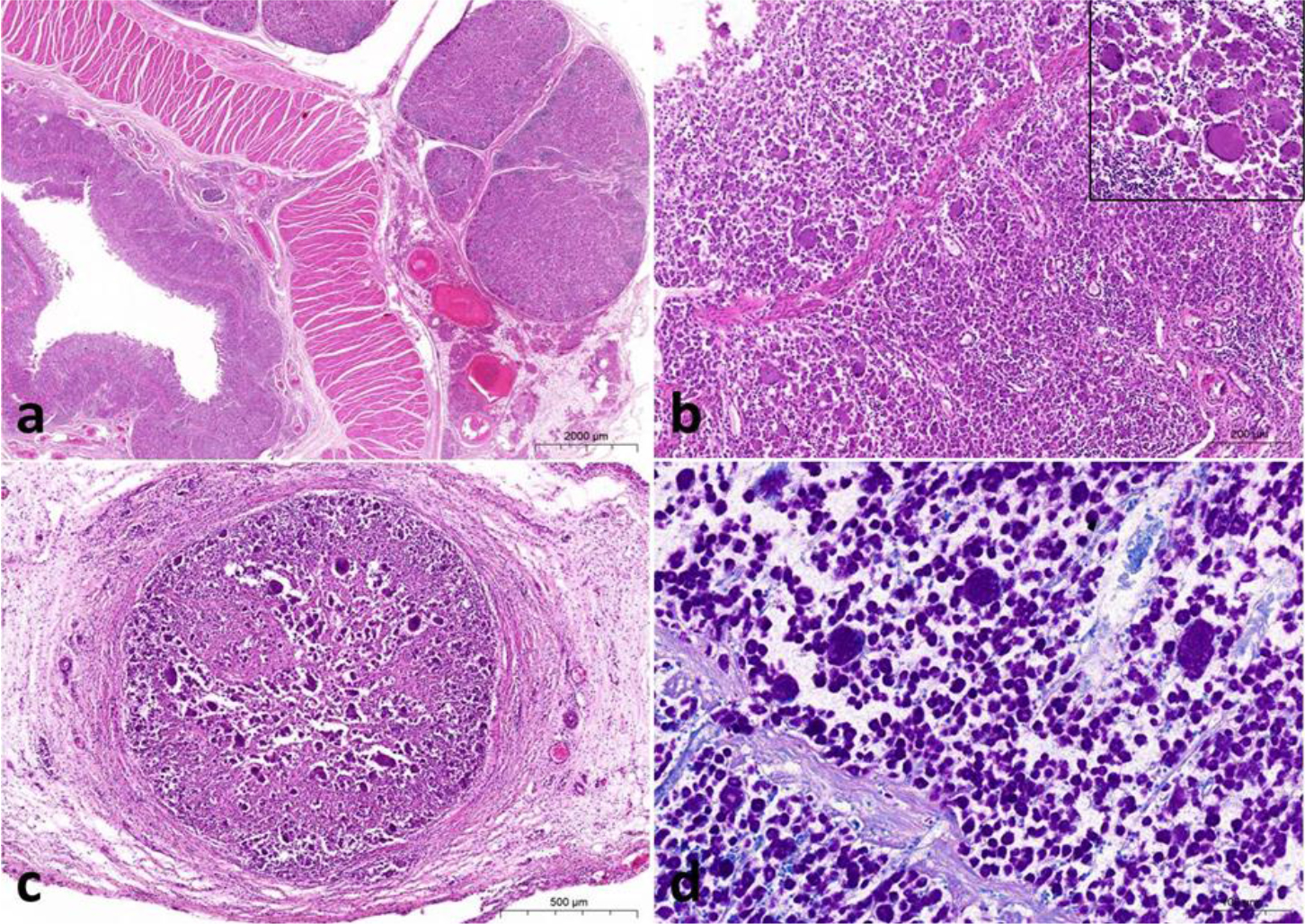
Fig. 2.
Micrographs of tissue samples from Polish horses with granulomatous enterocolitis. a – Haematoxylin and eosin (HE)-stained cross section through a large colon wall and adjacent lymph nodes. Massive granulomatous inflammatory infiltrates in the mucosa and submucosa and in the adjacent lymph node parenchyma. Remnants of lymphoid follicles visible in the cortex. Scale bar = 2000 μm; b – HE-stained lamina propria and submucosa of the large colon widely infiltrated by epithelioid macrophages and aggregates of lymphocytes and plasma cells; multinucleated giant cells with peripherally located nuclei (insert). Scale bar = 200 μm; c – HE-stained cross section through a mesenteric lymphatic vessel occluded by epithelioid macrophages, multinucleated giant cells and fewer lymphocytes and plasma cells. Scale bar = 500 μm; d – Ziehl–Neelsen-stained large colon with numerous macrophages in the lamina propria and submucosa containing intracellular acid-fast bacteria. Scale bar = 100 μm
Table 4.
Matrix-assisted laser desorption/ionisation–time-of-flight mass spectrometry (MALDI-TOF MS) results of Mycobacterium species identification in tissue samples from Polish horses with granulomatous enterocolitis
| No. | MALDI-TOF MS results | |||
|---|---|---|---|---|
| Species | Points | Probability | Symbols/colour | |
| Horse No. 1 | Mycobacterium avium subsp. hominissuis | ≥2,300 | Highly probable | +++/green |
| Horse No. 2 | Mycobacterium avium subsp. hominissuis | ≥2,300 | Highly probable | +++/green |
| Horse No. 3 | Mycobacterium avium subsp. hominissuis | ≥2,300 | Highly probable | +++/green |