
Introduction
Brucellosis is one of the most serious zoonotic diseases of bacterial origin. It is caused by bacteria of the genus Brucella (2). Among the dozen or so known Brucella species, the most widespread globally and the most pathogenic to both humans and animals are Brucella melitensis, B. abortus, and B. suis. Although each of these species exhibits a degree of host specificity – B. abortus primarily in cattle, B. melitensis in small ruminants, and B. suis in suide – they are all capable of infecting a wide range of vertebrate species, including humans.
Based on biochemical, serological, and molecular characteristics, three biovars of B. melitensis, eight biovars of B. abortus, and five biovars of B. suis have been identified (2, 15). These biovars differ in their virulence, pathogenicity, and, in some cases, in their natural host preferences.
The incidence of brucellosis in farm animals is accompanied by significant economic losses, primarily resulting from abortions, periodic infertility, reduction in milk production. Brucella infections spread rapidly primarily in immunologically-naïve or immunocompromised herds, causing numerous abortions sometimes referred to as an “abortion storm”. In herds with an endemic disease, abortions in infected females usually occur once and there is rather unlikely to appear during subsequent pregnancies. However, such as in the case of a rapid course of the disease in a herd, animals from endemic herds may remain carriers and spreaders of Brucella for a long time.
Natural transmission of Brucella via horizontal road can occur through ingestion of microorganisms present in the tissues of aborted fetuses, placental membranes, amniotic fluids, blood and other uterine discharges/excretions, as well as in feces, urine or milk and in water or food contaminated with the above-mentioned infected biological material. Another way of Brucella transmission can be inhalation. Furthermore, the semen of infected males can carry the germ, triggering vertical transmission of Brucella via uterine infection.
Due to its worldwide spread and relatively difficult control, animal brucellosis has a significant economic impact in many countries. This involves costs related to reproductive losses in livestock, loss of productivity, costs associated with treatment and eradication procedures. The expenses include also safeguarding people against the transmission of diseases from animals and, in the event of their transfer, the requirement for long-term medical care for individuals.
Poland is one of the European countries where, due to restrictive, consistently conducted control and eradication programs the livestock population has been considered brucellosis-free for some last decades. However, some wild-living species, such as wild boars, hares or some rodent species, are considered reservoirs of Brucella, mainly B. suis biovar 2. The risk associated with the possibility of transmitting these microorganisms to the domesticated pig population makes it necessary to monitor the spread of Brucella infections among wild boars. The last serological survey of wild boars regarding the spread of mentioned above infections was carried out in Poland in 2012 (23). The seroprevalence recorded then was 24.44%. The aim of the presented study was to acquire data enabling the determination of the current level of spread of infections caused by Brucella in the wild boar population in Poland.
Material and Methods
Serum samples
In the course of the study, a total of 1000 serum samples were randomly collected from wild boars legally hunted in 2023 and 2024. Of these, 500 samples were obtained from wild boars hunted across Poland in 2023, while the remaining 500 were randomly collected in 2024 from six voivodeships that had exhibited a seroprevalence above 20% in the preceding year. The animals hunted in 2023 came from 15 out of 16 Polish provinces (voivodeships). From 14 to 51 blood samples were obtained from individual voivodeships (Table 1). The numbers of tested samples from animals hunted in individual voivodeships in 2024 are presented in Table 2. Blood samples were collected from the thoracic cavity, heart, or pericardium into plastic tubes and allowed to clot. In the laboratory the sera were separated by centrifugation and stored at –20°C until testing.
Table 1.
Comparison of the number of wild boar serum samples collected in 2023 from particular voivodeships tested for the presence of anti-Brucella antibodies using the ELISA
| Voivodeships | Number of the serum samples | ||
|---|---|---|---|
| tested | positive | negative | |
| Dolnośląskie | 51 | 10 | 41 |
| Kujawsko-Pomorskie | 31 | 11 | 20 |
| Lelskie | 37 | 9 | 28 |
| Lubuskie | 26 | 2 | 24 |
| Łódzkie | 31 | 21 | 10 |
| Małopolskie | 31 | 4 | 27 |
| Mazowieckie | 14 | 5 | 9 |
| Opolskie | 31 | 14 | 17 |
| Podkarpackie | 45 | 23 | 22 |
| Pomorskie | 31 | 5 | 26 |
| Śląskie | 31 | 5 | 26 |
| Świętokrzyskie | 31 | 7 | 24 |
| Warmińsko-Mazurskie | 31 | 9 | 22 |
| Wielkopolskie | 34 | 7 | 27 |
| Zachodniopomorskie | 45 | 9 | 36 |
| TOTAL | 500 | 141 | 359 |
Table 2.
Comparison of the number of wild boar serum samples collected in 2024 from particular voivodeships tested for the presence of anti-Brucella antibodies using the ELISA
| Voivodeships | Number of the serum samples | ||
|---|---|---|---|
| tested | positive | negative | |
| Kujawsko-Pomorskie | 217 | 76 | 141 |
| Lubelskie | 56 | 27 | 29 |
| Łódzkie | 99 | 12 | 87 |
| Opolskie | 25 | 3 | 22 |
| Podkarpackie | 13 | 3 | 10 |
| Warmińsko-Mazurskie | 90 | 22 | 68 |
| TOTAL | 500 | 143 | 357 |
ELISA
All serum samples were tested for the presence of anti-smooth-lipopolysaccharide (LPS) antibodies against Brucella spp. by the use of ELISA kit developed in the National Veterinary Research Institute in Puławy (22, 26). The test was developed on the basis of LPS antigen obtained from the strain B. abortus S 19. The ELISA was performed as previously described (23). The mentioned ELISA is used in the National Veterinary Research Institute for routine serological diagnosis of swine brucellosis and for verification of serological positive results obtained by using the Rose Bengal test (RBT).
Statistics
The seroprevalence of Brucella spp. was estimated using the ratio (percentage) of positive samples to the total of samples analysed or to the group of samples collected from a specific voivodeship. The 95% confidence interval (CI) for seroprevalence proportion was calculated. The chi-square test was employed to verify any differences in seroprevalence identified during subsequent phases of our study, as well as between the findings of our own study and those of the study conducted in 2012 (23). Statistical significance in this study was defined at the P ≤ 0.05 level.
Results
In a collection of 500 samples acquired and examined in 2023, a total of 141 (28.2%; 95% CI 24.3–32.1%) serums were identified to possess antibodies against Brucella smooth strains (Table 1). The percentage of positive samples in individual voivodeships ranged from 7.7% (95% CI 0–17.8%) to 67.7% (95% CI 51.3–84.1%) (Fig. 1). The increased percentages of positive samples (>20%) were noted in the Łódzkie, Podkarpackie, Opolskie, Mazowieckie, Kujawsko-Pomorskie, Lubelskie, Warmińsko-Mazurskie and Wielkopolskie voivodeships. The study conducted in 2023 found that there was not a single voivodeship in which all wild boar serum samples did not show anti-Brucella antibodies. Apart from the results noted in Podkarpackie and Dolnośląskie the percentages of positive serum samples from the voivodeships located at the southern and western borders do not exceed 20%. Higher percentages of positive sera were observed in the central part of the country.
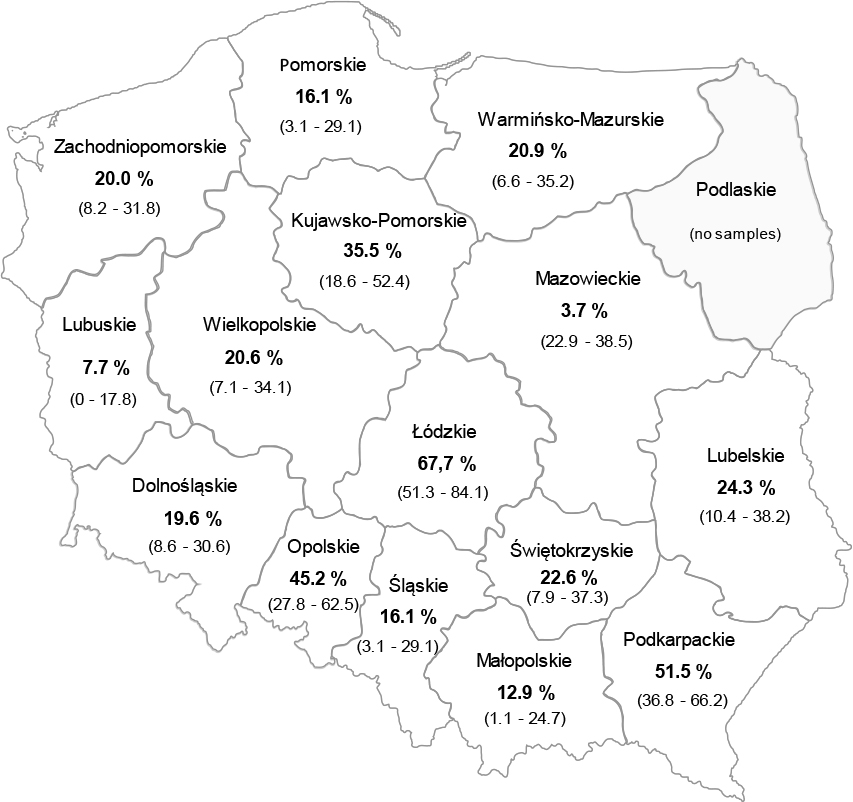
Fig. 1.
Percentage distribution of serum samples with positive ELISA results for anti-Brucella antibodies in individual voivodeships in 2023. The ranges of 95 % confidence intervals are presented in parentheses
The study conducted in 2024 also revealed the presence of seropositive wild boars in all the regions surveyed (Table 2, Fig. 2). This year 143 (28.6%; 95% CI 24.6–32.6%) positive serums were found, which is not a significantly higher value than the one recorded in the previous year. The results from the voivodeships Lubelskie, Łódzkie, Opolskie and Podkarpackie indicated a significantly different seroprevalence compared to the values found there in the previous year, whereas there were no significant differences in the outcomes from the voivodeships Kujawsko-Pomorskie (high number of samples tested) and Warmińsko-Mazurskie.
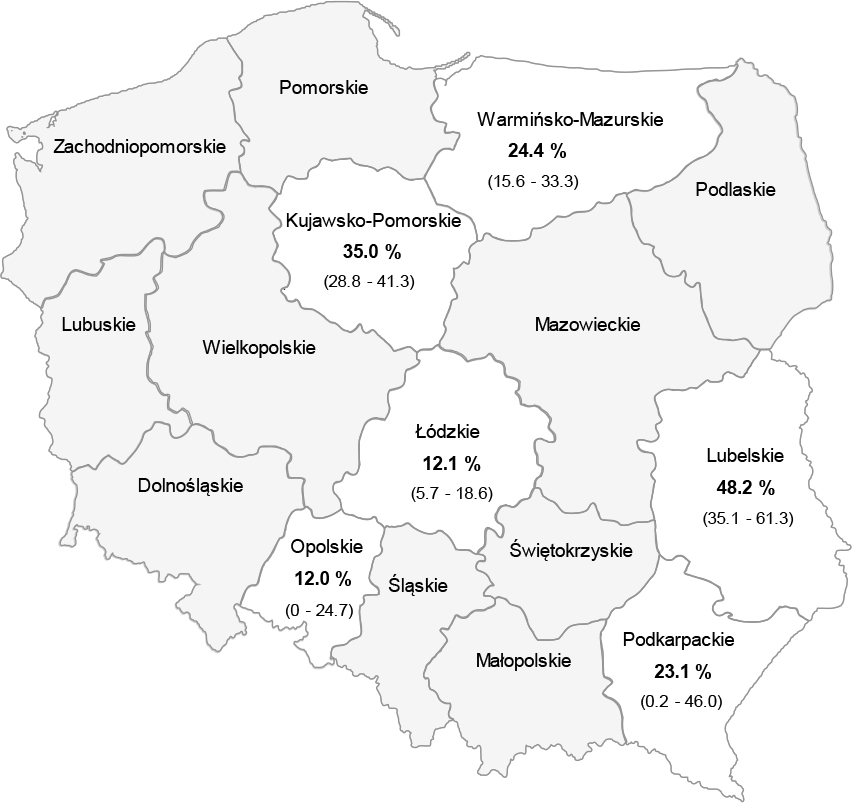
Fig. 2.
Percentage distribution of serum samples with positive ELISA results in 2024 from selected voivodeships that showed increased seroprevalence in the previous year. The ranges of 95 % confidence intervals are presented in parentheses
Discussion
In the initial phase of the presented study, conducted throughout the country, the percentage of positive serological results was 28.2%, which is slightly higher than in the previous comparable study conducted in 2012 (24.4%) (23). However, the difference between these results (verified by the Chi square test) is not significant. Although the previous study used a much larger sample group (over 4400), it included animals from a smaller area, covering 12 voivodeships. The distribution of areas with the highest percentage of seropositive animals was also different then. For example, in the Łódzkie voivodeship, where the highest seroprevalence (67.7%) was recorded in 2023, this rate was previously among the lowest in Poland (15.5%). Also in the Podkarpackie voivodeship, where 51.5% of positive results were recorded, this percentage had previously been just over 22%. In turn, in the Małopolskie voivodeship (Lesser Poland Province), the observed seroprevalence (12.9%) was more than two times lower than in the previous study (34.02%), and in the Wielkopolskie voivodeship (Great Poland Region), the observed seroprevalence (20.6%) was also clearly lower than previously (37.29%). However, taking into account the results of the survey presented here and the results from 2012, it is not possible to clearly indicate specific zones or areas of the country with consistently high or low seroprevalence.
The results obtained in the second phase of the survey seem to be closer to the values observed in the 2012 study, while simultaneously erasing the significantly elevated seroprevalence observed in some voivodeships during the first part of our survey. This was the case with reduced seroprevalence values found in 2024 in the Łódzkie and Podkarpackie voivodeships. In the Opolskie voivodeship the reduction was even more pronounced. In Kujawsko-Pomorskie and Warmińsko-Mazurskie the seroprevalence remained similar to the previous year, and only in the Lubelskie voivodeship an increase was found. Nonetheless, the observed modifications in individual voivodeships in 2024 did not result in a significant alteration in the overall level of seroprevalence (taking into account all samples tested in a given year) as compared to 2023.
The seroprevalence observed in our study appears to be relatively high compared to those reported in most countries within this region of Europe. Data from north-eastern Germany (1) indicate a seroprevalence of 22.5%, whereas the seroprevalence observed in southern Germany (Bavaria) (16) was lower, amounting to 17.5%. Results of a survey conducted in Latvia, based directly on the Rose Bengal Test (RBT), complement-fixation test (CFT), and ELISA, indicated a seroprevalence of approximately 22%. However, taking into account additional ELISA results detecting antibodies against Yersinia enterocolitica, and considering the cross-reactivity of serological tests, the authors recalculated the seroprevalence of Brucella exposure in wild boars at a level of 9.6–14.0% (10). A similarly low seroprevalence (9.0%) was reported from Finland (7). An even lower rate was observed in the Czech Republic (8.7%), although these data were based on a study of 204 wild boars hunted between 1993 and 2001. However, in a subset of 108 animals hunted exclusively in 1995–1996, anti-Brucella antibodies were detected in nearly 15% (13).
A relatively low seroprevalence was also reported in Ukraine: 10.4% using ELISA and 11.3% using RBT and CFT (20). Data from other European regions show considerable variation. For instance, a report from Belgium indicated a relatively high seroprevalence of 54.9% (11), while in the Netherlands it ranged from 4.1% to 11.6%, depending on the province (28). A study conducted in France reported seroprevalence rates ranging from 20% to 35%, depending on the department (8). In Switzerland, seroprevalence was reported at 35.8%, with a bacterial prevalence of 28.8% (30).
Surveys from the Iberian Peninsula showed that in Spain, depending on the region, seroprevalence ranged from 25% to 46% (19), while in Portugal the average was 26.5%, with values ranging from 13.7% to 50.0% (17). In southern European countries, the percentage of seropositive wild boars varies by region, time, and the diagnostic tests used, generally ranging from approximately 5% to 25%. These findings were reported, for example, in studies from Italy (18, 20), Serbia (31), and Croatia (4, 5).
Most of mentioned positive serological reactions appear to be caused by B. suis biovar 2 infections. Historically, the geographical distribution of B. suis biovar 2 has been in a broad range between Scandinavia and the Balkans. The prevalence in wild boars appears to be high throughout continental Europe (27). It is known that serum samples from wild animals are more difficult to collect due to unfavorable field conditions (conducive to sample contamination), sampling by amateur collectors (e.g. hunters), transport difficulties, etc. Thus, serum samples can easily undergo hemolysis, show strong anti-complementary activity or contain a wider range of antibodies (16). Since even the standard diagnostic methods recommended by World Organization for Animal Health (WOAH) such as ELISA are not 100% specific, it should be remembered that they show a certain percentage of false positive results. Various causes of cross-reactivity are assumed for serological tests for brucellosis, including antibodies against Yersinia, Escherichia, Francisella, Salmonella, Moraxella or other antigens common in natural habitats (16). On the other hand, the limitations of serological methods may be related to a periodic decrease in antibody titers or the occurrence of latent infections.
Additionally, standard serological tests routinely used for livestock are not typically validated for the study of wildlife. The reason can be e.g. lack of an adequate number of serum samples (positive and negative) of the relevant wildlife species. However, while the ELISA kit used in our study was originally developed and validated for domestic pigs sera, it has also been used for years in research on wild boars and has been tested using several thousand samples of their sera (23, 24, 25).
Infections caused by B. suis biovar 2 are often underestimated due to their low pathogenicity to humans. However, in recent years, clinical cases of human brucellosis have been reported, caused by B. suis biovar 2, most likely transferred from wild animals (14). Other reports describe a number of cases of hunter infections (sometimes fatal) caused by B. suis most likely transmitted from the wild boar (3, 6, 9).
The detection rate of anti-Brucella immunoglobulins in wild boars observed in various European countries is higher than in other wild ungulates, in hares or other wildlife species (12, 19, 20, 29). The seroprevalence found in our current and previous (23) study may suggest a potential risk of transfer of B. suis from wild boars to domestic pigs. However, it appears that the consistent application of biosecurity measures in pig farms effectively reduces the risk of introducing infectious agents there. Negative results of routine large-scale pig serological tests for brucellosis conducted in Poland over the years seems confirm the efficacy of mentioned measures.
The results of our findings also suggest a higher risk of human Brucella exposure related to wild boar hunting. However, the few cases of human brucellosis recorded over the years in Poland almost exclusively affect tourists returning from countries where the disease is endemic. Nevertheless, regular, nationwide serological surveys of wild boars provide valuable data allowing to estimate and predict the risk associated with the possibility of transmission of Brucella spp. to humans and livestock on a country-wide scale or in individual regions.
Conclusion
The results of the presented serological survey confirm the role of wild boar as a reservoir species of Brucella spp. The seroprevalence level found in Poland as a whole does not show a statistically significant difference compared to the results of a similar study carried out twelve years ago. The significantly increased levels of seroprevalence found in some voivodeships are not a permanent phenomenon, and the comparison of the overall seroprevalence levels in subsequent years does not show statistically significant differences. Further, more frequent serosurveys would be desirable.
Notes
[1] Conflicts of interest Conflict of Interests Statement: The authors declare that there is no conflict of interests regarding the publication of this article.
[2] Financial disclosure Financial Disclosure Statement: The study was carried out as a part of the monitoring program “Free-living animals as a reservoir of infectious and invasive pathogens dangerous to human and livestock health” financed by the Minister of Agriculture and Rural Development.
[3] Animal Rights Statement: Ethical approval was not required for this study as blood samples were obtained from dead wild boars legally hunted as part of the hunting economy program and within hunting limits (Dz. U. z 1995 r. Nr 147 poz. 713, Ustawa z dnia 13 października 1995, “Prawo Łowieckie” z póź zm. (Journal of Laws 1995, No. 147, item 713; Act of 13 October 1995, “The Hunting Law” as amended).
[4] CRediT Authorship Contribution Statement: Bernard Wasiński: research concept and design, collection and assembly of data, data analysis and interpretation, writing the article, critical revision of the article, final approval of the article. Martyna Olejarczyk-Kuś: collection and assembly of data, data analysis and interpretation, critical revision of the article. Maria Kubajka: collection and assembly of data, data analysis and interpretation, critical revision of the article. Jolanta Złotnicka: collection and assembly of data, data analysis and interpretation, critical revision of the article. Anna Gal-Cisoń: collection and assembly of data, data analysis and interpretation. Katarzyna Stępniewska-Jężak: collection and assembly of data, data analysis and interpretation. Kinga Urbaniak: collection and assembly of data, data analysis and interpretation. Krzysztof Szulowski: research concept and design, critical revision of the article, final approval of the article.