
Table 1.
Specific primary and secondary antibodies used for immunocytochemistry
| Primary antibodies | |||||||
|---|---|---|---|---|---|---|---|
| Marker | Primary antibody | Type, clone | Host, isotype | Reactivity | Dilution | Catalogue No. | Supplier |
| mucin 1 | MUC1 | mAb, MUC1/955 | mouse, IgG | human, mouse | 1 : 150 | NBP2-44658 | Novus Biologicals, Centennial, CO, USA |
| cytokeratin 8 cytokeratin 18 | Cytokeratins 8/18 | mAb, 5D3 | mouse, IgG | human, mouse | 1 : 100 | NB120-17139 | Novus Biologicals |
| Ki-67 | Anti-Ki-67 | pAb, N/A | rabbit, IgG | human, mouse | 1 : 300 | ab15580 | Abcam, Cambridge, UK |
| Secondary antibodies | |||||||
|---|---|---|---|---|---|---|---|
| Primary antibody | Secondary antibody | Type | Host, isotype | Reactivity | Dilution | Catalogue No. | Supplier |
| MUC1 | Alexa Fluor 488 goat anti-mouse IgG (H+L) | pAb | goat, IgG | mouse | 1 : 300 | A-11001 | Invitrogen, Carlsbad, CA, USA |
| Cytokeratins 8/18 | Alexa Fluor 594 goat anti-mouse IgG (H+L) | pAb | goat, IgG | mouse | 1 : 300 | A-11005 | Invitrogen |
| Anti-Ki-67 | Alexa Fluor 594 goat anti-rabbit IgG (H+L) | pAb | goat, IgG | rabbit | 1 : 300 | A-11037 | Invitrogen |
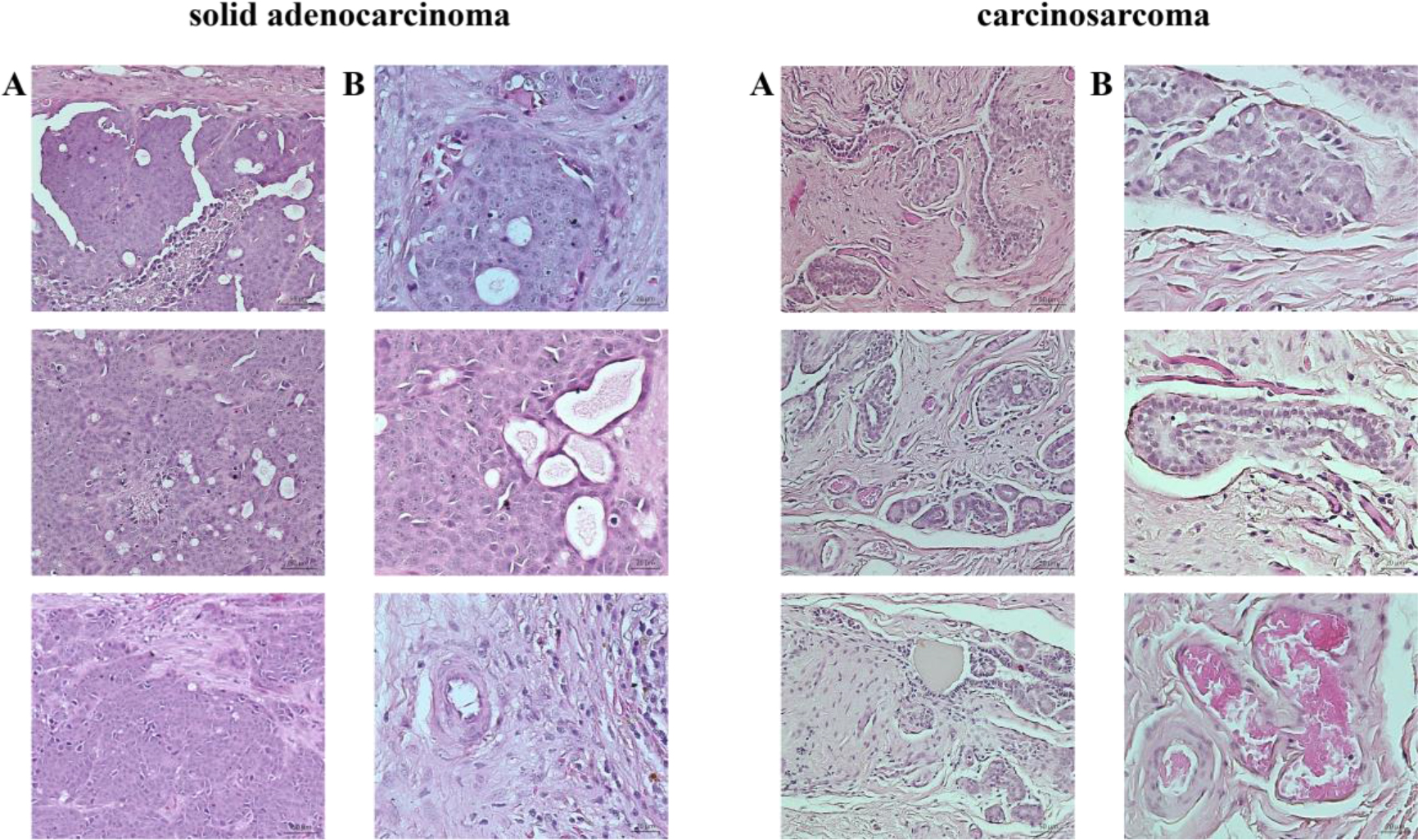
Fig. 1.
Microphotographs of mammary gland tumours. A – magnification 200×, scale bar 50 μm; B – magnification 400×, scale bar 20 μm
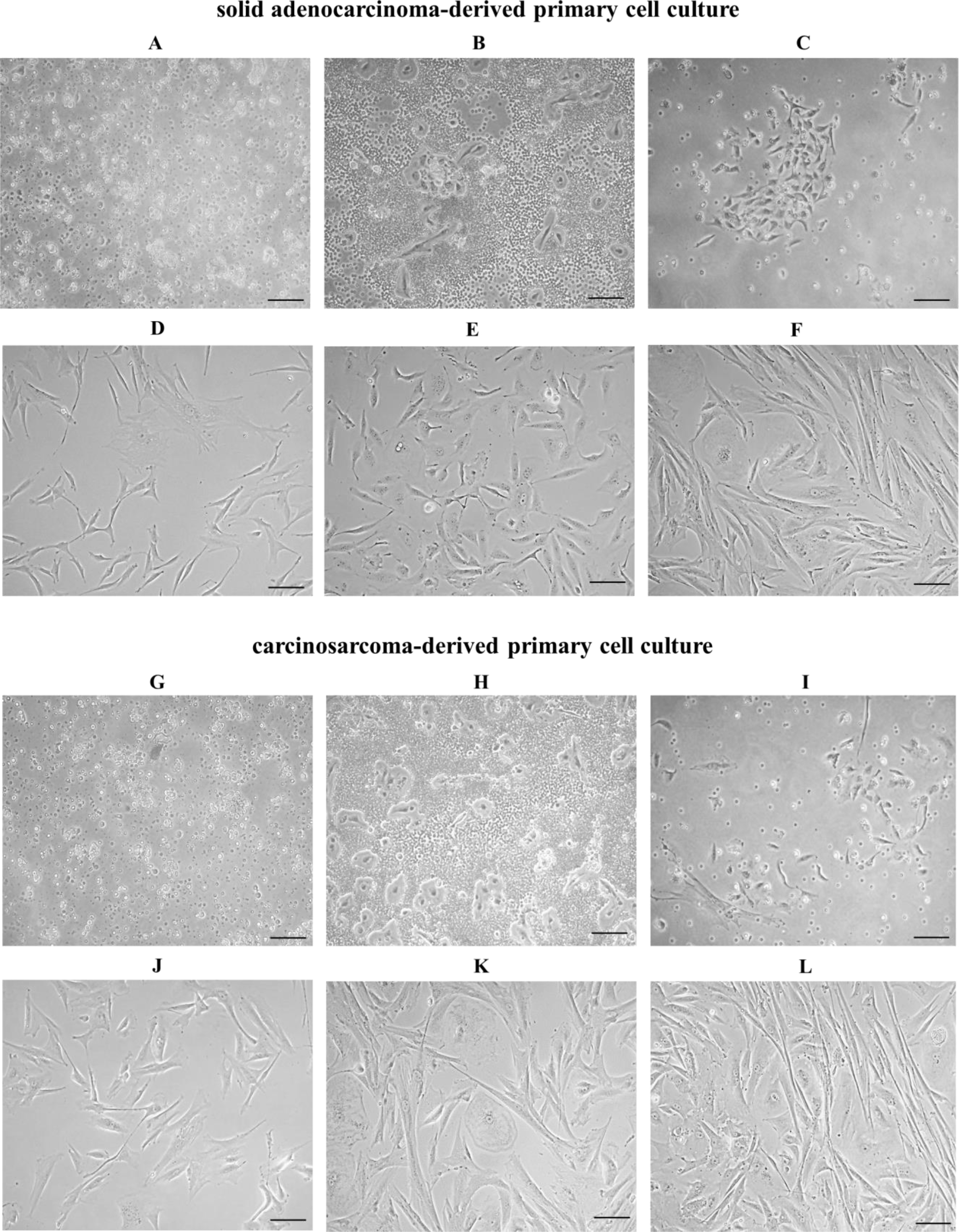
Fig. 2.
Primary cell cultures derived from mammary gland solid adenocarcinoma and carcinosarcoma. A and G – cellular debris and blood cells present directly after plating the cells on day in vitro (DIV) 0; B and H – cells before washing on DIV 1; C and I – cells after washing on DIV 1. Washing the cells effectively removed the majority of cellular debris and non-adherent cells; D and J – enlarged irregular and star-shaped cells on DIV 3; E and K – larger polygonal and irregularly shaped cells on DIV 5; F and L – cells with a range of morphologies from spindle-shaped to polygonal-shaped on DIV 7. Magnification 200×, scale bar 50 μm
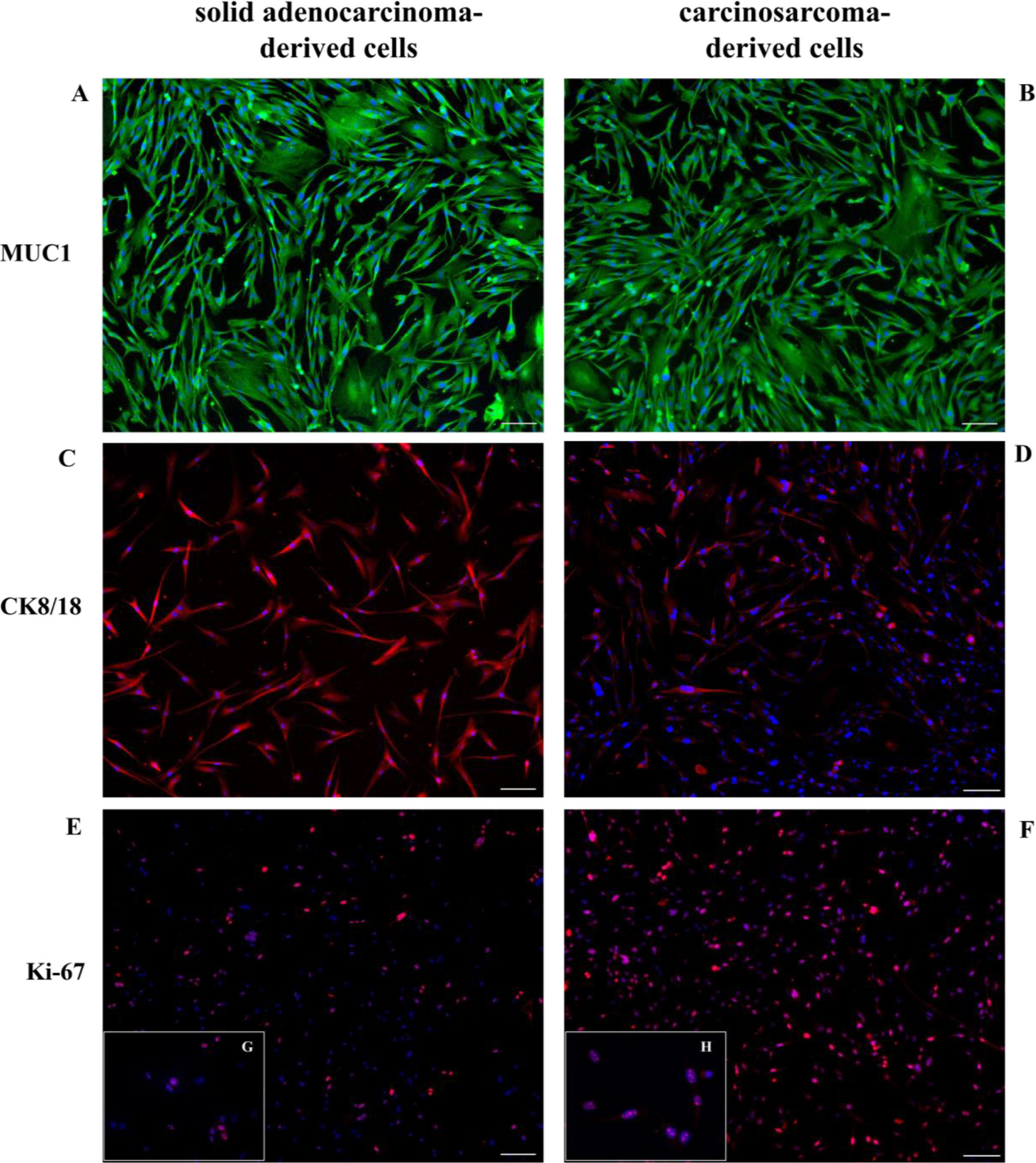
Fig. 3.
Immunofluorescence staining to show mucin 1 (MUC1), cytokeratins 8 and 18 (CK8/18) and Kiel 67 (Ki-67) expression in canine mammary gland tumour cells. A and B – solid adenocarcinoma-derived and carcinosarcoma-derived cells expressing MUC1; C – solid adenocarcinoma-derived cells showing higher expression of CK8/18 than carcinosarcoma-derived cells; D – carcinosarcoma-derived cells showing lower expression of CK8/18 than solid adenocarcinoma-derived cells; E – solid adenocarcinoma-derived cells showing lower expression of Ki-67 than carcinosarcoma-derived cells; F – carcinosarcoma-derived cells showing higher expression of Ki-67 than solid adenocarcinoma-derived cells; G and H – 400× magnification of details of E and F. Nuclei were stained with 4′,6-diamidino-2-phenylindole. Magnification 100×, scale bar 100 μm
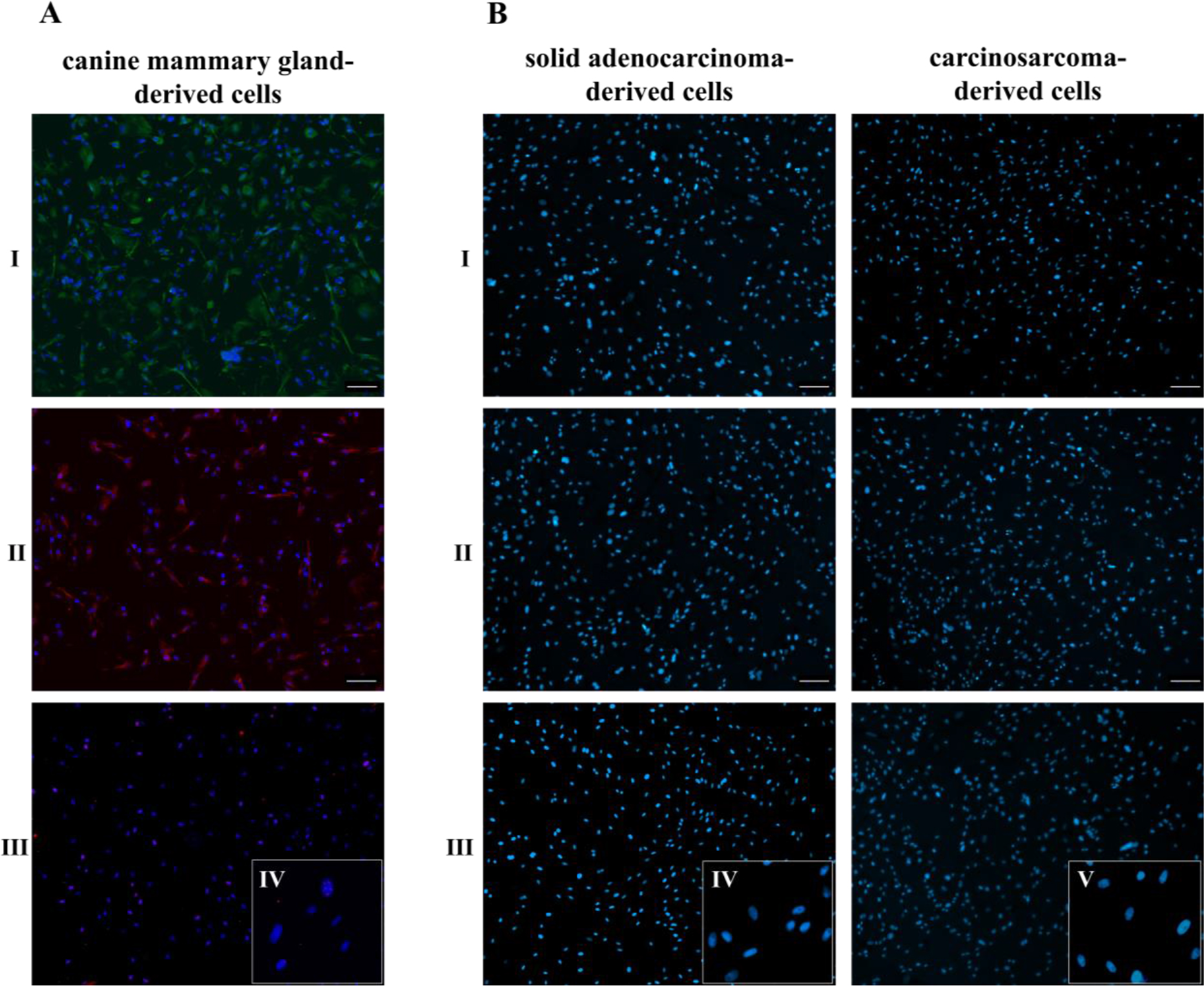
Fig. 4.
Immunocytochemistry controls verifying the specificity of primary antibody staining. A – non-cancerous cells isolated from canine mammary glands demonstrating weak positive staining for mucin 1 (MUC1) (I) and cytokeratins 8 and 18 (CK8/18) (II), and minimal Kiel 67 (Ki-67) staining (III). (IV) is a 400× magnification of details of (III); B – negative controls where primary antibodies (MUC1 (I), CK8/18 (II) and Ki-67 (III)) were excluded from the assay. Nuclei were stained with 4′,6-diamidino-2-phenylindole. Magnification ×100, scale bar 100 μm